
Edward’s Rare Large B-Cell Lymphoma Diagnosis Came With a Second Opinion That Changed Everything
Edward’s large B-cell lymphoma story started when he was 25. As he was building a career as a stage actor in New York, touring the country in productions of the musical “Hairspray,” he found a lump under his arm in the shower. It didn’t hurt, so he assumed it was nothing more than a swollen lymph node. Over several months, however, it kept growing, from the size of a peanut to the size of a grapefruit. After a CT scan, his doctor’s first read was an infection. Edward was prescribed antibiotics and sent back on the road.
Interviewed by: Taylor Scheib
Edited by: Chris Sanchez
The lump didn’t shrink. When he came home between shows, a biopsy confirmed what his doctor had brought up earlier as a possibility. It was cancer, a rare large B-cell lymphoma (a kind of non-Hodgkin lymphoma), and he needed to start chemotherapy within days. What followed was four rounds of chemotherapy that each shrank the tumor and then saw it grow back, before 30 days of radiation finally stopped it for good.
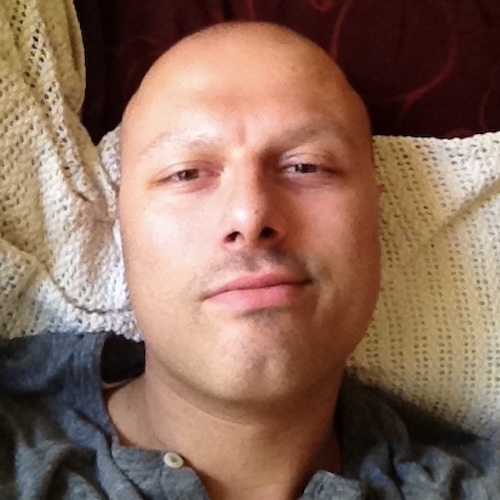
When his medical team pushed for a stem cell transplant using a donor, Edward pushed back, arguing that at 25 and in the best shape of his life, there was no reason he couldn’t be his own donor. When they discouraged him from seeking a second opinion, he went anyway. At Memorial Sloan Kettering Cancer Center, a new oncologist looked at his original slide and told him his cancer had been misclassified. The doctor re-diagnosed him on the spot and identified a medication he was still taking that had been limiting his ability to collect his own stem cells, but he eventually went on to do the transplant.
Edward has now been cancer-free for more than a decade. He describes the period after treatment ended as harder, in some ways, than treatment itself. The doctors, scans, and daily structure that had organized his life disappeared all at once, and he spent years avoiding any association with having had cancer. It has taken most of that decade to start talking publicly about what happened, through his own videos and a documentary, “Back to Normal: A Cancer Survivor Documentary.” Today he does advocacy work with Blood Cancer United and the American Cancer Society. He advocates for standardized, routine cancer screening as part of annual physicals, regardless of age or family history.
Watch Edward’s video and read the edited transcript of his interview. You’ll gain more insights into his large B-cell lymphoma experience.
- Edward’s medical team discouraged him from getting a second opinion on his rare lymphoma, telling him he’d become just a number elsewhere. He went anyway, and the new oncologist corrected his diagnosis on the spot and caught a medication interaction that had been limiting his stem cell collection.
- A diagnosis doesn’t ask permission before it rewrites your calendar, your career, or your sense of who you are. The people who discourage a second opinion are rarely acting in your best interest, and that’s as true for a rare lymphoma as it is for any other diagnosis.
- Edward has come to see the person he was before cancer, during cancer, and after cancer as three different people, each one gone once the next arrives. He’s found that rebuilding an identity after survival can take longer and feel harder than the treatment itself.
- The hardest part of Edward’s experience wasn’t the chemotherapy or the radiation. It was the silence that followed being told he was cancer-free, when the doctors, scans, and daily structure that had organized his life for a year disappeared all at once.
Edward’s Diagnosis Facts
- Name: Edward M.
- Age at Diagnosis:
- 25
- Diagnosis:
- Large B-Cell Lymphoma
- Symptom:
- Appearance of a lump in the armpit that grew from the size of a peanut to the size of a grapefruit over several months
- Treatments:
- Chemotherapy, including intrathecal chemotherapy and conditioning chemotherapy before stem cell transplant
- Autologous stem cell transplant
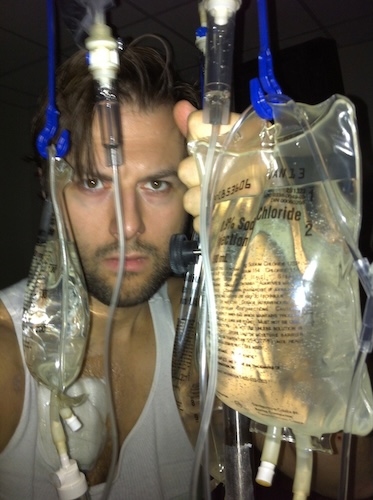
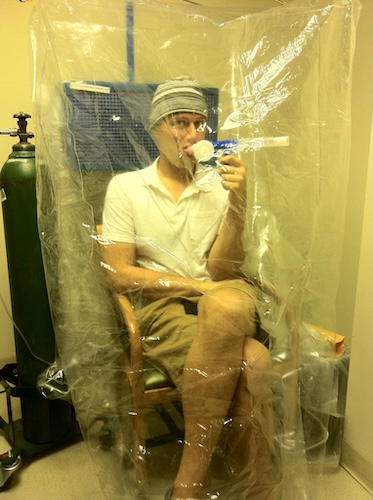
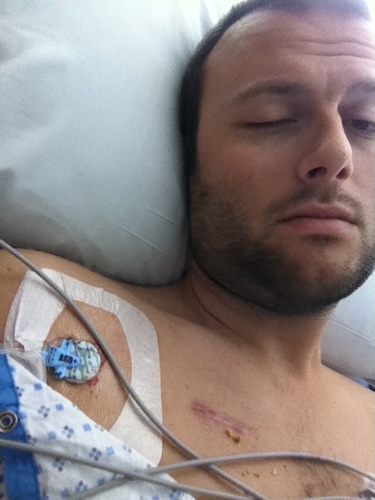
This is not medical advice. Please consult with your healthcare provider to make informed treatment decisions.
- Edward’s Diagnosis Facts
- Diagnosed with rare large B-cell lymphoma at 25
- Life as a working actor in New York before cancer changed everything
- From “cat scratch fever” to chemo in five days
- Pushing back on a stranger as my stem cell donor and finding a second opinion
- Losing my sense of identity and the friends who helped me find it again
- My biggest hope for change: Standardized cancer screening for everyone
- Hear from people living with non-Hodgkin lymphoma
Diagnosed with rare large B-cell lymphoma at 25
Hi, I’m Edward. I was diagnosed with large B-cell lymphoma, a kind of non-Hodgkin’s lymphoma, in 2011.
Life as a working actor in New York before cancer changed everything
Everything was derailed. I was an actor. I moved to New York City to do music and theater, and I gravitated more toward theater, and I ended up doing shows all over the country. When all of this was happening, I had just finished a production of “Hairspray” in the middle of Ohio. I came home and found this lump, and then I was about to start rehearsals for another production of Hairspray. That was my life. I was very lucky that, up until that point, I had always worked, be it in a smaller theater or a larger theater. I was very lucky that I worked out of New York as an actor.
I was an idiot 24-year-old, running around the country in my 20s, just trying to have fun and build a career and meet new people. I wouldn’t say that I was a party girl, but maybe party girl adjacent, because I did have other aspirations too. I had a production company that I was running, where I was helping people get new headshots and film audition reels and stuff like that. So when I wasn’t doing a show, I was doing that, and I ran websites. I helped people with their resumes and other websites. It was fun.
I’ve always had that side of my brain activated. And it was definitely part of the day-to-day where I would do all that in the morning and then get myself together and go do a musical.
Feeling invincible, until I found a lump in the shower
It was just so weird because this wasn’t an overnight thing. The lump appearing was an overnight thing, but from the moment I knew that it was there, which was, again, between productions. I was at my parents’ house visiting them because I’d been away for a couple of months. I was lying out in the sun in the backyard and it got too hot, so I went inside to shower and I found it under my arm while I was showering. And I thought, “Not good.” I asked my mom; she’s worked in medicine. I asked my best friend, because her mom was also in medicine, and they both said, “You’re going to have to go see your GP. This is above my pay grade.”
It was very strange because I did feel healthy. I was going to the gym for like 2 or 3 hours a day because we had nothing else to do when you’re not doing a show. I think I was just living a very normal everyday life of an actor. Outside of running my own business on the side back in 2011, it was very get up and go to the gym and do whatever until the show you have to be ready for. And I felt fine. I felt fine, I looked great, I was very active. You’re working out and then you’re also doing a show, so it’s double duty. The cardio was crazy. And at that point I was in Reno, Nevada, which is at elevation, and when you’re running around on a stage at elevation, that’s a totally different animal.
Also, at the time, I think this is an age thing, but also, I was working. I was lucky enough to be working as an actor. And so I felt, in a way, invincible, that I had all this life in front of me and I had all these possibilities. I started having bigger casting houses starting to email me and call me about bigger projects. And it was like, “Oh, you’re in the middle of Reno.” And then all of a sudden I’d go, “Oh, possibilities are over here. And I can’t wait to get back to New York because I feel like something’s going to change.”
And I wasn’t wrong. It was just for the wrong reason.
Watching the lump go from the size of a peanut to a grapefruit
Oh my God, the time that I spent playing with it is actually gross. When I think about it, it makes me want to gag. But it started out pretty small. I mean, it was like the size of a tiny little peanut.
That’s why I didn’t think much of it because, if you’re sick or something, your lymph nodes can inflame or whatever. And then it was only a couple of weeks before it became peach pit-sized, and then after a couple more weeks, it turned into the size of a golf ball. And then over time, it just kept growing and growing and growing.
That was June or July, and by November, when I came home, when the show was over and right before Thanksgiving, it was the size of a grapefruit. I had this huge thing under my arm. I still have like stretch marks under my arm and over my chest from how big it got and how much it stretched me out.
It was jarring because I did have that feeling of like, “Oh, possibility, but also I probably am going to have to deal with whatever this is.” I thought maybe it was an infection that they were just going to lance, and it would explode and they’d drain it and call it a day, or surgically remove whatever this thing was, and I’d just go about my day, go about my business.
And it wasn’t until maybe a week after I got back that my doctor sent me in for a biopsy, and they went, “There are no possibilities over here. You have to do this instead.”
Why I didn’t rush to the doctor and the day the diagnosis finally landed
I had no reason to think I needed to go to a doctor other than I had this thing growing under my arm. I felt fine. And, again, I was in Reno and they’re not known for their doctors, so, I was just waiting to get back to the city to go to my actual doctor that I knew. Not to mention, I had poor people state insurance at the time, so it didn’t work outside of New York State, and so I couldn’t really do that.
It wasn’t easy to ignore in the sense that it was there and it was a presence. It got so big that they actually had to let out my costume because I couldn’t close my costume, so that was weird. And I do remember I had this shirt that I loved that had like this royal crest on the front of it. It was so cool. And it started to get this tiny little hole in the seam under the arm. And I was out with friends, drunk one night at some bar in the middle of nowhere, and I just ripped it open so that this thing could not be scratching up against the seam. It was messy.
There was part of me that was really scared about it. And then there was another part of me that was going, “This is such a nuisance. Get this out of my life, whatever this is.” When the final diagnosis finally landed, it was very scary. I had a horrible emotional reaction the day we checked into the hospital, because up until that point, it didn’t feel real. Up until that point, it was very much like, “Can we just get this over with? I have stuff to do. This is such a hindrance to my life. Stop.” I was kind of a catty b**** about it, which I don’t feel sorry about, because I wasn’t ever terribly rude to anybody. But it just wasn’t part of the plan, obviously. It’s never part of the plan to get cancer.
There are very complex emotions there, because you’re terrified, but you want to move on with your life and do the things you set out to do, and hopefully you have ambitions and aspirations and things to pursue. And then I was also feeling and thinking, “Ugh, this is so annoying. Cancer is so annoying.”
From “cat scratch fever” to chemo in five days
It was a long time coming. When the lump first showed up, I did go to my doctor and he had me do a CT scan. From that scan, he deduced that it was more aligned with an infection. He called it cat scratch fever and gave me antibiotics and sent me on my way, which to this day is the most infuriating thing, because that’s not even a real thing. I was also mad at myself for not pushing back and asking, “Are we sure?” But I had a show to do, so I was like, “Great. Give me drugs and let’s get on the road.” (EDITOR’S NOTE: Cleveland Clinic describes cat scratch fever, also known as cat scratch disease, as a rare bacterial infection that people can get from a cat scratch or bite. Cats can get infected with B. henselae bacteria from fleas and can then pass the infection on to humans.)
When I finally had the biopsy upon my return, I remember sitting in his office in the Upper East Side, and he and his colleague were looking at it and they were just puzzled. They were like, “Well, you look great and you don’t have any other symptoms, so I think we’re going to have to send you for a biopsy.” They sent me to a hospital nearby. I don’t remember if it was the same day or a couple of days later; the timeline there is a little hazy. I remember being in this tiny exam room that was very dark, with five or six people in there. I had a gown on with my arm up. They did a little needle biopsy and stuck it in a couple of different places. I don’t remember if they told me then and there or a couple of days later, but they came back and told me what it was, and that I was going to have to start chemotherapy in about a week or less. I don’t even think it was that. I think it was more like four or five days.
The first time my GP mentioned cancer to me was before the cat scratch fever. He sent me for a CT scan the day I saw him, and as I left his office, he said we need to get the scan because this could be Hodgkin lymphoma. I just remember thinking, “Hodgkin?” I called my mom, freaking out, bawling my eyes out, walking down Park Avenue to get to the doctor’s appointment. I had stuff later that day that was time-sensitive that I couldn’t miss, so I pounded the pavement to get there.
I remember being so freaked out and thinking, “This isn’t my life. This isn’t possible. How is this a possibility that is happening to me? I’m immune. Me? Cancer?” That was the first time I’d had a cancer-related diagnosis thrown at me. When it turned out to be “cat scratch fever,” and I was told, “Here are some drugs, go away,” I was so relieved. But then as it grew and grew, I remember calling the doctor from Reno and saying, “It’s getting bigger. These drugs aren’t working. What should I do?” Basically, I waited until I came back, and when I came back and he sent me for the biopsy; I truly don’t remember the phone call or the in-person conversation. I think it’s like one of those things where you hear people say, “I just blacked out. I don’t remember.” I literally don’t remember if it was a phone call or in person. But I do remember not registering it.
My approach to anything is a lot like my mother’s: Here’s the problem. What do I have to do? What’s the protocol to move forward? What’s the solution to get this done? I defaulted into that mode until the day I checked into the hospital for chemotherapy. Up until that point, there were heart scans, EKGs, and kidney and liver tests to make sure the organs were healthy enough for chemo. Thankfully, I had youth on my side, and I was athletic at the time, so I had a lot going for me in that sense.
There was a day I went to the hospital for those scans, and the Affordable Care Act had just passed. I had no insurance. I had crummy state insurance, so I was able to get on my mom’s insurance for coverage during treatment, which was great, but it took a little while, and there was overlap with these appointments. When I went to have the EKGs and MUGA scans and all this other stuff done, they wouldn’t let me in because my insurance was pending, and they wouldn’t let me do the appointment unless I paid thousands of dollars out of pocket. I got into a screaming match with the guy in the finance room in the basement of the hospital, who wouldn’t let me go to my appointments because I didn’t have $6,000 as a 24-year-old lying around to plop down. (EDITOR’S NOTE: The American Heart Association defines the MUGA, or multiple-gated acquisition scan, as a nuclear imaging test that shows how well one’s heart is working. The MUGA scan is also known as radionuclide ventriculography or radionuclide angiography.)
I left, I called my mom, and we had to figure out what to do. She put it on a credit card, and it took us three years to get reimbursed for it. It was the whole thing in itself, like a circuitous phone call: “Oh, you have to call this person.” Such a mess. I came back, and the guy was like, “Well, we don’t have your appointment anymore; we canceled it because you left.” I said, “I am not leaving here without it.” At this point, you could see it growing. It was getting bigger daily, and it started to creep up into my lymph nodes under my clavicle. I was literally screaming at this guy in the office, “I hadn’t even been gone 10 minutes. I found a solution. We paid you. Let me do the thing. The appointment wasn’t taken by anyone else in the time I was gone.” We did finally get in to have those appointments that day. I had to wait a little bit, and I was furious, and it was raining, and I was soaking wet, and I went and sat in Central Park and called my mom and cried on a bench while we tried to figure out what to do.
All of those moments were scary, but we were still in solution mode: How do we get to the next step? I don’t remember how many days later; it was less than a week. Between diagnosis and treatment, I think it was maybe 10 days. Because it was so aggressive and growing so quickly.
I didn’t really register what was happening until I was checking in for chemo session number one. I came with a bag of stuff, like a change of clothes, things to sleep in, things I’d be comfortable in. When I got through the stacks of paperwork they have you sign, stacks and stacks of standard release forms that basically say if you die, you can’t sue us, you can try, but whatever, which feels really great when you’re getting checked in, we finished all that, and they called us back to the room, and they handed me these plastic bags and said, “You can put your stuff in here.” I said, “Well, why?” Because I thought we were going up to a room, like checking into a hotel. They said, “It’ll be in the room waiting for you after your surgery.” I said, “Surgery? What surgery? No one talked to me about surgery.”
They should have told me. Maybe it was in a take-home packet that I didn’t read because I was trying to drink my way through the next couple of days to be copacetic enough to get into the hospital. I didn’t want to go. I had my mom meet me at my apartment because, otherwise, I wasn’t going to go. It was to have my port put in. But no one told me that.
They took my things. I was put into this room to change into a gown, and my mom was standing outside the room, and I completely fell apart. Because up until that point, between all the appointments I was trying to get through to make sure this could happen, I was also taking my friends out individually to dinner to tell them. I didn’t want to do a big group thing. I wanted to individually sit down with each person, phone call, in person, however the case, and be like, “This is important. I need you to show up.” That was a whole process. It took days.
But up until that point, I was being very strong for myself, and then just standing in that room, completely like getting undressed to put the gown on and as soon as I put the gown on, I just completely lost it. And like, my mom heard me and she came in, and I was trying not to make a scene, but how could you not? You’re allowed to make a scene. Make a scene. And then the nurse came in and asked if we were ready, and I yelled at her. It was big emotions. It’s a big moment. And it’s really scary because you do kind of feel like you’re staring down this long, dark tunnel of the end. And you can’t help but think that. I think that’s the most normal thing to think because humans tend to lean on the side of negative anyway for some strange reason, but you do have moments where you’re like, “This is the end.” And I’m just like walking to my executioner as soon as I have the surgery done.
Not having a port is crazy. I can’t speak for anybody else, but I know what my protocols were like, and some of those were 8 to 10 hours. I was spending weeks at a time in the hospital. Doing that through a vein, how do you sleep? How do you do anything? I’m so glad I had the port. But I would have been a little more glad if someone told me that I was going to have one. But they explained it to me while they were shaving me down to cut me open and put me under and put this thing in. I did eventually learn at the 11th hour what was happening.
Four rounds of chemo that didn’t work, then 30 days of radiation
I was supposed to do eight rounds of chemo. I did four, because they weren’t working. In the beginning, it was so deceptive. I’d never had chemo before, so I didn’t know what to expect. Day one happened, and the next morning, I woke up and that tumor had shrunk down to nothing, and we thought, “Oh, this might actually be kind of easy. Great. No problem.” So we went through all of round one, which included intrathecal chemotherapy, and they messed it up. I was flat on my a** because I had positional headaches. What happened is they took out too much fluid and didn’t replace enough, and I had this massive headache, so they gave me hydromorphone. It was a whole mess.
But I left, and the tumor area was basically flat, and I thought, “Oh. Maybe I won’t even need round two.” Then over the three and a half, four weeks between chemo rounds one and two, it grew back. It wasn’t as big as it was before; it was a different shape, and it eventually turned that green-blue bruise color. It was horrible. For a couple of short days I thought, “Oh. Maybe this won’t be so bad,” and then it got worse.
So on all four rounds, that happened: it shrank down, it grew back, shrank down, grew back. Eventually, they put me on a 30-day radiation treatment. I still have my little tattoo marks from how they lined up the machine. That worked.
After radiation, it never grew back. It kept shrinking and shrinking, and that seemed to be like the light at the end of the tunnel.
Pushing back on a stranger as my stem cell donor and finding a second opinion
Radiation seemed to be working. I never understood chemo brain until I didn’t have it anymore. It was very much like during the COVID pandemic. I had it at the very beginning of the shutdown and didn’t really realize it, because I was just sitting around the house. I’d go to work out and be completely wrecked, and I’d be like, “Get your s*** together. You need to be working out more.” Then as soon as I was done having COVID, I thought, “Oh, I think you were sick. Because now you feel great.”
It was the same with chemo brain. I didn’t realize how bad it was until it was gone, or at least had started to dissipate, because then I started thinking clearly about what they were asking of me and what protocol they wanted me to go down. They wanted me to have a stem cell transplant with someone else as my donor, and my argument was, “I’m 25. Before all this started, I was in the best shape of my life; there was zero reason why I shouldn’t be my own donor.” They gave me all these excuses, and then they finally gave in to try to have me collect my own. (EDITOR’S NOTE: As Dana-Farber Cancer Institute explains, stem cell transplants can use the patient’s own stem cells, or these cells can instead be sourced from a compatible donor. The former is referred to as an autologous transplant, while the latter is called an allogeneic transplant.)
I was barely collecting anything. There’s a 2 million stem cell count threshold you have to meet for them to do it, and I was getting 100,000 here, 200,000 there. I think I did it for a week, and we ended up with maybe 1 million, something like that. They kept pushing this other stem cell transplant. I didn’t want to do it; you have to take meds for the rest of your life to make sure you don’t have graft-versus-host disease (GvHD), which is so scary, and I just didn’t want to have that impact my quality of life. They also wanted to do full-body radiation, two rounds of it. I know full well what that did to my skin. The hair right here still hasn’t grown back, and this is 14 years later. If we’d done that to my whole body, I’d look like a salamander. I didn’t want that. I was 25. I was hot. I was like, “Please don’t do this to me.” (EDITOR’S NOTE: The Patient Story held a webinar that brought together patient advocates and experts to discuss key advancements in GvHD treatments and clinical trials. Read the summary of the webinar here.)
I ended up getting a second opinion. My medical team tried to discourage me from doing so. I wanted to go to Memorial Sloan Kettering Cancer Center, and they said, “They’re just a well-oiled machine, and the quality of care will drop because you’re just a number there.” I thought, “Okay, well, I don’t want to do what you’re telling me to, so I’m going to go talk to them anyway.” Getting my file was a whole mess. They tried to make me pay for it, I think $75 or $100 for copies, and I said, “No. That’s mine. Give it to me. I’m not paying you.”
I went to this other oncologist, and she took one look at the slide of my cancer type, and she said, “Oh, that’s not what that is,” and she re-diagnosed me on the spot. We went through all of the medications I was on, all the prophylaxis and everything else, and she asked, “Are you still on this antibiotic?” I said yeah, and she said, “No wonder you can’t collect. That’s messing with your red blood cells. Why do they have you on this?” She knew the oncologist I was working with, and she said, “She trained under me. She should know better. I’m calling her.” Really wish I could have been in the room for that.
This oncologist is incredible. She literally saved my life, but she’s just 5’1” and the scariest person I’ve ever met, dressed to the nines every single day, so fabulous. I loved her, and also, I was so afraid of her, because every time I saw her it was bad news. But anyway, I went and got a second opinion, and we ended up going forward with a stem cell transplant where I was my own donor. I did end up getting just barely enough. We went that route, which was exponentially better.
Because I was not standing up for myself, I was so deflated; there was very little I wanted to do. Thankfully, my mom was there, taking notes for me, writing everything down. She used to mix chemo, so she understood what all the protocols were, which was such a godsend. My dad was also there for moral support and would run out and get me food and sneak it into the hospital because the hospital food was garbage, so that was cool.
The second opinion came as the result of a snowball effect of everything that was going wrong. After chemo session number three, I texted my oncologist and asked if I could meet with her. She met me in the lobby of the hospital, and I said, “I’m not going to make it, am I?” She said, “We’re coming up short on what we think we can do, and we don’t know, but we’re not giving up. I’ll do everything I can to make sure that’s not the case.” And then the circus of the transplant went from there. They carted in some other woman who had a transplant where someone else was her donor to talk to me about it and walk me through what it was like. I was so irritated because it felt like they were forcing something on me.
This is a teaching hospital. I’m not trying to disparage any of that, but this is my life we’re talking about, and it felt like they were doing everything they could to publish a paper, because the cancer was so rare.
I’m very pro doctor. Again, my mom works in medicine, and I grew up around it my whole life. So I’m very pro medicine, very pro doctor. But that circumstance at the time felt like I was a means to an end to get a paper published through their facility about this rare cancer. At the time, there were about 900 cases worldwide. That’s what was making me uncomfortable, and that’s one of the reasons I pushed so hard to leave.
That conversation was me finally putting my foot down for the first time, because up until that point I was just like, “I don’t know. I’m going to trust you and put my life in your hands.” Then, once again, as chemo brain started to dilute after radiation, I thought, “This doesn’t feel right. I think I need to say something.” It became apparent as they were pushing back on me going somewhere else that they actually didn’t care.
No one in their right mind would discourage someone with a rare cancer from getting a second opinion. I’ve never heard a story of someone being told, “No, don’t do that.” I’ve only ever heard, “Yeah, go get a second opinion, and then come back and we’ll talk about it, or don’t come back if that’s what it is.” In my opinion, from what I’ve seen, it has always been about saving the patient’s life, and this did not feel that way. I’m glad I left and I’m glad I didn’t die. I’m glad I didn’t pay them for the copies of my own records.
Telling almost no one: Secrecy, support, and switching hospitals before the transplant
I had a little mailing list of people that I put together, like need-to-know only. I did not tell anyone outside of my close friends and family. Nobody knew. I did that for a couple of reasons. One, because being in entertainment, you don’t want to be the sick person people wonder about. “Can we hire them? Are they okay?” It sounds dumb, but that’s what I was thinking. I was trying to hide the fact that something was happening to me, because I didn’t want to put my future career in danger. Things are different now.
The other reason I didn’t tell people I didn’t trust or know well is that I’d seen, in general, people come out of the woodwork during a traumatic experience just to say, “Oh, I was there. I was there when this happened,” when they hadn’t been. If something had happened to me where I didn’t make it, I didn’t want my parents to have to deal with those people. It’s a hard enough situation without randoms glomming onto grief and trauma for their own benefit, saying, “Oh, we were best friends,” when I never even talked to them.
That was my headspace around telling people. I had a very small circle of friends and close family who were informed. My mom and dad were constantly going back and forth, coming to visit me in the hospital. All my friends did the same. We made the best of it. When I switched to Memorial Sloan Kettering to do the stem cell transplant, it was night and day from the previous place. When I went in for the transplant, even though I’d had a slew of complications before that, which were mostly my own fault, I was still in a honeymoon phase. I remember thinking, “This is a bright, shiny, beautiful hospital. The food was great. They gave you a menu and a phone number you could call any time to order food for your room. It was wonderful.” Because at the last place it was, “Dinner’s at six. If you’re not hungry, tough luck. Here’s your wet cardboard. Enjoy.” It was terrible. This menu had pizza and salmon and tacos. I was like, “I could stay here.” And I did for 22 days.
One of the things I think about a lot too is that during that period, I’d never worn a mask, never worn PPE, never done any of that, and that was something everyone around me had to do when I was in quarantine for the stem cell transplant. I’d never been quarantined. It was all these new experiences in this beautiful, cushy, comfortable hospital. I had this giant leather couch in my room that I slept on instead of the hospital bed because it was so comfortable. Chemo makes you hot, and the leather couch was cold, so that was another thing.
I have such good memories of being in that hospital, despite the reason I was there, because we made the best of it. As I said, the difference from the previous place was night and day: the care, the aesthetics, the way you’re treated, the amenities, which sounds ridiculous to say about a hospital, but it’s true. We also had friends over individually and as a group. We did a pizza party one night, called down to the hospital kitchen and ordered pizza for the room, and they sent it up. We had a good time.
The complications, the parasite, and why life after cancer was harder than treatment
I have complicated feelings about a lot of that. I don’t feel like I did anything. I don’t identify with the cancer warrior stuff. Whatever works best for you, live your dreams. That’s cool, but for me, I just feel like I showed up to the appointments and did what I was told, and that was it, and then the cancer was gone. I didn’t actively do anything to get rid of it except show up.
If anything, I did things that could have made sure I didn’t survive, because of the nonsense I was doing, including drinking my way through chemo. I flew down to see my sister in Florida and went into the ocean and got an infection and almost died. There were so many things that happened. I got a staph infection in my port that had to be surgically treated. This was within about two months before my stem cell transplant. I was checked in for the parasite, and she came into my hospital room and literally said, “What the f*** is wrong with you? You’re going to need so much therapy when this is over.” I said, “I’m sorry?” And I did; I just started therapy recently.
I think, in hindsight, looking back at it, it’s so funny, because it feels like a giant nothing-burger and also this hugely profound thing that happened. But the thing I talk about the most is how, when it’s over, that is hard. It’s harder in a lot of ways than being told you have cancer and then going through treatment. When the doctors and the nurses and the appointments and the checkups and the scans and the friends and family go away afterward because you’re fine again, the expectation is that you just go back to the way life was. As hard as you might try to do that, it’s not going to happen. You don’t realize how much all of those things were a support system for you while they were happening, until they’re gone.
In a way, you want to go back, since that’s the normal you’ve created for yourself, or that’s been created for you. You have an appointment today. Great, that gives you something to do; that’s what you’re going to go do. When that’s gone, you don’t know what to do. There’s a lot of what I’d call trauma responses that either make you fight or flee in that moment, and I definitely fled. I just defaulted back to what I knew. I went back to auditioning, back to working odd jobs here and there. I did anything and everything I could to stay busy, to ignore the fact that that’s what had happened.
In the first year after treatment, I was still going for scans and whatnot, but for the most part, people would see me and say, “Where have you been for the last year?” And I’d just say, “Oh, I had cancer, whatever, it’s fine. It’s gone now,” and completely brush it off. I wanted nothing to do with it. I wanted to not be associated with it. It has taken me almost this long to be able to talk about it. Not because I was uncomfortable talking about it necessarily, but I didn’t see the importance in talking about it, and I didn’t want to be associated with it.
I didn’t want cancer to be my entire personality. And here we are. But it’s such a weird, emotional roller coaster coming out of treatment and having gone through this crazy event. The experience of having cancer is nuts, and then after the fact is also nuts, but in a different kind of way. The assumption is that you’ll just go back to the way your life was, and the realization that you can’t do that takes people some time.
It took me a decade to be able to think, “I don’t think that’s going to happen for you. I don’t think you’re going to feel like 24-year-old Edward ever again. I think he’s gone.” I’ve framed for myself and others that the person I was before cancer, during cancer, and after cancer are all dead, and I’ve had to come out on the other side as something else. It does give you a great opportunity that’s exciting and beautiful and scary to hit reset and start over.
Losing my sense of identity and the friends who helped me find it again
It’s funny. My therapist, who I see every other week, and I talked about this a little, because I think a commonality among people who have had cancer and survived it is that they struggle with a feeling of loss of identity. They don’t know who they are anymore after cancer. There’s a lot of searching oneself to reclaim, find, and reinvent who you are.
My therapist suggested that I find friends who still talk to me, who knew me before cancer, and ask them to tell me how they remember me before cancer. I’m very fortunate to have friends I’ve known for nearly 20-plus years, so it was easy for me to ask these people, and it was amazing. The responses I got were incredible.
The throughline to all of it was that everyone remembered me as being completely fearless and that I would just do whatever. If I got an idea in my head, I was just going to do it. I think that’s still true, but I feel less fearless. I was talking to a friend about how I feel more afraid now than I did before cancer. I have a documentary called “Back to Normal: A Cancer Survivor Documentary,” and one of the people in it who gave their take on life after cancer said that you’re no longer able to assume that nothing bad is going to happen, because the bad thing already happened, so it could happen again. I think that’s the source of my fear and lack of fearlessness.
I had a big birthday recently and I took a bunch of my friends to dinner, and one of my oldest friends took the opportunity to make a toast. He brought up this prompt I’d given everyone to tell me how they remembered me. He’s known me through almost every iteration of my life. There’s a five-year gap where I didn’t see him at all, but other than that, he’s known me my entire adult life. He said, “I don’t remember you as being anything other than yourself.” To answer the question of who I am now, I don’t know. If the perception is that I’ve never been anything but myself, and my feeling is that I’ve changed so much, then I’m still in the throes of figuring out what that means. I have an upcoming therapy appointment and we’re going to talk about it.
One of the reasons I’m talking about it is because you get to articulate how this is in real time. Thankfully, there are a lot of creators online who talk about this now. But the aftercare of surviving cancer was a non-conversation when I was going through it. It was just like, “You get to go back to life now. Aren’t you grateful? Isn’t this just a gratitude parade every day?” And no, it wasn’t. There were so many days when I felt empty and lost and completely shattered and didn’t know what to do, so I just bucked up and defaulted back to what I knew.
The me now is better at having a bigger-picture idea of what I want my life to be like, and I’m trying every day to harness that fearlessness to go do that. I’ve created it on the back end; now it’s just a matter of going and doing it. That’s also why I say start over. Yes, deal with all the emotions you need to deal with, fine. But also consciously take the opportunity to draw a line and step over it, and say, “That’s no longer who I am.” This can inform who you are, sure, but moving forward, who you are and who you become is your choice, and it always was. I think cancer puts the magnifying glass on the fact that it always was part of it, so you take the opportunity of getting a second chance, or however you want to look at it, to just become your dream, as the artist De La Vega used to spray-paint all over New York City.
Why I finally started talking about having cancer
My initial why is that there can never be too much conversation about surviving cancer. I truly believe that. And that certainly comes from a place where, back in 2012, when I was told I was cancer-free, there was no conversation. Social media has amplified our ability to have that conversation and dive deeper into what people mean by it, which is great and will never be a bad thing.
I also think it’s therapeutic for me. I feel like I owe it to myself from 2012 to talk about it and just flap my gums on the internet about it, because there was no one doing that back then. Hopefully, there’s someone out there I can impact who’s in a similar situation. Maybe by accident I pop up on someone’s feed and something I say speaks to them. It’s self-serving in a way, but it’s also so important to keep talking about it, since it isn’t talked about much.
We’re getting better, but hospitals need to get on board with the aftercare conversation, especially the mental health component, in a formal way. You go to an appointment and they ask, “Are you having thoughts of harming yourself?” You answer that however you answer that. But I truly believe that after your cancer is gone, you should have some transitional therapy, like what they do with those in the military who have PTSD. There needs to be something along those lines. I have a lot of opinions about the medical industry and what’s going on with cancer; a podcast for another time. But I do think that the more of us who are talking about it, the more attention it can get, and the better the system can become in the future, because people are talking about these things. (EDITOR’S NOTE: Determining how to move forward after cancer can take some time, may necessitate the management of long-term health concerns, and can also require finding support as a cancer survivor, as the American Cancer Society explains.)
It does feel stupid sometimes. I’m talking to my phone and posting it on the internet, and that feels so reductive to what I want to happen. But then I do hear from other people in the comment sections or DMs that I’ve somehow impacted them. I had someone recently tell me they’d seen a video of mine, and it was the reason they went and registered to be a stem cell and plasma donor. I was like, “What? That’s cool.”
You never know. I think it’s important to talk about it, because even if it impacts just one person. Me talking about whatever I was talking about, that person saw it, and donated blood and plasma and stem cells, and that’s going to go into someone’s body who needs it. The ripple effect of just speaking is underappreciated.
My biggest hope for change: Standardized cancer screening for everyone
It’s so important to have the conversation about cancer care before having cancer. I do a lot of advocacy work with Blood Cancer United, the American Cancer Society, and other such organizations. Their programs are in the right place and they’re doing nothing wrong, but a lot of times, because government, legislation, and healthcare are such massive, unwieldy systems, we don’t know how to make change.
One of the things I wish we could all focus on is to standardize cancer screening and make it part of getting a yearly physical. It shouldn’t be a struggle to say, “I’d like to get scanned for cancer. I have a family history,” whatever the story may be that would bring you to wanting a screening. That should be standard for every single person, whether they have a history with cancer or not. It should be part of a yearly physical, blood work, CT scan, MRI, PET scan, whatever.
I recently tried to get scanned for colon cancer. My grandfather had it. I recently knew someone who passed away from stage 4 colon cancer at 36 years old; they didn’t know they had it. I spoke to him right before he passed, and he told me what was happening, and it was like, “You’re loved and you’re a great person,” but I don’t want to be that person, and I don’t think anyone else should have to go through that. How do we mitigate that?
We stop putting these stringent requirements on screenings. For me to get a colonoscopy, I have to be over 45, symptomatic, or have an immediate relative who’s had it or died from it. Nothing outside of that. I jokingly said to my doctor, “Okay, then I’ll just tell you that I’m bleeding when I use the bathroom. What are you going to do?” And he said, “Well, that’s insurance fraud.” They really do kind of handcuff you with your options, unless you can find a doctor who’s willing to just do it and look.
People are being diagnosed with cancer younger and younger every year, with colon cancer being one of them. Why aren’t we moving the goalposts as the goalposts change? That’s the hill I will die on. I would like to see standardized screenings in annual physicals.
This interview has been edited for clarity and length. The views and opinions expressed in this interview do not necessarily reflect those of The Patient Story. This content does not replace professional medical advice.
Inspired by Edward’s story?
Share your story, too!
Hear from people living with non-Hodgkin lymphoma
Real experiences with diagnosis, treatment choices, side effects, and life beyond non-Hodgkin lymphoma — in their own words.

Leave a Reply