
Five Surgeries, Two Inconclusive Biopsies, and Finally a Diagnosis: Sarah’s Diffuse Large B-Cell Lymphoma Story
Sarah was 30, working as a long-term substitute teacher in Washington State, when a cough she assumed was a cold turned out to be something far more serious: diffuse large B-cell lymphoma (DLBCL). An inhaler and cough suppressant didn’t touch it, and when a routine Crohn’s disease infusion left her feeling worse than usual, she went to urgent care expecting to hear that she had a viral infection. An X-ray and CT scan instead found a tumor in her chest measuring about 10 centimeters.
Interviewed by: Tory Midkiff
Edited by: Katrina Villareal
What followed was months of trying to get a confirmed diagnosis while her body kept getting sicker. A mediastinoscopy came back inconclusive. A bone biopsy, scheduled a month out, was also inconclusive. Two more surgeries to biopsy the tumor directly returned only necrotic tissue because the mass was growing faster than doctors could get ahead of it.
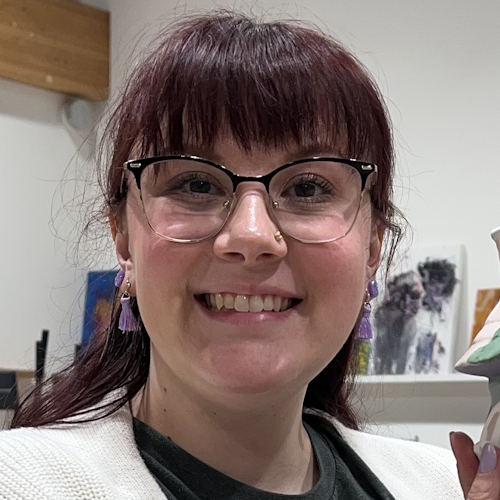
It took a fifth procedure, this one with a pathologist standing by in the operating room, before doctors finally confirmed cancer cells. By then, her tumor had grown to 13 centimeters, and she needed supplemental oxygen to move around her own house. She and her husband decided to push through with fertility preservation and paid $10,000 out of pocket for egg retrieval, so she could have the option of having children later.
The diagnosis came in early September: diffuse large B-cell lymphoma. Her oncologist didn’t wait for further subtype testing. He had her admitted within days and started on EPOCH chemotherapy immediately, choosing the most aggressive option rather than risk undertreating her. Chemo brought relief; she said she felt like a superstar within days of leaving the hospital.
But the road stayed rough. She was hospitalized again after becoming neutropenic, and on Christmas Eve, five days after her fifth chemo cycle, her bowel perforated during a holiday gathering she’d spent weeks planning. Emergency surgery removed a foot of her bowel and kept her hospitalized for two weeks.
Sarah completed six cycles of chemotherapy, transitioning partway through from EPOCH to the outpatient R-CHOP regimen. A follow-up scan showed nearly all activity gone, apart from one ambiguous spot near her small bowel that she nicknamed Schrödinger’s cancer, never confirmed as cancer or cleared as something else.
After a tense stretch that included getting things in place for possible CAR T-cell therapy with a second oncologist and canceling life plans, a repeat scan confirmed she had no evidence of disease. She now gets PET scans every three months, remains unmedicated for her Crohn’s disease for now, and has taken up ultimate frisbee, with a half marathon on her list for next spring.
Watch Sarah’s video or read the edited transcript of her interview to find out more about her story:
- Sarah’s tumor came back inconclusive from a mediastinoscopy, a bone biopsy, and two separate tissue biopsies before a fifth procedure finally produced a diagnosis. Her case is a reminder that a difficult-to-biopsy tumor doesn’t mean nothing is wrong; sometimes it just reflects the limits of current diagnostic tools and the need to ask what other options may be available to you. Comment end
- Because Sarah didn’t yet have a confirmed cancer diagnosis, her fertility preservation wasn’t covered by insurance, and she and her husband had to pay out of pocket. Anyone facing a likely-but-unconfirmed cancer diagnosis and weighing fertility preservation may run into this same insurance gap, and it’s worth asking about early.
- Sarah’s bowel perforated on Christmas Eve, five days after a chemo cycle, in symptoms she and her husband initially mistook for ordinary chemo-related constipation. Any new or worsening symptom during treatment is worth mentioning to your care team without delay. It may be more than just a rough day.
- Sarah now describes cancer as something that reshaped how she spends her time, without letting it define who she is. She took up ultimate frisbee, is training for a half marathon, and says she no longer wants to wait to do the things she loves.
Sarah’s Diagnosis Facts
- Name: Sarah V.
- Age at Diagnosis:
- 30
- Diagnosis:
- Diffuse Large B-Cell Lymphoma (DLBCL)
- Staging:
- Stage 4B
- Symptoms:
- Persistent cough
- Migraines with increased aura activity
- Extreme fatigue
- Night sweats
- Feeling feverish
- Difficulty breathing
- Feeling faint
- Chest pain and pressure
- Treatments:
- Thoracentesis
- Chemotherapy: EPOCH, transitioned to R-CHOP after official diagnosis was confirmed
- Surgery: emergency small bowel resection
This is not medical advice. Please consult with your healthcare provider to make informed treatment decisions.
- Sarah’s Diagnosis Facts
- My life before my diffuse large B-cell lymphoma diagnosis
- An X-ray, a CT scan, and the discovery of a 10-centimeter tumor
- The long road to my cancer diagnosis
- Starting with EPOCH chemotherapy immediately
- Hearing “diffuse large B-cell lymphoma” for the first time at 30
- Almost dying twice: Facing fear and dark thoughts during treatment
- Ringing the bell and the long road to being cancer-free
- My husband, Skyler: “I picked a good person to spend my life with”
- What I’d tell someone going through something similar
- My life now: Ultimate Frisbee, half marathons, and not waiting to live
- Hear from people living with diffuse large B-cell lymphoma (DLBCL)
My life before my diffuse large B-cell lymphoma diagnosis
My name is Sarah, and before I got diagnosed, I was a long-term substitute teacher in Washington State. Prior to that, I had just gotten my master’s degree. It had taken a long time for my certificate to go through, so I was excited once I started subbing and getting into the classroom, because that’s one of my absolute favorite things in the whole world.
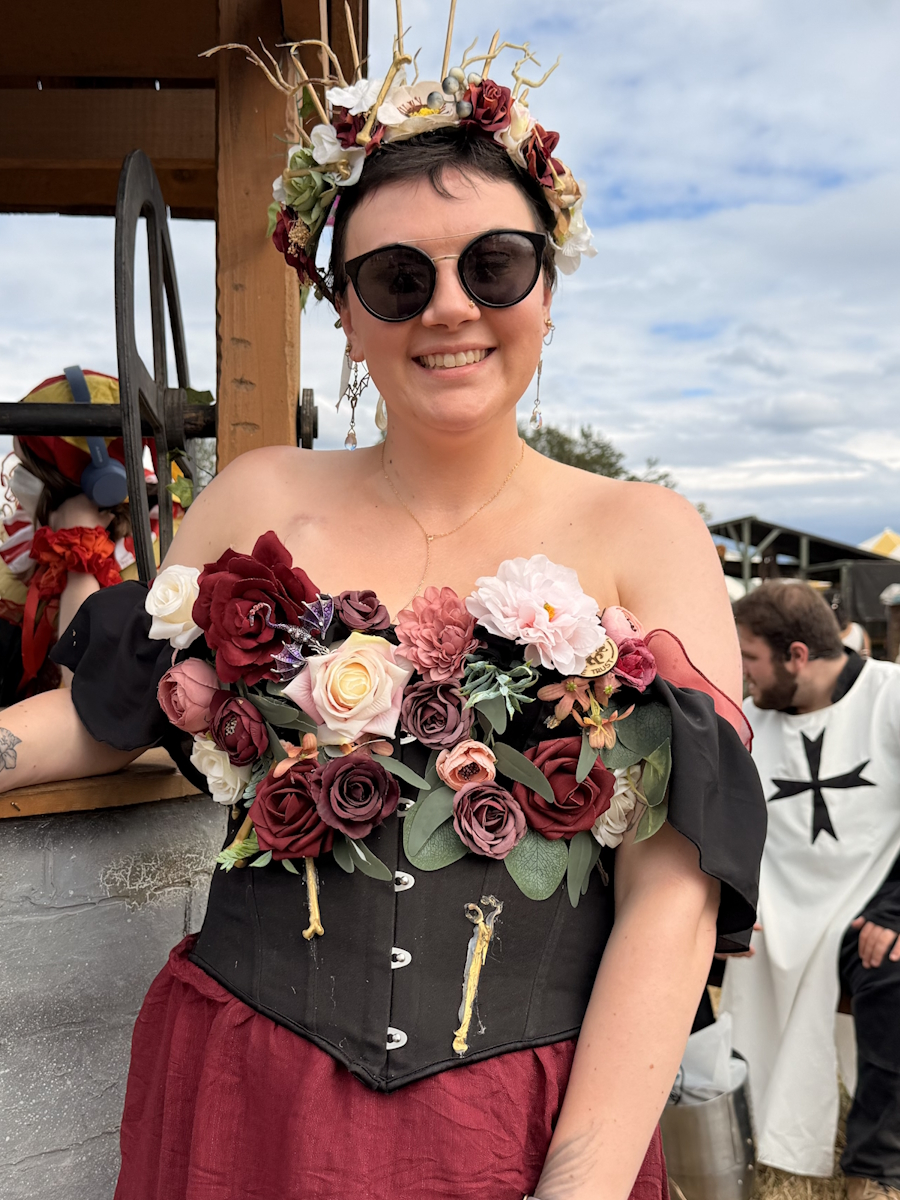
On top of that, I’m a big crafter. I’m also a giant reader. I love reading. I have two tiny little dogs that I love taking to the dog park and spending time with. My husband and I also go to renaissance fairs every summer and do all sorts of dog, fantasy, and reading activities.
A cough that wouldn’t quit: The first signs something was wrong
Toward the end of subbing, about a month before summer break, I started to get a pretty gnarly cough. Like most teachers, I assumed I picked up a cold because I was teaching elementary kids. I love them to death, but kids are germ factories, and they can be gross sometimes. I assumed I picked up a pre-summer cold, but it wasn’t going away. I got an inhaler and a cough suppressant, but they weren’t doing anything.
On top of not feeling well, I was starting to get migraines. I’d had them before, but I was starting to get insane auras with my migraines. I thought maybe I was sitting weird and decided to go to a chiropractor and see if that would help.
I also have Crohn’s disease. I went in for my regular infusion, like I did every eight weeks, and I felt like garbage after. That’s when I went to urgent care. I said, “I think I have a crazy viral infection.” Once I got to urgent care and waited three hours to be seen, that’s when we found out I had a giant tumor in my chest.
An X-ray, a CT scan, and the discovery of a 10-centimeter tumor
They did an X-ray. It was insane. I went to urgent care and said, “I have a crazy cough,” and they said, “It could be pneumonia. You waited so long, but I’m fairly confident it’s pneumonia, so you don’t have to get an X-ray if you don’t want to. But it’s totally your call. I support either decision.” I said, “I waited three hours in urgent care. I’m getting my X-ray.”
After the X-ray, they came back to the room about an hour later and said, “We saw something funny. Let’s do a CT scan and go from there.” I like proving doctors wrong sometimes, so when they came back and said we should do a CT, I was like, “I told you guys. I told you guys I was sick. I told you it was something.”
After the CT scan, there was a long wait. I want to say we got the CT scan at around maybe 11:30 p.m. or closer to midnight, and then we didn’t see the doctor again until 2:30 or 3 a.m. We arrived at urgent care at around 7 p.m., so we’d been there for a long time. I had fallen asleep because I was exhausted. That was one of my big symptoms too. I was extremely exhausted, but I thought I was just tired from teaching.
The doctor came back and said, “So sorry, I didn’t forget about you guys. I was on the phone with oncology for 45 minutes. We found a tumor in your chest. It’s about 10 centimeters. We want to get you to Overlake to the oncology department.” I was shocked. It wasn’t the information I thought I was going to get. It was crazy.
The long night at urgent care and waking up to the possibility of cancer
I asked my husband to come with me to urgent care, because there had been times previously when I’d gone and they wanted to give me medication that would make me sleepy, so I couldn’t drive myself. I knew it was just a cough, but I said, “Why don’t you come with me just in case?” He was with me through the entire thing and was also there when we got the news.
The doctor apologized for giving us the bad news and closed the curtain on the door. My husband’s a very stoic person, so he just stood there and let the information hit him. On the other hand, I started crying and bawling my eyes out. My husband was rubbing my back, saying, “It’s going to be okay.”
My phone died, so I borrowed his phone and said, “I should probably call my parents.” I live in Washington, but my parents live in Illinois. At this point, it’s 4:30 a.m. their time. I called my mom and said, “I think I have cancer, because they said it’s probably lymphoma. It looks like lymphoma, but obviously we can’t be sure.” She freaked out and woke my dad. He freaked out too, but fell back asleep. Classic dad behavior. The next day, my mom told me that my dad asked, “Was that real or was I dreaming?” My mom said, “No, that was real. Sarah’s in the hospital.”
I’m very thankful my husband was there. He was able to go home and grab a bunch of stuff, because we didn’t know how long I was going to be at the hospital. They weren’t entirely sure. They gave us very minimal information because they also had minimal information. He raced home, grabbed some chargers and snacks, and raced back. Thankfully, he was able to stay with me once he got back in, even though we were a little unsure because visiting hours were technically over. But the nurses were fantastic. They said, “He can come right up. It’s not a big deal.”
The long road to my cancer diagnosis
My diagnostic journey was bad. My tumor grew very quickly. It was two days after summer break when I was admitted to oncology. While there, I met with a doctor who could’ve been in oncology but could have been internal medicine. I also met with a thoracic surgeon because my tumor was in the middle of my chest, around my mediastinum and all up in my arteries.
The thoracic surgeon said we needed to get a PET scan, but that could only be done outpatient. They wanted a more comprehensive view with a different type of CT scan while I was admitted, but internal medicine and interventional radiology said no, so the next step was a PET scan. It happened maybe two weeks after I was admitted.
In between getting admitted and my PET scan, I had a mediastinoscopy. I don’t have a scar anymore, but they enter at the base of your neck, grab some tissue samples, and send them off to the lab. While we’re waiting for those results, I got my PET scan. The results showed that the cancer wasn’t just in one spot; it was in a lot of places. It showed spots on my right rib, my bowel, my hip, my femur, and a couple of lymph node areas. It looked like I was lighting up like a Christmas tree. It was bright everywhere.
When I finally got the results from the mediastinoscopy, they were inconclusive, which was frustrating, but apparently somewhat common. With that information, they decided to move forward with a bone biopsy. They could see where the spots were on my bones and thought they’d for sure get something there. Unfortunately, the bone biopsy’s first availability was about a month after my surgery.
From the beginning of July to the end of July, I slowly got sicker and sicker. At that point, I couldn’t have an oncologist, because I technically didn’t have cancer; I just had inflammation markers, because that’s what PET scans show. I had a care coordinator who was my in-between person, who I was messaging probably every day.
As I was getting sicker, as the care coordinator was talking to me, and we were getting more information from my PET scan, we concluded that it probably is cancer and it was stage 4. We didn’t know what kind of cancer. This was all unofficial. We were just piecing together information from all the different scans and doctors.
As a 30-year-old, when I got this preliminary information and knowing I wanted to have kids, my husband and I decided to move forward with fertility preservation. Before the bone biopsy even happened, we started fertility treatment and decided to do egg retrieval. That became a huge issue. Because I technically didn’t have cancer, the fertility preservation wasn’t covered by insurance, so we had to pay $10,000 out of pocket.
On top of that, because of where my tumor was, I was starting to have a hard time doing physical activity in general. My oxygen levels while lying down were perfectly normal, because I’m not doing anything. But the second I stood up and walked around, just doing normal activities, my oxygen levels would start to plummet. At that point, they were around the low 80s, which is not great deemed okay enough that I didn’t need oxygen quite yet.
I started fertility treatment with all the shots. I’m very grateful because I only had to pay for the surgery and the storage. I didn’t have to pay for the medication because the fertility doctors and my care coordinator were able to sign off on that. If you have cancer, they pay for the medication, so I paid zero for medications, which would have been an additional $5,000 at least.
Then I got my bone biopsy done. I was nervous about that too, because when people say they’re going to drill into your bone, it’s very scary. Thankfully, I didn’t feel a thing. It was a combination of great medication and being so exhausted. The second I lay down and relaxed, I fell asleep, so that went off without a hitch.
Later, we found out that the bone biopsy is inconclusive. It showed normal bone cells: no cancer, no inflammation, nothing. Then I had to go back to the thoracic surgeon, the same person who did my mediastinoscopy. He sat me down and said, “You don’t want me to do this surgery. I’m just your average surgeon. You need someone good at this. I’m going to send you to the guy I would want to do my own surgery.”
He called my oncologist because at this point, I had already set up an appointment. After all, we assumed the bone biopsy would come back with something. He called up what would be my future oncologist and the surgeon at Virginia Mason. He said, “If you don’t hear from either of these people in a day, you’re going to call or text me, and we’re going to figure this out.” I still have his phone number because he was fantastic. He was a really good dude to have on my team.
While we’re waiting to see my thoracic surgeon at Virginia Mason, I did egg retrieval. Because of my tumor and my oxygen levels, they refused to put me under, so I was awake through the entire surgery. I got minimal pain medication, as much as they could give me without causing me to fall asleep, but I felt the entire procedure. I didn’t know I wasn’t going to be put under until I got to the hospital. It was a double whammy of being very hormonal from the egg retrieval and also having to take 3 or 4 shots a day. Not a pleasant experience.
I didn’t think I was going to have to do this at 30. This was not part of my child planning. From the second I entered the hospital to the second I left, I was crying. I cried through the whole procedure. The anesthesiologist was great, held my hand and talked me through the whole thing, but it’s not a pleasant experience. No matter how numb they make you, being awake for that is uncomfortable.
After that, he decided on a different approach, which was the second option my first thoracic surgeon had told me about. He said, “We’ll either go through here or the side.” He went through the left side to get tissue. I also got a chest tube. I was in the hospital for 36 hours, then I was sent home. While in the hospital, I was continuing to deteriorate. My tumor has grown to almost 12 centimeters. They sent my tissue markers off and we were thinking we’d get answers this time.
No, we don’t get answers this time either. We get necrotic tissue. Because my tumor grew so quickly, there was dead tissue in the way of getting to the cancer cells. He says, “I can’t believe I have to tell you this, but we don’t have cancer cells. We don’t know what you have.” Being the great surgeon that he is, he was at a conference that weekend and talked to a bunch of colleagues and pathologists — anybody he could show my scans and case to.
They decided to do the same approach on my right side. But this time, they had a fail-safe in place. He said, “You’re the first surgery of the day. My pathologist is going to be in the room with me, and I’m not closing you up until we can confirm we have cancer cells.” Ten days after the previous surgery, I had a fifth procedure to get my diagnosis. He has the pathologist in the room. This time, he can’t use the robot because it’s hard to navigate. At this point, my tumor is constricting both aortas, which is why it’s hard for blood to pump, why I feel very faint and tired all the time, and why I have such a hard time breathing.
Also, because of where the tumor is located, any time I have surgery, I get fluid flushed out. He described it: Any time the tumor is putting pressure on stuff in your body, it causes the internal organs to sweat. At my first surgery, I had a 2-liter bottle of fluid around my lungs drained. At the second surgery, I had the same amount of fluid drained.
When they take tissue samples, they’re less than the size of a pinky nail, but he said, “We’re going to take giant tissue samples this time.” They took the samples and the pathologist confirmed we have cancer cells. It’s finally go time.
Finally receiving my diagnosis: Diffuse large B-cell lymphoma
I don’t get diagnosed with diffuse large B-cell lymphoma until September, so that whole summer, I was progressively getting worse. My tumor, at its largest, was 13 centimeters wide. Even if we waited to do egg retrieval until my official diagnosis, I don’t even think I would have been able to do it. Walking and getting around was painful because it’s in my bones and causing a whole lot of issues.
Finally, in mid-September, I get a call from my oncologist, who I’d already met. He called me at 6:30 p.m. on a Friday and said, “You have diffuse large B-cell lymphoma. We’re not waiting for the cellular diagnosis of what subtype it is. On Tuesday, you’re being admitted, and we’re putting you on EPOCH chemotherapy immediately, regardless of whether it turns out your subtype doesn’t need that aggressive of chemo. It doesn’t matter. I would rather you be on the most aggressive treatment and then taper down than have you need a more aggressive treatment later.” That’s how I got diagnosed with diffuse large B-cell lymphoma. Very long process.
Feeling trapped by my own body and the emotional toll of a drawn-out diagnosis
It felt like I was trapped by my own body, like I was being held hostage by it. I hated how hard it was. It honestly felt like I was being punished for something I didn’t even do and it’s not even my fault. I was so miserable. The first time I got bad results, I thought it was fine and that we’d get better news next time. By the time I was at my last surgery, I literally couldn’t care less. Start me on chemo. I don’t care anymore. I’m either going to die waiting or die getting the wrong chemotherapy.
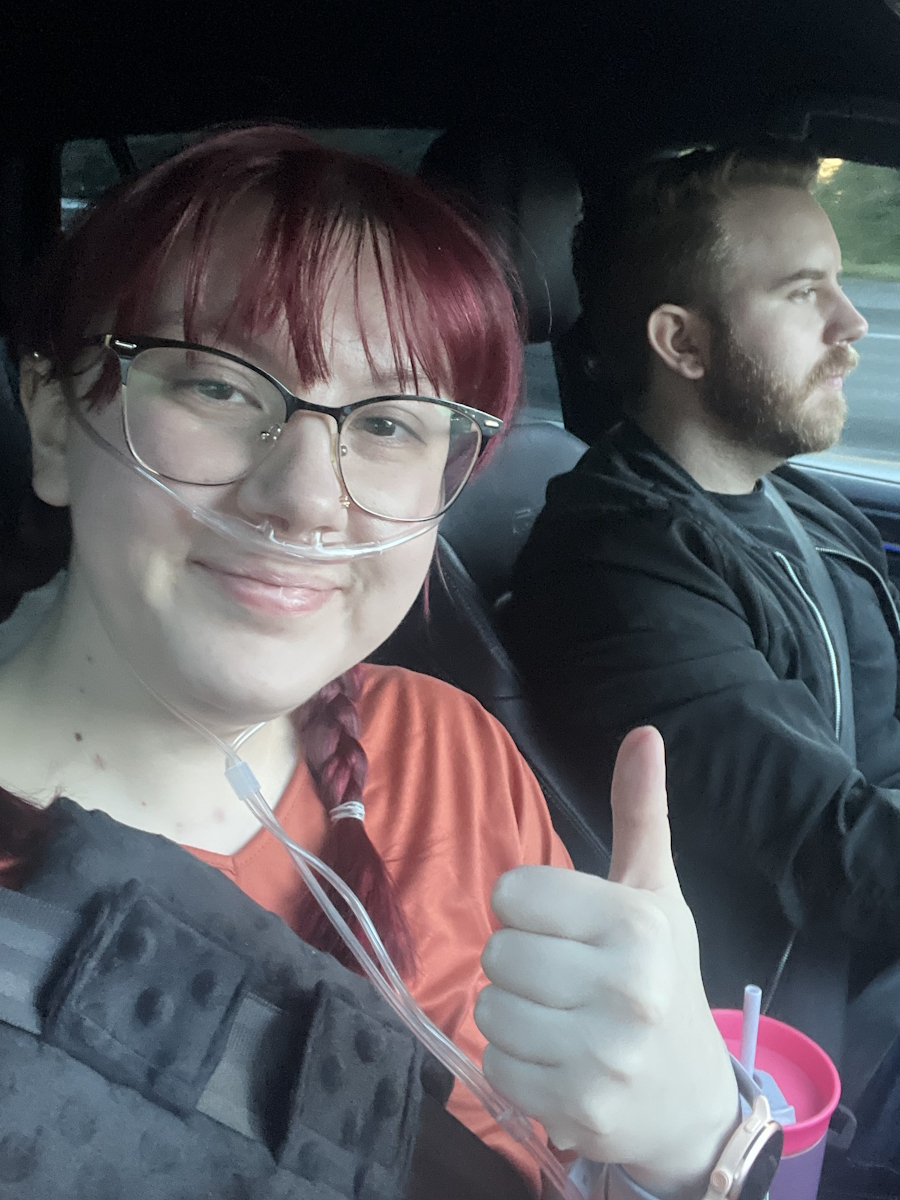
It was hard and very alienating. It felt like a Hallmark story, in the worst possible way. I had cancer, but we had no idea. Also, good luck trying to breathe and get around. Because by the time I got diagnosed, I had to be on oxygen full-time. There was no way I could get around my house without it. When I walked down the stairs, I would almost be passing out by the time I got to the last step.
I was miserable. I wanted something to stop and I felt so trapped. My mom had been with us the whole summer too, so she was watching all of this happen. My husband was also slowly watching his wife deteriorate, which I’m sure was hard for him.
Starting with EPOCH chemotherapy immediately
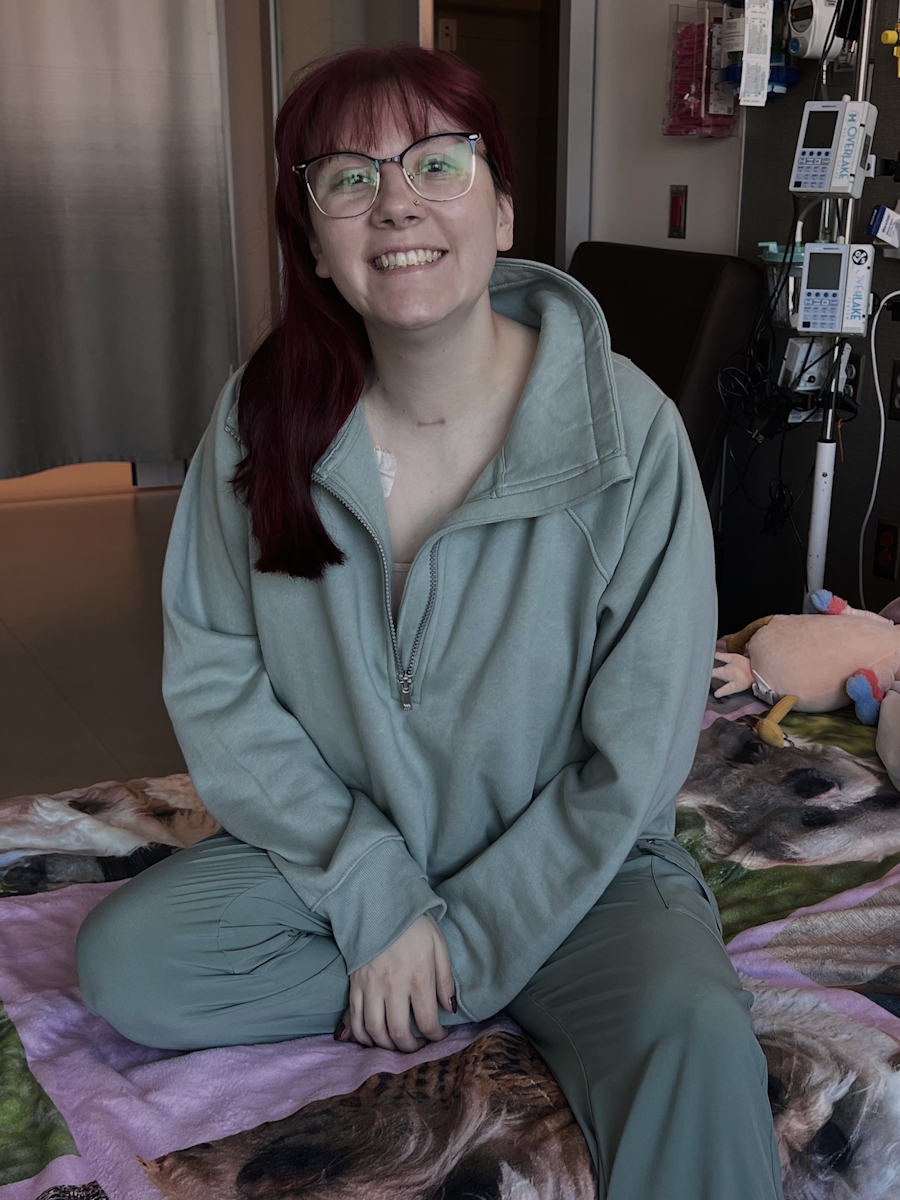
Strange was the best way to describe it. I can’t speak for all cancer patients because we’re all different, but I was under the impression that I would get sick very fast from chemo. My oncologist said the opposite was going to happen. Because I was severely sick beforehand, by the time I left the hospital, I felt awesome. I felt like a superstar. I could breathe a little better, my oxygen levels were going up, and I could make it up and down the stairs. My side effects from chemo were feeling a little nauseous, a little tired, and having stomach problems, either diarrhea or constipation. I was living with normal cancer patient side effects. I was like, “This is great.”
Unfortunately, I got neutropenic very fast after my first cancer treatment. About a week after my first chemo, I had to go back to the hospital and was there for another week, which sucked. That was hard, because I’d had this insane high of finally getting my diagnosis, finally feeling better, and finally getting to walk around and do more activities. Granted, the activities were cooking myself breakfast and making coffee. Then I got neutropenic and they said I had to go to the hospital because I was about to spike a fever or could be spiking one very soon. By the time I got off the phone and had enough energy to get in the car, I made it to the hospital and did have a 101°F fever. It’s a good thing they were tracking my levels, as annoying as it was going to appointments every four days.
After that, normal-ish life would creep back in a little bit. I always had to go to urgent care every chemo cycle, but after I was neutropenic and we finally got the subtype diagnosed, I didn’t have to go to the hospital for every chemo. We switched from EPOCH to R-CHOP, an outpatient chemo regimen, which was awesome.
The nice thing about it was that I went to the same infusion center I’d already been going to for my Crohn’s infusions. Not only was I going to a place that felt very familiar, but I already knew most of the nurses there. It’s a terrible place to feel at home, but I felt great. I had all my favorite nurses there. Everyone knew my name because I’d been going to that infusion center for three years at that point for my Crohn’s medication. They had come to know me very well as a person, so it was nice to have familiar faces at every infusion.
I’d feel better, get chemo, feel a little worse, get a little better, and feel a little worse again. It went from feeling great after the first chemo to feeling like absolute trash by the time we got to the fifth cycle. But once treatment started, I felt great. I felt like I was finally going to get my life back and things were starting to get on track.
I tried to do as many normal activities as possible, even though I’d have to mask up and use hand sanitizer constantly, and no one was allowed to see me if they were sick. But I had a great support system. No matter what, people would ask me what I needed and they knew to stay away if they weren’t feeling well, which was nice.
Hearing “diffuse large B-cell lymphoma” for the first time at 30
By the time I got diagnosed, I knew every cancer under the sun, especially lymphoma. When I got to the hospital that first night, they said it was probably lymphoma, so I did all of my research. Because of where my tumor was located, my husband said, “I bet it’s mediastinal lymphoma.” Thankfully it wasn’t, because that’s a little more of an aggressive type and a little harder to treat.
Before treatment, one of my good friends’ brothers had just finished chemo and was going through a stem cell transplant because he had Burkitt lymphoma. I consider her parents like my own at this point; I love them to my core. They’re so sweet and kind. We’re unfortunately both part of a lymphoma club, but it was nice to have family and it was great to bounce information off them and get additional resources and ideas of what to ask.
But before being admitted, I had never heard of diffuse large B-cell lymphoma. I knew what lymphoma was, but never did I think I was going to get it at 30. I did think eventually I was going to get cancer, because I have a lot of cancer in my family history, but 30 was not on my bingo card.
Surprised by how fast everything moved after the diagnosis
I was very surprised at how quickly things moved forward. When they said, “We’re going to get you in immediately for surgery,” I assumed that meant something like 10 days to two weeks. When they said, “We’re going to schedule you in three days,” I wasn’t too surprised, because my oncologist warned me. He said, “Once we get this diagnosis, we are not waiting. We are going full steam ahead. You are going to be in the hospital within that week of us figuring out all the information we can.”
Advocating for relief: Thoracentesis, pain medication, and speaking up
Because of where my tumor was located, my organs would sweat, so I had to have a thoracentesis before Virginia Mason. I was having such a hard time breathing. Taking a deep breath was virtually impossible. At one point, I had to message my care team to say, “I can’t breathe.” It wasn’t an oxygen issue quite yet, but I said, “I need this fluid drained. I need something, because this is not it.” They got me in for a thoracentesis, which was not a pleasant experience, but they drained, I think, at least a 1-gallon bag of fluid, sent that out for testing, hoping maybe we could get cancer cells. No such luck.
There were times, especially as I got closer to September, where I’d see doctors and say, “I’m in so much pain.” On top of that, my cough was so bad. It’s not like a cough where you’re trying to get rid of phlegm; it’s a cough because your heart and your vessels are being squeezed, so no inhaler or cough suppressant is going to do anything.
My doctor put me on oxycodone to see if that would help lessen the cough. It did to an extent, but because I had to take it all the time, he suggested I transition to extended-release morphine and oxycodone for breakthrough pain. As I got closer to September, I was living in narcotic la-la-land a little bit, because I was constantly on pain medication.
Almost dying twice: Facing fear and dark thoughts during treatment
I like to tell people, in a joking-not-joking way, that I almost died twice last year: once because it took so long to get diagnosed, and a second time when my bowel exploded. It’s not that the medical community was failing me; it’s just that nothing was going right. It felt like I was being left behind, even though I wasn’t.
Doctors can say, “I’m sorry,” nurses can say, “You’re going to figure this out,” and family and friends will say, “You can do this. You can fight,” but at certain points, I didn’t want to. There were days when I wanted this to be over. I would not toy with the idea of death being an easier way out, but suffering felt like a terrible way to keep living, especially on the hard days when I couldn’t finish sentences without having a coughing fit to the point where I would throw up. I don’t think anything can prepare you to feel that way. I reached the point where I was thinking, “Either fix me now or take me out, because I can’t do this anymore.”
An unforgettable Christmas Eve that led to emergency bowel surgery
This is another Hallmark story, if you will, but a horror story. This was right after my fifth chemo session. I had R-CHOP that Tuesday and then I picked up my parents and my brother from the airport that Thursday or Friday. They were going to be with us for 10 days. I was very excited because I hadn’t seen my brother in over a year. My mom had come out in October around her birthday. She doesn’t work, so she’s able to fly out as frequently as I needed her. And my dad had been with me for my first chemo treatment.
I was excited to finally have people come to my house for reasons other than being sick. We were going to celebrate Christmas. I invited my in-laws and my best friends who weren’t going to see their family for the holidays. I broke out the china. I had 17 people coming to my house. I was in heaven. I love hosting parties. This was like my magnum opus. I had hand-drawn calligraphy place cards, tables set… the whole nine yards.
It was Christmas Eve, and I wasn’t feeling well, but it was only day five or six after chemo treatment, so it’s very common to feel nauseous, have a stomachache, and deal with constipation or diarrhea. I was doing all the things I’d been doing: taking my laxatives, drinking lots of water, staying hydrated with electrolytes, and making sure my white blood cell shots were on time. They still weren’t helping.
I took a pain pill, thinking I’d feel better, and decided to take a bath because sometimes that helps with stomach cramps. I filled up my tub, got in, and thought, “Something isn’t right.” I truly thought I was just constipated, so I sat on the toilet, but nothing happened. I thought, “That’s weird,” and I started to feel a lot of pain, more than usual. I figured I must not be feeling good, because part of the chemo regimen can cause constipation, which is very common.
I thought it was just unfortunate, so I decided to take a laxative and see if it would do its thing, but the pain kept getting worse. I ended up on my bathroom floor, trying to sit up, and then I started vomiting. My brain did not go to my bowel being perforated, because who would think that? I called my husband, who was downstairs, and said, “I need you to come to the bathroom. I do not feel well. I need a pain pill.”
He came up and gave me a pain pill, but I threw it up immediately. I tried to drink some water. He said, “Maybe you’re really constipated. Maybe you should try a suppository.” I said, “I don’t know if I can make it.” He helped me put some clothes on and I was writhing on the floor in so much pain, crying with silent tears going down my face, trying to feel better. We waited the 15 minutes for the suppository to work, but nothing happened. I said, “Something isn’t right.”
I was in too much pain to call the on-call nurse myself, so I told my husband, “Skyler, this is your time to shine. Call the number and figure out what we’re supposed to do.” I started not feeling good at around 4 p.m. and now it was around 7:30 p.m., so it had been a couple of hours. He was explaining my symptoms and then he hung up, looked me in the eyes, and said, “I have to call emergency services.”
That was my biggest fear as a cancer patient. I know that sounds delusional, but I did not want to be that sick person who had EMS come to the house and wheel me out, on Christmas of all nights, with everyone’s eyes on the road looking out at the scenery. But in that moment, I said, “Yeah, that sounds about right. You should probably do that.”
He called and explained what was going on: that I was in a lot of pain, not feeling well, lightheaded and dizzy, and my stomach hurting so bad. We live very close to the fire station, so they said they’d arrive in about five minutes.
They took my vitals and they came back somehow totally normal, but I was still in a lot of pain. My mom was rubbing my back and I was yelling at her, “Don’t touch me. Nobody touch me,” because when I’m in that much pain, I have to drown everything out and find a happy place, even though other people are trying to comfort me. They asked if I wanted to drive myself or have them drive me. I said, “Take me. I’m not getting in a car. I want to lie down. Please just take me.” Thankfully, it wasn’t a busy night for them, so they asked where I wanted to go, and they took me to the same place where I’d had a couple of my surgeries and where my oncologist also worked.
My poor dad had just gotten back from Christmas Eve Mass when I was being taken by EMS and he’d been home for maybe 45 minutes. He asked what was going on and my mom said, “I don’t know. Sarah’s not feeling well.” They put me in the emergency vehicle and drove me. My sweet husband doesn’t know what to do with awkward silence, so he was making small talk with all the EMS workers in the car, asking casual questions, even though every time he talked, I wanted to punch him in the face.
Once I got to the hospital, things got pretty blurry. I was seen by a bunch of nurses doing triage and transfer from EMS, asking my pain level, why I was there, and all of that. I kept saying, “My pain’s 10 out of 10.” “What can we get you?” “Morphine. I need morphine. I need pain medication right now, immediately.” They got the doctor very quickly, who saw me maybe 10 minutes after I’d arrived. He said, “We should get pain medication right away,” but that didn’t do anything. I got a second dose; still nothing.
Because I was on so much pain medication, I wasn’t fully comprehending where I was going or what scans were happening. They did an X-ray and said they couldn’t see the whole picture, so they wanted to do a CT scan. They came back and said, “Your bowel perforated, and there’s something else going on we’re not 100% sure of. Because it had exploded, there were air pockets and it was a hard picture to read without going in for emergency surgery.”
They called the surgeon on call and he got there in about 45 minutes. Because I was on blood thinners from blood clots I’d been getting from chemo, I had to have an emergency coagulant infusion before surgery. I remember being taken to my prep room and doing emergency surgery prep, which I’d never done before. It’s very similar to regular surgery prep, but faster and with less concern for certain things. They scrubbed me down as quickly as possible and a nurse helped me get undressed into a gown.
The next thing I knew, I woke up missing a foot of my bowel, because not only had it perforated, but it had twisted on itself and I had a bunch of adhesions. We don’t know why all the extra things happened. The perforation is most likely due to the thinning of the lining from chemotherapy, but because I have Crohn’s disease, was going through chemotherapy, and had cancer in my small bowel, the exact reason the perfect storm happened is unclear.
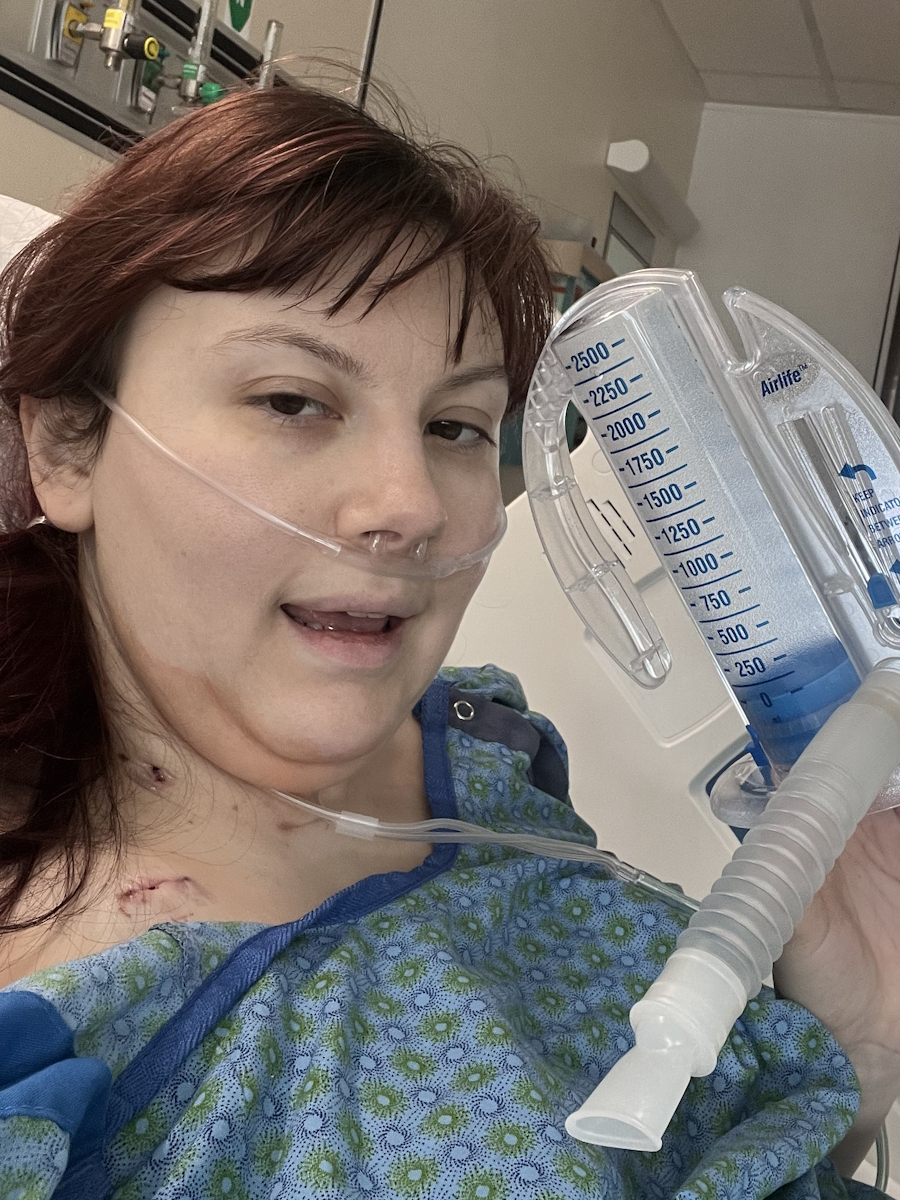
I’m very thankful I didn’t end up with a colostomy bag. I don’t know how that happened. I was only supposed to be there for five days, since that’s routine for bowel surgery, but I was there for two weeks. It was a rough recovery. I was in an extreme amount of pain. I had a patient-controlled pump, but that wasn’t doing it, and I was hitting it every 10 minutes. Eventually, they put me on ketamine to help ease the transition from post-surgery pain. They thought for a bit that I was starting to collect fluid, so I had to have an additional tube put in on top of the two drainage tubes already in from the surgery itself.
Walking around was hard. It’s not that I had to relearn how to go to the bathroom, but I had to relearn what my new signals were. There were instances where I’d get up thinking I’d have to go to the bathroom and then I’d poop my pants because I couldn’t make it in time.
I was also on an NG (nasogastric) tube to pull out stomach acid, and I was on parenteral nutrition. Every four days, I had to get new IV lines because they’d clog up, and certain medications couldn’t be put into the same IV line. They all had to have separate entry locations. It was a hot mess, and I thought I was going to be in that hospital forever.
That was the low point of my whole cancer experience. Egg retrieval sucked, but having Christmas, New Year’s, and everything I’d been looking forward to all year pulled out from under me was awful. On top of that, I didn’t think I was going to make it by the time I got to the hospital.
Ringing the bell and the long road to being cancer-free
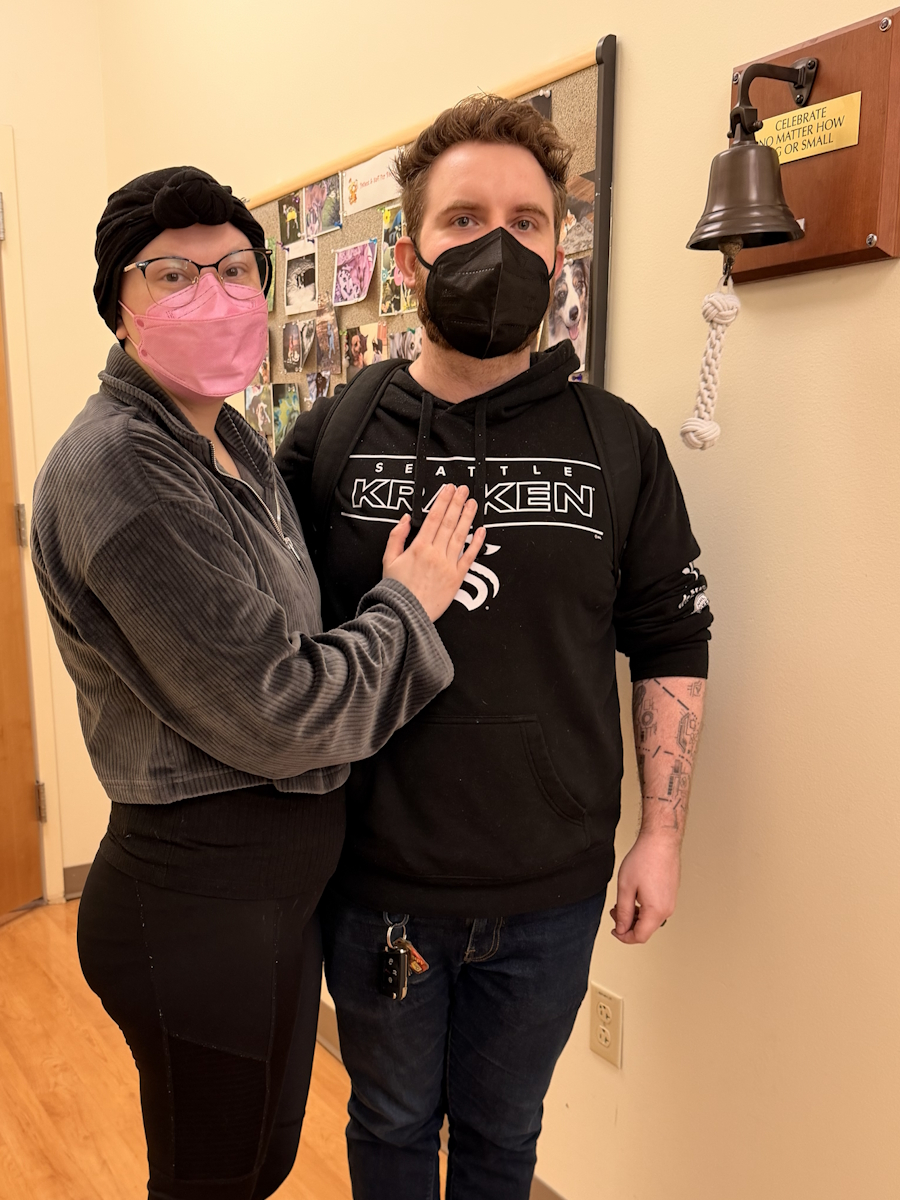
While I was in the hospital recovering from the bowel surgery, my oncologist said I didn’t necessarily have to do one more chemo cycle. Results showed that if I only did five, it would probably be fine. But I’m not one to hope or guess; if I was told I needed to do six, I should probably do six. We waited a month after I was discharged from the hospital to do my last chemo. I got to ring the bell, which was very exciting and a nice little moment of encouragement.
After that, we did a six-week post-chemo PET scan and found a lot of great information. Most of my cancer was gone: no bone activity and no activity in my chest, and those were the big spots. The one spot that gave us some pause was near my small bowel, still showing some activity, but we weren’t sure whether it was inflammation from the surgery, from my Crohn’s disease, or cancer.
During this time, I kept telling people I had Schrödinger’s cancer; it’s cancer, but it’s not cancer, we don’t know. It’s not big enough to biopsy and it’s not easy to biopsy. My oncologist said it wasn’t worth putting me under the knife again to take a small amount of cells to confirm whether it’s cancer or not, as I’d had too much surgery already.
We did another wait-and-see. At that point, he said, “Well, it’s not going away, but it’s not getting bigger, so let’s have you establish care in case you need CAR T-cell therapy down the line.” I had an unpleasant experience with the new oncologist. He didn’t look at my scans before my appointment and didn’t take into consideration what my previous oncologist had said.
He said, “We’re going to keep waiting and scanning every six weeks.” As annoying as that is, I’d rather do that than have you tell me I might need unnecessary treatment. CAR T-cell therapy is great and it’s awesome from a science standpoint. But from a patient standpoint, you probably shouldn’t tell someone that they need CAR T-cell therapy without looking at every single scan beforehand and giving them the full information.
He gave me this information and said I should probably do it, so I canceled a bunch of stuff for the summer, because he said we’d get the ball rolling again. I went to see a fertility specialist again to see if I should do more egg retrieval, and found out that chemo had, in fact, ruined my ovarian reserve. In hindsight, I’m glad I did egg retrieval, but getting pregnant naturally is going to be hard. I also had to back out of a show I was going to be in because I thought I might be having treatment.
Then, six weeks later, I got my scan again and saw him, and he said, “Great news. It looks like you don’t have cancer anymore.” I was annoyed that he’d decided to tell me all that information and then decided to wait and see after I’d canceled everything. I’m very happy that I probably don’t have cancer, but that was also extremely rude. Make sure you ask your oncologist if they’ve looked at your recent scans.
I saw my regular oncologist and he said, “I think we’re done. I don’t think you need treatment anymore.” That was January 1, 2026. I got a tattoo with my cancer-free date as well as my mom’s cancer-free date to commemorate the whole process. It was almost a full year to the day. It’s crazy. Now I’m back to living a normal life again. I went to my first concert recently and that was exciting.
Ongoing monitoring for lymphoma and Crohn’s disease
We’re going to be monitoring every three months from now on. I’ll get a PET scan and we’ll go from there. The nice thing is we’re getting very close to being out of the danger zone for recurrence. If I’m remembering correctly what my oncologist said, the first year is the most likely time for recurrence to happen, and then after that, it’s the first five years. Once you pass five years, you’re looking good.
Out of all the scans I’ve ever gotten, PET scans are probably the easiest, as time-consuming as they are. You get your radioactive sugar, sit there for an hour, get scanned for 10 minutes, and go home. I get the fewest pokes possible and there’s no large contrast. I much prefer that over CT scans any day, though everyone’s different.
For now, that’s my only monitoring, along with additional monitoring for my Crohn’s disease. Since I got diagnosed with cancer, we stopped all Crohn’s medication, so I have to be diligent about my symptoms, in case there’s any breakthrough activity. My doctor wants to put off any sort of biologic for as long as possible. Right now, I’m unmedicated for Crohn’s and having very few symptoms, if any. Hopefully, we can put that off, but we’ll see. I love science, so if I need to be on medication again, it is what it is.
My husband, Skyler: “I picked a good person to spend my life with”
This is the part that may make me cry. He was amazing. He took off work every time I had chemo. He took me to every single appointment. We’re very grateful we had insurance that covered all of my chemo costs, so we didn’t have additional costs coming out of nowhere. He was there every single day.
If I needed something, he would get it. If I said, “I can’t eat this food. It’s grossing me out,” he’d say, “No problem. What can I get you?” He was at every surgery and every scan he possibly could be at. The only things he didn’t come to were egg retrieval-related ultrasounds, because those happened every two days, which is a lot.
I truly could not have gotten through it without him. There were days where I would just cry and be so upset. Even now, I’m still upset that we don’t get to have the family planning route we wanted. That’s still hard for me to accept. It’s not that the door is closed; it just looks very different now.
But he was a rock star. He would stay every time I had overnight surgeries, sleeping on those crappy chairs in crappy tiny rooms, and he never complained once. He went with me to get my port removed and that was exciting, because it felt like the true end of treatment. I could not have done it without him. I picked a good person to spend my life with.
What I’d tell someone going through something similar
Cancer is not who you are. It’s not going to define you for the rest of your life. There may be days when it’s a little bit louder than others, but you’re so much more than a crappy diagnosis. You’re such an important part in so many people’s lives. The hard parts are going to look fuzzy when you get to the end of this experience.
It’s okay to take things one day, one hour, even one minute at a time if you need to. You don’t have to make it all day without crying. Take your moments to cry. Take your moments to feel joy. I think a lot of people sometimes forget that. When you’re going through cancer, people assume that you’re sad all the time, and it is sad a lot of the time.
But you deserve to have people come over and make you laugh, and you need people around you who are going to uplift the other awesome parts of you, rather than just the sick parts. I don’t think I would have gotten through it if I didn’t have my husband, my family, and my friends making me laugh every single day. In fact, that was one of the rules I gave them: Just because I have cancer doesn’t mean we can’t make jokes about me having cancer, so don’t ever stop.
People need to try their best to surround themselves with genuinely great people and to lean on their people. Don’t be afraid to ask for help. Don’t be afraid to ask people to come to appointments or just sit with you. Literally say, “Hey, I need someone to sit with me while I process my feelings.” It’s hard to ask for help. Trust me, I’ve been there. But you’re going to be so happy you did it.
My life now: Ultimate Frisbee, half marathons, and not waiting to live
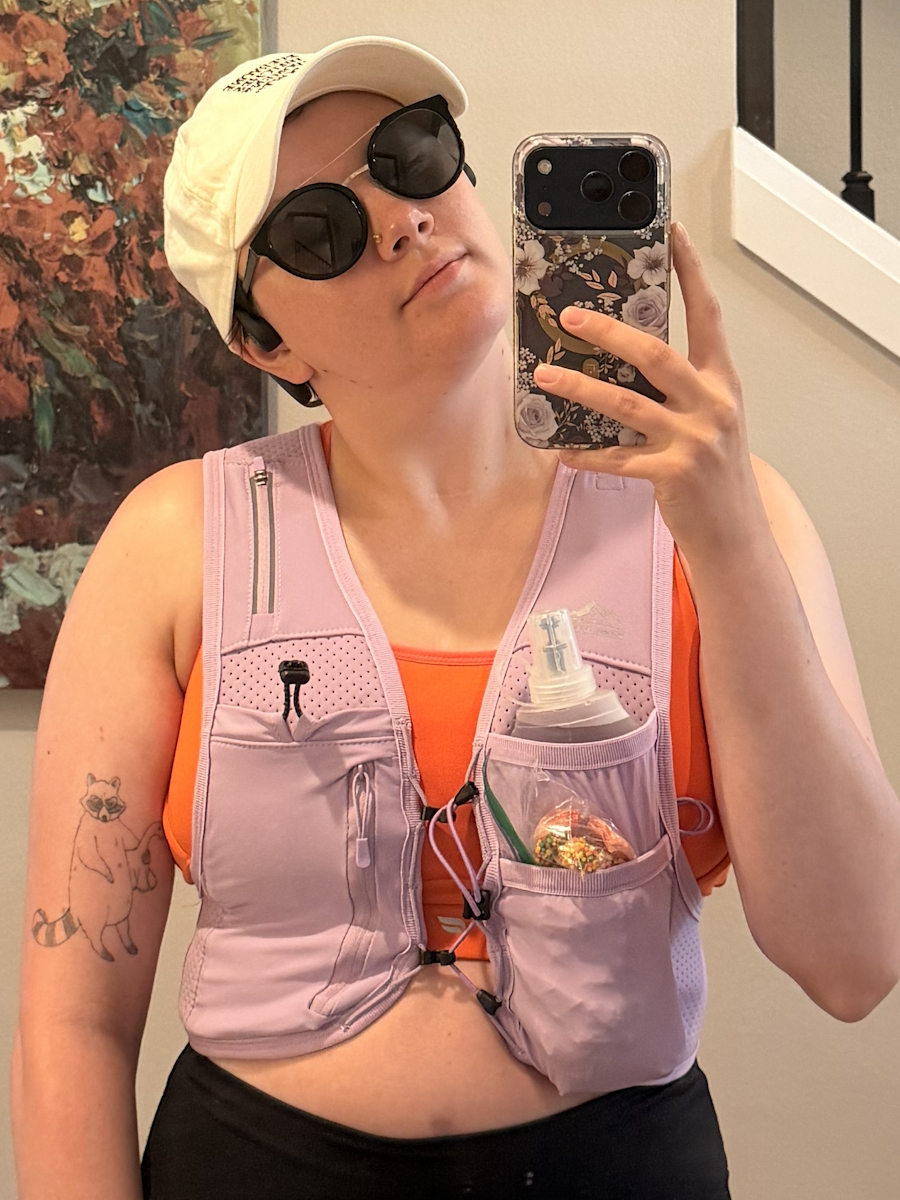
I’ve found an awesome group of people to play Ultimate Frisbee with, and it’s become one of my favorite adult activities recently. I wanted to do something low-stakes that still got me a little bit active, so I started doing Ultimate Frisbee and it’s been awesome. I love my team.
I’ve started to run and be active again. I’m hoping that by April 2027, I’ll have run a half marathon. Not everyone can do that after cancer treatment, but I’ve been working hard.
I know it sounds cliché, but once you have cancer, you get that feeling that life’s too short not to do the things you love. It’s so cliché, but it’s so true. I go on dates more often with my husband, I hang out with my friends, and I’m not going to wait until I’m 50 to try to run a half marathon. If I can start tomorrow, I’m going to start tomorrow. That’s been one of the silver linings of cancer. As terrible and as horrible as it is, and I don’t wish it on my worst enemy, it does make me appreciate my life and what I can do with my body now.
This interview has been edited for clarity and length. The views and opinions expressed in this interview do not necessarily reflect those of The Patient Story. This content does not replace professional medical advice.
Inspired by Sarah’s story?
Share your story, too!
Hear from people living with diffuse large B-cell lymphoma (DLBCL)
Real experiences with diagnosis, treatment choices, side effects, and life beyond diffuse large B-cell lymphoma — in their own words.

Leave a Reply