
Courtney Spent Months Convincing Doctors Her Cancer Had Returned; Then Mayo Clinic Rewrote Her Original Diagnosis: Composite Lymphoma
Courtney was 30, working out, and feeling better than she had in years when the back pain started. It was late 2021, and she chalked up her weight loss to a new headache medication and her sore shoulder blade to a bad knot she couldn’t work out. But by January, the pain had become constant, and a terrifying night when she had a facial droop and the sound of a loud bang in her head that woke her from sleep sent her to the ER. Doctors ruled out a stroke and sent her home with a diagnosis of migraine and panic attack. Over the next six weeks, new symptoms piled on fast: nightly deafness in one ear, chest pain, drainage that wouldn’t stop. She would be diagnosed with follicular lymphoma, though nobody knew it yet.
Interviewed by: Taylor Scheib
Edited by: Katrina Villareal
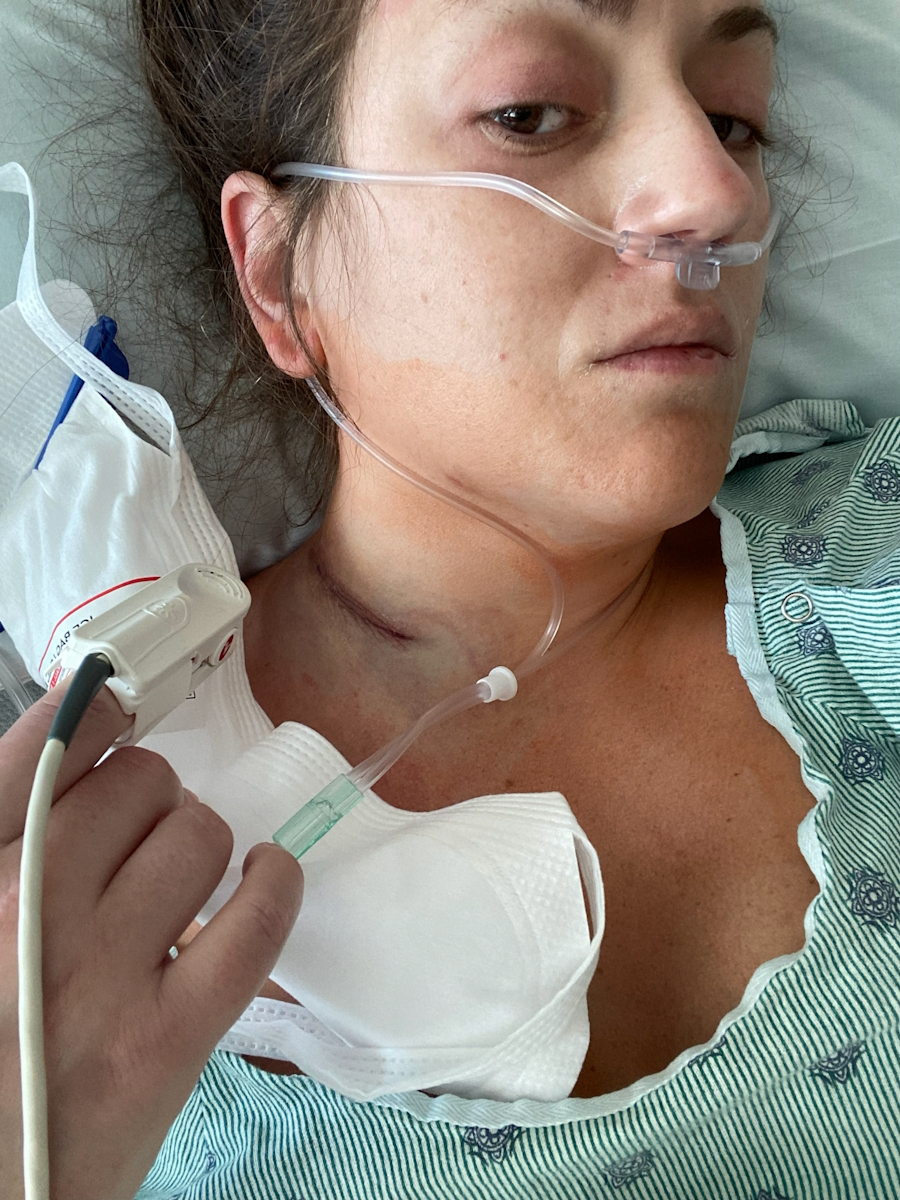
The first turning point came on a trip to Mexico, when Courtney woke up with a swollen neck. Back home, she went to urgent care, where a doctor recognized the signs immediately. A CT scan found a grapefruit-sized mass in her chest. Within hours, she was admitted to the hospital, and a radiologist told her that she had lymphoma.
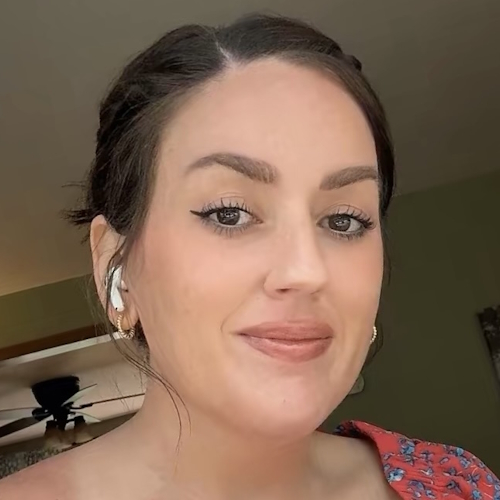
The diagnosis that followed was about as rare as they come: stage 3, grade 3B follicular lymphoma with a triple-hit, a set of three genetic mutations occurring together, something her care team described as basically unheard of.
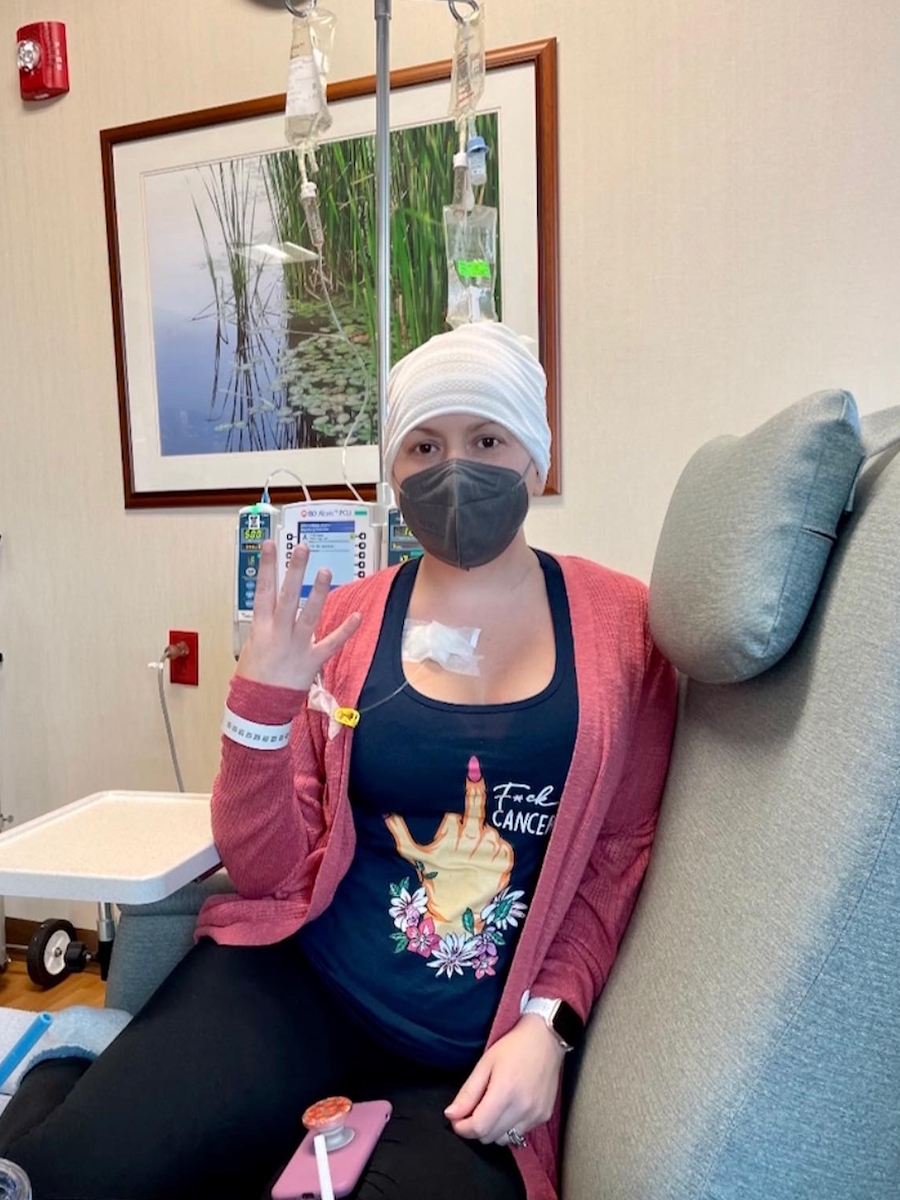
Courtney’s treatment was six cycles of R-CHOP chemotherapy over four months. She doesn’t remember much of it now, other than that it gave her something to hold onto and something to fight for. The years since have brought their own kind of exhaustion: complications from chemotherapy that altered her body and mind in ways she’s still working through, and a recurring need to convince doctors that a cancer patient who doesn’t look sick is still a cancer patient.
In spring 2026, a swollen, painful lump near her elbow sent her through months of normal scans, but she was increasingly convinced her cancer had returned. A message from a stranger on Instagram led her to Mayo Clinic, where a full-body scan ruled out any active lymphoma. Then came the twist nobody expected: A re-review of her 2021 biopsy revealed that her initial diagnosis had been incomplete.
Courtney doesn’t have one rare lymphoma. She has composite lymphoma, two distinct cancers that developed simultaneously from the same lymph node, a diagnosis that would have changed her original treatment plan entirely. Four years into a remission her new care team calls statistically remarkable, she’s still living with a symptomatic arm that has no answer yet, and with the knowledge that her disease is more likely to come back than she was originally told.
Watch Courtney’s video or read the edited transcript of her interview to find out more about her story:
- Normal test results don’t always mean nothing is wrong. Courtney’s ultrasound, X-ray, and first MRI all came back clean while the swelling in her arm kept getting worse. She kept pushing for answers anyway, even when it made her feel like she was losing her mind.
- A new diagnosis. Courtney started chemotherapy 12 days after her original scans, before her biopsy results were even back. Four years later, a second opinion found that her original diagnosis had missed a second, distinct lymphoma.
- A second opinion, even years later, can change everything. A message on Instagram from a stranger led Courtney to Mayo Clinic, where a re-review of her original biopsy uncovered a diagnosis her first care team had missed.
- Cancer doesn’t end when treatment does. Courtney describes years of chemo-related complications and a recurring need to convince doctors that she is still sick, because she doesn’t look like what people expect a cancer patient to look like.
- Advocating for yourself is exhausting, and worth it anyway. Courtney pushed through a canceled appointment, a misordered MRI, and months of normal scans to get an answer. Her message to other patients: “You are the driver of your own health.”
Courtney’s Diagnosis Facts
- Name: Courtney L.
- Age at diagnosis: 30
- Diagnosis:
- Composite Lymphoma
- Follicular Lymphoma (Grade 1 to 2)
- High-Grade B-cell Lymphoma with Double-Hit Status (MYC and BCL2)
- Composite Lymphoma
- Symptoms:
- Firm, non-movable lump near the left elbow; area became warm and discolored, with swelling gradually spreading through the arm
- Increasing heaviness, weakness, shaking, numbness, and tingling in the left arm, eventually struggling to hold up the arm or use it normally
- Night sweats
- Overwhelming fatigue
- Loss of appetite
- Unexplained weight loss
- Treatment:
- Chemotherapy: R-CHOP
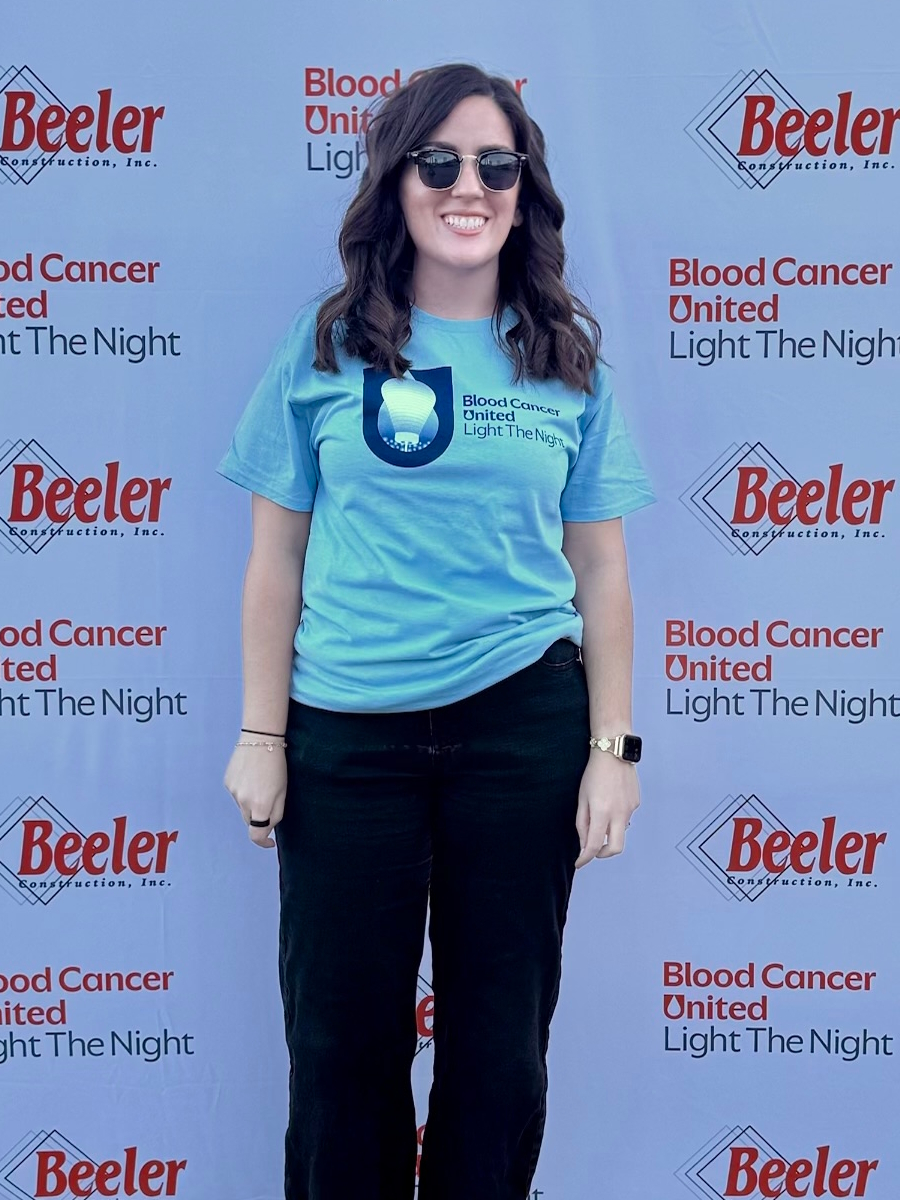
This is not medical advice. Please consult with your healthcare provider to make informed treatment decisions.
My first symptoms
I was first symptomatic for about two months. This was in late 2021. I had intense back pain around my shoulder blade. It wasn’t all the time, but when I had it, it was excruciating, like somebody was stabbing me in the back.
A couple of months before that, I switched my headache medication and one of its side effects was weight loss, so when I started losing weight, I thought it was because of the medication. Honestly, I felt good physically because I was losing weight, working out, and eating better. I thought I was in the best shape of my life, because it was the first time working out seemed to be working because the weight was falling off.
But the back pain kept getting more severe. By November and Christmas that year, I was asking for heating pads and back massagers, because I thought I had a bad knot that I couldn’t work out.
Then in early January 2022, I woke up in the middle of the night to a loud bang in my head, a noise that startled me awake. There was nothing there, and half my face was drooping. I thought I had a stroke.
A frightening night and a misdiagnosis
I was able to go back to sleep. I even went to work the next day. I work at a hospital, but not on the medical side. One of my coworkers ended up taking me to the emergency room. They called a stroke code, ruled out a stroke, diagnosed me with a migraine and a panic attack, and sent me home.
For the next six weeks, things continued to worsen, dramatically and quickly. I had constant drainage out of my nose that never stopped, like an open valve with no shutoff. Every night when I would go to sleep, I would wake up deaf in my left ear, slowly regain the ability to hear throughout the day, only to repeat the cycle the next night. I had increasing chest pain and difficulty breathing. I kept thinking I wished I could get a chest X-ray, but I didn’t want to go back to the hospital, because they’d already told me I was fine. I felt stupid going back. They said I had anxiety, which I had a history of, so I assumed that’s what it was.
I had increasing fatigue too. I told a coworker, “I’m so tired.” I had some minimal night sweats, not drenching; I never had to change my clothes or my sheets, but I remember thinking I must be having a lot of fevers, because I figured I had a sinus infection that wouldn’t go away.
My symptoms got worse while on a trip to Mexico
I went to Mexico in February, which was about six weeks after my symptoms started. After the first night, I woke up with my neck swollen. I didn’t know what it was. I thought it was an allergic reaction. It was also the height of COVID, so I was honestly more concerned about getting COVID and being stuck there for two weeks than anything else.
I came back on a Friday night. On Saturday, I told myself, “I have to go today, or I’ll never go,” because I’m back at work Monday. I didn’t have a primary care doctor, so I tried an online virtual appointment first. They rejected it immediately and said I had to be seen in person, so I went to urgent care.
That doctor knew right away. She did a phenomenal job keeping her cool and not letting on, but she definitely knew.
The mass and the word “lymphoma”
She sent me to the hospital to get a CT scan of my neck. At the top of that scan, it showed a grapefruit-sized mass in my chest. She called me several hours later and said I had a mass in my chest and needed to be admitted to the hospital that night. I had just returned home from Mexico the day before, and now they were telling me I needed to be admitted.
I didn’t know what a mass was. I was clueless. I’d spent the week before Googling all of my symptoms, and it kept saying cancer, but I’d convinced myself it wasn’t, because they always tell you that Google gives you the worst-case scenario, and it’s usually not that.
I got to the hospital late Saturday night. A radiologist met me in the waiting room of the main lobby, walked me to my room, sat me down, and said, “You have lymphoma.” I still didn’t know what lymphoma was. I remembered commercials from being a kid, the kind that say if you’ve been exposed to Roundup, you may be eligible for compensation.
I think the notes from that visit say I was near panic. I said, “Yeah, you could put panicking.” That was sheer panic.
Getting a rare and aggressive cancer diagnosis
They said lymphoma, and eventually, it came back as grade 3B follicular lymphoma. That radiologist told me, “I think it’s the good kind of cancer,” based on my age, gender, and race. I think he meant Hodgkin lymphoma.
I had a biopsy of my neck the next day, and then I started chemo within 12 days. That urgency meant something I didn’t understand at the time: They started chemo before the biopsy even came back, before we officially knew what the diagnosis was. They were going off my CT scans and my PET scan, which showed widespread disease, and got me into treatment before I had an official diagnosis. I didn’t learn any of this until more recently. They just said, “You’ll see this doctor on this day,” and I said okay, and that’s what I did.
Reflecting on it now: I don’t know that I had time to think it through. It could have been fatal, given how severe, widespread, and quickly the disease was growing. But I’m also stuck with a certain system because of where I work and my insurance. I’ve learned very quickly that trying to go outside of that would cost me everything financially. I didn’t have a choice.
Undergoing six cycles of R-CHOP chemotherapy
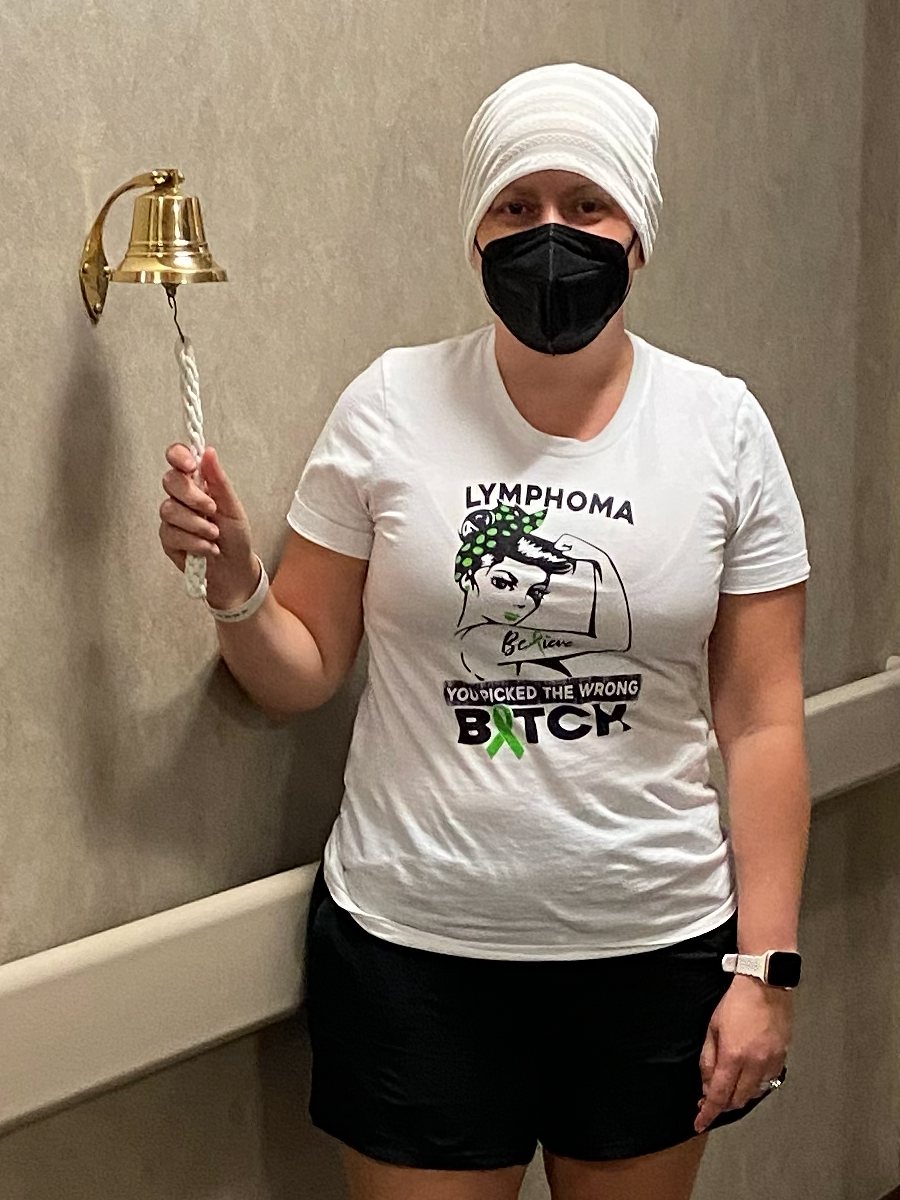
My treatment plan was six cycles of R-CHOP. It went on for about four months, one cycle every three weeks. I did have one setback: I got too sick toward the end and had to take a bit of a break.
I honestly don’t remember a lot from that time, other than that it gave me something to look forward to. It gave me purpose. It gave me something to hold onto, to fight for. It gave me comfort and stability. It gave me security. It also made me sick and changed me forever in ways I might not ever figure out.
The type of lymphoma I actually had
The type of follicular lymphoma I have isn’t the average kind people get. I got one of the rarest, most severe forms possible: grade 3B follicular lymphoma with a triple-hit. Most people get grades 1 to 2, lower grades and lower stages. I got grade 3B, which is treated more like a high-grade B-cell lymphoma, and I was at stage 3, meaning it was already spreading everywhere. Then I also had the triple-hit, which meant all of my genes were actively mutating. Having both of those together is basically unheard of.
They told me that the higher the grade, the worse the disease is, but it also means there are more actively dividing cells, so chemotherapy has a better chance of eliminating them. I was starting to understand and accept that, because I’d met all of the milestones I wasn’t supposed to meet. I’d beaten all the statistics. I had a successful treatment, and I thought maybe the disease had been eradicated, because it was fast and aggressive and the treatment worked.
Life after chemotherapy
The last four years have been a roller coaster. I feel like I’m doing my best to hang on, metaphorically, because I’ve had a lot of complications from chemo that have been very difficult to figure out and address. My body, my mind, and my brain are altered. I feel that forever. I’m trying to come to terms with that and find a way to live with it, but also get people to believe me, to listen to me, to take me seriously, and to understand that just because what I’m experiencing is bizarre and probably not what they’re used to doesn’t mean it isn’t real for me.
I never thought that after getting a cancer diagnosis, I would have to fight so hard in the medical field to prove to people that I still have cancer and that I’m still sick, because I don’t look like a typical cancer patient. I’ve been bounced around every three months, not wanting to rock the boat, wanting to be a palatable patient, and wanting to be easygoing. But I got to a point where I couldn’t do that anymore, where I was being forced to repeat testing because people didn’t believe my results were accurate, and then the results would come back worse.
I have a super rare cancer. It’s not crazy to me that my symptoms after the fact would also be rare.
Routine monitoring for my cancer
I have a routine follow-up with different providers. I’ve been seeing my primary care doctor every three months for a checkup. I see neurology routinely. I was seeing sleep neurology and psychiatry, and I started going to therapy. I was seeing my oncologist every three months and having scans every six months. I had gotten pushed out to six-month oncology appointments, right before all of this happened. I have a robust team.
Finding a new lump and feeling familiar fear
In February 2026, I started getting night sweats. I paid very close attention to them, because I feel like I missed them the first time. I’ve had a lot of bodily changes since treatment, so I’ve had to learn when things are normal and when they’re not. The night sweats happened every day, so I knew this wasn’t normal.
Then I started getting rashes all over my body that weren’t going away. At work one day, I was showing somebody one of the rashes, and when I looked at my arm, part of it was swollen. I had other people look at it to make sure I wasn’t crazy, and they confirmed there was a swollen area on the inner part of my elbow. That was March 6th. I only know the date because I’ve repeated it so many times.
Fortunately, I already had an appointment with my oncologist scheduled that coming Monday, so I felt confident. I decided I’d take some pictures, send them through the patient portal, see him Monday, and it would all be fine. I honestly thought I’d wake up Saturday and it would be gone, but it was still there.
I started frantically looking up what’s in that area of the arm, and found out there are lymph nodes there that can get swollen, though it’s rare. That’s since been ruled out, but my first thought was that I had a swollen lymph node in my elbow, and I was convinced my cancer was back.
There have been so many times over the years when I’ve thought my cancer was back, because I think that’s natural. But this was the first time I had another physical lump, and it took me right back to the first time. I only had the lump in my neck for a week before it was removed, so I was frantically trying to remember what it felt like, what it looked like, and whether this was the same thing. Seeing something physical was the hardest part, because every other scare eventually passed. This came and never left.
Chasing answers for mysterious symptoms
I saw my original oncologist as scheduled and he took me seriously. He was able to see it and feel it, and validated that there was something there. He sent me for an ultrasound, since a CT scan wouldn’t capture it. I went for the ultrasound within a couple of days. The ultrasound tech said, “Yeah, I see it. I feel it,” which felt very validating. Then the results came back completely normal.
The swollen area kept getting bigger, and I kept becoming more symptomatic. I lost feeling in my pinky finger. I was having a lot of pain. My wrist was getting so swollen that my watch didn’t fit right anymore. There was one day at work where I took off a cardigan, and one arm had fabric pattern pressed into the skin from the sleeve, and the other one didn’t. That’s when I knew I wasn’t imagining it, even though I felt like I was losing my mind.
I went back to urgent care a couple of weeks later, since they’d helped me before. The doctor who originally found my cancer had since become my primary care doctor and I hoped she’d be working that day; she wasn’t, but the team still took me very seriously. I couldn’t lift my arm without it shaking. They did an X-ray, which came back fine, and sent me for another ultrasound to check for blood clots, which also came back fine. They told me I should see an orthopedic doctor.
I saw my primary care doctor as well. It wasn’t the best visit we’ve had. I felt like I had to do a lot of convincing that I wasn’t crazy, but I left feeling crazy. To be fair, I understand it’s not typical, but to me, it was abnormal, and it was causing me a lot of distress. I needed help. They scheduled me with an orthopedic doctor, who ended up not specializing in the right part of the arm, and canceled my appointment at the last second. That was devastating, because I’d been waiting to get in with the doctor everyone kept telling me I needed to see.
Sometime then, I also had a CT scan, because when my ultrasound came back normal, my oncologist’s office said they could send me for one, though it wouldn’t capture my arm specifically. They called me and told me to call them back, and they never call me. Everything is normally done through the patient portal. I started breaking out in hives all over my face because I was convinced they found something.
I pulled up the results on my computer while sitting in my car and talking to the nurse. She said everything looked fine. I said, “But not everything has results yet; only one of the scans has come back, so how can you tell me it’s fine?” I looked at the images and it hadn’t even scanned my arm. I was thankful for a clean scan, but I still needed to know what was wrong with my arm. I told her, “Call me back when you’re confident it’s fine. I was breaking out in full-face hives because I thought you were calling to tell me bad news.” I was mortified.
After all of that, I finally got in to see an orthopedic specialist who did specialize in the right body part. He said, “Yes, I see what you’re talking about.” But that was after a failed MRI first. They’d put in an order for my forearm. I went in for the appointment, after waiting weeks for it, and the technician looked at me and said, “This order isn’t for the right body part. I can see what you’re talking about, but if I scan your forearm, it won’t capture that area.”
I broke down because everything felt like it was falling apart and failing. She contacted my primary care doctor, who put in a corrected order for my elbow. My oncologist, separately, had an order in for my humerus. I ended up having an MRI of my elbow, which came back completely normal, even though that’s exactly where the lump is. I felt like I was crazy.
I finally got in for the MRI of my humerus, and there was something indistinct on it, though nobody could say exactly what it was. The orthopedic doctor confirmed there was swelling, said he wasn’t sure what it was and that it might be pressing on something, but that he was more concerned about a nerve issue. I ended up having surgery on my elbow to decompress the nerve. I wanted to know what was wrong with me. He told me I should get nerve testing done through neurology and handed me a list of neurologists, one of whom was already my doctor. I could have just called him myself.
That’s when I decided I needed more help, so I went to Mayo Clinic.
Getting a second opinion at Mayo Clinic
Mayo Clinic was a four-hour drive from where I live. I’d never been there before and I was completely unfamiliar with the process. Somebody messaged me on Instagram. I think it was a friend or a relative of someone who’d had breast cancer, who’d gone through a similar runaround locally, and had success going to Mayo Clinic. She recommended I look into it, so I did. Though, honestly, I was hoping things would work out and I wouldn’t have to go.
Getting to the actual phone consultation was a whole process on its own. I somehow ended up scheduled for an appointment in London, which doesn’t even offer oncology services, so they referred me back and listed me as an international patient, even though I only live four hours away. I restarted the whole process. When they called back, they offered me an appointment the next day, and I said I needed more time to prepare, so I scheduled it about two weeks out instead.
I met with a lymphoma specialist, along with a fellow and the physician. They were great. They did an incredibly thorough and comprehensive background and exam, and I could tell they understood my history. Reading through the notes afterward, they listened to what I said and put a lot of my own words into their notes. I don’t know exactly what they were thinking at the time. I tell myself that the diagnosis I’ve been given is rare, aggressive, and a once-in-a-lifetime kind of thing, but I don’t get a lot of validation of that from people, aside from occasionally from Google. They did a lot of validating that I was still in remission, which is good, but I had no indication at that point that things were about to change.
Based on my symptoms and what I was telling them, they validated that there was clearly something there, and they understood why I wanted more help. They did a head-to-toe PET scan to rule out any lymphoma involvement, and it came back clean — no nerves lighting up, nothing. They said they thought this was a neurologic issue and referred me back to neurology. I asked if I could see my neurologist back home, since the travel was expensive, and they agreed. I also got to do a same-day PET scan, which was efficient, and I had a follow-up visit with them virtually at the end of that week.
Even with clean scans and confirmed remission, I never felt fully at peace, because the arm was still a mystery. I know cancer. It’s familiar to me, and I’ve prepared for a future with it. I know there’s a plan for when it returns. But whatever was happening with my arm was still undetermined. There was no answer and no idea; just progressive symptoms that kept getting more debilitating, that might or might not ever have an answer, a cause, or a treatment. That scared me more than a disease I already know I have and know can be treated again if it needs to be.
My initial cancer diagnosis, reexamined
I went to Mayo Clinic on a Monday and had my follow-up appointment that Friday, virtually, with the lymphoma specialist. I was expecting to go over results I’d already seen in the patient portal, the same things we’d already discussed in clinic. Instead, she started the call by saying that they had done a complete re-review of my original biopsy from four years earlier and determined that my original diagnosis was incorrect. What I have is composite lymphoma: two completely different lymphomas, simultaneously originating from the same lymph node.
I was originally told I had grade 3B follicular lymphoma with a triple-hit, which is one lymphoma with three genetic mutations, extremely aggressive and rare. What I actually have is two separate lymphomas from the same lymph node: 60% of it was follicular lymphoma at grades 1 to 2, not grade 3B at all and the other 40% was high-grade B-cell lymphoma, completely different from the follicular lymphoma.
I did have all three of the genetic mutations they’d originally found: MYC, BCL2, and BCL6. But the MYC and BCL2 mutations were about 80% confirmed to belong to the high-grade B-cell lymphoma, and the BCL6 mutation was only 40% confirmed. They couldn’t say for certain which of the two lymphomas it belonged to, since I have two separate ones. They could confidently say I have double-hit lymphoma, but not confidently confirm triple-hit, even though I technically have all three rearrangements.
She told me that if I were being diagnosed for the first time today, they would have treated me with much more intensive chemotherapy than what I originally received.
Living with uncertainty
I asked what this changes going forward. I don’t think I’ll be able to consistently go to Mayo Clinic, because I can’t afford it, even though I would love to. Seeing a lymphoma specialist regularly would be amazing, but it’s simply not something I can afford.
She told me it’s pretty remarkable that I’ve been in full remission for four years, given the diagnosis I have and that I never received treatments I technically should have gotten, like CNS prophylaxis and methotrexate. A sustained remission is pretty unheard of. I’ve beaten all of these statistical odds, and I’m still trying to understand why it was so hard, in the beginning, to get a diagnosis, for someone who ended up beating odds she shouldn’t have been able to beat.
Finding my voice
I felt so scared for so long. Cancer made me think I was going to die. Even after treatment, I still thought I was going to die. For whatever reason, I haven’t. I’m still coming to terms with the fact that this will be a part of me forever, and that the version of myself I thought I knew has changed, though I suppose everything is always changing anyway, no matter what I think I know.
So many people message me because they saw a video or because of something I said, and they went in for a test, asked a question, or pushed for something they wouldn’t have pushed for before. That’s all I can ask for, because there was a time when I never would have done that either.
If a stranger hadn’t messaged me on Instagram about Mayo Clinic, I never would have gone. I never would have known any of this. I might have been fine anyway, but I would have been living with a different understanding of the odds of my disease coming back, because this changes that going forward. I’m forever grateful to that person.
Someone I connected with on TikTok told me she did a big endurance event, an 11-time climb of a mountain trail, in my honor, with a ribbon bearing my name on her bib. Each climb was 1.7 miles with about 2,026 feet of elevation gain. She’d hoped to do it 15 times, but her fatigue told her to stop. She was there with a friend who had glioblastoma, for what was likely going to be that friend’s last endurance event. She told me she appreciated me and that I’d helped her more than I knew. I don’t know how to express what that kind of gratitude means to me, from someone who isn’t a stranger to me anymore.
This interview has been edited for clarity and length. The views and opinions expressed in this interview do not necessarily reflect those of The Patient Story. This content does not replace professional medical advice.
Inspired by Courtney’s story?
Share your story, too!
Hear from people living with lymphoma
Real experiences with diagnosis, treatment choices, side effects, and life beyond lymphoma — in their own words.

Leave a Reply