
Kiana Had a Heart Transplant in 2023; Six Months Later She Was Diagnosed With Stage 4 DLBCL
Kiana had a transplant in October 2023 to replace a heart that had been failing since 2019. Her diffuse large B-cell lymphoma (DLBCL) story started when she was still recovering from the operation in the spring of 2024. She found a small lump under her arm and didn’t feel sick. Doctors told her they’d follow up with more imaging in a few months, and life moved on: She went back to university, back to work, back to what felt like “normal.”
Interviewed by: Taylor Scheib
Edited by: Chris Sanchez
By August, something was clearly wrong. Months of unexplained weight loss, exhaustion, and low blood counts came to a head on an ordinary day: Kiana noticed her stool had turned stark white, a sign of a blocked bile duct. Within hours, she was in the emergency room, turning yellow, hearing a term she’d never heard before: PTLD, or post-transplant lymphoproliferative disorder.
Imaging found masses throughout her body, including her liver, colon, and lymph nodes. The diagnosis that followed was more serious than anyone had first suspected. Kiana was staged with PTLD-derived stage 4 DLBCL, with the cancer having reached her brain. She’d spent months describing symptoms doctors couldn’t explain, such as low blood counts, constant fatigue, and abdominal pain, before anyone connected them to cancer. She later learned that the post-transplant imaging protocol was set up to catch something like this sooner rather than later, but it didn’t.
Kiana wasn’t eligible for the lighter approach some transplant patients get, lowering immunosuppression and letting their own immune systems respond. Instead, she went through six cycles of R-CHOP, a combination chemotherapy regimen, alongside six cycles of high-dose methotrexate and two additional treatments delivered directly into her spine to reach the cancer in her brain. One of the drugs in R-CHOP carries a real risk to heart function, a serious concern for someone who had just received a new heart, and her heart’s pumping ability did drop into a range associated with mild heart failure during treatment. A cardioprotective medication, found after her mother pushed for a specialist, protected her heart while the chemotherapy did its job, and her heart function fully recovered.
Kiana has had no evidence of disease for about a year and a half. She still goes in for blood work every three months to keep an eye out for anything that might come back. In the meantime, she has gone back to watching concerts, traveling, seeing her grandparents and her partner, and going to school and work. She says the biggest thing she took from it all is trusting your gut, along with having someone in her corner who can push for answers when something isn’t right.
To learn more, watch Kiana’s video and read the edited transcript of her interview.
- Trust your instincts about your own body. Kiana knew something was wrong months before her DLBCL was found, and she says the single biggest lesson from the whole experience is to keep pushing when your gut tells you something isn’t right.
- A second opinion, or a second set of eyes, can change the outcome. When Kiana’s heart function started dropping during chemotherapy, her mother read through her medical reports herself and found a cardio-oncologist who identified a medication to protect her heart.
- Recovery doesn’t always look linear, and that’s normal. Kiana describes her heart transplant recovery as steady and easy to measure, but says cancer treatment felt much harder to track, and that she felt worse before she felt better.
- Isolation can be part of treatment, even with a strong support system. Kiana says she was never physically alone (her parents took shifts staying with her), but she still describes the experience as socially lonely.
- Staying engaged with follow-up care can ease fear of recurrence. A year and a half into remission, Kiana still goes in for blood work every three months. She says that regular monitoring, rather than avoidance, is what keeps her fear of the cancer returning manageable.
Kiana’s Diagnosis Facts
- Name: Kiana D.
- Age at Diagnosis:
- 22
- Diagnosis:
- Diffuse Large B-Cell Lymphoma (DLBCL)
- Staging:
- Stage 4
- Symptoms:
- Daily vomiting
- Unexplained weight loss
- Headaches
- Night sweats
- Dizziness
- Difficulty breathing
- Difficulty walking
- Sleeping all the time
- Abdominal pain
- Bed-wetting (seizures)
- White chalky stool
- Low red blood cell count
- More frequent menstrual cycles/spotting than usual
- Treatments:
- Chemotherapy: R-CHOP, methotrexate
- Surgery: gastric bleed surgery
This is not medical advice. Please consult with your healthcare provider to make informed treatment decisions.
- Kiana’s Diagnosis Facts
- Meet Kiana
- A heart that started failing
- When I first noticed a lump
- Hearing the word “cancer”
- Starting treatment for DLBCL
- Wanting to give up
- Reaching no evidence of disease
- What I’ve learned
- My outlook from my experiences
- Hear from people living with diffuse large B-cell lymphoma (DLBCL)
Meet Kiana
My name is Kiana. I was diagnosed with PTLD-derived stage 4 diffuse large B-cell non-Hodgkin’s lymphoma (DLBCL) in 2024.
A heart that started failing
We’re not totally sure why my heart started failing. It definitely wasn’t genetic. My family had genetic testing done, and it wasn’t that. In 2019, my heart started failing a little. I’d always been monitored by cardiologists just in case, and I don’t know why, but that year it started to falter. It had a pretty drastic decline in 2022, when I was put on an LVAD (a mechanical pump that helps support a failing heart). I was on the LVAD for 50 weeks, and then a heart became available. That’s when I had my heart transplant, in October 2023.
(EDITOR’S NOTE: An LVAD, short for left ventricular assist device, is a mechanical pump that doctors implant in people with heart failure. The LVAD helps the lower left chamber of the heart pump blood to the aorta, the largest artery in the human body, and from there, to the rest of the body.)
It was frustrating. It felt like one thing right after the other, because I graduated high school in 2020, so at first my biggest concern was not getting to prom because of COVID. Then it was disappointing to hear I needed a transplant, but when I found similar stories to my own, it gave me guidance for what I was going through. Reddit gave me a lot of stories, and they were from a lot of people my own age too, which surprised me. Social media helped me connect with other people in my position, not on the cancer side, but on the transplant side. So it was probably disappointment and a little fear. Nobody likes going through surgery, but it was manageable. It wasn’t the end of the world.
The wait for a heart, and the call
A lot of it was my mindset, and the information my doctors shared with me. They were upfront. While I was waiting for a heart, my cardiologist and the transplant team would tell me when there had been heart offers that weren’t up to par or weren’t a good match. So when they told me they had turned down some hearts, it made me feel confident they were holding out for the right one for me. When they finally called and asked if I wanted to accept the one they’d found, I felt sure I was ready. That transparency helped me make the choice.
I also had time, almost a year between being told I needed a transplant and actually getting one, to wrap my mind around it. It’s frightening, but you do frightening things all the time, and I felt confident in the team doing the surgery. I knew the surgeon beforehand, and that put my mind at ease. I was as ready as I could be. It wasn’t the easiest surgery. I ended up being a rough case to wake up. I was in a coma for 10 days, but they figured it out.
They were fantastic. Care teams can be great, and everybody can give you all the positives, but hearing them be critical of themselves, knowing they’re not infallible, is also reassuring. It means they’ll learn from their mistakes, because they know they make them. Hopefully not on me, but it gives you better confidence too.
Recovery after transplant
I wanted to get back on my feet right away, which just isn’t practical. Your muscles have been wasting away for 10 days, and it takes a huge toll on you. Your sternum is cracked open; you can’t use your arms, and you have to relearn to walk, get up, and eat. You’re on a lot of medications, steroids, immunosuppressants, and pain medication that make you feel like you’re not yourself. It’s all very blurry, but the recovery process went pretty well. I was out of the hospital in three weeks, which is fast. There were steps to my discharge: I had to be able to go up the stairs in my home, walk a certain amount, and make sure I wasn’t in rejection, which meant biopsies. They’d go in through my jugular and take samples from my heart. If there was no rejection, I was good to go home.
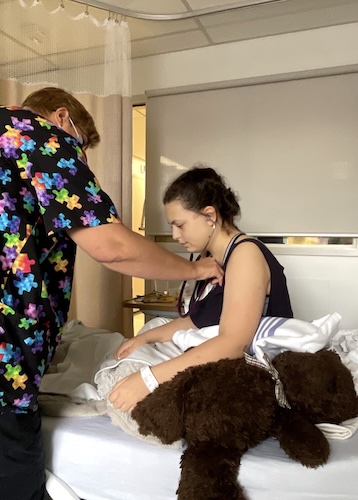
There was a complication. I got an infection in my groin from the extracorporeal membrane oxygenation (ECMO) machine, which temporarily supported my heart and lungs. It set back my walking and meant I had to go back to the hospital for debridement. Then I went home again, and I was home for Halloween, which was fun and felt like a stable moment before I went back in.
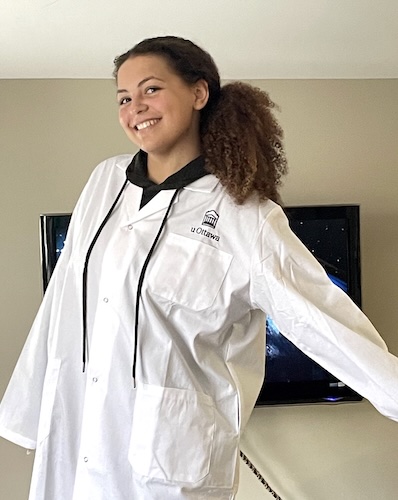
After that, recovery was slow. I’m a university student studying life sciences, and in January I went back to school, which was quick, but I had this overwhelming feeling of falling behind. Recovery at that point was less physical and more mental, realizing I’d gotten through it, and staying mindful of germs. Other than that, it was a good recovery.
When I first noticed a lump
It was less than six months later, actually. I found my first lump in March. I found it under my left armpit. I didn’t feel ill or unwell at that point; it was just a lump. I thought it would go away. They did an ultrasound and said they’d follow up. I think they wanted to follow up in three months, but I didn’t get seen for another six months.
I later found out that imaging for lumps after a transplant is supposed to happen a lot sooner than that, so it went longer than it should have.
A body that wasn’t adding up
That was my first real symptom. I was on prednisone, a steroid, at a high dose, and I was gaining weight quickly. I was 160 pounds around the time of my transplant, and maybe three months later, I was 190. I talked to my healthcare team about semaglutide to help with weight loss and started taking a low dose to offset the prednisone weight gain.
That was before my other symptoms started. When the nausea came, I didn’t think much of it; I assumed it was the semaglutide, but I was throwing up every day — morning, afternoon, whenever. It was intense. Then I started losing weight again, and at first I thought it was a good thing. The extra weight was coming off, and the moon face from the prednisone was fading.
But then my red blood cell count started dropping. I was anemic and tired, and I kept hearing suggestions like trying a cast iron pan or exercising more. I was already active, eating well, and taking iron supplements. It didn’t make sense. They wouldn’t give me a transfusion unless I hit a certain threshold, which felt awful.
I can’t remember the exact numbers, but I know normal is around 115 to 150 g/L, and I was sitting in the 80s. They wouldn’t transfuse me unless I dropped to 70 g/L or below. I was feeling really unwell. I was still working at a retail shop, but I was on my own, and I started passing out at work. I’d go sit in my car on my breaks and fall asleep, then sleep through my alarm, which got me in trouble, but I was bone-tired all the time. My appetite was gone, my blood counts were low, and nobody had a clear explanation. They just told me to keep eating red meat.
Then I started getting bad headaches. I was sleepy all the time, nauseated, and having abdominal cramps. I remember walking around with my hand resting over one side of my stomach without even realizing I was doing it.
The day my body turned yellow
This had been going on for a while, but then in August, on my dog’s birthday, I had a scheduled blood draw. My hospital tracks me through multiple specialists, so if one doctor wants an extra test added on, they can. I asked the phlebotomist to add a liver panel because my upper abdomen was tender. I had a feeling it was my liver, even though I don’t drink or smoke, so there was no obvious reason it should be affected. I did the blood work and went home.
At home, I noticed my stool had turned stark white. About 10 minutes later, I got a call from the hospital telling me to go to the ER right away. My bile duct had been blocked. I went to the ER, and within a matter of hours, I turned yellow. I started talking with the ER doctor, and he asked if I’d ever heard of PTLD. I hadn’t. He explained that, given my transplant history and how recent it was, this could be post-transplant lymphoproliferative disorder.
(EDITOR’S NOTE: The National Kidney Foundation describes PTLD as a post-transplant condition in which white blood cells multiply at abnormal rates. PTLD can potentially lead to lymphoma.)
They put in a stent to open the bile duct back up. They did imaging around 3 a.m. the next day and found masses in multiple places: my colon, my intestines, my liver, under my arms, and my lymph nodes. But that wasn’t the staging yet. The staging didn’t come until about a month later. They kept me in the hospital for observation. They ran a cancer antigen test to help figure out what kind of cancer it was, but they were already fairly sure. It came back as non-Hodgkin’s lymphoma.
Hearing the word “cancer”
I thought I had a proliferative disorder, so hearing the word “cancer” threw me. I thought surely they were mistaken. I got the notification on my hospital’s patient portal app before anyone told me in person. I remember thinking there was no way I had cancer, that it had to be a misdiagnosis, because there had been nothing wrong with me six months earlier.
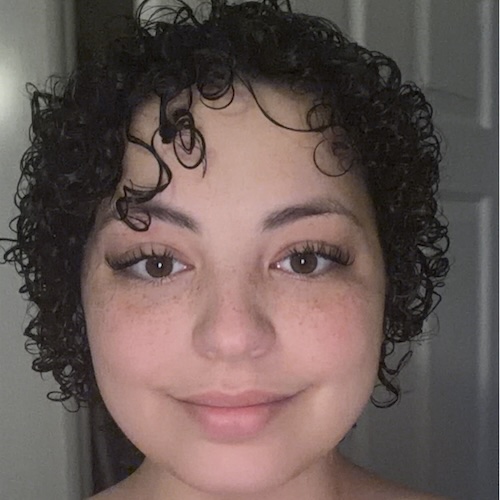
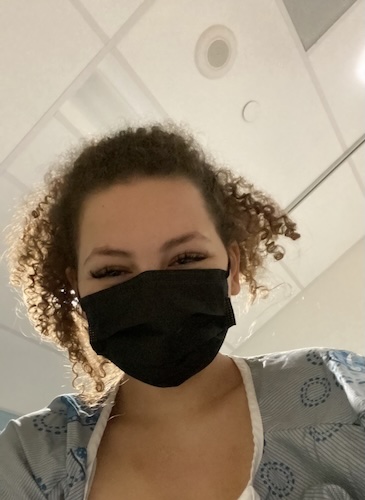
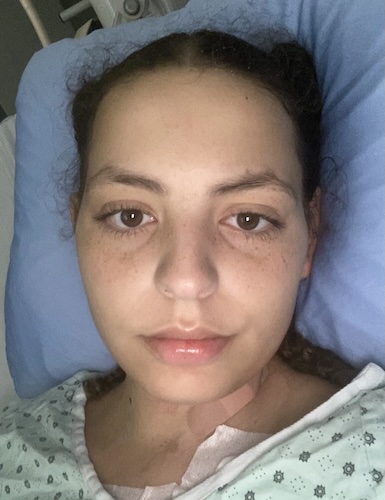
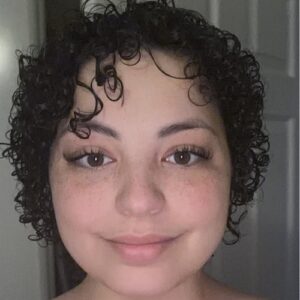
I took a photo of myself the morning I found out, because it felt so unreal. Three days later, they came in and confirmed it. That’s when my parents found out too. I hadn’t told them yet, because I didn’t believe it myself. It felt like disbelief. It felt like it couldn’t be happening, like I wasn’t supposed to get cancer. Nothing happens that fast.
Starting treatment for DLBCL
Things started moving quickly. I was still in the ICU because of the blocked bile duct. They gave me a pre-dose of chemotherapy, which included high-dose steroids, prednisone, and dexamethasone. The next day, I had my first round of chemo.
Everyone was so nice to me, almost oddly sweet, which made me think it was probably worse than I realized. The chemo itself was fine, but that night, I spiked a fever for no clear reason and was started on antibiotics. My mom was at my bedside the whole time, holding my hand. We’re very close. While I was sleeping, I had a febrile seizure and started shaking. She called the nurse over, and that’s when they ran more tests. I’d also had another symptom I was too embarrassed to mention before then: occasional bedwetting.
They discovered the cancer had reached my brain as well. Once all the testing and staging were done, I was diagnosed with stage 4 PTLD-derived diffuse large B-cell lymphoma (DLBCL) with CNS (central nervous system) involvement.
That’s when they told me it wasn’t going to be as simple as they’d first hoped. Some people in my situation can lower their immune suppression and let their own immune system take over and clear the cancer, but I wasn’t eligible for that. So I went straight to R-CHOP as my main treatment, plus high-dose methotrexate for the cancer in my brain, and two intrathecal treatments (chemotherapy delivered directly into the spinal fluid). I had six cycles of R-CHOP and six cycles of high-dose methotrexate.
(EDITOR’S NOTE: Intrathecal chemotherapy is a method of bypassing the blood-brain barrier by injecting chemo drugs into the cerebrospinal fluid. Doctors can administer intrathecal chemo by lumbar puncture, which is an injection into the spine in the lower back, or into an Ommaya reservoir, which is a small port installed under the scalp and attached to a catheter in a brain ventricle.)
The R-CHOP itself wasn’t too bad. The worst part was the shot I got afterward to help my white blood cells recover, which caused deep bone pain. They told me to take antihistamines for it, which didn’t help much, so I was on heavy opioids, tramadol and hydromorphone. The first day after chemo was when I was at my most energetic, probably from the steroids. But on days two and three, I couldn’t get out of bed.
The hardest days of chemotherapy
My first high-dose methotrexate infusion was the roughest because all of those medications take a toll on your kidneys, and mine cleared the drug more slowly than most people’s. With high-dose methotrexate, you have to stay in the hospital until your body clears it. Most people with healthy kidneys can clear it in about three days. The concentration in your blood needs to drop to a certain point, and if it hasn’t, you don’t get to leave. It stayed in my system so long that it caused mucositis, where the lining of your mouth breaks down. The sides of my tongue and the inside of my cheeks sloughed off, and I had to stay longer for pain medication because my mouth was raw. I was losing weight because I couldn’t eat or drink, and without drinking, I wasn’t clearing the medication either, which made it worse.
The chemo cycles were supposed to be 10 days apart, as long as my blood counts allowed it. Once they realized the drug was staying in my system longer than expected, and that I’d been slightly overdosed, they adjusted my dose to match how my body was processing it. After that, it went better. I still had mucositis for most of treatment, but it became manageable, and the pain medication helped.
It was very hard socially too. I still think my friends are good friends, but nobody knows how to approach you when you tell them you have cancer. Some of them figured the kindest thing was to give me space. But it was lonely.
A long night in the hospital
Right after my first round of chemo, I still wasn’t feeling quite right. I was getting blood work done every morning. I remember I had a day pass to visit my animals at home, and that morning, I felt a little anxious, which felt strange, but I got ready anyway. A nurse practitioner had just checked on me. I told her I was just a little anxious and my stomach was upset.
My mom was in the room too, since she was going to drive me home. I don’t get to drive anymore because they took away my license after the seizure. I put my shoes on and thought maybe I’d just lie down for a minute. I passed out. My mom started calling for the nurse practitioner, who came back in. Then I started vomiting, and my mom held the bucket for me. It wasn’t ordinary chemo sickness. It turned out the cancer had reached my stomach, and my stomach lining was gone. I had peptic ulcers and a gastric bleed.
There was a lot of blood. A physician’s assistant, whom I love but who can’t handle the sight of vomit, had to step out and get someone else. The hospital has a rapid response team, and one staff member in particular who’s especially good at starting IVs quickly. He got three IVs into me, and I had a liter of fluid given to me at my bedside faster than I’d ever experienced. Then they took me down to cauterize the bleeding. For a gastric bleed, you’re only lightly sedated, called twilight sedation, because you still have to breathe on your own. So I was awake, with a bite guard in, listening to the medical team casually talking about current events while they worked.
I came out feeling great, still with heavy medication on board, including a fentanyl injection. Afterward, your body reacts to having blood in your digestive system, so the after-effects weren’t pleasant, but they had to monitor me for that too. That’s how I ended up with a gastric bleed from the cancer in my stomach, on top of everything else.
Wanting to give up
The cancer was worse for me mentally than the heart transplant, and it was a long haul. With the heart transplant, I could see myself making progress every day: I went from not being able to walk, to walking 10 steps, to 30 steps, to a flight of stairs. It felt linear, and I got updates daily. With cancer, I didn’t always know if I was doing well. You feel worse before you feel better, and I was in a lot of isolation. It was harder on me than the transplant, which feels strange to say, but it’s true.
Being back in the hospital after everything felt like a kind of betrayal. The transplant was supposed to be the answer to my problems, not the cause of new ones. At one point, I was on the floor of my bedroom crying because it was too much, especially with the methotrexate. My mom told me that if I let her, she would take me all the way there and handle everything, and that I wouldn’t have to do a thing myself. I let her. I don’t think I would have gone through with it without her.
I didn’t realize how close I’d come to giving up until later. In a follow-up appointment, a nurse looked at my treatment record and asked how many of the six R-CHOP cycles I’d actually completed. I told her I did all six. She said most people only do three. I hadn’t known that. But I’ve been in remission for a solid year and a half now, so if it worked, it worked.
(EDITOR’S NOTE: While most people who are treated with R-CHOP receive six cycles of this chemo drug, the number of R-CHOP cycles a patient needs will ultimately depend on their diagnosis.)
Reaching no evidence of disease
Around the halfway point of treatment, I got a progress report: There was no evidence of disease in my brain, and my red blood cell counts were starting to recover naturally, even before I’d finished treatment. Everything was pointing in a positive direction before I even got the official news that I was in remission, or that there was no evidence of disease.
I was never alone through any of it. My parents are separated, but they took shifts staying with me. It was lonely in terms of friendship, but not in terms of family. I got to ring the bell twice: once for inpatient treatment and once for outpatient treatment. My last outpatient infusion for R-CHOP actually landed on my birthday, and the high-dose methotrexate finished a little after that. It felt like the best day, even though I didn’t know for sure it was over yet. I’d set out to do something, and I’d done it.
They didn’t scan me again until about four weeks later, to let any leftover treatment activity clear so it wouldn’t show up on the scan. When I finally went in for that scan, I read the report before my oncologist called, and I’d read it a million times. I was waiting to hear him actually say the words. The report showed it resolved in every location: the liver, the gastric area, the upper left axilla, the tonsils. I thought that had to be everything.
A couple of hours later, my oncologist called and confirmed there was no evidence of disease. We joked around a little, the way we usually do, and I told my parents. Everyone cried. It felt like the biggest breath of fresh air, like I’d been holding my breath through the whole scan and the wait for results, needing to hear it from someone professional before I could believe it was real.
Getting back to living
After that, I started moving on. My hair and eyelashes started coming back, and it was fun watching that happen. I was able to travel again and saw my grandparents, who live about a four-hour flight away. My partner and I are in a long-distance relationship, and he’d been advised not to visit right away because of travel germs during treatment, which was hard, being separated from him on top of everything else. Once I was in remission, we took a couple of trips together, one to a town about four hours away, another about two hours in the opposite direction.
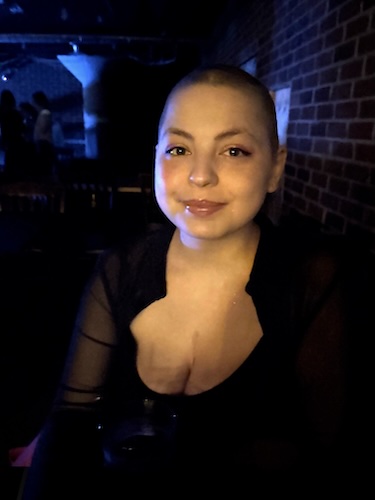
It took some time to figure out what came next. Even once I was told I was cancer-free, in the beginning I felt strange: I was bald, I wasn’t sick anymore, and I didn’t know what to make of how I looked. I felt pretty self-conscious for a while, but it came back quickly. I went shopping, got made up, and had some fun with it.
I started seeing friends again. They came back into my life pretty quickly too. I don’t fault them for stepping back earlier. They didn’t know how to handle it, and I was the first person with cancer that a lot of them had ever known. I’d also closed myself off when I was feeling low, so I started making more of an effort to go back out.
My last dose of treatment landed around my birthday, in January. By March, I was going out again, and in April, I went on a few trips. I took that summer off to see my grandparents, then went back to school. I got back to things I love, like concerts. I’ve been to a handful since then. I went back to school, back to work, and a friend introduced me to some film work, which I got to try for a while. Things went back to normal pretty quickly.
I don’t know if it’s like this for other cancers or if people even have the opportunity for it, but because of my background, I still go in for regular blood work; that keeps my mind at ease. I know blood results would come back in a certain way if it was cropping up again. Some people go back for annual checkups, but I go back every three months, even a year and a half out, and my blood work is even more regular than that.
I don’t carry a lot of fear that it’s coming back. Part of the reason it happened at the beginning was that my immune suppression was so high, and I had a virus that wasn’t controlled. When I see that the virus isn’t active, that my red blood cell count is high, that my LDH is low, all of it tells me I can live comfortably. The more proactive I am about my blood work and the less I put it off, the happier and more confident I feel.
What I’ve learned
Trust your gut. If something isn’t right, it isn’t right. I knew something was wrong before anyone would listen. One of the nurses on my transplant team told me at one point to just drink Gatorade. You have to push for real answers. You have to have someone with you, a second pair of ears, because between forgetfulness and the emotions, you miss things. Having a support person is critical. If you can find support somewhere, in faith, in people, even in your pets, hold onto that.
Medical professionals are trying to help you, but you can also push back if something isn’t working. As a transplant recipient, one of the drugs in R-CHOP, often nicknamed the “red devil” (doxorubicin), has cardiotoxic or potentially heart-damaging properties. I was very scared of graft loss and graft dysfunction during chemo, because I could see my ejection fraction (a measure of how well the heart pumps) dropping with each round. It went from the 60s before chemo, which is considered normal, down to 48%, which is considered mild heart failure for a woman. This heart gave me a second chance, and now the same cancer it caused is going to take it.
(EDITOR’S NOTE: An ejection fraction (EF) shows how much blood leaves the left ventricle of the heart with every heartbeat. A normal EF is between 55% and 75%; an EF that’s lower than normal can indicate heart failure.)
But my mom read through my reports and found a cardio-oncologist who told us about a cardioprotective medication that could protect my heart while still letting the chemotherapy work everywhere else. My heart function came back. I made a full recovery, and I didn’t lose the graft. If something isn’t working, you have to push or look for other options, because sometimes people default to doing things the way they’ve always been done. Everyone’s different, so you have to tailor it to yourself. Have an advocate. Search for solutions together with your medical team.
My outlook from my experiences
My baseline is pretty upbeat. I have my moments where I need to draw uplift from other people during times I’ve been low and haven’t been able to joke about anything. But if I can be positive, I choose to be. Being miserable doesn’t help anyone else, and it doesn’t make you more likable. There’s a positive if you look for it, and if you don’t train yourself to think positively, it won’t be there when you need it.
Am I proud of myself? I think so. I’m impressed, honestly, because there were so many times I didn’t think it was possible. My dad likes to remind me that your brain lies to you constantly, even about small things, like thinking you can’t lift as much weight as you actually can at the gym. I’m impressed I could do this, because I didn’t think I could. I think other people are proud of me. I don’t know if proud is quite the right word for how I feel; it’s more that it’s something to be proud of, even if no single word captures it. It was rough. I wouldn’t do it again. But yes, I’m proud that I got through it, even though it was maybe 20% me and a lot of other people who helped carry it.
Being diagnosed with DLBCL
I want to clarify that the heart didn’t actively give me cancer. I’m so grateful to the young man who donated his organ and gave me a second chance at life. What happened is that some viruses can go undetected if they were contracted within a certain window before a donor passes away. In this case, the donor had contracted Epstein-Barr virus within about six months of his death, so it wasn’t detectable during the cross-match.
Without a healthy immune system, Epstein-Barr virus can cause certain white blood cells, called B cells, to stop dying the way they normally would, and that can turn into cancer; in my case, diffuse large B-cell lymphoma. Because I’m young, my immune system had to be suppressed even more aggressively than in a lot of older transplant recipients, which made me more vulnerable.
It was a combination of circumstances, not something directly caused by receiving an organ. It’s more common in pediatric cases. I was unlucky to have it happen, and lucky that it was caught. The virus, left unchecked, turned into cancer, and that’s how I ended up here.
Epstein-Barr virus is common. It’s the virus behind mono. For most people, it’s low-risk; it just happened to turn out this way for me. I don’t want anybody on a transplant list thinking that if they get an organ, they’re going to get cancer. Likely, no.
This interview has been edited for clarity and length. The views and opinions expressed in this interview do not necessarily reflect those of The Patient Story. This content does not replace professional medical advice.
Inspired by Kiana’s story?
Share your story, too!
Hear from people living with diffuse large B-cell lymphoma (DLBCL)
Real experiences with diagnosis, treatment choices, side effects, and life beyond DLBCL — in their own words.

Leave a Reply