
Atiya Thought Her Cough Was a Cold; It Was Non-Hodgkin Lymphoma (Primary Mediastinal B-Cell Lymphoma or PMBCL) in Her Chest
Atiya was a busy, working mom of two young boys. A cough that wouldn’t quit, some extra fatigue, and a puffy face she chalked up to a hectic holiday season turned out to be the first signs of primary mediastinal B-cell lymphoma (PMBCL), a subtype of non-Hodgkin lymphoma. She’d already seen her family doctor, who diagnosed a chest infection and sent her home with antibiotics. It wasn’t until she blacked out while reaching for her front door that she went to the emergency room.
Interviewed by: Taylor Scheib
Edited by: Chris Sanchez
An ER doctor found a 14-centimeter mass in her chest compressing her vena cava, a complication called superior vena cava syndrome that explained everything from her puffy face to the fall. Within 10 days of that ER visit, Atiya had a biopsy, was transferred to a hospital with oncology care, and had her first round of chemotherapy. She started the R-CHOP regimen while further testing worked out exactly which kind of lymphoma she had.
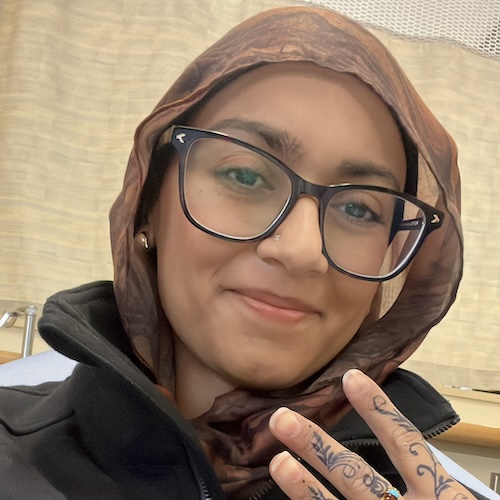
That distinction mattered. As her doctors’ read on her subtype came into sharper focus, primary mediastinal B-cell lymphoma rather than the more common diffuse large B-cell lymphoma, her medical team’s tumor board moved her chemotherapy schedule from every three weeks to every two. When a follow-up PET scan later came back ambiguous, Atiya asked her radiation oncologist about proton therapy, an option he hadn’t raised, after hearing about it through a family connection in the U.S. He applied on her behalf, and Atiya spent 17 days receiving proton radiation at the University of Pennsylvania that summer, fully covered by her home province’s health plan.
She rang the bell at the end of radiation, feeling proud but also emotional and fearful. Every ache made her wonder if the cancer was back. Being home with her husband, her two boys, and a wide extended family has helped that fade. Today, Atiya is back at work, planning a vacation, and getting ready for her sister-in-law’s wedding, while holding onto what she says treatment taught her most: the value of asking questions, accepting help, and permitting herself to slow down.
Watch Atiya’s video and read through the edited transcript of her interview to learn more about her PMBCL experience.
- A diagnosis can become even more clear after treatment has already started. When a repeat biopsy suggested Atiya might have primary mediastinal B-cell lymphoma rather than the more common diffuse large B-cell lymphoma, her care team took the question to a tumor board rather than guessing, and adjusted her chemotherapy schedule to be more aggressive. Her own research and a second opinion helped shape that decision too.
- One question opened a door her own doctor hadn’t thought about. Atiya’s local radiation oncologist hadn’t brought up proton therapy until she asked about it, based on something she’d heard from a family friend’s colleague in the U.S. That single question led to 17 days of treatment at the University of Pennsylvania, fully covered by her home province.
- Asking questions is not the same as being difficult. Atiya’s biggest piece of advice for anyone facing a new diagnosis is to keep asking questions, even when it feels uncomfortable. Doctors consult each other constantly, she says, and a patient asking for more information or a second opinion isn’t going to offend anyone; she believes it’s part of how she got the care that was right for her.
- Cancer taught Atiya that she’s allowed to say no. During Ramadan, a month she’d normally spend packed with family gatherings, she permitted herself to skip events without guilt and to ask for help with her kids instead of trying to do everything herself. She’s holding onto that lesson now that treatment is over.
- Support comes from multiple places. Atiya found real relief working with a cancer coach from her own community, someone outside her family who understood both her diagnosis and her culture. She wasn’t ready for a support group during treatment, not wanting to measure her case against anyone else’s, and treats that choice as a legitimate one rather than something to apologize for.
Atiya’s Diagnosis Facts
- Name: Atiya M.
- Age at Diagnosis:
- 34
- Diagnosis:
- Primary Mediastinal B-Cell Lymphoma (PMBCL)
- Staging:
- Stage 2B
- Symptoms:
- Coughing
- Facial puffiness
- Dizziness
- Treatments:
- Chemotherapy
- Radiation therapy: proton therapy


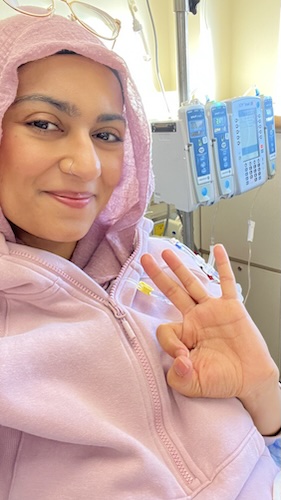

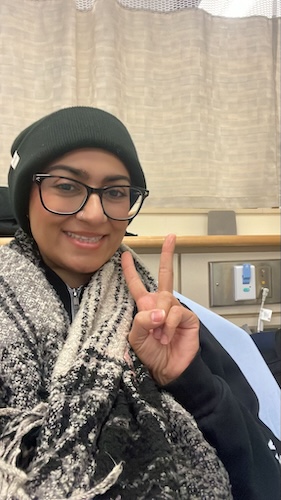
This is not medical advice. Please consult with your healthcare provider to make informed treatment decisions.
- Atiya’s Diagnosis Facts
- Diagnosed with primary mediastinal B-cell lymphoma (PMBCL)
- Life before my diagnosis: Busy, full, and never a dull moment
- The puffy face, lingering cough, and symptoms I explained away
- The blackout, the ER, and the moment that someone said “Good luck,” which changed everything
- From “This looks like lymphoma” to my first round of chemo for PMBCL, all in 10 days
- The PMBCL treatment plan: R-CHOP chemo, a diagnosis still coming into focus, and a tumor board decision
- Proton radiation: The treatment I had to ask about myself
- “This is the first day of your recovery”: The mindset that carried me through
- Ringing the bell and the fear of being on my own again
- What nine months with PMBCL taught me about myself
- My message: Advocate for yourself
- Hear from people living with primary mediastinal B-cell lymphoma (PMBCL)
Diagnosed with primary mediastinal B-cell lymphoma (PMBCL)
My name is Atiya. I was diagnosed with non-Hodgkin lymphoma in January 2026. The diagnosis was specifically primary mediastinal B-cell lymphoma, or PMBCL.
Life before my diagnosis: Busy, full, and never a dull moment
Before my diagnosis, life was busy, as most middle-aged women can say.
I work full-time as a speech-language pathologist. I work with little kids, helping with their communication needs, going into daycares, going into homes, and into the clinic. I also have two little boys of my own, a four-year-old and a six-year-old, so that definitely keeps me busy.
I also have a big extended family. My husband has four siblings, and I have a brother of my own, and we all live in the same town. Life was pretty exciting. There was always something to do and people to be around.
The puffy face, lingering cough, and symptoms I explained away
In December 2025, I started to develop a cough. It may even have been after a cold or the flu. The cough lingered and stayed there, which, to me, was nothing too abnormal. It’s December; it’s flu season. I work in a child care center. It’s pretty common to have a cough, and coughs do linger sometimes, so I didn’t think too much of it. I did notice I had to adjust the way I slept at night, maybe elevate my head a bit, because it would get worse when I would lie flat. I tried taking a puffer or something my dad had given me. It didn’t help.
Other than that, I did notice I was a little bit more tired. I would sometimes feel the need to take a nap in the middle of the day. But again, I’m a mom of two little kids. I’m running around, taking them to extracurriculars, waking up early, and going to bed late, so it didn’t surprise me that I would feel a little bit more tired.
The more unusual symptom I noticed was around Christmas time. I started to wake up in the morning with a very puffy face; around my chin, my jaw area would be quite puffy. And it would be just my face; the rest of my body had no swelling. My mom noticed it. Not everyone would notice it, but people who are close to me and used to seeing me often were like, “Oh, you look a little off.” It would subside during the day. I actually had a full general checkup booked with my family doctor for the first week of January, so I thought I’d just mention it to her when I go for my appointment.
I was still functioning as normal. We had Christmas, we had New Year’s family things, friend things. I went to a musical downtown during that time too. So I was still functioning as normal. And then my GP appointment came around January 9th, and I went to see my doctor. I told her about my symptoms, and she gave me antibiotics and said it seemed like a chest infection. So I took them and went on my way.
The next day, January 10th, I went to work in the morning. I came home and took a nap because I was again feeling that fatigue that had started to come on. I heard the doorbell ring because my son was being dropped off at home, so I got up and started walking towards the door, and I just fell flat on my face. I didn’t go unconscious, but I blacked out. You know, when you get up quickly sometimes, and you get kind of a head rush, and your eyes go black? That’s what happened. But I couldn’t catch myself, and I had just fallen. After that, I was like, “Maybe this is something more than an infection,” and that’s what led me to go to the emergency room.
Chalking it up to being a busy, working mom
I was still going to work. I was still doing all the things at home. It was impacting my life, but not in a way that I couldn’t do what I needed to do. The one time I noticed it a lot was towards the end of the summer. I had gone for one of those Korean head spas, and I was lying flat on my back, and they were trying to wash my hair, and I kept coughing and couldn’t stop for a while. And I was like, “Uh, this is kind of odd.” But again, it was flu season, and I didn’t think it was more than maybe just a normal cold or a normal chest infection, like my doctor said.
The blackout, the ER, and the moment that someone said “Good luck,” which changed everything
When I blacked out, just my one son was home, and the other one had just come home, so I was alone with the kids, and my husband was out. I called him. I said, “I think you need to come home. I need to go to the ER. Something doesn’t feel right.” We actually had plans as a family that evening to go to someone’s home, so I said, “Drop me off at the ER. You guys go ahead. It’s probably nothing. I’ll be fine.”
I remember even on the way to the ER in the car, I said, “I feel so silly going to the ER just for a cough. This doesn’t feel like an emergency.” But I got there. They dropped me off, and then I told the nurse what I had been feeling. Once the doctor came in, they said, “You’ve had a fall, and you’ve had a cough, so let’s do some imaging.” They ordered a chest X-ray and a head CT, just to make sure. I didn’t have any injury; I just had a bit of bruising on my face. They wanted to make sure no injury to my head had occurred.
They ordered some blood work. The blood work showed really low iron, which, again, is not abnormal for me. I’ve had low iron in the past. I’m not so great about taking my supplements, so that didn’t surprise me. But then the doctor said, “This is significantly low. You look like someone who doesn’t eat, basically.” I said, “That’s concerning,” so they started me on an iron infusion and some fluids.
And then they did the head CT; that was all clear. They did the chest X-ray. Right after, within a few minutes, they called me back. They said the doctor wants to do a chest CT. So I went and did that. Usually, when you do the imaging, the technologist is not supposed to say anything to you. But after he did the chest CT, he said, “So how long have you had that cough for?” And I said, “Oh, about a month.” And then he said, “Good luck.” And that kind of tipped me off that maybe this is something more.
I finished my imaging, went back to the waiting room. Within a few minutes, the doctor came, pulled me into an examination room, showed me the imaging, and said, “You’re not going home today. You have a huge mass sitting right in the middle of your chest, and this looks like some kind of malignancy, so we’re going to need to do some more testing.”
As I’m saying malignancy, I’m getting goosebumps, because that is something I had never expected to hear. Everything just went silent. As alarming as that was to hear, I think it was good that I was by myself, because I think if anyone in my family was around me to hear that at the same time, I would have been so worried about their reaction. I got to process it on my own, as much as I could, before starting to make those calls and letting the family know that there was something going on. And then they admitted me after that.
Not scared, just hungry: What it felt like before I knew
I don’t think I ever felt scared or anxious. I remember just feeling hungry at that time when I was waiting, and I said, “Oh, I can’t wait to get out of here. I’m going to go get a chicken sandwich or something.” I was even texting my family, saying, “Is anybody close by to bring me some food?” I really just thought it was routine checks. My chest is fine, my head is fine; maybe it’s the iron thing that’s causing this. That’s what they initially said, actually, before they got the imaging: low iron can cause these blackouts and the puffy face. (EDITOR’S NOTE: As Mayo Clinic explains, headaches, being dizzy or lightheaded, and feeling extremely tired are some of the symptoms of iron deficiency anemia.)
I thought it could even be a thyroid thing, because my family has a history of thyroid deficiencies. It never crossed my mind that it could be something like this, enough to make me scared or anxious about what they would find. Only when they ordered that CT right after the X-ray, and the comment that the technologist made, maybe that was when I started to feel a little bit nervous, but it never even occurred to me that it could be something like this.
Bringing my husband in and calling my mom
Once I was settled in a room, when they told me they were admitting me, I called him and told him, “They think this is a malignancy, but I don’t want you to come here. I want you to stay with the kids, because that’s the most important thing right now. Keep them with you. Keep them calm. Don’t say anything.”
I have a large family network around, so after I called my husband, I called my brother. His wife is actually a doctor who works at the same hospital I was at, so they came right away. They were the first family I spent time with after hearing my potential diagnosis.
After that, I was hemming and hawing about how I wanted to tell my parents, because being a mom myself, I didn’t know how my mom might react. I was debating: “Should I wait until tomorrow? But I think I need my mom.” So I did end up calling my parents and saying, “I’m here. You don’t need to come, but they’re going to be keeping me and doing some investigation.” And they said, “Are you kidding? We’re coming right now.” It was nighttime by this point. When I got to the hospital initially, to the ER, it was 5 p.m., and by this point it was maybe 10 p.m.
From “This looks like lymphoma” to my first round of chemo for PMBCL, all in 10 days
That night in the hospital, after they admitted me and transferred me to the medicine doctor, he came in and said, “This looks like lymphoma.” He already knew based on my age profile and what it looked like from the imaging. He said, “Oh, yeah, we’re seeing this a lot nowadays with younger patients. It’s six months of treatment, and you’ll be good.”
He made it sound like, “It’s not great that you have cancer, but this is one that we deal with all the time, and it’s a pretty simple and well-understood treatment.” So that put my mom and me a little bit more at ease, since she was with me when the doctor came in. But obviously, they didn’t know for sure that’s what it was yet.
The next day, I saw a respirologist. They told me that this mass in my chest was causing something called superior vena cava syndrome. “It’s putting a lot of pressure on your vena cava; that’s why your face is puffy, and it’s not draining. That’s why you’re coughing so much, because it’s pressing on the area where your lungs are. That’s why you had the blackout, because the blood flow to your brain is not optimal and is being restricted by this mass.” (EDITOR’S NOTE: Cleveland Clinic says that superior vena cava syndrome results from something blocking or pressing on a large vein in the chest. This disrupts blood flow and can cause swelling and bulging veins.)
The respirologist also said, “This looks like a lymphoma, but we have to rule out that it could be a thyroid condition or a lung cancer.” That got me a little bit alarmed, because I know that’s very different treatment, prognosis, and all that. Someone else came in, too; I can’t remember. There were a few doctors. They all were thinking along the same lines: that this is a lymphoma.
They did another full CT of my neck and abdomen to see if there were any other masses or spread. They did more blood work. They also did the needle biopsy. They took it out of the main mass in my chest, as well as another enlarged lymph node they had found in my clavicle area. They wanted to get it done pretty quickly. Everyone kept saying, “They were expediting this because we can’t send you home. This mass is obviously impacting your breathing, and something terrible could happen.”
They kept giving me a lot of reassurance that they were working as quickly as possible. The biopsy obviously takes a few days to come back. But the oncologist who eventually got connected to me said, “Even based on the earliest results of the biopsy, we can start your treatment. If anything else comes out later in terms of subtypes, we can always adjust, but let’s just get started.” In fact, as soon as they did the biopsy, they started me on prednisone to reduce some of the inflammation, and that helped a lot, actually. My coughing went away, and my puffiness went away just from that.
They did order a PET scan, but we did that later. They just wanted to get me started on treatment as soon as possible.
The hospital I was actually at didn’t have any oncology services there, so I got transferred after a couple of days to its sister hospital, which is also nearby. There, they got my biopsy results. At that time, it said it looked like definitely a non-Hodgkin lymphoma, so what everyone had been saying, which was reassuring because I had already been preparing myself to hear that.
It was, of course, still not great news to hear that I definitely have cancer, but at least it was something that wasn’t completely different than what I had been preparing myself for and hearing from all the doctors. They said, “You’re going to be starting on chemotherapy.” The regimen was R-CHOP. The doctor called me, went through what it would look like, said that it’s going to be every three weeks, and that these are all the side effects and things like that.
At that point, I was like, “It doesn’t matter what the side effects are. I have to do this.” And, of course, immediately after hearing my diagnosis those few days before, I obviously only thought of my family. That was the only thing that mattered. I said, “Whatever I need to do, I will do it. Side effects or not, I have to be here for my kids, for my parents. I need to survive this, so we’ll deal with that. But yeah, let’s go. Let’s get started.”
They scheduled me to get the port installed, and the same day we got the port installed, I went straight to chemo. They did that first cycle in the hospital. They kept me there for a couple of days, just to monitor how I would react to the chemotherapy. It was a lot better than I thought it would be. The way they had described it was, “You’ll get this nausea, pain, and this and that,” but thankfully, I responded really well to it. I even remember thinking to myself, “Did they even give me anything? Was this like a placebo? Because I felt just fine.” The only pain I felt was from where they had done the surgery to install the port, but otherwise, I felt fine.
I live in Canada, in Toronto, and I know people have a lot to say about the healthcare system. But my sister-in-law, who works in health care in the hospital, said this was really fast. From the day I got to the ER to the day I got my first chemotherapy was like 10 days. It was pretty quick. Then I was discharged a couple of days later to continue with outpatient chemotherapy.
Isolating, but never alone: Finding people who understood
It was isolating. I had heard of lymphoma, Hodgkin and non-Hodgkin, but didn’t know anyone who had had it. I didn’t even know what it was, what was happening in my body. The doctors who were talking me through what was going to happen in the treatment, that was fine, from a practical standpoint. But I don’t think anyone ever told me, “This is exactly what’s happening in your body,” and what the disease actually was itself. It was isolating from that perspective, but from having people support me, not at all. Lots of family, lots of friends, lots of visitors all the time checking in. But I didn’t have someone I could relate to who had been through something similar.
I have family members who have had cancer, breast cancer mostly, but not this. What was really helpful, though, was that I have a cousin in the US who works for a pharmaceutical company in hematology, in blood cancers. Having that connection made my experience so much better, because he actually had time to sit with me and explain the disease to me. He connected me with oncologists in the US who work with patients, so they could give me a little bit more information. Here, where the doctors have such limited time, and again, not their fault; it’s just the way the system works here. They just don’t have the time. They have so many patients and so many things they need to get done. But because of that personal connection that he had, I was able to learn so much more, and it made things less scary, just knowing what was actually happening and knowing about options.
Somebody else I spoke to said, once I told them this is what they’ve diagnosed me with and that this is the treatment they’re recommending: “Get a second opinion. Find out if clinical trials are happening that you might qualify for.” I mentioned it to my oncologist, and she said, “Sure, I can refer you to the doctor at one of the bigger cancer centers in Toronto, and they can see if you qualify for any trial.” So that was great.
I did get to go there and meet with the doctor. I didn’t qualify for anything at the time, which was kind of good because they usually see people with more advanced stages. Based on my PET scan, I was stage 2 bulky because it was a 14-centimeter mass, so quite large, but still not spread as much in my body as it could have been. (EDITOR’S NOTE: Blood Cancer United defines bulky disease in lymphoma as an area of lymphoma that measures above a certain size. This is usually 10 centimeters or greater.)
Having those people who I could speak to on more of a friend level, and they were also young women, so they could kind of put themselves in my shoes, from a personal lens, but also from a medical lens, in terms of what would be best. That made it less isolating to have those connections.
The PMBCL treatment plan: R-CHOP chemo, a diagnosis still coming into focus, and a tumor board decision
Initially, my treatment plan was going to involve R-CHOP chemotherapy, which was going to be once every three weeks for six cycles. I would go into the hospital, get my infusion for a few hours, and go back home. I did my first one as an inpatient. My second one was scheduled three weeks later. I had gone in for the pre-infusion check-in with my doctor. I started to feel a little bit sick at that time, and I ended up having COVID, so they had to delay my second treatment by a week. That was a four-week gap between my first and second.
But interestingly, after my second infusion, they got more results from my biopsy, because initially, they had just gone off the main diagnosis. They hadn’t done all the subtype testing and all that. When that came out, it said potentially primary mediastinal B-cell lymphoma. But they couldn’t tell for sure because, in the needle biopsy, there was some crush artifact, so it’s not the best way to do the biopsy. But they were using the resources they had and trying to get things done as quickly as they could.
Now we’re sitting at: Is it just diffuse large B-cell lymphoma, which R-CHOP is the standard treatment for, or is it primary mediastinal B-cell lymphoma, which has a different treatment regimen, which is R-EPOCH, which is a little bit more intense? It’s actually like three days of continuous infusion every three weeks, I believe, rather than just one day. This is where having that second doctor from the cancer center involved in my care came in handy, because then we were able to get more opinions about what we should do. (EDITOR’S NOTE: The R-EPOCH chemo regimen is usually administered over several days and not in just a single infusion day.)
We asked whether we should switch to the new regimen, based on the fact that it might be better for this diagnosis. It’s more aggressive; it has potentially more side effects and long-term risk factors. They took it to their tumor board, and then they decided that instead of R-CHOP every three weeks, they were going to do R-CHOP every two weeks, make it a little bit more frequent, as long as I could tolerate it. It was their happy medium. We weren’t going all the way to the intense regimen, but we’d make this one a little bit more aggressive in terms of how often we were taking the treatment.
I felt comfortable with that, and so that’s what we did. It also made me end my treatment sooner, which was nice.
Along with the treatment itself, I’d also be home, immunocompromised, with two little kids and a social life. It took a lot of adjustment, not being able to be close to my kids and being so careful. Don’t sit on this, don’t use this blanket, because Mommy just used it. I was like, “Great. If I can be done sooner, wonderful.” Thankfully, I was able to tolerate those more frequent infusion sessions.
Proton radiation: The treatment I had to ask about myself
Mid-treatment, we did a CT scan to see how things were going, and it looked great. The 14-centimeter mass had shrunk to, I think, 4 centimeters. I don’t know what that is in inches, sorry. But that’s more than 50%, which my doctor was pretty surprised by. So we thought, “We’re going to get to the end, and things should look good.”
My final chemotherapy session was April 15th, and then on May 19th, I did a PET scan. The PET scan showed a Deauville score of 4. A Deauville score of 1, 2, or 3 means you had a complete response to treatment and there’s no active disease. A Deauville score of 4 means there could be active disease, but it also could be residual inflammation. (EDITOR’S NOTE: The Deauville score is a 1-to-5 visual scale used by doctors to read PET scans of lymphoma patients. It measures how much of the radioactive tracer has accumulated in areas that are either known to have lymphoma or are suspected to have it. The scores go from 1, which is read as a complete response to treatment, to 5, which indicates cancer that is still active or has returned.)
My local oncologist, as well as the one at the cancer center in Toronto, both felt that it could be a false positive and that we should wait a little bit. They said, “Based on how well you were doing mid-cycle and based on other cases we’ve seen, if you wait and redo your PET scan in about six weeks or so, you should see it further reduce and not show active disease.”
But in the meantime, they also referred me to a radiation oncologist at another hospital, just in case. They said, “If you don’t want to wait, we can start radiation.” Again, I had no idea about radiation. I went and met with that oncologist and went through what radiation would look like and the potential side effects. That was what everyone was afraid of. All my doctors here said doing radiation, especially to that area, as a young woman, in the long term, can increase your risk of having breast cancer and cardiac health conditions. We want to preserve your health as much as possible and not introduce more risk of disease. But then we also want to make sure that you don’t actually have anything now that needs to be treated soon. So that was a really hard decision for me.
But before meeting the radiation oncologist, I had spoken to one of my cousin’s colleagues in the US, and she told me from the beginning, “I think after you’re done chemo, you should do radiation.” By this point, they had kept looking at my biopsies, doing more and more investigation, and did end up saying this is most likely PMBCL. Because of that, they said, “You didn’t get the most aggressive chemo regimen, so you probably should do radiation, to seal the deal and give yourself your best chance of this not coming back and being completely gone.” Obviously, you can never eliminate that possibility; that’s something I will just have to live with. “But if we can do something to maybe reduce your chances of having a recurrence, then why not?”
Anyway, she mentioned, “If you’re going to do radiation, see if you can do proton radiation.” I mentioned it to the radiation oncologist when I went to meet him, and he said, “Oh, where did you hear about that? We don’t have that in Canada.” I mentioned, “Oh, I have a cousin who has a colleague at the University of Pennsylvania. She brought it up, and she said it can reduce the risk of those secondary conditions because it has less exposure to the other tissues and organs around the area they would radiate.” He said, We do have a program where we can apply for you to go and get that treatment, if it’s deemed beneficial in your specific case, and it’s fully covered by our healthcare plan here.” And I said, “Okay, let’s apply and see how it goes.”
At this point, I didn’t think that it was going to happen; it just seemed so far-fetched and far away. In the meantime, they still scheduled my repeat PET scan. I said, “Okay, that’s great that I asked about the proton radiation, because they didn’t even bring it up. If I hadn’t asked, I don’t know if they would have ever brought it up.” He said, “People don’t usually go for that option because it disrupts your life. You have to leave.” I said, “If it’s going to be for my health, I will do it. I have a lot of family support. The kids are taken care of. My work has been flexible and understanding about everything, and has allowed me to work remotely throughout my entire treatment. I will make the arrangements. If it gets approved, let’s do it.”
Some time had passed, and I had kind of forgotten about things. I was feeling great. Life had kind of gone back to normal. I was still a little bit disappointed at my PET scan result. I was hoping for better, but we did the repeat PET, and it ended up being a Deauville 3, so it showed that I had a complete response. But my oncologist here said, “If you have the opportunity to do proton, you still should.” Again, just because they treated me based on not the exact diagnosis when they did my chemotherapy.
I spoke to a couple of other doctors in the States as well, and they all had a similar opinion. I felt good that I had done as much research as I could, and there seemed to be a consensus amongst different professionals in different countries. In mid-July, I did my repeat PET, and then it showed a good response. And then at the end of July, I went to the University of Pennsylvania because everything got approved on our end, and they accepted me as a patient.
I went for a consult and met the doctor; she was fantastic. She explained to me what the benefits of doing this type of radiation versus the regular photon radiation were, and it sounded good to me. So, in mid-August, I moved. I left my family in very good hands, with lots of grandparents, aunts, and uncles to help out, and moved to Philadelphia for about three-and-a-half weeks. I stayed there and did the radiation treatment. Luckily, I have a lot of family in Philadelphia and New Jersey, so it wasn’t like I was completely alone. I did that for 17 days.
“This is the first day of your recovery”: The mindset that carried me through
I have to credit my mom’s sister for giving me that quote, “This is the first day of my recovery,” because I definitely wasn’t thinking that way. Until my diagnosis, I was healthy and fine, and the treatment is what makes you realize that you’re sick. I had lost weight, not too much muscle, and no hair, which, for me, didn’t show, because I cover my hair anyway. When you picture somebody with cancer, you picture someone who looks sick and feels sick. I kept thinking, “When I start treatment, I’m going to feel sick. I’m going to look like a sick person.” And then my aunt said, “This is the first day of you getting better.” And I said, “Oh, wow, yeah, that’s so true, because if I wasn’t here, I would not be getting better.” So it was helpful for me to keep reminding myself of that. I didn’t have a lot of chemo side effects, but sometimes I would just feel down or tired, or a little tingly in my fingers, things like that. But I said, “No, this is me getting better.”
And even through the radiation, too. I definitely wanted to do it, and I’m glad I did it, but that was a little bit hard for me, because I was like, “Oh, I thought I would be done by now,” and as we approached the end of my radiation, I started to get very emotional. I said, “How am I going to keep getting better now that I’m not having treatment?” It was a weird way to think about things, but I had to remind myself it obviously has to end, and I’m going to keep getting better, and I’m already better. This is just giving me my best chance of being as healthy as possible.
In the beginning, it helped me a lot, but then towards the end, I had to shift the way I thought, because I said, “Okay, now without treatment, how am I going to get better?” I have to teach myself that I am okay even without active treatment.
Ringing the bell and the fear of being on my own again
It’s been up and down. When I rang that bell at the end of radiation, I was so emotional because I was done. I was proud of myself. I did all of this. But then, again, there was that fear of being on my own. There were a few days recently when, in response to every little tiny thing I felt in my body, I would go, “Is this another cancer? Is this something to worry about?” It’s definitely been hard that way.
But I was also not in my home with my routine and not with my family. Once I got back to my own environment, those thoughts started to go away, because life goes on and life is busy. I don’t know if this is the healthiest way to cope with it, but for me, it is healthy to be distracted by life and see that things are happening.
My sister-in-law is getting married in two weeks. I’m back to work now. I’m trying to plan a vacation. Giving myself things to do has been helpful. In those last few days, when I was going through my radiation treatment and it was nearing the end, I was alone for a lot of that. I was in my hotel by myself. I didn’t have a lot to do. I was spending some time with my cousins over there, but still, primarily I was on my own, like sitting on the train and going to my hospital. And when your mind is idle, it can go to some dark places and spiral. It’s been a mixture of emotions.
What nine months with PMBCL taught me about myself
I’ve learned that it’s okay to give myself permission to slow down and say no to things. One of the biggest things that took place towards the beginning of my treatment was Ramadan, which is a very big spiritual month for us. There’s a lot of socializing that happens, a lot of gatherings, food, gift-giving, and things like that. It can be very overwhelming, as joyous as it is. (EDITOR’S NOTE: Ramadan is the ninth month of the Islamic calendar and a holy month of fasting for Muslims. The American Halal Foundation describes Ramadan as a month that strengthens the connection between Muslims and their faith, during which acts of kindness, empathy, and charity are encouraged.)
But this year, I said it’s okay if I don’t do all those things. Nobody’s going to be offended. Nobody’s going to think less of me. I can say no. I don’t have to go to everything I’m invited to; in fact, I shouldn’t go to everything I’m invited to. But it’s okay if I don’t do this this year. A lot of the pressure that we think is on us comes from ourselves, and the damage it does to us after is something that only we have to deal with. The good, everybody gets. The work that you put in, everybody benefits. But the damage it does to yourself is only yours. It’s important to permit myself to say no, to prioritize my sleep, and to not have to put my kid in every single extracurricular activity so that I can rest, which is something I learned this year that is important.
I learned that I do need to ask for help sometimes. Even after having kids, it was so hard for me to ask anyone to come and help me with my babies, because I’m a mom, and I should be able to do all of this on my own. But I learned that people want to help. I’m so lucky that I have so many amazing family members and friends who were just looking for ways to help me. Telling them what I need and being okay with the fact that I needed that at that time was fine. I don’t need to do everything on my own and feel less if I can’t.
My message: Advocate for yourself
What stood out to me in my experience was the importance of being able to advocate for yourself and not feel scared or intimidated by healthcare professionals. They’re people too. They’re doing their job, and they are going to do it to the best of their ability, but you also need to be as active as you can.
I know that not everyone’s going to be in the headspace to be able to do research and ask questions when they’re dealing with the diagnosis. It’s so much on you. Ask someone else to look into things for you. Ask a lot of questions. Go for second opinions. The doctors are doing their best, but they’re not going to be offended. They themselves consult amongst their own colleagues.
The doctor I was seeing at the specialized cancer center said, “I don’t know if I can make this decision on my own. Let me take it to the board,” so they are very willing to collaborate and get opinions from each other. Don’t feel like you’re going to make them feel bad or seem like a non-compliant patient if you’re asking questions. If I hadn’t asked the questions I had asked, my treatment may have looked very different. Maybe the outcome would have been the same; maybe not. To give yourself your best chance, learning, asking, and connecting are very important elements of your journey.
A cancer coach and learning that I wasn’t ready for a support group yet
There is a person I spoke to often, who’s a cancer coach from my community. She’s a life coach, but also a cancer coach. That was also helpful to have somebody not in my family but aware of our culture. Having her perspective, in addition to the medical perspective, was helpful. She was asking me the right questions to get to the way I was feeling.
I did have a lot of days where I was overcome with emotion, and I didn’t want to talk to my husband. He’s already doing everything and more for the kids. I didn’t want to talk to my mom because moms worry, and I didn’t want to stress her out. Having someone I could talk to, like a therapist, who’s been through it but also has a little bit of insight into the dynamic of how our families function was amazing. I would recommend finding a resource like that.
She also runs a cancer group, like a support group, but I wasn’t ready at that time to be in an environment where people are talking about their cancer situations because I didn’t want to make myself think that my journey is going to look exactly like that, for better or for worse. I didn’t want to put that in my head. I said, “Okay, this is my specific body, my specific experience, and I want to see how it plays out for me before I start putting ideas in my head based on how other people’s have played out.”
I wasn’t ready for the group yet, but I was definitely ready for the one-on-one. She taught me simple things, like breathing exercises, putting myself in the present, and validating the way I feel and making it seem okay. She was asking me things that make me happy and making sure I do that. If you can get someone like that, or someone to kind of fill that role, you might find it as helpful as I did.
This interview has been edited for clarity and length. The views and opinions expressed in this interview do not necessarily reflect those of The Patient Story. This content does not replace professional medical advice.
Inspired by Atiya’s story?
Share your story, too!
Hear from people living with primary mediastinal B-cell lymphoma (PMBCL)
Real experiences with diagnosis, treatment choices, side effects, and life beyond PMBCL — in their own words.
Leave a Reply