
Doug Chose Immunotherapy Over Bladder Removal to Treat His Muscle Invasive Bladder Cancer
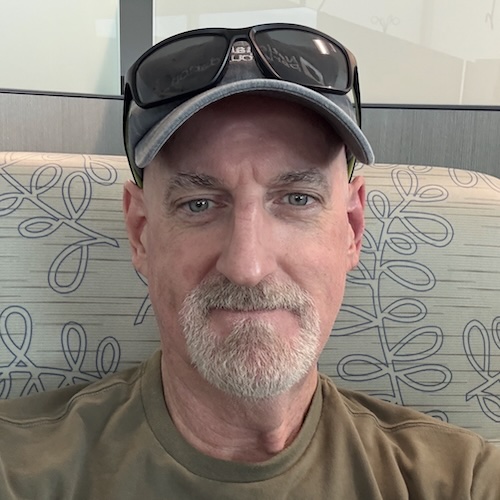
Doug’s muscle invasive bladder cancer story started when he was 62. He had just negotiated a retirement package and decided to put his newfound time into his health. He turned vegan and joined a gym program, training four to five days a week and tracking his calories closely. He was determined to prove that a vegan diet could still build muscle. Then his urinary tract started acting up.
Interviewed by: Tory Midkiff
Edited by: Chris Sanchez
A urologist told him he might have an enlarged prostate, but could not say for sure. Doug switched urologists, found one who scoped him right away, and confirmed that his prostate was abnormally large. In October 2025, Doug had an aquablation procedure to reduce it.
In early 2026, months after the prostate had healed, the symptoms came back. When his urologist looked again, he found tumors that had been hiding behind the enlarged prostate. A biopsy in July showed bladder cancer at three different stages, including cells that had grown into the muscle of his bladder wall. Doug was told this meant a stage 2 diagnosis of muscle invasive bladder cancer.
Scans from his neck to his knees came back clear, with no spread to his lymph nodes or anywhere else. Doug started a two-drug immunotherapy and antibody combination built specifically for bladder cancer. One drug activates the immune system’s own cancer-fighting cells, while the second carries chemotherapy straight to the cancer cells while sparing healthy tissue. He credits a year of disciplined gym training, going into treatment already in the best shape of his life, with helping his body handle it well.
He was also enrolled in Signatera, a blood test that tracks cancer DNA. His baseline came back negative before he had even started treatment, a result that gave him real hope going in.
Doug’s medical team at Moffitt has offered options to try to preserve his bladder rather than remove it outright, depending on how he responds to treatment. A surgery scheduled for mid-November 2026 will help determine which path it turns out to be.
Today, Doug is back on a stationary bike, raising money for childhood cancer research. He leans on his wife, his rescued Rottweiler, and a detailed symptom log to help him navigate treatment.
Learn more about Doug’s muscle invasive bladder cancer experience by watching his video and reading the edited transcript of his interview.
- A tumor can hide in plain sight. Doug’s bladder tumors weren’t visible until his enlarged prostate was reduced and had time to heal. What looked like a straightforward prostate procedure ended up being the reason his cancer was caught early enough for him to have options.
- A negative Signatera result before treatment even started gave Doug something to hold onto. Watching a number on a graph, rather than just waiting and hoping, gave him a concrete way to track whether the disease was still there and whether his treatment was working.
- Getting a second opinion changed the shape of Doug’s entire treatment plan. His first urologist couldn’t tell him what was wrong; a second one caught it. That same instinct, to keep asking until an answer actually holds up, is something Doug carried through every decision that followed.
- Doug found his own comfort in tracking every detail of his experience. A marble notebook, color-coded by red, amber, and green, gave him a way to bring order to something that otherwise felt out of his control, and to walk into every appointment with real information instead of a vague memory.
Doug’s Diagnosis Facts
- Name: Doug M.
- Age at Diagnosis:
- 62
- Diagnosis:
- Muscle Invasive Bladder Cancer (MIBC)
- Staging:
- Stage 2
- Symptoms:
- Urinary tract irritation
- UTI-like symptoms
- Frequent urination
- Treatments:
- Surgery: transurethral resection of bladder tumor (TURBT) with blue light cystoscopy
- Immunotherapy and antibody-drug conjugate combination
This is not medical advice. Please consult with your healthcare provider to make informed treatment decisions.
- Doug’s Diagnosis Facts
- Retiring, turning vegan, and getting into the best shape of my life
- Chasing down an enlarged prostate diagnosis and choosing an aquablation
- Hearing “muscle invasive bladder cancer” and waiting on the CT scan
- Starting a two-drug immunotherapy and antibody combination for bladder cancer
- Questioning the gut biome, nutrition gaps, and wanting to write a guide for others
- What went through my head when I heard I might have bladder cancer
- Finding Moffitt, a clinical-trial-focused doctor, and the Signatera test
- Juggling multiple medications like a Rubik’s cube
- The conversation at Moffitt about bladder removal
- Feeling hopeful going into November and getting back on the bike for Childhood Cancer Awareness Month
- Staying out of the gym and an emergency room scare next to a COVID patient
- Bathroom access, quality of life, and becoming my own father
- Leaning on my support system while my family is spread across the country
- My advice for anyone facing a new cancer diagnosis
- Feeling grateful for clinical trial participants who came before me
- Looking ahead to Thanksgiving, Christmas, and a 40th anniversary bucket list
- What follow-up care and monitoring will look like
- Hear from people living with bladder cancer
Retiring, turning vegan, and getting into the best shape of my life
I was 62, sitting in Tampa by myself, working virtually in Zoom meetings. It got to the point where I thought, “I think I’m ready to retire.” So I reached out to my boss and said, “I’m not feeling this anymore. I want to try something different, see what else I can do with my life, and I’d like to get a retirement package.” I negotiated my job elimination and got a retirement package, and they gave me a severance package, which gave me a one-year salary. And I said, “Okay, now I’m going to pursue my passions.”
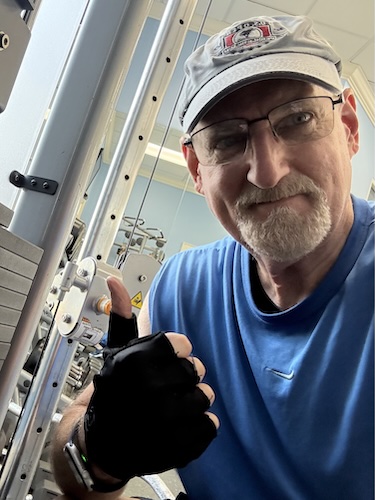
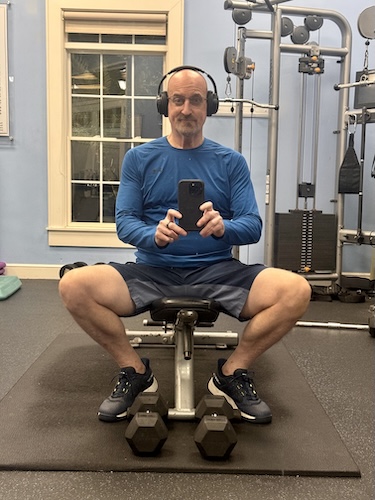
I’ve always been a gym rat, and I hadn’t really made the time for it up to that point. So I said, “Okay, I’m going to focus on my health, mental and physical,” and I joined the vegan gym. It was basically called The Vegan Superhero Academy, which sounds hokey, but it worked. When you graduate, you’ll be a superhero. Vegans are superheroes. My wife and I had been vegan for about 10 years, so I said, “Okay, I could do this. I’m going to prove that on a plant-based diet, you can grow muscle and get in good shape.”
Chasing down an enlarged prostate diagnosis and choosing an aquablation
They had me working like a dog, four to five days a week in the gym. They had me on a strict diet, so I was tracking all my calories. I was basically going through the motions, and I saw progress, and it was looking good. I got to a point where my urinary tract was not behaving itself. It was giving me trouble. I was having UTI-like symptoms.
I went to a urologist. They checked me out and basically said, “Oh, you may or may not have an enlarged prostate. We’re not sure.” They didn’t give me any satisfaction, so I made a decision to change urologists because I have a bunch in the plan. I looked up the best urologist in the area and went with him.
He said right away, “Okay, we’re going to take a look. We’re going to take a scope, go up through the urethra, and see what’s going on.” He came back and said, “Yeah, you have a very large prostate, and we can do an aquablation and reduce the size. We don’t have to remove it because there’s no cancer. We’ll just reduce the size, and that’ll give you some relief.” (EDITOR’S NOTE: Aquablation is a procedure to treat an enlarged prostate, also known as benign prostatic hyperplasia or BPH. It locates excess prostate tissue with ultrasound imaging and removes it using a high-pressure water jet.)
From prostate surgery to a shocking discovery
I signed up for that, and on October 8, 2025, I had the aquablation, through which they reduced the size of my prostate. It was right in the middle of my vegan gym four-month window, so they gave me a month off to recover and put me on the injured list. I started working out again, little by little, got back into the gym, and continued through January.
By February, I started having symptoms again, so I went back to my urologist. He took a look again, and around May or June, he gave me the news that he thinks I had bladder cancer, so I was a little taken aback by that.
But I was in the office with the nurse and the doctor, and I was looking at the video camera and seeing what he was seeing. I could see these lumps in my bladder. It looked like when the prostate was enlarged, it was hiding them. Once they reduced the prostate and it healed, he could tell it wasn’t scar tissue but a tumor.
So he signed me up for surgery in July, and I went in for blue light cystoscopy. They inject a dye, and since the cancer cells are very aggressive, they absorb the dye and they turn a different color, allowing the doctors to take them out.
Hearing “muscle invasive bladder cancer” and waiting on the CT scan
He went in and was in there for a couple of hours. He scraped out and cut out everything he could find, did a biopsy on all of it, and it came back with three different stages of cancer. Some were pre-cancer cells, some were not aggressive, and some were aggressive and were actually in the muscle tissue, so that gave me a stage 2 diagnosis. Basically, I had muscle invasive bladder cancer.
That set off some alarms, because if it’s in the muscle, it may have gone outside the bladder and could be in other organs. The next thing was to wait for the CT scans to come back to tell me whether or not it had metastasized. They checked the lymph nodes. They basically gave me a scan from neck to knee and checked everything in between.
Finally, four or five days after the scan, they told me there’s no sign of any cancer anywhere else. “You don’t have any swollen lymph nodes. You don’t have any lumps anywhere else. It looks like we isolated it in the bladder. We got there in time.”
Starting a two-drug immunotherapy and antibody combination for bladder cancer
I started a very cutting-edge, state-of-the-art immunotherapy and antibody therapy. It’s a combination specifically for bladder cancer, where they give you these two drugs together. One of them supercharges your immune system and gets your T cells to go after the cancer and ignore the feedback that the cancer cell is giving. It’s saying, “Hey, I’m okay. These aren’t the cells you’re looking for.” It basically overrides that, and the immune system now kills the cancer cell.
The other one is an antibody, which I was fascinated by. The antibody goes in. These little antibodies are going through your bloodstream; they find a cancer cell, they look for a specific protein in the cancer cell, they attach themselves to the cancer cell, and they inject a payload of chemotherapy at the cellular level.
That means they’re not giving my whole body chemo and killing healthy tissue and cells. This antibody therapy goes only after the cancer cells and kills them, but it doesn’t cause all this collateral damage to your system. It was an amazing combination, and some of these things were recently FDA-approved.
The interesting thing is, throughout my career, I’ve been doing cancer research fundraisers through the bank and independently for Moffitt Cancer Center and Memorial Sloan Kettering. We do a Cycle for Survival every year. We’ve been raising money every year for rare cancer research. Some of that research helped put these things on the market that I’m benefiting from now, which is pretty wild.
Experiencing minimal side effects from treatment, and how a year of vegan gym training prepared my body
They want me to do four cycles, and I just finished my second cycle. The side effects have been minimal, which is great. I have a little bit of a rash, frequent urination, things like that. My appetite sometimes isn’t all there, but I eat on a schedule. I don’t wait till I’m hungry. I’m conditioned from the vegan gym; 12:00 is lunch. You wake up, you have breakfast, you have lunch. I have four or five small meals a day throughout the day, with an eye on protein.
All the conditioning that the vegan gym put me through prepped my body over a year to be ready for this cancer diagnosis and to be able to deal with it. My body is actually stronger now because of the conditioning. If I had talked to my June or July 2025 self, when I was a little overweight, wasn’t healthy, wasn’t eating right, and wasn’t sleeping right, and said, “You’re going to go through cancer treatment,” I don’t think the results would have been as good as they are now. I was totally conditioned and in great shape. My aerobic capacity was good. I was running, cycling, rowing, and resistance training. So I think all of that helped position me.
Questioning the gut biome, nutrition gaps, and wanting to write a guide for others
My immune system was supercharged because I was eating a lot of fermented foods, like kimchi and sauerkraut. I do a lot of independent research since I’ve been retired, and I found out that your immune system and your gut biome have a relationship with your white blood cells. I had that perfect storm going on in my gut until, of course, they gave me antibiotics after the surgery. After the surgery, they give you these heavy-duty antibiotics.
I didn’t realize the relationship between the gut biome and the white blood cells until I started researching, and that set off the little alarm in my head. Why didn’t my oncology team tell me about this? Why didn’t my urologist tell me about this? No one gives you that information. I even reached out to them and said, “I’d like a nutritionist to consult with on what kind of diet changes I should make as I’m going through the immunotherapy,” and they didn’t have much feedback for me.
That was kind of an eye-opener. All that information is out there, but no one’s packaging it for you and sharing it with you. I’ve always wanted to write a book, so as I’m going through this, I’m going to document everything I learned and put it in a shareable form (something easy to read, like a little white paper), and I’m going to try to get that out there and share it digitally.
I read everything they gave me. I read all the papers about the side effects and everything, but there was nothing about a healthy diet. They just said eat small meals multiple times a day. They didn’t talk about macros or protein. Every person is a unique individual. You have to look at your age, your weight, and your metabolism, and then say: Okay, how much protein should I be getting a day, so I don’t have muscle loss? I’m cutting back on my calories. I’m going to be nauseous. What can I eat to avoid that?
What went through my head when I heard I might have bladder cancer
It caught me off guard, because I thought I had the prostate reduction and I’m done. They did the biopsy originally and said, “Your bladder looks good. Your prostate looks good.” It was a 180-degree flip. It was, “You’re good, you’re on the road to recovery,” to “You have bladder cancer.”
My first thought was, “Okay, what does that mean?” I looked up muscle invasive bladder cancer, and the gold standard is that they remove your bladder. First, they zap you with radiation, chemotherapy, and all kinds of stuff, and then after your treatment’s done, they remove your bladder.
(EDITOR’S NOTE: Bladder removal, also known as radical cystectomy, is part of the standard curative treatment for patients with muscle invasive bladder cancer. According to the National Cancer Institute, chemotherapy is administered before the bladder is removed, and a new exit for urine is created through a process called urinary diversion. Another standard treatment is radiation therapy in parallel with chemotherapy.)
When they remove your bladder, and you’re male, they take your prostate too, because they’re connected. Basically, I was looking at losing my bladder, losing my prostate, and having a bag on my side for the rest of my life. Or they rebuild your bladder from your small intestine, and you have to maintain it, and you can have what functions like a fake bladder.
Researching muscle invasive bladder cancer and the fear of losing my bladder
I wasn’t happy with any of that. How can I keep my bladder? If you talk to an older urologist, he’s going to say, “We’ve got to take out your bladder because I don’t want you to die.”
If you talk to a younger urologist-oncologist who’s in the research and participating in clinical trials, like they are at Moffitt Cancer Center, they’re going to be like, “Oh yeah, we can save your bladder, but you have to satisfy the strict criteria, and we’ll have to give you the treatment. And then at a certain point in time, we’re going to have to make a judgment call: Are you going in for a cleanup surgery, or are you going in for bladder removal, based on where you are in the treatment and how your body responds?” They gave me hope, but initially I was just in shock. It put me into a little bit of a depression initially.
I read up before the diagnosis came through, because I was waiting five days after the scan. I looked up CT scan, bladder cancer, all the possibilities, and I read up on everything. As soon as I heard “muscle invasive,” I knew exactly what it meant. My wife and I were in shock when I shared with her what I had learned.
Finding Moffitt, a clinical-trial-focused doctor, and the Signatera test
Then I talked to my urologist, who referred me to Moffitt. Luckily, Moffitt is 10 minutes from my house, and my urologist was 10 minutes from my house. They’re in the same building. He’s on one end of the building, and Moffitt’s on the other end.
I found out the doctor I’m dealing with was involved in clinical trials for all of these state-of-the-art drugs, and he’s very well-versed. He’s a presenter and a speaker. I was very happy to meet with him and find out that there is hope.
Another thing: There’s this test called Signatera. They had some good clinical trials and good results. They take a piece of your biopsy, and they actually create a marker for the DNA of your specific cancer. Then you do blood work, and they look in your blood to see if that DNA marker is in your blood. I had my baseline done for Signatera. I raised my hand immediately. I said I wanted in on that.
The day before I started my immunotherapy, which was August 24th, they did blood work for my regular immunotherapy, but they also drew blood for the Signatera test, and they had a tissue sample from the biopsy that was done on July 15th.
Getting a negative Signatera baseline before treatment even started
They took that, found the DNA marker, and tested my blood. I got the results back, and my baseline was zero. There was no cancer DNA in my blood. Before I even started the immunotherapy, my blood was already, for lack of a better phrase, cancer-free. There was no DNA floating around. The therapy now is a guarantee that nothing’s left. The therapy is going after anything that’s left in my system. It gave me a boost when I found out I was starting with a negative DNA marker for the cancer, which is cool.
I’m a bit of a geek. I’ve got to admit: I went on YouTube and watched PowerPoint presentations from oncologists. I read all these different papers. I did a deep dive into the science and watched a lot. I’m a visual person, so they had some nice visual aids of the cellular-level interaction of the immunotherapy and the cancer cells, and how they work. It was pretty wild.
I was impressed by the science. It’s also kept me out of trouble, doing the research and everything. It keeps my mind off of worrying; instead, I’m learning. And I’ve gotten some compliments from the team.
Deciding to stop taking oxybutynin after researching the risks
Another drug I was taking is oxybutynin to deal with bladder spasms. My bladder was saying, “I have all this debris in me from the surgery,” because the surgical scars and the scabs start to slough off, and they have nowhere to go but out through my urinary tract. My bladder was contracting constantly to try to get rid of it. It could be painful at times and very uncomfortable.
They said, “You could take oxybutynin, and it’ll lessen the effect, as it kind of numbs your bladder.” When I started taking it, I noticed that things got better. But then I started thinking about it: My bladder is trying to purge debris, and I’m taking a drug that’s making it less effective at doing that to avoid a little pain. Is that wise?
I started doing searches on that, and they said, “If you can handle the pain, let your bladder be at full strength so it can force the things out. Otherwise, you could have a blockage. The urine can back up into your kidneys, and you could have kidney failure.” I said, “Okay, that’s all I needed to hear.
I stopped taking the oxybutynin and let my bladder do its thing. If I have to get up every 30 minutes in the middle of the night to go to the bathroom, then so be it. I’m letting nature take its course. My bladder knows what it’s doing. I’m letting it purge on demand.
Juggling multiple medications like a Rubik’s cube
People will prescribe things for you. Sometimes you’ll get three or four drugs prescribed at the same time, and no one ever says, “Oh, don’t take this one until three or four hours after you take that one, and make sure you take this one on a full stomach, that one on an empty stomach.”
Whenever I have all these drugs lined up, I have to research them. I create a spreadsheet and a timeline: This is when I’m taking this one, then I’m going to eat. This is when I’m taking that one. This one’s six hours apart. This one’s eight hours apart.
It’s basically like a Rubik’s Cube. You have to figure out when to take this medication, what’s the ideal time, and how you can get in the recommended three doses a day. No one hands you that. They just say, “Here’s your prescription,” and you’re on your own.
The conversation at Moffitt about bladder removal
It was offered with some caution. They’re obligated to tell me the best way to keep from ever getting cancer again is to remove the bladder when they finish my treatments. That’ll guarantee that it won’t come back from the bladder. They had to repeat that many times, but it ended with, “We’ll do the best we can to help you keep your bladder.”
I appreciated that. I didn’t buck it. I said, “Okay, I hear you. We’ll see what Signatera tells us, and we’ll see where we are three months from now.” I started in August, and my last treatment is in early November. We already have a surgery date scheduled with my doctor at Moffitt in mid-November, two weeks before Thanksgiving.
That surgery is a placeholder. It’s meant to be either a bladder removal or one final scrape to get rid of any debris from the infusions. The infusions are basically attacking the lining of my bladder, making sure there’s no cancer left. And there is some collateral damage, so they might need to go in and do a scrape and final cleaning, as opposed to removal. That’s the look I’m going for at this point, and it seems hopeful.
Feeling hopeful going into November and getting back on the bike for Childhood Cancer Awareness Month
I’m feeling pretty good at this point. The scans had no sign of metastasis, and the Signatera is coming back negative, so I’m pretty hopeful. I’m listening to my body, and I can tell things are kind of getting back to normal, even though the bladder is still a bit angry because I keep giving it these toxic drugs. They say, “Make sure you drink plenty of water to flush them out.”
I’m back to exercising again. I’m using the bike. September is Childhood Cancer Awareness Month, and I’m participating in the Great Cycle Challenge for the 7th year. Everybody’s riding throughout the US to raise money for childhood cancer. I’ve gotten about $3,000 in donations. I’m doing most of my rides on the stationary bike. Normally I’d be on my road bike in the park, but the medication I’m taking makes me photosensitive, so I can’t go out in the hot Florida sun.
I’ve done a couple of night rides with the lights on, but in Florida at night, you’re taking your life at risk if you’re riding at night, even with the lights on. I decided I’m just going to do the stationary bike in the home gym, in the air conditioning, and put on a movie or something. I did 20 miles yesterday and took the dog for a mile-long walk.
I’m starting to get my exercise in. I’m starting to use free weights again, some dumbbells, but I’m not supposed to do anything that stresses my core, because it’ll cause the bladder to maybe purge some things prematurely, before they’ve had a chance to heal. There’s a lot of caution around core workouts when your bladder is still recovering. I’m trying to respect that, even though I’m dying to get back into the gym, because I was addicted to it. I was going four or five days a week. Going from that to nothing, it’s like I’m having withdrawal symptoms. When I walk the dog, I go past my gym and see the guys working out, and I think, “Oh, man. I want to go in there.”
Staying out of the gym and an emergency room scare next to a COVID patient
It’s a good gym and it’s about a third of a mile from my house. I would basically jog to the gym, work out, and jog home. I’m looking forward to getting back into that.
Another reason I can’t go to the gym now is that my immune system is compromised, even though it’s supercharged. I don’t want to get a summer cold, the flu, or COVID. One night, I went to the emergency room because I was experiencing pain from the blockage when I was in the middle of purging. It was week eight or nine after my surgery.
I was sitting in the emergency room, and on the other side of the curtain was an older gentleman. The nurse went to him and said, “Sorry to inform you, sir, you have COVID.” Here I am, recovering from surgery, immunocompromised, and the guy next to me has COVID. I thought, “I need to stay the hell out of the emergency room. I can’t deal with this.”
My social life has kind of taken a hit. We don’t go out to parties. I stay away from crowds. No beach days. We live in Florida. My wife has had to make an adjustment because she’s going out with her friends and stuff, and I’m home with the dog. I come alive at night. I’m like a vampire. I come out at night.
Bathroom access, quality of life, and becoming my own father
Other than diet changes, the one big issue for me is when you have issues with your bladder and you have to constantly use the bathroom. You don’t want to go out and think, “Where’s the restroom? Where’s the restroom? Where’s the restroom?” I feel more comfortable staying at home because we have four bathrooms in the house, so there are plenty of options. I would imagine with other kinds of cancer, they’d have different kinds of constraints, but when you have a urinary tract-related cancer, it’s difficult. You take it for granted.
My dad was living with us. He was in New York, and he came to us when he was in his 90s because he couldn’t live on his own anymore. He moved in with us, and we had him for like two and a half years. He was 95, and he lived to be 97. He had all kinds of issues, and I was his primary caregiver. He was home with me. I was working from home, so I was taking care of him and dealing with a lot of his issues.
One of them was incontinence. It’s weird, because he passed, and then two years later, I’m looking at my life and thinking, “Oh my, I’ve turned into my dad when he was in his 90s.” I have the same issues that he had. I’m taking the same kind of medication. It’s like I’m going through the same thing. It gave me a different perspective on what he must have been going through, because it’s very humbling. It’s a very humbling experience to go through that.
Leaning on my support system while my family is spread across the country
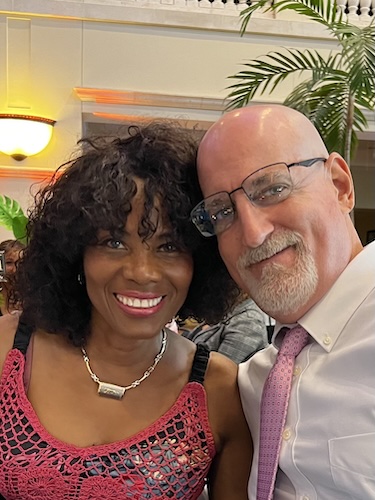
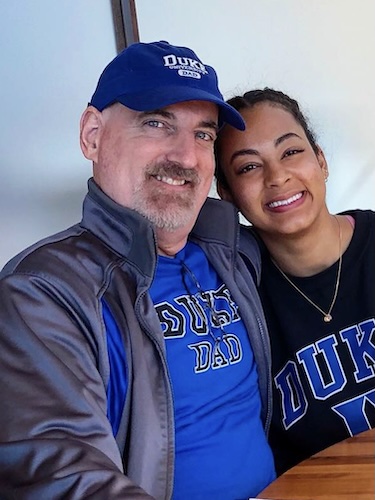
I have a good support system. My wife’s been great. Friends and neighbors. I’ve gone out to dinner locally with some neighbors who are good friends. Family chats and stuff. FaceTime. Most of my family’s in New York, like my brother and my sister. We moved to Florida back in 2000, when my job moved here. My daughter’s in New Jersey. The family’s spread out, so it’s definitely challenging.
I’m also not able to do the things I used to do. I’m a handyman. If something’s broken, I fix it. My wife’s like, “You can’t lift that. Don’t do that. Stay off the ladder.” She doesn’t want me hurting myself. She’s hiring professionals to come in and do stuff that I would normally do, so that’s a little frustrating.
My advice for anyone facing a new cancer diagnosis
Definitely be your own biggest advocate. Ask the questions. Do the research. Get second opinions. If someone gives you an opinion you don’t like, get a second opinion and compare notes. If you’re dealing with an older person in the field who’s stuck in the old ways, they might not be in tune with the latest advancements in the technology that’s out there. They might say, “Okay, we’re just going to remove it, because that’s the safest thing.”
Look for communities, like bladder cancer forums, where you can find people with similar stories and issues. Watch some of their videos. I’ve watched YouTube videos of people who survived muscle invasive bladder cancer. I’ve watched videos of people who saved their bladder and had a full remission. I’ve watched people who had their bladder removed, and then the cancer came back. You never know what you’re going to get. But stay hopeful and try to stay positive.
Finding joy, meditating, and lowering cortisol to let the body fight
Take deep breaths, meditate, and find things that you love. Watch a good movie. Take up an art or a craft. If you like to paint, dust off the canvas, get the brushes out, and do some painting. Take your camera and do some photography. Sketch some still lifes. Whatever you’re into. Spend time with family and friends.
Try to boost your mood. Don’t get caught up. When someone’s going through depression, it’s easy to say, “Hey, snap out of it,” but do things that bring you joy. Try to stay positive, lower that cortisol level, and let your body fight.
If you feed your body, fuel your body with the right nutrients, and give your body a nice, calm state, it’s going to focus on fighting the cancer. I think that’s very important. Your body’s got limited resources, so you better try to make sure they’re allocated for the best possible outcome.
Feeling grateful for clinical trial participants who came before me
I looked for clinical trials available in my area. I said to my team, “I’m open to clinical trials,” but the only clinical trial they had me lined up with was Signatera. The treatment they had me on was cutting-edge, state-of-the-art, hot off the press from 2025, so I feel like I got bladder cancer at the right time. Everything lined up, and the best treatment was available. There weren’t any additional clinical trials that were a fit or that interested me, but I was open to it. I definitely did the research and asked, “What’s out there?” I was looking through the different trials that were available.
There are participation criteria for those. You have to match the criteria. They don’t want to experiment on you. I’m glad I was able to line up with something that was approved and had good results in clinical trials. Thank God for the folks who participated in those clinical trials, because they helped it get approved, so that I could take advantage of it.
Looking ahead to Thanksgiving, Christmas, and a 40th anniversary bucket list
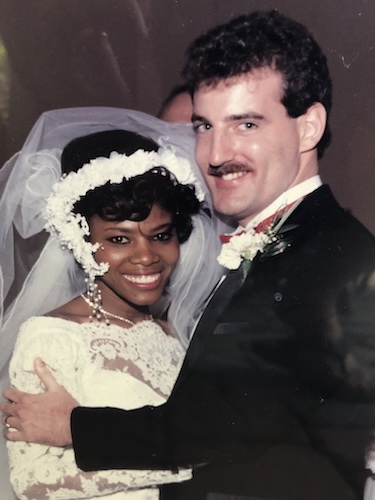
My hope for the future is to get through this, have a nice Thanksgiving with the family, celebrate Christmas, and then start making plans. My wife’s got one year left as a sixth-grade teacher. When she retires, our plans are to look at the bucket list: Paris, the Mediterranean, a cruise to Alaska, and Hawaii. We have a destination each year that we want to plan out, something we’ve been saving for and working towards. We’re coming up on our 40th anniversary, so for our 40th, we want to go somewhere cool.
What follow-up care and monitoring will look like
They’re going to want to check on me. I think the Signatera will stick around, and they’ll keep doing the Signatera check, because they say that’s a good indication of whether it’s coming back. It’s one of the best indications of whether you’re in remission, and then if it suddenly comes back, the blood work will tell you.
But also, I think they’re going to do a visual inspection of the bladder, like every three months. I’ll go in, they’ll do the catheter, and check that everything’s okay and there are no issues with the healing. Then two or three years from now, it might be every six months or annually.
But they’re going to be poking and prodding for a while into the future if I keep the bladder. If they remove the bladder, which I don’t think is a possibility at this point… I’m not sure what that means, but I’d imagine there would be follow-ups for that as well, with its own set of issues.
Tracking every symptom in a notebook with a red, amber, and green system
I started logging all my interactions, doctors’ appointments, and anytime I have a symptom. If I have something negative, I write it in red; something positive, I write it in green. Project manager for 40 years: red, amber, green rating. I track things pretty well. If I’m on the phone with my oncology team, I can read back exactly what happened. It’s definitely helped. It gives me a little peace of mind and has the whole story documented. It helps me look for patterns too.
When I’m through this, I’m probably going to write something about what I went through, how I handled it, the things I learned, the tools I had available, and share the experience, so I can help other folks who are going through it or about to go through it.
Adopting Jelly Bear, the rescue Rottweiler, right before my diagnosis
One of the things that helped me get through the original diagnosis was adopting a dog in March. We rescued a Rottweiler. She was two years old; she had just had four puppies, and she was living in someone’s backyard, under a shed with the dogs. They brought her and the four puppies to a shelter, dropped them off, and said, “We don’t want these dogs in our lives.” The male was a Rottweiler as well, so all four puppies were purebred Rottweilers. Adorable.
My wife and I were at a cancer fundraiser. We were rowing for a cause, trying to raise money for Memorial Sloan Kettering, for Cycle for Survival. We finished that, and as we were walking back to the car, there was an open street fair, and we saw a sign that said: “Adopt Me.” We walked over, and there were three or four dogs there, with a big old Rottweiler lying in the shade. We walked over and checked her out, and she put her head in my wife’s lap and fell asleep with my wife scratching her. We looked at each other and said, “Looks like we’re going to be Rottweiler owners.”
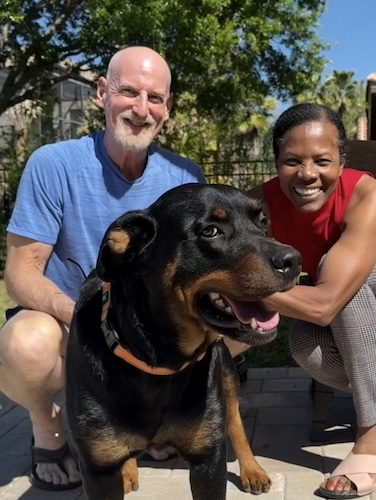
We applied for the adoption. The woman liked us so much that the next day, she dropped the dog off with her crate, food bowls, and her favorite toy, and said, “No backsies. She’s yours now.” We adopted her in March, and I got the diagnosis in June. She and I had already bonded. Having her with me helped me emotionally. There’s something comforting about a dog and their unconditional love: the head in your lap, the noises, the playfulness. She’s been a blessing.
How my emotional support dog helped me through bladder cancer treatment
She’s so much fun. My wife and I love her to pieces. It’s been a joy having her. When I come home from a procedure and she can see that I’m not 100%, she’ll come over and lean on me and get some loving, or she’ll lie down in front of me for a belly rub. Rottweilers love belly rubs, so they lay down with all four paws up in the air.
She’s got to be making physical contact with me. She has to be near you and physically touching you. When you sit down, expect to have a 90-pound dog on your feet. It makes it hard to use the recliner when she’s right in front. Having a dog or any kind of emotional support animal has been a blessing. I was a skeptic at first when I used to hear that, but having her in my life through what I went through has definitely helped make it easier, for sure.
Now she’s my walking buddy. Every day, I have no choice. If I don’t walk her, she comes over, does a little dance in front of me, and barks, telling me, “It’s time to go for a walk, buddy. It’s after 8 p.m.; the sun is down. Come on.”
This interview has been edited for clarity and length. The views and opinions expressed in this interview do not necessarily reflect those of The Patient Story. This content does not replace professional medical advice.
Inspired by Doug’s story?
Share your story, too!
Hear from people living with bladder cancer
Real experiences with diagnosis, treatment choices, side effects, and life beyond bladder cancer — in their own words.
Leave a Reply