
Stratton Had No Symptoms, But His PSA Number Uncovered High-Risk Prostate Cancer
Stratton spent more than four decades as a civil defense trial lawyer. He was easing into retirement when a routine physical revealed an elevated level of PSA, or prostate-specific antigen, a possible indicator of prostate cancer. He had no symptoms. A follow-up blood test and an in-office biopsy confirmed high-risk prostate cancer, with lesions positioned on the outer edge of his prostate.
Interviewed by: Taylor Scheib
Edited by: Chris Sanchez
He told his wife, Debbie, immediately and waited until he had a clear treatment plan before telling their three adult children on a family Zoom call. A radiation oncologist warned him that starting with radiation could make a future surgery harder if the cancer came back. Stratton chose robotic-assisted surgery, a prostatectomy performed with a da Vinci surgical system. His PET scan had come back clear, and the cancer seemed to be gone.
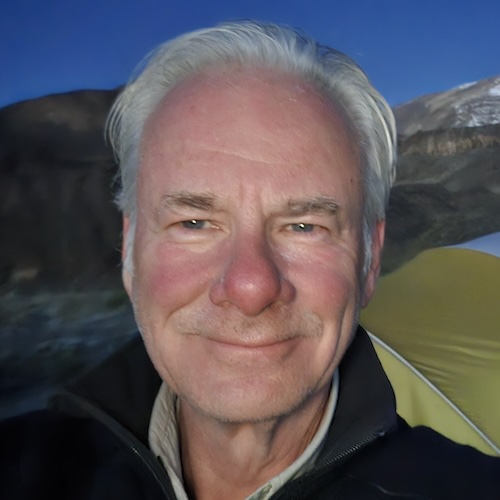
Two years after his surgery, Stratton’s PSA number doubled within a single month, a sign the cancer had returned. He went through 39 sessions of proton radiation therapy at the Texas Proton Therapy Center under a radiation oncologist he calls world-class, finishing at the end of June 2026. He is now partway through an 18-month course of hormone therapy meant to cut off the testosterone his remaining cancer cells rely on to grow.
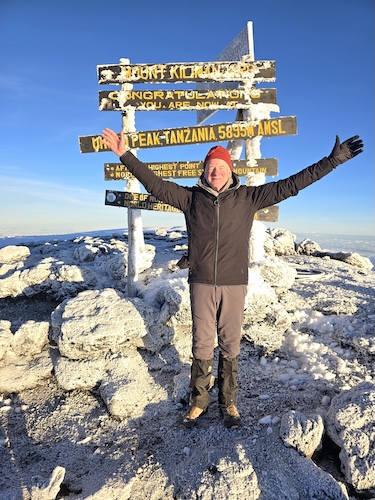
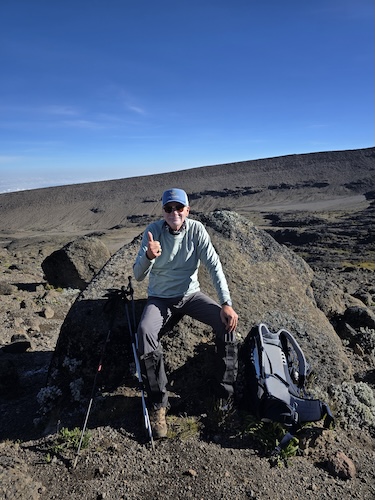
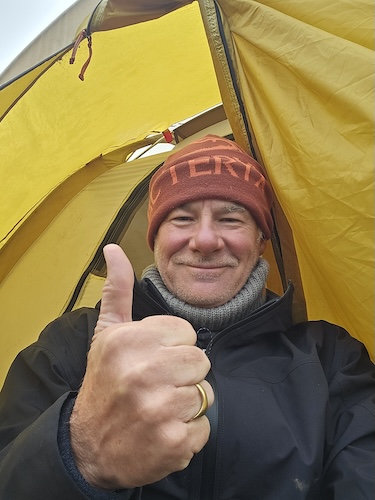
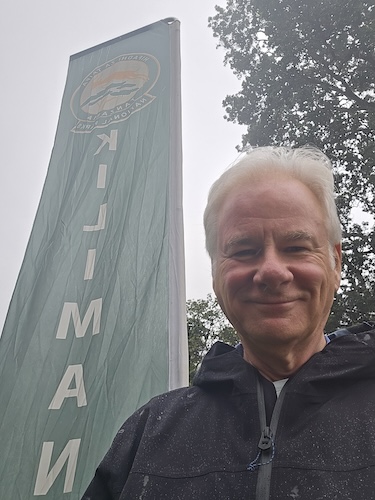
In the year between his surgery and his recurrence, Stratton climbed Mount Kilimanjaro, a physical goal he set for himself to reclaim some sense of purpose after treatment. Reaching the summit and reuniting with Debbie afterward as a changed man became the basis for his book, “From Crisis to Kilimanjaro.” Today, six months into hormone therapy and still waiting to see how his body responds, Stratton says the diagnosis reshaped how present he’s willing to be in his own life and how you just have to keep climbing.
Find out more about Stratton’s prostate cancer story by watching his video and reading the edited transcript of his story below.
- Stratton treated his cancer diagnosis the way he treated legal cases: Gather every fact, rely on real experts, and build a plan before acting. That instinct led him to weigh his surgeon’s recommendation against his radiation oncologist’s warning rather than rushing into either treatment. He says preparation, not certainty, is what got him through it.
- A clear PET scan gave Stratton some comfort right after his diagnosis, but he later learned the scan can miss the smallest, microscopic disease. Two years after his surgery, his PSA doubled in a single month, meaning his cancer had returned.
- An elevated PSA number was the only warning sign Stratton ever got. He had no symptoms at all, and that’s exactly why he tells anyone who will listen not to skip the routine physical that caught his high-risk prostate cancer before it had a chance to spread further.
- Climbing Mount Kilimanjaro the year after his surgery gave Stratton a physical goal to match the uncertainty he lived with. Reaching the summit changed how he saw himself, and he came down the mountain feeling humbled rather than euphoric. That shift is what convinced Debbie he should write a book about it.
- Stratton pushed back against the instinct some of his colleagues had to keep a cancer diagnosis private. He chose instead to tell Debbie everything in real time and to treat his diagnosis as something the whole family was facing together, not something he carried alone.
Stratton’s Diagnosis Facts
- Name: Stratton H.
- Age at Diagnosis:
- 66
- Diagnosis:
- Prostate Cancer
- Gleason Scores:
- Two 9s and two 7s
- Symptoms:
- None; found through PSA testing
- Treatments:
- Surgery: da Vinci radical prostatectomy
- Proton radiation therapy
- Hormone therapy: androgen deprivation
This is not medical advice. Please consult with your healthcare provider to make informed treatment decisions.
- Stratton’s Diagnosis Facts
- I had no symptoms, and an elevated PSA level changed everything
- Telling Debbie, then the kids: “It’s not just my diagnosis; it’s we have prostate cancer”
- A second opinion that devastated us, a robotic prostatectomy, and a prostate cancer recurrence two years later
- Finding a cancer family in the proton therapy waiting room
- On the summit: Seeing Debbie again as a changed man
- Hear from people living with prostate cancer
I had no symptoms, and an elevated PSA level changed everything
I thought I had my life exactly where I wanted it. I had basically started my trajectory to resign from a law practice that I had been involved in for over four decades, which had defined me. That’s how I thought of myself: as a civil defense trial lawyer who handled the biggest cases in the country.
I was retiring in stages. I had basically let go of all my administrative functions in my law firm, where I had been the managing partner of my office and region for 27 years. I co-founded the Dallas office of the national law firm that I loved, Wilson Elser. I helped grow the firm as a lateral hiring partner from a few hundred lawyers to 800 or 900 lawyers, so we had great growth. I had come to the conclusion that I just wanted to be a working lawyer to round out my career.
For the first time since I was a young associate in a firm here in Dallas, I was a working lawyer. And I loved it. I was handling cases. I was there for my clients. I loved my clients. They were fantastic. I had challenging, terrific cases, some of the biggest mass shootings. In fact, the biggest mass shooting in the country’s history, I worked on for four years. I was writing articles. I was prolific. I wrote and published. I had published nationally over 40 articles in the last two years of my practice, and I was loving it. I was thriving as a working lawyer. Honestly, I think I could have gone on in that regard for longer. I was in a good place.
Then the liminal moment occurred. The three words you never want to hear: You have cancer. My doctor said, and this is a quote, “You’re going to have to grapple with this for a while.” I go into great detail in my book, “From Crisis to Kilimanjaro,” about this, because my cancer was picked up on a routine annual physical by my general practitioner, who said, “Everything looks good, except your elevated PSA levels.” I said, “Really? What’s that?” And she said, “PSA levels are such that it’s an antigen put out by the prostate gland. The higher the level, it indicates that there’s something not right, not normal.” She asked me if I had a urologist, and I said I do. And she said, “I think you might want to see him.”
Being a lawyer who’s spent over 42 years handling big cases, and trained to think about the worst case, I said, “Hmmm, I had no symptoms. I felt great. I thought I felt as good as I’ve ever felt in my life at the time. I had no symptoms that would ever indicate there was something amiss at all, much less with my prostate.”
I did see my urologist very quickly after that, with that mindset and training as a lawyer. I said, “I better get this checked, just in case.” Thank goodness I did. He gave me another blood test called the Galleri right in his office, and it showed a 40% chance of cancer. That led to a series of diagnostic tests over a few months, including the dreaded in-office prostate biopsy, which I do not recommend to anyone. Very draconian, I might add. Despite the fact that modern medicine amazed me throughout this process, this was a throwback to what I consider more ancient times. But I had that biopsy, and it showed that not only did I have cancer of the prostate, but I had aggressive, high-risk cancer, which absolutely floored me. I could not believe it when I heard those words.
Forgive me if I’m going into too much detail, because I think this is important. Early detection is one of my main takeaways in my book, and I’m preaching the gospel of early detection. When I heard that diagnosis, my wife Debbie and I met in the doctor’s office about the biopsy. He told me that my lesions were on the outer side of my prostate, and that I had Gleason scores of two 9s and two 7s. For card players, you know how you have two of a kind? Not a good thing if you have two of a kind with those numbers in cancer. Not good at all. The higher the number, the worse the cancer is. And the higher the number, the more propensity there is for metastasis to break out.
The fact that my lesions were on the outer side of my prostate gave a real strong possibility that it had reached the prostate wall, or the capsule, and gone into my body. In other words, it had metastasized. That was frightening. For someone who was at the later stages of a law career, planning a robust and very active retirement, doing things I had postponed for many years to handle my cases, clients, and firm activities, all of a sudden, all of that was in danger. My life was in danger. I had a hard time understanding what was happening to me.
I called it a liminal moment because liminal means a time in your life when your life will never be the same as it was before that moment. In other words, when “You have cancer” is said to you by a doctor, and that is a diagnosis by a physician, your life will never be the same as it was for the few seconds it took to give you that diagnosis, as it was before. My life became before cancer and after cancer, just like that.
Again, I had thought I had no symptoms. I thought I was doing great. And then all of a sudden, cancer crashed into my life, as I call it. I wrote an American Bar Association Journal article about this. I said, “I was planning my retirement, but cancer filed an objection. And did it ever file an objection, in legal terms. Wow, what an objection. I tried to argue against it, and I was overruled by my doctor: This is your diagnosis; you have got to accept it, and you’ve got to deal with this.” That’s how that unfolded.
Telling Debbie, then the kids: “It’s not just my diagnosis; it’s we have prostate cancer”
In my three-and-a-half year cancer experience, I have found that people handle this very differently, men especially. I know this because I know so many colleagues of mine in law.
Once they have cancer, if they talk about it at all, they talk about it only with trusted colleagues. Many of the professionals I know, admire, and respect, who have had a similar situation, hold it close. They don’t want anybody to know, including their spouses and family. They certainly don’t want other lawyer colleagues to know, because it might give them a competitive advantage to have that kind of knowledge going into client situations. “You may not want to go with that guy. He’s got this cancer situation going on,” and it has been used that way, as hard as it is to believe, as a sword by some to take advantage of the situation.
Some lawyers that I know purposefully hold this very close, and I understand that. I get it. It’s a very personal thing. It’s a very tough thing to get your arms around from an individual standpoint, let alone having conversations about it with other people. They just don’t want to talk about it.
I approached it 100% differently, because I felt: If I have this, and I didn’t know I had it and I didn’t have any symptoms, it could happen to anybody. And it had happened to other partners of mine, beloved partners, who had passed away with prostate cancer or other kinds of cancer, and they didn’t talk about it. You didn’t know what was going on with them, but you always were concerned. You didn’t hear from them for a while, and they just became isolated and took themselves out of the picture, so to speak. I said, “No, I’m not going to do this.”
I took this as a lesson. I was going to include not only my loved ones in this experience; I was going to expand this universe to include my professional friends, my colleagues, and my everyday friends who are not practicing law with me but did other things, because I wanted to get the word out that if this happened to me and I didn’t know it, then it could be you as well. From my reading, rates of prostate cancer, even for younger men, are up, down to the 40s and maybe even the 30s. I said, “This is going to be my mission: to share this experience with everyone, to make sure the word gets out that early detection not only saves lives, but it allows you to treat it faster, sooner. It saved mine, so far.”
(EDITOR’S NOTE: The American Cancer Society says that prostate cancer is more likely to develop in older men, with around 6 in 10 prostate cancers diagnosed in men 65 and older. The average age of men when they are first diagnosed with prostate cancer is 67. While prostate cancer is rare in men younger than 40, a study on prostate cancer in young men has found that worldwide, the incidence of prostate cancer has increased across all groups between ages 15 and 40. The study also found that prostate cancer diagnoses have steadily increased by an average of 2% yearly since 1990.)
My point is: Don’t fear the diagnosis. Embrace the diagnosis so that you can deal with it. That’s the lawyer in me, and it’s another reason I wrote the book “From Crisis to Kilimanjaro.” I put my legal training into effect. I had handled crisis management. I mentioned some of the biggest cases in the country; that’s what I did for over four decades. Now I was the patient. Now I was the client. And I had to apply my crisis management skills to handling my own crisis.
One of the main things I had learned as a lawyer is: prepare, prepare, prepare. You rely on experts, you hire the best experts, and then you rely on what they’re telling you about whatever the subject matter is in the case you have. When I talked to my doctors, I embraced what they were telling me, but I prepared by doing my research as to what was going on inside me that I didn’t know, what I could expect, and how this could unfold.
When I was a lawyer, at the beginning of a case, I would try to see the step-by-step progression and the outcome, so that I could develop a strategy on how to deal with it, so that I knew generally how it was going to unfold, as a legal case. So I wanted to know how this cancer diagnosis was going to unfold in my case. I prepared, prepared, prepared. I had great doctors, and I took their advice. I wasn’t going to be an idiot and not take their advice. But more importantly, I wanted to share this story and bring everybody in.
With my loved ones, there was never a doubt in my mind that I was going to tell Debbie everything, in real time, as it occurred. I was not going to hide anything. I was not going to sugarcoat it. We had that kind of relationship of complete trust and honesty. From the very beginning, I shared this with her, and she was with me. People think that when you have a cancer diagnosis, that’s an individual diagnosis. “You have cancer.” But in reality, it’s, “We have cancer.” We have cancer, as a couple, as husband and wife, as friends. I have three grown kids. We had cancer. I wanted their judgment, and I wanted their counsel, just like I wanted the doctors’ counsel. I knew they had my best interest at heart, and I knew I was not going to go through this alone and rely on my own judgment, because I was not objective because it was happening to me. I wanted them as, you might say, a board of advisors who I knew cared deeply about me and had my best interest at heart.
Telling Debbie was easy, because we’re very close. Telling my kids was totally different. We waited. We decided to wait until we had the facts, until we knew what was going on, because we knew they were very smart kids and they were going to ask tough questions. We wanted to wait until we had all the facts, until we had a strategy in mind, until we could tell them, “This is the plan.”
I told them on a Zoom call, because they live elsewhere. They were on the screen and had no idea what the family Zoom was about. And I just said, “This is going to be a hard conversation, but I share everything with you. I have cancer.” I told them the details. And I could see the look on their faces; they were shocked, as I was, that I had it, because I couldn’t believe it either. But I told them, “We are going to do everything we can to get past this. We have great doctors, we have great care, we have had great advice, and we have a plan. Here’s the plan.” I laid it out. I said, “I’m going to fully retire. As I mentioned, I was retiring in stages, but now this became the break.”
I had decided I was going to fully retire to take care of my health. It was all hands on deck, and I wanted them to know there would be no distractions in how I was going to handle this. I felt like I had already taken too much of their time when I was practicing law, missing some of their key events, like sporting events, dance recitals, and piano recitals, by working on cases. I was not going to do this again. I was going to try to give back as much time to them as possible going forward. I felt like this was the first step in telling them how serious I was. Not only was I going to approach cancer like this, but I was also going to approach life differently than I had. I was going to backfill and try to make things up to them, because I was feeling a lot of guilt about taking that time away from them. It just hit me, all of a sudden, that I’d had my priorities totally upside down for a long time. As part of this process, all of these things started coming out.
A second opinion that devastated us, a robotic prostatectomy, and a prostate cancer recurrence two years later
We had the plan. We’d told the kids. I retired in September. My cancer surgery was in 2023. It was at Presbyterian Hospital in Dallas.
The plan was: My urologist was a surgeon, and he told me my prostate was very diseased. We did a PET scan, and it showed that the cancer had not spread. However, I later learned that PET scans aren’t perfect. They can only detect lesions that are 2 centimeters or larger, so they don’t catch microscopic cancer. I had some degree of comfort, although when I learned that, I said, “Oh no.” Just because you have a clean PET scan does not mean it’s the end of the story, which is setting up for later on.
My surgeon said, “Look, I’m a surgeon. I can take it out. We can do this great procedure, a prostatectomy, which isn’t as invasive as it used to be. We can use this state-of-the-art machine called a da Vinci.” It basically has metal arms that come down from the machine; the surgeon operates the machine remotely from another part of the room, but the machine itself is right over you. He said the state-of-the-art approach would make five incisions, only about an inch each. The good point of that is we can be more accurate, more precise, and it also lessens the recovery time. All of that sounded good. They said, “I recommend you see a radiation oncologist, because radiation is also an option.”
We saw the radiation oncologist my doctor recommended. We walked away from that meeting feeling as bad as I’ve ever felt in my life. I’ve handled some really bad lawsuits in my career, defended them, but I felt whoa. He said, “Stratton, the type of cancer you have, I recommend you go with the surgery first, because radiation causes scar tissue. If it comes back, we may not be able to operate and take it out if you have radiation first. The scar tissue may prevent you. But whatever treatment you decide, you will see me again. Your cancer is microscopic, and it has migrated out of your prostate.”
Now, bear in mind, I’d had what I thought was a good PET scan. And he said, “It’s hiding in your body, and I will see you again.” We were devastated. We walked out of there, and I thought, “Oh my God. What can I do?” I went and talked to the surgeon, and the surgeon said, “He’s a radiation oncologist; that’s what he says, that’s what he does. I think we have a good shot at getting it all.”
I had the surgery. I had a good recovery, although with some missteps. I found myself back in the hospital within a week of my surgery for another issue, which I talk about in my book. It’s a very personal thing. People say, “You go into a lot of detail in this book,” but it’s very personal. I said, “Look, if I’m going to tell a story, I’m going to tell the whole story. It’s going to have to be out there: the good, the bad, and the ugly.” I hope people don’t find it too much detail.
I had the surgery, and I had that hiccup about a week in, where I was back in the hospital. It was the day that Hamas attacked the Israeli music festival. I’m literally watching this on the news on a Saturday morning. I’m recovering from my surgery earlier in the week, and I see this horror unfold in front of my eyes, and I’m thinking, “Oh my gosh, this is horrible.” Then I have these horrible, horrible pains, and I end up in the emergency room right after all this. I’m thinking, “Oh my gosh, life is incredible sometimes,” and not in a positive way. I end up in the hospital, get that issue taken care of, recover, and go through recovery.
Unfortunately, my radiation oncologist was right. I had a recurrence two years after the surgery. My PSA doubled in a month. With PSA, it’s not just the number; it’s the velocity of how it increases and the fact that it doubled in a very short period of time. It went from undetectable to detectable, to right at the cusp of a breakout. I was devastated again. I’d done everything I thought I could do to hopefully get past this.
My first thought when I got the numbers was, “He was right.” I did see him again. Back in his office, he didn’t say “I told you so.” He just said, “Do you believe?” I said, “Believe in what?” “Do you believe?” And I said, “Well, I guess I believe.” He told me, basically, “Your die is cast. You’ve had a recurrence, and these are microscopic particles. They could be anywhere in your body. Only time will tell.” Again, he’d been right already, and I’m thinking, “Oh my gosh, here it is again. Horror movie part two, the sequel.” Debbie and I came out again, devastated. It almost made me think, “What’s the point?”
But fortunately, circumstances led me to Dr. Andrew Lee of the Texas Center for Proton Therapy, who is a world-class, renowned radiation oncologist. In May and June, I went through 39 proton radiation treatments, and I finished at the end of June. Now I’m on hormone therapy for another year and a half. I’ve been on it for six months so far. And that, of course, is like going through “manopause.” I call it that because I’ve had the symptoms that ladies go through during menopause.
I have night sweats. I wake up in the middle of the night with hot flashes. I start sweating in the middle of the day for no reason. I don’t think I have mood swings, but Debbie tells me I have mood swings, and she’s all over this. She said, “Well, now you know what I am going through.” And I said, “You know you’re absolutely right. I take back everything that I ever said,” about when she woke me up in the middle of the night with her hot flashes. It made me feel very sorry and guilty about how I had treated her throughout that. It came back as karma, and now it’s haunting me. But that’s a small price to pay for trying to keep this at bay.
I had a recurrence. I addressed it again and did the same thing. I did my homework; I did my preparation. I saw doctors and decided on proton radiation therapy as opposed to photon radiation, which is different. Again, it goes to preparation, talking to experts, learning the types of treatments available, making a decision, and staying with it.
Hormone therapy suppresses the levels of testosterone, which is the fuel or food for the cancer cells. Hopefully they’ve been weakened by the two months of radiation. Now the idea is to starve them to death by taking away their food supply in their weakened state, so hopefully they’re terminated. But I won’t know the complete success of my treatment until that ends. Because artificially, right now, they’re weakened by the radiation, hopefully, and now they’re being starved to death. I won’t know until a year and a half from now, once I’ve weaned off the hormone therapy, how successful all of this has been. I know I’m doing everything I can to try to get as far away from this cancer as I possibly can.
(EDITOR’S NOTE: As Mayo Clinic explains, testosterone itself isn’t likely to increase the risk of developing prostate cancer. That said, testosterone has been found to help cancer cells grow and multiply, but only up to a certain point. The relationship between testosterone and cancer is nuanced; it was once believed that higher testosterone levels brought about greater growth of prostate cancer, but modern research has disproved this.)
I want to emphasize what it’s done to me psychologically, emotionally, and mentally. It has been a release. It’s made me awake and totally present. I have learned so much through this experience. I have adopted a saying by Marcus Aurelius, the great Roman emperor, one of the five great emperors of ancient Rome, who wrote a book called “The Meditations,” which is something I kind of live by. One of his great sayings was, “What stands in the way becomes the way.”
What stood in my way, cancer, has now become my way forward. Going through this process has taught me to be totally present in each and every moment, and not to take anything for granted, not to assume I have tomorrow, because all I know I have is this moment, and maybe the next. But beyond that is clear uncertainty about what the future holds. In a very odd, contradictory way, it has totally increased the joy of my life beyond measure. It has opened everything up to possibilities, and I have embraced this experience.
I originally titled my book, “From Cancer to Kilimanjaro,” but my publisher and Debbie said I should call it “From Crisis to Kilimanjaro,” because it provides a structure to guide people through a crisis, whether it’s cancer, relational, professional, healthcare crisis, whatever kind of crisis you may be facing, whatever you’re going through. I wanted to write this book to help other people in their journey. I want them to know that what stands in your way can become your way forward.
I used Mount Kilimanjaro as a metaphor for this crisis, because my takeaway is that not all mountains are made of rock. It’s a metaphor for whatever crisis you may face. It may appear as the tallest mountain in front of you, and you don’t think there’s any way you can climb that mountain or confront your crisis. You can’t let fear paralyze you so that you can’t continue your climb. Because I’m here to tell you, you have to keep climbing.
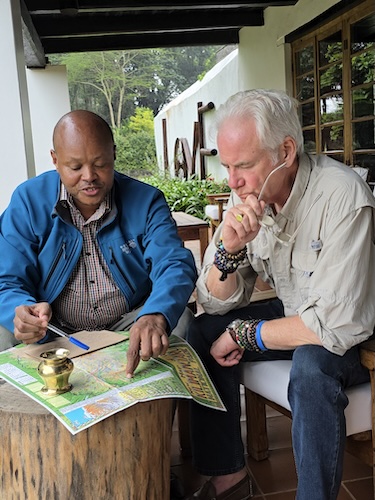
One of the key things about climbing Mount Kilimanjaro that taught me this was my guide, Moses; that was his real name, not a stage name, and you’re going to follow Moses, right? His advice to me was simple, and it was the way forward to success in climbing Mount Kilimanjaro: “pole pole,” which means “slowly, slowly” in Swahili. You climb the mountain, no matter how immense or how big the mountain or crisis is, one step at a time.
You don’t look at the summit from the base. You look immediately ahead of you, and you take it one step at a time. Slowly, slowly. You’re not going to climb that mountain if you race up to it. You’re going to have thin oxygen that’s going to take you down, and you won’t be able to finish it, or you’re going to have other problems, like headaches, nausea, and exhaust yourself if you try to run up that mountain. You don’t face a crisis like that either. You face it one day, one step at a time. If you approach it that way, before you know it, you’re making progress; you’re climbing up the mountain.
Yes, it’s going to be hard, it’s going to be steep, and you may want to give up, but you don’t give up, because you’re going to take that next step. You’re not going to look at how far you have to go; you’re going to look at how far you’ve come. And then you start to realize: Wow, I am making progress. I am getting closer to the summit. If you keep climbing and understand that what’s in your way becomes the way, you realize that you can do this. The closer you get to the top, the more confidence and courage you have to finish the climb. I can tell you, there’s no more beautiful view than from the summit of the mountain or the crisis that you have faced. You know that you are not just dealing with it; you are confronting it, handling it, and you may conquer that crisis. And that makes the way down a lot easier.
Finding a cancer family in the proton therapy waiting room
My proton radiation therapy was 39 weekdays in a row. I would go to this state-of-the-art, beautiful, incredible facility for my proton radiation treatments every day. The doctors wanted us to come in at least 30 minutes before each treatment. I’d be there 45 minutes, sometimes even an hour before. I didn’t want to take any chances. There were people from all over the world at this facility, and there were people with all kinds of cancer: prostate, brain tumors, glioblastomas, lung cancer, kids, bone cancer. I looked around that room, and I said, “These are the most courageous people I’ve ever seen.” The kids especially; my heart went out to them. I’ve had a nice, long life, but these kids, facing such a difficult situation at such a young age, haven’t had a chance to experience life yet, and my heart went out to them.
There were other adults, too, whom I got to know and who had obvious issues. Talking to them and hearing their stories made me feel so humble, because they were facing, in many ways, far worse situations than I was dealing with. I had cancer that I didn’t even know I had, and they had horrible symptoms they were dealing with and horrible surgeries. I say horrible surgeries because their cancers were caught later in life than mine was. My heart went out to them too.
All of a sudden I realized I had another family: a cancer community. As much as I identified with men with prostate cancer, which I do, and made many new, good friends through this process, it made me realize how broad and vicious cancer is, and how it reaches everybody. No one’s beyond it. It can touch anybody, at any stage of life. Every time I walked into that room, I learned something. I didn’t dread it; I embraced it, because these were the most incredible people I’ve ever known.
I invited many of them to my book launch, and many of them said they would come. I want them there, because I consider my cancer family a big part of my life now.
There’s a publication in the waiting area called “Cancer Health Magazine,” the kind of thing you read to kill time in a doctor’s office. I started reading it, and I realized, “Wow, this is a huge community.” I actually wrote to the editor and said, “I’d like to do an article for the magazine.” To my surprise, he got back. I wrote the article, sent it to him, and it’s going to be published in October.
That led me to a real realization again. It goes back to “what stands in the way becomes the way.” This is my life now: reaching out to the cancer community. That led me to you, and to The Patient Story. It led me to my social media. My posts on Facebook and Instagram are all hopefully motivational, inspirational, and to keep climbing. Not all mountains are made of rock. Keep climbing, keep going, no matter how big or insurmountable it may appear. I’m here to cheer you on. And that’s become my way forward.
I love the people who are going through this. When you don’t have cancer, and someone tells you, “I have cancer,” there’s no way you can understand what it does to you, not just physically, but psychologically: waiting for the blood test, the scans, after the surgeries, after the treatments. The rest of your life is going to depend on the next blood test, the next scan, the next X-ray, the next CT scan, or PET scan. That’s your life.
I get it; I couldn’t relate to it either. There’s no way you can relate to it unless you’re in it. But it can defeat you or it can motivate you. My mantra now is: I am not going to let cancer defeat me. I am not going to let cancer define me. I am going to make cancer motivate me. And that’s what it’s doing. It’s motivating me to help get the word out.
Early detection. Don’t fear the diagnosis. No matter what diagnosis you face, take it one step at a time. Don’t try to look ahead and see the top of the mountain from the base. This is how I’m going to do it: one step at a time. I’m going to prepare, prepare, prepare. Do my research and rely on my medical care providers and my family and loved ones to guide me. That’s my platform. That’s what I’m all about right now.
On the summit: Seeing Debbie again as a changed man
Debbie did not climb Kilimanjaro with me; she has trouble with heights. We were apart for about two weeks while I was climbing. I was on the mountain for eight days, came down Kilimanjaro, and went straight from the mountain to our hotel, where she was waiting for me. Moses was with me, and I saw Debbie after that time apart. But I saw her differently, because I was different.
At the summit of Kilimanjaro, instead of feeling euphoria at having conquered the mountain, I felt humility. I felt gratitude that the mountain let me climb it. I had done nothing; the mountain let me do it. The mountain had already become, even before I started to climb. It was a metaphor for my cancer. I needed a goal and challenge.
After my cancer surgery, after my recovery, I needed something I could reclaim my life. When I was on the summit of Kilimanjaro, I said to myself, “You have cancer, but you’re on top of Kilimanjaro.” It was a little over a year from the time of my surgery to the climb. The training was motivational and taught me a lot about myself. That journey culminated with the summit of Kilimanjaro, where I realized I was a different person than I was right before my diagnosis. Not only was I a different person; I was a better person. How is that possible? How is it possible that cancer made me a better person? It made me stop and think that my life had been threatened, that I was about to lose it all. And then I was on top of Kilimanjaro, and I realized that this experience made me a stronger, better person.
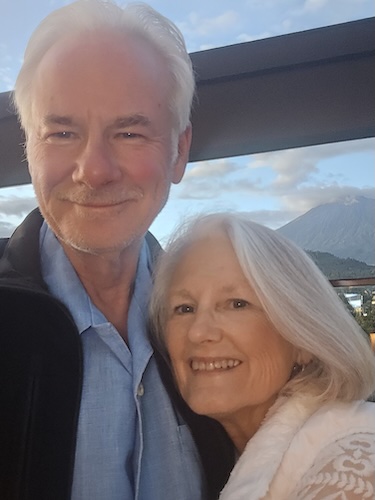
When I came down from the mountain and saw Debbie for the first time after that, I wanted to tell her that, but I said, “No, you have to show her that.” That reunion became my way of showing her that I was different, and that I was better. She wanted to know all about it. We had this beautiful reunion at the top of this beautiful hotel in Arusha, Tanzania. The sun was setting; it was just beautiful, and I was so happy. I’ve never been happier in my life, I don’t think. Being there with her after doing this, and knowing I was different, and wanting to show her that I was different, I realized how much she meant to me in that moment. She said, “Really, what happened to you on that mountain?”
I hearkened back to Moses and what happened on the mountain. I felt like a changed person. I did feel changed, and she could see that change. She wanted to know how this happened, and I told her. She said, “You know what, I think you ought to write a book about this.” I said, “You think so? You think anybody would read it?” She said, “Yes, I think people can learn from this. I mean, you did.” And she was right; I did. In that moment I said, “You’re right. I’m going to write a book about this.” I started writing it right away, and it wrote itself.
It changed our relationship. We became much closer, just like that. But it took 42 years. We’ve been married for 39 years, but it took that long for me to realize, and it took cancer for me to realize things. I have cancer, but you know what? In the craziest, most contradictory way, it’s done all that for me personally. Now I live each moment with purpose, in the present. I was not living that way before, even though I thought I was.
It made me realize that when you’re in the storm of daily life, when you’re a professional, working, or whatever you’re doing, it’s impossible to see what is happening to you. Cancer stripped all that away and made me realize: You have not been living in the present, son. You think you have, but you have not. You have not been living a healthy life, physically. You kidded yourself for all those years that you were. But you’re not eating right, you’re not exercising, and you’re not thinking right, because you are all in that mindset. And you didn’t know that until it was threatened and it was gone, and then you realize, “Oh my God, that’s who I was.”
But this is a message I hope everybody can take away: This taught me it is not who you were, it’s not even who you are; it is who you are becoming. And I love what I am becoming. It is not the destination; it’s the journey. If you think your journey is done, then you’re missing the point, because your journey is what it’s all about. It’s not the destination. It’s the journey that’s important.
I love this journey. I love being taught. I love talking about this. Hopefully, my goal is simply to help other people at this time. If I can be a resource and a force of change for who they are becoming, then I’m happy, and I’ve achieved my new mission, and that’s all I’m about right now: stripped bare, humble, grateful, and fully present.
This interview has been edited for clarity and length. The views and opinions expressed in this interview do not necessarily reflect those of The Patient Story. This content does not replace professional medical advice.
Inspired by Stratton’s story?
Share your story, too!
Hear from people living with prostate cancer
Real experiences with diagnosis, treatment choices, side effects, and life beyond prostate cancer — in their own words.
Leave a Reply