
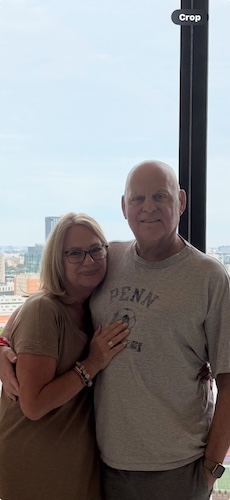
Nan Was a Caregiver Through Her Sister’s Pancreatic Cancer and Her Husband’s BPDCN Diagnosis
Nan’s caregiver experience began when she noticed a strange spot on her husband Jim’s back. It looked, she says, like an almond. Jim wasn’t worried. Nan was, and she kept asking him to show it to his dermatologist. But it took a spreading rash across his face and trunk and a call from a parking lot before anyone would biopsy it. The diagnosis was blastic plasmacytoid dendritic cell neoplasm, or BPDCN, a rare and aggressive blood cancer that she and Jim had never heard of.
Interviewed by: Tory Midkiff
Edited by: Chris Sanchez
By then, Nan already had two other cancer cases on her hands. Her sister had been diagnosed with pancreatic cancer in June of that year, and Nan had moved in to help her through it. That December, Nan was told she herself had stage 1, grade 2 breast cancer. When Jim’s BPDCN diagnosis came, she had to learn a completely different kind of caregiving. Her sister had wanted Nan to make every decision for her. Jim needed the opposite: To steer his own treatment, choosing where to get second and third opinions at Dana-Farber, MD Anderson, and Penn, while Nan stepped back and supported him.
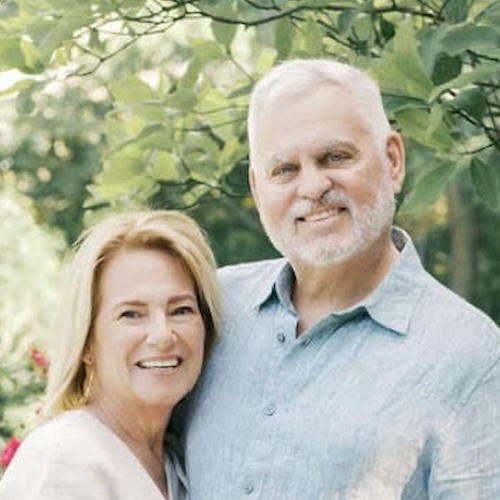
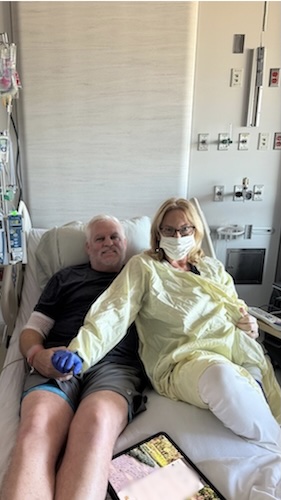
Nan supported Jim through a 47-day hospital stay during his stem cell transplant. She says being able to go home at night to rest and care for herself meant a lot. The real weight of caregiving landed after the transplant. Coming home didn’t mean the hardest part was over. It meant bleach-scrubbed bathrooms, a long list of foods he couldn’t eat, and daily infusions that Nan was expected to handle.
Today, Jim’s appointments have stretched from weekly to monthly, with less frequent visits ahead. Nan is now finding time to pay attention to her own health again. Looking back, she says the biggest lesson of caregiving is that it isn’t one-size-fits-all: It depends entirely on the relationship, and on understanding what the specific person in front of you actually needs. Her advice to anyone just starting this is to advocate for your person, trust your gut, and never assume a question is a bad one to ask.
Watch Nan’s video and read through the edited transcript of her interview to learn more about her caregiving experience.
- Nan didn’t wait for a specialist to confirm her instincts. From the moment she noticed the spot on Jim’s back, through the wedding weekend when it spread to his face, to the morning she stood at the dermatologist’s front desk asking them to move up his appointment, her persistence is what got Jim’s rare cancer caught and biopsied.
- The stem cell transplant didn’t end when Jim came home; in a lot of ways, that’s when the real caregiving started. Nan learned that the bleach cleaning, the food restrictions, and the daily infusions were simply handed to her, with no one checking whether she felt ready to take them on.
- Nan’s biggest lesson from caring for two people with cancer, back to back, was that caregiving looks completely different depending on the relationship. Her sister wanted Nan to make every decision; Jim needed to make his own. Learning to read that difference, Nan says, matters more than following any single formula for how to show up.
- “Advocate for your person even when they’re advocating for themselves, and don’t dismiss a gut feeling just because a doctor says it’s nothing.” This advice applies far beyond her own family. As Nan puts it, there are no bad questions, and that’s as true in a medical situation as anywhere else.
Jim’s Diagnosis Facts
- Name: Jim T.
- Diagnosis:
- Blastic Plasmacytoid Dendritic Cell Neoplasm (BPDCN)
- Symptom:
- Appearance of a firm, shriveled, almond-sized skin lesion on his upper back/shoulder area, later spreading to his face, forehead, chin, and trunk
- Treatments:
- Chemotherapy
- Allogeneic stem cell transplant
This is not medical advice. Please consult with your healthcare provider to make informed treatment decisions.
- Jim’s Diagnosis Facts
- Life before two diagnoses collided
- The Wawa parking lot: Reading the statistics before telling my husband
- More than a little advocating: Getting the first biopsy
- “If I love you, I’ll fight tooth and nail”: Where my advocacy comes from
- Jim takes the wheel: Choosing where to get a second and third opinion
- Learning the caregiver’s job was the stem cell transplant itself
- Friends who showed up with gluten-free snacks and silence when needed
- 47 days: Coming home the day before our anniversary
- Finally making time for my breast cancer diagnosis
- Grateful for a new treatment and for every rare disease getting attention
- Feeling seen instead of isolated
- The hardest part: Watching the people I love feel pain I couldn’t fix
- What being a caregiver means to me
- The same lesson, learned twice as a caregiver: Stepping up or stepping back
- My advice: Advocate, every time
- Hear from cancer caregivers and care partners
Life before two diagnoses collided
We lived in Florida and were in the process of moving. My sister became ill, so I went to a doctor’s appointment with her and moved into her house. I didn’t give anybody a choice; I just moved into her house, and later said, “If you don’t want me here, you need to let me know, because I didn’t give you a choice. I just moved in,” and they all said, “No, please stay.”
Jim was still in Florida. Actually, we had sold our home in Florida and were in the process of coming back here, but couldn’t find anything, so he was in my sister’s house in Florida. She was in her Jersey house, and I said, “I can’t do this without you. You need to come north.” So he came up and rented a home in Pennsylvania while we were looking. I think I saw him five times over a period of months, because I was with my sister.
She was diagnosed in June. In December, I was diagnosed with breast cancer. I was very fortunate in that it was caught very early. I was stage 1, grade 2. There were some things that I wanted to do, and unlike most people, because I was so wrapped up in my sister, I treated my cancer like an inconvenience. I said, “Whatever you need to do, just do it because I have things I need to get to with my sister.” I never gave myself the time to give my own cancer the reverence, if you will, that it deserved. Then Jim got sick.
It’s just been a crazy whirlwind around here. I don’t remember what life was like before all of it. It’s just been a whirlwind. But one thing that it has taught us is that in the whirlwind, there’s a life to be lived. Regardless of what you’re going through, there’s still your life to be celebrated and shared. You mire through all the muck, but it’s the rest of it that matters. Sometimes that’s just coffee in the morning or a hug at night; it doesn’t have to be a major event. And we learned that in a big way.
“That’s what they’re looking at”: Recognizing my sister’s diagnosis before the doctors said it
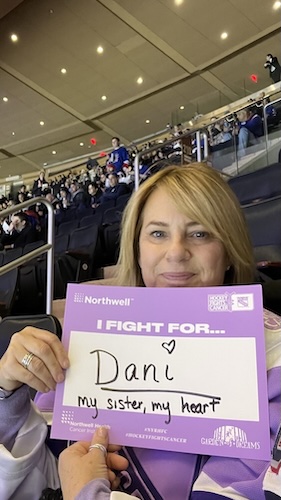
My sister was traveling when she sent me a report and said, “I need you to look at this.” I’ve always been the caretaker in the family. She owned a women’s boutique. She was traveling in Savannah and said they wanted her to stay for a test. I don’t remember what it was, but they wanted her to have a dye test. She didn’t react well to the dye. They wanted to admit her, and she refused to be admitted because she was on a buying trip for her store. They insisted that she go home and have this test done as soon as possible.
She sent me the report, and I looked at Jim and said, “My sister has pancreatic cancer. That’s what they’re looking at.” And he said, “What?” I said, “That’s what they’re looking at, and nobody said that to her. They said, ‘You need to go to the doctor as soon as possible.’ And she said, ‘I’ll go after my season is over.’” She owned a seasonal boutique at the Jersey Shore, and I thought, “No, you can’t wait that long.”
But I also wasn’t 100% certain that I was looking at what I thought I was looking at, and I didn’t feel that it was necessarily my position to share that. I knew she was trying to go see a new doctor, so I said, “Why don’t we do this? Do you want me to go to that doctor with you? Why don’t you get the test done? Because he’s going to want that test, and then we bring that with us to that doctor.” And she said, “Okay, that’s a good idea.” That’s when she was diagnosed.
Carrying the secret, then watching a doctor hand back control
It wasn’t great. It wasn’t fun. But I knew that my job was to lead her to the team that could help her. That’s what I saw my role was. When we had her first appointment with the doctor she wanted to end up with, she was treated at Memorial Sloan Kettering, and they were terrific. She sought treatment both in New Jersey, where she lived, and in Manhattan, where we were a lot because she was studying.
At the first appointment we went to with the primary doctor, my sister looked at the doctor and said, “Don’t even tell me I have three months to live, because if you tell me that, I can’t.” The doctor looked at me, and to her credit, she pivoted and said, “Okay. Why don’t you tell me what you know about your disease?”
I thought that was such an empowering way to handle that. She gave my sister control. She allowed my sister to put up a screen against what she did and didn’t want to hear. And the relationship was terrific from then on. She had a great team. So did Jim. So did I. Each one of us had wonderful care from start to finish.
The major difference is I’m a complete control freak, and she wanted me to handle all of it. She was married. Her husband was around, my nephews were around, and she wanted me to handle it. She said, “You’re smart; you handle it. You make the decisions.” There was a moment when she wanted me to consider making her end-of-life decisions, and I said, “I won’t do that. I’ll be your voice. I’ll give you a voice. But I won’t do that.”
The perspective that gave me was that when Jim was diagnosed, I knew that if he was going to go all in and believe in his treatment, he needed to be the decision-maker. He needed to take control. In our house, he’ll be the first one to tell you that it’s rare that I shut my mouth, and it’s rare for me not to have a say in things. But when we were going to Dana-Farber, UT MD Anderson, and Penn Medicine, and we were investigating his options and his treatment teams, I knew he needed to make the decision. It was my job to step back and support that decision, because I felt he was going to be a lot more successful and manage his care better if he was the one steering things.
That was a completely different position than I was in with my sister, even with my care. My doctor was annoyed because I kept saying, “Oh, I want to do this, I want to do this, and I need to get this done before I have anything done with your team.” And she said, “Do you hear yourself? You have cancer.” Please don’t take this as discrediting anyone who’s gone through any cancer. But, in my mind, I had my sister’s pancreatic cancer on one hand, and I had my stage 1 breast cancer on the other hand. I knew that mine was going to be a nuisance, but the odds were that I was not going to die from it at that time. Maybe it would come back years later. Maybe I would have complications. But she was in a different place. And then Jim was in a very different place. The scenarios were so different, and they all needed to be managed differently.
I think I was smart enough to understand my husband. We’re coming up on our 40th wedding anniversary, and we’ve been through a lot together. I know him well enough at this point to know that he needed to feel that he was in control, and that was going to be the thing that gave him what he needed from this.
If he was in a position where everyone dictated to him what he needed to do and he felt somebody was making decisions for him and he was not fully investigating, it would be a problem. Who wants to carry that for someone else? It was rough to carry that. Would I do it again in a heartbeat? Absolutely. Would I do what I did with him in a heartbeat? God, I hope I don’t have to. But if you have a significant other, if you’re fortunate enough to have a significant other, your relationship plays such an important part in your role as the caregiver: what parts you take on, and how you extend that care.
The Wawa parking lot: Reading the statistics before telling my husband
I had a piece of paper in my hand from the dermatologist’s office with a list of oncologists on it and the BPDCN diagnosis. Jim had gone into Wawa to get something to drink, I think, and while he was in there, I looked up the diagnosis. You look it up, and you read nothing but extremely scary, pretty lousy statistics in terms of mortality. Who wants to read that? Who wants to be sentenced to a statistic? Nobody’s a statistic. I’m not. My sister wasn’t. He wasn’t.
Your numbers matter in studies, drugs, and everything else, but who says you’re going to be the statistic? Why can’t you be an outlier? I looked up Jim’s diagnosis, and as he was getting back in the car, I thought, “What am I going to say to this man?” We had very little conversation on the way home. I think he took one look at my face and didn’t really want to have a conversation then, because he knows I’m not quiet often.
A cancer neither of us had heard of
With Jim, the BPDCN diagnosis came about because he’d had a problem with his shoulder. I’m a big universe feeder, as my daughter calls me. He’d had a shoulder injury, so he was sleeping away from me. I’m up a lot in the middle of the night, so I turned on my side and noticed this spot on him, and I thought, “I don’t like that. That doesn’t look right to me.”
If he hadn’t hurt his shoulder, the universe never would have shown me that spot. I never would have seen it. I don’t see his back when he gets out of the shower or at any other time. Unless I’m standing behind him, I would not have seen it. I feel like, as bad as the diagnosis was, we are so fortunate that things lined up the way they did, and I saw it.
The spot that looked like an almond
He was not at all concerned. I was concerned because it didn’t look like anything I had ever seen before. It was different.
It looked like an almond, honestly. It had a shriveled, wrinkled texture on it. It was about the size of an almond. It looked very much like an almond. I didn’t like how it looked.
I said, “When are you going to the dermatologist again? When you go, can you please show them this?” He said, “It’s fine. It’ll be fine.”
More than a little advocating: Getting the first biopsy
There was more than a little advocating. We’d gone to the wedding of a childhood friend of Jim’s. Their kid got married. I noticed during the weekend that whatever was on his body had spread to his face. It was on his forehead, in his beard, along the side of his face, and on his trunk. Fortunately, his GP is amazing, and they have walk-in hours every afternoon. I said, “Monday afternoon, we’re going. Let’s go see what this is.”
The doctor took a look at Jim. Jim could not see his face because he was standing behind Jim, looking at it. He looked at me, and I thought, “Oh, he’s not liking that.” I was glad Jim couldn’t see his face. Honestly, it looked like a blood rash. He said, “Jim, I don’t know what this is. I’ve never seen anything like it before. But I’m going to do a complete blood panel, you’re going back to the dermatologist, and you’re going to get it biopsied.” We got in the car. They did a bunch of blood work, which was all fine, which made us relax a little.
He was checking out as I went out to the parking lot. I called the dermatologist’s office from the car and said, “My husband is a patient, and I’m a patient. We’ve been patients there for 30 years. He needs to have something biopsied. We’re at his GP’s office, and they gave me an appointment in two weeks. He needs this now. He needs it as soon as possible.” I was told two weeks is not that long to wait for a biopsy. That it’ll be fine.
I went there the next morning, drove to the office, stood at the desk, and said, “What can you do? Can you get him in sooner?” They said, “Well, we can get him in Tuesday instead of Thursday.” I gave him the option, and he said, “At this point, I’d rather just wait till Thursday, because that’s the doctor I’ve been seeing.” I went with him to that appointment, and the doctor said, “This is not a big deal.” I looked at him, and I said, “This is systemic in nature.” I could be wrong, but I’m pretty sure he believed it was some kind of rosacea. I said, “You biopsy everything else. Biopsy it.” He said okay. And that’s when Jim got biopsied.
“If I love you, I’ll fight tooth and nail”: Where my advocacy comes from
That’s my personality. I’m very much like Jim’s dad was: If he loved you, he was like the lion protecting the cub. He would go to the ends of the earth for you. And I’m very similar.
If I love you, I will fight tooth and nail for you. If I don’t love you, go on your merry way. You don’t mess with the people I love. I see that as part of my job.
Jim takes the wheel: Choosing where to get a second and third opinion
He did the work.
He jumped right into it and said, “I have this, this, and this all set up. We’re on a plane on Monday and on Wednesday, and this is what we’re doing.” We went into motion.
Learning the caregiver’s job was the stem cell transplant itself
There’s a lot that goes into that. Initially, there was no real discussion about the role of the caregiver. Where the discussion came in was the transplant process and when Jim would come home. That was huge. The carpets and the couches needed to be cleaned. The sheets needed to be changed every so many days. The bathroom needed to be wiped down with bleach all the time. With food, there’s a huge list of foods he could not eat. I don’t know how anyone without a partner or a significant other can get through that stage, because it is so involved.
When he wanted to come home, he was very unsteady on his feet for a little bit. He was very weak, and he wanted to come home. I don’t get afraid too often, but I was terrified for him to come home. We have a very vertical home with open staircases. When I was at my sister’s, at one point, she couldn’t manage the stairs, and her sons put her in a chair and carried her up the stairs. I thought, “If I have to get him upstairs, what am I going to do? If he falls, what am I going to do?”
I was very fearful. I didn’t tell him I was afraid. I think he was aware that I was afraid. What I broached was the subject of: I want you to come home, but I want you to come home safely, so that you can remain home. If you come home prematurely, we’re not doing anybody any good.
When he came home, it was, “Oh, you’re going to do these infusions every day for him.” I said, “What infusions?” And they said, “Oh, it’s fine, you’ll do fine.” I think because I had taken such a proactive role in the hospital, the belief was I would do fine, and I did do fine. But how do you know that? How do you know I’m going to do just fine with this? Maybe I faint at the sight of blood. Did you ever ask me if I wanted to do it? Did you ever ask me if we could set up a service? It was, honestly, it was assumed that I would do it and do it well.
They were scary, initially. And then, like anything else, when you get the hang of it. I don’t know that you can prepare for that. I think you just have to go through every day and do what you need to do as you need to do it, because every day was different, depending upon how we felt.
Coming home every night: What the hospital stay asked of me
I was very glad we made the decision. One of the doctors had such sage advice. She said to us, “Please do not discount the importance of being home when you can.” When we thought about treatment in Houston, we were set up for me to be in a hotel adjacent to the hospital for three months. Instead, I came home every night.
The first night, he said, “Can you stay?” I was shocked, because I think he was scared. Who knew the two of us could fit in a twin bed? It’s a good thing there are guardrails. So I stayed that first night. But when he was in the hospital, I went every day and went home every night. I was glad to be home in my bed at night with our dog. Our son is living with us, and he managed so many things on the home front. I was tired.
I called his mom most nights, because I can’t imagine being 89 years old and waiting for word on your child every night to know how he’s doing. I called his sister most nights because it wasn’t their choice; it was Jim’s choice. But they knew that I was the one entrusted with the care, and I felt a responsibility to let them know what was going on.
I will say I didn’t always tell them everything. There was no reason for them to know it. They didn’t need to know just how sick he was. They needed to know the good things. I didn’t sugarcoat things when I did tell them things, but there were times when I left a lot out. It was important to me to sleep in my bed and have access to things that bring comfort. He couldn’t come home, but I could come home, and I think that mattered a lot.
Friends who showed up with gluten-free snacks and silence when needed
I have a very solid friend base, and I’m very close with my brother. My sister was my person, but I’m very close with my brother, and we’re even closer now. My friends were amazing. They couldn’t be here, even when he came home, but they sure checked in. And when I didn’t want to talk, they knew I wasn’t going to talk, but they made it known that they were here for whatever we needed.
Two of my friends got together and dropped off a thermal bag for me to take food to and from the hospital. I’m gluten-free, so it’s harder to eat out of the house. They put together gluten-free snacks and things I could take back and forth, thoughtful things that mattered.
He got me through it, too. He’s a strong guy. He’s a headstrong guy. And in the end, he wanted to come home. There were times when he wasn’t doing so well, when I would move his arms and legs for him, because I didn’t want his muscles to atrophy, and he was pretty out of it. I’d sit there all day, and I’d say, “Honey, I’m going to go home.” And he’d say, “You’re going?” I thought, “I just watched you sleep for nine hours. Yes, I’m going.”
But when he made up his mind that he was coming home, he told the staff, “I’m going home.” And they said, “You need to consume a certain number of calories for several days in a row, if you’d like to do that.” He said, “I’m not going to get well unless I go home.” Whether that was true or not, I’m not quite sure, but it doesn’t matter, because that was what was true in his mind, and he decided that he was going to go home.
So whatever requirements they set forth, I went out and bought the highest-calorie foods I could find, like a big, fat piece of cheesecake. I think it was awful for him to eat that, but he did it because he wanted to come home. He’d had it. He was done. I think that’s a great sign. He was aggravated, finally, at being in the hospital. He didn’t want to be there anymore. Whereas before that point, half the time he didn’t know where he was.
47 days: Coming home the day before our anniversary
The first round was eight days. This was 47. It was a long time. He came home on September 27th, and our anniversary is September 28th.
Maybe a week or two later, he said, “Our anniversary.” I said, “What about it?” He said, “You didn’t tell me.” I said, “Why would I tell you? I didn’t want you to feel bad. You never thought about it. You never missed it before. It was clearly not a thing, and I didn’t want it to be a thing.”
This year, we’re fortunate that he got the clearance from the team. We’re going to go away for our anniversary.
Celebrating with a bottle of wine: Marking one year since the transplant
For a lot of our life together, he was busy climbing the corporate ladder, so we tended to fit our anniversary in. Our anniversary might land on a Tuesday, and we’d go out on Saturday. We’d celebrate it whenever. But this date was non-negotiable.
For the anniversary of the stem cell transplant, we went out for a very nice dinner with a very nice bottle of wine, and we said we’re celebrating this in a very important way. This is a huge deal, and we’re so fortunate and so grateful.
Finally making time for my breast cancer diagnosis
I try to acknowledge it, but it’s done. Now I go to my follow-ups. I did have a little bit of a scare in 2025, in the midst of everything. But it’s in our lives now. It’s not something we’re focusing on.
I’m playing catch-up with all the things I missed in the last year and a half, and trying to get back on track to make sure I’m monitoring my health as well. His appointments continue. Thankfully, instead of once a week, we’re now at every month. Soon, we’ll go every other month, which is wonderful, so it will feel like less of our agenda being full of medical appointments.
Grateful for a new treatment and for every rare disease getting attention
It’s fantastic to know that dollars are going there, that there is attention going there. We’re grateful to The Patient Story for featuring BPDCN and getting the word out there about rare disease. I have a friend whose husband passed quite a few years ago from cholangiosarcoma. (EDITOR’S NOTE: The American Cancer Society explains that while nearly all bile duct cancers are cholangiocarcinomas, bile duct cancers that start in gland cells, other kinds of bile duct cancers exist, including lymphomas and sarcomas, many of which are far less common than cholangiocarcinomas.)
One of my best friends’ brother-in-law passed from cholangiosarcoma not that long ago. When I said my friend’s husband had cholangiosarcoma, she said, “You must have it wrong. Nobody has that.” I said, “I’m telling you, he has cholangiosarcoma.” We have a very good friend who right now has pancreatic cancer, and she just started on one of the new drugs that was just approved.
It’s always so important to see the money go in, the attention go in, and then finally see that somebody is benefiting from it. Our friend who has pancreatic cancer right now said, “I just don’t want to be like your sister. I don’t want to die before I get a chance to go on this drug.” If Jim had this disease 10 years ago, he probably wouldn’t be alive.
Feeling seen instead of isolated
The day-to-day was isolating, because you’re so busy managing the back and forth to the hospital and appointments. But now we all talk on our phones in the car: You put them on speaker, and you can still stay in touch with people. Years ago, somebody gave you a gift card for the phone, and you went down the hall in the hospital to talk to somebody, and that was the only time you could do so. Now we have so much more access to people.
It was isolating for us in the sense that we felt like nobody had any experience with this disease. We felt that we had a great team. We felt that people were there to support us, if we allowed them. In some ways, it drew people closer to us, and us closer to people, because we let ourselves be more vulnerable.
We had the fortunate experience of meeting a woman the day Jim was discharged from the initial chemo. She had had a transplant. She was wonderful, and she talked to us for quite some time. She and Jim have kept in touch. In August, we met her and her husband for lunch one day, so that’s been nice. We met some amazing people. The nursing staff was just incredible: from housekeeping to phlebotomy to everyone. They understood that kindness mattered. More in this experience than at any other time, we felt seen.
The hardest part: Watching the people I love feel pain I couldn’t fix
The hardest part was when they had pain that I couldn’t control or do anything about, whether it was physical pain or emotional pain. That was hard, because you can’t always take someone else’s pain, as much as you’d like to.
What being a caregiver means to me
You show up for the people you love, period. If you love somebody, you show up in whatever way they need you. That’s part of your relationship.
It may sound naive, but I don’t care if you show up with a message saying good morning or asking if you can donate blood, or if you show up to the hospital every day. You show up for the people you love. That’s what families do. That’s what friends do. And that makes us human.
What do we have if we don’t have that?
The same lesson, learned twice as a caregiver: Stepping up or stepping back
I didn’t know what to expect. The biggest message for me was that the idea behind being a caregiver is so relative to your relationship with the person and understanding what they need from you.
My sister needed me to be the point person, and Jim needed me to be the point person when he wasn’t able to be the point person, but to step back and support when he was.
My advice: Advocate, every time
Always advocate for your person. Even if they’re advocating for themselves, you advocate more.
If you have questions, if something doesn’t sit right with you, listen to your gut. There’s a reason it’s talking to you. If you don’t, you’re going to always wonder about that. Get past that. Speak your mind.
It’s your team’s job to entertain those questions and to explain. There are no bad questions, and that goes into this medical situation as well. There are no bad questions. If you have a question, ask it.
Advocate for your person. Speak up for them. It goes right down to the biopsy. Biopsy it.
This interview has been edited for clarity and length. The views and opinions expressed in this interview do not necessarily reflect those of The Patient Story. This content does not replace professional medical advice.
Inspired by Nan’s story?
Share your story, too!
Hear from cancer caregivers and care partners
Real experiences with caring for cancer patients — in their own words.
Leave a Reply