
Growing Up, Her Father Had Stage 4 Colon Cancer, Then She Was Diagnosed at 43
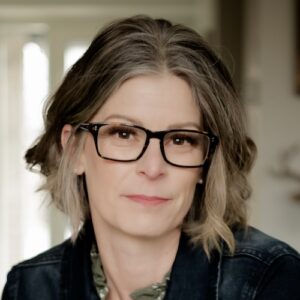
Kathryn had already lived through stage 4 colon cancer once, in the worst way possible: She was 22 when her father died of it. So when a sharp pain in her side and a strange new exhaustion sent her to the emergency room in November 2014, she wasn’t naive about what cancer could look like. She was, however, dismissed. The ER doctor said she was constipated. Her family doctor refused to even discuss the possibility of cancer, despite her father’s history. It took a walk-in clinic doctor, three months later, to finally order an ultrasound, spot suspicious activity on her liver, and set her on the path to a colonoscopy that revealed her colon was almost completely blocked.
Interviewed by: Tory Midkiff
Edited by: Chris Sanchez
In February 2015, surgeons removed half her colon and confirmed what the ultrasound had suggested: The cancer had already spread to her liver. Her oncologist gave her the diagnosis she had feared, stage 4 colon cancer, and laid out a plan built around 12 rounds of FOLFOX chemotherapy (a combination of oxaliplatin, leucovorin, and fluorouracil) and a resection to remove the entire right lobe of her liver. Kathryn and her husband asked him not to share survival statistics. She wanted to move forward without a number attached to her.
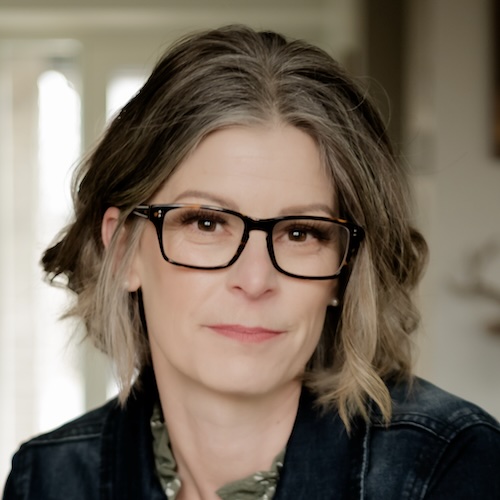
Treatment brought its own surprises, including a rare, temporary loss of her mid-distance vision that her care team said they had never encountered before. By round 10, with peeling skin and mild neuropathy in her hands and feet, she and her doctor agreed to stop the oxaliplatin early. Kathryn rang the bell in 2015, but stage 4 colon cancer rarely offers a clean finish line. A recurrence in her right lung arrived around the three-year mark in 2018, followed years later by a second recurrence in her left lung.
She has never reached the five-year milestone many patients count toward, and she has stopped trying. Now more than a decade from her original diagnosis, she manages her cancer as a chronic condition, still checks in with her oncologist by phone, and channels her experience into advocacy with Colorectal Cancer Canada, pushing to lower the screening age to 45.
For more about Kathryn’s colon cancer experience, watch her video and read the edited transcript of her interview.
- Kathryn spent three months bouncing between an ER doctor who diagnosed constipation and a family doctor who refused to discuss cancer, even after she reminded him her father had died of the same disease. It took a walk-in clinic doctor willing to order one ultrasound to change everything. She still carries the lesson that “we’ll wait and see, come back in three months” is never a good enough answer.
- When her oncologist offered to walk her through survival statistics, Kathryn and her husband asked him not to. She didn’t want a number standing between her and the next day, and it’s a decision she has never regretted, even through two recurrences.
- Twelve rounds of FOLFOX chemotherapy, a liver resection, and two separate lung surgeries have taught Kathryn that treatment for stage 4 colon cancer doesn’t move in a straight line. She developed a temporary vision problem so rare that her own doctors had never seen it before.
- Finishing chemotherapy didn’t feel like the relief everyone expected. Kathryn describes losing her sense of identity once the structure of appointments disappeared, a part of survivorship she says isn’t talked about enough.
- A milestone doesn’t have to define whether someone is doing well. Kathryn has never reached the five-year, cancer-free mark that many patients count toward, and letting go of that number has made more room for her to actually live.
- Cancer has reshaped how Kathryn moves through the world. She describes herself as slower, kinder, and more attuned to the people around her, and she has turned her own delayed diagnosis into advocacy for lowering the colorectal cancer screening age.
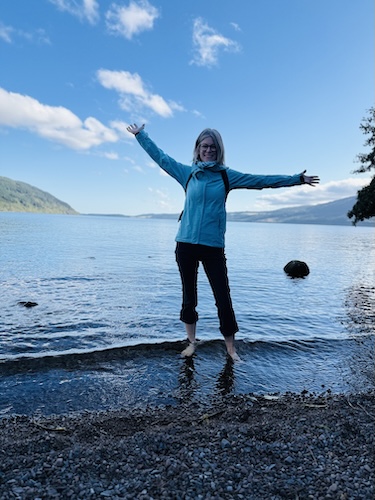
Kathryn’s Diagnosis Facts
- Name: Kathryn W.
- Age at Diagnosis:
- 43
- Diagnosis:
- Colon Cancer
- Staging:
- Stage 4 (Metastatic)
- Symptoms:
- Abdominal pain
- Shortness of breath
- Dark thin stools
- Exhaustion
- Treatments:
- Surgeries: right hemicolectomy, right hepatectomy, abdominal resections, right lung resection, left lung resection
- Chemotherapy: FOLFOX
This is not medical advice. Please consult with your healthcare provider to make informed treatment decisions.
- Kathryn’s Diagnosis Facts
- I grew up with my father’s stage 4 colon cancer
- A sharp pain, constant fatigue, and being sent home after being told I was just constipated
- Waking up from a colonoscopy to news I wasn’t expecting
- Facing my first major surgery as a wife and a mother of two teenage boys
- Meeting my oncologist, a plan for 12 rounds of chemo, and choosing not to know the statistics
- The first five rounds of FOLFOX felt manageable… until they weren’t
- Finishing 12 rounds, moving to scans every three months, and the first sign trouble was coming
- What ringing the bell felt like
- Finding purpose again through yoga, a marathon goal, and a hard lesson in food anxiety
- A devastating recurrence in my lung at the three-year mark
- A difficult question about genetic testing for my sons
- Turning my story into advocacy for earlier colorectal cancer screening
- What living with stage 4 colon cancer looks like, more than a decade later
- My advice for anyone newly diagnosed with cancer
- Hear from people living with colon cancer
I grew up with my father’s stage 4 colon cancer
I’m Kathryn, and I’m a stage 4 colon cancer survivor and thriver; I like to call myself a thriver. Precancer is really interesting. My story actually starts back in 1996. When I was 22 years old, my dad died of stage 4 colon cancer, and I was with him when he died, which is relevant because I knew what that looked like. I was not told to do anything. Everyone was like, “Oh, sorry about your loss,” and go on and live your life. And when you’re 10 years younger than your dad was when he passed (he was 63), so at 53, you should think about getting some screening done.
I just went about my life. I was a teacher. I was married to my amazing husband. We have two children, and we just lived life. I’m busy; busy is a badge of honor, busy and doing all of the things that normal families do. Until things started to change in my body, and then it was like, “Something’s going on here.”
Hearing “stage 4 colon cancer” after already watching my father die of the same cancer
It was very surreal. It was one of those moments where I was like, “This can’t actually be happening. This is not possibly happening.”
I remember when my oncologist said “stage 4.” Because in my mind, for some reason, we knew I had cancer going into the oncology appointment because they had discovered it through a colonoscopy. But when he said “stage 4” in the appointment, I had no words. I couldn’t think straight. I thought, “I have seen this before; I know what this looks like, and this is not good. This does not end well.”
A sharp pain, constant fatigue, and being sent home after being told I was just constipated
I was a teacher, and busy going about work. I remember being at work one day and having this sharp pain in my left side, and I thought, “Oh, that’s kind of odd.” And then it kept happening and kept happening. I thought it could be pancreatitis, because I’d had pancreatitis some years before.
And then I started noticing that I was really tired. I had this sharp pain on the left side, and I was tired. But like every mom and person who has a job and goes about their busy life, it’s like, “Well, I’m probably just tired from life.”
I was outside of my school, a couple hundred meters from the school, and I couldn’t walk to the school without leaning up against the wall and being exhausted. Not normal exhausted. I was a runner. I knew what tired felt like as a mom, all those things. But this was a different kind of tired.
And then I went to the emergency room one day, because I was having such sharp pains that I was almost passing out. The emergency room doctor gave me morphine, enough to knock me out so that I wasn’t in agony, and they told me I was constipated. No diagnostics, no nothing. They just told me I was constipated and that I should go home and take some things to figure that out.
To make a very long story short, my family doctor also did not want to have a conversation about cancer. We had brought this to him and said, “I’m having these symptoms. Things are not going well. Just a reminder: My dad died of stage 4 colon cancer,” and he’s like, “No, no, we’re not talking about cancer.” I was almost 43 at the time.
It was actually a walk-in clinic doctor who listened to me and sent me for an ultrasound. They found the spots on my liver, and they ended up being metastases. And I was sent to a surgeon to have an upper GI scope, and the surgeon said, “No, we need to do a colonoscopy.” When I woke up, he said, “Your colon is almost 100% blocked. We’re going to have to do surgery. It’s probably cancer, but we won’t know until we see it.”
It kind of landed in my lap in a post-op room, by myself, not expecting to hear that. And yet, at the same time, grateful that he had listened to me and that now somebody was actually listening to me and things would go forward.
Learning to advocate for myself after a lifetime of trusting that the doctor knows best
That’s something I’ve learned, and I’m going to have to give my husband a lot of credit for that. I wasn’t a big advocate. I thought, “The doctor knows, and they would know if there was something wrong.” I wasn’t that person to push. It was my husband who pushed me to go to the walk-in clinic doctor, and then a whole bunch of other things where paperwork got lost.
I didn’t know how to advocate for myself; it wasn’t part of my personality. But my husband is a stronger person that way. I’ve learned from this that you absolutely have to advocate for yourself. You have to say, “So if it’s not this, then what is it? And how are we going to know? And when are you going to see me next, so that we can figure this out?”
The next steps part is crucial. Not just walking out of the office with, “We’ll wait and see what happens and come back in three months,” or something like that. That is not good enough.
Three months between my first ER visit and the doctor who finally looked closer
The emergency room visit was in November 2014, and the doctor who said, “Let’s have a look at this,” was in January 2015. So about three months.
Waking up from a colonoscopy to news I wasn’t expecting
The first thought I had was, “I need my husband. I can’t be alone to hear this.” And then from there, I recall it being, “This is not good. I have seen this before.” Kind of the same thoughts I had when the oncologist dropped it in my lap.
But I also felt a great deal of confidence in this surgeon. He was very compassionate and very kind. Could he have had my husband there with me? Yes. But I think we all know that people are often alone. It was a matter of, “Okay, this is at least going to get us some answers, and maybe somebody will take care of me, and I’m going to be okay.”
What the scans revealed about where the tumor was hiding
He was very confident that the colon was almost 100% blocked, so he said, “We’re going to do some further testing. You’re definitely going to need surgery one way or the other. Half of your colon is going to have to come out because of that blockage.” And then he sent me back to my family doctor, where it went very quickly from there.
It’s like this ironic piece of, “You’re too young to have colon cancer,” and now you’re in this place where it’s like, “Oh, you probably have colon cancer, so we’re going to move things along quickly.” It’s a very odd space once they know.
I had the liver ultrasound, an MRI, and a barium enema so they could see where the tumor actually was. It turns out the tumor was growing on the outside of my colon, at the curve of the ascending colon and the transverse colon, so it was difficult to find. They were able to locate it, and they wanted to make sure they knew where it was. I had CT scans and a lot of blood work, all of the things.
Facing my first major surgery as a wife and a mother of two teenage boys
It was the first big surgery I’d ever had. Our sons were teenagers at the time, so we were navigating my emotions, my husband’s emotions, and those of two teenage boys. There was a lot of anxiety in the house, to say the least. This threw me off a little bit.
They actually called me two days early to say, “We actually need you to come in now because you’re so anemic. You need to have a blood transfusion because we can’t operate until we get some more blood into you.” We were not ready for two days from then, but psychologically we weren’t ready for going in earlier either.
At the same time, I guess things are going to keep moving forward, and we’re just going to make this happen. It turned out I needed two blood transfusions. I was that anemic. And then being in the hospital for that bit of time before the actual surgery gave us some time to ask other questions of the staff about what this was going to look like and to meet with the surgeon. We got a little bit of pre-care, as opposed to showing up on the day of and being moved straight into surgery.
A successful surgery, confirmed liver spots, and the surgeon I call my lifesaver
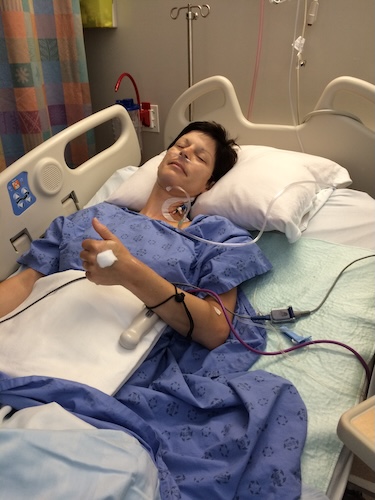
The surgery was very successful. The surgeon took out half of my colon. It’s maybe a little bit too much information, but he said he went across my whole colon and through my bowel, and checked every inch of it to see if there were any other spots that had shown up that they needed to be concerned about, which there weren’t.
He did confirm that there were spots on my liver. We were not familiar with the world of cancer and all of the language around it; we just knew that’s not good. We already knew they were there, but he confirmed that there were multiple ones. He took some lymph nodes to test. I can’t remember how many exactly; I think it was 19, and a few of them showed evidence of cancer in the lymph nodes. So it was a lot.
It was a lot for never having had that kind of process before. But I had so much faith in my surgeon. I always say that he’s the person who saved my life. The walk-in clinic doctor who listened to me got the ball in motion, but the surgeon, when he said we needed to do a colonoscopy, is the person who saved my life.
Meeting my oncologist, a plan for 12 rounds of chemo, and choosing not to know the statistics
Surgery was in February 2015, and at the beginning of March, I was in the oncologist’s office to meet my oncologist for the first time. He was absolutely wonderful. He was very compassionate and very thorough. We went in and told him that we did not want to know the prognosis. We had zero interest in knowing any statistics. We had already decided going in that every day was a 100% chance of surviving, and I didn’t want my mind to be clouded by statistics.
I know other people find statistics helpful, but for me, having seen my dad go through cancer, there was just that mental picture. I have to live. Whatever this is, I have to live. He told us that it was stage 4 colon cancer and gave us some time to process that. I think we were there for two to three hours with him for the initial visit. It was very thorough. He went through all of the things around it: blood tests, chemotherapy, and the next steps: where we were going to go from there. He really laid out a very clear and confident plan for us.
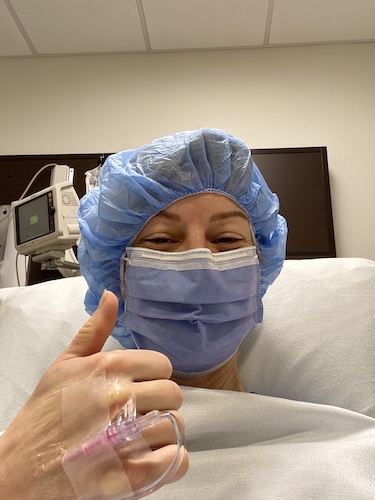
The plan was to have five rounds of FOLFOX chemo, have some time off, and then they would talk about a liver resection, which did end up happening, and then chemotherapy after that. Twelve rounds of FOLFOX was the plan from the beginning. He gave us lots of time to ask questions, and when we left, I went to shake his hand and thank him for his time, like it was this general meeting about nothing important. Then he asked, “Are you a hugger?” I said I am, and he said, “Then bring it in,” and gave me a big hug. And he has hugged me at every appointment since. He’s always very honest with us and very compassionate. He said from the beginning, “I will support you all the way. We are in this together, and I will take good care of you,” which meant a tremendous amount for two people who had no idea what the world of cancer really looked like.
It has been a huge part of my mindset around navigating cancer. I’ve had my moments. But I believe every day that I need to get up and keep moving forward, rather than feeling clouded by other possibilities.
Preparing two teenage sons for my chemotherapy
Teenage boys are difficult on a good day. When we told them, my oldest was very pragmatic, and he was just like, “Everything’s going to be fine. You’re going to be fine. It’s all going to be okay.” My younger son is more emotional, and he basically went to his room and shut his door. We had to figure out how to interact in the household.
I started chemo in April, so we had a month to a month and a half before I started chemo where we had to figure out what this was going to look like and try to get the boys to understand that I was going to be different and that things weren’t going to be the same.
But what we embraced from the beginning with the boys was open communication, being honest and clear with them because they were 15 and 16 at the time, and trying to be normal leading up to the beginning of chemotherapy. We started something we called mandatory family fun days, and that carried through until they left home. When we were going to have one of those days, it was like, “Okay, everyone’s going to clear their calendar, and we’re going to spend time together and do something. Who wants to pick? What are we doing?” We’ve done kayaking, mini golf, and ax throwing. We’ve done all kinds of things to try to keep the family bond and keep the communication open. It was not perfect by any means. But there’s no guide to parenting teenagers when you are diagnosed with cancer out of the blue. I think a lot of it was just trying to stay normal.
My husband’s job takes him away from home a lot. He’s a pilot, so he’s on a pilot’s schedule. But his company was very compassionate and gave him time to be at home so that we could mentally and physically prepare ourselves for this. We were able to go into the chemo unit and see what it looked like. I live in a smaller city. We have a beautiful hospital that has an eight-bed chemo unit, so I was able to do chemo seven minutes from my house, which was helpful.
When I’d had my colon surgery, I announced it on Facebook: “This is what’s happening in my world. Positivity only. Can you send me some positive songs?” I made a positivity playlist and took that in with me. A friend bought me an adult coloring book, and I took that in with me.
I decided that I didn’t want to go into chemotherapy to socialize. I know some people do; some people love having the conversations. I needed to be in my own space and have my own way of moving through it. It was a very insular thing for me, but it was also kind of meditation in motion, the coloring and the listening to music, and being able to care for myself as I was going through chemotherapy.
I didn’t ever have anyone stay with me. I wanted to be alone and navigate this in my own way. It’s not that I didn’t have offers, but I just wanted to do it quietly. It made a big difference. I did some knitting too. The chemo experience is so different for everybody. The nurses were compassionate about me not wanting to socialize with other people, and gave me the space that I needed.
The first five rounds of FOLFOX felt manageable… until they weren’t
When I got home from round one, I remember feeling, “Okay, this wasn’t as bad as everybody said it might be.” I felt fine after round one, but people had said it was cumulative.
The first few treatments were manageable. The oxaliplatin wasn’t a problem for the first five rounds that I had. I was tired and didn’t feel great, but I kept doing as many normal person things as I could. It was rounds seven through 12 that it got a little more difficult.
A six-hour liver resection, a vision side effect doctors had never heard of, and choosing to stop oxaliplatin early
After round five, I always joke and say they gave me six weeks off for good behavior. So I had six weeks to recover from the five rounds, and in that time we did fun things, we just kept living, and I traveled with my husband a little bit. I went to my high school reunion across the country. I thought, “These are the things that I need to do now, because we don’t know what this is going to look like later on.”
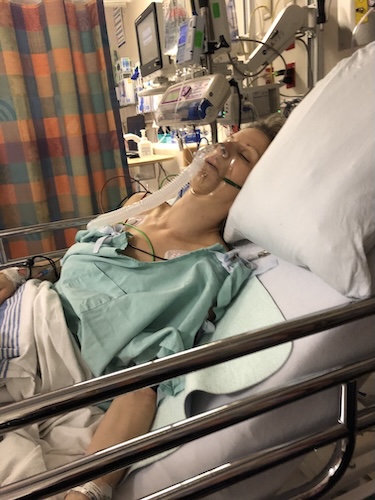
At the end of July 2015, I had my liver resection, the whole right lobe. It was interesting. It was a six-hour surgery. I had an amazing surgeon. We’ve been blessed with an amazing medical team. He told my husband, when he came out of the surgery, that it was his opinion that the spots were all scar tissue, that the chemo had done its job. But he took the right lobe anyway, because I’m young and healthy. They’re going to be really aggressive and get everything.
I had another six weeks off to heal, and then went into rounds seven to 12. I was recovering from a big liver surgery, and psychologically, a lot was going on. There were a lot of mind games. My abdomen hurt. The nerves were coming back, so things were tingling. It was a full abdominal surgery. It wasn’t laparoscopic; they opened up my rib cage, and my ribs were always achy. There’s just a lot of other pieces to it that weren’t even part of the cancer. My body is shaped differently now, because of where the liver regrew. All of these pieces that I didn’t know what they were then, but they just felt off.
Going into round seven, I was like, “Why are we doing this? Did we not get everything?” But as I understand it, retrospectively, they wanted to just make sure they’d hit everything. Rounds seven to 10 were difficult. I had some very strange side effects.
The biggest one, which, when I brought it to the doctors, they said they’ve never heard of it before, was when I lost my vision. I couldn’t watch television because the TV was too far away, and I couldn’t read a book or be on my iPad because it was too close. I had middle vision, but I didn’t have distance or up-close vision. That would happen when I was on the pump, when I brought it home. Once the bottle came off, it was about a day to two days after that that things sort of re-regulated themselves. But I remember being very afraid of that. I can’t lose my vision. They never heard that side effect before. I said, “You might want to add that to the list, because it’s a weird one and it’s very disconcerting.”
I remember being on the couch a lot. I watched 12 seasons of a series on Netflix because I couldn’t do much aside from that. My husband would get me out of the house as much as we could. He had a motorcycle, so I would ride on the back of the motorcycle with him just to go anywhere. We live close to the country, so we’d go out in the country and have a picnic. When I’d tell him that I was exhausted, we’d come back home and do a lot of sleeping, not much of anything else.
Around round 10, I was starting to feel the oxaliplatin. My feet and hands were starting to peel. I was fortunate. I’ve talked with other people who’ve done FOLFOX. I had tingling in my fingers and a little bit of numbness in my feet, but not nearly what I know other people have had. But the doctor who was caring for me through the chemotherapy said that I didn’t need to do 11 and 12 with oxaliplatin if I didn’t want to, so we elected not to. We decided that I was all done with that.
Blood work, a chemo bottle, and the white blood cell shots I learned to give myself
Every two weeks, I was in for blood work in the morning, and then I would have my treatment. It was usually about half a day, once everything was said and done. And then I’d come home with the bottle for 36 hours. I was very fortunate that there was a nurse who would come to the house and take the bottle off for me. I didn’t have to do that on my own.
I was also taking shots to keep my white blood cell count up. She was delivering those, and at a certain point I just started doing it myself, because I learned how to do it out of necessity. Then I would have a full week off.
We started calling them the good weeks and the bad weeks. The bad weeks were post-treatment, where things felt yucky and down. And then the good weeks were when we would live, do as much as we could, and enjoy our life and do things that brought us joy. Then it was in for the blood work and back into it. It was a week on and a week off for five rounds, and then the same for the next seven.
Finishing 12 rounds, moving to scans every three months, and the first sign trouble was coming
I did two more rounds of without the oxaliplatin and rang the bell. I had another colonoscopy to make sure that things were good. I was on three-month scans for probably a year to a year and a half, and then they moved to six-month scans.
Then I had a recurrence in 2018. As I thought I was getting closer to moving towards five years, I was about the three-year mark when we were thrown back into the whole thing.
The scanxiety neither of us recognized for what it was
Scanxiety is definitely real. It’s funny, because I’m more of a go-inside when things are uncomfortable, and my husband is more like, “What can I do to make things better?” There was a lot of anxiety, probably a good week or two leading up to what was to come. There’s always that thought of, “What if?” What if they find something? Numerous scans were clear. They were clear for three years, almost.
We didn’t understand what we were feeling. We knew that there was a lot of emotion, and we didn’t understand it. We had this weird dance around each other. He would be like, “What can I do? I need to help you. I need to do something to make this better.” And I was like, “I just need to be alone. I just want to go over there and be by myself. I don’t know what I need right now. This is hard.”
It was coming up on the three-year mark when we finally had a conversation around it. We were like, “Why are you behaving this way?” And then we’re like, “Oh, I have a scan in a week.” This was our dance of getting ready that we didn’t recognize. Once we recognized that each of us was feeling the same emotions but responding differently, our interaction with each other started to change. The anxiety around having the scans didn’t diminish; that’s something I’ve learned to manage much further out. But knowing this is why we’re feeling the way we’re feeling allowed us to come together as a couple and work through it together, rather than fighting each other’s emotions on it.
What ringing the bell felt like
I honestly thought it was something you were supposed to do. That was the symbol that you’ve done it. I’m going to ring the bell, and that’s going to symbolize that I’ve done this. I have no problem with ringing the bell; that’s not what I’m saying. It was just like, “I guess that’s just the next step, we do that, and then we go home.”
At our beautiful little clinic, it’s actually wind chimes that you ring, so it was very delicate and very pretty. I had my mom, my husband’s parents, and our sons there. Then it was like, “Okay, good luck! You don’t have to come back, so you can go home now.” The bell itself was emotional and closure in a way, but it was what came after it that I found was the difficult part.
“Now what?”: Finishing stage 4 colon cancer treatment and losing my identity as a teacher
I can speak about this very comfortably because I’m so far out from it now and I’ve had so much time to process it. I’d always try to remember where I was when I talk about it, because time changes how you remember things. But it is very surreal.
My whole year was about appointments, having to be somewhere, and being so highly monitored and so highly taken care of. For the exception of those six weeks off in the summer between surgery and chemotherapy, I was in the system. This whole “Congratulations! You rang the bell. You’re done! You finished twelve rounds of chemotherapy. I guess we’ll see you in a couple of months,” it’s like, “I’m sorry, what?”
I remember going home, looking around, and thinking, “Now what do I do?” I literally have nowhere to be. I had already decided I wasn’t going back to my job. With the brain fog and the physical fallout from chemotherapy and the surgeries, I couldn’t go back to being in a classroom. Now what do I do?
The medical system had become like a security blanket, and to have that blanket taken away? I don’t even have my own blanket. How do I take care of myself? How do I get up every day with nobody expecting me to be anywhere? It’s very weird. It’s like you go from 100 to 0 literally in the ringing of a bell. Everybody’s really happy for you, and it’s great. You’re all done, and you can go back to your life.
I remember thinking, “I don’t even know who I am. I don’t even have an identity anymore. I don’t want to be known as Kathryn the cancer patient, or Kathryn the cancer survivor, but I don’t feel like I have any other identity. Now what do I do with my life? How do I get up every day? And what do I do with those days?” It’s not talked about enough.
Finding purpose again through yoga, a marathon goal, and a hard lesson in food anxiety
I’m a learner. I like to learn. First of all, I went back to yoga. I found that was very helpful because it allowed me to reconnect with my body and try to get stronger again. To backtrack a little bit, when I was in the hospital for my first surgery, there was a whiteboard at the foot of the bed, and at the bottom it said, “My goal is.” I always joke that it’s probably supposed to be like, “My goal is to get up and go for a walk,” or, “My goal is to poop,” or something like that.
But I said to my husband, “I’m going to run another marathon,” because we had been marathoners. So I set that goal to run another marathon, sort of as my “I did this,” which we ended up doing about two years after all of the chemo and everything had been done. But in the interim, I needed a purpose. I needed something in my life. People had fallen away. We didn’t have a lot of people coming over and helping, and that might have been on us, because I mentioned I’m very insular. I wasn’t good at asking for help. In the world of cancer, some people don’t know what to do with you, so a lot of people fell away, and that’s okay. We’ve managed that.
It was a bit of a lonely process. Who do I call? How do I reintegrate myself into going out? Do I go out? I don’t want to get sick. It was a lot of mental gymnastics. So to keep busy, I signed up for a course. I took a nutrition course to learn more about food and what I should be eating, why, and how it would be helpful for me.
Ironically, the food course ended up giving me a tremendous amount of food anxiety, which has lasted for many years, because I started to become afraid of food. If I put that in my body, is that going to hurt me? Is that going to bring the cancer back? If I ate something, I thought, “Oh no, have I hurt myself. What have I done?” The course was great. I learned a lot of things, and I’ve used it and carried it through with me. But it was a good way to keep me distracted, to keep me busy, and to give me a purpose and something to look forward to in that year between ringing the bell and the first anniversary.
A devastating recurrence in my lung at the three-year mark
That was very devastating. I had a previous surgery there. We think that there were some seeds dropped from the original colon surgery, so I’d had an encapsulated cancerous mass beside my surgical site that I had taken out. I had become very hyper-aware of my body. But the metastases were in my right lung, so there was no knowing that it was there.
I was completely devastated. It was very difficult. I had signed up for yoga teacher training. I’m grateful that I was in that space when they told me about the mets, because I was with the most amazing people who held me, emotionally and physically, when I was working through the emotions of having to have lung surgery, which I was not familiar with.
There was a bit of a wait and a lot of fear. Why are they waiting so long? How come they’re not getting me in for surgery? I guess I’m not going to make it to five years, which is the gold standard of getting through cancer. I don’t subscribe to the five-year mark anymore. I have never made it to five years.
Now we’re back to zero, and I have to start all over again, which in itself was psychologically very difficult and telling our sons. That’s when we went ax throwing. We were all very angry, so we were like, “Okay, what are we going to do as a family to release this rage that we are all feeling?” We found a healthy outlet for it to try to bring everyone back together and figure out what’s happening here.
Letting go of the five-year milestone for good
I’m very blessed. Again, I hear other people’s stories, and I just feel so very grateful. There was no maintenance chemo. A couple of years later, I ended up having another one of those encapsulated cancerous nodules beside the first one. I don’t remember when, but they found another metastasis in my left lung this time; that’s why I’ve let go of the five-year mark. In 2023, I had lung surgery.
I’ve gotten to three years, and then I’ve gotten to three more years, and then I’ve gotten to three years again. There’s nothing I can do about it, except say, “That’s okay.” And my oncologist and I have talked about it, and he has said I’m an outlier. There are no statistics for my particular situation. He’s not focused on the numbers anymore. He’s just here to make sure that I keep moving forward.
I’ve been able to let go of that five-year piece. It’s a little bit liberating, because it allows me to live now, instead of having this goal. Again, I know that for many people, that five-year mark is important to them, and I am not diminishing that. It’s a very common belief, a common practice for people to want to get to that five-year mark. Maybe I will someday. I’m three years out now. I expect that I will. That’s my goal, that’s my plan, but I don’t focus on it anymore.
A difficult question about genetic testing for my sons
I asked my oncologist about it not so long ago. I don’t think we ever did any genetic testing, but there was never any conversation around it. He said he would have to go back and look. The conversation for me now isn’t about myself, but about my sons, and wanting to know whether they will be open to going for genetic testing or not.
I understand more about genetic testing now, and how it can be very purposeful if they have something, and how that could be helpful for them in their health moving forward. But it’s a difficult question to answer, because my oncologist and I have briefly talked about it, but we’ve not had any big conversations around it.
I feel like I have put the boys through a lot. I’ve had the conversation with my younger son and said, “If you were having it done, they may or may not find something. But if they do find something, and down the road you end up having colon cancer, they’re going to know what to do with you.” If it’s Lynch syndrome or a KRAS mutation, they will say, “We know what we’re looking at,” and that, in my opinion, would set him up to get started right away. There wouldn’t be any kind of delay.
I haven’t been able to have the conversation with my oldest yet. They’re just different guys. And as a mom, I know that conversation has to happen. My youngest has had a colonoscopy; he advocated for himself and had one. My oldest has not, but he’s going to do the fecal immunochemical test (FIT), so we’ve had that conversation. (EDITOR’S NOTE: The FIT test, also called an immunochemical fecal occult blood test (iFOBT) or a hemmocult test, is a stool test that looks for occult or hidden blood. The presence of blood can signify that a person has precancerous polyps or colorectal cancer. The Colorectal Cancer Alliance says that a colonoscopy is still the gold standard, but the FIT test can be an option for some people.)
Turning my story into advocacy for earlier colorectal cancer screening
Part of what I’m doing with all of this is advocating for earlier screening with Colorectal Cancer Canada. I’ve been supporting them in trying to get the screening age lowered to 45 in Canada. I know in the United States and in Australia it already is. I’m passionate because of my boys, what they need and what other young people need.
Advocacy and that screening is important in my world and in my messaging. That’s why I like to talk to people about it, because cancer doesn’t care how old you are. I was 43. I just talked to someone who was 25 and has Lynch syndrome. I’m not sure how that happens, but the screening part is just so important.
That’s empowering in itself to know that you have control over what you can do and choose to do or not do. The messaging being out there that so many young people are getting colorectal cancer is in itself eye-opening. Hopefully, younger people are hearing it and learning about it from people like myself.
They didn’t want to start screening me until 53. That’s a 10-year gap right there. I’m still under the age where regular screening should be happening, or is happening, at 45. I still feel like there’s room for improvement in the screening processes, but we’re getting there. It comes back to advocacy and building awareness around the symptoms. People’s symptoms are different, but there are some key ones that people need to be aware of.
What living with stage 4 colon cancer looks like, more than a decade later
It’s been a ride. It was difficult to wrap my brain around that. And then when I had the first metastases, my doctor, who had delivered my chemotherapy, called me and said that she wanted to give me this idea of living with cancer. I was very angry, because I don’t want to live with cancer. I want this to go away. And she explained it to me in a helpful way: If I look at it like a chronic illness, then I can get off of the roller coaster. And it’s helped.
I’m able to self-regulate in a way that’s not manic anymore. This is my life, and I don’t have active cancer that I’m aware of right now. Again, it’s very easy for me to say it kind of casually, because I’m almost 12 years out from my initial diagnosis. But after that three-year conversation, it was like, “Okay, I just need to be vigilant, I need to take care of myself, I need to be on top of anything that I feel, and I need to live, because I’m still here.”
We leaned into living and enjoying life in the in-betweens, and it’s brought our family closer together. We don’t take time for granted, but we also know that things have popped up, so we don’t live pretending like it’s not a possibility again. Every moment is about learning how to manage the scans. I recently had a colonoscopy, and I was like, “Hey, I’m back. Good to see you! It’s time for my routine colonoscopy.”
I’m every three years now, which in itself is like, “Yay me! I don’t have to have a colonoscopy for another three years,” which is great news. It’s about not living in fear, but knowing that the fear is still there. I get emotional talking about it because there is still the undercurrent. I’m not desensitized to it, but I’m more comfortable with it. Whereas my husband still struggles, he still has a lot of trauma from the hospitals and everything from his side of the house as the caregiver.
But I have to view it as: I’m still here, I’m healthy, and I still have my security blanket. My oncologist had a conversation with me probably about a year ago, and he said, “We can maybe start talking about releasing you from care.” I was like, “Absolutely not. That is not happening. You are not leaving me, and I am not leaving you, and we’re just going to keep this phone call relationship.”
We started even before the COVID pandemic, and I didn’t go into the clinic. We said, “We don’t want to come in unless there’s something we need to come in for,” so we’ve been doing phone conversations since 2019. I was like, “It’s just a phone call. All you have to do is call and tell me that my CEA is good and that my scans are good, and then we’ll just keep moving forward. Nope, I am staying on your roster.”
My advice for anyone newly diagnosed with cancer
Be your own best advocate. Ask the questions. Don’t accept, “We’ll see.” Ask for help. Accept help. I know it’s very overwhelming, but find the people who want to help you, and tell them what you need.
There’s a lot of self-trust and self-belief that helps to shift the mindset. Believe in yourself. Believe that you are not the statistic. You’re not the prognosis. You are a human going through a very human experience that nobody ever wants to go through. But here you are.
Don’t let them tell you that you can’t do this. You can get up every single day and decide, “I’m going to do this in my way, in the best way that I can.” It may not be a super fantastic day, but it’s still your day to do what feels good for you.
How stage 4 colon cancer changed who I am
Cancer has changed me as a person. I’m not going to tell people that it’s a gift, but it has brought things into my life that I would never have seen before. I was a busy mom and busy teacher; busy, busy, busy. It’s taught me to slow down. It’s taught me to love myself. It’s taught me to appreciate the little things in life.
I think I’m a much kinder person. I’m much more in tune, not just with myself, but with family, friends, and the world. It’s been transformational in a good way. I feel blessed to be able to say that, because I’ve been able to get to where I am. But it has been a very big learning experience, good and bad. I choose to take the good from it, so that I can keep thriving and living my life.
This interview has been edited for clarity and length. The views and opinions expressed in this interview do not necessarily reflect those of The Patient Story. This content does not replace professional medical advice.
Inspired by Kathryn’s story?
Share your story, too!
Hear from people living with colon cancer
Real experiences with diagnosis, treatment choices, side effects, and life beyond colon cancer — in their own words.
Leave a Reply