
Living From Scan to Scan: Young Dad Nathan’s Stage 4 Colon Cancer Story
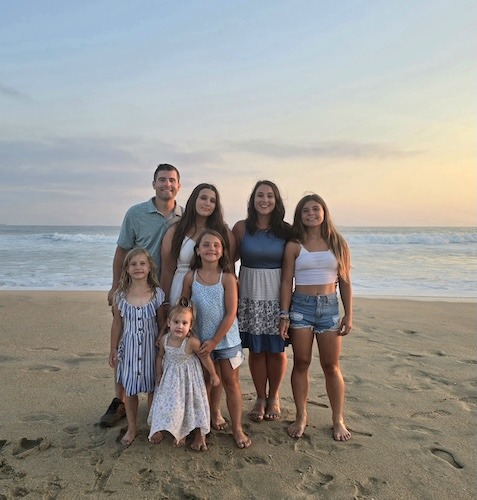
Nathan, a 36-year-old father of five daughters from Colorado, shares his stage 4 colon cancer experience. It began with symptoms he didn’t recognize as warning signs. An active outdoorsman who snowboards, mountain bikes, and camps with his family, Nathan dismissed his persistent heartburn and feeling overly full after meals as simply overeating. When stabbing abdominal pain finally sent him to the emergency room in August 2024, doctors discovered he was severely anemic. A colonoscopy revealed the shocking truth: a baseball-sized tumor blocking his colon, a golf ball-sized tumor in his descending colon, and 15 polyps.
Interviewed by: Carly Knowlton
Edited by: Chris Sanchez
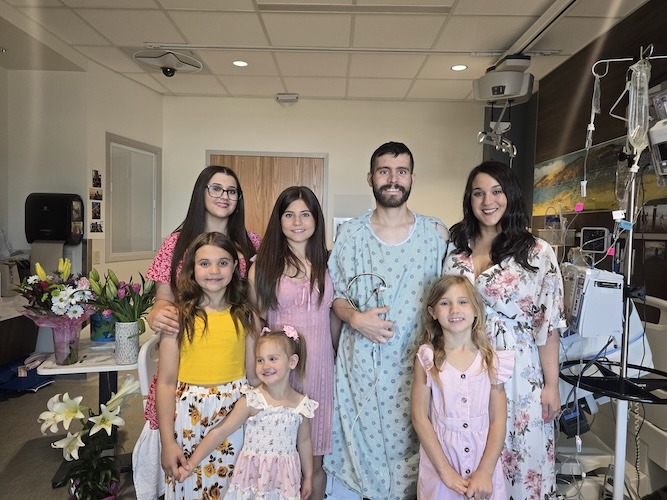
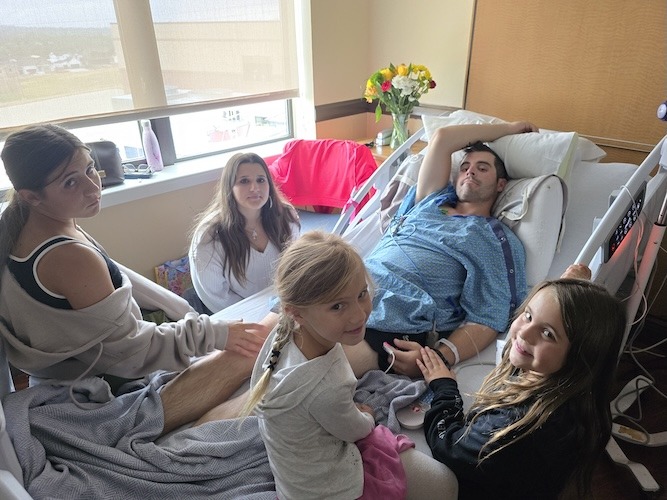
The colon cancer diagnosis came while Nathan was waking from anesthesia, leaving his wife Allison to receive the devastating news alone and then tell him. After spending 12 days in the hospital undergoing tests, Nathan learned the cancer had metastasized to his liver and peritoneal membrane, making it stage 4. His initial prognosis was nine to 18 months. As the sole breadwinner for his young family, with his daughters ranging in age from four to 16, Nathan faced tough questions about time and legacy.
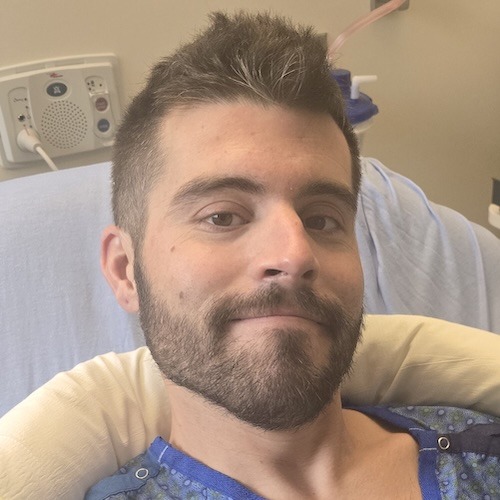
Treatment began with a colectomy, followed by ten grueling rounds of chemotherapy. The physical toll was devastating. Nathan’s weight dropped from 183 to 130 pounds as his body lost muscle mass. Chemo-induced diarrhea, sleep deprivation, and extreme weakness left him unable even to carry his four-year-old daughter to bed, a moment that remains seared into his memory.
But Allison refused to accept that chemotherapy alone was the only option. Her insistence on a second opinion changed everything. Nathan qualified for HIPEC (hyperthermic intraperitoneal chemotherapy), a rare, 12-hour “mother of all surgeries” that only a small percentage of stage 4 colon cancer patients can undergo. During the procedure, surgeons removed his peritoneal membrane and 30-plus lymph nodes, and filled his abdomen with chemotherapy medicines that were heated to 108 degrees.
Today, Nathan is in surveillance mode with scans every three months. While doctors won’t use the term “no evidence of disease,” all tested tissue except one mesenteric mass came back negative for active colon cancer. Living scan to scan brings its own anxiety, but Nathan focuses on what he can control. He is present for his daughters and wife, cherishes every moment, and shares his story to help others understand the life-saving importance of second opinions.
For more about Nathan’s stage 4 colon cancer story, watch his video and read the edited transcript of his interview below.
- Second opinions save lives: Nathan’s first oncologist planned to keep him on chemotherapy indefinitely without offering surgical options. The second opinion connected him with HIPEC surgery, which wasn’t initially discussed, a treatment that changed his prognosis entirely.
- Persistent gastrointestinal symptoms in young people warrant investigation: Nathan had chronic heartburn for years that was treated with omeprazole. He and his wife believe that if his doctor had investigated the underlying cause instead of masking symptoms, the cancer might have been caught earlier.
- Employer support makes cancer treatment survivable: Nathan’s employer told him that as long as he could send an email or text, he was working that day and would be paid for a full day. This financial security allowed him to focus on healing rather than worrying about losing his job.
- The mind-body struggle is real during treatment: It affects all cancer patients. Nathan’s mind wanted to stay active and engaged, but his chemotherapy regimen left his body unable to keep up. It helped him to find activities like building Lego sets that kept his brain busy without requiring physical exertion.
- Transformation through crisis: Nathan went from living a “carefree” life where he assumed he had unlimited time to understanding that every moment with his family is precious. He now lives fully present, telling his daughters he loves them daily, and making memories rather than waiting for perfect moments.
Nathan’s Diagnosis Facts
- Name:
- Nathan G.
- Age at Diagnosis:
- 35
- Diagnosis:
- Colon Cancer
- Staging:
- Stage 4 (Metastatic)
- Symptoms:
- Persistent heartburn
- Feeling full after eating
- Severe abdominal pain
- Treatments:
- Surgeries: colectomy, cytoreductive surgery, lymphadenectomy
- Chemotherapy: FOLFOX, HIPEC (hyperthermic intraperitoneal chemotherapy)
This is not medical advice. Please consult with your healthcare provider to make informed treatment decisions.
- Nathan’s Diagnosis Facts
- Introduction and diagnosis
- My symptoms and what led me to the hospital
- Hearing the stage 4 colon cancer diagnosis
- First surgery: Colectomy
- Ten rounds of FOLFOX chemotherapy
- How my employer supported me during colon cancer treatment
- Maintaining a positive mindset through bad news
- Why I needed HIPEC surgery
- Managing post-surgery blockages and complications
- Our high school love story
- Being a parent and what my daughters mean to me
- Life after HIPEC and my current status
- My message to other young cancer patients and families
- What colon cancer has taught me about time and love
- Hear from people living with colon cancer
Introduction and diagnosis
My name is Nathan. I’m 36 years old currently. I live just north of Denver in Colorado. And I have stage 4 colorectal cancer. I found out about it in mid-August of 2024.
My life before diagnosis: Family, passions, and hobbies
I have five beautiful daughters. One is about to be 16, so she’s getting her license and driving. The youngest just turned four in October of this year. So she’s just the little one getting crazy before everything hits. I might be your typical Colorado guy. I snowboard during the winter. I mountain bike during the spring and summer. Camping, fishing, hiking — even outside of my neighborhood or even outside of the mountains, I ride my road bike around our neighborhood. I golf, I play Frisbee golf. I might be your stereotypical Colorado person. But I very much like to be outdoors and active. And that includes my daughters. I bring them in whenever I can.
I work for a cranes and rigging company. I work on the rigging side, so I call us heavy machinery movers. I work in the office, so I’m not one of the field guys. But basically, anything heavy that needs to be moved indoors that a crane can’t reach, that’s where we come in. And ironically, a big part of our business is medical equipment — CT machines, PET scans, MRIs. So before I got on the side of being put in those, we were putting those into hospitals and things.
I would like to think my kids would describe me as fairly easygoing and just fun-loving. I just like to do whatever’s fun. If we’re painting nails one night, I want to be in on it. If we’re watching a Disney movie or Frozen or something, I want to be in on it. We’ll play dress-up, whatever it is. But that also includes trying to bring them into my hobbies. I snowboard. It’s expensive, so I can’t bring them all the time. But mountain biking, camping, fishing — I like to get them all in on that. And trying to bring them into video games as well. They’re not quite so hard on that one.
What my life was like before my colon cancer diagnosis
Before diagnosis, I would just describe life as carefree.
Everyone says we have a limited amount of time, and realistically, everyone does. You just don’t know when it’s going to happen, right? Car accident, anything like that. But you don’t really live your life that way. And the turning point, when I found out that I had cancer and that I may not live as long as I had hoped, truly emphasizes the reality of time and just what you do with that time and how you spend that time, and who you spend that time with.
Maximizing the people you want to be with and maximizing it in the sense of doing the things that you really want to do while you have that time.
My symptoms and what led me to the hospital
I didn’t really have a lot of symptoms. Now that I look back, I see them as symptoms. But right up until I went to the hospital, it was that I would eat a meal and I would think, “Oh, man, I’m really full. I’m not digesting that well. I need to just go lie down.” I also love food. It’s one of my hobbies. So I did overeat sometimes. I mean, everybody kind of has that, right? You do a little too hard, and you’re not feeling so great afterwards, so I didn’t really think anything of it. Those would really be the only symptoms that I had leading up to anything. And now I see them as symptoms. Before, it was just, “Yeah, I ate way too much, and I’m paying the consequences for it.” So I really didn’t have anything major that stuck out.
And I was your healthy, average guy. I went to the doctors when I needed to. I did my annual physical, and the doctors were jokingly like, “Oh yeah, we don’t need to see you for another ten years. You’re healthy, you’re good, you exercise.” Blood pressure was a little wonky, but not even that was anything that they felt was dangerous.
I will say one of the big things that was covered up that we think was an issue is that I had heavy gastrointestinal problems. So heartburn is a big one, and it was always just, “Take omeprazole,” kind of cover it up, put a Band-Aid on it. And my wife and I do feel that if at any point my doctor had said, “Hey, this isn’t going away, this isn’t getting better, you change your diet, you’re on the medicine. Let’s look into this,” we may have found something a lot earlier than when I started showing major symptoms.
One day, I want to say it was in the evening, I was lying in bed, and I got right around my gallbladder — so kind of my upper right or mid-right torso — just a stabbing pain. And I’ll be honest, I had gas things like that before. So I didn’t really think anything of it. After a few hours, it didn’t go away, and it was only feeling worse. It was only getting worse. I was getting paralyzed by the pain, actually. I was just lying in bed, not moving because it was that bad. And I’m your average guy. I’m like, “Oh, let’s give it time. Let’s see, let’s wait.” My wife, on the other hand, was like, “No, this is something we need to go get looked at.” So we rushed into the hospital, right into the ER, and they immediately ran blood work, doing tests, things like that.
Come to find out, right in the ER, after some blood work, I was extremely anemic. So I had major blood problems. Iron deficiencies, hemoglobin deficiencies. Which actually would explain, before my diagnosis, why I was exhausted. I just thought it was my full-time job, and my five kids.
I just live a busy life. I’m tired all the time. Turns out I was extremely anemic and would later on need a blood infusion to help balance that out. So we went in, got all the blood work. They really weren’t sure where the pain was coming from. They were helping me with pain medication, things like that. We were able to kind of get that under control. And actually, my primary care doctor was the first one to suspect some sort of cancer. And she was like, “Listen, we can get you in and out of different facilities for tests.” She’s like, “I recommend you go get admitted to a hospital right now. You meet the requirements, they’ll admit you, and then they’ll run all your tests back to back to back to back to get this all looked at as quickly as possible.” So that was one of the most major pieces of advice that I ever got — get into the hospital, get admitted. So they will run all these tests in a single building and start building this process and this story that you have. So the first thing was the abdominal pain, the serious abdominal pain, and the trip to the ER.
Hearing the stage 4 colon cancer diagnosis
It took about 12 days in the hospital to really not get very far, if I’m being honest. They were great. But we really didn’t get much of anything. I was getting blood work. They were even telling us — we had multiple doctors coming in, like, “Hey, we’re not sure what’s going on. But all these tests are coming back. Blood tests — cancer is on the table, but it’s at the very edge. It’s on the back of the table, ready to fall off. We do not even think that’s a concern right now.”
And then I believe it was August 12th of 2024. They’re like, “Listen, we’re going to go in and do a colonoscopy. We’re going to go take a look, see what’s going on.” And that was when they found everything out. So everything went from not a concern to “You have cancer, and it’s a baseball-sized tumor in the top part of your colon, the lateral part of your colon right there.” And I actually have in my descending colon, I had a golf ball-sized tumor as well. And the baseball-sized tumor was blocking my colon. That’s what was causing all the abdominal pain that I was feeling.
The experience of finding out it was stage 4 didn’t hit for a little bit because I was still just coming out of anesthesia. So my wife actually is the one who got the news, had to deal with it, digest it, walk through the hospital, meet with all the nurses, and come find me. I was still asleep. And I remember her telling me she was just waiting for me to wake up. She said, “I can’t believe I have to do this. I have to wake him up and tell him probably the worst news we’re going to hear as people, as a couple, as a husband and wife, and as a father and a mother.”
And I have a distinct memory of opening my eyes and just being so happy to see her. I was just smiling. I was just so happy to see her. And I had a good nap. I felt kind of good, right? I was waking up from anesthesia, and she’s like, “I don’t know how to tell you this. You have cancer, you have colon cancer, you have a baseball-sized tumor in your colon and in your descending colon. You have another golf ball-sized tumor, and you have about 15 polyps outside of that that have a high potential of becoming tumors as well.” So just kind of all over my colon. And at that point, we didn’t know it was stage 4. We just knew I had this going on. So for me, it was all a little hazy, and it didn’t really hit me until a day or so afterwards. But for her, it was very immediate, and she was very much aware and awake to the whole experience.
Managing my family during my hospital stay
My wife, God bless her, kind of ran back and forth. But she wanted to be there for every doctor’s visit, and I will give total respect to her. She is my better brain. She knows all the questions. I’m the type who would just say, “Okay, this is where we’re at. Okay. What’s the next step?” She has all the questions. She was on top of everything. She hands down is the reason that I am still here today. But we had her parents and my brother and his wife, who live out of state — they came in from Wyoming, so not super far. They came down for a little bit. She has three older brothers. So they were in and out as well. So we had lots of family to kind of cover the gap and help with the kids.
But even since then, I followed up with them, and for them, it was almost a blur. It was chaotic, just people coming and going, and “Who’s going to be home when we get home from school? We don’t really know. What about dinner?” Things like that. We had a bunch of people donating food and meals. But it was just kind of this day-to-day unknown of who was going to be there, what we were eating, what the schedule was — very, very chaotic and hectic. But, luckily, we had a lot of family that was able to step in and help.
My older three daughters did play softball. So I had three of my five girls in softball, and my 13-year-old was competitive, so very high maintenance, lots of practices, games every weekend, tournaments. I mean, very difficult to keep up with, even as parents, let alone an in-law or someone not used to it stepping into the situation, and that was very tricky. And that was where my wife had to kind of make the call to, “Okay, I’ve got to go. I’ve got to be in at least half of her softball game. I have to split my time a little bit, be here with you.” And I was trying to tell her, “I’m in a hospital. I’m not really doing much. So I love your presence, but I understand you need to be where you need to be. And I want you to be with our kids right now, whenever possible.” So very difficult on her, I feel, to kind of split that life.
First surgery: Colectomy
With the amount of polyps and the presence of cancer in my colon, the first thing they wanted to do was remove my colon.
Obviously, I had lots of questions. What does that look like for me? Ostomy bag, things of that nature. What will my whole digestive tract look like after that? And I will say, before that, they had put a stent in to open up that area with the tumor to buy me some time and buy my body some time to adjust to this whole process. But we did conclude that, based on what we saw, it was best to get rid of my colon. So the first major surgery I had was a full colon removal, a colectomy. And that was interesting.
It was rough. And they were able to save the last couple of inches of my colon, so I didn’t have to jump into any sort of ostomy bag, ileostomy, or colostomy bag. And things were as they told me they would be. Bowel movements, everything like that, were different. Not to get into it, but the colon absorbs and removes a huge amount of moisture and water from everything that goes through your digestive tract. So liquids were just coming out. That’s kind of how it went. Not to get too graphic on it, but everything changed on that level. And not to get ahead of it, but once we rolled into the next few steps, it just kind of compounded from there.
For that one, it actually wasn’t terrible. Hindsight, now after what I’ve been through, it wasn’t terrible. They were able to do it laparoscopically. So, a few small incisions for the robotic components to go in and do their thing. About three inches below my belly button, I did have to have — it’s basically like a C-section scar — I did have to have a horizontal, about five-inch scar incision to remove everything. So I do have that, and I have my laparoscopic scars as well.
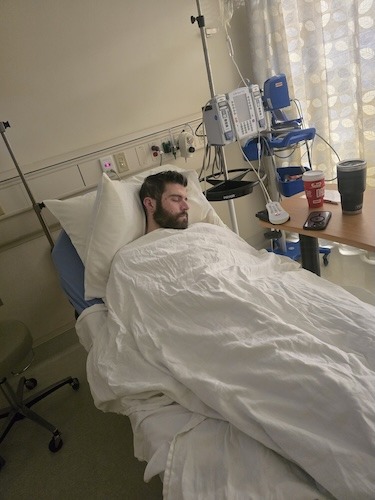
Recovery was about two weeks in the hospital. And realistically, it wasn’t terrible. I was pretty much up and moving. They basically just had to keep me there to make sure that everything was connected properly, functioning properly, and I wasn’t having any major leaks into my abdomen that could lead to all sorts of other septic problems, things of that nature. So it really wasn’t terrible, other than monitoring what needed to be done and what needed to be managed.
Ten rounds of FOLFOX chemotherapy
FOLFOX. That’s where things kind of got interesting.
I wasn’t sure what to expect with chemo. I had read stories. I had been involved in groups. I went on Facebook, joined groups, which was both helpful and difficult to deal with because it’s almost an overdose of information. Sometimes people can kind of get you panicky if you’re not careful.
So we went and did the first round of chemo. And this was at my first oncologist’s office — Rocky Mountain Cancer Center. And they got us kind of where we needed to be. They got us to start. We needed that. I’ll put it that way. And I did the first round, and I actually felt pretty good. I really didn’t feel bad. And they even said, “Hey, 3 to 4 days afterwards you go in, basically get your infusion” — I have my port — “they leave you hooked up for 46 to 48 hours. You have to go back in and get disconnected. And usually after you’re disconnected is when it kind of hits.” And I did. I felt a little sick, a little off, a little tired. But I was still working. I had no problem going into work and just kind of taking it easy there for the most part.
So initially, I honestly thought — I had a snowboarding pass. I was like, “I’m going to keep this. If this is how it is, I could do that. I can get through a day of snowboarding here and there. That should be no problem.” And November 5th, 2024, is when I first started my chemo, my first rounds of chemo.
So FOLFOX is compounding, which they did say, and I think most chemos are. So probably around three, round three is really when I was like, “Okay, this is bad. This is really difficult.” And I’m 35 at this point. I get sick, I get hurt, I still bounce back pretty quickly. So that’s kind of what I’m used to. So the physical aspect was very difficult. Just to give an overview of it, I went into surgery basically at about 183 pounds. At the end of my chemo, I was about 130 pounds. And I’m not an overweight guy. I didn’t really have 60-plus pounds to lose, and a lot of it was muscle mass because I didn’t have the fat to lose. So my body just started deteriorating muscle mass. Yeah. So that was very difficult.
Yeah, we kind of got a handle on what to expect. And unfortunately, with each round, it was just that much more difficult to get through. It was getting to the point where my recovery period was the length of time until my next infusion, and FOLFOX is roughly every two weeks. So yeah, it would take me almost a full two weeks to start to bounce back. And then I was getting hooked up again. And the infusions are something you do in a hospital.
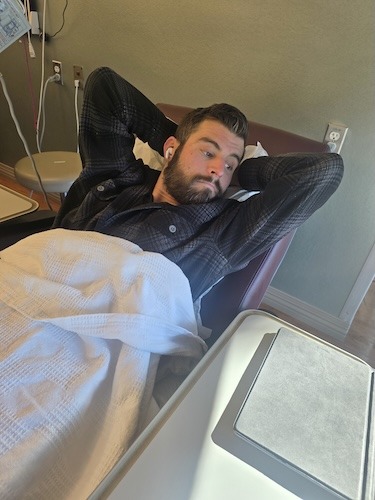
So every two weeks, I was going in and spending three — just the infusion alone was like three-plus hours. And you have meetings with doctors before that. You have to get blood work before that. So I’m at a five, six-hour day at a hospital every two weeks, no questions asked. And I’m the sole breadwinner. I make the money for the household. So I’m still trying to maintain a job at this point to provide for everybody and going to the office as much as possible.
How my employer supported me during colon cancer treatment
I will say the company I work for was fantastic. There are a few guardian angels or bright light moments. And one of them was not only my immediate boss, my manager, but the president, who came to me as soon as this happened.
And just to say beforehand, I’m the guy who likes to do everything. I like to stay busy all day. So realistically, I was doing 5 or 6 jobs in a day at this office, which I had no problem with. So they loved me as an employee, and they immediately came in. And I remember them — the general vibe was, “Listen, we don’t know which way this is going to go. But we do know that whatever the outcome, you’re not going anywhere. The only way you’re going somewhere from this company is if you quit or this goes extremely south for you. We’re not getting rid of you. If you can answer an email or send a text, you’re working that day, and we’ll pay you for that full day.” So they were fantastic about that whole situation.
But it was very tough. I mean, I would try to work from home a little bit whenever I could get a break, and I would have to take naps at the office. I’d have to take 20 to 30-minute naps a couple of times a day just because sleep wasn’t happening. And I was a great sleeper. I would hit the pillow, fall asleep, and the next thing I knew, the alarm was waking me up. I was getting maybe 2.5 hours of sleep every night.
Part of the issue with the chemo was that I had — on top of losing my colon — I had chemo-induced diarrhea. So I just went from liquids to even worse coming out. And part of the problem that we weren’t exactly able to identify is that I was going multiple times an hour, even at night. So I was waking up every single night five or six times, going to the bathroom. It was extremely unpleasant. Extremely painful. We couldn’t dial in what was going on with that. They were trying to figure out why it was so bad, putting me on all this medication. Come to find out, at a later surgery, the small portion of my colon that I had left had flipped. So I had basically a whole other blockage going on that I was not aware of. And that’s why it was so painful and just extremely unpleasant for me in that whole situation.
We started the chemo on November 5th. It was in October that I was getting all my scans and just trying to figure everything out. We found out it was in the lymph nodes. I had a mesenteric mass, which we thought was a lymph node. We weren’t 100% sure at that point, but it was attached to my major artery that runs straight down through the center of the abdomen. Huge blood supply. So they wanted to take care of that. In the scans, they found two spots on my liver, and they weren’t 100% sure. Things can happen to the liver. You can have fatty spots, you can have scar tissue, anything like that. They did go in and biopsy them, and they did test positive for cancer. So I think it was in mid- or late October, right before Halloween, when we found out that not only did I have cancer, but it was stage four cancer that had metastasized to my liver.
So at the end of 2024, bad news just kind of kept hitting left and right.
Maintaining a positive mindset through bad news
I think if you ask anyone who knows me, I’m a fairly easygoing, positive guy. It’s pretty hard to bring me down. And I will say cancer had its moments during which it most definitely did bring me down. And it still does. But I’m very much, “Okay. What are we doing? What’s the next step?”
I like to know what the next step is. I don’t like to hang in the unknown. Which is why the scans at this later point are so difficult for me. Because that’s where you live. You live in the unknown. I like to know if it’s good news or bad news. Which direction are we going? What are we doing? That’s comforting for me to know what the next step is.
So I just had a very naturally positive mindset, and everybody around me was telling me, “That’s what’s going to get you through.” But it was very difficult, especially being physically just destroyed, basically, to keep that positive mindset, because I’m a very active person and my mind was ready to be active, but my body could not keep up with it. So I like to call it the mind-body struggle. They were just fighting each other. My brain was like, “I need to be doing things.” My body was like, “I can’t get up off the couch right now, so we’re not doing anything.”
One of the major things I did find out that helped, which is kind of silly, was Legos. Not physically demanding. I could sit in a chair, and it was enough to keep my brain busy. I probably now have about 40 Lego sets around my house that we don’t know what to do with because they don’t really go with the decor. But that was a huge part of what I did during the day. Just to keep my brain busy and not be doing something too demanding physically. I would sit around, and I would build Lego sets.
Why I needed HIPEC surgery
I wrote it down: hyperthermic intraperitoneal chemotherapy. They call it HIPEC for short. And I will say this all came to fruition after a second opinion.
I just want to emphasize that second opinion. If you don’t like the tone or the way things are going where you’re at, you have to do it yourself. And again, my wife was the one who pushed for it. My oncologist, we met with him and nothing bad against him, but he hit a limit — I think it was the facility limitations. We got to a point where we were like, “What’s the next step?” And he was just like, “What do you mean? We’re on chemo. If the chemo gets rid of everything, we’ll look at additional steps. But right now, you’re just going to ride the chemo train as long as you need.” And at this point, or later on, we kind of found out chemo probably would have killed me if chemo did exactly what it needed to do for my cancer. I had just no muscle mass. I was not exercising at all. It probably would have just eaten me alive from the inside.
So that second opinion is what changed everything. They were basically like, “Listen, this is as far as we can go. We’re going to keep doing chemo.” My wife was like, “No, no, no, no, that’s not on my list of things to do right now — to just watch my husband deteriorate from either cancer or chemo.” So we ended up going to UC Health Anschutz in Aurora, Colorado.
And immediately everything was different. The first thing was, I didn’t have an oncologist. I had an oncology team. I had an oncologist, but I had an oncology surgeon. And everything that I’ve dealt with after that, I had skin problems — I had an oncology dermatologist. Everything after that is oncology-based and cancer-based. So they don’t just hook you up with your generic dermatologist, things like that. It’s anyone who is in the know about cancer related to dermatology, nutrition, or anything. So I had a whole team of people working with me. We went in there, and they immediately had a list of like, “Okay, this is where you’re at. These are our options.”
And talking about HIPEC, we got to that point because I didn’t even know this existed, but you have what you call your peritoneal membrane, which is this thin membrane that runs over all your organs. It just kind of helps with everything rubbing against each other. The problem in my case with that is it’s very vascular. Lots of blood flow, and it touches everything in your abdomen. So they’re very worried that if we don’t take care of this, it’s like a highway for cancer to get everywhere inside of me. So they were like, “It’s on your liver, but it’s also on your peritoneal membrane.”
And talking with my oncologist and my oncology surgeon, we discussed doing HIPEC. And if you think about everyone who has stage 4 colon cancer as a pie, there’s a very small part of the pie that is capable of doing this HIPEC, based on many factors. The genetic makeup of the tumor and the cancer itself, there are all sorts of things that they have to test, and you have to meet specific requirements for this to work. It has to be part of the peritoneum. Otherwise, they’re not going to remove that membrane, which is a huge part of the surgery.
Also, my age and my health were important considerations. HIPEC is called the mother of all surgeries because it is very invasive and it is very difficult to recover from. So if your health isn’t where it needs to be, if your age isn’t where it needs to be, you are not in the spectrum of being an applicant for HIPEC. And I just happened to meet all the specific requirements to fall in that very small piece of that pie to be able to do this.
So we agreed we were going to do that. I think it was a 12-plus-hour surgery that I got signed up for. And that’s kind of why I said my colon removal wasn’t so bad, because now I know, in hindsight, what bad was. I bounced back from my colon surgery after a couple of weeks and was able to work through my laptop, even through chemo. My wife has videos of me sitting in my chair, getting my infusion, sitting on my laptop, doing work. That’s kind of how I did it. So my surgeon and everything, they’re like, “Listen, you want to put in for family leave through your company? Put in for the maximum amount.” And I’m like, “Okay, yeah, we’re going to do this. Give me 2 or 3 weeks. I’m sure I’ll work through it. No problem.” I needed the full seven weeks for recovery, and even then, I could barely get back into the office at that point.
And then on the tail end of that, I had a blockage. So right afterwards, I was recovering. I had a blockage that I had to go back into the hospital for. So I got out of the hospital, I recovered, and jumped right back into the hospital. And that blockage was bad. I felt some pain that was crippling. And my wife and I, we have a cabin. My wife’s family has a cabin up in northern Colorado that we had been missing out on because of all my surgeries and just all my problems. She wanted to take the kids up there for a weekend. I was like, “Go! I can’t physically do it. But you guys go.” It has running water, electricity, internet, the whole bit. So it’s totally doable for all of them. And just so happens that was the weekend I got my blockage, and I remember crawling to the bathroom because I was in so much pain.
And at this point — that was also during my HIPEC — is when they found out that I had my colon twisted. And it also, because of all the bathroom problems I was having, I opted for an ileostomy to be put in while I was under for that surgery. And I still have that. It was supposed to be reversed. I have ulcerative colitis on top of that that we found out, so I can’t really get it reversed until that’s managed.
What HIPEC surgery involves
Just a brief overview of HIPEC. They cut you open, they open you up, they strip away that peritoneal membrane, which is extremely time-consuming because we’re dealing with major organs. They have to peel it away, and they have to be very careful of everything that’s going on. And then when they’re almost done, once they have all that, and while they’re doing this, they’re looking for spots on the liver. And I had 30-some lymph nodes removed as well from my abdomen. I did have that mass that they were worried about — that was removed. Chemo had shrunk it enough to the point where they were comfortable removing that. Then they kind of did a quick sew job, and then they filled me with hot liquid chemo, at about 108 degrees.
They basically just dump it inside of you. They sew you up, and then it’s a nurse’s job to sit there for two hours and just gently rock you back and forth so that it gets in all the crevices, all the cracks. So on top of doing the chemo, ten rounds before the surgery, during the actual surgery, I had a massive amount of chemo just dumped in my abdomen.
Then they opened me back up. They got all the chemo fluid out, and they stapled me back together. And I actually, when I got my staples removed, the nurse I was talking to, she was like, “I was the one who had to shake you, actually.” I had no idea that was her. So I was talking with her, and she was telling me how she got to see that and had never done it before. And just to give perspective, because I’m not sure how much they put in you, she said, “You looked like a seven-month pregnant person at that point.” That’s how full they fill you with that when they’re doing everything. Yeah, I had no idea. I just kind of figured they put it in your cavity. But no, I was distended. Extremely distended when they did all this.
It was absolutely wild. And yeah, as I said, it was a 12-hour surgery. And there’s always that in the back of your mind that, “Am I even going to come out of this?” I mean, when they talk it up to be the mother of all surgeries or abdominal surgeries, even with my health and my age, that is a legitimate question. And keep in mind, at this point, I’m ten rounds into chemo. I’m the lightest weight I’ve ever been. I haven’t been eating like I should be eating. I couldn’t keep up with eating. And so I’m at my weakest point that I’ve ever been in my life.
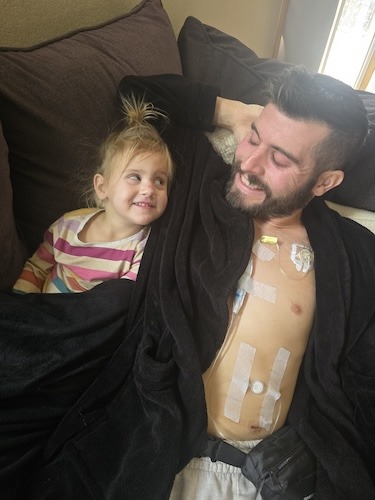
I think right before surgery, I have a very dominant memory as an example of just where I was physically. My four-year-old at that point had fallen asleep in the playroom at night, and I was going to carry her to bed, but I couldn’t pick her up. That was just one of those moments that hit really hard as a father. I had to go get my wife to carry her up to bed because I couldn’t even do it. And we’re talking about a four-year-old. I play with my kids all the time. It was no big deal. That time, I couldn’t even get her up off the ground. That’s how much muscle mass I had lost at that point. And for some reason, that’s just one of those memories that really is stuck in my brain.
Managing post-surgery blockages and complications
And again, that didn’t require any surgery. Unfortunately, even after surgeries and everything, they basically don’t feed you for like three days. You’re allowed water, and they’re giving me nutrients through an IV. But they basically just kind of stop putting things in there, hoping the blockage will take care of itself, which it did. But that was extremely difficult as well, because I could not lose weight and have my body go through that again. But yeah. So we got in for that, got that taken care of, got back out, and immediately went to a restaurant to get some food, which probably wasn’t the best idea.
But it’s a weird dynamic when you are told at the very beginning, when we all found out this was stage 4, I was given 9 to 18 months. And I have a four-year-old. So the reality is, even if I live another ten years, that’s not long enough. That’s not long enough. I need to be there for graduations and dances and marriages and husbands and boyfriends and anything else in between. I want to be there for all of my daughters and for my older one. She’s lucky she gets and has gotten the most time with me, but for my little one, ten years isn’t long enough. And I think that’s the hard part, is everyone talks so favorably about, “Oh, I’m confident you’re going to make it another five years at least.” And that’s great. But that’s not enough.
That’s not enough time for me with having kids and my wife. And my wife and I have this relationship where we are husband and wife, but she’s my best friend. And I know a lot of people probably say that, but I don’t care what we’re doing. If we’re doing it together, that’s where I want to be. Whether that’s going out, whether that’s baking a pie, cooking dinner, watching a movie, doing Legos, sitting there on our phones next to each other, showing each other stupid videos and things that we find funny or crazy. Whatever it is with her is where I want to be all the time. And having to have her look at me and ask me, “How? How am I going to do this without you?” I still don’t have an answer for that question. She’s asked me multiple times, and I don’t know how to answer that question correctly. I don’t know if there is a correct answer for that question, especially at 36 years old. With the life we’ve established, our life is very much a two-person life. Just with the physical requirements of kids, sports, and everything else. Aside from needing a husband emotionally and my kids needing a father emotionally and physically, I don’t have an answer for that. And she has asked me. And when we have our down moments, she still asks me, and I don’t know how to answer.
Our high school love story
We actually met first when we were about 13 years old. Confirmation. So, in religious class, and I went to a religious school. She did not, but her parents were religious, so they put her in the class. So we didn’t go to school or anything like that together. And I’ve told her a thousand times, I saw her and I was just like, “I have to be with her forever. I don’t know what it is, but it’s just like you see that person and they talk about it in movies, and it sounds so cliche, but it’s just like, I swear, lights were coming down, and it was just like she walked in the room and I was just like, ‘I have to be with this person.’”
And we hung out in the same group of friends. So we ran into each other at parties in high school and things like that. And there was a very loose connection, kind of through friends, where we kind of knew of each other and would talk to each other and interact. But towards the end of high school is when we really started to date — 17, 18 years old. And I mean, the rest was kind of history. I mean, we got married young, and we started having kids right off the bat. I’m good at things. I’m good at my job. I love being a father, though. I mean, it is just where I feel like I thrive. I just enjoy kids so much. If we won just a ridiculous amount of money in the lotto, I’d have a ton more kids. I mean, if I could afford a bigger house, bigger vehicles, and more food, I would have so many kids. Kids are fantastic.
So basically, we had as many kids as we could without losing the house or going into bankruptcy or anything like that. And we started young and, as I said, it’s had its ups and downs even before cancer. But there was never a doubt in my mind that she was the person that I needed to be with constantly.
Being a parent and what my daughters mean to me
I’m not hesitant to tell my daughters how I feel about them. I will hug them, I will kiss them on the forehead, and I will tell them, “I love you so much.” And at the end of the day, they are going to be parents. They already know this. They are going to be parents someday. And whether that’s adopting kids or having their own kids, they are going to be mothers. And I tell them all the time, someday you are going to have kids, and you are going to understand the love that I have for you guys. And it is going to blow your mind. It is indescribable, the love that I have for them. And I’m not afraid to say that. I’m not afraid to tell them that. And even with my older ones, as they get into their teenage years, I will still tell them, “I love you so much.” And I will give them a hug and a kiss on the forehead. And I don’t care if their friends are around. I don’t care what’s going on. That is my daughter, and I love her to death.
And I think that’s the biggest thing, just being present with them. Whatever they want to do, I want to be a part of it. And I think that’s the biggest thing. And my wife is the same way. We are very much hands-on parents. We want to be involved in everything they’re doing. And I think that’s the biggest part of being a parent, is just being there and being present and showing them that you love them no matter what.
Life after HIPEC and my current status
So after HIPEC, as I said, it was a very long recovery. Seven weeks. And then the blockage. And then after that, it was basically just, “Okay, we need to let your body heal.” So I did not jump back into chemo right away, which was fantastic. I got to kind of get my strength back, start eating again, start gaining weight. And that was probably one of the better periods post-diagnosis, that recovery period, because I wasn’t on chemo. I was healing. I was eating. I was gaining weight. I was getting my strength back. And mentally, that was huge for me because I could start to see myself coming back a little bit.
And then we got to the point where we did scans, and this is where things get tricky. After HIPEC, after all the surgeries, after everything, they did scans, and they couldn’t find active cancer. The lymph nodes, the mesenteric mass that was removed — it tested positive, but it was removed. So everything that they took out, they tested. And the only thing that came back positive was that mesenteric mass. Everything else that they tested — and they tested a lot — came back negative.
So technically, I am… they won’t say “no evidence of disease,” but they will say that I am currently in a very good spot. The problem is, with stage 4 cancer, especially with peritoneal carcinomatosis, which is what I had, the concern is always, “Is there microscopic disease that we can’t see on scans?” So that’s where I’m at now. I’m in surveillance mode. I’m doing scans every three months. And that is probably the most mentally difficult part of this entire experience, living scan to scan.
Because you get your scan, and then you have to wait a week or two to get the results. And during that time, you’re just in limbo. You don’t know. Is it back? Did it spread? Is everything okay? And that unknown is so difficult. As I said earlier, I like to know what the next step is. I don’t like living in the unknown. But that’s where I’m at. That’s where I’m going to be for the foreseeable future. Every three months, scans, waiting, hoping that everything is still clear.
The reality of living with stage 4 colon cancer as a young father
And I think that’s the hardest part about all of this, the unknown. Because even if I make it five years, ten years more, that’s still not enough time. My youngest is four. In ten years, she’ll be 14. And I want to be there for her high school graduation. I want to be there for her college. I want to be there to walk her down the aisle. I want to be there when she has kids. And the reality is, with stage four cancer, even with the best-case scenario, there’s always that question mark of, “How much time do I have?”
And that’s something that my wife and I talk about a lot. And it’s something that keeps me up at night. Because I look at my daughters and I think, “What if I’m not here for these moments?” And that is the most gut-wrenching, heartbreaking thought that I could ever have. Because I want to be there. I want to be there for everything. And the reality is, I might not be. And that is something that I have to come to terms with every single day.
But at the same time, I can’t live in that fear. I can’t live in that “what if.” Because if I do, I’m going to miss out on the time that I do have. So I try to focus on being present. I try to focus on making memories with my kids and my wife. I try to focus on doing the things that we love to do together. And I try not to think about the “what ifs” too much. But it’s hard. It’s really hard.
My message to other young cancer patients and families
I think the biggest thing I would say to anyone going through this, especially young people with kids, is not to be afraid to ask for help. Don’t be afraid to lean on your family and friends. Because you can’t do this alone. I couldn’t have done this without my wife. I couldn’t have done this without my family. And I couldn’t have done this without my employer being as supportive as they were.
And the second thing I would say is to get a second opinion. Don’t just accept what one doctor tells you. Because if I had just accepted what my first oncologist said, I probably wouldn’t be here right now. That second opinion at UC Health Anschutz saved my life. They gave me options that I didn’t even know existed. And that HIPEC surgery, as brutal as it was, gave me a chance. It gave me hope. And that’s what you need in a situation like this — you need hope.
And the third thing I would say is to cherish every moment. Cherish every moment with your kids, with your spouse, with your family. Because time is precious. And when you’re faced with your own mortality, you realize just how precious it really is. So don’t take it for granted. Don’t wait for the perfect moment. Make every moment count.
Living with scanxiety and the unknown
Living scan to scan is probably the hardest thing I’ve ever had to do mentally. Because every three months, I have to go through this process of getting scanned, waiting for results, and hoping that everything is still okay. And during that waiting period, my mind goes to the darkest places. I think about what happens if it’s back. I think about what happens if it spreads. I think about my kids growing up without me. I think about my wife having to do this alone. And those thoughts are crippling.
But then the results come back, and they’re good. And I get three more months. Three more months of relief. Three more months of being able to breathe. Three more months of making memories with my family. And then the cycle starts all over again. It’s exhausting. It’s mentally exhausting. But it’s also a reminder to live. To really live. Because I don’t know how many more of these three-month cycles I’m going to get. So I have to make the most of each one.
What colon cancer has taught me about time and love
If there’s one thing colon cancer has taught me, it’s the value of time. Before my diagnosis, I thought I had all the time in the world. I thought I would grow old with my wife. I thought I would see all my daughters grow up, get married, and have kids of their own. And now, I don’t know. I don’t know if I’ll get that. And that uncertainty has changed everything.
But it’s also made me appreciate every single moment I have. Every breakfast with my family. Every bedtime story I read to my daughters. Every conversation with my wife. Every hug, every kiss, every “I love you.” All of it means so much more now. Because I know it could end at any time. And that’s terrifying. But it’s also beautiful in a way. Because I’m not taking anything for granted anymore.
I’m living fully. I’m loving fully. And I’m making sure my family knows how much they mean to me every single day.
This interview has been edited for clarity and length. The views and opinions expressed in this interview do not necessarily reflect those of The Patient Story. This content does not replace professional medical advice.
Inspired by Nathan’s story?
Share your story, too!
Hear from people living with colon cancer
Real experiences with diagnosis, treatment choices, side effects, and life beyond colon cancer — in their own words.

Leave a Reply