
Tyler’s Thymic Carcinoma Diagnosis Started With What He Thought Was a Golf Injury
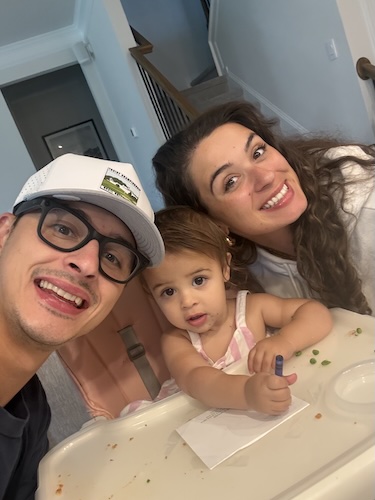
Tyler was 30 and married, with a 15-month-old daughter, when a dull ache in his upper abdomen turned out to be stage 4 thymic carcinoma, a rare cancer that had spread to his liver. He thought the ache was a strained muscle from a golf trip. An urgent care visit cleared him in under five minutes. Two days later, the pain was bad enough that he drove himself to the ER, convinced he had a gallbladder problem instead. An ultrasound showed his gallbladder was fine, but his liver looked concerning, and a CT scan found many lesions, including a mass nearly 9 centimeters long.
Interviewed by: Taylor Scheib
Edited by: Chris Sanchez
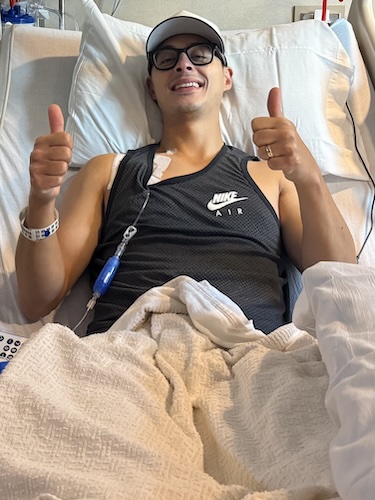
A friend, who happened to be an ER doctor with access to Tyler’s chart, guided Tyler to another emergency room, where he was admitted. Another CT scan of his chest showed a second mass in his thymus, which doctors initially set aside as unlikely to be connected.
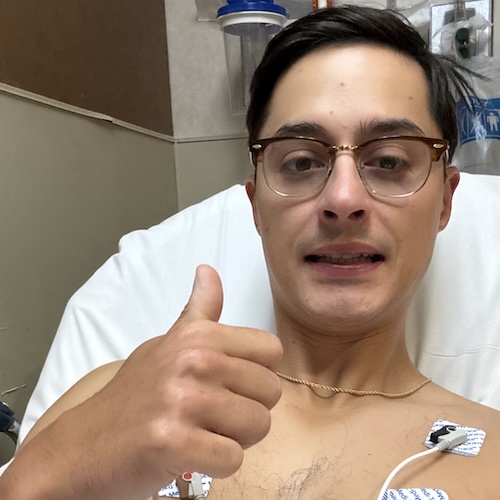
The biopsy confirmed thymic carcinoma, a rare and aggressive cancer of the thymus, a gland that trains the immune system before puberty. Tyler’s case was unusual even for this rare disease: Instead of spreading to the chest or lungs, it went straight to his liver. Doctors called it incurable, a word Tyler first heard as a death sentence, before he connected with other thymic carcinoma patients online and learned that long-term remission is possible.
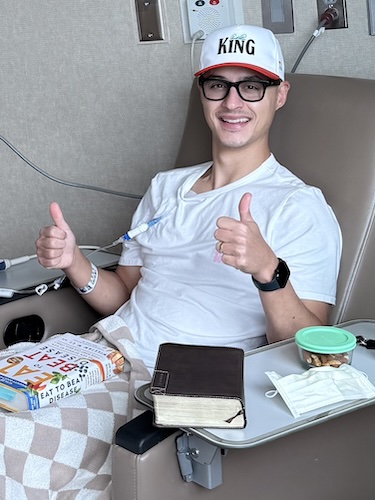
Tyler is now several cycles into chemotherapy aimed at shrinking and containing the tumors. His liver enzymes, elevated and “angry” at diagnosis, have come back into a normal range, an early sign of response. He’s assembling a care team across institutions, including a visit to Memorial Sloan Kettering Cancer Center for a specialist in thymic carcinoma.
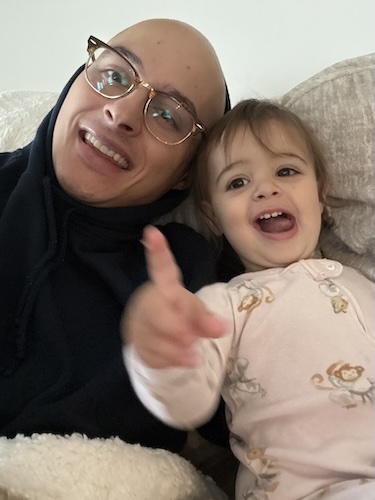
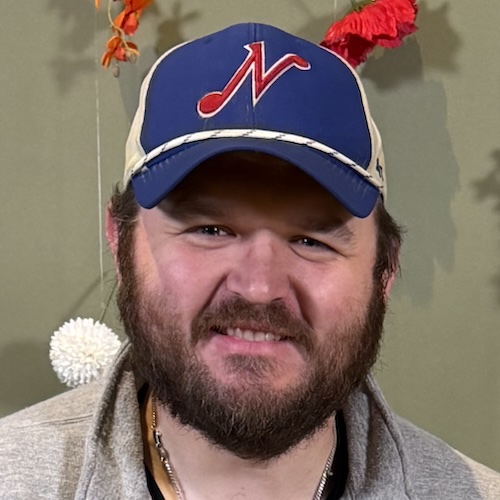
Today, Tyler leans on his wife, daughter, faith, and a Facebook community of fellow thymic carcinoma patients. He shaved his head with his longtime barber, started a GoFundMe for the cost of care, and is thinking about advocating for patients who lack the access to specialists he has.
Watch Tyler’s video above, then scroll down to read the edited transcript of his interview for more on his story.
- Tyler thought his abdominal pain was a golf injury, then a gallbladder problem. Both were more common explanations. Not until an ultrasound and CT scan did they find mass lesions across his liver.
- Waiting for a biopsy took frantic phone calls to neighbors and friends in the medical field before Tyler was told to get himself admitted to the hospital the next morning.
- The word “incurable” initially felt like a death sentence to Tyler, until he found other thymic carcinoma patients who had been living with the disease, and in remission, for years.
- His liver enzymes, elevated and “angry” at diagnosis, came back into a normal range after two cycles of chemotherapy, an early sign of response.
- As much as Tyler has created a strong community, he says the hardest part hasn’t been just asking for help, but truly letting himself accept it.
Tyler’s Diagnosis Facts
- Name: Tyler L.
- Age at Diagnosis:
- 30
- Diagnosis:
- Thymic Carcinoma
- Staging:
- Stage 4 (Metastatic)
- Symptoms:
- Dull pain in the upper abdomen that progressed to sharp, constant pain
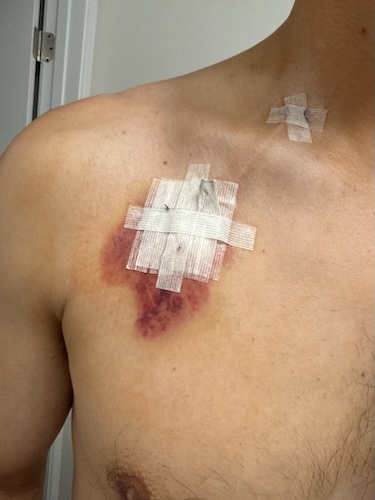
- Referred pain at the tip of the shoulder (related to the phrenic nerve)
- Treatment:
- Chemotherapy
This is not medical advice. Please consult with your healthcare provider to make informed treatment decisions.
- Tyler’s Diagnosis Facts
- Learning to control what I can after a life-changing thymic carcinoma diagnosis
- Life before my diagnosis: Building a family while going through previous tragedy
- Hearing “cancer” for the first time in the emergency room
- How a GoFundMe and a flood of community support carried my family
- Getting the diagnosis: Thymic carcinoma, a rare cancer of the thymus
- I felt isolated by my rare diagnosis until I found a thymic carcinoma Facebook group
- Assembling a care team “like the Avengers” across cancer centers
- Early signs that chemotherapy is working: Liver enzymes trending down
- Balancing fatherhood and marriage while fighting cancer at 30
- Advice for other fathers and husbands facing a cancer diagnosis
- Hear from people living with rare cancers
Learning to control what I can after a life-changing thymic carcinoma diagnosis
I’m not sure it has fully sunk in yet. For better and for worse, we’ll talk a lot about it, I’m sure. But it’s so cliché to think this could never happen to you. You hear about it, you see people who go through something like this, and you always think in the back of your mind, “Thank God that’s not me. There’s no way that could ever be me.” Then overnight, it’s like, wow, it actually is me.
And that’s kind of a gut punch, like a dragged-through-the-mud feeling, where you go through all the stages of grief — why me, I’m sad, I’m angry. But I feel as if, over the last month, as more of the puzzle pieces have come together and we’ve gotten a bit more confidence in knowing what there is to know — what are the problem areas in my body, what does the treatment plan look like, what does best case look like — gathering all of that helps you focus on the things you have control over. I don’t have control over my diagnosis at this point, but I have full control over how I show up every single day. The father I am to my baby. The husband I am to my wife. The person I am to my friends. Those are the things I can now focus on, and I have full comfort and faith that I’m controlling everything in my power. So there’s a lot of comfort and peace in that. But it took a little bit to get there.
Life before my diagnosis: Building a family while going through previous tragedy
Life was busy and beautiful. That’s the only way I can put it. My wife and I have been together for several years, and we’d just had our beautiful baby girl about 15, 16 months ago. I work full time and love my job, doing a bit of traveling, and really just finding our groove in life. We were finding some stability. We were growing a family. We were happy, healthy, and active.
There’s this coming-of-age point I think 20-somethings through 30-somethings start to experience, where you settle down, but in a very not-settled way. I don’t know if anything about having a one-year-old is settled, but it’s settled in its own way. I wasn’t going out and partying anymore. It was all just really focusing on building a beautiful life with my wife and daughter, and hopefully more beautiful babies in the future.
Last year was actually a pretty tough year, because we had our baby in April, and my wife’s mother was diagnosed with stage 4 brain cancer. We spent about three or four months up in Connecticut, through the end of her life, helping take care of her. All of this with a six-, seven-month-old — just kind of living out of a suitcase, trying to make trips back and forth, and managing and coordinating work and time off.
So it was a really rough year that felt like, again, just a beautiful thorn in the journey. And I’m very grateful that we got to spend some very meaningful months with my mother-in-law. And through all of it, our baby girl — she’s still a baby, and needs to be parented, needs support, and for better or for worse has no idea what’s going on through all of this. That’s something that kept us so grounded and even-keeled, and I don’t know what we would have done had we not been in that phase of life.
Now I’m seeing that carry over into this new chapter, where no matter what, life continues to be life. That’s one of the good and the terrible things about any kind of grief or trauma — you’re going through something, but the rest of the world keeps spinning. We’ve been feeling that, and now that’s a big factor in all of this. Today, I’m fighting this cancer, and I’m battling this diagnosis, but I still have to show up every day. You can’t take the time to just lie in bed all day. And while I’m feeling good, and while I’m able to — every single day is important.
Feeling healthy and active at 30, with no warning signs
I’ve always been active and into sports. I play a lot of golf, used to play a lot of baseball and basketball growing up, and have played in men’s leagues as I’ve gotten a little older. I golf two or three times a week. The first sign of a symptom through all this was that I was convinced it was a golf-related injury — I thought my abdomen was strained from golfing too much.
Don’t get me wrong, in your 30s it’s also a point where you start to get the aches and pains and maybe can’t do everything you used to be able to do. But I was very healthy and active. Never any thought that I could even be a candidate for a crazy left-field diagnosis. I guess nobody ever does. No chronic illness or issues that would lead me to believe anything other than that I’m a healthy 30-year-old man.
Mistaking my thymic carcinoma symptoms for a golf injury and a bad gallbladder
I had just gotten back maybe the week before from one of my close friend’s bachelor trips — a golf trip where we golfed four rounds in three days. It was hot out, so there was probably a lot of dehydration going on. I got back and started to feel this dull, achy pain in my upper abdomen area. I was fully convinced it was an intercostal muscle strain, because I’d had a similar type of pain or muscle-strain feeling in my left rib area at certain times before. So I really didn’t think anything of it. I even golfed a couple times through it.
At one point my wife got sick of me talking about it and not doing anything about it, and she said, “Look, you need to go to the doctor.” So I ended up going to an urgent care — I think it was a Wednesday after work, maybe 30 minutes before closing — and I just figured I’d go in, check the box, they’d tell me it was fine, and then I’d leave. And that’s exactly what happened. They had me in and out in maybe five minutes flat. They said, “You’re upright, you sound good, you’re not doubled over — go ahead, you’re fine. Follow up with your primary care in a couple of days if it doesn’t resolve.” Then over the next 48 hours — I was actually supposed to golf that next morning, and for the first time ever it was an early morning tee time.
I got in the car and called my friend, and I was in so much pain. I said, “I’m not going to be able to golf today, but I’ll ride in the cart with you.” And he said, “Dude, no. If you’re not feeling that good, I’m not going to golf — you can just sit in the car.” Okay, I made it through that day, but it just kept getting worse throughout the day. That night I couldn’t sleep at all — I was up all night, and almost went to the ER that evening, but decided to wait it out until the next morning, and then went to the hospital.
Of course, we live in this era of access to information, ChatGPT, AI, and Google, and it’s all great until it’s not. At that point I had ruled out a golf muscle strain, because it was clearly something a bit more serious, but I was fully convinced I had a gallbladder issue — “Okay, I need to get my gallbladder out. I’m having this abdominal pain, all the symptoms match up.” So I showed up to the ER doubled over, and as if I’d already diagnosed myself and I knew exactly what was going on. They did an ultrasound and came back and said, “Your gallbladder actually looks fine, but your liver looks really weird.” Liver? That’s really odd. So they ordered a CT scan, and it came back showing that I had mass lesions across my liver.
At that point, it seemed so non-serious that my wife didn’t even come to the ER with me — I drove myself there; I was clearly fine. But when we first got the heads-up that they were ordering a CT scan because something really out of the norm was going on with my liver, she came and brought the baby, and we knew something was going on.
The CT scan confirmed that there was a lot of what appeared to be metastasized cancer spread across my liver, with a dominant lesion almost nine centimeters long — so some pretty significant tumor burden. Then they did an MRI just to confirm, and I’ll never forget the conversation with the ER doctor, because he was just as beside himself as I was — he couldn’t believe it.
In that moment, it’s so scary, because even the doctor doesn’t really understand what’s going on. All you want in that moment is answers — you want something definitive, “This is what’s happening, this is what it looks like” — and it’s just something you can’t get in that situation. They have the scans; they can tell you maybe what it appears to be, but they’re not an oncologist. They’re not trained to really diagnose what appears to be metastasized cancer in the liver. So that was really scary. That was really, really scary.
Describing the abdominal pain and shoulder pain that led me to the ER
When it started, it felt like a dull fullness — almost like an achy stomach, like something didn’t sit well with me. In retrospect, I’m like, yeah, stomach aches don’t really work like that, but they almost do. I’ll give you another detail — the night I started to feel the pain was the day after my wife and I had grilled these two really big, thick chicken breasts for dinner. I’d told her, “I cooked them very thoroughly, but if you see any pinkness, let me know; we shouldn’t see anything.” The chicken was good. But then the next day I started to get this dull ache, and for a minute I was thinking maybe I hadn’t cooked the chicken thoroughly enough.
It wasn’t painful, exactly, but you could feel there was something there. The pain was present. It was obvious, but it wasn’t painful. The interesting thing about this area — specifically where the liver capsule can push up against it — is there’s a nerve called the phrenic nerve that runs up to your shoulder. I had some really severe shoulder pain, right on the tip of my shoulder, and every time my stomach pain would flare up or feel more aggravated, my shoulder would always really hurt too. It’s apparently a pretty common thing for people going through gallbladder issues to experience as well.
That’s one of the tidbits where I thought, oh, it’s got to be that. But the pain started achy, and then it got to the point where it was painful — kind of jabby. It was constant, but would also get worse depending on the position I moved into. The shoulder pain too was this weird thing where I thought, maybe I’m just having a weird aching pain, or maybe there is something wrong with the gallbladder. I’d just take over-the-counter Advil and Tylenol, thinking that would help with some of the residual pain.
I think the thing that was hardest to track is that it wasn’t a clean, linear progression of getting worse. Ultimately, it did end up getting worse — but some days it would be better than the day before, and then the day after would be a little worse, and then it would go away for a little bit. It was almost as if it was muscular — maybe I slept weird last night — just looking for every excuse not to need to go to the doctor. We all have aches and pains at some point, and I just kept chalking it up to that, until there was too much evidence for it to just be some normal wear and tear.
Hearing “cancer” for the first time in the emergency room
It was thrown around in a hedged way — “We don’t know, but this is what it appears to be.” The MRI report explicitly said it appeared suspicious of metastatic cancer. And of course, you get all the updates in your chart, to your phone, before the doctor’s even in the room. So I’m reading this stuff and just reeling, in these small ER rooms — what the heck is going on?
The doctor again wasn’t confident in much of anything other than, “This doesn’t look great,” but he really did try to calm me — “The fact that we don’t know what this is until you get more testing, you should view that as a positive thing.” But yeah, cancer was absolutely in my discharge papers. It actually said I was diagnosed with liver cancer, which is not the case, but that’s what my discharge papers said. So leaving that day, we were pretty confident, at least from a doctor’s perspective, that whatever I had brewing in me looked and appeared to be cancerous.
Fighting the system to get a biopsy scheduled
This was probably the hardest part of the story, and also the most beautiful… the time I really saw, for the first time, my community steps up in such a meaningful and impactful way.
We had the MRI at the ER — it was about 2:30 on a Friday before Father’s Day weekend — and the doctor came in, told us what they saw, confirmed what they were thinking, and said, “Look, man, you’ve got to go try to get scheduled for a biopsy as quickly as possible. Here’s a phone number; they’re expecting your call, you’ve got to go get this checked out as soon as you can.” He sent me on my way, and my wife and I were sitting in the car, just beside ourselves, trying to wrap our heads around what we’d just been told.
I called the number he’d given me, and it was a receptionist at one of the clinics that does biopsies. She basically told us, “All the nurses have left for the day, you need to call back on Monday, there’s nothing I can do for you.” So I’m pleading with her on the phone, letting her know what we’d just heard, that we don’t know what to do, and can she guide us in any other way? And she’s basically like, “I’m sorry, I cannot help you right now. There are no nurses here. You need to call back Monday. Even if I could get you scheduled, it’s going to take at least two weeks to get you in.”
Hearing that, I remember the feeling of despair — what am I supposed to do for two weeks? How do I go home and even eat dinner normally? I’m still in pain, I have no idea what to do, nobody seems to care. Then I called the ER again once we’d gotten home, and they said, “Sorry, it takes time for these things to process, and it’s Friday afternoon.”
So I immediately started reaching out to every medical person I know in our community and my friend group, and I was so fortunate to have some phenomenal neighbors — one is an ER doctor at a health care system, another is an ER doctor at a larger health care system, which is where I ended up going to get all my treatment, and another works for Levine’s Cancer Center, which is where I’m getting treatment. I talked to the one ER doctor, and he had access to my charts and everything. He said, “Look, you have to go to Atrium tomorrow and get yourself admitted. You cannot wait until Monday to call and try to get something scheduled. Go get yourself checked in.” So the next morning I went into Atrium first thing, and six days later I had my first round of chemo.
How a GoFundMe and a flood of community support carried my family
I’m floored by it every day, honestly, because there aren’t many times in life where you’re forced to lean on your community in such a heavy way. I’ve always really appreciated and tried to build my community, show up for people, and just be a good person by default. I’m a firm believer in not burning bridges, in leaving somebody with a smile on their face. And it’s mind-blowing to see how many people you don’t even realize you may have had an impact on, or who’ve had a positive experience just knowing you, or working with you, or talking with you — and how those people show up tenfold in a time of need.
This has obviously been a very expensive endeavor already, and we started a GoFundMe, which was really difficult for me — to really try to accept help. But my wife and I had a conversation where we realized we needed to lean into the community and the support we were getting. The amount of people I haven’t talked to in ten years who’ve donated or reached out and said, “You were always so nice when we used to work together,” or whatever the case is — that is what has carried us through a lot of this.
People do care, people do want to help, and people will show up if you show up for them. I feel so incredibly motivated, throughout all of this, to pour back into people the way I’ve been poured into, because it’s probably so easy to just turn a blind eye and think, “Oh man, that sucks, but I haven’t talked to this guy in a couple of years.” I genuinely feel that I have such a strong support system and group of people who have just shown up for me, and I’m incredibly blessed by that.
I think the one thing that breaks my heart is seeing people who are also going through their own battles, who may not have a foundation of faith or a community they feel they can lean on and get support from. That’s heartbreaking to me. And on the other side of it, it makes me feel that much more blessed and fortunate despite everything going on. It could always be so much worse. It could always, always be so much worse.
Spending Father’s Day admitted to the hospital, waiting for answers
It was my second Father’s Day, but my first where the baby was really coherent for it — a real Father’s Day.
It was tough. It was really tough. A lot of it was tough because I wanted to be there for my baby and for my wife — it’s not fun being in the hospital. I think through all of this I’m like, look, don’t worry about me; I know I’m going to suck it up and do whatever needs to be done. But I feel for my wife and for my baby, and I don’t want to put anybody else through strain or trauma or turmoil because of this.
That day was tough because we wanted to spend time together in an environment that wasn’t the hospital. I was in this holding area — kind of a temporary space they leave you in after you leave the ED, before you get a long-term room. We didn’t even have real privacy — we had curtains and shared space with a bunch of neighbors, basically one big hallway.
There was no privacy, no space that was even suitable for more than one visitor, let alone a 15-month-old baby running around. It was great that I was still alive and able to spend the day with them. We had some other people come by, and this little space — I kid you not — was really not suitable for more than one or two people. At one point we had like nine or ten people in there, two kids, just overflowing into the hallway, probably making a mess of everything. But I just felt the love. I felt bad, really bad, dragging people to the hospital — nobody wants to spend their day here; I don’t want to spend my day here. But it was a Father’s Day I’ll probably never forget, one I’ll be grateful for eventually, but one I hope I never have to repeat.
Getting the diagnosis: Thymic carcinoma, a rare cancer of the thymus
When I first got into the ER where I ended up doing my stay — not the first ER — they did a CT scan on my chest. Before that, I’d only had an abdominal scan. So when they came back with the CT scan that first day, they said, “We also found a mediastinal mass in your chest.” The plot had thickened. Up until that point, we knew my liver had all this going on, thinking liver cancer — what could it be? And when they found the mass in the chest, that seemed like another big clue at the time, but all the doctors kind of swept it under the rug. Nobody was too concerned about the mass in the chest, which I thought was odd, and now I understand why.
Over the next few days leading up to the biopsy, there were a lot of questions — family history, my own personal history, exposure to things — and none of the doctors felt it was entirely possible, but not likely, that this thing in my chest could be the primary source of the cancer. At that time I had very intentionally stayed away from the internet and Google and all of that. But when they did the biopsy, they confirmed it was thymic carcinoma, which is a very rare and aggressive cancer that forms from the thymus.
The thymus is a gland that’s pretty active pre-puberty and is responsible for training T cells, basically how your immune system learns how to function. So it’s pretty important from an immune perspective before puberty, and then they don’t really know what it does after puberty. There’s one camp that kind of thinks it’s useless, turns into fat — there’s a specific word for organs that are only used for a certain period of time — but it’s small, and very rarely does it actually develop or form a cancer, or mutate like this.
At the time I couldn’t figure out why nobody was paying much mind to it, but it turns out it’s because it’s so rare — a mass there, with as much expression of disease on my liver as there is, is an even rarer variation of thymic carcinoma. I’ve talked to maybe 50 thymic carcinoma patients at this point, and I haven’t heard a single scenario similar to mine. It usually grows much bigger where it starts and spreads more locally — to the chest, the lining of the lungs, the heart, the rib cage. Mine is, I’d call it, on the smaller-to-medium side of the tumor, but then it just hopped straight to the liver, and didn’t touch anywhere else on the way. It’s a really odd expression of the disease.
When we got the biopsy — up until that point, nobody really wanted to conclude that this was a likely scenario. Nobody would even speculate until we got the diagnosis. They stripped me down and looked at my entire body to check for melanoma, after they’d seen the tumor in my chest — they were looking for any answer as to what else this could be, because it seemed pretty unlikely that it was this thymic carcinoma thing.
Anyway, my dad and my uncle were there, and my cousin had flown in from New York, where they live. My wife was in the room. We’d been waiting for biopsy results for about a day and a half at that point, and knew it was coming. That waiting period is painstaking — you just don’t know what’s on the other side of the diagnosis.
Two oncologists came in and broke the news, and it all kind of didn’t make sense at first. I’d never heard of thymic carcinoma. I didn’t know what a thymus is. There were just so many questions immediately. I think I’m so used to going to the doctor in the context of, you’ve got strep throat, here’s a medication that will fix you, and if not, call us back in five days.
This ecosystem of cancer diagnosis — there’s no straight answer to anything. It’s all gray area, all very subjective, all dependent on a lot of different things. Cancer is a word that covers such a broad universe of different forms, mutations, and expressions of what the disease really looks like from person to person. So that was the first thing where I’m like, well, what does all this actually mean for me? The words are really scary when you don’t have context.
They told us this is incurable, and that was a really difficult thing to hear. I didn’t know what “uncurable” meant — I know what it means today, but at first, incurable to me meant terminal. I’m doomed, I’m dead, I’ll have this thing and die soon. It honestly wasn’t until after I got out of the hospital and started talking to other people battling this disease that I learned there are things like NED (no evidence of disease) and remission, where people can go into long periods of remission for years and years and treat it basically like a chronic illness. The hope in the diagnosis I was given felt very minimal, because the words were very scary and I didn’t have all the context that I have today.
I felt isolated by my rare diagnosis until I found a thymic carcinoma Facebook group
It was the most isolating thing, because there are so many factors that make my situation a bit more unique — I think age is a big one — but just how rare this diagnosis is. All I wanted was to talk to somebody who had some perspective, who had battled cancer before. I immediately felt very comfortable, and better, talking to people who had battled cancer and overcome it — it gave me hope from day one. But it still wasn’t scratching that itch entirely, because nobody had my type of cancer. And again, I don’t think everybody’s situation is unique, and I think that’s one of the hard parts about cancer and cancer treatment. But it was really tough.
I think the one turning point in this journey was actually finding the thymic carcinoma Facebook group, which is filled with so many people who have either gone through it, are going through it, or have a loved one in this situation. Facebook groups are Facebook groups at the end of the day, but this one is very community-driven — we all recognize we have this rare, crazy thing, and we’re all going to be here for each other.
Finding that group, and talking to the admin, who’s also the founder of the Thymic Carcinoma Center nonprofit — he was the first person I talked to, and he said, “I’m in year 14 battling thymic carcinoma. I was part of the first clinical trials even offered in the US for this disease.” And I’m like, 14 years, wait a second, you’re still here, and you’re still kicking, wow. That in itself was this epiphany — all right, there’s a lot of fight to be had here. You’re not down for the count by any means.
Assembling a care team “like the Avengers” across cancer centers
That has been the number one focus over the last few weeks, as we’ve gotten into the groove of treatment. I’m not going to say the dust has settled, because it absolutely has not, but we’ve been able to focus more on setting myself up for success. I’ve been incredibly fortunate to be local to Levine’s Cancer Center, which is the sister cancer organization to the hospital system I was admitted to, and they have a phenomenal team who are highly regarded by everybody I talked to. But it’s a rare, rare disease, and there are only so many cases to see and treat it annually, so immediately the thought was, we need to go wherever they treat this at the highest volume. That’s what we set out to do.
For better and for worse, because it’s so rare, there’s not a sea of people to choose from — there are maybe five or six names you kind of hear in the community, and again, this Facebook group has been incredibly helpful in connecting some of those dots, and if nothing else, confirming and validating that I’m looking in the right areas, having the right conversations.
We’re actually going up to New York City on August 4th for a new provider visit at Sloan Kettering, to get seen there — there’s a specialist who sees many thymic carcinoma cases. I’m actually meeting some friends I’ve made through the Facebook group up there who are also being seen there, so I’m excited to meet them. Then there’s one gentleman who works for the National Institutes of Health. He doesn’t see patients in a clinical capacity, but he’s very involved in the research side, the clinical trial side, and likes to keep his hand on thymic carcinoma cases and patients as he continues to do research, working closely with oncology teams that are driving treatment plans.
So what I’ve told everybody is, I’m assembling my care team like the Avengers. I’ve already given my local oncologist the Captain America role — he’s locked that down. We’re working on the rest. Hopefully over the next few weeks we’ll have a good care team that’s all working together, and as my treatment and response to treatment evolves, we’ll have good alignment on the best path forward for me.
Early signs that chemotherapy is working: Liver enzymes trending down
The good news is the initial first line of treatment for what I have seems very non-controversial. The whole goal is to shrink, contain, and stop the spread. Every doctor I’ve talked to universally agrees this is the first line of treatment; you’ve got to go do it. That gives me a lot of comfort — I know what the immediate plan is from there. What comes after depends on how I respond. It could be some type of surgery or resection to the liver; there are so many options, and a lot of it just depends on how the initial chemotherapy treatment works.
I’m on day seven after cycle number two. One of the first big wins we’ve gotten in all of this is that my liver enzymes, since the day I was initially checked into the ER, were very high, very elevated — showing my liver was angry. Since starting treatment, those have trended down, and as of my last labs last week, they’re in the green for the first time since all of this started. They’re all in an acceptable, not-high, not-elevated range — look like good, normal labs from an otherwise healthy person. That was super great news, and the doctor thinks it’s a good early indication that I’m responding to treatment. Just a huge blessing. Things seem to be trending in the right direction — my pain has subsided substantially, and I really don’t have any of the liver pain I was having. We’re scheduled for a restaging scan to get a full picture of progress before my next infusion in a few weeks.
Shaving my head with my barber and family by my side
This just goes back to the community. The second my barber — who I’ve been going to for five years or so at this point — found out what was going on, he said, “Just let me know whenever you’re ready to chop it off, I’ll be there.” Just so many people like that right now, offering whatever they can.
I thought I was in the clear, because we were on day 15, 16 of the first cycle and still had a full head of hair. I thought maybe I’m an anomaly, as I have been throughout the rest of this. Then, just overnight, clumps — handfuls of hair. It was something I was mentally ready for, knowing it was a very real possibility that it would all go quickly. As much as you can control in this, you have to, so I didn’t want to wait another day of pulling hair out, another reminder that something’s happening to me right now. Let’s get in front of it, shave it off, and own this look.
He did a great job. It continued to fall out over the next day or two, so now I’m completely bald, but it was good to have that period — symbolic ownership over the diagnosis, like, this thing is not stronger than me; we’re going to beat this thing. It does not own me. It does not own anything other than a rent in my liver that’s about to get kicked out and evacuated from here shortly. It was good for our family to have that moment, for sure. Hats too, now — which works out, since I love golf.
Balancing fatherhood and marriage while fighting cancer at 30
It’s so multi-layered, in so many ways. The big thing that motivates me is my family — being there for my daughter today, tomorrow, next year, five years from now, ten years from now. My mother passed away when I was in high school, and I know how that impacts you growing up, how important having stability in family is. Every day I’m motivated to give that to her, and to fight so I can be here for her and for her future.
Same with my wife — she’s been through more than anybody at this point, and I tell her every day, I know this is probably got to be harder for you than it is for me. I am, unfortunately, in a position where I need to lean on my family in a very heavy way right now, and on my community in a very heavy way. But at the end of the day, I feel so inspired to show up for them every day, because they’re the ones who deserve it and who need it. That in turn gets me going — that’s what helps me get up every morning and not hit the snooze button for the fifth time, and just show up, because for better or for worse, they need a dad, and I’m committed to being there for them.
Advice for other fathers and husbands facing a cancer diagnosis
One day at a time, one day at a time. And lean on — I think as men and as fathers, it’s very easy to want to be the one who carries the world on our backs, who climbs the mountain and doesn’t need to ask for help. But you need to lean on your community and your family — that way you can show up as the best version of yourself for them.
The hardest thing I’ve had to overcome is not only asking for help, but accepting it. That has genuinely made all of this a thousand times easier and more special, because I think the reality is that people want to help. A lot of times people don’t know how to help, or don’t know how to actually add impact and value. But if you allow them to be helpful — which, again, is easier said than done — it makes everything so much easier.
What this diagnosis has taught me about faith and myself
It’s taught me that I can do tough things. I can do tough things. And that my God is greater than any diagnosis. There aren’t many times in life where you’re truly pushed up with your back against the wall, and you definitely learn a lot about how you react and respond to things when they seem like doom and gloom. I think what I’ve learned most about myself is that I’m fully capable of doing this, and also of being present as a father and as a husband.
Giving what I shouldn’t have to carry alone to God has helped us find comfort and peace in all of this. It’s interesting, because a lot of people — and I can say this for myself too — when you first get diagnosed, you go through that questioning of, why me, questioning your faith, is there a God, because how could he let this happen?
But I’ve found over the last month that my faith has never been stronger, and it’s only getting stronger. I think that’s what has carried me and us through a lot of this — just knowing that we’re not fighting this alone, that it’s not something we have to bear ourselves. The community, the acts of kindness, everybody who has made this chapter of life a little more pleasant — that’s an extension of that.
Why survival statistics don’t tell the whole story — and neither does access to care
There’s one thing I’ve been thinking a lot about lately, and whether or not you want to include this, I just think it’s a topic I haven’t really uncovered until I’ve been in the thick of all of this. Early on, especially when we talk about prognosis and statistics, I’ve been from day one like, don’t Google, don’t ChatGPT, I’m not a statistic, I don’t care if it’s 1%, it doesn’t matter to me, I’m going to beat this thing. But the more I’ve dug into it, there’s a lot of, I think, stigma about cancer that you’re never confronted with until you experience it, or a loved one experiences it.
With the statistics — at least in my situation — it’s like, okay, this is the percentage of how many thymic carcinoma patients make it past five years. But that doesn’t account for age; it doesn’t account for comorbidities. Okay, that makes sense.
One of the things I keep seeing, though, is a third prong with that, which is access to health care. It breaks my heart, because I’ll see, in all these new Facebook groups I’m in, or just conversations with people, where it’s like, God forbid you were diagnosed with thymic carcinoma in a more rural town, don’t have the means to go to a specialist, don’t have insurance to cover something, and then you’re just at the mercy of the system, unable to get the treatment you need.
I’m on a certain treatment right now that’s fresh out of clinical trials as of late 2025. It’s $30,000 every three weeks, and I don’t have to pay a dime of that because my insurance covers it.That could be the drug that saves my life, and just knowing that some people are not in a position to get access to the thing that could save their life — irrespective of whether they have kids, whatever the case is — it’s terrifying and super sad to me that that’s just the reality we live in.
I hear the age and comorbidities things tossed around all the time, but I just don’t hear the access-to-health-care thing thrown around a lot. I think part of my purpose on the other side of this is definitely going to involve some advocacy or awareness around that, because even things like — I’m so fortunate to have the job I have, and they’ve been super supportive of me throughout all of this — but I don’t know, if I worked somewhere else, it’s like, sorry, now you’ve got to pay, we have to force you onto short-term leave or whatever the case is, and it messes up the insurance thing. It’s like, well, now I can’t go to New York City to see the specialist who sees this a lot, because it’s not covered by insurance. It’s just heartbreaking. Heartbreaking.
I want others to listen to their bodies and catch cancer earlier
I think, first and foremost — and I’ve already seen this — I want to motivate people like me to listen to their body.
There’s a lot there, because until it hits so close to home — as we talked about earlier, this could never happen to me — I don’t know if going in two weeks earlier, when I first had that pain, would have changed much. But I don’t even want to bet on whether going in two weeks later would have changed much. So I think that’s table stakes, first and foremost.
But secondly, there are so many phenomenal organizations out there that do this, and it all makes sense to me now — the programs available for people going through something like this, whether it’s funding for treatment, rides to therapies, or just being there and showing up for people.
I don’t know what it looks like yet, but I know that the way my community has shown up for me has taken such an extreme burden off of my family, and I need to give that back somehow. I need to be able to provide that for others, because it goes such a long way, and I don’t even think people realize how far even a simple check-in goes. That’s what I want to give back.
This interview has been edited for clarity and length. The views and opinions expressed in this interview do not necessarily reflect those of The Patient Story. This content does not replace professional medical advice.
Inspired by Tyler’s story?
Share your story, too!
Hear from people living with rare cancers
Real experiences with diagnosis, treatment choices, side effects, and life beyond cancer — in their own words.
Leave a Reply