
Living With Stage 4 Melanoma: How Megan Found Her Groove Again
Megan was 36 when an itchy mole on her back, one that had also changed color and texture, led to her first melanoma diagnosis in the spring of 2017. She was diagnosed with stage 3A melanoma, a kind of skin cancer, and the doctor delivering the news went straight into survival rates before she’d had a chance to absorb any of it.
Interviewed by: Taylor Scheib
Edited by: Chris Sanchez
Genetic testing during that first year showed Megan carried a CHEK2 gene mutation, which raised her risk for other cancers and added breast MRIs, mammograms, and thyroid ultrasounds to an already full schedule. She chose surveillance over more aggressive prevention, switching her care to the University of Michigan. For nearly five years, the cancer stayed quiet.
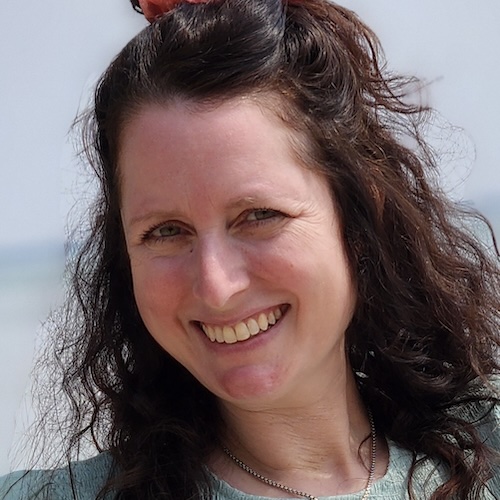
Then, in early 2022, a strange, escalating pain in her hip and leg turned out to be melanoma that had returned and spread to both femurs, her pelvis, spine, and stomach. Her melanoma was now stage 4. The disease in her femur was serious enough that she needed orthopedic hardware before she could safely start treatment. Megan began immunotherapy and radiation right away and saw strong results.
In the years since, her care has continued to shift: a break from immunotherapy after pancreatitis, a return on different drugs, and in 2025, a new spot on her kidney that a biopsy confirmed was melanoma again. She treated it with radiation and a return to her original immunotherapy drugs, and an April CT scan showed no evidence of disease in that area. Today, Megan lives in Michigan with her family, manages a spot on her spine that is still being monitored, does yoga each morning with her husband, Justin, and hosts a podcast with him about living with melanoma as a couple.
Watch Megan’s video and read through her edited interview transcript below for more on her melanoma story.
- Megan’s recurrence didn’t announce itself as cancer. It started as hip and leg pain she blamed on a stretching video, and it took months and a spine MRI before her Michigan team pulled her in for a PET scan that showed the disease had spread to multiple places.
- When the melanoma reached her femur, treatment couldn’t start until she’d had surgery to place orthopedic hardware, because the bone was fragile enough that her doctor wouldn’t let her fly home.
- Cancer in the bone came with a specific, grinding kind of pain that Megan says nothing helped for a long time. She had to wait for surgery and for the treatment to work on the cancer itself before the pain eased.
- Her CHEK2 gene mutation meant that even during five “quiet” years, Megan was never fully off the clock, cycling through breast MRIs, mammograms, thyroid ultrasounds, and one breast biopsy scare that turned out to be nothing.
- A stretch of feeling genuinely well on prednisone became the thing Megan built a life around: early mornings, yoga with Justin, a porch garden, and Saturday matinees. She learned to move fast on the good days because she knew they wouldn’t last forever.
- After years of never wanting to say the word “cancer” out loud, Megan now hosts a podcast with Justin about living with melanoma, and she describes talking openly about it as one of the most therapeutic things she’s done.
Megan’s Diagnosis Facts
- Name: Megan C.
- Age at Diagnosis:
- 36
- Diagnosis:
- Melanoma
- Staging:
- Stage 4 (Metastatic)
- Mutation:
- CHEK2
- Symptoms:
- Itchy mole on the back that changed color and texture
- Escalating pain in the hip, lower back, and leg
- Treatments:
- Surgeries: wide excision of mole, removal of 10 lymph nodes from right armpit, orthopedic hardware surgery (femur)
- Immunotherapy
- Radiation therapy
This is not medical advice. Please consult with your healthcare provider to make informed treatment decisions.
- Megan’s Diagnosis Facts
- The itchy mole that started everything: My first melanoma diagnosis at 36
- The CHEK2 gene mutation and why I did genetic testing
- Five years of surveillance: Living life while the scans keep coming
- “It was eating my femur alive”: The stage 4 melanoma recurrence
- Starting immunotherapy and radiation all at once
- Two years on: Infusions, a pancreatitis break, and relearning how to walk
- Living with melanoma: What “no evidence” does and doesn’t mean
- Starting a podcast with Justin: Talking about it, together
- “I’m very proud of myself”: Nine years, and becoming who I am
- Hear from people living with melanoma
The itchy mole that started everything: My first melanoma diagnosis at 36
So this diagnosis of stage 3A took place in 2017, end of March going into April.
It was the result of having an itchy mole that had changed colors and textures surface-wise. It’s something I waited too long to get checked out. I’m aware of that. I don’t dwell on it, but that’s what it was. It was a mole on my back that I needed to get checked out, and I went to my primary care doctor. We had moved states, and we had relocated back to Maine, and I went to my primary care doctor.
She looked at it and said, “I think we need to get this checked out further, and I’m going to refer you to a dermatologist within the medical facility system.” So that’s not the right word, but she meant the medical system. So my primary care doctor referred me to a dermatologist who got me in within a week. I went to the dermatologist. I had that mole biopsied.
One of my biggest memories was being in the room and the nurse telling me, “Oh, in the worst-case scenario, it spreads to your lymph nodes. If it is anything, if it is cancerous. Worst case, just worst case, it will spread.” And in the back of my mind I thought, “Oh, okay, well, we don’t live in the worst-case scenario.” But at the same time, the mole had been bothering me, changing colors. It had itched. So, thank God I went to the doctor and got it biopsied.
And then they called me pretty quickly. I was at work. The dermatologist said, “We need to dive further into this. It’s definitely something that we need to do: clear your margins.” I didn’t know anything about melanoma that much. I really didn’t. I grew up knowing to be careful of the sun, but I really didn’t think too much of it, or I would have gone sooner. But my dermatologist said, “I want to refer you to an oncologist”. My dermatologist wanted to get a better picture of what was going on, and so I called my mom, and my mom said, “Okay, I’m going to talk to my husband,” my stepdad. And they actually had someone, a family friend, who worked at a hospital in Boston. And I was in Maine.
At Mass General Hospital, I got referred to a surgical oncologist. And my dermatology office in Maine was very supportive and said, “Yes, this is the right thing to do.” So I went in for an appointment to just get it checked out and to get the surgical oncologist’s input. And his input was, “We need to clear the margins, and we need to see if it’s spread to any lymph nodes.”
This was all happening very quickly. This was all in weeks of each other, if not days.
Surgery, ten lymph nodes, and hearing “stage 3A”
So my mom flew in. We went to this appointment with the surgical oncologist. We said, “Yes, let’s do it. We need to get the surgery.”
So within another week or so, I had surgery on the mole. And they also did nuclear medicine, I believe, where they inject the dye around that area. That’s very, very painful. So when you’re getting all of this done, you know the reason why. And that’s so incredibly scary. So you’re not thinking, “Oh, they’re just getting this done, it’s painful, I’ll have the surgery and then I can move on with my life.” It was more like, “I’m getting this surgery to find out what’s going on with cancer, with melanoma.”
And so I had the surgery done. I had ten lymph nodes removed from my right armpit. The dye had drained into many, many areas. So they wanted to be as careful as possible and just get as many as they thought that they needed to, just to ensure that they get everything and to check everything. And they did.
I did have one lymph node that tested positive for melanoma. So that meant my mole on my back had melanoma, and it spread to a lymph node. They did clear the margins, so everything was okay on my back.
But the next steps after surgery were getting the results. So I went to my appointment to get the results with my mom and my husband. My mom and I are very close. She was in Michigan at the time — I mean, because I live here now, but my mom flew in from Michigan, flew into Boston.
We went to the appointment, and I had a different doctor in the room, and this doctor read the results and said that I had a lymph node that tested positive for melanoma, and diagnosed me with stage 3A. And the doctor immediately went into survival rates and kind of strange things that you don’t want to hear, because you just don’t want to believe that you have any sort of cancer, and that that is the worst case.
Scanned head to toe: PET scans, a brain MRI, and learning I was claustrophobic
So I’m thinking, “Okay, yes, the worst case happened.” And then there were next steps. I next needed to get scanned up and down. Including a brain MRI — melanoma does tend to spread to the brain, unfortunately. It spreads everywhere. So they needed to do PET scans, CT scans, and a brain MRI. And that was the next step. And the three of us were just in shock, and you never get those moments before that back. You are never carefree again. You will always live with “what if,” all of that. So we would just have to take care of business.
So we set up the appointments. I got scanned as quickly as we could. My husband took me for all the scans. So, scan day — that was interesting. And then at the same time, because I had work, I had to get time off. I had to go on short-term disability, because with lymph node removal in my armpit, that was pretty serious in terms of pain and needing time to heal. So I couldn’t go back to work for a few weeks after that.
So you’re trying to get better, you’re trying to be normal. And then at the same time, we’re spending now days into weeks wondering about this cancer. I got scans done. Thankfully, thankfully, it had not spread anywhere else. And I learned I was claustrophobic. I didn’t know. You go into all of these machines, as I’m sure many people watching this will experience. With the MRI, because of how I was feeling, they allowed me to do something that they don’t often allow; this was a one-off. I probably was allowed just because of the location, and the tech felt bad, so they allowed my husband to be in the room with me, and he held my foot, and they talked to me through the speakers. So I could hear, because with the brain MRI you have very little space; you can’t move your head. And then you also have a cage on top of your face. And so I just needed that reassurance.
Hearing my husband’s voice, he held my foot, hearing the tech say, “Great, you’re doing great, the next scan will be three minutes.” Since then, they’ve started to allow music to be played. So that’s been great, because I’m still doing this.
I have to say I’m very lucky, because I was surrounded, and I surrounded myself, with the important people that were there for me. And they will always be there for me. And I am incredibly grateful and lucky to have them.
The CHEK2 gene mutation and why I did genetic testing
I do have to mention that at the time when I was diagnosed, I did genetic testing, and so I found out that I was positive for a CHEK2 gene mutation. So within those years, I was screened for colon cancer, breast cancer, and thyroid cancer, because my risk, according to studies done, meant I had a higher risk of those cancers. And so they kept an eye on me.
I even forgot about this recently until doing some more thinking about it. But at the end of 2016, my mom had been diagnosed and treated for breast cancer, and she was coming off the heels of radiation when I had to tell her that I was going to the doctor to get my mole checked. And she did great. She went through it, and she’s doing just fine. But at that time, because my mom had gone through what she went through with breast cancer, she did genetic testing. And then when I was positive for melanoma, my care team brought it up to me at U of M and said, “We want to talk to you about this as an option.” And I said, “Absolutely,” because my mom had just been dealt the hand of breast cancer, and I had just gotten melanoma. They did all the genetic testing, like BRCA; they did all of that. And luckily, it was just the CHEK2 gene mutation that they found.
But at the same time, even with the higher risk, they do present you with the same things: surgery and the medication tamoxifen. They present you with all of these options, as if you want to prevent it. And that was too much for me. I didn’t take any of that on. I said, “We will do MRIs, mammograms, all of that. But I don’t want medication or surgery.” It would just upset my already fragile state — just managing; I’m managing that. So that’s how I got involved with genetic testing.
It’s tough. It is, but I’m glad I did it. I’m very glad I did it, thankfully. And I’m tested regularly. So all of these other scans and ultrasounds and doctors are incorporated into my melanoma team.
Five years of surveillance: Living life while the scans keep coming
When I was diagnosed with melanoma, my doctor suggested interferon, which at the time was still being used for treatment. That’s what was brought up to me. I got a second opinion, and I ended up getting my care at the University of Michigan, and they felt that surveillance — regular blood draws, scans, ultrasounds, all of that stuff — was good; they would just keep an eye on it. And so that way, if anything new popped up, they’d be ahead of the game, and they’d see it beforehand. So I didn’t know any different. I know that it’s 2026 and, from what I know now, it’s a different world. But this was also nine years ago, so not everyone was getting the same treatments that they’re getting now, nine years ago. So I had melanoma in 2017.
And then what they ended up doing was a mammogram once a year, a breast MRI once a year, and a thyroid ultrasound twice a year. And they did that at the same time as an ultrasound of my right armpit, where all those lymph nodes were removed. And I got all of this done. Because I was traveling to Michigan, we tried to coordinate all the tests at once — to see my doctors, to get scanned, to get my brain MRI, and all of that, and the CT scan. I was traveling to Michigan every six months. Now, in between, what I had was a local doctor. I did get an oncologist locally, so some of it I had done locally — actually, my CT scan, unless it was a follow-up that Michigan wanted to see.
Sometimes hospitals, doctors, my care team wanted to do the tests themselves. And so I did some locally, and if I had something that wasn’t feeling right, I could go to my oncologist in Maine. But I was traveling every six months to Michigan, and I was exhausting my PTO. I was having to deal with being out of work, with leave and getting approval, and that plus finances — that’s a whole other conversation. It’s such a huge toll when you’re trying to keep your life together, and all of your time off and all of your brain capacity when you’re not working is dedicated to appointments. And trying to remember, “Did I pay for that already?” And I still deal with that right now.
So we just lived with it. I would say we lived with it well. We did it. It was really hard. It was super hard. And I didn’t want to act like I was sick, because I wasn’t sick. My cancer wasn’t active. And melanoma is skin cancer. So people didn’t understand. And so I just lived my life knowing I had this big thing, but I’ll just go on and live life, that type of thing. I didn’t want to talk about it a lot either, because if I talked about it, that made it real.
And I didn’t want to be the one that said, “I have cancer, I have cancer.” So I just wanted people to know how to act and how to be. And that’s not fair either. So it’s a shift. It’s a shift with relationships and friends, and just figuring out your day-to-day.
So we got in our groove, and things were totally fine. It was just a life-altering change — I was 36, so that was definitely a shift. And when you’re not financially well off — you want to be, but a lot of stuff goes to those costs. Just a lot of money. It’s very draining. It’s very draining financially, as you know.
The breast scare: A spot that turned out to be nothing
I was diagnosed in 2017. Then in January of 2018, through an MRI, they found a spot in my breast that they didn’t want to ignore or wait to check. Not because they were raising red flags that I have breast cancer, but because of my CHEK2 gene mutation and my higher risk, they have to be super careful.
They ended up having to do an MRI and ultrasound — but an ultrasound-guided biopsy, an MRI with an ultrasound, and also an ultrasound-guided biopsy and an MRI-guided biopsy. It’s annoying just to have a breast MRI. But when you’re getting a biopsy at the same time, and you’re in and out of that machine, and then afterwards, they don’t tell you about the bruising and the scar tissue.
So everything, thank God, was fine. But that’s an example of when you do have a higher risk for something, they just have to be super careful.
Feeling “good” and moving to Florida: The calm before melanoma came back
It had been almost five years. So I was starting to be in the flow of getting checked every six months. Justin was in the flow. We were really in the flow of it. So we were doing really well, and we were very positive. I’m a very positive person. So we were ready to conquer the world and move to Florida. We had gone through a lot during COVID. A lot of people had to either move or shift jobs or make big changes in their lives. And so we made a big shift, and we moved to Florida, and we decided to have fun and relax. Life’s been pretty challenging, and we’re going to live near friends and family and really enjoy ourselves, which we did for a few months. We moved in the summer of 2021.
In January of 2022, I was stretching. I was on Instagram, and I was just scrolling around, and it said to release the tension from your hips — you know, one of those posts. And I said, “Oh, okay.” So I just do stretches. Just stretching, nothing out of the ordinary, nothing that would harm me or be unsafe. So I do stretches, and then the next two days I felt like you do after you overdo it working out, but it didn’t feel like a regular strain.
This is strange, but I didn’t think a lot of it. I just took some Advil, and I didn’t think too much of it. And I even got my regular CT scan and everything. My regular CT scan, of course, wasn’t on my legs or my hips or my back or anything like that. But I was getting this pain, and I wasn’t even thinking that it could be cancer. 100%. I just thought, “People get leg pain.” But I ended up having excruciating pain in my lower back, on my left side, and down my leg, in my hip. The months went by, and I was just getting excruciating pain. And I went to see my doctors, and they said, “Oh, just go to the orthopedic specialist.”
So I was in Florida, and I went to the orthopedic doctor, and I was giving them my symptoms, but they didn’t match what they’re used to seeing. So they put me in PT. It seemingly was helping. I had that electrode kind of stuff, where they plug it in and they put it on you. And I thought, “Oh, this is great.” Of course, you’re just telling yourself that you’re feeling better. That doctor couldn’t decide what was wrong with me. So he sent me to another doctor in the practice, and that doctor ordered a spine MRI. And that spine MRI showed a lot of “what ifs,” or things that weren’t right.
It was done in Florida. It was done by the orthopedic office. So I don’t know the type of reading on it, who was reading it, or what they were really looking for. So I was pretty much laid out in pain every day. And I can’t explain the pain. It was really bad. And so I had the spine MRI done, thankfully. And then my oncology team in Michigan said they read it, and they said, “We want you to come to Michigan for a PET scan. We prefer to do the PET scan ourselves because we want to read it. And so I said, “Okay, no problem.” Our time in Florida was going to be cut short anyway. We were going to stay a year, and we decided to move back to Maine. And I got on a plane and came to Michigan to get a PET scan. And I never went home.
“It was eating my femur alive”: The stage 4 melanoma recurrence
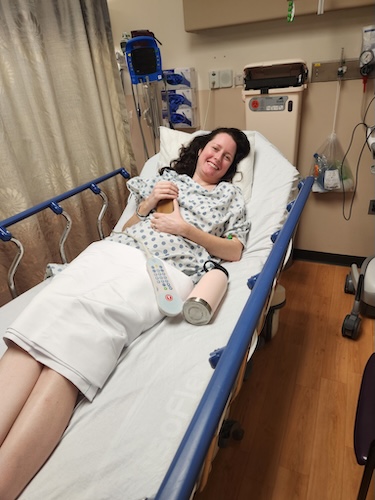
I got a PET scan immediately. And what I had felt in my leg was melanoma. It was in my femur, eating my femur alive. I say that because I was in so much pain, and the doctor told me I couldn’t get on a plane because my femur would break and I would probably get a blood clot. I needed surgery to get support. I needed orthopedic hardware so that when they started doing the treatment, I wouldn’t break my leg, and that would help with the healing process.
So when they called me about my results for my PET scan, they said that the melanoma had come back, and it was everywhere. The cancer was in both my femurs, more so on my left side. I needed surgery. I didn’t feel it in my right side, thankfully. And it was in my pelvis, my hips, my spine. It was in my stomach. And they don’t know everything based on the PET scan — they can read it and say, “This is what we think, but then you need to get biopsies.” And that’s uncomfortable and challenging. So you go through a process of, okay, this is what the PET scan reads; now we have to check, and we have to make sure it’s melanoma, and where is it? And so then I had testing done, biopsies, and a shot in my back and my spine, and a lumbar puncture. I don’t even remember that as much, because I was in so much pain. I couldn’t sit up. I needed help; I needed treatment. Thankfully, I got here, I’d say, in the nick of time before everything was too far. So I immediately started treatment when I got here, and Justin drove up with our dog at the time. And we’ve been here ever since.
Well, my pain was so bad. And so I had a very tough quality of life for the last few months. And I got the PET scan, and I’m getting scans and tests, and I’m very uncomfortable doing this because my body is not well, and my husband hadn’t gotten here yet. Justin hadn’t arrived. I was with my mom. We were in the den, and U of M called, and my nurse was reading the results and kept going with these areas of cancer — I mean, listing it, you couldn’t make it up. It just kept going. And so my mom and I just looked at each other. We just were in disbelief. What do you do? What is this? What happened? This happened very quickly. I had gotten regular CT scans of my chest and my abdomen. I’ve gotten blood draws. I’ve gotten ultrasounds. I have had things that should indicate it. And so when it came back, it came back really quickly and fast. It snuck right back in at the five-year mark.
We just called Justin right away, and we just said, “You have to get here.” Our apartment was half packed, so he just had to get here with our dog, and he drove here.
Starting immunotherapy and radiation all at once
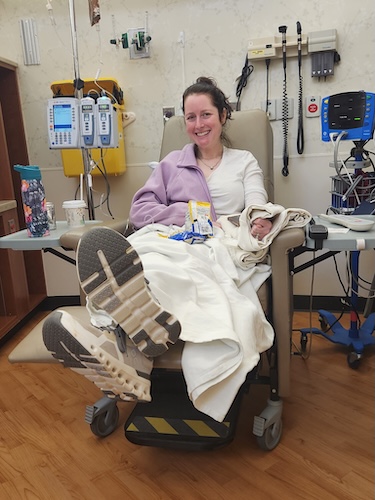
And then we just started going to appointments, because we had to get everything found out. We needed to get everything solidified. You don’t just jump on a bench and get radiation. There’s the consult, there’s the mapping. There’s a lot to it. There are the biopsies; there’s a lot that you have to get done before they start everything. So my husband got here, and we went to our appointments. I started immunotherapy right away. And I started radiation right away. And I had fantastic results. It took time, and it wasn’t immediate, but I started to see results — like the spots in my stomach, the tumors in my stomach, things were getting better, thankfully.
Though at the same time, my body was still cooking it. So then I had a pain in my butt, and I had to start PT, because I’d had surgery on my left side, and with the hardware and everything, they have to make sure I have balance and that I’m stable. So they put me through to PT, who wanted me to do a squat, and I just did a squat, and that did not do so well for the tumor in my buttocks. And that exploded, and that was painful. And that was a 24-hour ER visit. And then that was the start of my radiation there.
And so we’re getting better, but then we’re still managing some new areas. I never read my test results in the portal. My mom did, and it scared the living daylights out of her. We laugh about it now, but it scared me because she would read it and get freaked out. I needed her to have access so that she could reach out to my doctors, because I was talking daily to my team. I was throwing up, or I couldn’t sit up, or I was dizzy, or I couldn’t eat — what could I eat? So I was in constant contact, and she needed to be that person for me, back and forth and back and forth. I was on short-term disability. Justin needed to work so that we had a paycheck. And we just got through it. We powered — we just powered through it.
When melanoma is in the bone: The pain nothing could touch
You can’t stop. And you can’t assume, because you’re on one medication or you’re doing something one way, that it’s set. You’ve got to keep on with how you’re feeling and communicate that with your team, because there are changes that they can make to what they’re doing, or how frequently, or what you can take. But, you know, one of the biggest problems was that when the cancer’s in your bone, there’s nothing that helps the pain.
So that took a long time for me to feel better from that pain. And that was excruciating pain. So they tried everything. I got everything. I didn’t even want it at one point — the pain patches, because it didn’t help me. It was just one of those things I had to wait for, like, get the surgery and get the cancer better in there. And so that’s what we did. That’s how we got started. And that’s what we’ve been doing.
Two years on: Infusions, a pancreatitis break, and relearning how to walk
Last time I got to talk to you guys was great, because I had continuously improved. I was feeling better. My body was reacting well to all the infusions. I’m on immunotherapy. I had been on a break from immunotherapy at one point because of pancreatitis. And then I went back on immunotherapy but on different drugs. And so after we spoke, it must have been like 2025, and I was feeling good. I started traveling for work, which was fantastic. I helped manage conferences. And so I had a great time. I was managing how I felt. I was in PT. I have mobility limitations due to radiation and the surgery. So my left side does not have the same mobility as my right side. And I have a tilted pelvis. I had a tilted pelvis — my hip abductor, rotator, those areas got all affected by it.
And so I was in PT for several years, which was a godsend. I was in specialized PT for the spine. So my gait — learning how to walk correctly, reteaching my legs how to walk right. Because I have one leg that’s — I don’t remember the measurement, but several inches different. I know everyone doesn’t have the same leg size, but mine is significantly different. So I have a tilt. I was going through 2025, graduating from PT, working on my exercises and doing really well, planning a trip to New England for work. And I had my routine CT scan and blood draw — everything I do every three months for scans.
A spot on the kidney: getting the call on the way to a work trip
My doctor called me on the way to New England, and she said that she saw a spot that looked like a tumor on my kidney. And this was in June of 2025. And it was like — really, really, really? Like, we’re on this path, we’re doing really well. Really? And I said, “Well, I’m going to be out of town for a week. Do I have to come back right away?” And she said no. I’m going to get a biopsy scheduled, because they see it, but then they need to biopsy it. She said, “We’ll get a biopsy scheduled and then we’ll take it from there.”
So this is the thing: when you have cancer, you’re not carefree, and making plans can always go up in the air. You can always blow up. But we had a wonderful trip — except it was stressful. It was really hard. I went through my week of work, and I had only told my boss, and that was it. And I saw friends. I told a few friends, but it was very hush-hush. We didn’t know, and I didn’t want to make the week about it. So we just had fun. We just did the best we could. We were in Maine, so we just ate lobster rolls and did the thing, and we had a great time.
But when I was coming back, I needed to immediately get a biopsy and to see my doctor. And so when I got back, I got my final fitting. I actually have different shoes that I wear now. They’re normal, they’re Brooks, but I need a different shoe. And I have orthotic inserts that are made for me for both feet. Game changer. So I got those, and I felt so much better walking.
Then it was time to get biopsied. And my doctor said, there’s a chance it’s not melanoma. And if it’s not — if it’s kidney cancer, for example — you’ll see a different doctor. That really messed with me for a minute, because I was like, I have you. You’re my everything for everything. I don’t want another doctor. I don’t want another — I want melanoma. I don’t want another form of cancer. Seriously. So they did the biopsy in my kidney. That’s not fun. But we managed. I got through it, and lo and behold, it was melanoma. So, yay! It was melanoma, not kidney cancer.
Choosing radiation again, and going back on the original drugs
And she suggested switching me back to the original immunotherapy drugs I was on. I was all for it. But the first time, I had pancreatitis. So you get scared a little bit — like, is that going to come? Am I going to get pancreatitis again? And is that going to be enough, because I had to go off of it before? And is my body going to react to it? Is it going to work, or what are my other options? Because you feel like, as you’re going through a cancer experience and you’ve had different things, you don’t want to run out of options. So I was very, very positive about going back on the original drugs.
And she said to me, “You know, you have the option of radiation.” And I said, “I want to talk to the radiation team. I’ve had this done many times before. I know them; I’m very comfortable with them. I’ve had great results from radiation, and I felt very comfortable.” So she said, “Okay, absolutely, that’s up to you.” She didn’t want to push anything on me. So I went and met with my radiation team, and they said it’s a spot that they can reach very easily, and none of the other areas would be touched, because with radiation, you can’t go back on the same spots. And so they explained it like it’s a hat on top of my kidney. And I said, “All right, I can manage this, I can do this.” So I immediately went back on the original immunotherapy drugs, and I went on radiation.
I powered through it. I just got through it. I got through four rounds of the new drugs, and then my body said, you need a break; you need a rest. I didn’t feel good. And with radiation, going through it was fine. It’s usually after the radiation I don’t feel well. So I did great with that. So that was into the fall.
Staying on top of everything else: The colonoscopy, the eosinophils, and prednisone
Then I also talked to my doctor about my regular colonoscopy checks, because I asked, “Do I still need to do this, because I have the gene mutation? There’s still all the other stuff going on.” And she said, “Yes, you still need to get a colonoscopy.” So I did it. I was a little worried, because I have pains and stuff — you just always do, with side effects. So that went really well, though. And that was a clean bill of health. So that was a huge positive relief for me.
My eosinophils started getting raised from immunotherapy. No issues with my pancreas, so that was fine. But they had to put me on prednisone, which I had been on before and was fine with. I went on prednisone. And so we’re getting into the fall, like late fall into winter, and I am seeing good results on the CT scan. But I still have the kidney — the kidney tumor, it’s still there.
Why prednisone was “one of the best things that ever happened to me”
So I was on a break from immunotherapy, and then I went on prednisone. And that was one of the best things that has ever happened to me. And I’ll just explain why, because I know that doesn’t make sense. But I have been living with cancer for years. They’re still monitoring a spot on my spine. I get so many MRIs and scans, because, for example, radiation causes issues in your spine, and the doctors need to check my spine more frequently than my oncologist does. So I get now, quarterly — it was every three months, now every four months — a spine MRI. So I’m in this all the time. So when this new spot on my kidney happened, it was: what is going on? What are we going to do? Because we could treat it, we’re going to treat it, obviously. But this is my life. This is our life. What are we going to do?
So we went through treatment, but we remembered that it’s important to have fun. And I just have to throw this in, because this is what helped me and saved me in the last year. So we said, “Let’s go to movies. Let’s go to Saturday matinees, when they open.” So we just made sure through all of this that we were doing things to have fun. We went to see all the good movies on a Saturday. Sunday morning we made plans. We took trips when I was feeling okay. The little things in life — you have to take advantage of those times when you’re feeling good and when you can be on the go, because it’s going to fly by. Time flies by. And then also, you don’t feel good, and you can let that just suck you dry, which is very easy to do, and it happens a lot. So every day I remind myself that we’ve got it. I can’t put my brain so in it that I’m upset about it.
So I went on prednisone, and I felt really good. I hadn’t felt that good in four, five years — for four years. And I started taking advantage of that. I was up early. I started a routine by getting up early, going to bed early. I started doing yoga. Justin and I started doing yoga every morning. It changed our day. I started having more improved mobility from our yoga. So I just was like, “You know what? I’m feeling good. I’m on a break from immunotherapy. What can I do that can make myself feel good?” So I got on a daily routine that I needed. I didn’t know I wanted it. I stopped drinking wine every night. I wanted to go to bed earlier. I did yoga in the morning. We have affirmations. We say intentions. We just created a routine for ourselves that we loved. And we planted our porch garden, our herbs.
So I went back on immunotherapy when my numbers, my blood work, were better. I was still on prednisone, but that went down, that got lowered. But I just did as much as I could, feeling good. I decided, I’m feeling good, I have to take advantage of that, which I did. I went into 2026 thinking, a lot of stuff has happened in the last year that we weren’t expecting, and we’re just rolling with it, but we’re taking care of ourselves.
Living with melanoma: What “no evidence” does and doesn’t mean
So I do feel like, having this happen again, where it was another area that they called cancer — it’s melanoma. That’s what happens, unfortunately. I do feel, though — I’m very positive that the drugs I’m on, the way I take care of myself, mean that I’m doing everything that I can to make it better. I am never going to be in the clear, because it’s in my bones, or it was in my bones. They can’t really give you a clear “you’re fine” when it’s been in the bone. I don’t have symptoms. They’re not concerned about it. But due to the nature of what cancer does to the bone, the scans just don’t read it the same way that they read other tumors and other cancers. So I just live positively, knowing that it’s fine.
I’ve had a spot on my spine for — I think it’ll be two years now. And the kidney spot, finally, I got a CT scan in April, and it showed no evidence of that area, no scar tissue from radiation, which happens. Radiation has a lot down the road you don’t know about — like, a year later, stuff pops up, and you’re like, oh, that’s scar tissue from my tumor, okay.
Starting a podcast with Justin: Talking about it, together
I then started a podcast with Justin, just in the last few months, because we’re living with my parents, his in-laws. This is our everyday life. This is it, folks. I’m going to live it to my fullest, and he is too. And so we decided we wanted to talk about it — from having melanoma, for me, but we live with it daily, and from a husband and wife’s perspective. Because there’s what I’ve gone through, and you forget that your people are going through it with you, and how do they feel? So we’ve talked about it, and we’ve created a podcast on YouTube. And so we’re just having a ball with it, because it’s been really good to talk, and really good to have conversations we’d never have. And we’ve had my mom on. So all these conversations we never would have sat down and had. And we have a really great dynamic that we’ve worked so hard on in our household.
So we have four of us and two dogs, so it’s pretty cool. I love it. There are no thoughts on going anywhere or moving. I have appointments all the time. So we’re good. We’re in a good location. But we travel — that’s something that Justin and I do get to do, and we work on that, so that we can get away. And I call it, like, I’m in my cancer bubble here, so I’ve got to get out of that. And then when we go out of town, it doesn’t matter how far or wide, but getting out of it, where you’re not in your zone of appointments and getting calls and making the calls and all of that — you’re not in it. And so we have found, for all of these years that we’ve been in it — nine years, and then four years with stage 4 melanoma — we’ve really found our groove and how we manage it.
And life’s hard, though. I’m not sitting here as if we’ve managed it and found our answers and life is easy, because it’s not. It’s very hard. It’s awful. I don’t know how everyone does it, but we all do it in our way. And you just have to be reliant on taking care of yourself and the people around you; hugging them, because you have to.
“I’m very proud of myself”: Nine years, and becoming who I am
I’m very proud of myself. I think everyone should be proud of themselves. It’s important to be proud of yourself. I have said that out loud, for myself and for others, because it’s very important. You have to advocate for yourself. You have to take care of yourself. You can do it, but you’ve got to work at it. And if you are just taking it in, day by day, actually able to work through it — I do think you have to find your happiness. And that’s hard, but you’ve got to find what makes you happy yourself. And that really, really helps.
I unfortunately got this diagnosis and have been living with this, but I can’t even now imagine a different life, because it’s been nine years of my life. I’m 46, I think — or 45, I don’t remember at this exact moment. But now, this is it. We know this is it. It’s helped me become the woman that I am today, and I’m proud of it. I’m very proud of it. And I want to talk about it. And that’s really what you guys gave me — this opportunity a few years ago. And that was so therapeutic. I couldn’t believe it. I could not believe, after that, how it felt so good, because I never wanted to talk about it. Justin was my mouthpiece. I never wanted to talk about it. I barely posted about it on social media, because then it was real. And now I know it’s real. It is real, I know. But I want to feel that I can talk about it, and that others are going to go through it, or have gone through it, or know someone who goes through it. We all will, at some capacity. And we all can do it. You just have to embrace it. You have to embrace it.
I can’t believe I’m sitting here talking to you about it like this. I can’t believe that, after a diagnosis that I got a year ago, and what we went through last summer to get to here, I’m here. So it’s just a reminder. I’m very proud of myself, like we were saying. But you can do it. It takes time, and also patience. This is an experience. And to have patience with yourself, and you’ll get there.
This interview has been edited for clarity and length. The views and opinions expressed in this interview do not necessarily reflect those of The Patient Story. This content does not replace professional medical advice.
Inspired by Megan’s story?
Share your story, too!
Hear from people living with melanoma
Real experiences with diagnosis, treatment choices, side effects, and life beyond melanoma — in their own words.
Leave a Reply