
“Listen to Your Body”: Kristen’s Stage 3 Colon Cancer Experience and Life After Treatment
Kristen’s stage 3 colon cancer experience began in March 2020 with abdominal pain and constipation that did not match how she had felt so far in her life. She had led Habitat for Humanity builds and enjoyed hiking, kayaking, and even traveling to Antarctica. All of a sudden, she struggled to use the bathroom and was told, repeatedly, that she had IBS‑C (irritable bowel syndrome with constipation). The pain returned every two to three weeks. When it did, she changed her diet, eliminated more foods, and tried to follow instructions, but nothing helped. Over months, she went from “healthy and never missing a day of work” to vomiting what she knew was stool, all while being dismissed and told it was still IBS‑C.
Interviewed by: Nikki Murphy
Edited by: Chris Sanchez
By September, after months of worsening symptoms and advocating for herself, Kristen finally “fought and clawed and cried” her way into a colonoscopy. During the procedure, the team perforated her colon when they hit a lemon‑sized tumor, triggering an emergency surgery that removed about 70 percent of her colon and her appendix. She woke up alone in the hospital in the middle of COVID, recovering from a bra‑line‑to‑panty‑line incision, and then heard the word “cancer” from an on‑call emergency surgeon, not even her primary doctor. Only later did she fully realize how different her colon cancer experience might have been if she had been taken seriously sooner and given a scan.
The complications did not stop there. A loose stitch led to severe infection, sepsis, and another emergency surgery, followed by a wound vac that she describes as a “medieval torture device,” but also a life‑saving tool. She developed E. coli pneumonia, ended up in the ICU on high‑flow oxygen, and heard a nurse tell her, “If you leave here, you are going to die.” Treatment had to wait until the wound vac was off and her abdomen healed.
When chemo finally began, Kristen had 12 rounds with oxaliplatin, which led to chemo‑induced peripheral neuropathy that still affects every step she takes. Today, years after finishing treatment and reaching her five‑year mark, she lives with constant pain, but has also reclaimed her sense of self. She talks openly about “scanxiety,” the invisible aftermath of cancer, how hard it can be for caregivers, and the long, slow process of feeling like herself once again. She has returned to leading trips, plans to return to international work with Habitat for Humanity, and wants other patients to know that there is a light, even when it feels impossibly far away.
Watch Kristen’s video and read through her edited interview transcript. You’ll learn more about her colon cancer experience.
- Trust your body when something feels off, even if you are told it is “just” a disorder like IBS‑C, and keep pushing for answers when symptoms persist.
- Neuropathy and other long‑term side effects can make post‑treatment life feel harder than chemo itself, and it is valid to grieve those changes while also rebuilding a meaningful life.
- Patients deserve to be listened to, believed, and taken seriously; your experience is real, and your voice in the exam room matters.
- Kristen’s transformation includes moving from feeling lost in the aftermath of cancer to reclaiming parts of her old life, like leading trips and organizing bike rides for research, while honoring who she has become.
- Care partners often absorb a heavy emotional burden as they watch, unable to fix the pain, and they need support and acknowledgment, too.
Kristen’s Diagnosis Facts
- Name:
- Kristen B.
- Age at Diagnosis:
- 44
- Diagnosis:
- Colon Cancer
- Staging:
- Stage 3
- Symptoms:
- Abdominal pain
- Constipation/difficulty using the bathroom
- Vomiting stool
- Treatments:
- Surgeries: colectomy, appendectomy, ileostomy
- Chemotherapy: oxaliplatin
This is not medical advice. Please consult with your healthcare provider to make informed treatment decisions.
- Kristen’s Diagnosis Facts
- Introduction
- My first symptoms and IBS‑C misdiagnosis
- Hearing “colon cancer” while alone during COVID
- Meeting the oncologist and starting chemo
- The often-overlooked burden on caregivers
- Scanxiety and reaching the five‑year mark
- How colon cancer changed me physically and mentally
- Finding hope and rebuilding life after colon cancer
- My message to others watching and reading my colon cancer story
- Hear from people living with colon cancer
Introduction
I am Kristen, I am 50, and my diagnosis was stage 3 colon cancer.
My active life before my colon cancer diagnosis
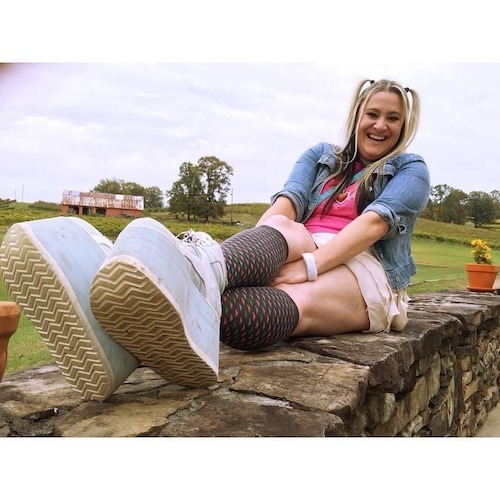
Before my diagnosis, I traveled. I led Habitat for Humanity builds in other countries. I led trips for people to go and explore the world. I hiked, I kayaked, anything that had to do with water. I love water and just really spent my time outside of work traveling to learn about other cultures.
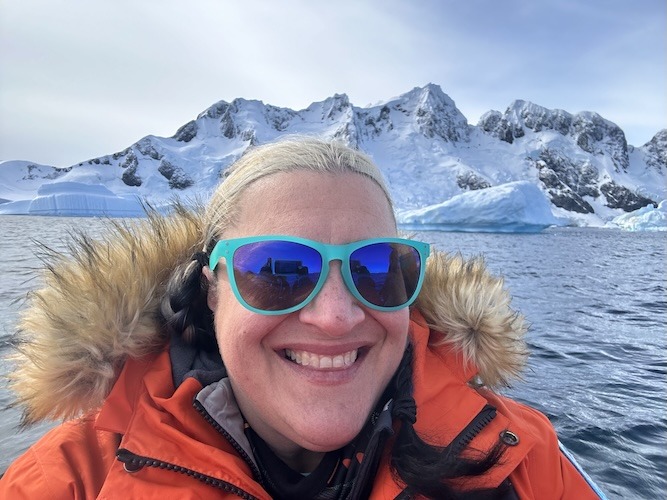
For Habitat, I have built 26 homes in about six countries. I have even been to Antarctica, but not with Habitat. It was amazing. My friend and I went with National Geographic for fun. It was a vacation. It was amazing. All I think about, really, is how do I get back there?
You fly down to Argentina into Ushuaia, which is kind of the bottom of the world, as they call it. Then you hop on a boat and go through the Drake Passage, which was amazingly fun. It was more fun than scary. We had a pretty good “Drake shake” coming back home. When the boat was going up a wave, you felt so light and “woo!” and then when it would go down the other side, it was like something was pulling down at your knees. But it was more fun than scary.
My first symptoms and IBS‑C misdiagnosis
So when I first noticed something was wrong, it was in March 2020.
Starting then, I noticed that I was having abdominal pains, and it was getting really hard to use the restroom. I had never experienced that in my whole life. Originally, I thought, as I am getting older, maybe I’m developing a reaction to cheese. So I decided I would eliminate cheese. But then it happened two weeks later, and I thought to myself, well, that is strange. So it cannot be cheese.
I went to the doctor around the end of April. Immediately, the doctor just said, “You have IBS‑C.” I thought, “Okay, maybe I do, things change.” I was given a couple of prescriptions. So I started eating way more healthily.
Then, about two weeks after that, I started having these abdominal pains. The pains were unreal. I could not use the bathroom. They would take me down for at least two days, and up until that point, I had never missed a day at work. I was healthy. I just did not get sick.
I went back in and said, “I do not know, something is not right.” Again, the doctor said, “You have IBS, you have IBS. Eliminate stuff from your diet.” I said okay; you trust your doctor. But it kept happening almost like clockwork every two to three weeks.
Vomiting stool and repeatedly not being believed
By June, it was starting to get really bad. I knew, because I was not able to go to the bathroom. Everything was coming up. I was throwing everything up, and I just knew, although I did not want to admit this to myself, that I was throwing up poop.
I went to the doctor in June and told him, “I know what I was throwing up this past weekend.” He said, “I do not think you were.” I thought to myself, even my mom thought I was crazy, like, is that even possible? So again, you tend to believe your doctor.
But this circle of events continued. I kept going back. When I finally went in again in September, I was in the doctor’s office every three weeks saying, “I do not know.” By the time I went in September, they were still telling me I had IBS‑C.
At this point, I had eliminated everything from my diet except sparkling water. That was all that was left. I even said to the doctors, “There is nothing more I can change. I kind of want to just have IBS‑C, but something is happening.”
I had to fight and claw and cry my way into a colonoscopy. I went in for that on September 14, and they perforated my colon when they ran into a lemon‑sized tumor.
Colonoscopy complications and emergency surgery
There was no conversation after the colonoscopy. I came out of that colonoscopy screaming because, of course, with a colonoscopy, they put all the gas and air in you. I was screaming in pain. Because they perforated my colon, I was getting prepped for emergency surgery.
They were trying to reach my parents because it is not ideal to put somebody under anesthesia twice in the same day. They obviously wanted to have verbal approval. They were trying to get in touch with my parents, and this was COVID, so I was all alone. This was the biggest thing that had ever happened to me.
I went into emergency surgery a couple of hours later, where they removed about 70% of my colon and my appendix, which I learned is sort of normal. At that point, they just stapled me up. Two days later, while I was in the hospital, the doctor — not my primary, but the on‑call emergency surgeon — came in to let me know that I had cancer.
Hearing “colon cancer” while alone during COVID
Because all of this was such a shocking blur, I do not think I was even able to process it right away. I vaguely remember calling my parents — again, this was COVID, nobody could be in the hospital with me — and saying, “Yeah, so they say it is cancer. Okay, bye.”
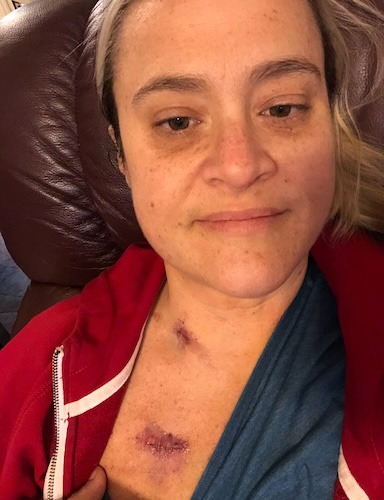
I am not even sure I processed all of it for a little while, exactly what it was, because I was trying to heal from a bra‑line‑to‑panty‑line incision. Again, I was all alone in the hospital, and I had never been in the hospital before.
I think there was a lot of dissociation with the diagnosis at first, kind of like, “Okay, cool, all right,” not “okay, cool” in a positive way, but very dismissive at first. Then I really started thinking about it. I wanted to walk into my doctor’s office and say, “What happened? This could have been completely avoided with just a scan.”
Post‑surgery complications, sepsis, and wound vac
I was in the hospital for five days, and then I was sent home. I started to run a little bit of a fever. I called my doctor because they said to go back to the hospital if I hit 102. I was reading 101.5, but I was also taking Tylenol to help, so who knows what my fever really was. He said, “No, you are still good.”
It was just crazy, the lack of anything from him. About nine days after the surgery, I started getting really sick at home. I had a fever. I ended up passing out. My parents called an ambulance, and again I was throwing up everything in my stomach. They realized that a stitch had come loose, and my entire abdomen and stomach were filled with everything you do not want there.
I was rushed to the hospital in an ambulance and went immediately into surgery. This was the biggest surgery because I was going septic. They were trying to clear out all the infection, but I was so infected that they could not close my stomach. They put this thing called a wound vac on it, from bra line to panty line.
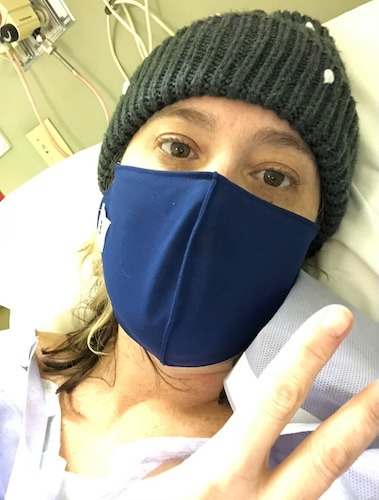
If you are not familiar, it is almost like a medieval torture device, but also a miracle worker, because it sucks the infection out and eventually starts to rebuild new skin. But it is so painful, especially when they are changing it. I had to have an ileostomy at that point. It was a much bigger surgery. I was in the hospital for about ten days with that, and then I was sent home with home care because the wound vac had to be changed every day. That was so painful.
E. coli pneumonia and ICU stay
About 12 days after that, I coughed and looked at my mom and said, “We need to go to the hospital.” I had that taste again and thought, something is not right.
Luckily — or not luckily — my abdomen was fine. There were no issues with the stitches or the ileostomy, but I think because I had been lying down for a couple of weeks, I got pneumonia. I did not just get pneumonia; I got E. coli pneumonia.
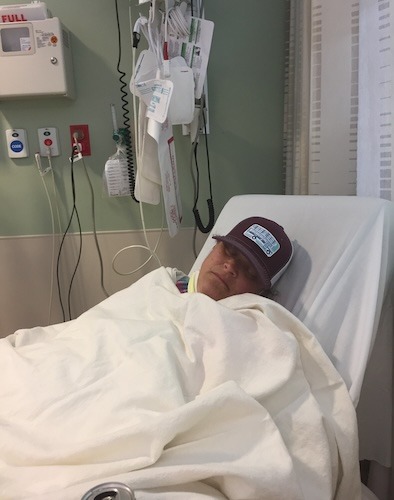
I was in the hospital, and that was actually the closest I was to death, even after being septic. I was in the ICU for about 12 days and had to be on level 10 oxygen because my blood oxygen was at 81. That was the longest and probably the scariest part, because the nurse kept saying, “If you leave here, you are going to die.”
I remember just bits and pieces of this, and I wonder, was I trying to leave? Why did she say that to me three times? That was another 12‑day hospital stay. I had to get a chest tube, which was painful too, and I was there for about 15 days. Then I went home and finally stayed home.
They could not do treatment with a wound vac on, because they literally sent me home with about a golf‑ball to egg‑sized hole in my stomach. You could literally see all the way in. I had to have that healed, and it took about four to four and a half months for it to finally close.
Confronting the hospital about the failure to diagnose
I finally went in to see my doctor. All of this was at the same hospital; my primary is at the hospital too. The main doctor came in — I think I was too tired to do anything — but I suspect they were dealing with a failure-to-diagnose situation.
I told that doctor, “I just want you to remember me. When somebody comes to you for five or six months, I need you to listen to them. Because again, all of this would have been avoided if we had just done a scan — all of those surgeries, the wound vac, everything.”
Meeting the oncologist and starting chemo
Everything started in September. I think I met with the oncologist around December. I did not start chemo until around mid‑January. The wound vac had to be completely off first.
The tumor in my colon had spread to my lymph nodes. They took a sample of about 27 lymph nodes and found cancer in three.
There were no treatment options. There was one blessing out of all of this: the kidney transplant surgeon who was on call that night. Usually, they remove about four inches on each side of the tumor. He actually went 7.5 inches to be extra careful that it would not come back. Because they removed so much of my colon and it was only in three lymph nodes, I did not have an option. I just had to go through chemo.
Chemo regimen and acute side effects
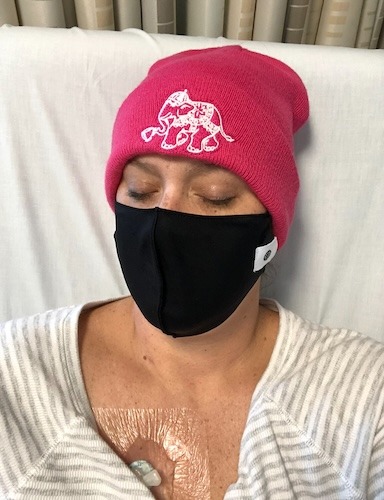
I had 12 rounds of chemo, so it was about six months. I cannot remember all of the drugs, but I would go to the hospital cancer center, get hooked up to chemo, and stay there for about four hours. Then I would go home with the pump, and I would have 48 hours of continuous chemo at home.
The actual chemo experience was not horrible. I did not have any nausea. They give you so much medicine to help with that; they really do not want you to be nauseous. For me, that was not where the worst effects were.
One of the drugs that almost everyone with colon cancer gets is called oxaliplatin. That comes with really intense side effects for neuropathy. The nurses always asked, “Are you feeling any symptoms of neuropathy?” About a quarter of the way into treatment, I started to feel the cold sensations. It was hard to drink an ice‑cold drink. My nose felt like frostbite.
It was manageable; I could deal with it. They always said, “We can take the oxaliplatin down. Just let us know,” because they tried to warn me about what could happen. But I kept thinking, if I take one of the drugs down, does that impact my chances of being healed or cured? So I lived with those side effects.
When I finished chemo, about a month afterward — so I finished in June, and by mid‑July — I was running to a neurologist because of the pain in my feet. That was when I really felt all of this neuropathy. During chemo, it felt manageable enough. I am not sure if lowering the dose would have changed my post‑cancer life. My post‑cancer side effects are almost worse than the treatment itself.
The often-overlooked burden on caregivers
I think there are two parts of cancer treatment that people do not talk about enough.
First, it is harder for the caretaker. We are so busy going through it — and “through it” can mean a million different things, whether nausea, vomiting, neuropathy, or something else. We are trying to get through that day, that hour. A caretaker can only watch. There is nothing they can do for neuropathy, for example. They just watch and try to be helpful, but there is not much they can do.
Because we are so busy literally doing it, there is almost a protective shield. We know what is going on around us, but we are focused on surviving that moment. The caretaker is watching their loved one go through horrible treatments.
Second, we do not talk enough about what happens after cancer.
Scanxiety and reaching the five‑year mark
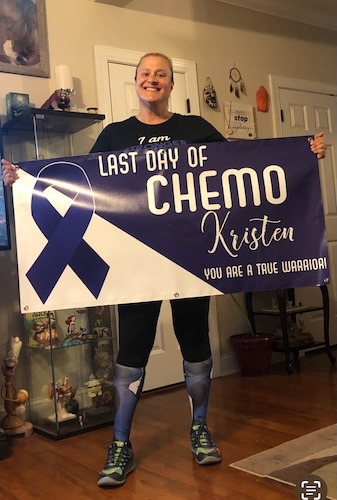
The last day of chemo is always a great day, but then there is a lot of anxiety afterward. I was getting scanned every three months. Any little thing that went wrong in the bathroom felt like PTSD.
I finally got my five‑year mark this past year, around May 2025. I did have some scares during those five years. In 2024, they thought my cancer was back because they saw 11 tumors on my liver. The liver is the first place colon cancer often spreads to. That ended up not being the case, thankfully.
You kind of have this build‑up to the five‑year mark: scans go from every three months, to six months, to once a year. It is a great feeling.
How colon cancer changed me physically and mentally
Colon cancer has changed me in every way.
Because of chemo, I now have permanent chemo‑induced peripheral neuropathy. Every step I take feels like I am stepping on fire rods, and the pain goes up my legs. My fingertips are not as bad as my feet, but it feels like I put my hand on a hot stove and burned the tips of my fingers.
I was such an outdoor person. I think I handle it relatively well, but now I live in constant pain. It has changed everything.
Mentally, I did not even know how much I was struggling because there is nobody to talk to after chemo. You ring that bell, and it is like, “High five, see you later,” because they have to move on to the next person starting treatment.
What we do not do is help people with the “now what?” I just spent the last two years fighting for my life. Now what? It is so polarizing because people do not understand.
Unless you have physically had cancer, people do not understand. I call it “the aftermath.” I want to write a book called Aftermath. People do not understand, and I do not think cancer patients fully understand how much they are mentally changed. You go in one way and come out another.
You try to explain it, and people — who mean well — say, “Well, at least you made it through.” Of course, I am grateful, but I have made it through, and now I cannot find myself.
I finished chemo in 2021. By 2024, we thought my cancer was back. It was not. It was not until 2025, last year, that I felt like whatever cloud was over me or in my head finally started to lift. I began to get back to whatever the new me is.
I cannot really hike anymore. I can, but it is so painful. Weirdly, it does not hurt as much to ride a bicycle, maybe because my feet stay on the pedals. I do enjoy that. It has changed everything.
Gaps in survivorship support and struggles with therapy
I do not even know what helps me get through the hardest days. That is where I feel we need to support chemo patients and survivors better. I do not know if I had a place to go.
Of course, I had family and friends, and my mom heard every rant and rave I ever had about how much I hurt. But the people in your support system eventually go back to their normal lives. Mine were probably thinking, “Thank goodness she is okay. She is fine,” when that is not the case.
I had a hard time with therapy. I wanted to talk about me, but the therapist kept talking in terms of groups: “I have heard that before,” or “There was another group I talked to that said that.” I struggled to explain that I did not want to hear about others, because nobody’s cancer journey is the same. I don’t think two journeys can be identical.
I also did not realize how much I was waking up during the night because of the neuropathy. I was not sleeping. They finally gave me a sleeping pill, and it was life‑changing. I do not think I have slept for the past four years.
I take about ten pills a day just for the neuropathy, and all that does is bring the pain down slightly. I think we can do much better for our survivors.
Practical tips for coping with neuropathy and chemo side effects
Neuropathy was the biggest issue for me. The neuropathy is no joke, but it is different for everyone. I seem to be an extreme case. I have a friend whose husband basically went through the same treatment, and most of his neuropathy was in his hands.
I think the nurses do a really good job asking, “Tell me if it gets bad. We can lower the dosage.” In a way, I wondered if they do not want to emphasize the permanent side effects because they need you to come in and get treatment.
The first thing I would say is talk to your nurse if you are starting to feel symptoms, because they probably can lower the dose and still keep the same success rate or percentage. Everyone’s neuropathy journey is different, but it is definitely there. Do not ignore those symptoms.
Also, you get a steroid before chemo, which I think is standard. The steroid fights with the chemo. You have this wired side of your brain, and another side that wants to drag you into your pillow and sleep for days. It is an inner battle.
Two things helped me. First, I talked to my doctor to see if I could take Xanax when I felt those two sides fighting. That helped. Second, because you get dehydrated — and I am terrible at drinking water — I learned to ask for an IV bag of fluids when they disconnect you from chemo. They do not offer this unless you ask.
Once I started doing that, around halfway through treatment, it really helped my recovery for that week. Chemo was every other week, so that made the “on” week more bearable, and the off week helped me build up my stamina again. I told my friend, “They are not going to offer this. You have to say you want it, but you want an IV bag of fluids when they disconnect you. It really helps.”
Finding hope and rebuilding life after colon cancer
There is a light at the end of the tunnel. Last year felt like I suddenly snapped out of whatever I was in. I think I finally left cancer behind me.
I feel like there is hope for the future, even though that is a hard question.
Personally, I would love to get back to leading trips. I am just starting that. I am going to lead a trip through South Africa next year, and I finally got re‑trained with Habitat. I feel like things might be starting to go back to somewhat of a normalcy, similar to before cancer.
There will always be things that connect me to cancer, especially because I have permanent side effects, but for the most part, I feel more like myself. Last year was the best year I have had since cancer. It was also my best year professionally. There is definitely a link there.
I feel more like Kristen. I do not talk about cancer as much anymore. That gives me hope — that I can do daily things without leaning on the “cancer crutch.”
My message to others watching and reading my colon cancer story
No matter how you are feeling, there is a light. Give yourself grace because you are about to embark on a journey that will only be yours.
I also stayed completely out of chat rooms. Stay out of chat rooms. You will start reading other people’s symptoms and stories, and might start manifesting or worrying about things that may never happen to you. Save the chat rooms for when you are done, and only if you have specific questions.
Just know that your loved ones love you so much. They may frustrate you sometimes; it is just because they do not get it. Stay connected with your chemo team because they are literally there in a second to help you with any symptoms you might be experiencing.
Genetic testing and family history
I did have genetic testing done, and I was negative.
There is no history of colon cancer anywhere in my family. I have a huge, huge family.
Giving back: I ride for cancer research
Every year, I do a 25‑mile bike ride for cancer research with Pelotonia. The 25‑milers are the non‑professionals, because some people ride 200 miles for research.
Twenty‑five is the lowest distance, so we proudly represent the back of the line.
This interview has been edited for clarity and length. The views and opinions expressed in this interview do not necessarily reflect those of The Patient Story. This content does not replace professional medical advice.
Inspired by Kristen’s story?
Share your story, too!
Hear from people living with colon cancer
Real experiences with diagnosis, treatment choices, side effects, and life beyond colon cancer — in their own words.
Leave a Reply