
Amber’s Stage 4 Colon Cancer Symptoms: How She Pushed Past “You’re Too Young” to Get Answers
When Amber first noticed her stage 4 colon cancer symptoms, they showed up during what was supposed to be a joyful, if exhausting, season of life: pregnancy and then the moments after with her baby daughter.
Interviewed by: Taylor Scheib
Edited by: Chris Sanchez
Amber ended up experiencing major changes in bowel habits during pregnancy, then severe constipation and intense fatigue after her C‑section. Because so many of these issues are common after childbirth, she and her care team initially chalked them up to postpartum recovery, hemorrhoids, and a fissure, rather than recognizing them as possible stage 4 colon cancer symptoms. Months passed as she tried to parent a newborn while feeling overwhelmingly tired and increasingly unwell.
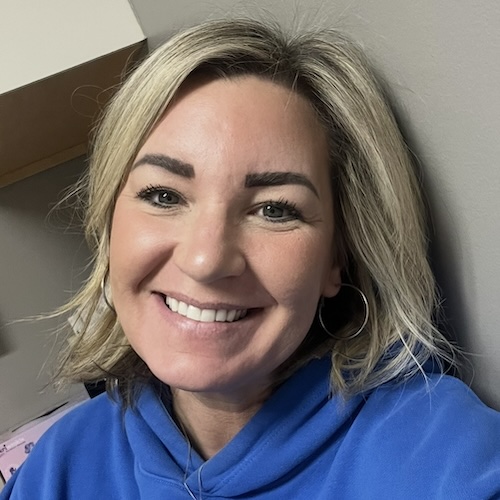
As time went on, the bleeding in Amber’s stool worsened. She saw both her primary care physician and a colorectal specialist, who repeatedly told her she was dealing with hemorrhoids. Even when Amber asked directly, “Are you sure I don’t have cancer?” she was reassured she was “too young” for colon cancer. Meanwhile, her body kept sending louder signals: dizziness when she stood up, a strange rush after using the restroom, blurry vision, abdominal cramping at night, and profound fatigue. She tried changing her diet and convincing herself things were improving, but deep down, she knew something was wrong.
Eventually, Amber decided she couldn’t take it anymore and headed to the ER. On the way, she called the specialist again and was told to go in for a colonoscopy. She went into the procedure believing she’d be able to go home after they “banded her hemorrhoids,” which is a minimally invasive, in-office procedure to remove them. Instead, she woke up to the words no one expects to hear: “I’m sorry, you have colon cancer.” Soon after, scans showed it had spread to her liver, and Amber learned she had stage 4 disease.
That moment “hit like the world spinning,” but it also marked a turning point. Surrounded by family and a supportive community in her small town, Amber moved from shock into “let’s fix this” mode. Her experience now serves as a powerful reminder that ongoing symptoms, especially rectal bleeding, severe fatigue, and changes in bowel habits, deserve attention, regardless of age or postpartum status.
Watch Amber’s video and read the edited transcript of her interview to learn more about her colon cancer story:
- Ongoing rectal bleeding, fatigue, and bowel changes that don’t improve over time deserve follow‑up, even when they can be explained by pregnancy, postpartum recovery, or hemorrhoids.
- Being told you are “too young” for colon cancer can delay diagnosis; Amber’s experience underscores the importance of self‑advocacy and asking for further testing when symptoms persist.
- You know your body best, and when something feels “off” for weeks or months, it is important to keep asking questions until you feel heard.
- Amber’s experience shifted from fear and denial to action: seeking multiple opinions, undergoing aggressive treatment, and eventually becoming an advocate who helps others find hope.
- Her story shows that a serious diagnosis and even stage 4 colon cancer can coexist with parenting, work, and moments of normalcy, especially when a strong support system is in place.
Amber’s Diagnosis Facts
- Name: Amber K.
- Age at Diagnosis:
- 36
- Diagnosis:
- Colon Cancer
- Staging:
- Stage 4 (Metastatic)
- Symptoms:
- Blood in stool
- Abdominal discomfort
- Changes in bowel habits
- Weight loss
- Dizziness
- Blurry vision
- Treatments:
- Chemotherapy
- Immunotherapy
- Surgeries: colectomy, lymphadenectomy
This is not medical advice. Please consult with your healthcare provider to make informed treatment decisions.
- Amber’s Diagnosis Facts
- My stage 4 colon cancer symptoms
- Hearing it was stage 4 colon cancer, and in my liver
- Telling my family and moving into “fix this” mode
- Choosing my oncologist and an aggressive treatment plan
- Immunotherapy, complete response, and colon surgery (but no liver surgery)
- Living with no evidence of disease after stage 4 colon cancer
- Telling my story: Becoming a colon cancer advocate
- Parenting young children through a stage 4 colon cancer diagnosis
- My best advice about colon cancer symptoms and early detection
- Hear from people living with colorectal cancer
My stage 4 colon cancer symptoms
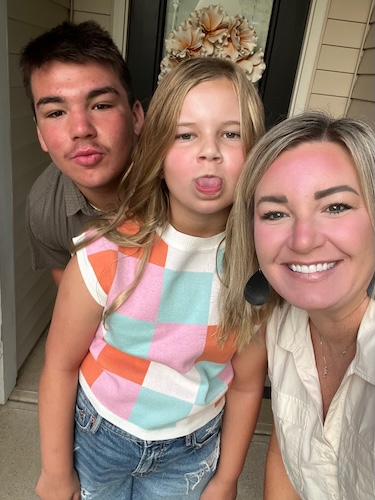
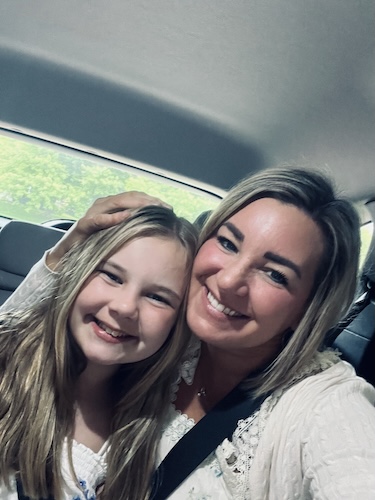
My name is Amber, and I was diagnosed at the age of 36 in 2017 with stage 4 colon cancer. I am from Indiana.
I was pregnant, and I had my daughter, Isabella, at age 35. While I was pregnant, I was having a lot of changes in my bowel habits. Of course, a lot of that comes with being pregnant, so we just brushed it off.
After I delivered Isabella, I had a C‑section, and I remember I could not go to the restroom. When they released me from the hospital, I felt really, really sick, and I thought, “This is weird; I don’t understand.” I didn’t feel like this with my son.
After we got home, things kind of changed. I wasn’t working; I was on maternity leave, and I just could not get “untired.” I was so fatigued all the time. I could not get up in the night with her; I could not. It was a fatigue that I’ve never felt before. Thankfully, I have a great husband who did everything, so we just brushed it off as being older and having a baby.
Eventually, I started to see blood in my stool. At first, I thought it was just part of postpartum, and it was hemorrhoids. Your mind doesn’t want to take you to the bad place, so I ignored it for a while. Eventually, it was there all the time, so I saw my primary care doctor. They confirmed that I did have a fissure, which is like a tear, and they said that was where it was coming from. I thought, “Great, thank you.” Time went on, and it just never went away.
Repeated hemorrhoid diagnosis and escalating symptoms
I was working in neurology at the time, and there was a colorectal specialist down the hall. I called and begged and said, “Can you please see me today?” They actually did see me, and he just confirmed that it was hemorrhoids. I felt good. I had seen my primary, I had seen a specialist, and I just had hemorrhoids.
Time went on. A few months went by, and things just got worse. The blood got worse. I went back to him a couple of times. We tried different creams; nothing was working. Eventually, I started to have a lot of other symptoms. I would stand up and get really dizzy. After I used the restroom, I would feel this kind of rush over my body. I was fatigued. I had to wear glasses because I had blurry vision all the time. I started to have some abdominal cramping at night.
One day, I decided that I was going to go to the ER; I just couldn’t take this anymore. On the way, I called my colorectal specialist and said, I’m just going to go to the ER. He said, “We’ll just do a colonoscopy. I was actually in the ER; I got my blood pressure checked and then decided I was going to leave because he was going to give me a colonoscopy in two days.
I got the colonoscopy thinking that we were just going to band my hemorrhoids and everything would be okay. I woke up, and he said, “I’m sorry, you have colon cancer.”
When colon cancer symptoms took over my daily life
I was working, and it was every day, all day, consuming me. Every time I went to the restroom, it was getting worse and worse, and the fatigue was awful. I would wake up in the morning and feel like I had the flu or like I was really sick. You don’t want these things; you don’t want it to be cancer. In my mind, I was thinking of everything that could be possible.
I even changed my diet. I did gluten‑free, I did low carb, I did everything. I would convince myself, I think it’s getting better, but it really wasn’t. I was just in denial.
Towards the end, there was a day at work when I just felt horrible. I called my mom first and said, “I need to go to the doctor; something’s wrong.” My husband picked me up, and that’s when we went. It was a sigh and a gut feeling, like you just know deep down, and things were getting worse.
I was so anemic. I would pull my eyes down and tell my family, “Let me see your eyes.” I would tell my kids, “Let me see your eyes.” Everybody’s eyes were red, and mine were as white as can be. I think the dizziness, the blurry vision, and all that were coming from the anemia because I was so anemic from losing blood.
Being told I was “too young” for colon cancer
The colorectal specialist I was seeing kept telling me it was hemorrhoids. I asked, “Are you sure? Why won’t you just do a colonoscopy?” I went there three times. The last time I said, “Are you sure I don’t have cancer?” He said, “Yes, you’re too young.”
Right then and there, I knew I should have seen somebody else. You can’t just look at someone and say that because they’re young, they don’t have cancer.
He finally said, “Fine, just come in, we’ll do your hemorrhoids.” When I woke up from my surgery, he said, “I’m sorry, you have cancer.” He told me, “It’s not going anywhere. I’m going on vacation for a couple of weeks, and when I get back, we’ll get you set up for surgery.”
I was just coming out of the colonoscopy and thought, “What?” I worked in neurology at the time, and these fabulous doctors found the best doctor in the whole world for me. He got me in the next day and explained the situation: we were going to do scans, and if it had spread, it was stage 4, and it was not going to be good.
Hearing it was stage 4 colon cancer, and in my liver
We did scans. I was standing in the hallway right here, and he called me and said, “I’m sorry, Amber, but it’s in your liver, and it’s stage 4.
That is when I hit the floor screaming. I can still remember it. It was like my world passed before my eyes. Everything was spinning, and I can still remember it clearly to this day.
Processing the colon cancer diagnosis before the stage 4 news
It was a shock, and I really didn’t have that much time to process. I only had about a day before I found out it was stage 4.
I remember waking up from the colonoscopy. You’re supposed to wait; I’ve had a million of them, so I know you’re supposed to wait, but I think I just got up and left and went to get the labs they had asked me to do. I was in shock. I don’t remember the ride home. I do know I stopped at my grandpa’s church to pray, but I don’t remember anything else. I don’t remember that night. It’s just a blur.
Deep down, yes, I knew that was probably the case. I’m in the medical field, and I know, but to hear those words when I was expecting him to band my hemorrhoids was something you’ll never get over, ever.
Telling my family and moving into “fix this” mode
After I found out that I had colon cancer, he ordered labs, and we did a carcinoembryonic antigen or CEA test. I went to see the new doctor, and he said he thought I was okay because my CEA was normal. We were kind of like, “Okay, we caught it early, because early‑stage colon cancer is very treatable.” I thought, “We’re good.” I did think that I was okay there.
When he called and told me it was in my liver, I gave the phone to my husband because I couldn’t talk to him anymore. I called my mom. I told her, “I’m dying; it’s in my liver.” I asked, “Can you get over here?”
My oldest was in school, and Isabella must have been at daycare, but my mom, my dad, and my sister came over. We made a plan that I would not be left alone and that we would do whatever we could.
We called everywhere. We called the big cancer center in New York, Memorial Sloan Kettering Cancer Center, and we called a big cancer center in California. We were trying to get different opinions and referrals. We were sad and crying, and then we went into “let’s fix this” mode. It was like that for weeks and weeks.
I told a friend, and then the word got out really quickly. My town is small, and everybody is the best. I can never repay everybody. They were all there for me, and I never had to worry about anything because of these people in this town. It was fight mode right then and there. We were doing everything we could.
I didn’t go out of state to get opinions, but I did get three opinions here in Indiana.
Why I sought multiple second opinions for the stage 4 colon cancer diagnosis
The new colorectal specialist told my husband that if I wanted to be cured, I needed to go to New York to Sloan Kettering. When he told us that, that’s what we looked into. There was some insurance stuff that we had to get through, and we felt like time was an issue. We wanted to see what my options were in Indiana and then go from there.
He was the one who suggested it. I wouldn’t even have known what Sloan Kettering was; I had no clue.
Choosing my oncologist and an aggressive treatment plan
The oncologist that I chose actually called me at home. When he found out I was going to get other opinions, he said, “Absolutely, do that,” but he treated me like family from the beginning. I felt so comfortable.
He told me, “We need to start aggressively right now, Amber.” He said, “Tomorrow, I need you here; we need to be aggressive.” He said we couldn’t do surgery because the tumors were too spread out on my liver. So we were going to start with very aggressive chemo. We would do six rounds and then scan and see.
When I went into chemo, I was still feeling pretty bad. After that first round of chemo, I went back in to see him. He asked, “How do you feel?” I said, “I actually feel normal, and the blood stopped.” He asked if I was kidding. I said no. He asked if I was having any side effects. I said, “Not really, not yet.” They did get worse, but I actually felt good at first.
We did a few rounds and then scanned, and that’s when we saw that it was working.
Scan results, miraculous response, and extending chemo
Waiting for scans — even now, almost ten years out — is the worst thing you can put anybody through. Back then, we couldn’t open them on MyChart, and I don’t know if that’s better or worse, so you had to go into the office. They’re always running behind, and you’re waiting.
When he came in, he said, “Amber, everything in your liver is gone.” He said the lymph nodes and the colon tumor had shrunk tremendously. He said, I have never seen anything work this fast. We were like, “Praise God, are you kidding me?” It was a miracle. He said, “We’re going to keep going,” so that’s what we did.
Eventually, the next scan showed that the tumor in my colon was gone, and the lymph nodes were gone. Instead of doing surgery after six rounds, he said we were going to keep going because it was working. We did 12 rounds. It wasn’t always easy, and it wasn’t always like I felt great. It got worse, but it didn’t matter because it was working. I would have done anything.
Immunotherapy, complete response, and colon surgery (but no liver surgery)
At the end, he said he thought I was the first patient of his to get a complete response to chemo. He said, “I don’t really know what to do with you.” He didn’t know whether we should stay on immunotherapy — because I was on immunotherapy too — or do more chemo. He said he was going to leave it up to me.
I did some research and decided, “Let’s stop because it’s working and my body is being affected by it.” I was getting really bad neuropathy. I thought, “If it comes back, hopefully we can go back to the same regimen, and it will do the same thing.”
After that, we waited a little bit because you have to wait a bit after chemo to do surgery. We went in and did surgery to remove where it used to be in my colon and all my lymph nodes, because they said if it came back, it would come back in the colon where it originally grew. We removed all those. Pathology came back clear.
The colon surgeon took a camera up to my liver and looked around, but we never touched my liver. No surgery, nothing. I haven’t done anything since.
Living with no evidence of disease after stage 4 colon cancer
Every time I got scan results, I just couldn’t believe it. I was always working, and I have a routine that I do with every scan. Still to this day, I have this routine.
I was put on palliative care from the beginning. My husband had called a nurse navigator and asked, “Can you cure her?” She said, “We can’t, because it’s stage 4. We can treat it like a chronic illness, like diabetes, as long as we can, but we can’t cure her.”
He never told me that. I never wanted to know any of that. I didn’t Google anything. But in the back of my husband’s mind, they couldn’t cure me.
Every time we went in for scans and my oncologist told us it was good, it was like a rush, the biggest high you could ever get. I only thank God for that, and that’s the only person who saved me.
Anxiety after finishing treatment and scan‑related PTSD
It got scarier after I stopped treatment. During treatment, everything is boom, boom, boom in your face, and everybody is around you. Then you stop, and it’s quiet.
There are fewer doctors, fewer nurses, fewer friends, fewer people. Literally, my finger could hurt, and I would think, “Okay, the cancer’s back.”
A few months after treatment stopped, I started to feel weird in my head. I thought, my head feels weird again; this is how it felt before. I called my oncologist, and he said, “You need to go to the ER.” I thought, “You’re the one that saved me — what do you mean, go to the ER?” I went to the ER and convinced them to give me an MRI, and I was fine.
Little things trigger me, and I think it’s PTSD. Every scan still is the best feeling in the world when it’s clear. I hug my family, I hug my kids, and I thank God.
I don’t know why this happened the way it did. I’ve met so many people along the way and lost so many people. I don’t understand; I wish I did, but I don’t. It could change in an instant, and I know that, so I’m just thankful for every day.
What survivorship looks like, 10 years after stage 4 colon cancer
At the beginning, survivorship was just being thankful and living in the moment. The further out I get, the more I want to help people.
On TikTok, a lot of people reach out to me and talk to me. I try to donate to as many GoFundMe campaigns as I can because that’s what people did for me. These last five years or so have been more about being supportive, bringing awareness to colon cancer, helping others, and helping family members, more than being in “survivor mode” and scared.
I still have it in the back of my head. I have scans in August, and I’ll be nervous for the whole month, but right now I’m a little bit calmer. I just want to be there for people who are going through what I went through.
How colon cancer changed my perspective on life and the future
Life is a little bit more precious now. I was 35, and I’m 45 now. Day by day, I don’t worry about the future the way I used to. I don’t like to make plans for the distant future.
I learned to live in the moment and live in the day, because it doesn’t have to be cancer — anything can change in a minute. Before, you know that it can happen, but you don’t really think about it. Now I know in an instant, like tomorrow, it could come back.
My perspective now is to make time with my family and friends and just enjoy everything, and not try to plan too far ahead. That’s one of my fears. People ask, “Do you want to plan a trip in two years?” I say, “I can’t,” because I have scans in between then. I have to live for now, and when that time comes, if I can go, then we’ll go.
Every day, I live for today and enjoy the moment. I work, and my oldest is getting ready to go to college to play football. My youngest is home on summer break, bored.
Life is not always perfect; it’s normal. I really just live for each day, and if I can help somebody, I will.
Telling my story: Becoming a colon cancer advocate
I think I became an advocate a few years out, probably around the five‑year mark. I had made it to six years. It was a little over five years because it was around 2020 or 2021 when COVID hit, and everybody was bored.
I didn’t even have TikTok at first, but I remember downloading it. I was bored with my kids. One day, I made a video and talked about colon cancer, and it was such a hit with people who were looking for hope.
I never Googled anything when I was sick, but I did try to find survivors and could not find anybody. I eventually found one girl. She wrote a journal and would come back once a year with an update. She was my hope that I hung onto. I thought, “Maybe I can be that for somebody, as long as I’m on this earth. Maybe I can be that hope that they can get to five years, that they can get to six years.”
I told my story, and it reached people. People said, “That’s what I needed to hear; this is the kind of positivity I need.” That way, when they go into treatment, they don’t think, I’m going to have this, this, and this happen to me. They think, I can beat this, I can do it.
There is more than one way to live with stage 4 colon cancer
Even though I got a complete response, in my hometown, I have four people with stage 4 colon cancer who are my age, who are living five or six years out. They’ve had surgery, they’ve had recurrences, and they’ve had ablations and different things.
You don’t always have to have a complete response to live. That’s the message I want to get out: there are other ways around this. Just because it doesn’t work for you as it worked for me doesn’t mean it’s not going to work.
Why every colon cancer journey is different
When I was first diagnosed, people were coming at me saying, “This is going to happen to you, you’re going to have this chemo and that chemo.” I didn’t want to hear it. I wanted to go in and do it my way.
I know they had been through it and knew what could happen, but I didn’t want to know. I just wanted to do it my way. I think it’s important for people not to dwell on other people’s journeys or say, “This is happening to them, and it’s not happening to me,” or, “I’m getting worse.”
Make it your own and say, “I’m going to beat this my own way,” and stay positive. It really comes down to attitude, and that’s a big deal. I know it’s easy to say because I was winning all the time, but even at the beginning, I thought, “Whatever I have to do, it’s going to hurt, it’s going to suck, it’s going to be horrible, but I’m just going to do it every single time.”
Parenting young children through a stage 4 colon cancer diagnosis
We have my son Connor’s graduation party on Sunday, and I was going through this bucket that I keep for my kids. When I was told I had stage 4 cancer, I was worried about the future. I was positive, but I wanted my kids to remember me.
In the bucket, I have a blanket that I made with our picture on it and notes, and I made them journals. I won’t read those things; I put them back down.
Connor was eight, and now he’s 18. Isabella was about one. That’s why I wanted to live, because I knew my parents and everybody else could live without me, but your kids can’t. That was my reason.
Isabella didn’t really know what was going on. We told Connor, and he said, “But you’re going to be okay.” We said “Yes.” I pretty much hid everything because he would go to school, she would go to daycare, and I went to work most of the time, even with my chemo.
Holding onto normalcy: Working, parenting, and staying active during treatment
From the beginning, I didn’t want to stop because when I was home, you get in your thoughts. I was never alone. I wanted to keep everything as normal as possible.
I was 36, and I know that’s young, so it was probably a little easier for me to keep going than it would be for somebody older. I went to work every day that I could, and it was very important because everything seemed normal.
Things got bad with the chemo; it’s not all easy. There were days I had to stay home or days when I had my chemo pack and would go to my car at lunch and take a nap, and nobody would know. You just dealt with it.
I love being around people. I love going to games. I loved doing everything because keeping busy kept my mind off it, and everything felt normal. There wasn’t any sitting at home thinking about it.
To keep going was the biggest thing. I was probably more active then than I am now. We worked out, took bike rides, went on walks, and did everything we could to stay really, really active, even on hard days, because that was easier than sitting on the couch thinking about it.
My best advice about colon cancer symptoms and early detection
My advice is: if you’re having symptoms, any symptom at all, get checked early. It’s better to be over‑cautious than under‑cautious.
If a doctor says no, then find someone who will listen. Don’t push things off. Don’t make excuses.
Colon cancer caught early is very, very treatable; very treatable. Don’t wait. If you’re having any symptoms at all, find a doctor who will help you.
This interview has been edited for clarity and length. The views and opinions expressed in this interview do not necessarily reflect those of The Patient Story. This content does not replace professional medical advice.
Inspired by Amber’s story?
Share your story, too!
Hear from people living with colorectal cancer
Real experiences with diagnosis, treatment choices, side effects, and life beyond colorectal cancer — in their own words.

Leave a Reply