
Stage 4 Colon Cancer at 26: Mariana’s Story of Missed Signs, Major Surgery, and Finding Her Voice
Stage 4 colon cancer in young adults often hides behind symptoms that seem easy to dismiss, and that is true in Mariana’s case. Right before she started experiencing her first symptoms, she was living what she describes as a normal 26‑year‑old life. She was working, coming home to her boyfriend, cooking dinner, and repeating the rhythm of her ordinary days. Over time, however, she began to notice bloating that looked more like weight gain and later began seeing blood in her stool. Even after multiple ER visits, she was told she was “just anemic” and sent home, only to learn later that cancer cells had been found in her colon.
Interviewed by: Taylor Scheib
Edited by: Chris Sanchez
Doctors first focused on a mass on her right ovary. Mariana went through repeated tests, long drives to different hospitals, and a colonoscopy that initially led providers to think they were looking at an ulcer. The reality was far more serious. By the time she finally got answers, she was told she had stage 4 colon cancer that had spread to her ovaries and that there was a “dusting” of cancer on her abdominal wall. At just 26, she had a major surgery that removed a 20 cm tumor, both ovaries, and her fallopian tubes, making it impossible for her to have biological children.
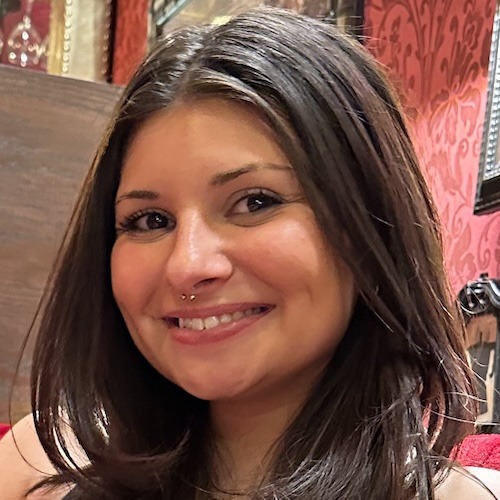
Mariana explains how this experience forced her to confront mortality and completely shift her outlook on life. She used to struggle with depression, anxiety, and constant worry. Now, she focuses on what truly matters and refuses to let cancer dictate every moment of her day. Her treatment includes surgery, recovery, and ongoing chemotherapy every two weeks, a routine she describes as “chemo, suffer for a few days, and then return to normal.”
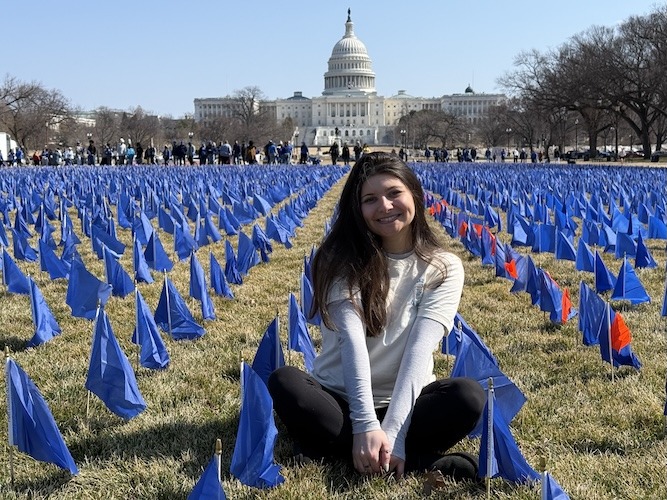
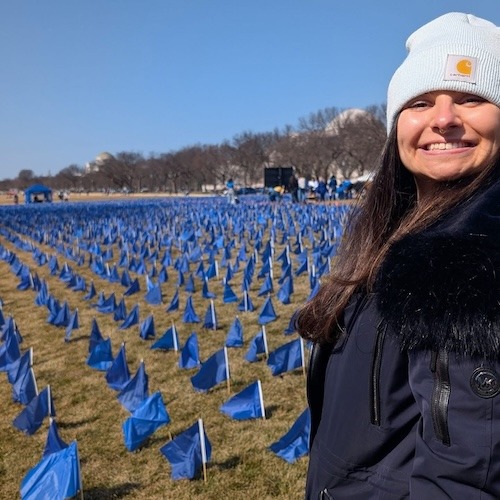
Supported by her parents, sisters, boyfriend, and friends, Mariana also found community through the Colorectal Cancer Alliance and connected with advocacy opportunities, including media interviews and a visit to Capitol Hill. Today, she uses her stage 4 colon cancer experience to urge others, especially people in their 20s and 30s, to take symptoms seriously, seek multiple opinions if needed, and speak out. She works to help make sure that colorectal cancer can be caught earlier, treated more effectively, and, one day, prevented altogether.
Watch Mariana’s video above, and read the edited transcript of her interview below, for more on her colon cancer story.
- Mild symptoms like bloating, anemia, and blood in the stool can still signal advanced colon cancer, even in one’s 20s.
- Major surgery removed a 20 cm tumor, both ovaries, and fallopian tubes, permanently affecting fertility and reshaping how Mariana thinks about her future.
- Regardless of age, stage, or cancer type – cancer is life‑changing, and no one needs to feel guilty for being upset about their diagnosis.
- Mariana describes a powerful transformation: from anxious and fearful to more present, outspoken, and unwilling to let cancer control the meaningful parts of her life.
- Advocacy, community support, and sharing her story publicly help her turn a painful diagnosis into action for earlier detection and better care for others.
Mariana’s Diagnosis Facts
- Name:
- Mariana T.
- Age at Diagnosis:
- 26
- Diagnosis:
- Colon Cancer
- Staging:
- Stage 4 (Metastatic)
- Symptoms:
- Bloating
- Anemia
- Appearance of blood in stool
- Treatments:
- Surgeries: bowel resection, oophorectomy, salpingectomy
- Chemotherapy: oxaliplatin, fluorouracil, FOLFOX
- Monoclonal antibody: bevacizumab
This is not medical advice. Please consult with your healthcare provider to make informed treatment decisions.
- Mariana’s Diagnosis Facts
- My first symptoms of colon cancer
- Ovarian mass, colon cancer surgery, and losing fertility
- Anger, acceptance, and refusing to let colon cancer rule my life
- Where my colon cancer spread, and why it is stage 4
- My colon cancer treatment plan and chemotherapy side effects
- Community support
- My urgent message to others with colon cancer symptoms
- Hear from people living with colon cancer
My first symptoms of colon cancer
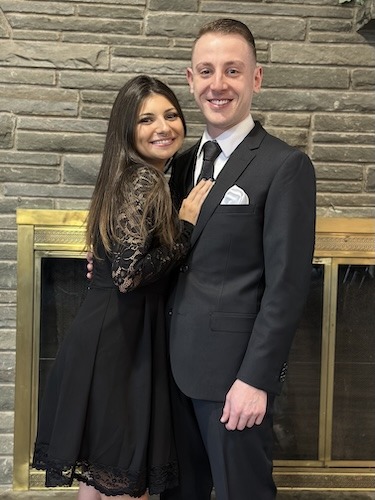
Right before my symptoms started, I kind of lived a normal 26‑year‑old life. I went to work, came home to my boyfriend, cooked dinner, had dinner with him, spent time together, and then kind of just redid everything from day to day.
Then last year, around April, is when I started noticing more of the symptoms. I mean, for a while, I was always a little bloated, and I didn’t really think anything of it. Honestly, looking back at myself, I can tell that I was bloated, but when it was happening, I couldn’t tell at all. It just looked like I was gaining weight, which wasn’t really abnormal for me because I’ve been on antidepressants for a while, and they kind of make you gain weight and lose it; it fluctuates your weight a little bit. So it wasn’t really alarming.
But then I started noticing blood in my stool. That was going on for some time, and I got in touch with my doctor about it. She saw me, and we did all of the CT scans, ultrasounds, and everything like that. Well, actually, before we did the CT, we did an ultrasound and blood tests. Then I ended up passing out at my house in May, and I had to go to the ER in Little Falls.
They basically didn’t really diagnose me with anything there. They just gave me fluids and told me that I was super anemic and to get in touch with my doctor again and let her be aware of that. After that, we actually did the ultrasound. That day, she told me to come back into her office, and they found a bunch of alarming things that were happening, but they couldn’t really tell exactly what. She then told me to go to a hospital an hour away where they could do more in‑depth testing. I was there for a few days. From there, they did CTs, a blood transfusion because I was losing blood and they didn’t know where I was losing it from, and then they did a colonoscopy.
There, they basically told me what they found — they didn’t call it a tumor then because, as I said, they didn’t really know what it was. They just called it a mass on my right ovary. They had me meet with a gynecologist there who told me that from what he saw, it looked like they could deal with that outpatient rather than do something inpatient because I wasn’t really showing any signs of that. It was bothering me, which it completely wasn’t. I didn’t even know that it was in me. I still had my period, and my functions were all good.
Then they did the colonoscopy, and I got discharged. Before I got discharged, I wasn’t diagnosed. They told me that what they saw looked like an ulcer and that I was fine to go home. Then a few days later, I got a call on a Friday night, and he basically told me that what they found was cancer cells in my colon. They told me that I should stick to the appointment with the gynecologist and that there was nothing else that they could do. They basically told me that they didn’t have any information. They didn’t really say anything. They just told me to stick with the gynecologist surgeon who saw me in the hospital, and that was it. That was the end of it.
So we were kind of in limbo for the weekend because I saw him that Monday, which was actually a huge blessing that I didn’t have to sit with that knowledge for longer. But it was a crappy thing to be told on a Friday night over the phone. I kind of just was like, “Well, that’s my life.”
Multiple ER visits and misdiagnoses before my colon cancer diagnosis
There were a lot of hospital visits before my diagnosis. From going back and forth to my doctor’s office, to a bunch of blood tests, to going to an ER about 20 minutes away from my home and then being told to go to another ER an hour away, and then going to another ER for a surgery, it was a lot.
The original thought I had was, “I have ovarian cancer.” That was my take on it. I asked her when she told me, “Do you think it’s ovarian cancer?” She said, “I’m not going to say anything,” because obviously they didn’t know, but that’s what they put in the paperwork as a possible diagnosis. She said, “I don’t want you to freak out when you see it, but that’s what it looked like,” without them doing in‑depth testing.
So at first I thought, “It’s probably ovarian cancer.” I was not expecting colon cancer at all. That was on the very end of the spectrum. I didn’t even know colon cancer was a thing, to be honest, just because I’ve never heard of it, and no one really talks about it. I’ve heard of breast cancer, leukemia, ovarian cancer, cervical cancer, but never colon cancer.
Before I knew there was a mass on my ovary, I thought — and even my family thought — it was just hemorrhoids or possibly IBS or some digestive issue going on, but never colon cancer.
Ovarian mass, colon cancer surgery, and losing fertility
I actually had to have surgery because of how big the mass was and how it was semi‑obstructing everything that was going on.
The gynecologist surgeon and a gastrointestinal surgeon did my surgery. They worked together because there were two things happening in my body. I had a big group of people in the operating room with me, which was kind of nice, just to know how many people were going to be taking care of me.
The place I went to is a learning hospital, so there were a lot of new med students in the operating room. Some of them looked really excited to be there, and I was like, “This is crazy that you’re excited to open my body and put your hands in my body.”
But the gynecologist surgeon was the one to break the news to me of what it actually was and what the stage was, which is bizarre. I am incredibly thankful for all of the people who were there at the beginning of this journey, because I think they helped me get a fighting chance for this very long journey that I had.
It was incredibly heartbreaking, and it felt like an out‑of‑body experience to be told that you’re 26 years old, you have stage 4 colon cancer, it spread to your ovaries, and they don’t know what else is going on. You’re told that there is a possibility that you might have to have a hysterectomy, or that you might lose one ovary or both ovaries. Sadly, I ended up having to remove both my ovaries and fallopian tubes, which makes it impossible for me to have children biologically. Being told all of that at such a young age changes you because a lot of people my age have different worries, and my worry at that exact moment was, “Am I going to live or am I going to die?”
It was a very surreal moment to be in that position and in that clinical room, being told all of this. So many words were being thrown at me, and I was like, “I don’t even know what half of these words mean, and I don’t know if I can do this.” That was my thought process. My parents were both in the room with me, and they were the ones who took over the conversation. I just remember sitting there at that table, bawling my eyes out, and being incredibly scared and angry at the world.
How stage 4 colon cancer changed my outlook on life
I would say that before all of this, in my mind I knew that young people do get cancer, but I kind of thought, “I’m not unhealthy. I don’t smoke. There are no factors for me that would make me get cancer. So I can’t get cancer.” I was more carefree with the world. I didn’t really think about the afterlife or death. I grew up in a very religious household, so we talked about heaven versus hell and all of that, but I never really thought about it like that.
I haven’t really been touched by death very closely, except a few years ago when my grandma died. Both my grandparents on my mom’s side died when I was younger, and then my grandpa on my dad’s side died before I was born. So I wasn’t around that much stuff or even medical stuff. My grandma didn’t even die from cancer, she died of natural causes because she was old. Cancer didn’t touch anyone close to me at a young age, maybe at an older age. My grandpa had liver cancer, but that was when he was like 80, so it wasn’t a young thing. I didn’t think about cancer or illness or death.
But when you’re told you are at a stage where the statistics aren’t on your side, it makes you reevaluate everything in your life. It makes you think that you shouldn’t be taking life for granted, and you should be doing what you can just to be happy. When I was younger, I used to be just not a very happy person. Now I think back, and I’m like, “I’ve wasted my younger years being unhappy and being scared. For what?”
Now I don’t see the benefit of being unhappy or being sad. Stage 4, we all know it’s not the best stage to be at. So my thought process is, “Why be unhappy when I’m here? Why deal with things that I would have shaken off or tolerated before all of this? Why would I tolerate it now?” I’m going to say and do what I feel like because I deserve to. So I wouldn’t say I’m completely changed because I’m still me, but my outlook on life and my attitude have shifted completely.
When I was younger, I was diagnosed with depression and anxiety, and my anxiety was a big part of my life because I used to be scared of everything. It’s insane to me that I’ve been told I have stage 4 colon cancer — you’d think I would be anxious all the time — and now I’m just like, “Whatever. What am I going to do about it?” I’m just going to take it day by day and keep cherishing these moments that are happening, and I’m going to do everything I can to still be alive. “My worry at that exact moment was, ‘Am I going to live or am I going to die?’… Now I don’t see the benefit of being unhappy or being sad.”
It’s a very interesting thing. You don’t know how you’re going to react until it happens to you.
Anger, acceptance, and refusing to let colon cancer rule my life
It sucks to have such a horrible thing happen to you and to have that mindset shift, but in the end I’m looking at it in a positive light. I give myself grace because there are some days when all I want to do is be mad at the world. Especially in the beginning, I let myself just cry and be mad and be bitter toward everything. At one point, something switches in your brain where you realize: What is the benefit of being mad at the world?
Even my mom told me that being mad is a good thing because it makes you hate what is going on inside of you and makes you want to get revenge on what is happening. That’s how I look at it. I look at it like whatever happens, I’m not going to let cancer rule my life or let it take over every happy minute that I have of living my life. That’s not a life that I want while I’m still here or while I’m still healthy.
Regardless of the stage, cancer sucks. I’m part of a bunch of Facebook groups, and a lot of people mention how they’re in the early stages of cancer, and they feel bad about being sad about it. I’m like, regardless of the stage, it sucks. For me personally, I know that if someone’s going to get cancer, I want to see them get it at a very early stage where it’s curable or even preventable. That’s why I talk about this and why I’m so open about my situation. Even if I can get a message across to someone who has the same symptoms and they catch it early, that’s what I want.
I obviously don’t want people to get cancer, but I want them to be able to catch it early so they’re not in this position of having to think about whether they’re going to live to see the future, or if they only have a year or a few years left. So that’s why I’m so vocal about my situation and my story.
Where my colon cancer spread, and why it is stage 4
My cancer started in my colon, and then it spread to my right ovary, which grew my tumor. My tumor was actually 20 cm, which is a pretty big tumor. The surgeons described what they saw during surgery. They basically cut me open from the top of my rib cage to the beginning of my pubic area, and they did a whole inspection. I’m not really sure the term for the type of surgery they did to inspect your body cavity, to make sure that it didn’t spread to my liver or my pancreas or my lungs, but they did that.
What they saw was that it spread to my ovaries and that there was a “dusting” of cancer on my abdominal wall. That’s basically why I’m stage 4 — because it spread to my right ovary and my abdominal wall.
My colon cancer treatment plan and chemotherapy side effects
I would say I got diagnosed at the end of June, because everything happened in April and May when I started getting symptoms, and then I went to my doctor and was transferred between different hospitals. I had surgery at the beginning of July, where they removed my ovaries and my fallopian tubes. They did a bowel resection to remove what they could of the colon that was infected, and then did a whole body search to make sure that there was nothing else going on.
They shaved down some of the spots on my abdominal wall. I know some specialists do that, and they weren’t specialists in that area, but they wanted to clean it up and make sure they could get what they could. That happened at the beginning of July, and I had to recover for six weeks before I was able to start chemo. After my six weeks were up, I had my port inserted. We waited maybe a week, and then I met with an oncologist, and he told me the game plan.
As of right now, I do chemo every two weeks. In the beginning, I started doing oxaliplatin, FOLFOX, and the 5‑FU pump. Now they got rid of the oxaliplatin because I’m doing so well, and they didn’t see a reason to keep adding that in, because oxaliplatin is a very intense form of chemotherapy. I hated it; it was horrible. The side effects were horrible. The way it made you feel was absolutely horrible. I couldn’t tolerate the cold. It made me so sick, and it would cramp up my legs to the point where, when I would stand up, I thought they would snap in half.
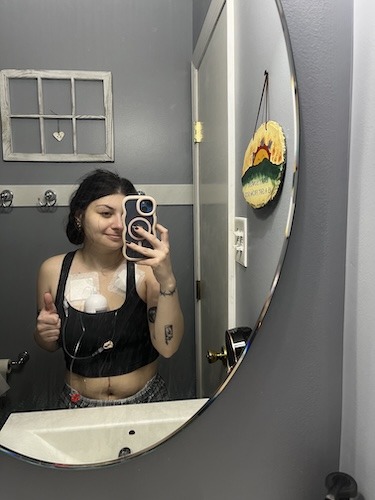
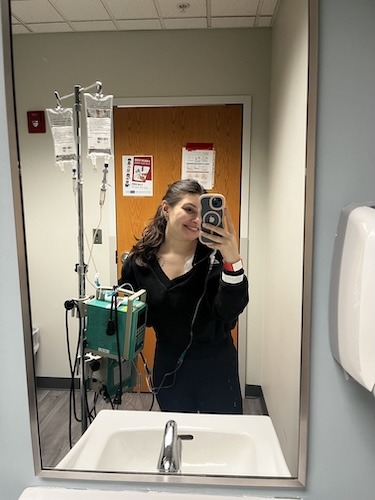
As of right now, I’m still doing chemotherapy every two weeks. I’m still doing the 5‑FU pump, which is on for 42 hours, and I’m still doing FOLFOX, which I get at the infusion center. I’m also doing bevacizuma, which is kind of an immunotherapy type of thing. So that’s my life at this point: every two weeks, chemo, suffer for a few days, and then return to normal.
Living life in my 20s in two-week chemo cycles
It was something that I never imagined. I basically live in my oncology office and infusion center because I don’t necessarily meet with my oncologist every time I go. I usually meet with the PA. The only time I really meet with my oncologist is in the early stages of treatment or for my CT scans — I meet with him because he’s the one who goes over them with me. But I meet with the PA every time before I get infusions, and I absolutely love her. She’s my favorite person ever.
I love the infusion nurses. They take such good care of me, and they know me by my first name. I think it hits home for them because I am so young. They see young people there, but not to the point of how young I am. There are a lot of young nurses there, and I think it hits home for them because it’s so real that this is happening to someone around their age range — or even the older nurses who have kids my age, and it hits home with them. The PA told me I have a special place in all of their hearts because I am so young.
I’m not grateful for the situation, but I’m so grateful for the people who are taking care of me during this time. I’m fortunate to have all of these people by my side. Obviously, it’s their job, but it’s part of their life to be taking care of these people, and I’m fortunate that I’m a part of that side of things. Not many people are able to say that; not a lot of people can say they’ve been taken good care of by medical professionals, which is true. I’m one of the fortunate ones who had a doctor who listened to me and surgeons who were ready to take care of me when I needed it. I’m very lucky in that aspect of my life.
Community support
Everyone in my life has been so encouraging and empowering, especially my mom. She is my best friend. When I get chemo, she’s the one who looks after me and cares for me, which I’m so grateful for. I have an amazing family. I have an absolutely amazing family and so many people around me who carry me when I can’t do it anymore.
Especially my sisters. I have three older sisters, and they are there for me at the drop of a hat. They also help take care of me. When I had chemo last week — how it works is I stay with my parents when I have chemo so they can look after me because my boyfriend works. Also, we have stairs that go up to our apartment, and they’re very steep stairs. It’s not really manageable because I am extremely tired when I get home. So my parents take care of me when I have my chemo.
My mom actually went to Florida when I was still recovering from chemo, and my sisters came over and stayed with me. We had a sleepover; they made sure that I got my anti‑nausea medicines around the clock, and we watched old family videos. My nephew and niece came to sleep over, too. It’s incredibly empowering to have such a loving family that fights with you and helps you through all of this. I’m so fortunate for it.
Even my friends, who are the ones coincidentally texting me right now, have been absolutely understanding and supportive. Everyone in my life right now is so supportive, and it makes my heart feel so gooey. I’m so fortunate.
I tear up every time I talk about my mom or my family because they hold such a special place in my heart. It’s insane because you would think I would cry talking about my story, but I cry when I talk about my family.
Finding the colorectal cancer community and becoming an advocate
When I first got diagnosed, I knew that there was the Colorectal Cancer Alliance. I was told that there are different platforms where survivors and advocates share their stories. At first, I didn’t want to be a part of it. I didn’t want to share my story or talk about my stage out loud or even say my stage out loud. For the longest time, the gynecologist surgeon who told me the news that I had colon cancer said it could be stage 4, but they didn’t want to get into it because it wasn’t his area of expertise regarding the colon.
For the longest time, I told the doctors, the surgeons, everyone, “I don’t want to know what my stage is. I want to not think about it.” Then, because I get overseen in New York City as well, one of the PAs there was the one who basically confirmed to me that it was stage 4 metastatic colon cancer. I was like, “Didn’t want to know that, but thank you for telling me.”
For a while, I didn’t want to think about it or talk about it. Then, like I said before, something in my brain switched, and I was like, “Okay, I’m ready to accept what’s happening to me, and I’m ready to talk about this.” I downloaded the Colorectal Cancer Alliance app, and I saw all of these people who either had the same diagnosis, an earlier stage, or were NED. I was like, “Wow, it’s insane how I didn’t know about this.”
Then I thought, “I want to do this. I want to talk more about this. I want to share my story.” Even at that time, and even now, I’m not cleared to go back to work. I’m basically bored, and I didn’t want to sit around and suffer in silence and just accept this. I wanted to talk about it and let people know that this is happening, and it’s not a disease that just affects older generations. It’s something that affects young people.
So I made a Facebook post. Then I made a short TikTok of me talking about it and going over my feelings and what was happening. Then I commented under a Colorectal Cancer Alliance post on Facebook where someone shared their story, and I wrote, “This is happening to me too.” They ended up reaching out to me and said, “Hey, we want you to do an interview with us.” I was like, “Okay.”
From there, Business Insider saw what I was doing, and they got in touch with the Colorectal Cancer Alliance people. Then they got in touch with me and said, “We have this opportunity that we want to do with you to spread more awareness,” and I was like, “All right, let’s do it.” From there, more people and more news articles got in touch with me, and I kept talking about it.
Then I saw what was going on with Capitol Hill, and I was like, “I want to be a part of that. I want to do that.” So I did it. I learned that there are so many incredibly brave and strong people that this community is built out of. It’s empowering to see all of these people come together for one cause and to see how many lives are lost. I’m so grateful to be part of such a community, a community that’s so understanding and built of some of the strongest people I’ve ever come across.
It made me think that I want to do more in honor of these people who are no longer here and in honor of those who are still fighting for these people who aren’t here. I want to do more for this community.
My urgent message to others with colon cancer symptoms
I guess just one thing that I want to add is to really say that whatever your symptoms are, please get them checked out. What I thought was such a small thing turned out to be a very big and life‑altering thing.
Cancer does not care about age, race, or lifestyle. It affects everyone. At this point, we hear about kids getting cancer and older people getting cancer, but it’s never in the middle. That’s something that I really want to make people aware of: anyone can get cancer.
I am the byproduct of that. I am someone who lived a relatively normal and relatively healthy life, and it still happened to me. If you are someone who is having these symptoms, get it checked out. If a doctor won’t listen to you, get a second opinion, get a third opinion, get as many opinions as you need for someone to listen to you, and be vocal about what is happening to you.
If you are someone who has the same diagnosis as me, or an earlier diagnosis, or just colon cancer or rectal cancer in general, speak out about it. Tell your story. Don’t just let it fester inside of you because we need more people to speak out about it. We need research. We need funding. We need more time to save lives and to make colorectal cancer curable and preventable. We need earlier detection than 45 and all.
I mean, I know they did lower the screening age to 45, but it’s not soon enough. If you have a history of cancer, they recommend getting a colonoscopy, but even now, it is so hard to get approved for a colonoscopy because of so many hurdles with insurance and trying to even get a GI appointment. It’s absolutely insane. I know so many people on the platform I have who are experiencing symptoms, and everything is getting delayed because their insurance or GIs are so backed up, and it’s insane. Even medical professionals kind of brush it off. We need more medical professionals to take this seriously and to listen.
This interview has been edited for clarity and length. The views and opinions expressed in this interview do not necessarily reflect those of The Patient Story. This content does not replace professional medical advice.
Inspired by Mariana’s story?
Share your story, too!
Thank you to the Colorectal Cancer Alliance for their partnership. They are here for you with information about screening and prevention, treatment options, and dedicated support through their certified patient navigators and helpline.
Hear from people living with colon cancer
Real experiences with diagnosis, treatment choices, side effects, and life beyond colon cancer — in their own words.
Leave a Reply