
Kimberly Was Exhausted and Severely Anemic; It Turned Out to Be Stage 4 Colon Cancer
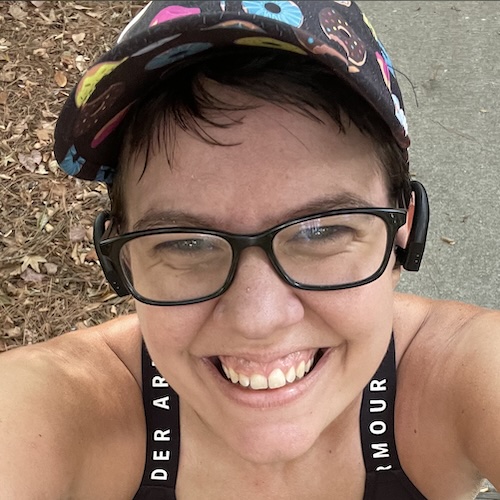
For nearly 10 years before her stage 4 colon cancer diagnosis, Kimberly was a work-from-home mom of two teenagers in Houston. She thought her exhaustion was ordinary. One doctor suggested therapy. Another told her to nap more and reduce stress. Blood work kept coming back close to normal, but then she began craving ice by the fistful and couldn’t finish a five-minute jog.
Interviewed by: Tory Midkiff
Edited by: Chris Sanchez
The turning point came when a routine anemia workup revealed her iron storage was almost nonexistent, and doctors told her they didn’t know how she was still upright. Months of iron infusions and menstrual testing didn’t explain why her levels kept collapsing. When new stomach pain, back pain, and a small amount of blood in her stool appeared, her doctor sent her for a colonoscopy. She expected to hear she had celiac disease. Instead, the gastroenterologist couldn’t finish the procedure. A tumor blocking her large intestine was too large to scope past.
Two days later, a biopsy confirmed colon cancer that had already spread to her liver. A surgeon who had initially described her surgery as simple reversed course after reviewing her scan. He told her he could not operate because the cancer had reached her liver, then personally called an oncologist to get her seen right away. Kimberly’s oncologist started FOLFIRINOX chemotherapy alongside a targeted therapy within days, before Kimberly fully understood that stage 4 colon cancer is considered incurable.
Four rounds in, scans showed her tumor had shrunk by more than half. After 11 rounds, she reached a complete response, with no detectable cancer, an outcome her oncologist called very rare for stage 4 colon cancer. Rather than stop investigating, Kimberly sought second opinions across Houston’s medical center, eventually clearing a tumor board evaluation that makes her eligible, in theory, for a future liver transplant if she ever needs one. To preserve that option, she recently underwent a robotic resection to remove the primary tumor from her colon.
Today, seven months into maintenance treatment and days removed from surgery, Kimberly is walking a mile a day, watching for her biopsy results, and weighing what comes next: a transplant, continued chemo, or waiting for new therapies still in development.
Watch Kimberly’s video and read the edited transcript of her interview. They’ll give you the details about her colon cancer story.
- For nearly a decade, Kimberly’s fatigue was written off as ordinary tiredness, even as her blood work quietly missed how severe her anemia had become. By the time a doctor finally checked her iron stores, it was nearly gone, and more than one physician told her they didn’t understand how she was still functioning. Her case is a reminder that persistent, worsening fatigue your blood work can’t explain is worth pushing on.
- When her oncologist first mentioned that her stage 4 diagnosis was incurable, Kimberly realized she had been going through treatment for months without understanding her own prognosis. Instead of retreating, she began seeking second opinions, eventually finding a transplant oncologist who cleared her for a future liver transplant her primary team couldn’t offer. Getting more opinions didn’t mean she doubted her oncologist. It meant she wanted every option on the table.
- Seven months before her colon resection, Kimberly couldn’t lift a gallon of milk out of her car. Six days before surgery, she ran five miles. The rebuild happened in a pattern that felt like two steps forward and three steps back for months, until a coach helped her see progress she couldn’t feel on her own.
- A persistent symptom that blood work can’t explain is often the exact signal worth pushing on, whether it’s fatigue, an ice craving, or pain that doesn’t resolve, even when every test comes back close to normal.
- After 11 rounds of chemotherapy, Kimberly’s scans showed no detectable cancer, an outcome her oncologist called very rare for stage 4 colon cancer. She’s careful not to call herself cured. Her doctors don’t use the word remission for stage 4 disease, and she’s had to hold both realities at once: that she looks and feels healthier than she has in years, and that she still technically has cancer.
Kimberly’s Diagnosis Facts
- Name: Kimberly R.
- Age at Diagnosis:
- 35
- Diagnosis:
- Colon Cancer
- Staging:
- Stage 4 (Metastatic)
- Mutation:
- KRAS
- Symptoms:
- Severe anemia
- Extreme fatigue
- Poor sleep
- Exercise intolerance
- Pica (ice craving)
- Abdominal pain
- Back pain
- Rectal bleeding
- Treatments:
- Iron infusions
- Chemotherapy: FOLFIRINOX, fluorouracil (5-FU)
- Targeted therapy: bevacizumab (monoclonal antibody)
- Surgery: right hemicolectomy
This is not medical advice. Please consult with your healthcare provider to make informed treatment decisions.
- Kimberly’s Diagnosis Facts
- Running a food blog, raising two teens, and calling my exhaustion normal
- The relief and the limits of relief in finally getting a diagnosis
- Waking up from the colonoscopy to colon cancer: A tumor too large to scope past
- Understanding what stage 4 colon cancer actually means
- The two questions I needed answered to get through chemotherapy for stage 4 colon cancer
- The scan that left every doctor mind-blown
- Hearing “12 rounds” and realizing this wasn’t close to over
- The word “incurable” and realizing no one had told me
- Learning that I was the one in charge of my care
- A complete response and getting cleared for a future liver transplant
- My stage 4 colon cancer timeline: Diagnosis, chemotherapy, maintenance therapy, and surgery
- From not being able to lift a gallon of milk to running five miles
- Weighing a future liver transplant against what science might offer next
- What the KRAS mutation testing did (and didn’t) change
- My advice to someone facing a new diagnosis: Take in what you can handle
- Hear from people living with colon cancer
Running a food blog, raising two teens, and calling my exhaustion normal
I work for a food blogger online, so I work from home. I’m a mom of two teens, so they keep me busy. People always ask what my weekend plans are, and I’m like, “Well, the children haven’t told me yet; I don’t know.” My life revolves around them, work, and my family, and I enjoy that. That can be a downside, but that’s how I set my life up intentionally, and that’s what I want to do.
10 years of fatigue that blood work kept saying was nothing
I now know that the cancer was probably growing for 10 years before it was diagnosed. For the last 10 years, I mainly was just tired. I would talk to other people, and everybody was kind of like, “Yeah, we’re all tired.” So I would be torn between feeling like what I was experiencing seemed to be more than what everybody else was expressing, and going to the doctor and having my blood work be fine.
One time, my vitamin D was slightly low; that’s the worst I had seen on blood work. I got brushed off a lot. “Maybe you should try therapy,” a doctor told me one time. “Maybe you should try to nap more. Try to reduce stress.” When you have two small kids while building a business, and you’re tired, and that’s your only symptom, nobody’s going to rush you in for a colonoscopy when you are sleepy.
It’s hard to explain, because all of the words align with being tired. I never felt rested, ever. I started sleeping poorly as well, so then you can blame tiredness on that. But I felt like I was muscling through life a hundred percent of the time. Even on great days, when everything was going right in my life, it was still difficult to get through the day.
Trying to run, hitting a plateau, and telling myself to push through
Now I know a lot more about how to advocate with the doctor. I did not at the time, so I only tried going to the doctor and getting help maybe one or two times over 10 years, because the first sign of them blowing me off, I would gaslight myself into thinking, “Okay, yeah, you’re just making things up. You just need to try harder.”
It started to become impossible to ignore when I was trying to run. I wasn’t trying to be a major runner; I was just trying to run for my health, and I plateaued. I couldn’t breathe when I was running, and I wasn’t getting any better. Other people who had started running after me were progressing, and I could not. I couldn’t run more than five minutes without walking breaks. I’m talking about two years of trying.
I would tell myself, “Am I just not trying hard enough? People say to just push through it.” I would try to do just that, and my body would revolt. I’d get a crazy headache, or I’d have to go to bed at eight o’clock at night, literally falling asleep in a chair, exhausted from the slowest jog that you couldn’t even call a run. That started to make me think that maybe something was wrong.
I tried troubleshooting on my own. “Maybe it’s my blood sugar. Maybe I’m not eating enough. Let me dial in my food.” I was trying everything I could on my own, because I didn’t trust that I could get any answers from a doctor. It kept getting worse and worse; my anxiety increased, and I stopped being able to sleep at night.
Then I started craving ice, which is such a silly symptom, but it was one of the most obvious ones. I would wake up in the morning thinking about how I could get ice to chew and go to bed thinking about how I could get ice the next day. True addict-style, thinking about ice throughout the entire day. I would walk miles to go get ice. It was very strange.
I Googled it and figured out this was probably iron deficiency. I thought, “Maybe that’s all it is.” I finally went to a doctor. They ran tests for blood sugar, iron, all of these things, and my ferritin was 1 ng/mL. The doctor was like, “I don’t know how you’re upright. I don’t know how you’re sitting in front of me.” Every doctor I saw for the next few months would look at my iron numbers and say, “I don’t know how you’re functioning, because I see people with 20 points higher than what you have and they literally can’t get themselves out of bed.” That was affirming that I hadn’t just been a wimp all of these years, that I had been struggling and trying to muscle through things, so I felt good when I got the anemia diagnosis.
The relief and the limits of relief in finally getting a diagnosis
I was relieved to finally have what I thought was an answer. I thought the answer was just anemia. “Oh, I’ve just been low iron all these years.” We need to figure out why I’m anemic, obviously, but there’s an answer.
I started getting iron infusions pretty much immediately to get my iron levels up, because they were dangerously low. My hemoglobin was so low that I could have had a stroke at any time. My doctor, when I told her I had still been trying to run, shouted at me that I needed to stop because it was so dangerous. My blood oxygen levels were so low. That’s how dire the iron situation had put me in.
I felt really happy and relieved at that time, thinking I was almost to the end of my health issues, which is so funny looking back. But that’s how it felt. I thought I needed maybe five or six iron infusions and then I’d be okay. That has not obviously been the case, but at the time, it felt affirming and exciting to have some answers and be on track to going back to normal, which is what I was expecting.
Chasing a menstrual explanation while the iron kept bottoming out
We spent about three to six months pursuing the idea that it was menstruation-related. We were doing ultrasounds, testing different things, and trying different types of birth control to try to make me bleed less every month while getting iron infusions. My iron would go up with the infusions and then bottom back out.
The first couple of rounds, they were like, “This is very normal. Your storage has to build back up. We’re not discouraged by this.” I was confused by it. That was when I started to think maybe something else was happening, because I felt like everything should be going up and it wasn’t. It would go up and plummet, repeatedly, several times.
In that same time period, I also started to get stomach pain for the first time. I hadn’t had any issues other than anemia and tiredness. I attributed the stomach pain to the iron pills I was taking, since I was getting infusions and taking pills to do everything I could. Everything you read online about iron pills says they cause stomach cramping, so I wrote off my stomach cramps to the iron pills. I stayed in the lane of going to the gynecologist and trying to figure out how to get my iron to stop plummeting.
When the stomach pain didn’t go away even after stopping the iron pills
The stomach pain was getting worse and worse. I also started getting some back pain, which I didn’t understand at all. I told myself, “I can’t figure out back pain right now. I need to focus on this one thing that I know is a problem for sure.”
In the late summer of 2025, I got an iron infusion, so I paused the pills because my body already had more iron than it could process. The pain didn’t go away. That, to me, was a big red flag. Something else was causing this pain. Now that was another symptom entering the picture, where we’d had very minimal symptoms to work with, very minimal ideas of what channels to pursue.
I got some blood in my stool a couple of times, a slight, tiny amount, where I wasn’t even a hundred percent sure if it was blood or not. But I decided to flag it, just in case. I messaged my doctor through the patient portal and said, “Hey, I think I have blood in my stool.” She sent me immediately to a GI.
Choosing a colonoscopy over a uterine ablation and expecting celiac disease
He said, “Listening to your whole story, listening to everything you’re talking about, I’m ninety-nine percent sure this is menstrual-related, and you need to keep pursuing that. But I don’t mess around when it’s blood in stool, so I want you to get a colonoscopy.”
I was like, “Really?” Because I feel like if you Google anything, it’s cancer. Doctors are always saying cancer, cancer, cancer. I was internally rolling my eyes, like, “Okay, we’ll do that for safety, but I know this menstrual issue is an issue,” so I wanted to pursue that first before I did this long shot. I was considering doing a uterine ablation to settle all the menstrual issues once and for all, and then get a colonoscopy after. But then I decided to switch it and do the colonoscopy first when the stomach pain didn’t go away.
I was thinking I probably had celiac disease, and that’s why I did an endoscopy and a colonoscopy at the same time. That’s what I was expecting to find. If you have celiac disease, part of the symptoms include iron deficiency and stomach pain. That made the most sense to me. I thought, “I’ll get this done, and they’ll tell me I have celiac, and that’ll be sad because I can never eat bread again.” And that is not what we found.
Cancer was not on my radar, not in the slightest. I guess the GI was concerned. I asked him, “What if I wait? What’s the worst-case scenario if I wait?” And he said, “Worst-case scenario would be you have a treatable form of cancer right now, and you wait a while to get the colonoscopy, and then it could be stage 4,” so he wanted me to come in and get it.
I was rolling my eyes, because cancer happens to other people; it doesn’t happen to me or anybody I know, so it’s probably celiac. We have a family history of celiac as well, so it made sense to me that that’s what it would be.
Waking up from the colonoscopy to colon cancer: A tumor too large to scope past
I got the colonoscopy and woke up. I was groggy and a little loopy when the doctor came in with images and started walking me through it. I don’t think you usually get images right away, but he had papers printed out 30 minutes later with pictures. He showed me and said, “Look, I couldn’t even finish the scope. You have a tumor so large in your large intestine that I could only get so far in. This is a dire emergency. We’re going to biopsy it to see if it’s cancerous.”
There was still a question mark that it could be cancer. But at that point, I don’t know of any tumors that grow that large that aren’t cancer; maybe that’s a thing, but I was assuming it wasn’t. He couldn’t diagnose me right then and there, but he said this is dire because it was so blocked, and he wasn’t sure if it was more blocked further up than his scope could go. He said, “You need to go see a surgeon immediately and get this cut out, because this is such a big deal. You’re in danger.”
I had been almost crying, thinking about not having pizza night with my kids anymore because of a possible celiac diagnosis. Then suddenly it’s probably cancer. The helpful thing was that I was a little loopy, so I mentally took that in slowly. My husband, who was in the room, said the doctor kept asking, “Do you understand what I’m saying to you? Are you taking it in?” I was just very nonchalant about it, because of the stuff that was still in my system. Then I had a couple of days to process that before he called and officially said, “It came back, and it’s colon cancer.”
From “It’s a simple surgery” to “I can’t operate on you”
He said to get in to see the surgeon immediately, “Don’t go to oncology. You need to see a surgeon. This is an emergency.” It shows how much it hadn’t registered, because I was like, “Oncology? That’s not a thing I need to do.” It felt so foreign, unfamiliar, and strange.
He got me in to get a CT almost immediately and started getting an appointment on the books with the surgeon before he even called me back. I think he called, and then the next day my CT was scheduled. We knew it was likely cancer. When I answered the phone and it was the doctor personally on the line, I thought, “All right. He doesn’t even have to say it. I know that this is cancer.”
I got in the next day for my CT scan. They gave me a disc of the scan. Somebody told me to always ask for the disc, so I asked for it. I didn’t get results back before I saw the surgeon, because I only saw him a couple of days later. But I went in and told him what my GI had said, and he walked me through what a surgery would look like. He said, “It’s very simple, easy, and quick. Because it’s on the right side, you won’t need a bag or anything. We’ll go in, cut it out, sew it back together, and you’ll be good to go.”
I was very scared of surgery, but he’s a jolly guy, and he was making me feel comfortable about it. Then I said, “Oh, I don’t have the results yet, but I do have this disc, if you want to look at my CT scan.” He said, “Oh, sure,” went to the other room to get on his computer, looked at the scan, came back in, and was no longer jolly. He looked white and terrified, and said, “I’m sorry, I can’t operate on you.”
We said, “The GI told us this was an emergency, that I had to be operated on immediately because I could have a blockage and die. What are you talking about?” And he said, “I cannot interpret a CT for you; that’s not my job. But I’m seeing lots of mets all across your liver. If we operate, those mets will blossom and make your situation so much worse, and I won’t do it. No one should do it. You have to go to oncology.”
We were bewildered. One guy says it’s an emergency to go see that guy, and then that guy says no, it’s an emergency to go see this person over here. I’m still thinking, “I know I have cancer and I can’t get treatment, because everybody’s saying everything is an emergency, so much so that we can do nothing.” That was the meeting with the surgeon.
We were stunned as we walked out. I was signing my name to leave, and he was on his cell phone in the hallway, saying, “I’m on the phone with your oncologist. I picked her for you. She’s going to call you later today.” We were like, “Whoa, that does not happen. Doctors making personal phone calls to other doctors to get you in. This is very strange and bewildering.”
It was absolutely frustrating. I finally knew what was wrong with me. There was still a little bit of relief in knowing. For years, I hadn’t known what was wrong with me. It’s not what I wanted, but at least I know why I feel the way I feel. Then the can kept getting kicked down the road to somebody else.
I now know how quickly everything actually went, because the medical system does not move quickly, but in the moment it felt like everything was moving so slowly. When you get told you have cancer, you want to start treating the cancer 10 minutes later, and that’s just not how it works. So there was a lot more waiting than I was anticipating, even though my medical care team moved so quickly to try to help me. In retrospect, I now know how quickly they moved. They moved mountains for me. But it felt very slow at that moment.
Meeting the oncologist who didn’t waste time
It was pretty low-key. She was very straightforward. She said, “Okay, this is what you have. You have colon cancer. There are mets in your liver.”
There were some issues with that first CT scan. When we got the results back, some of the stuff was written incorrectly, so she wanted me to go in for another scan, but she said, “We’re not waiting to start treatment. We’re going to get you in for that scan whenever you can. You’re going to get a port placed. We’ll start chemo the next day.” It was very matter-of-fact, very straightforward: This is what we’re doing.
She said, “You could go to MD Anderson. You could go anywhere. This is first-line treatment for stage 4 colon cancer. This is what you do. This is what we’re doing.” We were just like, “Okay.”
Understanding what stage 4 colon cancer actually means
I’m not sure when she actually said stage 4. My husband looked it up and knew that it was stage 4 just because it’s in another organ, so we knew that, but we didn’t know the fullness of what that meant.
I didn’t know that it was an incurable diagnosis until several more months into it. We knew it was stage 4, but I was coming to understand that stage 4 isn’t what I thought it was. Every time I heard stage 4, I thought the patient would die about three months later. That’s the understanding I had of cancer, so I was trying to reshape that.
Apparently, that’s not necessarily what it means. I still didn’t have the full understanding, at least for my diagnosis, that it’s considered incurable and how to make sense of all of that. She hadn’t given me all of that information yet, and I’m glad she didn’t. It was too much information to try to process. I was just trying to process chemotherapy, and that was big enough to figure out on day one.
The two questions I needed answered to get through chemotherapy for stage 4 colon cancer
She said we were going to do four rounds of chemotherapy and then do another scan, so I asked what we were aiming for after four rounds. I have no background in cancer. I don’t know anybody close to me who’s had cancer, so I don’t know how to manage my expectations.
She gave me a very weird look, and then finally said, “Significant improvement.” I was like, “Okay, cool.” I don’t know why you’re giving me a weird look, but mentally, I needed something happy to cling to, like, “I’m going to significantly improve in the next eight weeks, because my chemo’s every other week.” That’s what I needed to latch onto.
I was experiencing bad pain in my stomach and in my back, which I now know was lymph nodes being inflamed. I asked a nurse, “When will this pain go away?” And they said, “Probably weeks. It takes a while.” What they didn’t tell me at that time was that sometimes chemotherapy doesn’t work. I knew that long-term, sometimes chemo doesn’t work. But I had no idea that sometimes first-line treatment doesn’t do anything. That you’re too far advanced or whatever. I had no understanding of that.
I clung to, “All right. In a few weeks, my pain will go away, and in eight weeks, I should have significantly improved. This is going to be great. It’s going to go well. I can do this.” I was very optimistic, not knowing the full reality of my situation at all. But those were my two biggest questions, so I could frame my expectations. My expectations were incorrect, but that framing helped me at the time. It helped me push through the difficult chemo for those first four rounds.
Nine hours in the chair, then a pump for fifty hours at home
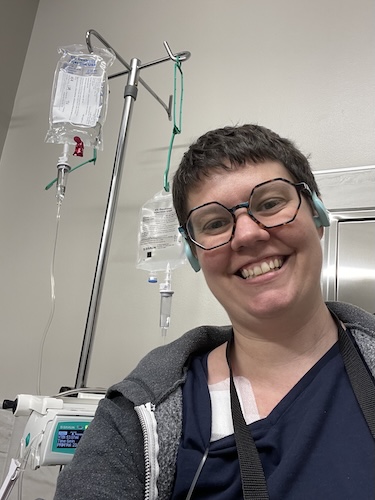
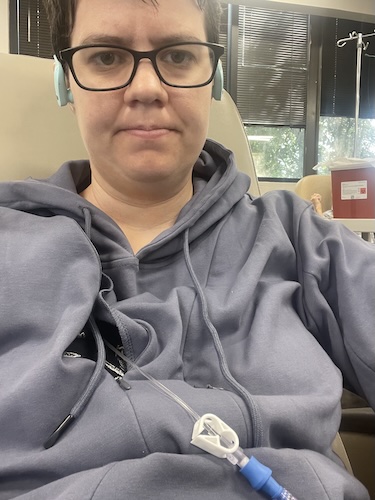
It was very different than I thought. Nothing can fully prepare you for how awful chemotherapy is. The chemo I get is nine hours in the chair the first day, and then I have a bag attached to me through my port for 50 hours at home. That was day one of chemo.
I watched other people coming in for their one-hour chemo treatments, and I’m thinking, “I’m here for nine plus 50.” That started to make me realize maybe I’m worse off than I thought I was, because all these other people… Either I’m young so they’re giving me more chemo, or things are dire. I don’t know how to process the fact that everybody else is coming and going, and I’m just stuck here in this chair. I opened the chemotherapy place, and I closed the chemotherapy place, and then had two more days to go.
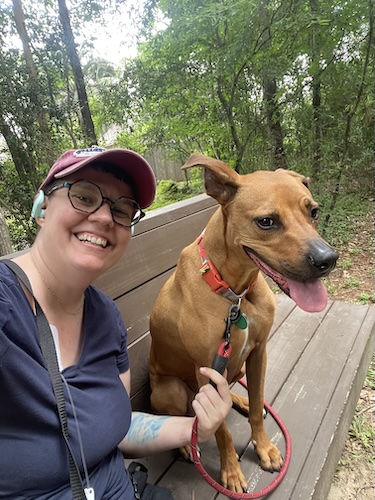
It was awful and exhausting. My whole body hurt, and I spiked a fever. It was rough. And then a week later, I felt pretty good, and I remember being shocked. Because the cancer you see in the media or in movies is constant throwing up and misery, and there are no good days. My first day that I was able to walk a quarter mile on this little trail and make it to a bench… It was a little waddle, but I was able to walk… I was like, “Oh my gosh, it’s a good day. I didn’t know there’d be good days after being diagnosed with cancer,” and that was exciting to me. It was such a small thing. I took the smallest baby walk ever.
But when you’re told you have cancer, it’s hard not to picture everything downhill from here, and that wasn’t the case. I started to feel better. My pain went away. They told me to expect weeks; five days later, my pain was dramatically reduced, which I now know is insane. But at the time, I was like, “Great! I’m doing good!”
Even when I told my doctor my pain was pretty much gone, just some twinges throughout the day, she said, “Okay, sweetie,” like that’s not a thing that happens. I’m thinking, “It can’t be a placebo. I was grimacing in pain multiple times a day, and I’m not anymore. Things must be going well, right?” It was very different. It was more difficult than I thought and also easier than I thought, and there were good days, which was not what I was expecting at all. I didn’t think there’d be any of those.
The scan that left every doctor mind-blown
I was nervous going into the scan, but I knew that there had been progress. Even if people didn’t believe me that I was feeling better, my family believed me. They had seen me doubled over in pain multiple times a day, and that stopped, so I knew some progress had been made. I didn’t know how it would compare to what my doctor was expecting.
Now, there’s always scanxiety: Is the cancer back? With that first one, I knew I’d progressed, but how much better were things? What was the next step? Because she hadn’t even told me what we were doing after the first four rounds of chemo. We were going to do four, and then we’d see what was next. I felt pretty good going into that scan, a little nervous, but I knew progress had been made, just not how much.
It was dramatic. The main tumor had decreased by more than half, if I remember correctly. A lot of the mets were gone. Many of the larger mets in my liver had shrunk dramatically. I knew it was very good results when my oncologist was like, “This is great. Your next scan is not going to be this dramatic. This is wonderful. We’re happy, but I just need you to set your expectations that most scans don’t look like this, and that’s okay. Don’t worry if future ones don’t look like this.”
Then I went back to the surgeon to update him, and he said, “Are you serious that these two scans are four weeks apart? This is nuts. This doesn’t happen this quickly.” I said, “I don’t know measurements. I’m just happy.” Every doctor who looked at those first two scans was mind-blown at how much progress had been made, and I’m like, “I told you guys I stopped hurting.”
Hearing “12 rounds” and realizing this wasn’t close to over
She keeps her cards close to her chest. I was assuming after four, I was going to get surgery, because at this time I still didn’t know that my diagnosis was incurable. I think it was at that point when she said, “First-line treatment for stage 4 colon cancer is usually 12 rounds of what you’re doing right now,” which was like a gut punch, because I was barely muscling through the four.
Even though there were good days, it was still a solid week of awful, rough times. It’s like I’d step out of space and time for a week, and then I’d be here, and then I’d be out, and then I’d be here. It was disorienting how much time was passing. It was strange. Thinking about that for another two times as much time again was big.
But still in my mind, I’m like, “Okay, I’ll do 12, and then we’ll have surgery, and then we’ll be done.” I’d heard people talk about cleanup chemo, so I was like, “Okay, so I’ll be clear, then we’ll have surgery, then we’ll maybe do some cleanup chemo, and then I’ll be done.” In my mind, we were always going toward being done. I didn’t know that that was not what we were going toward until several more months into treatment.
Chemo delays, muddled timelines, and tumor DNA that kept shrinking
Twelve rounds total is what she told me to do. We do scans every three months, typically, so it was after another four or five; I don’t know the numbers exactly. My chemo was delayed several times because my liver numbers would be too high, my white blood cells would be too low, or other things, so the timing of how many treatments happened between each scan got a little muddled. Because for a time period in the middle, I think we had to delay by a week almost every single round, which was frustrating at the time.
It would be every three months, regardless of how many treatments I’d had, that I’d get scans again, and I’d get the blood work that measures your tumor DNA again, and it kept shrinking. That was good. She was right that it wasn’t as dramatic as the first time, but it significantly improved every time.
The word “incurable” and realizing no one had told me
We were eight or nine rounds in, and I had settled into a routine of my treatment and how I dealt with it. I hired a dietitian who was helping me stay strong through chemo. I started working out a little bit, little tiny baby workouts, anything I could do to keep my muscles up. I noticed how much weaker I was getting, and that was stressing me out. I was trying to put things in place to get me through all 12, because 12 was a high number.
At one of the appointments, I finally asked her, “Okay, so after 12, we’re getting surgery, right?” Because she hadn’t made that clear, and I was envisioning this, I wanted to be sure what I was envisioning was correct. She was very casual, because she thought we had been on the same page, and said, “Since it’s stage 4 and it’s incurable, some people do the surgery, but for some people, there’s no real benefit putting your body through a lot, and what benefit you’d get out of it may not be there.”
I froze and said, “Can we go back? You just used the word incurable.” Immediately, I’m thinking, this must be a medical term that I don’t understand. Maybe there’s a loophole or a nuance or something. What am I missing here? And she said, “No. Stage 4 colon cancer is not curable. You’re going to be on treatment forever.”
I was shocked. She said, “You know this. You’ve Googled this. You’ve looked into this.” I said, “I haven’t. I haven’t Googled anything about prognosis, about any of those things. I had been avoiding it because I needed hope, and I needed to just walk in.” So she was shocked that I was unaware of my actual situation. She walked me through things, and that was eight or nine rounds in, several months before I found out that she was not aiming to cure me.
Deciding to seek second opinions
It took me a couple of weeks to process that. This was brand new information, so I needed to process it. Then it shifted my focus. I need to get second opinions, because this person is saying she does not have a curative pathway for me, but that doesn’t mean every doctor is going to say there’s no curative pathway for me.
I’m very fortunate to live in Houston. We have an incredible med center, so I’m going to go get every opinion that I can. I didn’t know how to do that. I didn’t know how second opinions worked; it seemed strange. I literally Googled “Houston + liver,” found a random doctor, went in and said, “Hi, would you talk to me?” And he said, “What? Why are you here? I don’t understand.” I said, “I just need your opinion.”
That’s not at all how second opinions work, but I didn’t know what to do. He said, “You don’t need to be here. You’re in first-line treatment. I have no information to work with.” But he referred me to another oncologist. So then I at least knew I needed to go see another oncologist at another hospital system, and I started to see how that would work.
I talked to my primary oncologist and said, “As we finish first-line treatment,” because we were getting close to being done with the 12 rounds, “I want to go see some other doctors.” She was extremely supportive of that. She said, “Absolutely. I want you to feel confident, and if you go get another plan of care or another idea, we can talk about it. I’m comfortable executing a different plan of care too. I’m going to tell you what I think, and I’ll always give you my opinion, but if you get another idea, let’s talk about it.”
She referred me out to several other doctors, and I found some on my own as well, and started getting all the ideas and all the opinions. I wasn’t going to just say I’m done trying. I was going to go see what people were experimenting with.
Working up the nerve to ask my oncologist for a second opinion
I was scared to bring it up to her, because I wasn’t unhappy with her. I love her. She’s still my primary oncologist. Even though I’ve gotten a different direction with my care, she’s still the one I see day in and day out. I adore her. She’s brilliant. She’s got my best interests in mind.
I wasn’t going to get a second opinion because I’m unhappy, which is what I had always thought second opinions were, when you mistrust your doctor. But that’s not the case. I literally wanted more opinions. As soon as I said those words, she was setting things up. She said, “I’ll send you to Baylor. I can send you to UT. I can send you here. I can send you there.”
She was so open to it and made that conversation comfortable, which I’ve heard all good doctors are and should be. But I didn’t know that, and I didn’t know how that conversation would go. It felt important enough to me that if I’m literally fighting for my life, I’m going to have that uncomfortable conversation, even from a place of, “I know this might be a waste of time and money, but I’m going to go see what people have to say.”
She was very supportive of that, and I definitely recommend it, especially for late-stage cancers. We have to see what other people are doing, because different hospitals approach different cancers differently, and there might be other ideas that people have.
Learning that I was the one in charge of my care
I’ve had to learn that I am the one in charge. It feels like the power dynamic is that the doctor is in charge and tells me what to do, and it’s not. They have the expertise, and they’re going to be the one executing the plan of care, but I’m the one in charge, because it’s my body.
I didn’t know that going into my cancer diagnosis, so I would walk into doctors’ offices very timid and apologetic, like, “I don’t know what’s wrong, but can you help a little bit?” Of course, they’re not going to help, because I’m not giving them all the information; I’m not communicating clearly, so I started walking into doctors’ offices with a binder with all of my information and saying, “I have this, and I have this question.”
I’d come prepared with all of the research I had done and important questions, locked and loaded and ready to go, because I needed to get information out of them and make the most of the 20 minutes I get with the oncologist.
One of my doctors still laughs at me. I researched and found him on LinkedIn. I found videos of him giving talks for other doctors about the cancer that I have, so I watched them. I couldn’t comprehend all of them, but I understood enough that I would take questions from the videos and go in with them, which made it sound like I knew what I was talking about. He’d look at me like, “How do you even know to ask this question?” And I’d say, “Oh, well, the video on your LinkedIn.”
And he’s like, “Kimberly, other patients are not watching the videos on my LinkedIn.” And I’m like, “Well, I am, and I have questions accordingly.” But then I get amazing answers, because when they see that you want to understand how it works, that you want to know all of the options, even if a pathway isn’t my pathway, I need to know and understand why that pathway isn’t my pathway.
They started to understand that about me, so I get tons of information that I feel like other people aren’t getting, because I did lots of research and preparation before going in, but still took the attitude of, “Please teach me.” It wasn’t that I now think I’m a doctor. It’s just, “Hey, I saw you say this, but I didn’t fully understand. Can you explain how this stat you were talking about in a video applies to me and where I fit into that?” So they’ve been very open to conversing with me and talking about my disease with me.
I write down questions when my brain is there. I’m researching and writing down questions I want to ask people, watching videos, making sure my whole list gets covered at every appointment, because it’s my 20-minute chance and I’ve got to make the most of it.
A complete response and getting cleared for a future liver transplant
To back up a little, after 11 rounds of full treatment, I had another scan and another round of blood work, and I had a complete response. That means I’m fully clear of cancer. I know; it’s amazing. For stage 4 colon cancer, that’s very, very, very rare. That was amazing. Again, my doctor said, “This is wonderful. Nobody thought this would happen. Just don’t overreact,” trying to calm me down, because I now know that even if that happens, it normally lasts a month or less. It doesn’t stick. (EDITOR’S NOTE: As discussed by Cleveland Clinic, for stage 4 colon cancer patients like Kimberly, achieving a complete response to treatment is rare. But it is possible, particularly with advanced treatments such as immunotherapy. That said, treatment outcomes vary significantly among individual patients.)
I’m seven months into no evidence of disease right now, but at the time, the doctor was managing expectations because she knows that’s what I need from her. We have that relationship. I hit no evidence of disease, went on maintenance treatment, and that’s when I started pursuing second opinions.
I had seen online that there are a couple of liver surgeries that can be curative for some people, and a liver transplant is also an option. A liver transplant is currently considered the only curative option for what I have. (EDITOR’S NOTE: A liver transplant is not a guaranteed cure for colon cancer. However, as Mayo Clinic notes, it may help certain patients survive long term when other treatments have not successfully cured them.)
Some people are just cured with chemo. It’s a tiny, tiny percent, and nobody knows why that happens, but it does happen to some people, so I could be one of those people. We honestly don’t know. But medically, a liver transplant is the only curative pathway, and it’s very difficult to hit what you need to hit for a liver transplant. But I’ve got to at least go see if that’s an option. If there’s a curative pathway scientifically right now, I want to know if I’m eligible. So that’s what I was asking some of these doctors.
I found a doctor at Methodist. He’s big in transplant oncology; he’s a researcher as well as an oncologist. He got me before their tumor board, which was another important thing. The oncologist I’m with doesn’t have a tumor board, so there’s no multidisciplinary group meeting to talk about my case; it’s just her. She said, “I can find some online, or I can send you out,” and I said, “Please just send me out.”
I was actually cleared for a liver transplant, which was shocking. We had been concerned about the main lymph node that had been hurting my back, which might make me ineligible, but they said that’s considered resolved with no evidence of disease. In theory, down the line, they will do a liver transplant on me. But to get a transplant, you have to have your primary location removed. My colon would need to be resected where the cancer started, even though there’s no evidence of disease, even though we did another colonoscopy, biopsied it, and there was no cancer. They simply do not do liver transplants if that primary location hasn’t been removed.
I was trying to decide, and that became the conversation with my second-opinion doctors. Should I go ahead and remove this? Because the other tricky thing is that if I have a recurrence somewhere, I can’t remove the primary location, just like in the beginning. You can’t go in and remove that section of your colon if you have cancer in your liver. It’s this weird time period. I need to do this so I’m eligible for it potentially in the future, if I might want to do it in five years.
I talked to multiple doctors about this. I even went back and talked to my primary doctor, who’s much more careful about it. She said, “They want you to do a transplant? You have no evidence of disease. You need to pump the brakes.” I said, “I’m not trying to get a transplant. I just want to remove the primary. That’s all I want to do, so that I’m eligible for this in the future.” If I have a recurrence in my liver, I would do chemo again, because it’s effective for me. It’s clearly still working. But if several years down the road chemo is less effective or something like that, I want the opportunity to be available to have a liver transplant, if that’s what’s needed.
Methodist agreed to do it. My oncologist agreed that it can be a smart move at this point. It’s not going to be detrimental to my care. It’s not going to be a big deal. It will also give us data about how I’m doing, because I have to be off chemo for two months to get the surgery done: a month leading up to surgery and then a month of recovery. Is chemo the only thing keeping me from having a recurrence? Am I doing better? We’ll get the data from the biopsy. We’ll get a lot of information to make the next best decision.
One of the doctors keeps telling me, “Kimberly, you ask all these questions about data, but there’s no data for patients like you, because there aren’t patients like you. We quite frankly don’t know what to do, because you’re in a unique situation. So this is now a conversation between the two of us about what you think we should do and what I think we should do. Let’s make something up together, because this is brand-new science. This doesn’t happen that often.” It happens to some people, and I’ve met people it happens to, but it’s not enough to make a data set and make good data-driven decisions. We’re just making the next best decision that we can.
My stage 4 colon cancer timeline: Diagnosis, chemotherapy, maintenance therapy, and surgery
I was diagnosed in August 2025 and started treatment at the end of that month. I did chemo all the way through February 2026, and then there was no evidence of disease. I switched to maintenance therapy, a 50-hour chemo bag plus targeted therapy every other week, and I’ve been doing that for the last seven months.
I paused a month ago because we did decide to do the surgery. I got surgery recently, and in another month, I’ll go back on chemo, assuming everything continues to go well with surgery. Then we’ll see what happens next.
From not being able to lift a gallon of milk to running five miles
That was wild. I had gotten extremely weak. I couldn’t even carry milk in from the car. I couldn’t stand up from a chair. I would have had to use both hands and get some momentum going to stand up. I wasn’t looking gaunt and wasted, but my muscles had wasted away. I actually gained weight during chemo because of a reaction to the steroids, so I wasn’t looking thin, but if I hadn’t gained all that weight, I would have looked really thin from the amount of muscle loss.
It was crazy how many things I simply could not do that were everyday things, like carrying groceries in from the car. And that’s even on good days, not just during chemo. On my best day, I couldn’t lift a gallon of milk because it was too heavy for my muscles. That’s where I was when I went on maintenance.
A lot of data supports exercising to help prevent recurrence; running can help prevent recurrence. I looked at every data point that I could. Again, there’s not a lot of research for colon cancer, so I was reading breast cancer studies about things that prevent recurrence, thinking, “If it helps them, maybe it’ll help me, and it’s definitely not going to hurt.”
So I’m dialing in my food, and I’m exercising. I hired a fitness coach, and she’s helping me. I crashed out a lot, because it feels like you’re not making any progress when you’re getting chemotherapy every other week. I’d take several days off for chemo and then have nine days of working out, and then step back for chemo. It would be like two steps forward, three steps backward, which is what it felt like for months, and I was freaking out.
I had more mental clarity, and I could work a little more. But even though I was functioning better, I was still freaking out because I felt so physically weak and felt like I wasn’t making progress. Thankfully, hiring a coach was helpful, because she would help track things for me. She would assign something, and I’d say, “I still couldn’t do it,” and I’d be down on myself, and she’d say, “Dude, you did three of the 10 sets this time. Two weeks ago, you could only do one. That’s still a big deal.”
I’m looking at it like I still failed and couldn’t finish; she was seeing progress and pointing out progress I wasn’t seeing. That was helpful, because it’s hard enough to try to work out when you’re feeling like crap from chemo. If I wasn’t in pain from chemo, I was in pain from working out. But an hour a day, most days, I would be either working out or starting to run, and I built my way up. Six days before surgery, I ran five miles. I can’t lift milk, but seven months later, I can run five miles. Insane. It felt like I was making no progress that entire time, but I was, apparently.
Even pre-cancer, I couldn’t do the things I’m able to do now, and that’s weird mentally. Technically, I still have cancer, right? When you have stage 4 colon cancer, they don’t tell you you’re in remission. They won’t say those words. I technically have this diagnosis. I technically have cancer even though they can’t find it. But I feel better than I’ve felt in years on the weeks I don’t have chemo. On chemo weeks, I still feel like crap, but that’s okay. I still feel better most of the time than I used to, and that’s incredible to me.
Walking within hours after a right colon resection
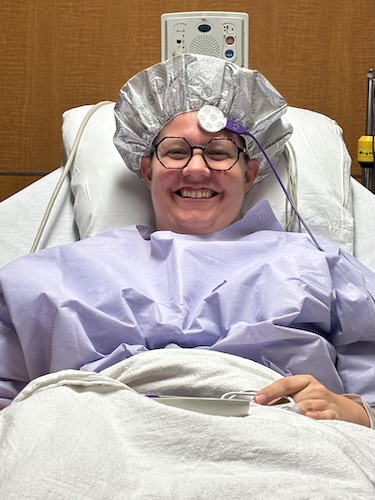
I had surgery, and it was awful. They did a right-sided colon resection, done robotically; it’s several little incisions where they put little robot arms in, cut it, pull it out, and put you back together. The first day was awful; I was in a lot of pain, but they said, “We want you up and walking on day one.” Within five or six hours of surgery, I was walking around the little recovery area for 10 to 20 minutes at a time. But they said, “This is what you need to do,” so I’m like, “Great, I’m doing it.”
I got to go home two days later, which I guess is a little fast from what I’m hearing now. I’ve never had surgery before, so I don’t know what to base it on. I was trying to go home the next day, and they said, “Dude, you need to chill. You need to pump your brakes; we need you to eat normal food a couple of times before we send you home. We need to make sure everything went okay.” I said, “Just send me home.”
I finally got released two days later, which I guess was really quick, and I feel pretty good. The only thing I’m allowed to do is walk, so I’m walking at least a mile a day and trying to take it easy. I’m quite bored. Recovering from surgery is very boring, but I’m doing my best to chill and walk. It all seems fine. I’m in a little bit of pain, but it’s fine. The pain is not a big deal, but I’m not allowed to drive for two weeks. I’m stuck at home, which is awful.
Weighing a future liver transplant against what science might offer next
I feel pretty good. There will be big decisions to make, and that could be intimidating, but I’m trusting that I’ll make the right decisions, that I’ll feel led by God on what to do, and it’ll be okay.
There are several pathways forward. I’m not rushing into transplant. They say there are best outcomes if you’re two years post-diagnosis, so that would be in 2027 before I would do it, and I know there’s a long, six-month lead-up to even get to do that. So maybe in January, I’ll start considering whether I’m doing the transplant this year.
They’re also working on other things scientifically. I kind of want to wait and see what comes out in the next two or three years, because there’s a vaccine for pancreatic cancer now. There’s this, there’s that. They’re working on a KRAS blocker shot for the mutation I have, and there’s one for the mutation next to the mutation I have. They’re close to several different curative options that are much easier than a transplant.
Part of me wants to wait it out and see what happens, but because we know this is on the table, we know this is a curative pathway, I’m going to make sure everything remains open for that. But I’m hoping to never need to take that pathway, because I’m hopeful that science will progress into a different option. Or I could be one of those very rare cases that’s cured through chemotherapy, because my biology responded well to chemotherapy, so I may be cured.
Unfortunately, I asked. One of my questions was, how do I know if I was cured through chemo, and they said the only way to know is if they cut out the organs and then find there was no cancer in them, so that’s not great. I would only know, if I choose to get a transplant while there’s no evidence of disease, that I actually was cured if my liver came out and it was cured. That’s unfortunate.
I have ideas of what I think I’m going to do, but we’ll see every data point that we get. I’ll find out when I get the biopsy back from everything they took out of me, if there was any cancer in there at all. They’re expecting there not to be. But if there was, that’s going to make things look a little different, and I would probably put transplant sooner if there was some cancer still in my colon. If there’s not, then in a couple of months, when we rescan and redo my blood work, if I have no evidence of disease after two months of chemo and a surgery, which disrupts everything, that’s a pretty big deal, and statistically unlikely.
I know going into this that I think 70% of people after surgery will have a recurrence, and I knew that going into this, so that may happen. (EDITOR’S NOTE: A study tried to determine how many patients might experience recurrences or metastases after curative resections for primary colorectal cancer. It found that out of 2,810 patients from the prospective colorectal cancer database of Asan Cancer Center in South Korea, 546 patients, or 19.4%, experienced recurrence. More than 70% of these recurrences occurred within two years of surgery.)
That’s okay. I’ll do chemo. But if it doesn’t, that’s statistically significant. I know that I want to be on chemo for at least another year, because the two-year recurrence rate is so high. But then I don’t know. One day, do I wean off of chemo? Do I switch to chemo pills? There are a lot of options, and I just try to make the next right decision. Thinking about leaving all possible options on the table, but what’s the next right decision for right now, while science figures itself out? I feel like that’s just what I’m waiting on. Science needs to get some things sorted, and then I’ll be good.
It encourages me, and I know there are different options at different hospitals as well. No one in Houston has offered me a HAI pump, for example, but if I went to New York City, they would offer me that. It’s a thing they put inside you that blasts your liver with chemo. If I had a recurrence and the FOLFIRINOX didn’t work the second time, that’s something I could consider before I did a transplant.
I don’t think I want that, but I’m willing to go to New York City and hear them out and talk to them, because there are a few different types of treatments they don’t mention to you unless they offer it at that hospital, I feel like. I’m trying to read up on all of the options and then get myself to that hospital and say, “Look at my stuff. What do you think? How do you think about this?” I want to get other ideas before I do something as drastic as taking out my liver. I want to hear everybody out.
What the KRAS mutation testing did (and didn’t) change
The KRAS mutation was at the beginning. They tested for what mutations I had. I believe if I had had a different mutation, it would have put me on a different pathway, chemo-wise. But with this one, they gave me the standard FOLFIRINOX, and they added bevacizumab, a targeted therapy. I don’t know if that’s because of my mutation specifically or if they were just, “She’s not doing well. We’re going to throw everything at her.” I’m not sure why that was added in. I wasn’t very good at asking questions when we started all of that. But it worked very well, clearly, so I’ve kept the bevacizumab with the 5-FU treatment I’m on right now.
But the only thing she told me when I got my mutation list back was basically that there’s no specific treatment for my mutation. There’s nothing special and unique to that mutation right now on the table, but maybe down the line there would be. The other KRAS mutation is the one that there’s a blocker for, so it’s so close. But they’re working on a pan-blocker for KRAS mutations, so who’s to say that’s not going to come out in the next year? Then I won’t need any of this. We’ll see.
My advice to someone facing a new diagnosis: Take in what you can handle
Trying to take in all the information at once can be very difficult, so taking in what you can handle at a time is important.
The other thing I don’t feel is addressed enough is that there are ways to make chemo easier. I adore my doctors. This is not anti-doctor at all, but our doctor’s job is to give us the chemo; it’s not to make it as easy as possible. There are medications they can provide.
But in finding the online community online and talking with other people, there are ways to lessen those side effects. As somebody who’s being told right now that I’m going to be on chemo for the rest of my life, I have to make the rest of my life not suck. Every round, I’m experimenting. I don’t want to be nauseous at this level anymore. What can I do to make nausea less? And I will test different things.
Just because chemotherapy is difficult and awful today on round one doesn’t mean it’s always going to feel as bad as it felt. You can put things in place and experiment with different ideas that will make it easier and more bearable, and make your body able to take more chemo. That’s always been my goal. I want to be able to take as much chemo as possible for as long as possible, so I troubleshoot a lot. How can I just make these side effects suck less?
And that’s not information I get from my doctor. I don’t do anything weird. I don’t take any supplements or anything, but I exercise, hydrate a lot, and eat lots of protein, simple things like that. Even just buying the right toothpaste so it doesn’t burn when you’re brushing your teeth. Little things that make your life a little better when you’re facing all one million chemotherapy side effects. I don’t troubleshoot all of them at once, but one by one, you can make this easier for yourself, and it isn’t always going to be as hard as it was on day one.
Quality of life is huge. Know that there are ways to make it better, and you don’t have to just grit your teeth. I was very grit-my-teeth-through-it. I didn’t even report my side effects to my doctor because I’m not going to complain; I don’t want to be a whiner. And then she’d say, “I could have given you better anti-nausea medication than the first one if you’d just said the first anti-nausea one wasn’t helping.” I had to learn to start voicing some of these things, because there are solutions for them. And you’re not whining; it’s just a matter of understanding how the chemo is affecting you, because there are ways to deal with it. You’re not whining or complaining; you’re just troubleshooting.
Learning to believe it when I tell myself I’m strong
Try to be confident in your cancer experience and tell yourself that you can do it. That sounds so stupid. I would roll my eyes at anybody who says that, and I roll my eyes at healthy people who tell me, “You’re so strong.” I’m like, “Whatever. Shut up.” But when I tell myself I’m strong, I believe it, because I know how hard this is. When other cancer patients tell me I’m strong, I believe it, because they know how hard this is. There is a certain measure of positive self-talk that does help. But you can look back and think, “If I did that, I can do this. If I did one round, I can do another round.” I don’t have to imagine 12 rounds; I just have to imagine getting through the next round.
It took me a long time to come to terms with chemo for life, because that’s what they’re telling me right now, until science progresses. But when I’m in the middle of chemo and struggling with it, I don’t picture chemo for life. I just picture getting through this chemo, and I’m strong enough to get through this chemo. I don’t have to make decisions about the next 50 years of chemotherapy today. It’s just, “I can get through this one. I’m strong enough to do this. I can get through one more round.” That mindset helps me keep going through a difficult diagnosis with a difficult plan of care right now.
This interview has been edited for clarity and length. The views and opinions expressed in this interview do not necessarily reflect those of The Patient Story. This content does not replace professional medical advice.
Inspired by Kimberly’s story?
Share your story, too!
Hear from people living with colon cancer
Real experiences with diagnosis, treatment choices, side effects, and life beyond colon cancer — in their own words.
Leave a Reply