
“I Was Weeks Away from Liver Failure”: Jim’s Unexpected Path Through Stage 4 Colon Cancer
Jim never expected to hear the words “stage 4 colon cancer” at age 43. He had no family history of colorectal cancer and no significant symptoms beyond occasional back pain. His diagnosis came completely by accident, during a routine employee physical. Elevated liver enzyme levels led to ultrasounds and CT scans. Within days came a devastating prognosis: metastatic colon cancer with tumors in his liver and lungs, and less than two years to live.
Interviewed by: Tory Midkiff
Edited by: Chris Sanchez
What followed was a whirlwind of aggressive treatment. Jim began one of the strongest chemotherapy regimens available for advanced colon cancer, just days before the new year. Despite the intensity of the treatment and side effects like extreme cold sensitivity, neuropathy, and sleeplessness, Jim tolerated it better than most. He completed nine rounds instead of the typical three to five, watching his tumors shrink by over 70%. When a life-threatening blockage formed in his colon, he advocated strongly for a partial colectomy over an ostomy bag, a risky choice that required pausing chemotherapy. The surgery ultimately succeeded without cancer progression.
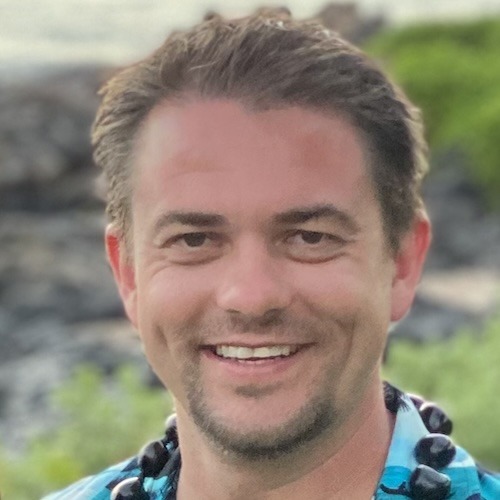
Jim’s experience underscores the power of self advocacy and second opinions. With support from his wife, a healthcare professional with deep medical family ties, and care teams at both his local hospital and Mayo Clinic, he pushed for the treatments and testing that felt right for him. Today, scans can no longer detect cancer in his lungs or colon, and while he remains on maintenance chemotherapy indefinitely, he’s outlived the timeline he was originally given.
Now, Jim shares his story with two goals: to urge earlier colorectal cancer screening for everyone, and to offer hope to those told their time is limited. “Numbers don’t lie,” he says, “but there are outliers — and I am one of them.”
Watch Jim’s video and read through the edited transcript of his interview below to take a deep dive into his story.
- Early screening saves lives. Jim was diagnosed at 43, but likely had cancer for seven years; current screening guidelines may still be too late for many.
- Aggressive treatment can work. Jim tolerated nine rounds of a very strong chemotherapy treatment far more than most patients would, leading to significant tumor reduction.
- Hope defies statistics. Though given less than two years to live, Jim continues to thrive well past that prognosis.
- Support systems are essential. Family, friends, and knowledgeable care partners play critical roles in navigating complex cancer care.
- Transformation through experience. Jim went from feeling healthy and invincible to becoming a vocal advocate for earlier testing and patient empowerment.
Jim’s Diagnosis Facts
- Name: Jim S.
- Age at Diagnosis:
- 43
- Diagnosis:
- Colon Cancer
- Staging:
- Stage 4 (Metastatic)
- Symptoms:
- Elevated liver enzymes found in a routine blood test
- Back pain, especially when sleeping for long periods
- Treatments:
- Surgery: partial colectomy
- Chemotherapy: FOLFIRINOX, fluorouracil, oxaliplatin, irinotecan
- Monoclonal antibody: bevacizumab
This is not medical advice. Please consult with your healthcare provider to make informed treatment decisions.
- Jim’s Diagnosis Facts
- My background
- My accidental discovery of colon cancer
- My initial reaction to my stage 4 colon cancer diagnosis
- The timeline from my diagnosis to my first treatment
- Colon blockage and surgery decision
- Getting a second opinion at Mayo Clinic
- The importance of advocacy
- My key messages: Awareness and hope
- Hear from people living with stage 4 colon cancer
My background
My name is James, but I go by Jim. I’m originally from Detroit Lakes, Minnesota.
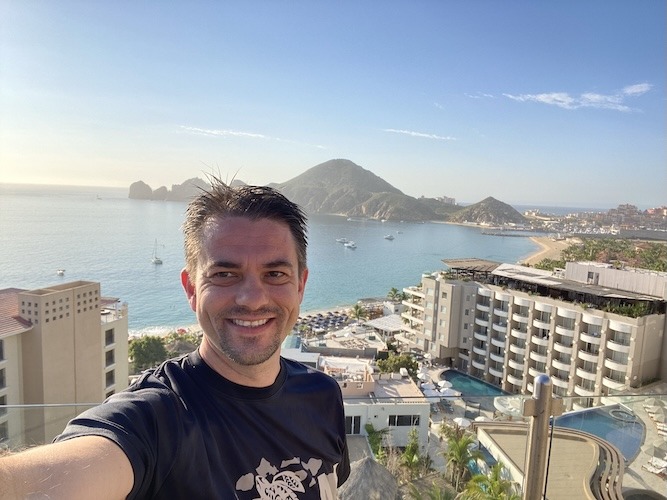
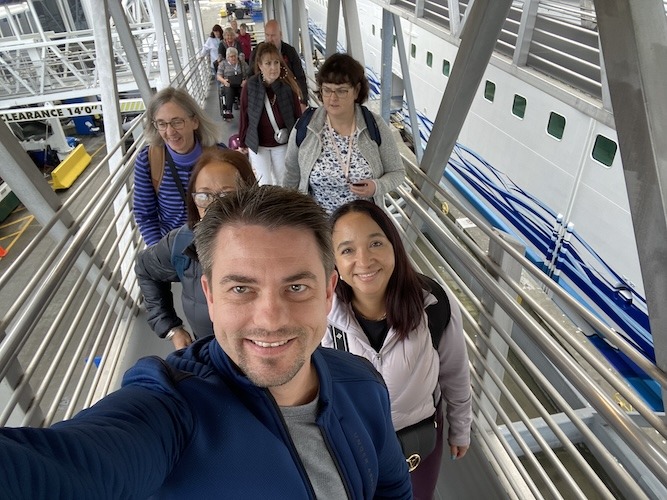
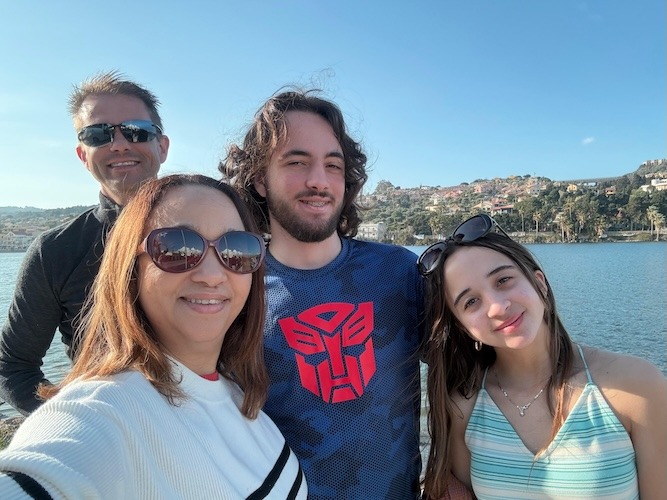
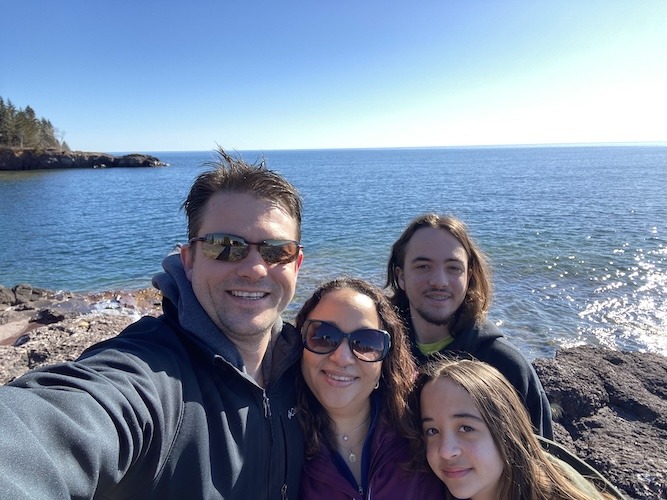
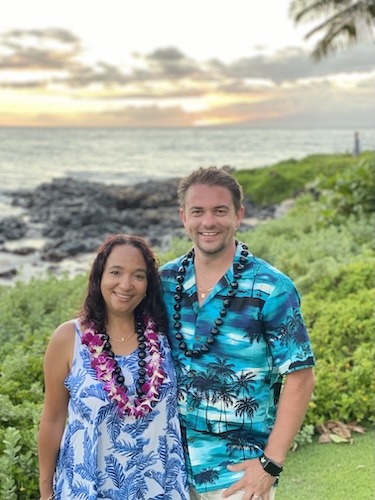
I have colon cancer, stage 4. I was diagnosed on December 12, 2024. Before that, I was doing normal things like other people. I have a wife and two kids. I work. One of the things I like to do with my family and friends is travel a lot. We are always active, having fun with the family.
My accidental discovery of colon cancer
I found out completely by accident.
I had a thing with new employees and their families. If they get a physical, it reduces the cost of health care. I went in and got blood work and just the basic annual physical. They noticed that my enzymes in my liver were high. That prompted them to let me know.
I went to my main medical doctor and brought her the results. She said, “Well, let’s just do another test because this is odd. You’re feeling great, right?” I said, “Yeah.” We did more blood work and had the same thing: high enzyme levels in my liver. They did an ultrasound and found various masses on my liver. She even said, “You still feel fine. They must be benign. I’m sure it’s nothing.”
A week or so later, I went to the hospital. They did a biopsy and a CT scan. Probably not much more than 30 minutes after I got home, they told me that I had colon cancer and it was stage 4. They knew that just from the CT scan. The only symptom that I realized I had was some back pain that would bother me, usually just when I was sleeping for too long.
Later, when I met with my oncologist, she said that it was cancer in my lymph nodes that were swollen and angry. She said, “After you take your first chemo, they’ll go away.” And they did. I haven’t had back pain since.
My initial reaction to my stage 4 colon cancer diagnosis
It was devastating. I was working out every day. I was even an instructor. I thought I was very healthy. Everything was great. You go from that to saying that you had stage 4.
Even then, I was very optimistic, because I knew that people had beaten this thing. I was devastated, but not totally wrecked. The thing that really got me later was when I met with my oncologist, and she said that there was no cure, that it was terminal. That was very tough. That was honestly the worst day of my life.
She told me it was less than two years because my case was so advanced. If I didn’t catch it when I did, I was a couple of weeks away from jaundice and complete liver failure. With colon cancer, it spreads typically to your liver first and then to the lungs and brain. When it starts metastasizing and moving, especially to your liver, that’s the problem.
I had it metastasized to my liver and both my lungs, but it was so small in my lungs, and my colon was not as much of a problem. They were always worried about the liver. The liver was killing me most immediately. Just being able to hear that and face my mortality was tough.
The timeline from my diagnosis to my first treatment
The diagnosis was on December 12, 2024, and within a week, I met with my oncologist for the first time. It was the second meeting that she told me I had two years left.
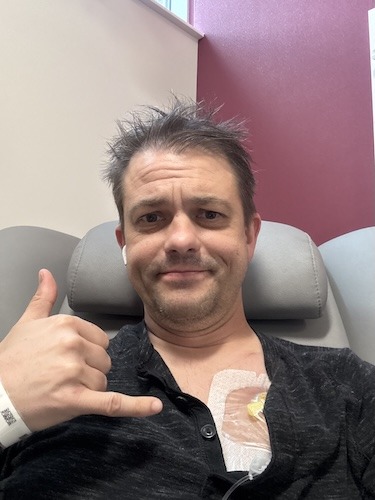
I had to go in for various testing and informational stuff. I think that’s pretty routine with cancer patients, just letting you know how the process is going to go. It was the 27th of December that I had my port installed, and I had my first treatment on December 30, 2024, right before the new year.
I was actually anxious to do it because just kind of waiting around was just the worst. I wanted to actually start fighting this thing.
My FOLFIRINOX chemotherapy experience
They got me on the strongest chemotherapy possible. It’s called FOLFIRINOX. It’s used for advanced-stage colon cancer as well as pancreatic cancer.
There are a bunch of other cocktails that were mixed in. The main thing was 5-FU, which is a chemo pouch packet that stays with you after your main infusion for 46 hours. The others were oxaliplatin, irinotecan, and then another separate dose of bevacizumab. I’m probably missing a few other smaller ones, but those were the main ones.
The treatment didn’t go too badly. It was a little bit tough the first time. Side effects included, at least for me, extreme sensitivity to cold from the oxaliplatin. Whenever I would wash my hands, whether it was even lukewarm water or cold water, it would intensify dramatically. I would feel like I put my hand in ice water — extreme ice water. Or if I drank anything, I would experience the same thing. I just had to avoid that, which wasn’t a huge deal.
I had neuropathy on my fingertips and toes, and trouble sleeping, usually the first 3 or 4 days after my main infusion, just because of the steroids. That was probably the worst side effect for me: the lack of sleep for a while. Also, just being wiped out. I had to have my wife drive me home. There was hair loss, too. I used to have a lot thicker hair. I never lost it all, but I lost a significant portion.
As far as treatments, we were playing it by ear because my doctor told me that we were planning on eight rounds of FOLFIRINOX. It ended up being nine that we did just because she said most cancer patients just can’t take this. They only last three, four, maybe five rounds, and then they have to quit. It actually got easier for me as I went through. My second dose was easier than the first. The third one was easier than the second.
I guess I look at it this way: my body was fighting this thing for probably at least seven years prior, undiagnosed. My body was fighting it by itself with no help. As I started getting the chemo fighting it, my body was responding because it wasn’t just being overwhelmed.
Colon blockage and surgery decision
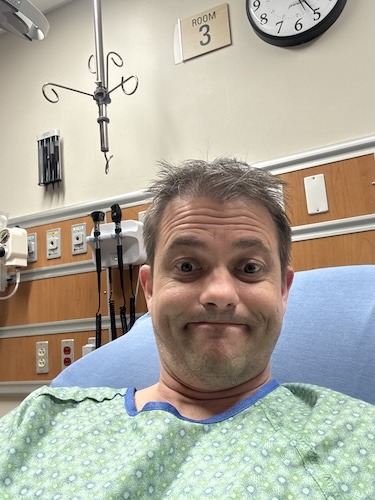
Then I ended up having to go to the emergency room with severe abdominal pain back in the beginning of April. It ended up being a blockage. My main tumor was in my colon, but as it was dying — because it was initially about softball size — what was happening was that it was calcifying. That calcification was helping to block my colon more and more.
When I went to the hospital, they ran tests to see if there was a blockage. They thought it was completely blocked, but I was still able to have bowel movements, so it wasn’t completely blocked. Later, when I got out of the hospital, I got a colonoscopy, which was the first one I’d ever had. They said that it was just a pinhole-sized — almost completely blocked. From what they told me, if it gets completely blocked and you have emergency surgery with fecal matter still in your colon, you have about a 15% survivability chance.
A couple of the options I had: the main one they were pushing for was an ostomy bag to redirect my colon. I didn’t want to live my life with that bag. I was really pushing for a partial colectomy or hemicolectomy. Essentially, slicing up both ends of the colon where the tumor was and then reattaching them.
My oncologist was initially against this because you have to go off chemotherapy a month before and a month afterward. The statistics they had: there’s less survivability for patients who do that because they’re off chemo for longer than if they have an ostomy. But she realized that it was really important to me and my quality of life to have that, so she agreed.
We moved forward with that, and it was successful.
Surgery recovery and maintenance chemo
I was doing some CT scans even afterward and around during that time, and I had no growth, no new growth, which was nice. That was huge because that was the biggest fear for all of us: that there would be growth, and as it turned out, there was none.
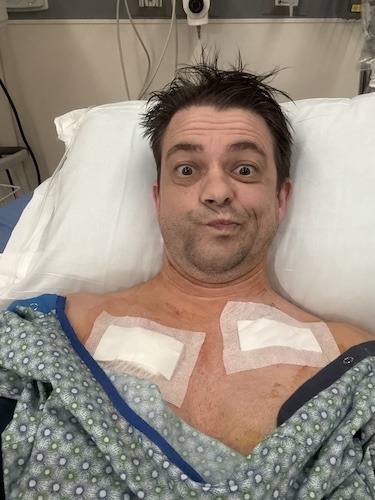
My recovery: They told me I’d be in the hospital for a minimum of five days after my surgery. I had the rest of that day, the next day, and I got out on essentially the third day. It wasn’t even me pushing it; the doctor came by and said, “Hey, you’ve had bowel movements. You were walking around because I wanted to recover fast.” They said, “If you want to go home, you can.” I don’t know any patient who wants to stay in the hospital, so I was out as soon as they pulled all the tubes and stuff out of me.
That surgery was at the beginning of June. Then I couldn’t start my chemo again until July, and I was on maintenance chemo. It’s pretty much the 5-FU pump and a few of the steroids and things that help it work better. I’ve always had chemo every two weeks on a Monday, and the pump stays with me for 46 hours, so essentially two full days. That’s pretty much up to date.
I haven’t had any new growth. My next CT scan is in two days, this coming Thursday. So far, with the FOLFIRINOX, it has reduced my tumors very conservatively by over 70%. They can’t pick up any cancer anymore in my lungs. Even though my oncologist feels that it’s still there, no test can detect it, and my colon is free because they removed it in the surgery. When the doctor removed it, he told me it was about the size of a golf ball. It went from a softball to a golf ball. As far as my lymph nodes, they removed all of them that they were able to, so I believe they’re all free in there.
Now it’s just in my liver. I asked if I could get surgery on my liver, but it’s kind of all over, so I can’t. Or if I got a replacement, I would be on dialysis, and they said that would be worse for me. Both my doctors, including my second opinion at the Mayo Clinic, said I’m on chemo for life.
Getting a second opinion at Mayo Clinic
It’s been really huge because at that time, it felt like they took away all hope initially when they said I had two years. I had three infusions before I had a CT scan.
I was admitted to Mayo to get my second opinion. They did the CT scan and showed huge results that we were able to send over to my hospital in Minneapolis, and they reviewed that as well because my main oncologist actually came from Mayo. Obviously, very qualified and good, but just being able to get that CT scan earlier and get those results was really helpful.
They haven’t given me a time frame, but I’ve obviously improved. With stage 4 colon cancer patients overall, it’s like a 12 to 13% five-year survival rate. That’s just going by the book. With mine, they gave me way less because my cancer had metastasized to two different regions, and it was extremely advanced — probably as advanced as you can get before complete liver failure. I was pushing the bounds on that one.
The importance of advocacy
When I feel like I’m not getting the answers I want or that there’s something else I can do, I’ve been pushing. My wife, especially, advocates harder than I just because it’s harder sometimes for the patient. She’s in health care. She works with the hospital, and both of her parents are medical doctors. Pretty much all of her side of the family are medical doctors.
We have tons of opinions: people saying test for this, send this, and let’s review that. With Mayo, it was not just my wife and I, but also friends and family, saying, “Go there. They are the best hospital in the world.” Frankly, it’s about an hour and a half from my house, so it’s not far. It was super useful to be able to go there and have another set of eyes look at it — in this case, a CT scan, but also for other options like potential trials for me in the future.
I advocated for myself to get the surgery that I wanted. I pushed for the hardest treatment possible. My body can handle it. My doctors and nurse practitioners, the ones who told me I had less than two years, when they see my results or see me all the time, they ask, “Hey, how are you feeling? What’s going on?” I’m usually good, fine. Nothing new. Kind of a routine schedule at this point, and they just say, “God, that’s just amazing.”
My support system
My wife has been the best support.
I also have my kids, my parents, my brother, and a bunch of good friends.
My key messages: Awareness and hope
The two things that I wanted to get out of this: one is awareness.
People just need to get tested all the time. Do the colonoscopies, or if there are other forms of cancer, get tested early. They originally had testing for colonoscopies at 50, it dropped to 48, and now it’s at 45. I got diagnosed at 43, and they told me I had it for at least seven years, so that put me in my 30s. I have no family history of colorectal cancer.
The testing for this needs to be dropped drastically because it is affecting families and literally killing people because of the lack of testing. Insurance providers don’t want to because it’s not worth it financially for them. Patients like me will raise the cost significantly, and that’s why it’s dropping, but it hasn’t dropped enough.
People, as soon as they can get tested, or even if they’re able to get it earlier, or find any type of loophole, need to get testing early. It will affect you and your family.
The other thing that I wanted to push for was my message of hope.
I was given very little to no hope on mine, and miraculously, I have been able to fight through this. My story, according to my doctors initially, would be about ending right now, and it’s not — because of me pushing, as well as my family and friends, and the care of the hospital and the doctors.
People who get these diagnoses that they are going to die within a certain amount of time, or they can’t do this, or can’t do that — I would like to be at least somewhat of a testament that that’s not correct. They have numbers and numbers don’t lie, but there are outliers, and I am one of them to be able to survive as long as I have.
It has been about a year and a half since my diagnosis. Thankfully, my story was supposed to end around right now, and it’s not. I’m doing better than I was when I first started my cancer journey.
This interview has been edited for clarity and length. The views and opinions expressed in this interview do not necessarily reflect those of The Patient Story. This content does not replace professional medical advice.
Inspired by Jim’s story?
Share your story, too!
Hear from people living with stage 4 colon cancer
Real experiences with diagnosis, treatment choices, side effects, and life beyond metastatic colon cancer — in their own words.

Leave a Reply