
When Cancer Progressed to Stage 4 Melanoma: Megan and Justin’s Story of Support
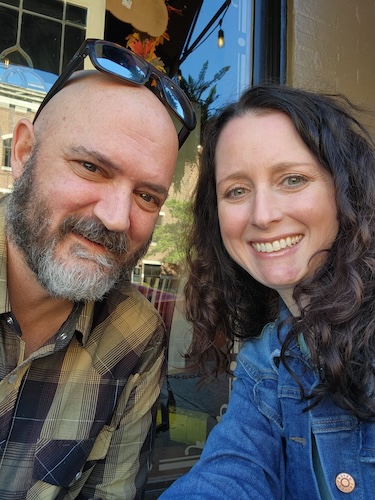
Megan noticed an itchy mole on her back in her early 30s, one that had changed color and texture. When she saw a dermatologist, a nurse warned her that if it was melanoma, the worst case would mean it had spread to a lymph node. That worst case is exactly what happened. Megan was diagnosed with stage 3A melanoma, the start of what would become nine years of living with melanoma that would later progress to stage 4, for Megan and her husband, Justin.
Interviewed by: Taylor Scheib
Edited by: Chris Sanchez
The day of that diagnosis, the doctor talked about life expectancy and survival rate before Megan had even absorbed what stage 3A meant. Afterward, she and Justin went downstairs for coffee, and Justin told Megan and her mother, “Whatever comes our way, we’ve got this.” Privately, he was terrified. He had read a little about what it means for melanoma, a dangerous kind of skin cancer, to metastasize, and closed the page because he couldn’t take in any more.
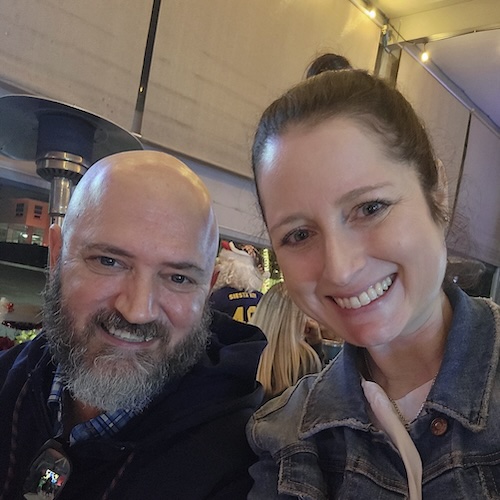
Megan got a second opinion and transferred her care to the University of Michigan, where she returned every six months for five years of screenings and scans, partly due to genetic testing early on that found a CHEK2 gene mutation, which raised her risk for several other cancers. That monitoring held until the melanoma progressed to stage 4.
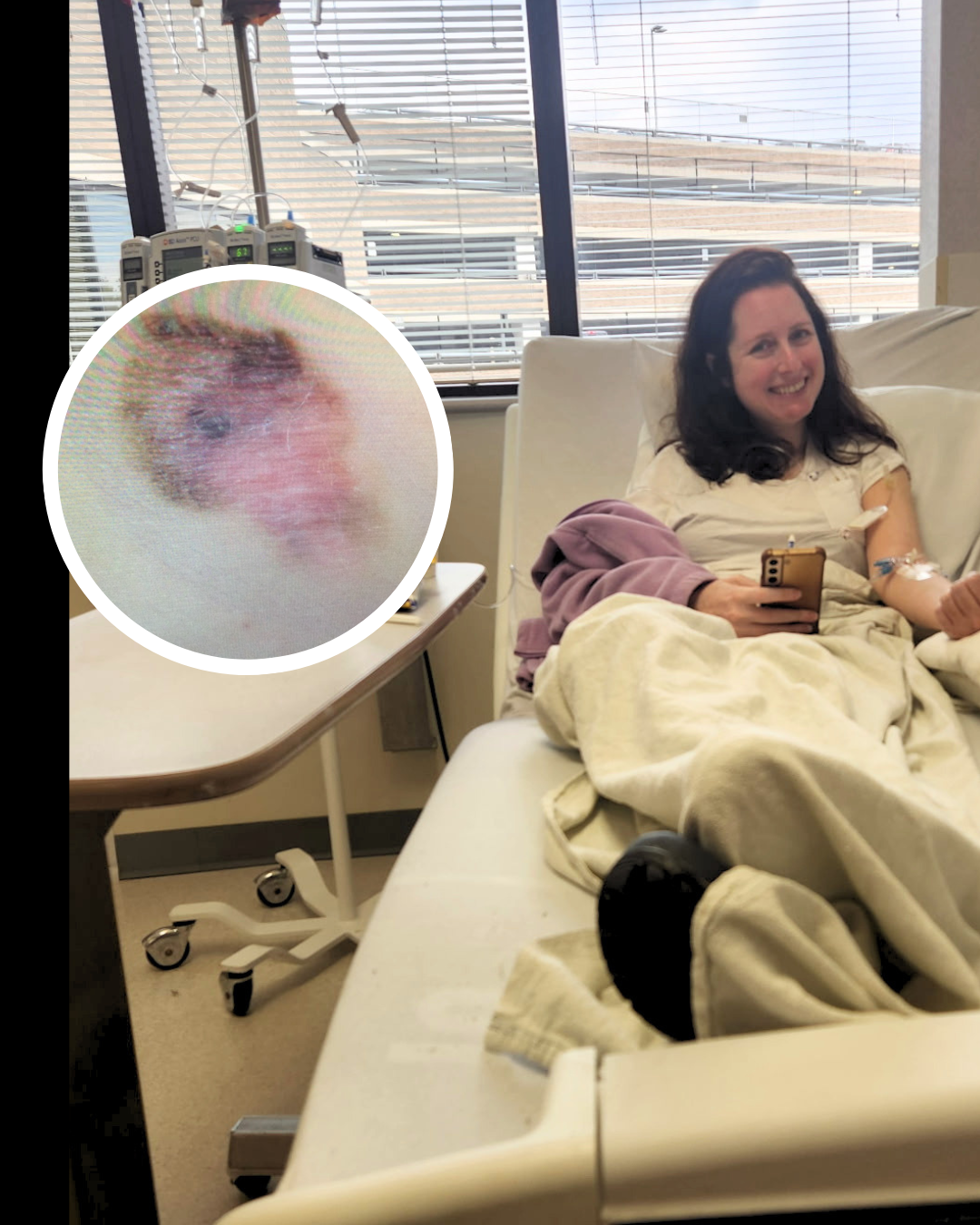
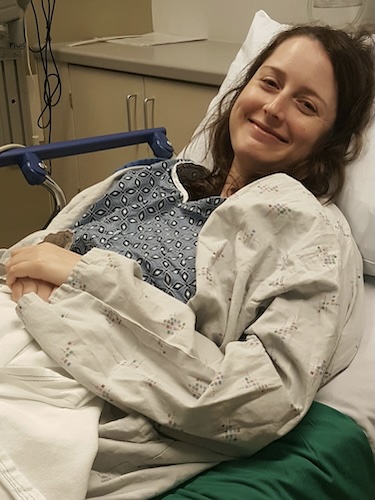
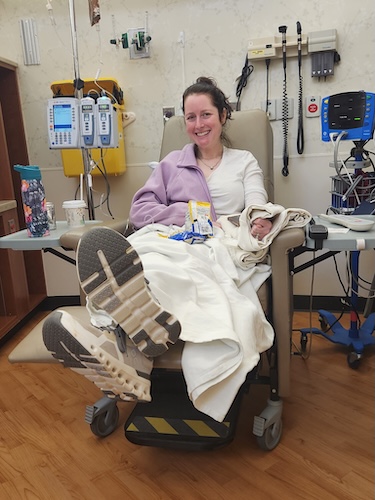
Since then, Megan has gone through immunotherapy and multiple rounds of radiation, including treatment to her spine that required her to be shrink-wrapped in place, an experience she describes as deeply claustrophobic. Justin has been at every appointment, and the two have found smaller ways to get through hard days, like yoga and finding simple joys in hard moments.
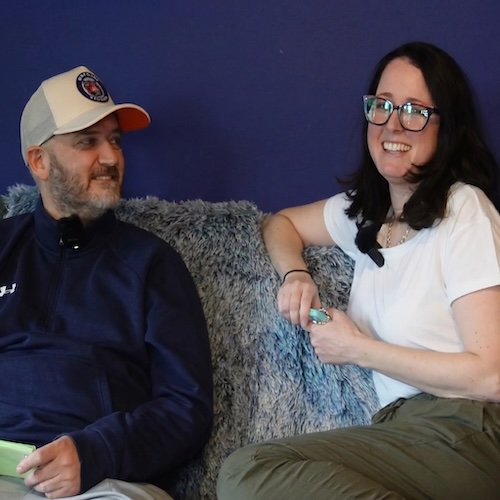
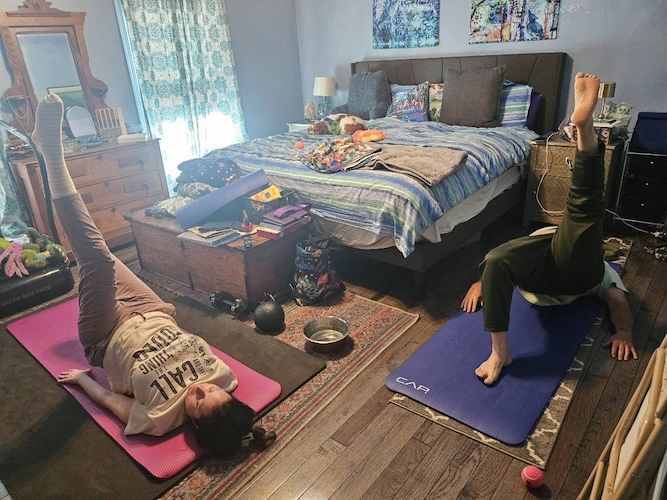
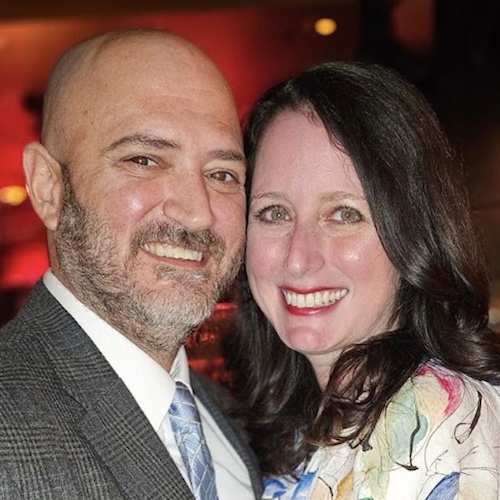
They start most mornings with yoga and affirmations, and they’ve started a podcast called “Between the Scans,” where they talk openly about what it’s like to face this as a couple. Megan keeps advocating for herself. Justin keeps showing up, one appointment and one hard day at a time, as they navigate stage 4 cancer together.
Watch Megan and Justin’s video and read the edited transcript of their interview:
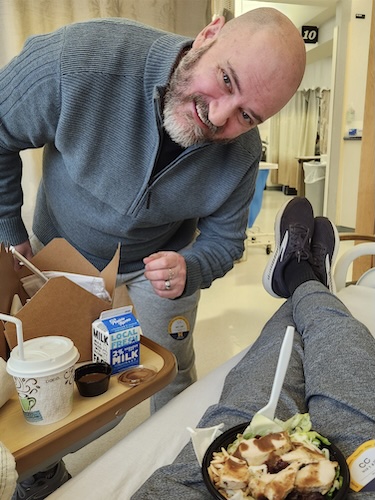
- A small ritual, like a trip to the hospital gift shop or cafeteria for Justin, can be enough to shift someone’s whole mindset on a hard day.
- Megan and Justin have built a podcast, morning affirmations, and yoga into a life that includes stage 4 melanoma, instead of one built entirely around it.
- Justin’s advice for anyone reading this is simple: Check that mole. Megan agrees, and adds that grace, time, and patience matter just as much once you do.
Megan’s Diagnosis Facts
- Name: Megan C.
- Age at Diagnosis:
- 36
- Diagnosis:
- Melanoma
- Staging:
- Stage 4 (Metastatic)
- Mutation:
- CHEK2
- Symptoms:
- Itchy mole on the back that changed color and texture
- Escalating pain in the hip, lower back, and leg
- Treatments:
- Surgeries: wide excision of mole, removal of 10 lymph nodes from right armpit, orthopedic hardware surgery (femur)
- Immunotherapy
- Radiation therapy

This is not medical advice. Please consult with your healthcare provider to make informed treatment decisions.
- Megan’s Diagnosis Facts
- Finding the person you want to go through everything with
- An itchy mole, no insurance, and putting it off
- Rescheduling a diagnosis around a trip to London
- Hearing “stage 3A” and “life expectancy” at Mass General
- When stage 3 melanoma became stage 4
- Sign me up: Choosing immunotherapy without all the details
- Shrink-wrapped for radiation
- The pain Megan didn’t always share
- The night in the ER that nobody could explain
- Starting a podcast called “Between the Scans”
- What we’ve learned from each other
- Our advice for anyone just starting this
- Hear from people living with melanoma and from cancer caregivers and care partners
Finding the person you want to go through everything with
Megan: You’re going to go through all sorts of things together, the good, the bad, the ugly, and the really difficult times. Be with a person that you want to go through those things with. If that’s the person you want to go through those things with, then that’s your person.
Justin: It’s very true.
Megan: We’ve had nine years together with a cancer diagnosis. We were together nine years ago when we heard the stage 3A melanoma diagnosis. We managed that for five years, and then there was a stage 4.
Megan: But when it’s health-related, that pulls the rug out from under you, and you lose all your carefree-ness. You lose it. You’re never the same.
Justin: I was positive from the very beginning. I always stayed positive. Even if I had doubts, I was positive for you.
An itchy mole, no insurance, and putting it off
Megan: I had an itchy mole that I knew needed to be seen and probably biopsied, that I put off. I put it off for too long. Finally, I went to the doctor, and I did get it biopsied. And then we did need to see a surgical oncologist, and we did need to handle it.
Justin: We always thought it was suspicious, but we’d put cream on it for a while.
Megan: I’m laughing because I was that idiot 30-year-old who said, “I don’t have health insurance. I work at a hotel, I don’t have health insurance, and we’re moving, and I don’t have the means to go to the doctor and pay for it, and I’ll be fine.” And we just looked at it. I remember feeling it, or looking at it, because it was on my back. I was like, “What is that?” And it itched. And then I knew it wasn’t right. But there was nothing that made me say to myself, “I have to go see a doctor.”
Megan: I just thought, wow, we’re doing magic here; we’re putting cream on it. But I didn’t know about melanoma. I knew the sun was bad, and tanning was bad, and I’d done all that, but you don’t ever think the worst case is going to happen to you.
Rescheduling a diagnosis around a trip to London
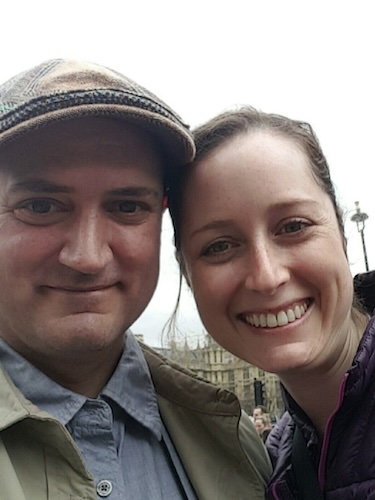
Megan: Justin, I don’t know if I ever told you this. My first appointment wasn’t with Intermed. It was with someone else. I changed the appointment to Intermed because we had planned a trip to London, and I didn’t want to go on that trip wondering if it was cancerous. I didn’t want to go on that trip with a diagnosis.
Justin: Right, I think you did tell me that.
Megan: When I went to the dermatologist, and I was in the room, the nurse said, “Well, best case, it’ll be fine. But worst case scenario, it will have spread to your lymph nodes.” I thought, okay. Well, now the worst case scenario happened. It spread to my lymph nodes.
Hearing “stage 3A” and “life expectancy” at Mass General
Megan: The doctor talked and talked and talked. But then he finally came down with the news, and I think he was talking about life expectancy and what that meant, and what stage 3A melanoma meant. I never wanted to hear about that. I never wanted to hear about life expectancy, survival rate, whatever he was saying. I’m not sure if it was just because it was his job. I didn’t want to hear that. We were all just shocked.
Megan: After the appointment, we went downstairs. We were at Mass General Hospital, in Boston, and we went down to grab a coffee and collect our thoughts. Justin, you were really positive. I didn’t know what to think. You said, “We’ve got this.” You even said that to me and my mom. “Whatever comes our way, we’ve got this.”
Justin: I did feel positive about it. I felt like we would be okay. I really did.
The fear Justin kept to himself
Megan: Justin, what was going through your head?
Justin: It was just such a shock at the time. Like, I couldn’t believe it. Like I was saying earlier, I had read a little bit, just quickly, about cancer metastasizing and what that means and everything. And I quickly closed the page on that because I didn’t want to read further. And then the next thing I know, that’s exactly what Megan’s diagnosis was, you know. So I felt hopeless; I just felt terrible. I didn’t know what to do. I didn’t know what to think. I started planning for the worst-case scenario, you know, what would happen if I lost Megan. I started thinking like that. And it’s a terrible, terrible thing to think like that. But yeah, I mean, I was just really scared, above anything. Just scared.
Justin: Before that, I had been reading a little about it, doing some research. So I read about what happened if it metastasizes and everything. And in my mind, I thought that it never happened, you know? But then it was like all those things that I read about were happening to us, and it was a nightmare come true.
Megan: It’s a different way to live. It teaches you a lot, though. We’re stronger because of it, but we don’t talk about it too much. It’s there.
Justin: I tried to comfort her with words, but mostly I think it’s just being with her, holding her, being in her presence. Sometimes I don’t say the right thing, so maybe just being with her is the best part.
Choosing a second opinion over interferon
Megan: Yes. I found someone, a partner in my life who just loves me up and down. No matter what we go through, we’re more than it; we’re stronger. Justin’s positivity, compassion, and demeanor are very safe. He has the warmest, kindest heart. And he means what he says. Everything is very genuine. And he meant everything when I got diagnosed. That’s how he felt, and that’s how we were going to live, and that’s how I like to live. And so that helped me a lot, a lot. You have to both be really together for each other. And you’re going to have moments when you’re not together, of course. And so at least one of you is together.
Megan: At the beginning, when I was diagnosed with stage 3A melanoma, my doctor suggested interferon, which wasn’t something I wanted to do. I got a second opinion and transferred my care to the University of Michigan.
Megan: We went through this together every six months. I was coming to the University of Michigan, to Ann Arbor, to get screened and tested and scanned.
Megan: We were very positive through it, but it was a whole different shift because of life. I was in my mid-30s. It was just like, this is life now.
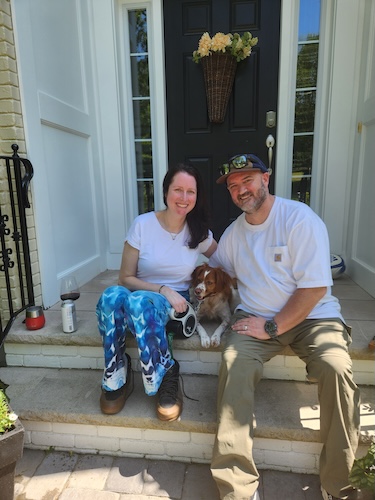
Justin: We just lived our lives the best we could. Went to baseball games, did a lot of fun stuff, traveled, kept busy, and really tried not to think too much about the diagnosis and just get on with our lives. We have our dog; we do a lot of fun things with our dog, we take her everywhere we go. The time in between was good. Yeah, until you get another diagnosis, and then everything kind of stands still.
When stage 3 melanoma became stage 4
Megan: This is something I have to embrace, because it’s part of my life. I don’t know when I’ll be cancer-free, or if I ever will be, but it’s okay. It has been the worst case for both of us, and it’s something we’ve worked through together.
Megan: I’m living with cancer. I live with stage 4 melanoma. It’s weird, and that’s what I tell myself. It’s weird, but it’s true. I like to go to bed with a smile. I think that’s having an accomplished day and being proud of yourself.
Justin: It’s unbelievable. I don’t know if I could do the same thing she does. If I had the same diagnosis, I don’t know that I would be able to go through the things that she endures. I mean, I know she has to, and she does it, but she does it with a smile. She really, she’s amazing. I’m so proud of her.
Sign me up: Choosing immunotherapy without all the details
Megan: I couldn’t even get through the meeting to sign off on immunotherapy. You have to sit through a video or something like that. I just said, “Sign me up.” I didn’t want to know any of it; I wanted to get treated, and that’s how I got through it. I wanted to get treatment, and that’s it. I didn’t want to know anything. I didn’t need to know. I didn’t want to know all the details. I didn’t want to know the side effects. Justin was really the one who stayed through the meeting and handled it, and then he’s been by my side so well through every treatment. The only thing he has a hard time with is the IV part.
Justin: Because they usually have a hard time putting it in.
Shrink-wrapped for radiation
Megan: And then I’ve had radiation, a lot of radiation. That’s been hard. The first time, they had to shrink-wrap me because they needed to reach a specific part on my spine. I felt like a steak, like shrink-wrapped meat. It was very claustrophobic, very stressful. I got a lot of anxiety over that. Then I had to do radiation again pretty quickly after, on my backside. Justin got me to every appointment. He’s been there for everything. All he does is support me.
Cafeteria food and gift shop runs
Megan: I don’t know your take, Justin, on when you’re watching me get infusions, when we’re there. Well, he’s focused on the hospital food.
Justin: Yeah, like hospital food. That’s the cafeteria.
Megan: But if he’s getting down about something, I’ll say, “Oh, you go to the gift shop and get something,” because he likes to shop, and that helps him get through things. I’ll say, “Well, don’t you need a new X, Y, and Z?” And he’ll go, “You’re right, I’ve got to shop for that.” It completely changes his mindset.
Justin: It’s true. I love to shop.
Megan: You have to find what makes the other person happy, especially in tough times, something that can snap them out of it.
Justin: I usually have to wait pretty long by myself while Megan’s having treatments. So I try to do things like go to the cafeteria just to occupy my mind. I don’t know, I just try not to go down the dark hole, and just keep positive thoughts, and don’t think about the distant future, but think of the near future, like today. So just worry about what today is bringing, and about getting through today. And then tomorrow, we’ll deal with that when it comes.
The pain Megan didn’t always share
Megan: I’ve learned to really talk to Justin about everything. He knew all the facts, but my worries, my fears, I sometimes didn’t want to tell him everything, because I don’t want to tell him everything, always. Because I didn’t want him to lose sleep over it. I didn’t want him to stress over it and have, you know, an episode, or just stress about it. I didn’t want him to worry about it. But part of a relationship, and with your person too, is relying on them and them taking care of you. And so I’ve worked through that.
Justin: It’s definitely heavy on me. Think about everything we’ve been through and come through. But it makes me feel stronger. It makes me feel happy. It makes me feel ready to face it, to face what the future will bring us. You know, it has, it brings a lot of emotions. It’s not just one.
Justin: She didn’t really talk much about the pain. She didn’t express the fact that she was in pain, but you could see it in her face. But she was always in discomfort. And that was a terrible time. That was hard. It was awful to see her like that. And just to think of the worst-case scenario, you start thinking of the worst things, you know, where it could go and what would you do and what would life be like without her, when you see her like that, because she’s just suffering, you know?
The night in the ER that nobody could explain
Megan: I remember when I’d started treatment and had been in it for a few months, I got a new spot, a new tumor, and it irritated things to the point where I was incredibly swollen. I blew up on my left side. It swelled up, and I went to the ER.
Megan: And Justin took me there, and they did not know what to do with me. All the different doctors, from the different teams — the team that did my surgery, my oncology team, they were all giving input, and they all were talking to the ER, and saying, “Try this test, try that test.” They didn’t know what was going on. So Justin got very worried, and he got very panicked.
Justin: One of my biggest fears is that Megan would just get held in the hospital. I thought they were definitely going to keep her that night for God knows how long. I was very fearful they were going to take her away from me.
Justin: If I could go back and do that over, I would do a lot of things differently. You know, that 24-hour night period, and it was so good to have to work the next day from no sleep anyway.
Megan: It’s because your wife has melanoma, cancer everywhere, and you don’t know what’s going on or what the next steps are. It’s scary, and it’s stressful.
Megan: I was very sick, and I didn’t tell anybody. Justin could communicate out, but he didn’t really tell people how sick I was. So it was very stressful. That time was especially, I know, hard for Justin, seeing me like that and then having to go to the ER. It was very scary.
Starting a podcast called “Between the Scans”
Megan: Justin and I recently started a podcast together called “Between the Scans, with M and J.” I asked Justin what his thoughts were on it, getting a husband and wife’s perspective, living day to day with the stage 4 melanoma diagnosis.
Megan: We have conversations we wouldn’t normally have. We talk with each other about this life we’re in, but the podcast takes it to a different level.
Justin: It’s nice to talk. It’s almost like we log our appointments in the podcast, keeping track of where we’re at.
Megan: That’s true. And we’ll say, “I have a scan tomorrow; how are we both feeling about it?” And I’m learning what it’s like for Justin and what he’s going through. I don’t think I think a lot about it, because I can’t; it’s hard for me, but what the other person is going through can come up, or all of us in this together. There’s a patient, but there’s also the people with the patient. There’s parents, friends, family, all of that.
Megan: It’s just made us stronger. There’s no resentment, no why me, or why us. It’s just more of, this is what our life is now.
Yoga, affirmations, and softball
Megan: We like to go to bed with a smile. Having an accomplished day and being proud of yourself, we just love living with it, and I think we do it really well.
Justin: “Don’t you look your best today?” And that’s enough.
Megan: That’s our yoga. We do yoga now; it’s part of our daily routine, morning and afternoon. Our daily affirmations. What’s the morning one?
Justin: I am in love with life.
Megan: That’s how we start our day. It really helps us, and it’s good for our bodies. Justin’s gotten into other things too, like softball. Being active and enjoying yourself is very important.
What we’ve learned from each other
Justin: I’ve learned that Megan is one of the toughest women I’ve ever met. Physically, she can handle needles, tests, MRIs, and tight spaces. She does amazing things. I’ve learned how strong she is, and how organized she is.
Justin: For my part, with my own moles, I had a mole removed that I would never have gone to get checked if it wasn’t for Megan. I wear sunscreen all the time now. I still played in a softball tournament and got some sun, but barely compared to what it would have been, because I covered up. She taught me to cover up in the sun, take my medication, and make sure I get sleep. I’ve learned a lot from Megan.
Megan: Justin has and manages a bipolar diagnosis, and he does it well. He takes his medication, takes care of himself, sees his doctor. That’s something we managed together for years before my cancer diagnosis. And then you became my person, to take care of everything.
Our advice for anyone just starting this
Justin: Check that mole.
Megan: Yes, check that mole. I’d say life gets very challenging and really rough, but you’ve got to give yourself grace and time and patience.
Justin: This is part of the battle.
Justin: Be true to yourself. Be patient with your partner. Be patient with yourself. Be optimistic. Always know there’s a way through it. Just be positive, and love one another.
Megan: It’s really awful. It’s rough. It’s going to shake you to your core, but do not give up hope, faith, or yourself. Don’t ever give up on yourself. Keep going. Please advocate for yourself. When the pain is really bad, when it’s at its roughest, you’re going to get through it. Just have patience.
Megan: You want to wake up and smile and have a good day; that’s what everyone should have. But you have to work on it. And that’s what I get to do. I wake up next to you every day.
Justin: That’s right.
This interview has been edited for clarity and length. The views and opinions expressed in this interview do not necessarily reflect those of The Patient Story. This content does not replace professional medical advice.
Inspired by Megan and Justin’s story?
Share your story, too!
Hear from people living with melanoma and from cancer caregivers and care partners
Real experiences with diagnosis, treatment choices, side effects, and life beyond melanoma — in their own words.



Leave a Reply