
Summer, 23, Thought Her Knee Pain Was Just an Injury. Then One Morning, She Couldn’t Walk. It Was Osteosarcoma.
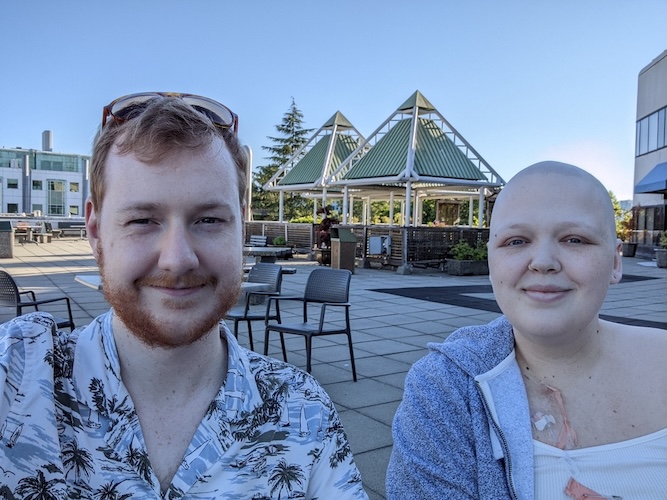
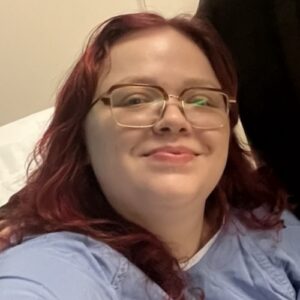
Summer was 23 and just settling into a marketing and publishing career when her left knee started to hurt. She assumed the pain was from walking on it wrong and ignored it. When it kept getting worse, she started physiotherapy. Then one morning in January 2022, she woke up and couldn’t walk. Her husband insisted that they go to urgent care, where an X-ray would reveal a tumor. A CT-guided biopsy, where they take a sample of the tumor, confirmed osteosarcoma, a rare kind of bone cancer. It was Valentine’s Day, 2022.
Interviewed by: Tory Midkiff
Edited by: Chris Sanchez
The rare tumor was large and aggressive, but it had not yet metastasized. Summer declined fertility preservation so that treatment could begin within a week. She went through five rounds of inpatient chemotherapy, then a 10-hour limb-salvage surgery that let her keep her leg. More rounds of chemotherapy followed, interrupted by a life-threatening intestinal infection that required a month of IV nutrition. She finished chemotherapy in October 2022 and slowly relearned how to walk.
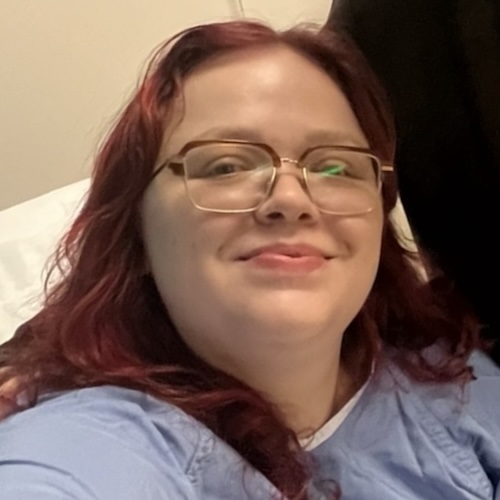
Two years later, mid-step on a walk near her apartment, her prosthetic hardware failed, and her leg snapped in half at the shin. She waited two and a half weeks in a hospital bed for surgery to replace the broken rod, passing the time by painting dozens of pieces for the nursing students on her floor. Soon after, scans found the cancer had returned: a nodule in each lung, removed in two separate surgeries. Then one day, she put her hands on her hips and felt a small lump on her side, which was also removed. Her next scan showed a lump in her breast. A PET scan before that surgery revealed a nine-centimeter tumor in her lung pressed against her heart. It was inoperable, and her cancer was now considered incurable.
Two days after that phone call, Summer and her partner of seven years got married in their backyard. She started inpatient chemotherapy the next morning. Today, the chemotherapy has stabilized her tumors, and she is preparing to start targeted therapy from home. She works with the Terry Fox Research Institute on patient panels for young adult cancer, and she is determined to outlive her prognosis.
Watch Summer’s video and read through the edited transcript of her interview below. You’ll learn more about her osteosarcoma experience.
- Summer’s knee pain didn’t go away with physiotherapy; it kept getting worse, on and off, for months before anyone ordered a scan. When treatment doesn’t resolve a persistent symptom, that can be a sign that it’s time to push for more imaging, not more time.
- Told the tumor was aggressive but hadn’t yet spread, Summer declined fertility preservation so chemotherapy could start within a week and because it wasn’t a loss she felt personally. Not every patient facing this choice is grieving the same thing.
- Summer had a strong support system through her first treatment, but no friends who had been through cancer themselves. Her advice: find your community, whether through a support group or social media.
Summer’s Diagnosis Facts
- Name: Summer K.
- Age at Diagnosis:
- 23
- Diagnosis:
- Osteosarcoma
- Staging:
- Primary Cancer: N/A
- Recurrence: Stage 4 (Metastatic)
- Symptom:
- Primary Cancer:
- Soreness and inflammation of the knee
- Recurrence:
- Appearance of nodules and a tumor in the lung, and a lump on the side
- Primary Cancer:
- Treatments:
- Primary Cancer:
- Chemotherapy
- Surgeries: limb-salvage surgery (proximal tibia replacement with gastrocnemius flap), proximal tibia arthroplasty
- Recurrence:
- Surgeries: video-assisted thoracoscopic surgery (VATS) wedge lung resection, subcutaneous flank tumor removal
- Targeted therapy (upcoming)
- Primary Cancer:


This is not medical advice. Please consult with your healthcare provider to make informed treatment decisions.
- Summer’s Diagnosis Facts
- Knee pain at the start of a new career: The first signs that something was wrong
- From physiotherapy to the ER: The X-ray that found the osteosarcoma
- A CT-guided biopsy and an official diagnosis of osteosarcoma on Valentine’s Day
- Five rounds of inpatient chemotherapy and a limb-salvaging surgery
- Relearning to walk: Recovery after a proximal tibia replacement
- Two years later, when the prosthetic hardware failed
- Lung surgeries, a Halloween phone call, and an inoperable tumor: When osteosarcoma kept returning
- Married life during chemotherapy: The same life, now with rings
- Living with an incurable osteosarcoma prognosis: Choosing to outlive it
- My advice for anyone facing something similar: Find your community
- Hear from people living with sarcomas
Knee pain at the start of a new career: The first signs that something was wrong
My name is Summer, and I was diagnosed with osteosarcoma in 2022.
Around the time that I was diagnosed, I had just settled into a career in marketing and publishing, which I was having a blast doing. I was living with my then-partner, now husband. I was 23 years old, so it felt like I was just starting in the real world. But I had noticed that my left knee was hurting quite a bit. I thought it was maybe just an injury from walking on it wrong or moving it the wrong way, so I ignored it. I was 23. I didn’t expect anything crazy. But I was having very substantial knee pain, and the swelling got a lot worse at night. I just thought it was an injury, and at nighttime, I thought that maybe I was just thinking about it a little more because there was less external stimuli to distract me.
The knee pain was almost like a burning pain. I describe it as very sharp, very hot, and just very, very uncomfortable.
From physiotherapy to the ER: The X-ray that found the osteosarcoma
I think it started in the summer of 2021, probably later in the year. And then it was getting progressively worse, but I’m really stubborn. I was really, really convinced it was nothing. Then my husband and I went on a trip to New York in November to celebrate my 23rd birthday. Big city, lots of walking. And my knee was getting worse and worse and worse as we were doing over 20,000 steps a day. And I made the decision that when I got back from that trip, I would start going to physio and see if maybe physiotherapy could help me out.
Physiotherapy was very hit or miss. My physiotherapist was great, but we found that it was one step forward, two steps back. He thought that it might have been an injury, so we were trying to strengthen the surrounding areas, and it was giving me some relief, but then it would get much worse, and then I’d get a little more relief, and then it would get much worse. So he suggested that I go get a CT scan or an ultrasound or something. But he did suggest talking to my family doctor just in case there was something more wrong. Again, we didn’t think of cancer. We just thought it might be a stubborn injury. And that brought us to the winter of 2021.
Sometime in January of 2022, I was just about to go to my doctor and talk to him about getting a CT. Wait times here in Canada can be long for that kind of thing. It can be upwards of six months to a year. It can take a long time to get in for that diagnostic imaging. So I was putting it off, but I woke up one morning in January, and I couldn’t walk. My knee was really inflamed, really painful. And again, I was really stubborn, and I was like, “No, I can just wait for the CT scan.” And my husband, who is an angel, was like, “Nope, we’re going to the ER. We’re going in an Uber or an ambulance. You get to pick.” I am very thankful that he knows when to call me on being too stubborn and is like, “Nope, it’s actually time to deal with this.” So we went to the ER, to urgent care, and they took an X-ray, and that’s when they found the tumor. It was very visible on an X-ray since it was bone cancer. So I didn’t have to do a lot of advocating for myself to check things out, because the first step in imaging for knee problems just so happened to find the problem.
Hearing “tumor” alone in urgent care: Fight, flight, or survive
It was difficult. Since we were still operating under a lot of COVID restrictions, I was alone. They didn’t let my husband come back with me, which is fine. It was a really busy urgent care. There wasn’t really even room for him. And I had a feeling something was wrong, because they took the X-ray and the X-ray tech was acting really weird. And then they left me alone in a room for two hours, and I was thinking to myself, “Okay, something showed up on that X-ray that is more complicated than I think anyone knows.” And in the moment that they said it was a tumor and it had some very concerning qualities, they couldn’t tell me it was cancer, but they could tell me that it looked aggressive, concerning, all the words you don’t necessarily want to hear. But I think in that moment, something switched in my brain, and I was scared and sad, but I was mostly like, “Okay, how do I survive this?” I refer to it as my lizard brain. Something clicked where I was like, “Oh, okay.” There’s fight, there’s flight, but there’s also just survival. And I think that’s what clicked for me. So I had to call my husband and tell him the news. And both of us were just like, “Okay, we will find a way through this.”
A CT-guided biopsy and an official diagnosis of osteosarcoma on Valentine’s Day
After that initial X-ray, it took about a month to get the full diagnosis. There was lots of blood work and CT scans, and then they also had to do a CT-guided biopsy as well to officially diagnose things. So I was diagnosed on Valentine’s Day, actually, of 2022, which was a weird date, but we took it. And then that’s when the official diagnosis began. And then I started treatment, I think, less than a week after that.
Five rounds of inpatient chemotherapy and a limb-salvaging surgery
For the initial treatment plan, I was given the option to preserve my fertility before we started. I did not take it. I had never really felt drawn to being a parent, and I also really didn’t want to delay my treatment any further. Because what they had said was that the tumor was large, it was aggressive, and it was a miracle it hadn’t metastasized anywhere yet. And I was like, “Okay, I’m done operating on miracle time. I would like to actually just move this along as quickly as possible.”
So the initial treatment after that was five rounds of chemotherapy, which was inpatient, so I stayed overnight for a week at a time. And then I had a very complicated limb-salvaging surgery. So I got to keep my leg, which was not a given. But the official name of the surgery was a proximal tibia replacement with gastrocnemius flap. So they took some of my femur, my entire knee, and most of my tibia and replaced it with metal, and then took a muscle from the back of my calf, cut it, and wrapped it around the front of my shin to stabilize the prosthetic. I think that was a 10-hour surgery. And then after that, I was technically no evidence of disease, but they wanted to make sure. So I did another, I think, five rounds after that. But there was a bit of a road bump where in my first round after surgery, I had a strange, life-threatening side effect where I got an intestinal infection and had to be put on IV nutrition for a month, and stay in the hospital and not eat anything, and give my stomach and my intestines time to heal. So that was a bit of a road bump in there. But then after that, I finished up treatment, and I finished chemo the first time in October of 2022.
Relearning to walk: Recovery after a proximal tibia replacement
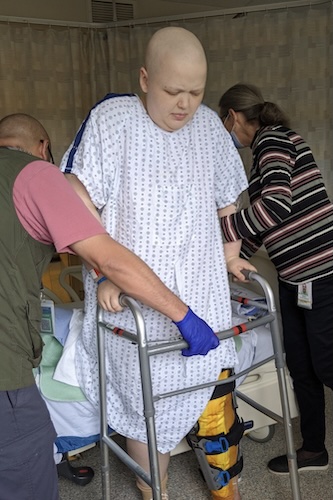
The recovery was very difficult. It was hard to relearn how to walk again on what felt like a brand-new leg, and also trying to learn to walk again while being so weak from all the chemotherapy. Building muscle was really, really difficult. Building stability was really, really difficult. I did the bare minimum while I finished up my treatment and then started actively rehabbing it in December of 2022. But honestly, I’d say recovery is ongoing. It’s a weird little leg that I have, and it requires a lot of maintenance. So I’m just happy that I got to keep it in the end.
Two years later, when the prosthetic hardware failed
In the summer of 2024, I was out for a walk with my husband, and we made it maybe half a block from our apartment, when, mid-step, my leg snapped in half.
There was no warning. There was no weird feeling. There was nothing. I literally just took a step, and my leg snapped in half at the shin. Which was very scary and very traumatic. And it took a long time for me to even get the surgery to fix it, just because I was on the emergency surgery list, but I was technically at the bottom of it because my life or my limb wasn’t threatened.
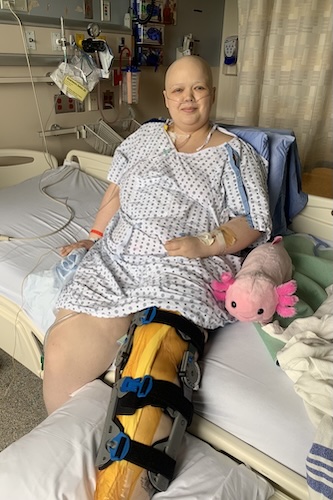
Everything was still not intact, but I was lying in bed, basically. And there are a lot of people, obviously, who are on the emergency surgery list who are not that stable. So I kept getting bumped. I’d get wheeled halfway to the OR, and they’d be like, “Oh, just kidding, back to your room.” So I think I waited two and a half weeks for surgery, stuck in bed, which was very difficult. And then I had a surgery to replace the rod where it had broken, and then I stayed about another week in the hospital relearning to walk again so I could go home. But yeah, very, very scary.
And the only explanation they could find was that it was just a hardware failure. There was nothing I did wrong, nothing the surgeons did wrong. It was just a freak accident.
The gap between the initial surgery and the hardware failure was almost exactly two years. I think it was just slightly over two years, by a couple of days. So it was a good amount of time, but they’re supposed to last, the surgery is supposed to last, for upwards of 10 or 15 years. So maybe not as sturdy as it should have been.
And at this point, I hadn’t had any recurrences or anything. So it was just a lot of focusing on recovering and healing. And then once my leg broke, everything kind of started happening all over again.
Support groups, painting again, and 60 paintings from my hospital bed
During that time, I was attending a lot of support groups with an organization called Young Adult Cancer Canada, or YACC. They do a lot of online Zoom support groups, which I found very helpful to try to find some community. And I also took up art again. I was always a creative kid, and then I stopped as I got older, but I started painting again and writing again for my own pleasure, not just for work. And those two things also very much helped me.
I definitely started painting much more when my leg broke, because I was stuck in bed in the hospital. And I’d done the inpatient chemo before, so I was no stranger to long hospital stays, but I was so used to feeling so sick that I just slept the whole time. So this time, I was awake and not sick, and in pain that was managed. So I was very bored. So I took up painting, and I was on a teaching floor in the hospital, and there was a bunch of nursing students, and they would all come in and make a request, and I’d paint it for them and give it to them. I think I left with maybe 10 paintings after a nearly 30-day stay, and I think I gave away probably 60. I was just painting all day, every day. Graduation cards, birthday cards, pet portraits, whatever they wanted, I would just paint and give them. And it made me feel really productive and good, and honestly helped keep my mind off the pain. So that’s something that I’ve adopted for all my other hospital stays afterwards as well.
Lung surgeries, a Halloween phone call, and an inoperable tumor: When osteosarcoma kept returning
There’s definitely been a lot since the leg break. It happened in June of 2024.
I went home, back to Winnipeg, where I grew up, for a bunch of weddings in August and September. And while I was there, I got the phone call that my most recent scan was showing some really concerning traits in my lungs, and that they could pretty confidently say that the cancer was back. So in September of 2024, there were lots of appointments and consults with a surgeon. They ended up telling me that there was a nodule in each of my lungs, so I would need to have two separate surgeries. So my first one was in October of 2024, and then my second one was in January of 2025. Those were just video-assisted thoracic surgery. They took a wedge out of each of my lungs, basically. The surgeries went really well. They got clear margins. Everything was looking pretty good until November of 2025. I noticed a really weird lump in my side, on my flank. I noticed it because I put my hands on my hips, and then I felt a little bump, and I was like, “Oh, that’s not how that usually feels.” It was maybe gumball-sized, and I could pick it up and move it around.
It wasn’t super painful. So I brought it up to my oncologist. She got an ultrasound on it. And I remember I got the ultrasound on that little lump in my side on Halloween. I finished my ultrasound, left the cancer clinic, went and grabbed a coffee less than a block away, sat down at the coffee shop, and my phone rang, and it was my oncologist. And she was like, “I’m so sorry.” I was like, “Whoa, okay, we’re doing this again.” She was like, “It doesn’t look like a cyst. It doesn’t look like a hematoma. It is very calcified, which is what bone cancer metastasizes to. It’s very bony and spiky. We could biopsy it, but we’re just going to remove it. We kind of know what this is. I’m sorry.” I was like, “Okay.”
So I got a PET scan as well around that time to make sure that there were no other metastases that we couldn’t see, just because this one was weird. Osteosarcoma doesn’t usually metastasize to subcutaneous tissue. So we were expecting more in my lungs or in other organs. And the PET scan was clear aside from that, which was great. So we did that excision surgery, actually, on my birthday. I have a weird thing for holidays, I think. Initial diagnosis on Valentine’s Day, I finished treatment the first time on Halloween, and then we had the Halloween ultrasound. And then on my 26th birthday, we did the excision surgery.
So I baked cupcakes for my entire surgical team, because what else are you going to do at that point? And we got it out. Clear margins came back. The pathology came back as osteosarcoma, which we kind of already knew. And then my next scan after that showed a lump in my breast. And we were very confused by that as well, because again, it’s kind of a weird spot for osteosarcoma to go, but fine. I waited a long time for breast imaging. I think I waited three months, because it’s so backed up in my province. And by the time they did the biopsy, mammogram, CT, whatever, the biopsy came back as osteosarcoma. And again, we were like, “Okay, let’s do a PET scan before we do surgery, just to make sure there’s nothing else.” And unfortunately, there was something else. And this time it was a 9-centimeter tumor in my lung pressed up against my heart, which was not there less than three months before that scan. So it grew fast. So this time it’s unfortunately inoperable. Which kind of puts me in the incurable category now, where we can’t take it out.
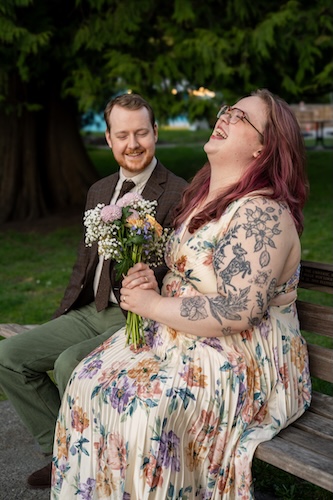
But right now, I’m doing inpatient chemotherapy again. And that came on really quickly. I got a call on a Friday in April that it was back, it was inoperable, and we needed to start treatment ASAP. My partner and I finished that phone call, looked at each other, and he was like, “Do you want to get married on Sunday?” I was like, “Absolutely, I do.” It was the easiest yes. We planned on getting engaged this year. We’ve been together for over seven years now, but my health was finally getting a little better, so we thought maybe an engagement would be good this year. We just skipped that. We got married in our backyard. It was super fun. We had the perfect day, planned a wedding in under 36 hours, and then had our wedding on Sunday. And then Monday morning, I went in for chemotherapy, which was a very strange honeymoon for both of us. But yeah, that’s where we’re at now.
I have two more rounds of inpatient chemo left, and then I’m going to be starting a more targeted treatment from home. That should work for anywhere from three months to a year, and then it will probably stop working, and then I’ll be looking into clinical trials.
Married life during chemotherapy: The same life, now with rings
Married life’s been great. It’s actually the same as the life we had before, except now we have rings. He’s been a great, great support and a great rock through all of this for me. And it felt very correct to do that in the two days that we had between learning that I don’t have too much time left and starting chemo again. It was a very good morale booster for us, in a way.
Living with an incurable osteosarcoma prognosis: Choosing to outlive it
It’s been difficult hearing that. I mean, initially, we didn’t even know that the chemotherapy that I’m on right now would work. It was very much a shot in the dark. We hoped it would. But the prognosis I was given was that it could be a few months, hopefully it’s more than a year, and no more than a few years. So it’s a very broad prognosis. And I’ve already outlived the few months, because the chemo is working and has stabilized the tumor. Like I said, it won’t shrink, but it certainly stopped growing, the one in my breast and the one in my lung. So we count that as a win. It’s dying, which is also great. So it was very difficult to hear those words initially, but it doesn’t really do me any good to dwell on them too much. Obviously, I still think about it a lot, but I have a lot more life outside of that prognosis, and I’m very stubborn and very determined to live. So I choose to believe that I will outlive even the predicted few years, because that’s all I can do, really.
Finding purpose in research and advocacy for young adult cancer
I think the one thing that I’m probably the most proud of through all of this is that I’ve taken up a lot of work within research and advocacy for young adult cancer, as well as sarcomas and rare cancers. So I’m very proud. I work with the Terry Fox Research Institute, which is probably one of the bigger research institutes for cancer in Canada. And I work on a lot of patient panels and patient working groups for access to precision medicine in Canada, as well as awareness and advocacy of young adult cancer. So I think that that is something that’s also been really healing for me. The ability to give back, and the ability to work as a patient and give that patient perspective to scenarios where it’s so desperately needed. I feel like it’s been something that’s really, really filled my cup and really fueled me to keep going. Alongside having a really wonderful community of friends and cancer friends and my husband and family. Those are the things that have kept me going.
It feels really nice to be able to give back and give those perspectives. I’m a very open book. So I do really enjoy working with researchers and people that may not get to interact with patients very often, simply because I’d rather they ask me questions that maybe other patients would find offensive or abrasive. I’m fine with it. So I’d rather they talk to me about it and learn and better their work that way.
What I’d tell myself on Diagnosis Day: Be kinder to yourself
I think if I could go back, I would tell myself a lot of things, but mostly to appreciate every moment that I had from that point forward. Because sometimes I feel like I took the few years where I had no evidence of disease for granted. Where I was really hard on myself with my healing. I thought I wasn’t getting better fast enough, I wasn’t going back to work fast enough, I wasn’t walking as far as I wanted to unassisted, or things like that. I was rushing my healing quite a bit, and I didn’t take the time to enjoy the fact that I didn’t have cancer at that point. And then obviously, I’ve dealt with a lot more recurrences since then. So sometimes I look back at that period, and I’m like, “Oh, you were so mean to yourself. You should have been a lot nicer and enjoyed that time.” But I don’t regret it. I think I had to do that to learn that I could be gentle with myself. But yeah, I would definitely tell myself to be a lot kinder to myself in that initial healing.
My advice for anyone facing something similar: Find your community
I would definitely say, find your community. And a lot of the time, that can be friends and family, but also a lot of the time, friends and family don’t necessarily understand exactly what you’re going through. I had such a good support system through my first round of treatment, but I didn’t have any other friends who had dealt with cancer. And that was really difficult, because my friends and family didn’t quite understand, and I didn’t want them to. The only way to understand is to go through it, and I don’t want you to go through it.
So find your community, whether that’s with a support group or through social media or something. Just find people who have been through something similar to you that you can either follow, listen to, or befriend. Just having people in your corner that know what you’re going through is really, really, really valuable. And it’s something that has really helped me through the latter half of my diagnosis.
This interview has been edited for clarity and length. The views and opinions expressed in this interview do not necessarily reflect those of The Patient Story. This content does not replace professional medical advice.
Inspired by Summer’s story?
Share your story, too!
Hear from people living with sarcomas
Real experiences with diagnosis, treatment choices, side effects, and life beyond sarcomas — in their own words.
Leave a Reply