
Diagnosed with Myxoid Liposarcoma After Doctors Called Her Lump a Lipoma
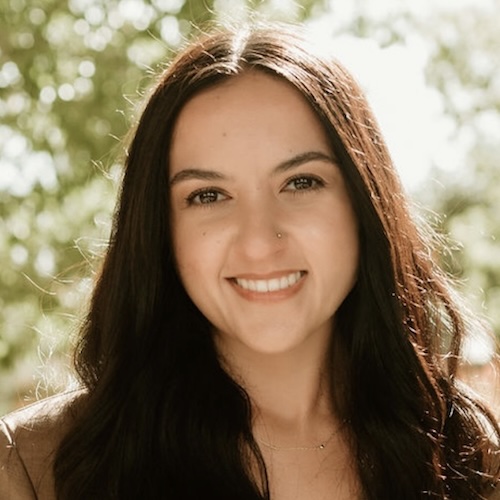
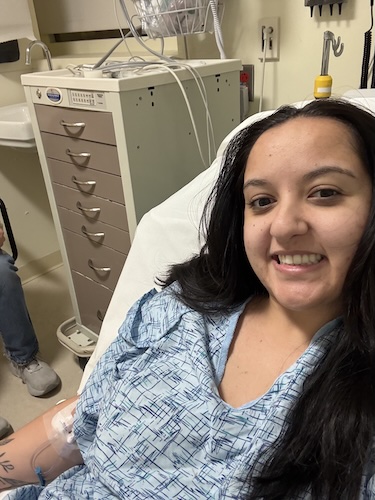
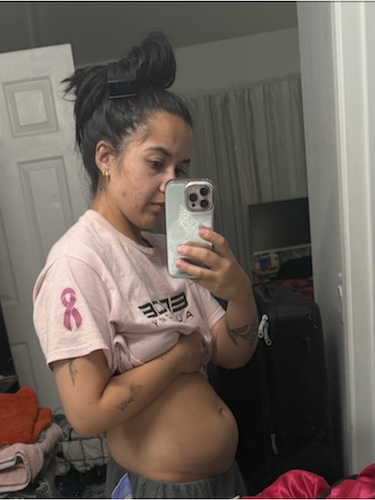
Kat was 28 and living in San Diego when she noticed a lump on the inside of her right thigh. After months of thinking it was nothing more than a muscle injury, she went to get the lump checked out. Kat’s doctors thought it was a benign lump of fat cells called a lipoma, so they removed the lump in a quick outpatient surgery that was expected to be routine. Instead, the tissue came back unrecognizable to her surgeon. Four anxiety-filled weeks later, a pathology report confirmed myxoid liposarcoma, a rare, low-grade soft tissue sarcoma.
Interviewed by: Taylor Scheib
Edited by: Chris Sanchez
Because this cancer is so rare, Kat had to leave her career and her home behind in California to get specialized care at Mayo Clinic in Minnesota, returning to where she grew up. Her care team explained that treating the tumor would require radiation to her thigh, followed by limb salvage surgery to remove tissue roughly the size of a football, a much bigger situation than the small outpatient procedure she had originally expected.
Radiation brought fatigue that came in waves, skin and tissue changes in her thigh, and unexpected panic attacks tied to a past car accident, which her care team helped manage with a short course of anti-anxiety medication. Now recovering after radiation, Kat is preparing for limb salvage surgery, a nine-to-12-hour procedure that will involve an orthopedic surgeon, a team of plastic surgeons, and roughly two years of physical therapy to relearn how to walk.
Beyond her own healing, Kat also decided she wanted to help support other people through future sarcoma research, so she did two things: enrolled in a clinical trial using a lower radiation dose for her particularly sensitive tumor, and also chose to take part in a tissue and blood biobanking study.
Throughout this experience, Kat has leaned on reconnecting with old friends, online communities for young adults with cancer, and her husband and parents. She continues to process the emotional weight of losing mobility and trust in the medical system after her initial misdiagnosis, while also finding meaning in advocating for herself and sharing her story so other myxoid liposarcoma patients can see what this rare disease actually looks like.
Watch Kat’s video and read the edited transcript of her interview below for more about her story:
- A lump that several confident providers called a lipoma turned out to be myxoid liposarcoma. Kat’s experience is a reminder that reassurance from multiple providers doesn’t rule out a rare diagnosis, and that following up after a “routine” surgery matters.
- Treating a rare sarcoma can mean a much bigger undertaking than it first appears. What Kat expected to be a small scar revision became 18 rounds of radiation and a limb salvage surgery to remove tissue the size of a football, with roughly two years of recovery ahead.
- Comparative suffering, the idea that someone else’s harder situation cancels out your own pain, is something Kat had to unlearn actively. Making space to feel difficult emotions, instead of minimizing them, is something anyone navigating illness can carry with them.
- Kat describes becoming someone who can ask her mother to carry medication up the stairs, after spending years priding herself on never needing help. Letting people show up for her, even in small ways, has become part of how she’s relearning to live with this diagnosis.
- Enrolling in a clinical trial and a tissue biobanking study gave Kat a way to participate in expanding treatment options for a disease that doesn’t have many yet. For rare cancers with limited research behind them, patient participation in trials is often what creates the next generation of options.
- Being newly diagnosed pushed Kat to reevaluate how she had been spending her time and energy, including an all-consuming career and friendships that gave little back. She’s now trying to weigh decisions by whether they align with her values and bring her joy, rather than waiting for “someday.”
Kat’s Diagnosis Facts
- Name: Kat G.
- Age at Diagnosis:
- 28
- Diagnosis:
- Low-Grade Myxoid Liposarcoma
- Symptoms:
- Night sweats
- Appearance of a painless, golf ball-sized lump on inner right thigh
- Treatments:
- Radiation therapy, including through a clinical trial
- Surgery: limb salvage surgery (upcoming)
This is not medical advice. Please consult with your healthcare provider to make informed treatment decisions.
- Kat’s Diagnosis Facts
- My myxoid liposarcoma diagnosis
- Eighteen rounds of radiation through a clinical trial
- Preparing for limb salvage surgery
- Learning to ask for help after a lifetime of independence
- The invisible reality of living with cancer
- My advice: Validate every feeling cancer brings up
- Hear from people living with sarcomas
My myxoid liposarcoma diagnosis
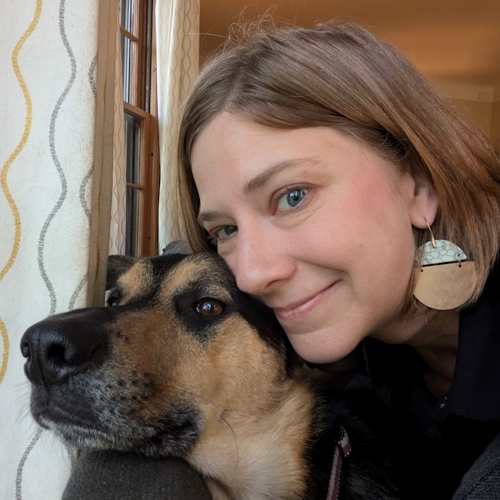
My name is Kat. I was 28 when I was diagnosed with myxoid liposarcoma in 2026. I’m originally from the Minneapolis, Minnesota area, but I lived in California for the last six years and just moved back.
From a lump in my thigh to myxoid liposarcoma
I’ll start maybe a year before I really found the lump. I had been struggling for years with polycystic ovary syndrome (PCOS) and endometriosis, both of which, for a long time, went undiagnosed and had evolved into type 2 diabetes. This had resulted in substantial weight gain, and I was over 200 pounds at 5-foot-1-inch. Finally, I moved to San Diego and found the right doctors, and I was able to get my medications right, to the point that I was actually able to lose 60 pounds. So, leading up to this, there were a lot of tumultuous hormonal issues. I was also going through weight loss, and my body was having a lot of changes. Primarily, I was struggling with endometriosis and chronic pain. Those health issues had really taken over my life and had been very debilitating, and had taken a lot of my attention. But it was back in, I think, November of 2025. At this point, I was very into my career. I was traveling a lot for work, and I had come home from a work trip. I remember I was unpacking, and my husband was standing in the closet, and we had a mirror outside of it, and I was wearing shorts, and I looked down and noticed a lump on the inside of my right thigh. Immediately, my stomach dropped because I’d been going through so many health issues. And I am someone who has a lot of anxiety.
I’ve dealt with a lot of medical invalidation from providers, so my first instinct was, “Oh my God, what if this is something really terrible?” But then I internalized some of that invalidation. I was like, “Oh, it’s nothing. I’ve been working out a lot. It’s probably a muscle injury, whatever; I’m just going to ignore it, because the lump had no symptoms.” It wasn’t painful; it was just something I could visually identify. And I was finishing grad school at the time, so I was like, “I don’t have time for another health problem, whatever. A month went by, and I noticed that the lump had grown. It was still firm and hard. I could feel it; I could see it. It wasn’t painful. But I thought, you know what, I was off work for Christmas break, and I thought, “Well, I’ll just go to urgent care and get it scanned. I’m sure it’s probably a muscle injury, and I don’t know why it’s not healing.” So we went to urgent care, and the doctor looked at it, and I said, “Yeah, I’ve been working out a lot, and I noticed this a month ago, but it’s not going away. I think it’s a muscle injury.” And he said, “Well, let’s get an ultrasound. I really don’t think it’s a muscle injury. I don’t think you caused this, but let’s just get a closer look.”
At this point, I’m not worried at all. I’m very heavily convinced this is a muscle injury. So I go in, I get the ultrasound, and the technician is scanning it, and it’s not painful, because again, it’s just a hard lump; it doesn’t really feel like much. And this technician — I’m sure a lot of cancer patients can relate to this — looks at the screen and says, “Don’t leave yet, I need to talk to the radiologist.” And I had a little panic moment of, “Oh my gosh, what if it’s cancer?” And then they called me back in and said, “Oh no, it’s a lipoma, which, if you don’t know, is a benign, basically overgrown fat blob. They can just be annoying; they can happen sometimes, it’s not a big deal, let’s just schedule surgery in a couple of months to take it out.” At that point, I thought, “Okay, providers have scanned it, they’ve reviewed it, they told me it’s benign, and it’s a lipoma, so I’m not going to worry about it.” Surgery was scheduled for March 23rd of 2026. Up until that point, I really wasn’t worried about it; I wasn’t thinking about it. I went and did my pre-op appointments, and no one was worried. They said, “Oh yeah, it’s a lipoma, totally rare; there’s a 1 in 1,000,000 chance that we’re wrong.”
So I told myself not to worry about it, and that’s fine. We get to the day of surgery, and nobody’s worried about it. The surgeon assures me, “Hey, it’s a lipoma, I’ve had them myself, we’ll take it out, no problem.” Surgery was super quick; it was like 40 minutes or something. I remember we got back in the car and we’re driving, and he calls my husband, and the doctor says, “Well, I took it out, and I don’t know what it is; it’s not a lipoma, it’s this hard, pink, fleshy thing, but we’ll send it to pathology, and you’ll hear back next week.” So at that point, I was a little worried, but there were so many more likely benign things it could have been, so I didn’t really worry. But then a week went by and I heard nothing, and I started to get anxious, and of course I was looking up all the possible things it could be, and I had read about liposarcoma and things like that, but I thought, “Well, that’s so rare, so I was looking more at this type of benign tumor, whatever.” Another week goes by, and I get a MyChart notification, and I think, “Okay, let’s see what it is.” And I found out they sent the slides of the tumor tissue to five bone and soft tissue cancer experts at the Mayo Clinic, across the country from where I was living at the time.
And I thought, “Why would they send it to these people?” I was pretty nervous about it. I went to my post-op appointment and asked about it, and I thought, “Well, maybe that’s a very normal second opinion; maybe they typically go to Mayo Clinic to have their pathology reviewed, who knows.” So I asked, “Do you guys normally have your tissue samples reviewed? They said, “We’ve never sent anything there, ever, to this hospital.” So I thought, “Oh my gosh” — it felt a lot like watching a car crash in slow motion. I was so riddled with anxiety. I think that was probably the worst part of the journey, just waiting for what the implosion was going to be.
It was two weeks after that — so four weeks from the surgery — that I finally got the pathology report: myxoid liposarcoma. I guess luckily it was the low-grade kind, which means it’s not aggressive in its biology. So initially I thought, okay, let me research this. I read a bunch of NIH studies, and I was looking up the tumor.
What does this look like? From the studies I was reading, I thought, “Oh, cool, okay, it’s like a 90% survival rate and less than 5% chance of recurrence, so nothing cancer, whatever.” Because it’s so rare, I had to go to a specialty center, and my options were Mayo Clinic in Minnesota, MD Anderson in Houston, and Memorial Sloan Kettering in New York. I had family in Minnesota; I was from there, so I initiated care there. I reached out to Mayo Clinic: “Hey, can I transfer my care here? Would you guys take me?” And I had such a strong moment of patient advocacy, because I was so worried they wouldn’t take me, since I was across the country. I actually worked with my primary care doctor to write up a letter that summarized, here’s my family history, here’s my symptoms, here’s my diagnosis. That letter really helped me get care, so if any other cancer patients are struggling to get the right providers, I felt that was a really helpful strategy.
But once I got there, they basically told me, “Here’s what we’re going to have to do: you’re going to have to do radiation to the leg, and then we’re going to have to do another surgery to remove the extra tissue.”
For sarcomas, they essentially have to remove a very large margin of healthy tissue around it, because of the way it can spread locally. My expectations going into seeing the providers at Mayo Clinic were that they’d probably just take out a little bit more if they did another surgery, and maybe do radiation and then chemo or whatever. But I really had a realization that my expectations were wrong when I got there. The doctor told me, “We’re basically going to have to take your whole inner thigh, and you’re going to have to go through radiation first.” And I think what really got me, and what’s kind of haunted me through this journey, is that the study I’d read — the 90% survival rate — that was for five years, and it goes down every 5 to 10 years. They have really great technology for local control now. Historically, they used to do amputations to treat this disease, but now they have what’s called limb salvage surgery, where they take a large part of the tissue of the limb and can plug in muscles from other parts of the body, basically reconstructing it to be a functional limb without fully having to take it, which is very extensive.
Processing a misdiagnosis and hearing the word “cancer”
I had different phases of devastation and overwhelm with it. I think I started with — this was probably the first opportunity, because going through all these health problems like PCOS and endometriosis that primarily affect women, I’ve dealt with so much medical invalidation and gaslighting from providers that I really started to doubt myself. And I think what was so disappointing is that with this lump and this misdiagnosis, it was one of the first times I’d actually really trusted my providers, because of how confident they all were — the surgeon, the urgent care doctor, the radiologist were all telling me it was a lipoma. I felt comfort in that, and it was the first time I thought, “Okay, I’m just going to trust these people; I’m not going to worry.” And to find out it was something to truly worry about was a lot. I think also, once I had the diagnosis and was researching it, the other difficult part was that because it’s so rare, it was hard to find other people’s stories, to understand firsthand what that experience is like. It’s very easy to find stories of women with breast cancer, and what that journey looks like, but I couldn’t find what this looks like to go through for a human being. It’s easy to find research papers, and I can read all of that.
That also set me up for not knowing what to expect in treatment. And then, of course, getting the diagnosis was terrifying and devastating. I remember I was in a meeting and my computer crashed, and that’s when I got the MyChart notification, and my heart was racing because I knew what it was — I knew it was the pathology report. I remember opening it, my meeting had crashed, and I read it, and I just saw “cancer.” I went to my husband and broke down. I said, “I can’t read the rest of this. Can you just go through it and tell me what it says?” I think part of that devastation comes from how cancer is presented in the media. A lot of what cancer looks like is diagnosis, chemo, bald, and dead. And that is the reality for so many patients, unfortunately. But what I’ve come to learn is that cancer, its biology and its treatment, is such a broad spectrum that I didn’t really know what to expect if it didn’t look like that.
That was hard. And then, of course, going to the doctor, reading these studies and having this expectation that, oh, this is easy and it’s nothing — and sitting down, and he tells me, “We can promise you that in the leg it’ll be less than a 5% chance it comes back, but there’s a 20% chance it’ll spread. And chemo doesn’t really work for this disease, so we’re just going to monitor you. Twenty percent chance it spreads, but if it spreads, it’s incurable, and we’re just buying you time; we can’t save you.” So there are a lot of phases to that. I’m still processing it. That’s hard — 80% chance I’m fine, and nothing bad ever happens, and surgery goes great, and it’s going to take me two years to relearn how to walk, but that day will come. And a 20% chance, two, five, ten years from now, because that’s how long sarcomas can remain dormant; it can spread, and that’s it.
So there are a lot of phases to the devastation. And I think the misdiagnosis, once again, kind of ruptured my trust in healthcare. But throughout the journey of the information I got, there were different levels to it, if that makes sense.
Living in the present with a 20% chance of myxoid liposarcoma recurrence
I think that’s hard, and I don’t think I’m at all an expert in how to manage it. But it’s made me realize that time is limited — and here’s the thing: We’re all limited in our time. I think we live in a very death-denying society. We’re all going to die someday; we just don’t know when. Maybe people like me just have better insight into that. But it made me realize how much I was spending time and energy in ways that were against my values. Now is kind of a time where I’m starting to reflect on things. I was so married to my career that I put everything else second in a way that wasn’t healthy for me. I overinvested in non-reciprocal friendships and neglected the friendships that were reciprocal and that did have a lot to offer, and overall, neglected my social life. I didn’t realize the value of that, or how important it is. But I think times like this, you have to learn what’s actually worth spending your time on. For me, the criteria are: do they align with my values and who I want to be, and do they bring me joy? I think I was in a mindset of, well, I’m going to trade my time now for joy later, but later is never promised — you could get hit by a bus tomorrow. That’s something I’m trying to work through. The other thing I’m trying to grow through with this is — I don’t know if you’re familiar with the concept of comparative suffering.
Comparative suffering is this logical fallacy. If I am experiencing something, but somebody else has it worse, then that invalidates the suffering of my experience, and I don’t deserve to feel those feelings; I don’t deserve empathy or compassion for them. I think especially with cancer being such a broad spectrum, it’s so easy — you can always find someone who’s doing worse than you, and you can always find someone who’s doing better than you. What I’m learning is to make space and deliberate time to feel the feelings of what I’m going through, because if you don’t do that, you push it down, and it just comes out sideways.
Leaving my career in California to get care at Mayo Clinic
It was definitely hard for me, because honestly, I hated growing up here. After all, 20 years ago, this was very racist and very segregated socially, and I wasn’t white enough to have a good time here. Moving to California was one of the first times I was surrounded by other people, even in professional environments, who looked like me — I’m French and Indian — and there was a lot more racial diversity out on the coast. That was very fulfilling for me. We were living a life where I was really growing in my career. I had gone back to school and gotten my MBA while working full-time. I had just graduated at the end of 2025 with a 4.0, and I thought, “This is it, I’m going to get promoted, we’re going to keep making more money, everything’s going to be great, we’re going to buy a house.” When I got the diagnosis, I knew it would be a lot. And learning about the surgery, and that it would be two years to fully relearn how to walk, I knew I needed more help, and I couldn’t put that all on my husband. And there was also the financial burden of going through something like cancer — right now I can’t work, because the radiation I received affected such a large part of my tissue that the side effects have been so debilitating that I can’t perform.
It was economical, too — out there, our rent had gotten to four grand a month, and I thought, “Okay, we can’t do that with cancer and only one of us working.” So we decided to move back home. My parents were very supportive and excited, because they didn’t like being empty nesters, so it all worked out. It started very quickly, because as soon as I got diagnosed and got in touch with Mayo Clinic, they said, “We want you here next week, and we’re going to do a hundred million scans.” So I had to basically pack up a suitcase really quickly and fly across the country, and my husband had to finish packing our whole house and drive across the country with our pets. That was a lot for us. And when I got here, because my parents are about two hours from Mayo Clinic, it was bouncing between here and my in-laws, and all these hotels — it was just very unstable, transitioning into this.
Eighteen rounds of radiation through a clinical trial
I was actually part of a clinical trial where they gave a lower dose of radiation, because my tumor is apparently very sensitive to it. That was kind of exciting.
It was 18 rounds, so 36 Gray, but it covered such a large area, basically penetrating my whole thigh, that even though it was a lower dose, it wasn’t less compared to other cancers — it was pretty substantial in the way it impacted my body.
Saying yes to a clinical trial and biobanking research
For me, first of all, I was so frustrated because of the biases you come in with for a cancer diagnosis. I had known a lot of people who’d gone through breast cancer, so that was the frame of reference I had, where they have so many treatments available and so many kinds of radiation — and then coming into this rare disease, where we are maybe where breast cancer was 40, 50 years ago, and finding that there aren’t a lot of options, and the only way they can build more options for patients is through clinical trials and through opting in to research. So I was asked if I wanted to participate in a study, first for the lower radiation, and then for biobanking. I donate the tissue, so once they’re done taking everything out in my next surgery, and it goes through pathology, it’ll go directly to research, so researchers can use all of my tissue. I also donate my blood every three or four months. So basically giving parts of my body to them. But for me, it never bothered me, and it never crossed my mind not to participate, because I knew how stressful it was to have a diagnosis of something rare without a lot of data and without a lot of treatments available, and if I could do anything to help, I would.
What radiation for myxoid liposarcoma actually felt like
I’ll start by saying, again, with the biases I had about what cancer treatment looked like — nobody talks about radiation. I thought it was nothing. All I’d heard was that you might get a sunburn, and you don’t feel anything while the machine’s going. That’s all I knew. So going into it, I was really unprepared. I remember my first session, I really just expected it to be nothing, that it wouldn’t impact me. You get on this little tray, basically, that they lay you down on. Most cancers, I guess, are in your upper body, so most people face away from the machine, but because mine was in my leg, I had to face toward it. It’s this huge thing that kind of looks like a giant KitchenAid mixer that you go under, and they lift you four feet off the floor, and you have four people orienting your body. I had this cast, this mold they made to place my leg in every day. So they line me up, get the machine going, and then they leave you in the room — and I had them play Taylor Swift for me. But it was really scary. I think it was the first time it hit me that, oh s***, this is cancer treatment. They don’t just do this to everybody — CT scans, MRIs, you can get those for so many reasons; anybody can get those.
This was the first time I thought, “Oh, we are killing cancer cells.” I had also gone through a car accident when I was 19 that gave me PTSD, and something about the sounds, the way the machine groaned, started to give me flashbacks and panic attacks — which is probably not something most cancer patients have to worry about, but I have heard that panic attacks and anxiety are very common during radiation, because it’s a situation that’s kind of claustrophobic, you can’t move, you have this giant machine moving around you, making loud sounds, and that in itself is very overwhelming. One thing I’m very grateful I was able to ask for — at first I was embarrassed about it, but I told my care team what was going on, and they prescribed me a short course of Ativan during treatment, and that really helped me get through it without the panic attacks and without the PTSD. That was huge. But yeah, it was really an adjustment over time. I got more used to it during the sessions, like, okay, this is my routine now. But as it went on, the fatigue was crazy — it would just hit me all of a sudden, and I would go down, and then I would recover, and then I’d have a day where I was high energy, able to walk a lot and exercise, and felt very lively.
As treatment went on, those high-energy days became more and more spaced out. And then, of course, there were changes to the tissue — my inner thigh became a lot stiffer and firmer. If I touched it, it would remind me of an overcooked steak, which sounds kind of nasty, but that’s how the tissue changes with the radiation. Luckily, I didn’t get too bad a burn, because I was very diligent with the skin care they provided, which was lotion and Aquaphor. But I had a lot of soreness, and I started to develop a limp about halfway through. Now I’m exactly three weeks out from my last treatment, and if you don’t know, your side effects actually peak two to three weeks after, and they can linger for a long time. Today is actually one of the first days, after having to basically be in bed for four days, that I have energy. The recharge time starts to take a lot longer, and on the days when you’re down, you’re just down — most days it takes me hours to get out of bed, just from the sheer exhaustion. And it’s not sleepy exhaustion; it’s that my body only has energy to lie down right now. I’m so grateful I was able to take time off work for this, because I don’t think I could perform in this state at all.
Learning to rest without guilt during radiation recovery
I think one of the harder parts is — and again, from all the invalidation I’ve had from medical providers — validating myself instead of telling myself, “Oh, it’s not that bad; this isn’t even radiation. It’s probably because I did X, Y, Z yesterday.” I think the first part is validating that you feel like crap because you just had a bunch of radiation to your leg. Letting myself feel that, and letting myself rest, and taking off the pressure to perform or go do things, has been very helpful.
I’ll also say time outside has been very important to me, and I’m very happy I’m going through this during the summer, so it’s a lot easier to be outside in Minnesota. Even just sitting outside, feeling the breeze and hearing the birds, makes a huge difference. And on days when I do have energy, I just put in my AirPods, listen to music, and take a walk. I think staying as active as you physically can is a huge part of recovery. I find the fatigue is worse if I can’t push myself to do short walks here and there, even if it’s just to the end of the block and back — it really makes a huge difference.
Preparing for limb salvage surgery
My initial assumptions about the surgery were that I would have a very small scar on my leg, so I figured they’d just go around and scoop that out. But I’m having what’s called limb salvage surgery, which essentially is a procedure where they remove a lot of the tissue. My tumor was 3.5 centimeters in pathology, but because it’s a sarcoma and they have to remove so much tissue around it, they’re going to be taking out tissue about the size of a football from my inner thigh. I don’t know exactly what they’re going to be doing, but from what I understand, there’s going to be an orthopedic surgeon who comes in and does the removal, and a team of plastic surgeons who come in to reconstruct the leg. I don’t know exactly what that’s going to look like, but their job is to make it functional and make it not look like a shark bite. That team is going to be working really hard to do that. And, of course, the research team will be there to collect some tissue. So it’ll be a whole thing — I think it can go between 9 and 12 hours, so it’s a pretty big procedure. I think the hardest part for me is not getting to see what that looks like, because there aren’t a lot of patients who go through it, and the patients who do are oftentimes osteosarcoma patients, so bone cancer, which looks very different from what I’m going to be experiencing. I hope that as I go through it, I can share on social media for other myxoid or other liposarcoma patients, so they can see what that looks like.
Grieving the loss of mobility before surgery even happens
I don’t think I’m fully processing it, honestly. I think I’m definitely suppressing the thought of really thinking about and understanding the gravity of it. Logically, I know I’m losing a lot of tissue, I won’t be able to drive for a long time, and I’m going to have to relearn how to walk. I actually had a stroke when I was 21 — I think it was a transient ischemic attack or TIA — and I had to relearn how to walk a little bit during that too, so I’ve kind of seen what that process can look like, but I don’t know what this PT process is going to look like. They said the first three months will be very intensive rehab, and then it’s going to be two years to regain normal-ish mobility. Knowing that I’m probably not going to be able to walk around by myself for a long time, that I’m probably going to struggle to do basic things for myself for a long time — I don’t fully know what the obstacles I’m going to experience are going to be. I haven’t fully grieved the loss of my mobility yet, and what that means and what that looks like.
Because the procedure is so intense, and where they’re doing the surgery, there’s a high risk of complications and wound healing issues, I’m going to be in the hospital for maybe five days or more. It’s a lot. You’re going to become deformed and disabled substantially from where you are, and just knowing that’s coming — again, it’s that feeling of watching a car crash in slow motion. You can consume all the information you want, but emotionally, I don’t know how much you can really process until you actually experience it firsthand.
Learning to ask for help after a lifetime of independence
If I look at who I was a year ago, I was someone who was working out two hours a day, traveling all across the country for work on my own, the breadwinner, finishing my master’s degree. I’ve always been very driven — I always want to be able to feed myself; I don’t want to have to rely on anyone for anything, for any reason. But of course, as humans, that’s not how we evolved, and it’s not healthy for us either. I get very defensive when people try to help me, and I’ve been having to learn not to do that, to let my husband do some of the physical stuff around the house. There was a day last week when I was on endometriosis medication, and a medication change was causing a lot of pain, and I was on the floor, and I thought, “I cannot go down the stairs to get my medication.” I had to ask my mom, “Can you go downstairs and get this for me?” And even that was difficult for me, because I’ve been so independent. So it’s hard, but I’m learning to make space for other people to be there for us.
I also think that truly reciprocal, loving, healthy relationships are not transactional. What I mean by that is real life is not always 50-50. Sometimes it’s 20-80, sometimes it’s 40-60, sometimes it’s 80-20. This is just a period of my life where I need to receive more, but that doesn’t mean there aren’t going to be periods where I’m not able to give more. I’d also say reconnecting with old friends has been really helpful: people from high school, people who really know me, who make me feel seen. Also, support groups, reaching out online, talking to other people with my disease, or other young adults with cancer. Walking into every waiting room and being the youngest person there, and not going through chemo, having all my hair, people just kind of staring at me, was a jarring experience too. So finding other people I could relate to has also been very helpful.
The invisible reality of living with cancer
First of all, I’ll say I have a limp, and I don’t walk quite right, so it’s obvious that if I’m not sitting down, something’s going on. But I think it was hard for me at first, because you have this idea of what a cancer patient looks like, and if you don’t look like that, well, “Are you really doing that bad? Is your disease really that traumatic and that difficult and that scary if you don’t look like a cancer patient?” But again, this experience has taught me that cancer is a spectrum, and how someone looks isn’t necessarily a reflection of the severity of the disease. For example, I know people who have gone through treatments that were hell — stem cell therapies, different chemos, all these things that look like hell — but their disease is so researched that there’s that hell to go through, and then they become cured, and it’s definite. Whereas for my disease, most chemos don’t work, and the chemos they do have are some of the most brutal and most archaic, and they really only use them to buy you more time. I have to live with this 20% chance that this is going to spread and kill me, and that could be years down the road. I think it’s also empowered me to want to connect with other people and share my story, to educate others that cancer doesn’t look one certain way, and the treatments and the severity of the treatments depend on the biology of the cancer, not necessarily a reflection of how well someone’s doing or how good their odds are. I think making space for that, and being an example of someone going through a cancer that’s rare and really scary, and still looking like this, I hope helps people be more aware that you really don’t know someone’s health just by looking at them.
My advice: Validate every feeling cancer brings up
My biggest piece of advice is to validate yourself. What you’re experiencing is real; what you’re experiencing is horrifying — there’s no good cancer; all cancers are bad cancers. Please give yourself the kindness, the space, and the compassion to feel every feeling that comes with that. One thing that’s helpful for me is listening to music — sad music, happy music, energetic music — that’s a way for me to express my feelings and connect with them, so find those ways for yourself. I think cancer is, in some ways, more difficult emotionally than it is physically. Don’t let anyone ever tell you any nonsense, like, oh, it’s not that bad, or so-and-so has it worse — don’t let anyone externally invalidate you. What you’re going through is very real, and give yourself the space for that.
Be your own best advocate in every appointment
Maybe not necessarily specific to the cancer, but going through other diseases, especially diseases that really only affect women, you are your biggest advocate. When something is wrong with your body, don’t ever let anyone, no matter what their profession or certification is, tell you otherwise, because you live in your body. I’d also say, if you’re going into an appointment, don’t let your priority be the comfort and happiness of your doctor — your priority is your care. And if you advocate for yourself, and maybe you upset them or you p*** them off, that is not your problem and not your responsibility. Keep fighting for yourself. If you have a provider who’s invalidating you or who isn’t helping you, get a new provider; don’t be afraid to tell them off. I’ve learned a lot about not being a people pleaser — it really only hurts you, because every yes you give to someone else is a no to yourself, and it isn’t helping anybody.
And if you have a really s***** provider who’s not listening to you, they need to be held accountable, because they’re not doing their job. I don’t care how burnt out they are, I don’t care how difficult and overwhelming their jobs are — those systems are broken, and that is completely valid. However, I’ve worked in the tech industry, I’ve been burnt out to all hell, and I’ve had to work while being very sick. I have no right to take it out on anyone else, and they don’t either.
This interview has been edited for clarity and length. The views and opinions expressed in this interview do not necessarily reflect those of The Patient Story. This content does not replace professional medical advice.
Inspired by Kat’s story?
Share your story, too!
Hear from people living with sarcomas
Real experiences with diagnosis, treatment choices, side effects, and life beyond sarcomas — in their own words.


Leave a Reply