
Amanda’s Rare Genetic Condition, Li-Fraumeni Syndrome, Led to Breast Cancer and Osteosarcoma Back to Back
Amanda was a mother of six and a marathon runner when a breast lump, first found by her midwife in 2018, was dismissed on ultrasound as cystic breast tissue. Because she wasn’t yet 40, insurance wouldn’t cover screening, and the workup was cash pay. Years later, while training for the Boston Marathon, she noticed nipple discharge and a chafing sore that wouldn’t heal. When the lump visibly protruded after her race, a friend who works as a mammogram tech urged her to come in. A mammogram and same-day biopsy confirmed ductal carcinoma in situ, the earliest stage of breast cancer. Genetic testing revealed something more: Li-Fraumeni syndrome, a rare inherited cancer predisposition. No one else in her family carries it.
Interviewed by: Taylor Scheib
Edited by: Chris Sanchez
The genetic result reshaped everything. Amanda chose a double mastectomy, and on the morning of surgery, she ran 18 miles from her house to the hospital. When she woke up, her care team told her cancer had been found in a lymph node, and her breast cancer diagnosis was reclassified as invasive. Because radiation is generally avoided with Li-Fraumeni syndrome, she moved to chemotherapy.
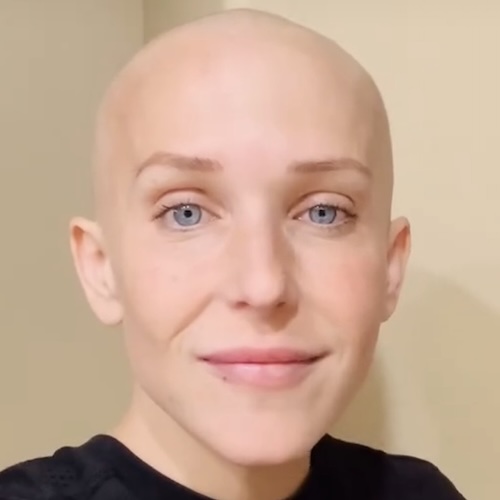
Three months later, jaw pain she attributed to an incoming tooth returned. By November, her cheek was swelling, and a December tooth extraction led to a biopsy. It was osteosarcoma. This time, she started with inpatient chemotherapy, spending days at a time in the hospital away from her kids, before traveling four hours to a specialist for surgery. She expected to lose one tooth. She woke with most of her upper teeth gone and a prosthetic palate built over a skin graft taken from her thigh.
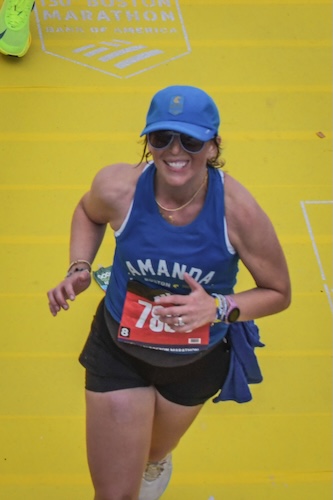
Today, Amanda is running again. She completed the Boston Marathon in April, less than a year after her jaw surgery. Doctors have found spots in her lungs that are being watched, and she is honest about the uncertainty. But she measures her days with a magnifying glass, not a telescope, and says gratitude is teaching her to love her body again.
Watch Amanda’s video and read through the edited transcript of her interview. They’ll give you more insights into her breast cancer and osteosarcoma story.
- Amanda’s lump was found in 2018 and called cystic breast tissue. Because she wasn’t 40, insurance refused to cover screening, and the entire workup was cash pay. It took a friend behind the mammogram machine, speaking plainly about what she saw on the screen, for the diagnosis to finally surface six years later.
- Genetic testing was optional, and Amanda had no family history pointing to it. She did it for her five daughters. The test revealed Li-Fraumeni syndrome, which took radiation off the table and shaped every treatment decision that followed, including her double mastectomy.
- Amanda expected to lose one tooth in her osteosarcoma surgery. She woke up with most of her upper teeth gone and a prosthetic where the roof of her mouth had been. Learning to be “Amanda differently on the outside” became its own recovery, separate from the medical one.
- Amanda couldn’t control her cancer or her genetics, but she ran 18 miles to her own mastectomy. Choosing her response, she says, is the one thing that has always remained hers.
Amanda’s Diagnosis Facts
- Name: Amanda R.
- Age at Diagnosis:
- 36
- Diagnoses:
- Breast Cancer (Invasive Ductal Carcinoma, initially classified as Ductal Carcinoma in Situ or DCIS)
- Osteosarcoma
- Mutation:
- TP53
- Genetic Condition:
- Li-Fraumeni Syndrome
- Symptoms:
- Breast Cancer
- Breast lump
- Nipple discharge
- Nipple soreness and chafing
- Osteosarcoma
- Jaw pain
- Swollen cheek
- Breast Cancer
- Treatments:
- Breast Cancer
- Surgery (double mastectomy)
- Chemotherapy
- Osteosarcoma
- Chemotherapy
- Surgery (maxillectomy: jaw surgery with skin graft and prosthetic palate)
- Breast Cancer
This is not medical advice. Please consult with your healthcare provider to make informed treatment decisions.
- Amanda’s Diagnosis Facts
- Meet Amanda: Breast cancer, osteosarcoma, and Li-Fraumeni syndrome
- Finding a lump after a home birth, then hitting insurance red tape
- My friend behind the mammogram machine: “Amanda, I think this is cancer”
- Running 18 miles to my own double mastectomy
- Why radiation was off the table: Chemotherapy for invasive breast cancer
- My jaw pain returned: From “It’s just a tooth” to an osteosarcoma
- How genetic testing came up: “If not for me, for my daughters”
- Li-Fraumeni syndrome, in my own words
- The weight of passing it on: Guilt, therapy, and forgiveness
- Choosing hope, because joy is brighter
- Monitoring between cancers in a small town: Cost, insurance, and wishing my oncologist had pushed harder
- Hearing “cancer” again, this time with eyes wide open
- Learning to love my body again after running the Boston Marathon
- Spots in my lungs, and choosing a magnifying glass over a telescope
- My advice: Moments don’t last, and we get to choose
- Hear from people living with breast cancer and osteosarcoma
Meet Amanda: Breast cancer, osteosarcoma, and Li-Fraumeni syndrome
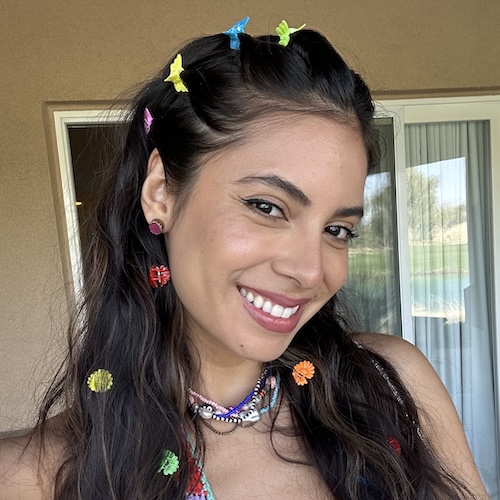
I am Amanda. I was diagnosed with breast cancer. We found out that I have a genetic mutation called TP53 and Li-Fraumeni syndrome. And after the breast cancer, I was diagnosed with osteosarcoma in my jaw.
I am from California, but I have to claim Utah. I’ve been here for a long time. I’m from Saint George, Utah.
Finding a lump after a home birth, then hitting insurance red tape
I had my son, and I went to my appointment. I had him at home, and I went in with my midwife and did the exam after, and she did a breast exam and noticed that there was a lump, and said, “I don’t like that. I think that you should go get that checked out.” So that was in 2018.
And so I did. I went through and I got that checked, and it was a hassle because I wasn’t 40, and insurance doesn’t cover it. You have to go through a lot of red tape with insurance. They weren’t going to cover it even if it was a lump. They just said no. And so this was all cash pay. And we were just starting with our family, and so it was a lot.
So when I went to the doctor to be seen, they decided not to do a mammogram because of my age. They went ahead and just did an ultrasound. And with the ultrasound, they deemed it to be cystic breast tissue. It’s not in my family; it’s not in front of me. I didn’t understand what cystic breast tissue meant. I just thought, “Okay, I’ll get a mammogram when I’m 40. I’ll make sure I’ll do that.”
Dismissing the second warning while training for a marathon
I went on with my life. I had another baby. And again, I went to my midwife, and she was like, “There’s a lump. I just don’t like it.” And it hadn’t gotten bigger. I feel like it had kind of stayed the same, and I had breastfed babies and different things. So there are always things with your breasts, like lumps and all the things.
When I went in and she said that, I was like, “No.” In that moment when that happened with my son, it stressed me out and made me really worried. So now with my second, with my daughter, I was just like, “You know what? I’m not going to stress. It’s fine. It’s nothing. I’m not going to worry about it.”
I just lived my life. I just went on, and it was wonderful. I started actively marathon training and being a mom, and I really wanted to get into Boston. So I had been training really hard. And through that training cycle, I had my little girl, but she’s a little bit bigger. And I had experienced some miscarriages, pretty late miscarriages.
And so when I was training for the marathon, I started to notice that there was some drainage from my nipple, and in my head, it was almost like it was milk coming out. That’s kind of what it looked like. And I had been breastfeeding for so long, and my milk had come in after my last miscarriage. So I was just trying to figure out, is this normal? Not normal? I don’t know. I didn’t know that discharge was a sign.
But I didn’t really even necessarily notice the discharge at first. What started happening was that within my sports bra, I started to chafe on my nipple. And chafing and running are normal, but I hadn’t changed my sports bra. I had breastfed babies, and you become pretty tough. I have never chafed on my nipple. And so that was kind of strange. And from the chafing, there was a sore, and it wasn’t healing. And so I was like, “This is so strange. I don’t know what this is about.” I had a silicone patch, and I said, “I’m going to just put the silicone patch on, and if it doesn’t heal, then we’ll move forward.” But it healed, and it was fine. And so I went on to do my marathon.
A toothache the day before the marathon, and a lump that got bigger
The day before I ran my marathon, I was stressed out because I had a toothache. I went to the dentist, and I’m like, “Oh my gosh, this cannot be happening. My marathon is tomorrow. This is bad news.”
I go in, prepared for the worst, and he checks it. He’s like, “No, your tooth is fine.” And they did an X-ray. They said, “You have a tooth that looks like it’s coming down. We think it’s a wisdom tooth, and you have enough room. It should be fine.” But looking back, I had all my wisdom teeth taken out, so I just thought maybe they missed a wisdom tooth and didn’t tell me about it.
So then after that, I just carried on with my run. I went ahead and did my marathon. And then after my marathon, it was maybe a week or so later, I was in the shower, and I had lifted up my arm to wash my hair, and I looked down. And I noticed that when I raised my arm, the lump protruded. It had gotten bigger. It was getting bigger. And so I was like, “Oh my gosh, is this in my head? What is this?”
I had a girls’ trip planned the following weekend. And I have a friend who is a mammogram tech, and she’s so busy, and she just has a lot of things come up. She says that she’ll come to things, and sometimes she doesn’t. And so, in my head, I feel like I talk to myself a lot. So in my head, I told myself this: that if she were to come like she said she was going to, to this girls’ thing, then I would ask her about this. Ask her if she thinks it’s something that I should be concerned about.
So I went, and she came, and I asked her about it. And she just said, “Let’s look.” And she said, “I think that you should come in. Just, why not? You’re worrying about it. Let’s just get it checked out.”
So I decided to go in, and it was really good because it was her. She was following up with me: “Amanda, have you made an appointment?” And I wasn’t 40, and so I had to go through that red tape again. But I was able to do it. I got a good doctor, and they just referred me over to her.
My friend behind the mammogram machine: “Amanda, I think this is cancer”
I had a mammogram, and I went in by myself, just because I thought, “It’s nothing. You have cystic breast tissue.” And I was really grateful that it was my friend Diane who did the mammogram for me. Because when we were in there, she was really honest and open with me about it. I feel doctors are kind of, “I can’t say anything. We don’t know for sure.” But she was in there, and she was explaining what she was seeing on the screen, and she just said, “This is what I don’t like.”
And she said, “There are these cells, and cells dying. There’s this mass, and then around it, there’s cell death. There’s some kind of disruption.” And so she’s explaining that: “Amanda, I think that this is cancer.” And those are words that you never want to hear. But there was something about my friend being there with me, and it was very direct. And I really think it was the best-case scenario.
We went on and did a biopsy the same day, which is kind of unheard of. They don’t usually do that. So they put me in another room. I had to wait a little bit, and they went ahead and did a biopsy.
Kneeling on the ground: The two doors of dread and hope
Before they had shut the door, I was in this little gown, this awkward gown, and I was by myself. And I remember just the weight of what could be ahead of me. If this is cancer, I have a baby. She’s not a baby; she just turned 4. But then I have five other kids. This is so crazy. I’m healthy. I run marathons, and I take care of my body. So how could this be?
I was kind of dealing with that when the door closed, and I just knelt. I knelt on my knees in this room, and I offered a prayer. And I just said, “Heavenly Father, I don’t know how to walk this. I don’t know how to do this, and I’m scared.”
It’s odd, but in my mind, my lovely talking to myself, I saw two doors in my head. And I opened the one door, and immediately when I opened it, it was dread. And it was terrible. “Why me? I can’t do this. This isn’t fair.” Just terrible thoughts. Just really, really heavy and dark. And I remember in that moment, I just couldn’t get out of that space fast enough. And I shut that door and went to the next door, and I opened it. And behind the door was hope. And I went, “Why not me? I can choose to be happy.” It was full of light and love. And I didn’t want to leave. I loved that space.
I feel like with my journey, there are definitely down moments, and there are definitely hard times. But I can continuously reflect on that moment, and it has really helped me to be mindful of where I’m at within my own head.
They came in and did the biopsy, and then I had to wait a little bit. And then, a week or so later, they let me know that it was ductal carcinoma in situ.
A DCIS breast cancer diagnosis, and learning I had Li-Fraumeni syndrome
The surgeon I was working with was like, “Amanda, this is barely even cancer. We’re trying to decide, do we do a mastectomy? Do we just do a lumpectomy? What do we do?”
During this time, I had also done some genetic testing and found out that I had Li-Fraumeni syndrome. And my family was all tested, and nobody else has it. Just me. When my DNA sequence was created, this just occurred. So I’m a mutant. I’m a mutant ninja turtle, I like to say. It just happened. And so I have had it my entire life.
We found that out as we’re trying to figure out how to gauge what to do. And we went ahead and just decided, “Well, let’s just do this. Let’s just do a double mastectomy, just to be safe.” We know that we have this thing, and we’ll see.
For many people with Li-Fraumeni syndrome, their bodies don’t create T cells like a normal body does. And T cells fight cancer. My body does not fight cancer. It kind of just follows suit and will just create more cancer.
I went ahead and just decided. But they were thinking, in situ means that it’s encapsulated, that it hasn’t spread anywhere else.
Running 18 miles to my own double mastectomy
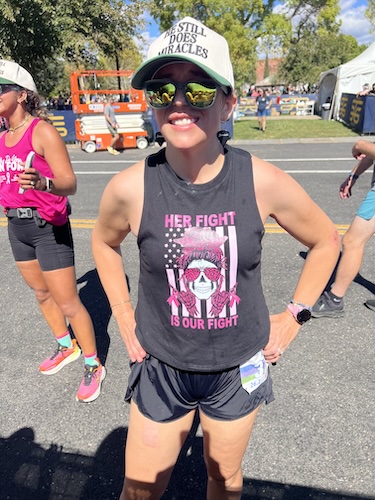
We went in and did a double mastectomy. And that morning, I had this weird thing in my head that I didn’t want to just walk in. I wanted to get there on my own. I wanted to move my body and get there. And I ran from my house to the hospital, 18 miles away. And my friends joined me, and they were there to see me off, and my husband met me there. We all hugged before I went up into the elevator to have that surgery done.
And it was incredible. And I think about that a lot, just how grateful I am that I was healthy enough to be able to do that. There’s something about me and my independence and wanting to control things. And in that scenario, I couldn’t control a lot. But I could choose that I could run. And I was so grateful that I could.
And then I went and had my mastectomy. And pretty much immediately after I woke up, my surgeon and my doctor came in, and they just said, “Hey, we took out three lymph nodes. And on one of those lymph nodes, we found some cancer. So instead of it being in situ, we’re deeming it as invasive. So we’re going to need to talk and see about what we do moving forward.”
Why radiation was off the table: Chemotherapy for invasive breast cancer
With my genetics, it’s just a little bit different. They don’t suggest doing any radiation for Li-Fraumeni, because it damages cells, and my body isn’t fixing them and so on, and it’s even known to cause another cancer, even X-rays and other things. When I go to the airport, I can’t go through the normal screening. I’ve got to do a pat down, unless I’m able to go through the metal detector, which is only if I’m with the kids or something.
And with this, normally, I believe that they would just do radiation, but they couldn’t do that. So I met with an oncologist, and we went ahead to do a chemotherapy plan. So I started chemo, and I did a lot of rounds of chemo, and lost my hair, and got sick, and all of those things. But I finished in June with treatment for breast cancer.
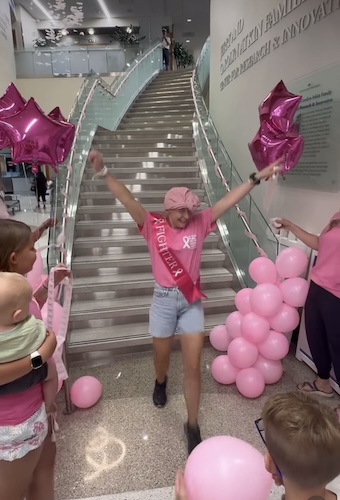
And again, I ran to that appointment from my house, after however many rounds of chemotherapy it was. I was able to. It was slow, and it was wonderful. I mean, I was tired, but I was able to run to that cancer center and have my last treatment, and I was done. And I got to run out and ring the bell. Oh, it was just so wonderful, just to put that behind me and kind of think to myself, I did that. I can be done with that for a minute.
My jaw pain returned: From “It’s just a tooth” to an osteosarcoma
I went on, and I lived, and I was doing really well. And it was about in September that I noticed that there was a little bit of pain again in my jaw. And I just thought, “It’s the tooth, it’s coming in. I’ll just wait it out,” that kind of thing. I was really over doctors at that point. I knew I couldn’t go and get an X-ray for my tooth. And I had a friend who has a brother who is an oral surgeon, and he had said, “I’ll take that out for you.”
So this was in September. I had finished chemo in June, so I was just coming off of everything with medical, and I just needed a minute. And so I kind of ignored it. I was meeting with my oncologist and discussing different things. But I would say by November, my cheek actually began to swell, right where my jaw is, right where a tooth would be. And so I just was like, “It’s the tooth, it’s coming in, and there must be maybe an infection or something.” But it continued to get larger.
And so we went ahead in December and got that tooth extracted. And upon the extraction of the tooth, the oral surgeon let me know that it was a strange situation. When they had gone in and done surgery, they were expecting some pus or different things, because they were thinking that if the cheek is swollen, there’s got to be an infection. And they went in there, and there was none. It was a tooth, but it was encased in bone. And so that’s not normal. It’s not. And so they went ahead and let me know: “Hey, we’re going to send this off to be biopsied, because we don’t like it.”
And so then I carried on. And I thought I had a prompting that it was not cancer. Within my heart, I was like, “This isn’t cancer. It’s okay.” And so I was able to just get it done. But my cheek was still really swollen. The tooth was out, and it would be swollen for a few days, and then it would go down. But it stayed. It didn’t really budge in size.
And then I was informed that it was actually osteosarcoma. The surgeon called me and let me know. And so I had to call my oncologist and tell him what was happening. And so in February, I started treatment. So in June, I was done, and then in February of the succeeding year, I started again, for the osteosarcoma.
How genetic testing came up: “If not for me, for my daughters”
It was my care team. With my age and with how they should treat breast cancer and different things, if they know genetics, they can choose different chemotherapies that tend to respond to different breast cancers better. And I didn’t have to do it. It wasn’t a have-to kind of thing. But I have five daughters, and in my head, I’m just like, “I have to. If not for me, for them, so that they know.”
And so they put me in touch with a genetic counselor, I believe is what it was called. And then I was able to be pushed through to the testing and get that all done. I’m so grateful that I got it done, because there were no signs that I had anything. No family, anything. And so it truly could have just gone unnoticed.
Li-Fraumeni syndrome, in my own words
So LFS is, I think I’m finding out more and more. But yes, my body does not create T cells like a normal body would. And so instead of a typical body that will come in and shut it down, my body does not come in and shut it down.
Li-Fraumeni is a mutation of when you were formed in utero. I don’t think that there’s anything that really causes it. It’s very random. It’s very rare. And I feel like there was some guilt, maybe, on my mom’s end, like, “What did I do wrong?” But truly, it’s not. It’s just that when you’re created, things go wrong. I mean, there’s a lot that needs to go right for a healthy baby to be born.
And this genetic, the name of it is Li-Fraumeni. And it is named after the guy who had this. (Editor’s Note: Li-Fraumeni syndrome is named for Dr. Frederick Li and Dr. Joseph Fraumeni Jr., the researchers who first described it in 1969.) And thankfully, there have been a lot more studies and different things on this, and so there’s more and more information coming out on it. But it affects families, because it is genetic. So, I mean, I’ve got six kids. They’ve all gotten tested.
The weight of passing it on: Guilt, therapy, and forgiveness
At first, when she told me, it was over the phone. It was a genetic counselor who had let me know kind of what it was. I mean, here I am, I have six children. I’ve had three of them at home. I’m not medically minded. There’s definitely a time and a place, but within my life, I’ve just been a healthy individual. So hearing that, I didn’t fully grasp what it was until a little bit later.
And then, learning that I could have passed this to my kids… That was the hardest thing to swallow. Knowing that I’m walking this road right now, and they’re here walking it with me, and they’re seeing and are aware of all the things, and that it was my fault that I passed this on to them. You don’t want anything bad for your kids. And when you find out that you’re the cause of that, it is so heavy.
It’s lonely. And it’s disappointing. And it took lots of mental debates and some therapy to be able to accept this, and to be able to own this, and to be able to forgive myself. And just to live, and to be grateful that I had my children, regardless. In my head, I thought, “I should not have had as many kids if I had known.” But then I think about it, and I’m so grateful for all my kids.
And this is a different road than most, but I hope and pray that as we continue, more and more will come out about it. And that with what they are given, they’ll continue to do good. And that from this, they’ll be changed. They’ll be kinder. They’ll be more willing to help and serve.
Choosing hope, because joy is brighter
I am so grateful for that opportunity, because looking at other cancer patients and things, absolutely, you can feel that way. Absolutely, you can be mad, and you can be sad, and all these different things. But when I look at myself, innately, that’s not who I am. And I’m so grateful that it was right away, in front of me, that I got to make that very conscious decision. This is this feeling. And hope is greater, and joy is brighter. And we get to choose every day. We get to choose.
Monitoring between cancers in a small town: Cost, insurance, and wishing my oncologist had pushed harder
It’s hard, because I live in an area that does not have the research like other hospitals do. Don’t get me wrong, I feel like the hospital here does a great job with what they have. But we’re a very small community. It’s getting bigger, but it’s very small. So the research and things that are just here are not the best.
And so I had been in touch with people in Salt Lake about coming in and doing further screening and different things. But it’s not free. I have to pay for the travel to get up there. And then, even though they are examining me and wanting my information and things, we have to pay for that. So then we’d have to pay my oncologist here, and then for the other things too. And then insurance doesn’t really cover both. And so you kind of have to make a choice. And within my head, it’s like, “I don’t want to take away anything else from my family than I already have, financially and different things.” And this is just how my head works.
And so I just went ahead, and we just met with my oncologist. I think it was monthly that I would go in.
So I was seeing him, and when the lump on my cheek came about, I would go into the appointment, and I knew my face was swollen, and I said, “It’s a tooth that’s coming in,” or whatever. And he didn’t push about it, and I didn’t either. And in my head, I’m like, “Why didn’t he ask more questions?” Being my oncologist, why wasn’t he more like, “Amanda, are we sure that’s just swelling from a tooth? Maybe we should look into that more. We think back about the MRI that you originally had, and it did show that there was,” I forget how they worded it, but something was going on within my jaw. They were aware that something was happening. We thought it was a tooth just coming in. But I kind of wish that my oncologist had taken those reins a little bit and directed me a little bit more. But I’m pretty independent, so maybe I just railroaded him. I was just like, “It’s nothing. Don’t look at it. Don’t look at my face. It’s nothing.”
Hearing “cancer” again, this time with eyes wide open
Well, I had an intuition. I had a feeling that this wasn’t cancer. I was pretty certain that it wasn’t cancer. So to hear that it was cancer was disbelief. And then wondering, “What didn’t I learn?” I understand my genetics, and I understand that this is on the forefront, and this could be on the horizon. But already? We’re doing this again already?
It was pretty devastating to know. Because I feel like I went into breast cancer, and I was naive, and I kind of had my eyes shut to all the different things that had to come. But this time, I was walking into it with my eyes wide open. I understood what I was up against. I knew the treatment. I knew what it felt like to lose my hair. I knew what it felt like to have a big surgery, and to already have to do that again, after just coming off of being done with something. That really brought me to my knees. That really made me question those doors.
Inpatient chemotherapy before jaw surgery: Missing birthdays from a hospital bed
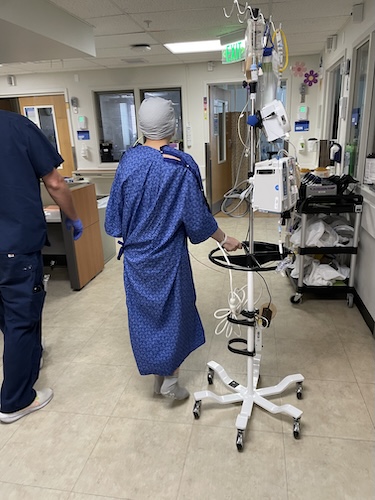
So they wanted to go in and move forward with some chemotherapy, because they wanted to see if they could get the mass to shrink before doing surgery. And they wanted to do a few rounds just at a cancer center. And then the other chemotherapy that I did was in the hospital, and I had to stay there. I had to be admitted to the hospital. So I had to leave my family and go and do this. I missed birthdays and different things. That was really hard.
But I would go in, and the treatment was going to the hospital for, I think, 3 or 4 days. To get the treatment one day, and then you have to get it out of your system before they can let you go home. So that was kind of their mindset: chemotherapy, then surgery.
Waking up with a prosthetic palate: The surgery that took more than expected
I had surgery. I went in after I finished all the chemotherapy and the weeks in the hospital. I’d go to the hospital and then come home, and then go back in. And so then, finally, it was time for surgery, and we had to travel. It’s four hours away from us, to go and get this done by a specialist, because it was in a really odd area.
And I had met with a prosthodontist before my surgery, and I was under the understanding that we were going to have to remove maybe my front left tooth, and then keep the other ones. But they create a prosthetic, and I’d be able to have that, and it would not really be that big of a deal. It would be okay.
So I went in and had the surgery done. And when I woke up, I woke up with my prosthetic in my mouth, because they had taken a piece of the skin on my thigh. They did this perfect rectangle, and they had done a skin graft in my mouth. So when I woke up, I had this prosthetic in my mouth. And it’s really cool because of how they did the prosthetic. They made it so that it’s plastic, but the way that it’s formed, they did molding. So when I touch the roof of my mouth with my tongue, I feel plastic, but it feels like the roof of my mouth. It has the same divots and the same ridges, which is really cool. So that was neat.
But I had to have a feeding tube. And the stuff that comes with the feeding tube, I swear, that was worse than the surgery. It hurt my stomach so bad, whatever it was that they were putting in, that when I went home, I was like, “This is hell. My stomach hurts so bad. Forget my face, my stomach hurts so bad.” I went rogue, and I just started making my own protein and giving it to myself.
But yeah, so the surgery. They went in, and they ended up having to take out quite a bit more. So they took out all these teeth right here, up until right here. I have three real teeth, and then all the rest here are fake. And then the roof of my mouth is gone. It is the prosthetic. So when I eat or drink, I have to tilt my head back further so that the water will go down, because if not, it comes out of my nose. So that’s really fun.
Discovering what was gone: Nothing could have prepared me for what wasn’t there
I didn’t understand the deficit fully in my mouth because of that mouthpiece in there. But I had to go in and get it adjusted, and they took it out for the first time. And I remember sitting in the dentist chair, and I had my tongue, and I pushed, I was lifting it and trying to feel around the roof of my mouth. And I would move my tongue a little bit, and I’m like, no. And then move it again. Nuh-uh. I was just shook. Nothing could have prepared me for what wasn’t there. I just couldn’t believe it. I had braces. I put in the work to have good teeth. And then they’re gone. They’re gone. And that was a lot.
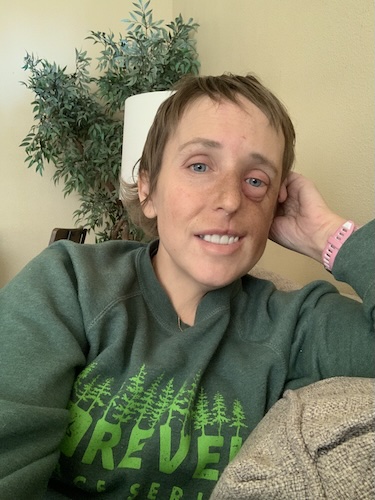
I had this massive scar on my face. And I couldn’t blink equally. And so I would blink, and then this one eye would lag, and I just looked like Quasimodo.
I remember I had to come home from being up north to my kids. And I really had to brace myself, because they’re kids, and I’m their mom. I’ve been to their safe place. And I’m going to walk in that door, and they’re not going to see their mom. They’re going to see this bald lady, who doesn’t even look like a lady, who has a giant scar on her face. How are they going to know me? How are they going to remember who I am? How am I going to be a mom like this? How can I do this?
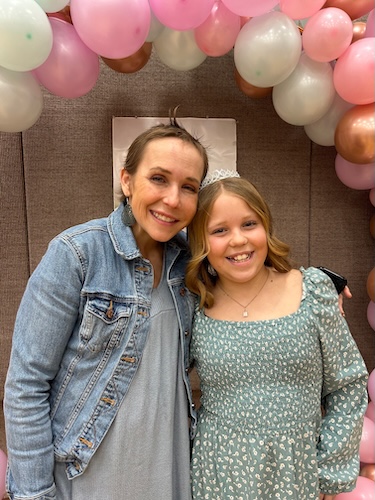
I had gotten home, and I walked upstairs, and it was so hard. They had each one of the kids come into our room individually, to sit down and just have a moment with each other. And that was really neat. But you could see in their eyes that this was hard. This was not an easy thing for them.
I feel like that was probably my lowest point, after that surgery. It was just in my room, in my bed. I’m just bald and toothless. And I just remember sitting on my bed, and I was like, “Dang, my gosh, how do I do this? How do I do this, Heavenly Father? Why am I even here? I think it would just be easier if I were not here. I’m just causing so much hurt.”
I love songs. Songs speak to me. And in my head, I don’t know if you’ve ever seen Frozen 2, but there’s a song, and Anna is singing about how this is dark, this is empty, she’s never felt this before. And I had seen that movie years and years ago. And all of a sudden, those words just came into my head. And it’s a sad song, but I went on, and I listened to it, and I just cried. And I was like, “I know that I’m being spoken to right now. These words are speaking to my soul.” And Anna goes on and talks about how you need to go on and do the next best thing, and the next right thing. And it really just kind of brought me out of it. And I started to build again, and started to adapt to who I was on the outside. I could still be Amanda inside and be the same, but I was learning how to be Amanda differently on the outside.
Learning to love my body again after running the Boston Marathon
I think it’s a continuous journey. I’m still walking. I’m still trying to figure out how to. But this body, it comes down to being active and running. This body has been able to do so much. I have been able to run. I just ran the Boston Marathon in April. And I feel like, because of this, there comes a deeper and greater love than I had before for my body. Before, I was striving to be skinny and look a certain way and do different things. And now it’s just like, “I want to be able to pick my kids up. I want to be able to run and feel good.” And from that has come such an innate gratitude. And I feel the gratitude is really helping me to love my body.
It’s just a shell. It doesn’t totally reflect who I am inside. Really, I’m still Amanda. I started telling people that my name was Jessica when I would go to, say, places where they ask, “What’s your name?” Like restaurants and stuff. And I would say, “Jessica.”
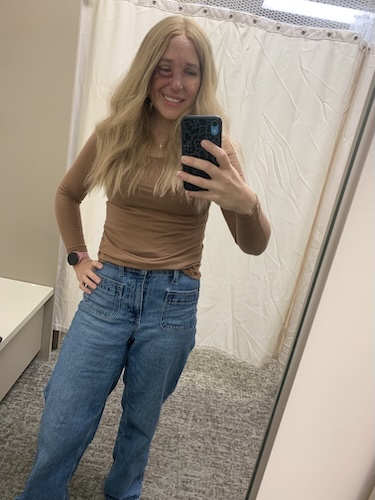
Another thing, too, that was really hard was when I would see people who know me, and I know who they are, but they see me, and they’d be like, “Who are you?” They don’t recognize me. And that took some getting used to. Having to be like, “It’s me. I’m Amanda.” And having to be okay with having to explain what happened. And stopping comparing myself to what I was. So, 100 percent.
It was amazing. It was so amazing.
Spots in my lungs, and choosing a magnifying glass over a telescope
Well, as far as the future goes, things are a little bit different because they found some spots in my lungs. And with that, I question, “How much longer do I have? How much time am I going to be given?” But it doesn’t take away my joy. I am still happy. There is sorrow for having to maybe leave this earth early. Maybe not being able to see my kids fully grow, or be with my husband for 50 years. But I am so grateful for the time that I’ve had here on this earth that I have a life that I will be sad to leave. What a blessing. What a beautiful gift that I have been given.
And so when I look into the future, I’ve just really realized that I can spend my time looking into the years to come and go down into darkness. Or I can be happy for the here, the now. The fact that I was able to help my kids get dressed. I was able to go out for a run. I was able to hold my husband’s hand. I was able to be a sister and be a friend. And if I just, instead of using a telescope and trying to look, if I just use a magnifying glass, and I just look around, it just magnifies everything.
I am so grateful for the experience that I’ve had because of the outlook that I have been given. It’s a different shade. It’s a different color. Not one that I could have ever learned without having to go through it.
My advice: Moments don’t last, and we get to choose
Moments are moments. They don’t last. Step by step. Day by day. Don’t judge your circumstances on unknowns. You can take everything with a breath. And the sun will come up. And it’s okay sometimes to sit in that hard spot and work through it. But it’s also important to get back up again, and to move, and to find the joy, and to find the gratitude.
Because we get to choose. We have agency, and we are the only ones who can decide for ourselves. When life throws things at us that are not of our control, we get to control how we respond. And that is the greatest gift. I’m so grateful that somebody can’t make me sad, or make me mad, or make me angry. That’s the one thing. I can’t control cancer. I can’t control my genetics. But I can choose. I can choose to stand. And they can stand, too. They can choose, and they can rise. And they can just know that there are better moments to come. I fully believe that there’s life after this.
This interview has been edited for clarity and length. The views and opinions expressed in this interview do not necessarily reflect those of The Patient Story. This content does not replace professional medical advice.
Inspired by Amanda’s story?
Share your story, too!
Hear from people living with breast cancer and osteosarcoma
Real experiences with diagnosis, treatment choices, side effects, and life beyond breast cancer and osteosarcoma — in their own words.
Leave a Reply