
JJ Was 27 and Thought He’d Beaten Colorectal Cancer. Six Weeks Later, He Learned It Had Spread.
JJ was 27, a former college football player working for his family’s business in a small town in western North Carolina, when he started feeling a throbbing in his abdomen that he assumed was a pulled muscle from a workout. It was 2015, and like a lot of people his age, he’d never heard of anyone young getting colorectal cancer. “I’m like, no, I’m still in my 20s,” he remembers thinking. “I’m invincible to that. That’s for older people.”
Interviewed by: Tory Midkiff
Edited by: Chris Sanchez
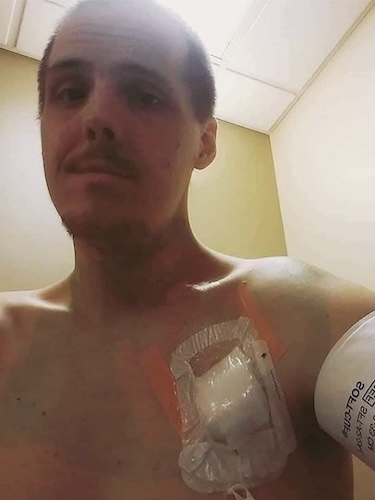
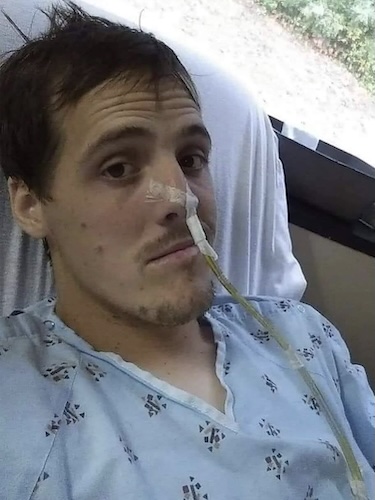
The throbbing got worse. He stopped wanting to eat, started having blood in his stool, and began losing four or five pounds a week. His skin turned gray, and he was sleeping 12 to 14 hours a night. When his mother finally got him to a doctor, the tumor was visible, pushing against his skin. Within a week, JJ was in surgery.
Surgeons removed 80% of his colon and believed they’d gotten clear margins. He completed six months of chemotherapy as a precaution. His follow-up colonoscopy and scans came back clean. Then, about six weeks after his last round of chemo, the same throbbing returned. The colorectal cancer hadn’t just come back. It had metastasized to his abdominal wall and lymph nodes throughout his chest, abdomen, and pelvis, and doctors classified it as stage 4 and incurable.
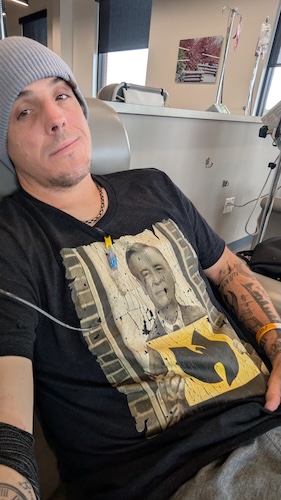
At Duke, JJ was told he had about a 15% chance of being alive in five years. He tried the remaining approved chemotherapy options before entering a clinical trial that year, his last remaining option at the time. He went in believing he’d have no say in his own care, and came out having learned the opposite: that patients hold the power in a clinical trial, down to the ability to stop at any time. That trial drug is now FDA-approved, and JJ is still on it more than a decade later, receiving treatment every 21 days for the rest of his life. Along the way, he also learned he has Lynch syndrome, the inherited condition likely behind his cancer, which now means lifelong screening.
He was told he had a 15% chance of being alive in five years. After trying different chemo options, he joined a clinical trial. The trial drug is now FDA-approved, and JJ is still on it more than a decade later.
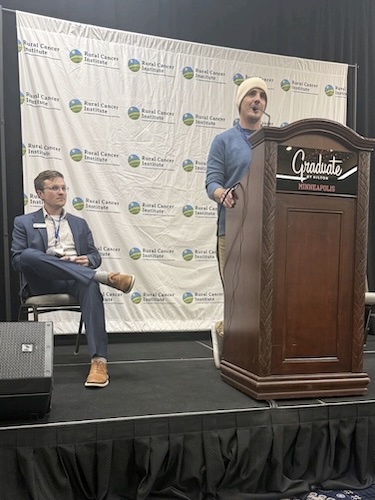
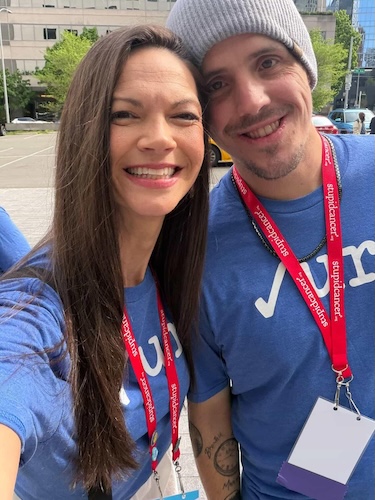
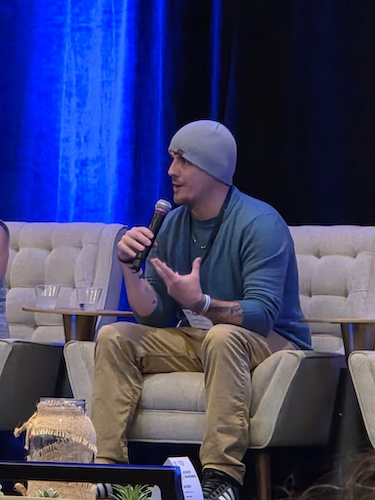
Today, JJ identifies more as a patient advocate than a cancer patient. He works with organizations including Man Up to Cancer, Fight Colorectal Cancer, the Colon Cancer Coalition, and Stupid Cancer‘s CancerCon. He speaks openly about the parts of survivorship that don’t get talked about enough: the mental health toll, the fear that any random pain means recurrence, and a definition of survivorship that, for him, will never include being done with treatment. “Getting cancer was the worst thing ever, and it’s been some of the hardest things I’ve ever imagined,” he says. “But now I get to use that to hopefully help the next generation not have to go through it.”
Learn more about JJ’s story by watching his video and reading the edited transcript of his interview.
- Colorectal cancer isn’t only an older person’s disease. JJ was diagnosed at 27, and by the time he saw a doctor, the tumor was visible, pushing against his skin.
- A clear scan doesn’t always mean it’s over. JJ’s cancer returned about six weeks after finishing chemo, and had already spread to his abdominal wall and lymph nodes.
- Entering a clinical trial doesn’t mean losing control of your care. JJ learned that patients decide what’s done to their body and can leave a trial at any time.
- Quality of life is worth advocating for, not just survival. JJ grew into speaking up about the difference between staying on a drug and having a life worth living while on it.
- Mental health struggles don’t disappear with time, even years into survivorship. JJ still has hard days, and says naming them out loud has helped him more than pushing them down did.
- Shared experience can lighten a weight that’s hard to explain. JJ found some of his closest friendships, including his best friend, through the cancer community, with people who “get it” without needing an explanation.
JJ’s First Video
JJ’s story began in 2023. Learn more about his symptoms, diagnosis, and treatments for stage 4 colon cancer. Watch now.
JJ’s Diagnosis Facts
- Name: JJ S.
- Age at Diagnosis:
- 27
- Diagnosis:
- Colorectal Cancer
- Staging:
- Stage 4 (Metastatic)
- Symptoms:
- Throbbing in the abdomen that he thought was a pulled muscle
- Indigestion
- Not wanting to eat
- Appearance of blood in stool
- Rapid and unexplained weight loss (four or five pounds a week)
- Skin turning gray
- Sleeping 12 to 14 hours a night
- Treatments:
- Surgery: resection of tumor
- Chemotherapy: FOLFOX
- Monoclonal antibody: pembrolizumab (initially through a clinical trial)
This is not medical advice. Please consult with your healthcare provider to make informed treatment decisions.
- JJ’s Diagnosis Facts
- Eleven years since my colorectal cancer diagnosis
- Finding advocacy through community
- How the clinical trial changed my perspective
- Learning to advocate for quality of life during colorectal cancer treatment
- Life on a clinical trial drug, years later
- Lynch syndrome and the genetic side
- Staying ahead of it: Monitoring and screening
- Living with the mental toll of a colorectal cancer diagnosis
- What survivorship means to me now
- A message for anyone going through something similar
- What I’d tell myself, 11 years ago
- The path to my colorectal cancer diagnosis
- Finding something to hold on to through the uncertainty
- Hear from people living with colorectal cancer
Eleven years since my colorectal cancer diagnosis
It’s crazy. It’ll be 11 years this September since I was diagnosed with colorectal cancer, in 2015, at 27. It’s wild to look back and think about how 11 years have passed since then. Back then, I had no idea about colon cancer or colorectal cancer. I didn’t think I was someone who ever had to worry about it, because I thought it was for older people, people my grandparents’ age. They got diagnosed, did the surgery, did frontline chemo. I thought I’d beaten it and was ready to get my life back at 28.
Then, about a couple of weeks later, I felt that same throbbing in my abdomen again, with the same symptoms. I found out the cancer had metastasized and spread throughout my body, to the abdominal wall and lymph nodes. That started the process I’m still in today: a lot of failed treatment plans and drugs, and then a clinical trial later that year saved my life. I’m still on that drug now, and it’s since been approved. Everything is stable-ish, but I still deal with a lot of the side effects, and everything else that comes with almost 11 years of constant treatment and surgeries.
In 2020, I finally started talking about the whole experience. It took me around five years to feel confident, or feel like anybody wanted to hear anything I had to say. My life has completely changed since then. Now I identify more as a patient advocate than a cancer patient. I’ve gotten to do things I never thought were possible in this life.
Finding advocacy through community
It’s crazy, when you’re a cancer patient, especially when COVID happened, how many online groups there were. That’s all people were really doing. Honestly, I didn’t like many of them, because it felt like I was sitting right back in my doctor’s office, with people asking medical advice and reviewing their whole treatment plans and appointments.
Then this guy asked me to join Man Up to Cancer and see how I liked it. I told myself I’d probably leave after a few days, but he wouldn’t quit messaging me, so I figured I’d just do it. It was completely different. It wasn’t about medical advice; it was just men hanging out, and at the height of COVID, that was refreshing. Some guys in there bugged me enough to apply to be an ambassador with Fight Colorectal Cancer, so I applied there too, mostly so they’d quit asking. I remember thinking, who wants to hear what a guy from a town of 1,500 people in western North Carolina has to say about all these big issues?
Once I did that and said yes to a few things after, it snowballed into working with the Colon Cancer Coalition, and then moving into advocacy in the adolescent and young adult cancer space and the clinical trial space. My favorite things I get to do are probably going to Arizona every year for the Cologuard Classic, which is an advocacy event but also feels like celebrating another year of being here. And then there’s CancerCon, an event through Stupid Cancer for people ages 15 to 39 who were diagnosed in that age range. It’s centered on peer support and community, instead of the education-heavy focus of a lot of the conferences I go to — the clinical trials, the drugs, the treatments. Those are the real highlights of this advocacy world I get to be part of every year.
What community changed for me
It changed everything. Finding human connection and community changed everything. When I started talking about this and joined some groups, I got a random connection request on Instagram and started following the person who ended up becoming my very best friend in the world. She’s a mom of two from Phoenix, Arizona, and I’m from western North Carolina, but she’s the one person I talk to every day now. We became best friends, and that showed me what connection and shared experience can do.
There are a lot of people who say, “Well, those are just your cancer friends,” and I think there are levels to that. But so many people I’ve met through cancer have become some of my best friends in life outside of cancer, in regular life too. Having that shared connection of what we’ve all been through, to still be alive, does something. They’re not asking you to explain every little detail of your life with cancer the way people who haven’t had it do, because they want to relate. It’s hard to put into words how much weight that takes off your shoulders, to just be with somebody, or a group of people, who get it.
How the clinical trial changed my perspective
My perspective changed because I became more knowledgeable about what a clinical trial actually was. I was in a strange kind of situation where the clinical trial was my last option. There were no FDA-approved drugs left for me, and no other trial options. It was that, or hospice, and dying. I was 28. I felt like I still needed to be here for a few more years, at least, so I was all in.
But I was so misinformed going into it. I thought I’d have no power, that they were going to tell me what to do, how to do it, like I was just part of an experiment. Through that process, I learned that the patient has all the power in a clinical trial. You’re in charge of what you want done to your body, the drugs you want, and you can stop a trial at any time.
That perspective changed for me. The more I got into advocacy in the clinical trial space, the more I saw that clinical trials aren’t just about the life-saving drug. It’s also about how long you’re on the drug, and whether your quality of life is improving or getting worse throughout that cycle. That opened up more doors and showed me the importance of quality of life, especially for cancer survivors. We hopefully have a long life to live, and you don’t want to go through something and not have a good quality of life for it.
Seeing those aspects of the clinical trial changed my perspective, and it’s made me want to help share that information with other people.
Learning to advocate for quality of life during colorectal cancer treatment
It’s something I’ve definitely grown into. When I first started going through treatment, I didn’t really know what quality of life was. I just thought, give me the treatment I need to survive, and everything else can be dealt with. It wasn’t until later that I realized I really needed to enjoy this life. I wasn’t going through so much just to not enjoy the good days or the good times.
Once my brain made that connection, that’s when I really started advocating for it, because so many people, as great as researchers and drug developers are in pharma or on the research side, if they’ve never been in your shoes as a cancer patient, they assume you just want the drugs so you can live. And yes, that’s true, but you also have to have a life worth living to do it.
Being able to be that voice in those rooms and those conversations means everything to me, because I know how much it can make the difference in whether somebody wants to try a new drug, or is okay staying where they are because they actually get to enjoy their life right now.
Life on a clinical trial drug, years later
The drug I’m on started as a clinical trial. It’s now a proven, FDA-approved drug that’s gone on to help many different cancer types. It saved my life, but it’s also been different, because I’m kind of a unique patient: the drug did enough to keep my cancer from growing, but it’s never going to kill all of it. That’s why I’m on constant treatment.
Realizing that I’m incurable and on treatment for life threw a wrench into what I thought the plan was going to be. But it’s also opened a lot of doors for long-term treatment advocacy and for changing how people think about survivorship.
A lot of the time, survivorship is what people think of after you’re done with treatment, when you’ve still got a life to live. My survivorship looks a lot different, because I’ll always be on treatment. There’s always something new, living with cancer, the treatment, the drugs. But knowing I was part of a clinical trial that’s now approved, and that the drug is out there saving countless people, is something very special to me.
Lynch syndrome and the genetic side
That was a shock too, because I live in a very small, rural area. The side of my family I get it from had no idea. They were very religious people, so when someone passed away, that was just seen as what was supposed to happen. They didn’t know much about genetics back when my grandmother and others in my family were going through it. It opened my eyes to the constant screening and the multiple tests I need to have from now through the rest of my life, so I can hopefully stay one step ahead.
It’s also something I try to help people learn about, because even in the colorectal cancer space I’m in, so many people have never heard of Lynch syndrome until somebody tells them. So many people don’t know about it, because genetics is still newer in this space, and it’s not exactly a hot topic yet.
Staying ahead of it: Monitoring and screening
Since I’m on constant treatment, I still see my oncologist, which makes it a little easier for me. A lot of people with Lynch syndrome, once they’re not on active treatment anymore and they hit that five-year mark, all of the responsibility for keeping up with screening falls on them. That’s a lot of pressure and stress. I have friends going through that.
For me, since my oncologist tells me when it’s time for a colonoscopy or another appointment, it’s made it easier to keep the screenings on a regular schedule. But I know it’s very complicated for people, because after they get that five-year clean scan, when everyone else says it’s the happiest day of the year and they get to be done, that’s when a lot of the pressure lands on them instead.
Living with the mental toll of a colorectal cancer diagnosis
Mental health is definitely complicated. It is not linear at all. There are times I feel like I’m doing really well with the anxiety, the stress, the depression of everything over the last 11 years. And then there are days where I can’t look at myself in the mirror, and I think I’m doing everything wrong, and I don’t know which way to turn.
Acknowledging that has probably been one of my biggest points of growth, because I used to just tell myself it was all in my head, that I had to push it down and keep going. Acknowledging that there are those days has been the biggest growth I’ve had over the last couple of years.
It’s something I talk about a lot, especially as a man who grew up in the South, in a very southern Appalachian culture, where you’re not supposed to talk about it. There are still people in my community, people who knew me before cancer, who don’t understand why I talk about the darker side of mental health as much as I do. But if anyone can see somebody like me talk about it and feel comfortable enough to reach out for help, that’s the main reason I do it.
It helps me a lot, too. Therapy has saved my life, but just getting the thoughts and feelings out of my head and into the world, no matter how they’re taken, is a really big form of therapy in itself.
What helps on the hard days
As strange as it sounds sometimes, acknowledging the hard days helps.
With cancer, people call them their “cancerversaries,” dates that bring up the hardest moments, maybe a surgery, maybe when the cancer came back, maybe losing a friend to cancer. Not hiding from those days, not shying away from them, and talking about my thoughts and feelings around them has helped a lot. And just knowing I have a group of friends who don’t know exactly what I’m going through, because we’re all different, but who understand it.
I say we’re all riding the same ride; we’re just in different seats, in different parks, in different places, but we all have that same, similar experience. Just knowing that there are people who can listen and understand has been the biggest thing.
What survivorship means to me now
Survivorship, to me, is continuing to go through everything I have to, to keep living, and living in a way I want to, where it’s not just dependent on treatment, recovery, and going to treatment again.
I have treatment every 21 days, and it’s hard. It’s probably the worst part of it. I do it 17 times a year, 17 of the worst three- or four-day stretches of the year. But after that, I’m allowed to keep living, and advocacy has brought purpose into my life.
So survivorship to me is chasing after that purpose and helping others through it. Getting cancer was the worst thing that’s ever happened to me, and it’s been some of the hardest things I’ve ever imagined. But now I get to use that, and hopefully help the next generation not have to go through it. That’s the ultimate survivorship, for me.
A message for anyone going through something similar
Don’t isolate, and especially don’t think you’re doing something wrong just because you’re going through something, or feeling some kind of way, because there are so many people out there feeling that same way, thinking the same thoughts, going through the same things.
Maybe you’re all going through it a little differently, maybe not the same, but it isn’t your fault, and it isn’t you doing anything wrong.
So just reach out, and don’t isolate from it all.
Hobbies, travel, and never saying no
Hobbies are great. I still love pretty much any sport: football, basketball, anything athletic, since that was my whole life growing up. I played Division II college football for a few years, and my whole childhood was wrapped around football, basketball, and running track, so anything with sports is great.
I also love traveling, and I’m lucky I get to do a lot of it with advocacy work. I just went skydiving this past weekend, which was a bucket list item, up in New Jersey, and coming down, I got to see the New York City skyline.
I try to live life as much as I can. That’s the ultimate hobby: trying new things, going new places, and never saying no.
I get to travel to a lot of different cities this year for advocacy work. I’m finally going to be a keynote speaker at a major conference this coming November, which was kind of a bucket list item too. Hopefully, sometime in the future, I’d love to attend a conference overseas, in Europe, and start traveling over there.
What I’d tell myself, 11 years ago
My best friend and I actually talk about this a lot, because looking back at who we were when we became friends versus what we’re both doing now, people from back then would never believe it. If I went back even farther, I’d tell myself that life is going to take some crazy, unexpected turns. “You’re going to do things you think are impossible right now.” I never imagined I could get up on stage and talk to people, especially about the topics I talk about now.
I’d also say, “Don’t take anything for granted.” Before I got sick, I was just working to pay the bills, to enjoy two weeks off a year, or the weekends. I was taking a lot of days and time for granted. Even when I first got sick, it was just, “okay, next treatment,” wanting to be done with it, looking six months ahead.
So mainly, I’d tell myself to try to embrace the moment more, the way I try to now. Eleven years ago would have been a lot better for hearing that.
The path to my colorectal cancer diagnosis
Going back to what led up to my diagnosis: I was a college football player, I got hurt, and I gained a lot of weight because I enjoyed college a lot. In early 2015, I started working out with one of my old high school coaches, doing CrossFit, wanting to get in shape. I’d just gotten a new promotion at the family business I worked for, and I remember thinking, I’m about to turn 27, I need to get my life in order, stop just enjoying the parties all the time. So I started working out.
Then, around Memorial Day in 2015, I felt a throbbing in my abdomen and thought it was a pulled muscle from a summer workout. It came and went, but kept getting worse. I stopped wanting to eat. I started having really bad indigestion, couldn’t use the bathroom much, and started having blood in my stool. In my head, it was always an excuse: I’d changed my diet, I was trying to lose weight. I’d look up the symptoms on my phone, and colorectal cancer would always be at the bottom of the list, and I’d think, no, I’m still in my 20s, I’m invincible to that, that’s for older people.
Then I started losing an insane amount of weight, four or five pounds a week, and my skin was turning gray. I’d go to work and come home and go straight to bed, sleeping 12 to 14 hours a night, which I’d never done before. I’d love to be able to sleep 12 hours a night now. My mom finally made me go to the doctor, and by that point, you could see the tumor pushing through my skin if I pressed my shirt against my stomach. He sent me straight for a CT scan, and within a week, I was in surgery.
It was September 4th, the Friday before Labor Day, when I did the CT scan. I had the colonoscopy the Tuesday after Labor Day, and then I was in surgery the next Wednesday. It went from “Is it this, or is it that?” to “Yes, you have colon cancer, now you have to go get surgery, and you’re going to have chemo, welcome to this world.”
The first recurrence
After surgery, where they removed 80% of my colon, they thought they’d gotten all of the tumor, that I had clear margins. But they still had me do frontline FOLFOX chemo, which is basically cleanup chemo, to try to kill anything that might still be there. I did that for about six months, from November through April, every two weeks. I had a colonoscopy, and my colon was clean. Scans were scheduled for about a month after that, and all indications were that I was good.
Then, about six weeks after my last round of chemo, I felt that same throbbing in my abdomen again. It turned out the cancer had been growing, and the chemo hadn’t done anything to it. It had grown into my abdominal wall, and I had lymph nodes in my chest, abdomen, and pelvis that all had cancer in them by then. That’s when it was classified as stage 4, and because it wasn’t in a solid organ, the word “incurable” came up, because they couldn’t just remove it. That’s when I went down to Duke and started going through all the other approved chemo options, to see if anything would work.
What went through my head in that moment
I didn’t want to believe it was the cancer again. I told myself it was scar tissue. I was at the doctor’s office about an hour before it even opened, waiting for him. Then it was just this constant numbness, going through all the scans and biopsies, waiting on results. It wasn’t really until my oncologist in Asheville told me. After they took a biopsy, I’d already figured, “Yes, this is cancer,” and in my head I was thinking, “Okay, I can do six more months; that’s still doable for another round of treatment. Hopefully, this will be the end of it.”
Then I went to Duke, and they told me my cancer had spread, that it was incurable, that I’d be on these treatments for life, and that I only had about a 15% chance of being alive in five years. That’s when I completely shut down.
The only reason I kept doing treatment at that point was that I wanted to make it to age 30. Not for myself, but to say goodbye to my friends and my family. I thought, “Okay, 30, that gives me two, two and a half years, enough time to make memories and tell them goodbye.” Because if this was going to be my life, I didn’t want it to be a 10-, 15-, 20-year life doing what I was doing then. A lot was going on for me mentally back then that I wasn’t in the mindset to get help with, not until a little later on.
Looking back at the lowest point
It’s crazy. I know it’s weird, as a cancer patient who’s been through so much, to say I’m very lucky, but I have a lot of friends who aren’t here anymore, whose treatment or trial didn’t work for them. I think that goes hand in hand with me finding my purpose in advocacy, to honor those people and to try to make my story more of the norm than theirs. I know that’s what they would want.
Looking back, it’s crazy to think I’m still here, and even crazier that I’m doing what I’m doing, for the reasons I’m doing it. Some days it’s really hard to believe.
Living with side effects and fear of colorectal cancer recurrence
From all the treatments and the surgeries, I have a lot of scar tissue, but I’ve also developed a kind of acute pancreatitis. When I had an attack from that, it was throbbing, in almost the same area as where my first tumor was. I freaked out and went to the emergency room. They did the scans and told me there was nothing there, that everything looked normal, but that I had this new condition.
Any pain in my abdomen that isn’t the normal tenderness, and after 10 surgeries and all that scar tissue, my abdomen is always a little tender and achy, but any random pain, and my mind automatically goes to thinking the cancer is growing again, that it’s moved, that it’s doing something. I think that’s just unfortunately part of this life, and it probably always will be. There have been a few instances where it’s taken my breath away.
Finding something to hold on to through the uncertainty
A lot of it came from getting into certain parts of advocacy, seeing the whole process, the whole circle of cancer, from patients to pharma to research. Seeing that there are countless people whose life’s work is to make this better for people like us.
When I was able to step back and look at that, it never alleviates the uncertainty, but it lets me know how much work is going into making things better.
This interview has been edited for clarity and length. The views and opinions expressed in this interview do not necessarily reflect those of The Patient Story. This content does not replace professional medical advice.
Inspired by JJ’s story?
Share your story, too!
Hear from people living with colorectal cancer
Real experiences with diagnosis, treatment choices, side effects, and life beyond colorectal cancer — in their own words.

Leave a Reply