
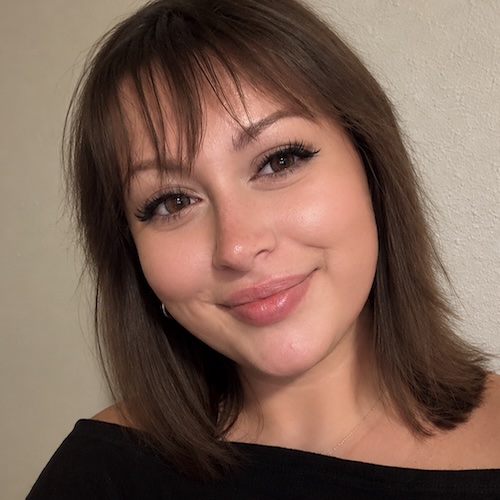
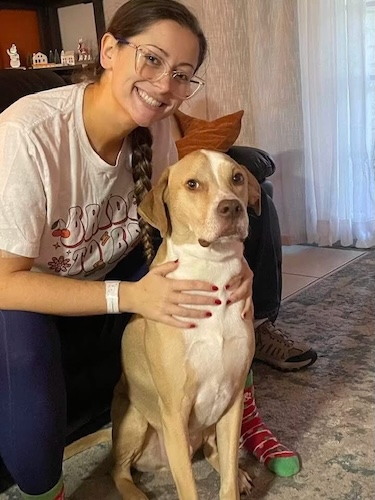
“This is Not a Death Sentence”: Emma’s Stage 3C Ovarian Cancer (Low-Grade Serous Carcinoma)
Emma’s low-grade serous ovarian cancer first showed up in the middle of the night as extreme left lower abdominal pain. An ER ultrasound found what the report called an “echogenic mass-like structure,” which the radiologist thought was possibly stool. They recommended follow-up imaging.
Interviewed by: Tory Midkiff
Edited by: Chris Sanchez
For the next six months, the pain persisted. Emma felt bloated and full, like she had eaten too much all the time. Her lower back ached, which she blamed on long shifts, and she lost about 50 pounds, which she credited to the gym. A referral to a gastrointestinal doctor was weeks away. “I knew before I even got the diagnosis that what I had was cancer,” she says. She called her doctor’s office crying, and they ordered scans.
The results came on her lunch break at work. A CT scan, a detailed X-ray image of the inside of the body, showed a large tumor pressing on her spine and crushing her kidneys. Doctors placed nephrostomy tubes to drain her kidneys, then performed an exploratory laparotomy, a surgery through a long cut down her abdomen. She woke up saying, “No babies, no babies,” and spent 12 days in the ICU with a colostomy. She was told the cancer was stage 3C low-grade serous carcinoma, a type of ovarian cancer. It had spread to nearby organs, abdominal lymph nodes, and her abdominal wall. The oncologist who explained it kept repeating, “This is not a death sentence.”
She began chemotherapy, but four minutes into her first infusion, she went into anaphylactic shock, a severe allergic reaction. Her team switched her to a different formulation for the rest of her treatment. After chemotherapy, a second-look surgery with HIPEC (heated chemotherapy washed through the abdomen) still found small amounts of cancer, so she did a second round of chemo.
Now Emma gets CT scans every few months, and, so far, they haven’t turned up anything new. Scan days still make her nervous, but she’s backed up by a team and support system she has full confidence in. She and her husband are now adopting. “We’re just excited to finally be able to start our family together.”
Watch Emma’s video and read the edited transcript of her interview to learn more about her ovarian cancer story.
- Each of Emma’s early symptoms had an everyday explanation on its own: back pain from long ER shifts, weight loss from the gym. Together, months of constant bloating, fullness, and abdominal pain added up to something she couldn’t set aside, and when she called her doctor’s office in tears, scans were ordered.
- A clear scan wasn’t the full picture for Emma. Her CT scan after the first round of chemo “looked perfectly clear,” but pathology from her second-look surgery still found small amounts of cancer, which led to a second round of treatment.
- Emma’s gynecologist went from someone she found “very cold” to the member of her care team she’s closest to. Looking back, Emma understands the distance at the start: the doctor “didn’t want to get attached if it was something bad.”
- Emma woke from surgery repeating “no babies, no babies.” Today she and her husband are adopting, and she says doing it differently has “just made us so incredibly sure that that’s what we want.”
- Emma’s advice to anyone facing cancer young is to let people see the hard days: “Don’t be afraid to tell people when you’re not okay.” She points to the people around her, including the family friend who was her nurse at every infusion, as what anchored her through it.
Emma’s Diagnosis Facts
- Name: Emma M.
- Age at Diagnosis:
- 24
- Diagnosis:
- Ovarian Cancer (Low-Grade Serous Carcinoma)
- Staging:
- Stage 3
- Symptoms:
- Bloating and feeling full all the time
- Constipation
- Left lower abdominal pain
- Lower back pain
- Nausea
- Painful intercourse
- Significant weight loss of around 50 pounds
- Fatigue from disrupted sleep
- High blood pressure not controlled with medication
- Treatments:
- Surgeries: nephrostomy tube placement, hysterectomy, bilateral salpingo-oophorectomy, colostomy
- Chemotherapy: HIPEC (hyperthermic intraperitoneal chemotherapy), CarboTaxol (carboplatin and Taxol), nab-PC (carboplatin and Abraxane)
- Immunotherapy
- Hormone therapy: hormone blockers
- Cold caps
This is not medical advice. Please consult with your healthcare provider to make informed treatment decisions.
- Emma’s Diagnosis Facts
- Life at 24 as an ER nurse, before ovarian cancer
- Finding out about a gigantic mass while on my lunch break at work
- Nephrostomy tubes, emergency surgery, 12 days in the ICU, and “This is not a death sentence”
- Stage 3C low-grade serous ovarian cancer: Understanding my diagnosis and genetic testing
- Carboplatin and paclitaxel, and going into anaphylactic shock four minutes into my first infusion
- A clear CT scan and a second-look laparotomy with HIPEC, which found that the ovarian cancer was still there
- Living with a colostomy bag at 24, through a wedding and a honeymoon
- Monitoring after treatment: CT scans and finishing immunotherapy
- How I handle scan days
- How cancer changed the way we’ll grow our family
- What I’d tell someone who’s facing cancer at a young age: It’s okay to not be okay
- Hear from people living with ovarian cancer
Life at 24 as an ER nurse, before ovarian cancer
I was working in the emergency room at the time. I’m a nurse. I was really starting to feel very comfortable there, like I had a grasp on it a little bit more. I’d been there for almost a year at that time. I had grown really close to a lot of the nurses there, a lot of the staff there.
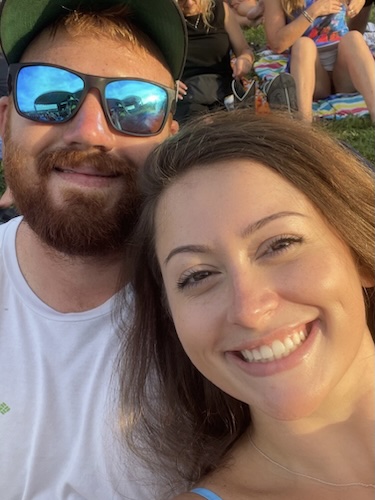
My at-the-time fiancé, my now husband, and I were very active. We were going out and doing things and hanging out with lots of family and friends. We were just living how we should have been living in our early 20s. We were really loving life, so it was great.
Waking up with extreme abdominal pain and the bloating that never went away
The first time I had any kind of concerning symptoms was probably about six months prior. I woke up in the middle of the night with extreme left lower abdominal pain. Being a nurse, my first thoughts were ectopic pregnancy, ovarian cyst burst, or ovarian torsion. I woke my fiancé up, and we went to the hospital where I worked. I had some imaging done, got discharged, and went home.
The pain didn’t really get much better after that. I had been following up with my primary care, and she was trying to help me out the best she could. But ultimately it just wound up being what it was. The abdominal pain was pretty constant. I always felt really bloated, just very full, like I had eaten too much all the time is what it felt like. That was my biggest symptom.
I’d been having some lower back pain, but I attributed that to being a nurse, working in the emergency room, and always being on my feet. One symptom that I didn’t really think was a symptom at the time, but looking back definitely was, was that I had lost about 50 pounds. I figured that maybe that time in the gym was working for me really well, and my diet changes were working, and it could have been that. But looking back, it most probably was a sign of the cancer too.
An ER visit and an ultrasound
When I went to the ER that night, I only had an ultrasound done. The doctor afterwards told me that it looked like there was an “echogenic mass-like structure adjacent to the uterus and ovaries.” The radiologist who read that report said it was possibly stool, but follow-up imaging was recommended to determine the cause. But ultimately, I was basically talked out of it. I ended up saying, “Okay, I don’t really think that’s it, but I feel better. So whatever, I’ll go home and get some rest, and hopefully I’ll feel better tomorrow.” But that was pretty much all that it showed then.
I didn’t have any further imaging until right before I got diagnosed. My primary care doctor had given me a referral to a GI doctor just because I was continuing to have the abdominal pain, the fullness, and the bloating. So she gave me a referral to him, and I was set to see him a few weeks after that. But I just talked myself into a panic.
I knew before I even got the diagnosis that what I had was cancer. I was looking at everything, basically, that I was experiencing, and I knew that’s what it was. I basically called her office crying, and she said, “Okay, we’ll get you some scans done.” So she ordered me a couple of outpatient imaging tests to be done.
My mother worked at an oncologist’s office at the time, and their scheduler was kind enough to help me get those spots secured faster, so I was able to go by the end of the week and get those images done. The week after is when we got the results of what they looked like.
Six months of bloating and back pain, and sleepless nights
It was definitely hard on me mentally because I felt uncomfortable in tight clothing and in jeans. My work clothes just didn’t quite feel right on me. I was run down constantly because the pain and the bloating would wake me up at night. I wasn’t getting restful sleep at all.
We actually bought a new mattress because we thought my back pain and waking up at night was something that we could fix with a better mattress; it didn’t happen. But it was just hard. I was definitely tired all the time and just not feeling my best. When you don’t feel good, you may not be technically the nicest person. You may lash out every now and then. My husband and I have made our peace with that now. But it was definitely hard.
Finding out about a gigantic mass while on my lunch break at work
I got a call from the doctor’s office when I was at work, and they asked if I could come in for an appointment. I said, “I can’t come in. She knows I’m a nurse, and she’ll call me and tell me.” We set up a time, about 2 p.m. I took my lunch break at work at that time, and I was in the break room when she called me and told me that I had a gigantic mass. It was, I think, 7 by 9 inches. It was really, really large.
That was really scary, because we didn’t know what it was at that time, because it was just a mass. That was all we had. I went back to work from my lunch break, and I went to my boss and told her what was happening, and she said, “You need to go home.”
I called my parents, and my parents wanted to come pick me up. They didn’t want me to drive because I was obviously a mess. When they were on their way, my boss came and found me, and she said, “Do you want to check in? We can do the CT scan that she wants to do on you.” I said, “Yes, absolutely.”
We got me checked in. Obviously, because I worked there, I knew all the doctors, nurse practitioners, nurses, and everything. I got really great treatment, and we really did everything according to what I wanted to do for myself, which was really great.
We got the CT scan, and it was massive. Massive, massive, massive. It was pressing on my spine, my lower back, which is why I had so much back pain. It was crushing my kidneys to the point where I actually ended up needing to get tubes placed into them to relieve the pressure in them before I had my surgery.
But finding out at work, in retrospect, was probably the best time I could have found out, because I was already there. I had all of my friends with me, and my family came, and my fiancé came. It was just good to have everybody there with me. Thankfully, I work close to where we live, so everybody was able to be there for me when I needed it.
“I told you, I knew it”: Facing how big the mass was
I had told them my fears about the cancer and how I felt like that’s what this was. I just kept saying, “I told you. I knew it. I knew it.”
Obviously, I was terrified. Because of the size of it, I figured it was pretty advanced, so I didn’t know what my odds were going to be. But it was definitely a really scary time for everybody.
Nephrostomy tubes, emergency surgery, 12 days in the ICU, and “This is not a death sentence”
I’m not sure if it’s because of how severe the case was or if it was because I worked there and maybe I got a little bit of preferential treatment, but I did get admitted to the hospital that night. I was in the ER for a couple of hours. I went upstairs to a room, and in that time, I had given my medical history to probably six or seven residents who came in and did all their charting.
Then they said, “This is going to be surgical, and they’re going to have to remove it while you’re here because of the way your body is reacting to everything.” My blood pressure was through the roof, not controlled with medications, and my kidneys were really, really, really struggling. So it was nice to be there.
I got admitted to the room, and then I got a surgery consult from a very well-known general surgeon in the area. He typically did oncology surgeries, so I already knew at that point. I was like, “That’s what we’re thinking.” I’d been told up until this point that it was likely a dermoid cyst, which is basically trapped tissue, random tissue. You can find all kinds of stuff in there, like teeth and hair. It’s a little bit creepy and that freaked me out, but I was hoping it was that rather than cancer. But I knew it was cancer.
But the surgeon came to talk to me, and he said, “We’re going to put nephrostomy tubes in.” I had the urologist come in, and he talked me through everything too. I had that done the next morning, bright and early. I had them on both sides, and it was a conscious sedation procedure, so you’re not fully knocked out for it. You’re awake. They just give you enough medication to calm you down and keep you from feeling all the pain. It was brutal. I had to lie on my stomach, which was basically on the mass, so I was very uncomfortable, and I just remember sobbing the entire time. It was not fun. But it definitely helped with my kidneys. It helped my blood pressure go down.
And then I got to meet with the gynecologist who was going to be doing my surgery. She was very cold, I thought, at the time. She wasn’t very warm and fuzzy. But she told me that she was going to do the surgery, and the other doctor was going to be there just on standby in case she needed to tap him in for anything else.
Within 24 hours of being admitted to the hospital, I was prepped for surgery. Thankfully, it worked out well enough. I figured I would have some sort of surgical procedure that day, so I didn’t eat anything. I had a couple sips of water early in the morning, and that was about it, so I was cleared to have the surgery the same day, which was really awesome.
When I was in pre-op, the general surgeon came in, and he walked me through the possibilities of what could happen, which was hysterectomy, colostomy, all these things that are so scary to hear when you’re 24 years old. But I signed the consent, and they gave me something really good, because I don’t remember anything until after the surgery.
The surgery was about seven hours. I went in at 7 p.m., and I didn’t get out of the surgery until a little after 1 a.m. The only thing I remember when I first woke up was that I just kept saying, “No babies, no babies.” I don’t know how I knew it, but my fiancé was there, and he was crying over me and he’s not a crier at all. He doesn’t show much emotion, so that really was when I knew it was bad.
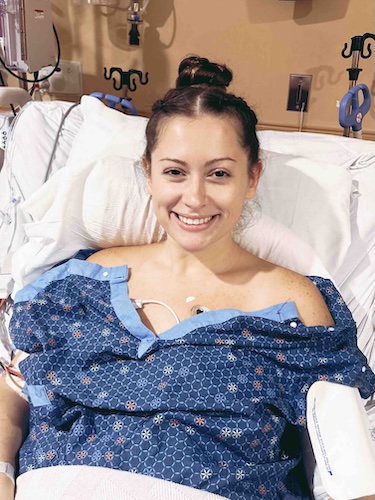
I spent the next 12 days in the ICU just recovering, because my surgery was major. It was an exploratory laparotomy. They cut you from the bottom of your sternum all the way to the bottom of your belly, and they were in there for seven hours. It was really intense.
About a week after surgery, the attending physician on my case came in and told me, “We got you scheduled for a port placement on Friday.” I said, “Why do I need a port?” Because I hadn’t gotten a diagnosis at this point, I didn’t understand. And he said, “Has anybody been in to talk to you about the pathology?” I said nope. It was just me and my dad in the room at the time. Everybody else was working. And I didn’t want them to put everything on hold for me, because I feel okay. Everything looks great. We’ll be fine.
The oncologist who my mom works with is just a saint. He’s an angel. He saves people. He’s the best of the best. My mom’s best friend works at the same office, and she said, “Let me go talk to him.” She went and talked to him. Within probably about three hours, he was at the hospital talking me through my diagnosis, making sure I really understood everything. My mom showed up a little bit later. We had our moment. My mom, my dad, and I were in the room, and we just cried on each other. But the thing that he said the most was, “This is not a death sentence.” He really eased my mind with that.
Stage 3C low-grade serous ovarian cancer: Understanding my diagnosis and genetic testing
He told me that the pathology report said that I had low-grade serous carcinoma, stage 3C. It’s advanced stage 3 ovarian cancer. It being low-grade is better because I have a better prognosis. That way, it’s easier to treat. (EDITOR’S NOTE: The American Cancer Society clarifies that cancer survival rates are estimates and, because they are often based on the experiences of numbers of people who all have a specific cancer, can’t predict the outcome of a particular person’s case. The Society further states that ovarian cancer treatment will depend on the type and stage of the cancer and other factors, and it might also include more than one treatment, such as chemotherapy or radiation therapy.)
I was stage 3 and he explained very well what that meant. It had spread to nearby organs, some abdominal lymph nodes, and was embedded in my abdominal wall, but it didn’t go any further than that. They had started drawing tumor markers on me. My CA-125, I had that done twice in the hospital and then I had it drawn regularly during chemo after that.
He said they were going to do some genetic testing on me to see if it could be familial or if it was just a fluke, and they did further testing to see if there were any gene mutations that could have caused it. Everything was negative. It wasn’t familial. It wasn’t anything that anybody in my family is at risk for, because mine was a fluke. There were no genetic mutations. I didn’t have any BRCA genes or anything. No other genes that would put me at risk for cancer.
It was epithelial, not germ cell. All of the things that it was coming back as gave me really good odds of treatment. We did a PET scan. Thankfully, because of the surgeon, he got so much of the little tiny bits of cancer out of my body that my PET scan was basically clear on the first go, before I had had any chemo, which was really great.
And then just standard basic labs that I had done every time I went there, so my blood levels, my white blood cells, my platelets, all that kind of stuff. But that was most of it as far as testing goes.
Carboplatin and paclitaxel, and going into anaphylactic shock four minutes into my first infusion
For my chemotherapy, I was going to be on Taxol, which is a brand of paclitaxel, and carboplatin. I was going to be doing the carboplatin every three weeks, and Taxol every week. With that, towards the end of my chemotherapy, I started getting the immunotherapy infusions, and I started needing to get the growth factor injections after my chemo as well, because of how depleted all of my levels were in my blood.
We had to change my chemo regimen on the first day. I was four minutes into my first infusion of Taxol, and I went into anaphylactic shock. My dad was there with me because he was helping me with the cold capping that I was doing to try to preserve my hair as much as I could. My mom was off that morning, but she worked there, so she was sitting there with me too.
Within four minutes, I was in anaphylactic shock, and I stopped breathing, and I had basically no pulse, no blood pressure. I definitely caused a big scene on my first day there. But luckily, I have the best doctor and the best nurses. They gave me lots of steroids, an epinephrine shot, lots of fluids, and oxygen.
But that moment was so surreal for me, because I have no allergies to anything. I’ve never had an allergy to anything, so I didn’t know what that felt like. Being a nurse, in nursing school they always tell you about the impending sense of doom that you can get when something bad is about to happen to you medically. If you’re about to have a stroke, you can have the impending sense of doom.
I felt it in that moment. I didn’t know how you could possibly describe that feeling to someone. But I was lying down because I had been given Benadryl, so I was very sleepy, and I shot up from my chair, and I looked at my mom, and I said, “Something’s wrong.” That was when I basically lost consciousness. I could not wake up until somebody actually physically touched me and said, “Emma, wake up.”
It was definitely like an out-of-body experience. I remember I was standing over myself in the chair, but it was just me and the room was just white. There was nothing in there. Nothing was going on. It was just me looking over myself, and I was trying to wake myself up: “Wake up, wake up. Come on, wake up. Breathe.” And I could not do anything until somebody actually physically touched me.
After that, we switched to Abraxane, which is the same medication, another brand of paclitaxel. It’s just got a different formulation. There’s literally one specific ingredient in that first chemo that, if you’re going to have a reaction, that’s what will do it. It’s not a very common reaction. But when somebody has that, that’s what causes it. It was just a differently formulated version, and it worked great the rest of the time. I did all of my six carboplatin treatments and my 12 Abraxane, and that was the first rounds of chemo done.
Facing the second infusion and the nurse who treated me like her own
I was absolutely more anxious to be getting into this again, especially what had been happening so far. I was terrified, but at the same time, it was more so a fear of that feeling again.
As far as my well-being, I knew I was in such good hands. Throughout the entire time that was happening the first time, I wasn’t scared. I wasn’t scared at all. I was very, very, very calm and at ease and just letting it happen.
The group of people I had around me is really where that confidence is anchored. My mom’s best friend was my nurse throughout all of my chemo treatments and she treated me like I was her own. She was just amazing. She would pray for me, and I could tell her anything. She was always there to comfort me if I was having a really bad day. But she was my nurse every single time I went there. She’s just the best.
A clear CT scan and a second-look laparotomy with HIPEC, which found that the ovarian cancer was still there
I got another CT scan that looked perfectly clear. But I had a surgical oncologist who I was following up with in addition to my regular oncologist locally and they talked to each other very well, and they communicated very well with me, too, thankfully. They both were in agreement that I was going to have a second-look laparotomy, so I was going to have that same big cut again.
During that procedure, not only were they going to pick out anything else that may have been in there, but they were also going to hopefully reverse my colostomy that I had placed the first time and I was also going to get HIPEC, which is hyperthermic intraperitoneal chemotherapy. They basically fill your abdomen full of hot chemo, close you up, swish you around for like 90 minutes, they dump it all out, and you’re done.
I had that surgery, and everything went pretty well. And then the pathology came back that I still had cancer, so we restarted everything again, but the scans and everything looked fine. My numbers were looking very, very good and going down the way that you wanted them to every time I had the labs drawn. Everything looked good, but there were still small amounts of it in there.
Round two of carboplatin and Abraxane, and cold capping the second time
I had the same carboplatin and Abraxane. We did fewer cycles of the Abraxane this time, so I didn’t need it every week. I did that and the carboplatin every three weeks, which was a very nice break.
We tried to do the cold capping the second time around. I was able to keep a good amount of my hair the first time, probably about 60 to 70%. I should have done more research on it, because it’s not as effective on your second round of chemo.
Within two weeks, I had started losing clumps of hair, and I was like, “Okay, time to go, I guess. We’ll just get rid of this.” But it was the same regimen, so I knew what to expect. It just hit me a lot harder the second time around.
Living with a colostomy bag at 24, through a wedding and a honeymoon
It was definitely very, very hard, because I was 24 years old. I was in what I thought was the best shape of my life, and I was so ready for the summer to come around, because I was going to wear all of the bikinis. I was so excited for it. Then you walk around and you have this bag on the front of you, and you can’t control what comes out of it.
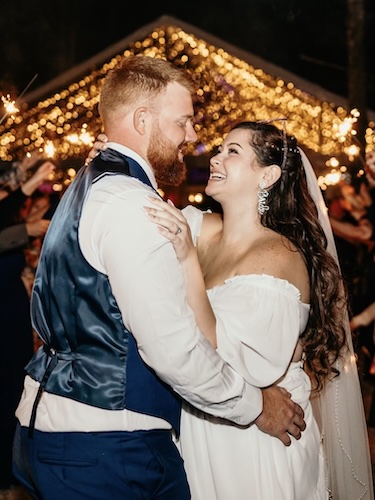
We were also planning our wedding. We had gotten married shortly after I started chemo. We managed to still go through with everything. But it was just very hard to navigate everything around that bag, always being scared that other people could smell it. A lot of people don’t realize, but it farts. It farts, and you can’t control it, and that’s traumatizing when you’re in public. It’s like you farted, but you didn’t fart, and you can’t help it.
When we went on our honeymoon, I couldn’t go swimming because the adhesive wasn’t waterproof. I couldn’t keep it on the whole time, so that was really unfortunate as well. It’s a lot on you mentally to walk around with something that is just so gross. You just can’t help it.
Monitoring after treatment: CT scans and finishing immunotherapy
From there, we did CT scans regularly. I’ve had them about every four or five months or so. They are all perfect. Everything always looks good. I’ve had ultrasounds on my breasts just to make sure, because it’s cancer, and you don’t want it to possibly have something growing elsewhere. You always want to be extra sure.
We did labs pretty routinely, and we finished the immunotherapy that I was on for about 18 months. I didn’t finish that until early 2026. Everything looks really, really good.
I went for a CT scan in August, and then I’ll go for another one in December. We just do labs right before, then do the CT scan. I have a follow-up appointment, and it’s done. It’s nice to not have to go in every couple of weeks and get poked with a needle every time. But we’ve got a pretty good routine down. I know what to expect when it comes time for that. So, looking good.
How I handle scan days
Scan days are definitely always nerve-wracking.
I’m fortunate enough to know that I will almost always get my results before the end of the day. But I go into it knowing that I’ll be fine no matter what happens. I have the best team, I have the best support system, and I’ve done treatment twice.
If worst comes to worst, I’ll do it a third time.
How cancer changed the way we’ll grow our family
My husband and I are currently in the process of adoption. We have the baby’s nursery and we’re excited to finally be able to start our family.
It’s made us so incredibly sure that that’s what we want. You never realize how big of a decision it is until you have to do it differently and have to spend thousands of dollars trying to grow your family, and the hoops you have to jump through. We’re just looking forward to the end, when it’ll all be worth it.
What I’d tell someone who’s facing cancer at a young age: It’s okay to not be okay
Don’t be afraid to tell people when you’re not okay. It’s so easy to put on a brave face whenever you’re going through something like this and feeling like you have to be strong. But that’s what support systems are for: for supporting you when you are not okay.
It’s okay to not be okay. You’re going through the hardest time in your life. You’re not always going to be okay. But having friends and family who love you and support you will be the best thing that you could possibly have.
The gynecologist who cried when she saw what they found
I just want to talk about my gynecologist who did my surgery for a minute, because she is an angel. She was cold to me at the beginning, and that was because she didn’t want to get attached if it was something bad. But after my surgery, the first day I saw her, she said, “I couldn’t help but stand back and cry when we opened you up and saw what we saw.”
She has been so amazing. I’ve never gotten closer to someone who has been on my care team in my life, but she is so amazing. She follows up with me whenever I need anything. She’s always supportive. She calls me her baby when she sees me. I’m like a VIP in her eyes, which is just amazing.
My sister had a baby in February 2026. The nurse was the one who followed her pregnancy throughout that entire time. We would go to her appointments together, and we would just have a great time. I knew that my sister was going to be well taken care of. When it came time for my nephew’s delivery, he was stuck, but she got him out safely. She just went above and beyond to calm everybody’s nerves. She’s just one of the most amazing people I know.
This interview has been edited for clarity and length. The views and opinions expressed in this interview do not necessarily reflect those of The Patient Story. This content does not replace professional medical advice.
Inspired by Emma’s story?
Share your story, too!
Hear from people living with ovarian cancer
Real experiences with diagnosis, treatment choices, side effects, and life beyond ovarian cancer — in their own words.

Leave a Reply