
Brooke’s Small Cell Ovarian Cancer Story: Chemo, Stem Cell Transplant, and Life After
Brooke was diagnosed with a rare and aggressive kind of ovarian cancer, in late 2018. It came weeks after she and her husband, Cody, lost a pregnancy to miscarriage. In the weeks leading up to the diagnosis, Brooke felt bloated and off, and noticed a small lump on her abdomen that hadn’t been there before. A month later, sharp abdominal pain sent her to the doctor, then the ER, where a scan revealed what doctors first called a large intestinal mass that they would later call small cell ovarian cancer.
Interviewed by: Taylor Scheib
Edited by: Chris Sanchez
The mass turned out to be on Brooke’s right ovary, measuring 14 centimeters. She had surgery the day before Thanksgiving. During the operation, her gynecologist found unexpected bleeding in her abdomen and told her the tissue looked unlike anything he’d seen before. Weeks of retesting followed before doctors could confirm what kind of cancer it was: small cell ovarian cancer, so rare her local hospital had never treated a case.
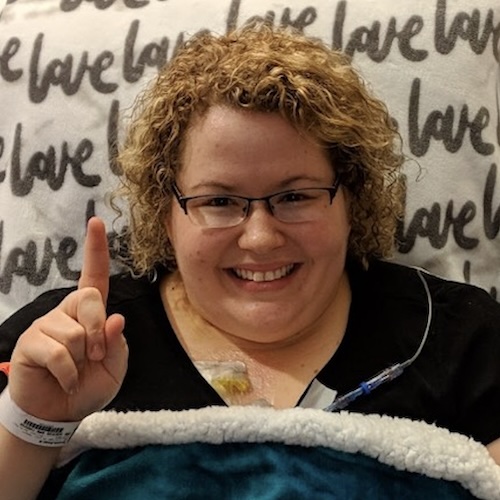
Brooke and Cody met with a local oncologist first, but they decided to explore a second opinion in Cincinnati. This suggestion came after joining a small cell ovarian cancer Facebook group. Genetic testing later showed Brooke and her twin sister both carry a SMARCA4 mutation, linked to certain rare cancers including small cell ovarian cancer. Her twin was also diagnosed with cancer, as was a second sister.
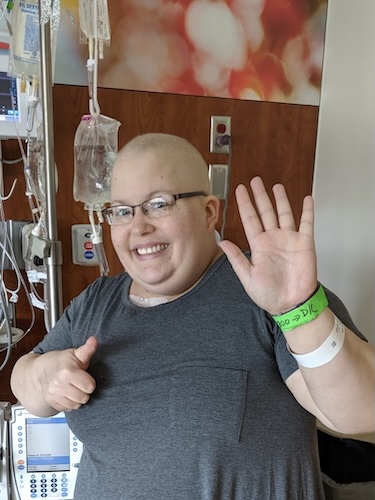
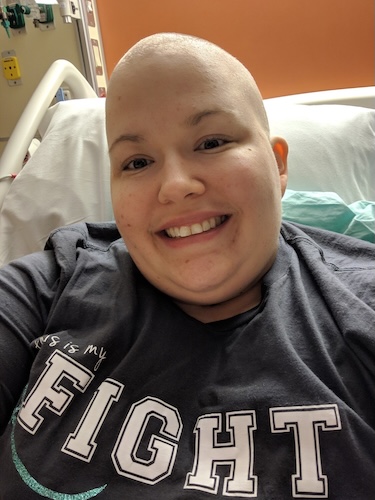
Treatment included six rounds of chemotherapy, heated chemotherapy (HIPEC) during a second-look surgery, and a stem cell transplant using her own collected cells, aimed at lowering small cell ovarian cancer’s high recurrence rate. She lost her hair during treatment and spent 30 days in the hospital after her transplant. A positive SMARCA4 result also changed the family Brooke and Cody had hoped to build. Unfortunately, an adoption attempt later did not work out.
Nearly seven years past treatment, Brooke manages lasting effects of her ovarian cancer, including abdominal hernias from the HIPEC chemotherapy and a hysterectomy she hasn’t yet scheduled. She works full time, travels with Cody, and has become a vocal presence in the small cell ovarian cancer community, a community where she has sadly lost a lot of friends. “I feel like I’m so blessed and thankful to be alive today,” she says, and uses that gratitude to speak up for other women facing the same rare diagnosis.
Watch Brooke’s video and read the edited transcript of her interview below.
- An earlier scan had come back normal. Two months later, Brooke’s tumor measured 14 centimeters, demonstrating the aggressive nature of small cell ovarian cancer.
- When a doctor refused to even call the specialist they trusted, Brooke and Cody walked out of his office and never looked back.
- Brooke did a stem cell transplant to help keep the small cell ovarian cancer from coming back.
- Seven years later, Brooke has turned surviving a disease that took several of her friends into a reason to keep speaking up for other women facing it.
Brooke’s Diagnosis Facts
- Name: Brooke M.
- Age at Diagnosis:
- 32
- Diagnosis:
- Small Cell Ovarian Cancer
- Mutation:
- SMARCA4
- Symptoms:
- Bloating
- Abdominal pain
- Small abdominal lump
- Fatigue
- Inability to stand upright
- Treatments:
- Surgery: oophorectomy
- Chemotherapy, including hyperthermic intraperitoneal chemotherapy (HIPEC)
- Autologous stem cell transplant
This is not medical advice. Please consult with your healthcare provider to make informed treatment decisions.
- Brooke’s Diagnosis Facts
- Who I am
- A small lump, constant bloating, and pain I couldn’t ignore
- Surgery, bleeding into my abdomen, and spending Thanksgiving in the hospital
- Learning from my husband that it was small cell ovarian cancer
- Six rounds of chemo, losing my hair, and collecting my own stem cells
- Finding out that I carried the gene, and grieving a family we couldn’t have
- Seven years cancer-free, and becoming a voice for small cell ovarian cancer
- The Brooke I am now: Carrying my friends’ memory forward
- My advice: Take it one day at a time
- Hear from people living with ovarian cancer
Who I am
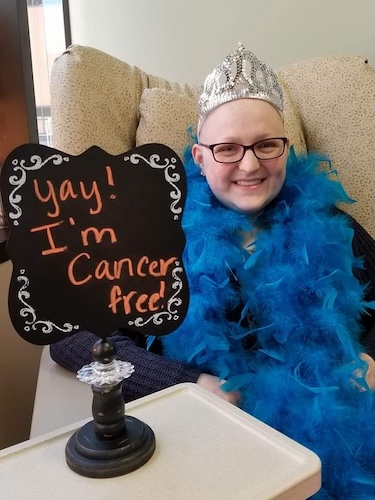
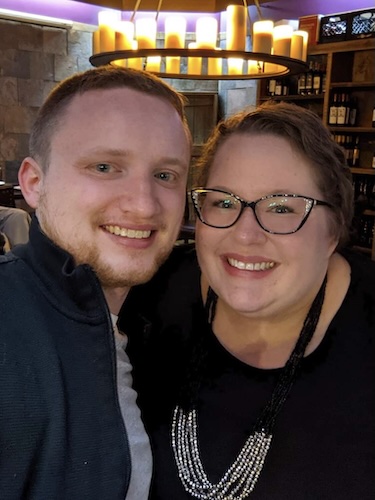
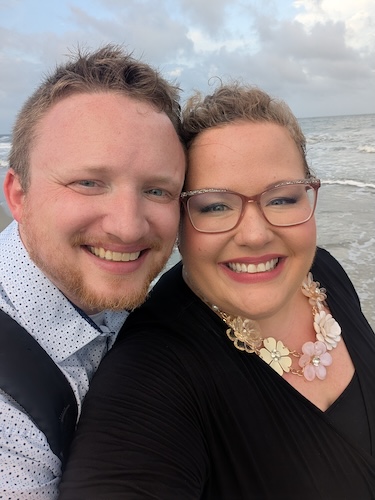
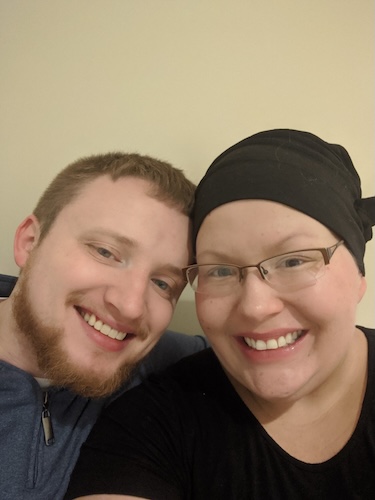
My name is Brooke, and I was diagnosed with two different kinds of cancers. One was melanoma on my right temple, back in 2015. And then, most recently, I was diagnosed with small cell ovarian cancer. I was diagnosed late in 2018 and did treatment for most of 2019. Since then, I’ve been cancer-free for almost seven years.
Diagnosed with melanoma three years before ovarian cancer
Luckily, we did catch it early, but it was less than a pencil-eraser-sized little dot on my right temple. That’s all it was, bright red. My dermatologist had looked at it and said he wasn’t concerned. But my husband and I, my fiancé at the time, were getting our engagement pictures done. And so I said, “Well, I think we should just get it off. I want everything looking nice for the pictures, and it’s just not really going away, so I think we should just check it.” And luckily, I pushed for that, because it ended up being melanoma.
With catching it early, I had to have just one surgery, and I didn’t require any chemo or anything afterward, and a plastic surgeon ended up doing the surgery along with an oncologist. So they just wanted to prevent as much scarring on my face too. So that was pretty much all my story for melanoma. I do get a six-month check, and then I’m just really careful in the sun and definitely wear sunscreen and sun protection. And so that was really my story with melanoma, but the small cell was a lot different.
A small lump, constant bloating, and pain I couldn’t ignore
My husband and I had a miscarriage in September 2018, and maybe about a full month after, it would have been October of 2018, I still just felt very bloated and off. But I kept thinking that the symptoms were my body bouncing back and that really anything specific wasn’t going on. But I also noticed that I had a very small lump on my abdomen that normally wasn’t there. And so I mentioned it to my husband, who is a nurse, and I said, “We probably should just watch this.” And we didn’t think twice about it after that.
And then, pretty much exactly a month after that, I still was feeling bloated and really just off, and even tired. One day I was at work decorating for my job, and I was going up and down a ladder, and I mentioned to my coworker that I really felt like pain was starting to happen in my abdomen. So not only was I having the bloating, but I was having some pain. And by the time I left work that evening, I could not walk. I was hunched over walking. And I called my doctor in the afternoon, my general GP, to get an appointment to be seen, because I knew something was off. I was having that pain, and I couldn’t stand up straight. So I ended up seeing my doctor the next day, and she was doing an abdominal exam, and she pushed on my lower right side of my abdomen, right about where your ovary is.
I had severe pain. So I shot up and shrieked a little bit. And she said, “Oh, you probably need to have your appendix removed.” And so she sent me over to the ER, and they did a CT scan, and the ER doctor looked at the scan and said that I had a large intestinal mass. And so we were really in shock, and he said I’d be getting transferred the next day to a different hospital, because the surgery would be really complex, and we would go from there.
And so, not only hearing that news, we ended up knowing that I’d have to be admitted overnight. And so we were just getting settled in the room, and a new set of doctors came in the room, and the doctor said that she would be taking out my ovary. And so I stopped her, and I said, “Why would you need to take my ovary if it’s a mass on my intestines?”
And so she then said that they had relooked at my scan, and the mass was actually a large 14 cm mass on my right ovary, and that they had looked at it incorrectly at first, and so that I would be having surgery the next day at that hospital. And so that was the day before Thanksgiving that I would have surgery. And so I had surgery that next day.
No time to grieve between the miscarriage and the diagnosis
That was really hard. I feel like, often with ovarian cancer, you feel the symptoms; they always say that they whisper. But I kind of, so I felt like we almost really didn’t get the time to grieve that loss, because it was just one thing.
And I do want to mention that after I had my miscarriage, they had checked and did a scan, and knew that nothing was off; all the tests after the miscarriage were coming back normal. And so they knew this tumor grew within 60 days. And so that was also really concerning, then knowing that this tumor grew that quickly. So I don’t know, I think we just really didn’t get the time to grieve like we should have been able to.
Hearing that the mass was 14 centimeters, and thinking about our future family first
I think I wasn’t really scared, but my first thing to the doctor was that I wanted to save my other ovary, so we could have a chance to have a family if we chose to do that in the future. And I had polycystic ovary syndrome (PCOS), so I was hoping that it wasn’t really a cancerous tumor. I was hoping it was just something going on with my PCOS.
So I think at the time I really wasn’t scared, and I thought, “Oh, there’s no way something could grow that fast that’s cancerous.” So I think I just at that moment was thinking about our future family, and wasn’t really thinking about the fact that this could be a very serious thing.
Surgery, bleeding into my abdomen, and spending Thanksgiving in the hospital
So thankfully, my doctor ended up doing my surgery. And so I felt really safe with him, and I felt like he would do anything that he could for me in my best interest. We had a great relationship, and so he just really brought peace to me. And he checked in before the surgery, and he said, I’ll try to save your ovary, but this one is really big. I am concerned about that, but I’ll do the best that I can, and whatever we need to do, we’ll just kind of go from there.”
He did end up checking on me after the surgery, and he said that the surgery went a lot longer than he would have thought it was going to, because I ended up bleeding into my abdomen. He had done an extra wash and said, “You know, Brooke, I am concerned that it is cancer. We won’t know for sure until we get the pathology back, but this is something I haven’t seen before. And it presented itself really differently, and even the color and the bleeding in your abdomen: those are two concerns that we definitely need to kind of take a rush on this, and I’ll keep you informed as best I can.” And so he pretty much said, “You know, you’re going to be here for a couple days in the hospital, and then you’ll go home and rest. And as soon as I find out results, I’ll let you and your husband know.”
And so I ended up spending Thanksgiving in the hospital, and that was kind of weird too. I was in the maternity area, with my age and what kind of surgery I was having. So that was a little weird, hearing babies cry, and I had just had a surgery that had gotten me worried about my family’s future. And my husband being a nurse, he had to work that night too. And so I had really great family and friends that visited over Thanksgiving, but that was hard, being in a hospital over a main holiday.
Learning from my husband that it was small cell ovarian cancer
We’re a smaller community hospital. And so my doctor said, “There is a little problem; we know it’s cancer, we just don’t know what kind right now. The two systems that tested it aren’t agreeing with what it is, so we’re going to have to retest it. So it’s going to be another two weeks.” I was like, what, and so I just did my best not to really think about it, or overthink it. At that point I was back to work, busy, which maybe was a good thing, to keep my mind not thinking about cancer.
Ultimately, my husband was the one who found out what kind of cancer I had. You know, I was definitely okay with that. I had shared with my doctor that he could contact either of us to give the news. And so I was home that day, though, when my husband didn’t call me, and I heard him pull in the driveway, and I was like, “That’s really unusual; he always calls me, and he knew I was home.” And I heard him pull up in the driveway, and honestly, my heart sank, because then I knew something was wrong.
And he came in the house, and he said, The doctor called. You have small cell ovarian cancer. I didn’t get to talk to him very long, because he was teaching a class at the time; he had to excuse himself during that, but the doctor said we’re going to be transferred right away, because they’ve never seen this before, and it’s really serious, and we have to move fast.” And so at that point, that’s when we were really scared, and we really took it hard then.
Googling a rare cancer, telling our families, and finding a small cell ovarian cancer community
We do what everyone does when you don’t know what something is: we Googled it. And within a few minutes, we had to put our phones away, because, oh, you know, it just made our hearts sink even more.
So also, at the time, my family had a little cold going on. And so I remember having to tell my family, not in person. We all live in the same town, but we knew that I needed to stay healthy with whatever cancer was going on. And I do remember the phone calls with my parents especially. My dad is a very joking, very carefree guy, and hearing him cry — one of the hardest times I’ve ever heard him cry — was really hard, as was not being able to tell them in person and hug them. We just kind of told my parents that we are going to do the best we can to figure out where we need to go. And then also telling my two sisters; my younger sister had cancer six months before I did, and a gynecologic cancer. And then I had a twin sister who had a gynecologic cancer that was treated by surgery, but my younger sister did have to do chemo. And so I just felt so sad, telling my family again, within a short amount of time, that we were going to have to navigate that together as a family again. My sister also is a nurse, the one who had the cancer six months before me.
So we felt like we definitely wanted Janelle’s support, with also kind of trying to navigate what the next steps are, because I feel like at that point, Cody and I were just kind of in a daze; we really couldn’t think straight. And then also telling my sister; she was pregnant at the time, so I also didn’t want her to get too upset, and keep her health good for herself and the baby. And she ended up doing a lot of research as well, and she found a Facebook group of the small cell ovarian cancer group on Facebook, and also a foundation; it was a website that was out there, put on by two parents that had lost their daughter, Stephanie, to small cell.
But between those two things that brought us hope, I almost couldn’t hope yet until I found the doctor we needed. I couldn’t really connect with anyone at that point. Personally, I felt like I needed to just navigate doctors and appointments at that time. But my twin sister Brittany did talk to several people in the Facebook group, and they all recommended this doctor in Cincinnati, Dr. Pressey. And so we kind of said that we would need to go to Dr. Pressey if needed, but that we would kind of look closer to home at first.
Wondering if three sisters with three gynecologic cancers could be connected
My doctor feels like there is something genetic, but they don’t know at this point.
They haven’t found a link yet, but my twin and I both have the SMARCA4 mutation, and he feels like there’s also another genetic link out there that just hasn’t been discovered yet.
So he does feel there is a connection.
Walking out when a doctor wouldn’t even call Dr. Pressey
My local doctor had helped kind of guide who to go to in our state. And so we ended up going to someone that he recommended. But I remember, the night before, we were discussing what would be the main things that we would decide if we were going to go with this doctor, or to seek that second opinion with Dr. Pressey. And we pretty much said it all depends on how many patients he’s had of small cell. I feel that ovarian cancer tends to just get lumped together, and small cell is very different than the typical high-grade, or the other types of cancers for ovarian. And so we just knew that we needed someone that at least had one other patient that had small cell. And so that was kind of our main question.
Luckily, Cody had talked with Dr. Pressey on the phone the evening before we went to our first official oncology appointment. And so Dr. Pressey kind of said that they had found that a six-drug chemo, with second-look surgery, chemo, and possibly radiation, was the best way to treat small cell. And so we’re like, “Okay, we’re going to take it to this other doctor.” One wonderful thing is that Dr. Pressey said he understood that if we wanted to stay home, if we could find a doctor that would coordinate with him to do that treatment, he would be happy to have us stay home. So that’s what we were hoping.
But the oncologist that we saw did not have any experience with small cell. And he suggested the typical treatment for ovarian cancer, the two-drug chemo, and a hysterectomy. And so we kind of asked if he would speak to Dr. Pressey, and kind of explain and go over things, and he wasn’t even willing to talk to him. And so we pretty much told the doctor that. But he had grabbed the surgery binder, because he’s like, “You have to have surgery. You have to. And if you do this treatment, you can pass away from it; it’s so toxic.” And I remember saying, “Yeah, it sounds like it is, but I have one life, and I’m going to do the best I can to keep living.” And, you know, he wasn’t really understanding, I feel, in my opinion. And so anyway, he went to grab the surgery binder, and he left the room, and Cody looked at me and said, “We’re not going here, Brooke, we’re going to go see Dr. Pressey.”
And so they came back in the room, and we just kind of said, “Well, we’re not scheduling surgery, but we’ll get back to you, basically, if we’re interested in contacting you,” and we never spoke with them again. And so we immediately called Dr. Pressey’s office after we left the doctor, and they got us scheduled within a week. So this would have been the middle of December then. We ended up going to Dr. Pressey and his team at Cincinnati Children’s, and we just felt right away that that was where we were meant to get my treatment. And so we got treatment scheduled, and the rest just kind of worked out.
Choosing to travel for treatment, no matter what it would cost us
It was definitely Cody that said those exact words, “I want you with me.”
We were worried about insurance. He kind of said, “We’ll worry about that later.” I was worried about his job and my job, and how we were going to afford going back and forth, and our dog, and having a home, and all those things. And he just kind of said, “We’ll figure it out, because this is where we need to go for you to survive.” And so he just really didn’t think twice about it.
I definitely can tend to be like a little more of a worry person than Cody. And so he really just kind of put his foot down, and he’s like, “You know, I always want to listen to your opinion, but this one, I want to say, I want to do this; it’s what we need to do.” So yeah.
Six rounds of chemo, losing my hair, and collecting my own stem cells
Treatment would be every three weeks, but Dr. Pressey did say, “It is not unusual at all for you to get a little off schedule, because infections are going to happen, or blood transfusions will be needed, you will be hospitalized at home in between for different things.” I really appreciated that he was very open to that and telling us what typically has happened, so each time that happened, it wasn’t a huge surprise.
So basically I had two rounds of chemo, basically about a month apart, and then around round two, I remember losing all my hair. And then also I got my stem cells collected after round two, and then did two more rounds. And then after round four, I had chemo, and I believe I needed about a month and a half recovery from it. And then had two more rounds of chemo.
So they’re all inpatient, over three days, is how each round would happen. And then after round six, I had about a month off, and then I had my stem cell transplant. And so I was in the hospital for 30 days after that. And that was it; that was my treatment, basically.
Why Dr. Pressey said the stem cell transplant mattered so much
Dr. Pressey had explained that he thought a stem cell transplant was really important. There were some mixed opinions out there in the small cell world about doing a stem cell, but he just basically said that he really felt that the stem cell was really important, to just kind of coordinate everything together, and just have that final step, to have it not come back, because often with small cell, the recurrence rate is really high. [Editor’s Note: According to the Ovarian Cancer Research Alliance, approximately 70% of ovarian cancer patients will experience a recurrence.]
And so he said he truly felt that stem cell was very necessary to do.
Finding out that I carried the gene, and grieving a family we couldn’t have
We were very open with Dr. Pressey and his team that we did want to have a family. Unfortunately, they did feel that we didn’t have time to freeze eggs or anything like that. But we were kind of hoping that if I didn’t test positive for the gene, that I possibly would have that other ovary. And Dr. Pressey, as I said, was open that there was a high chance that the other ovary wouldn’t work, but that there were other avenues that we could go, if we wanted to talk about a family afterwards. But after round four, I did find out then that I was positive for the gene, and so that did just kind of change a lot of things in our life plans, I guess.
We just were hoping that maybe even adoption would be an option, and we did go that route for a little bit, and it didn’t work out with a certain situation. And so that was really hard, I think, especially after the failed adoption; that is when I just kind of knew for my own heart that I had to kind of protect that, and that maybe it just wasn’t going to work out for me to be a parent with Cody that way.
But you know, I think that’s something that I’ll always kind of struggle with, and that that was, I don’t know, maybe like the word taken away, but I feel like we should have still been able to have that option. But we had great support from the medical team, and they were very kind about it, and they did everything they could to help that way too.
I’m a dog mom, though, which is the best. We love our fur baby, and she is everything to us.
Seven years cancer-free, and becoming a voice for small cell ovarian cancer
I almost can’t believe it. Oh my gosh, Dr. Pressey says year two is a big one. So after two years cancer-free, I just was like, “Wow, I can’t believe it.” And then, you know, five years cancer-free, I still am like, wow, I can’t believe it. And now seven, it just almost seems unreal.
But I stay really busy in my life. I love going on trips with Cody, and with friends or family; we love going to concerts. Some people in my life, they’re like, “I don’t know how you work full time, and then you’re doing all the things on your calendar; I would be tired, I don’t know how you’re not tired.”
And I am tired, but you know, I feel like I’m so blessed and thankful to be alive today. And so I just want to have as much fun as I can.
And so one thing I really try to do too is be a voice for ovarian cancer, especially small cell, and younger women with ovarian cancer, because I feel it’s really important so people don’t feel alone.
What HIPEC chemo left behind: Hernias, a hysterectomy still to come, and a body I’m proud of
It’s very much worth it.
There are definitely days where I get tired. You know, as I mentioned, I work full time and I’m busy, but I think I have been trying to navigate resting more when I need to, and just being active when I can, eating healthy. But you know, I have abdominal issues, especially from the HIPEC heated chemotherapy treatment; I think that really affected it. I have a large belly button hernia, and a few hernias in my abdomen that eventually I will have surgery on, and I still have my uterus. So I will be getting a hysterectomy as well, but Dr. Pressey feels it’s not something I have to do right now, and I’m thankful that I kind of still have time to process it and heal.
On average, I’m very proud of my body. I feel like it’s gone through so much, and maybe days where I get frustrated, if I’m tired, or I maybe can’t do as much as I would like to, I take a moment to kind of think about how my body has gone through so much, and I should be proud of what I can do every day.
The Brooke I am now: Carrying my friends’ memory forward
The Brooke then kind of seems like a different person.
You know, I feel like life has a lot of ups and downs, but it’s all about creating memories and being with the people that you love, and I’m so thankful for that. You know, one thing that has been a little hard with small cell is I’ve lost a lot of friends that have passed away from small cell. But I also feel that they would want me to keep going too, and to be that voice for our group and the community.
So, on the days where I feel that I miss them, or I feel so sad for the people that they love, I also feel honored to be here, and I feel like I’ll never let their memory go. And then I’m always going to make sure that everybody remembers them.
My advice: Take it one day at a time
My favorite advice that I have ever received is to take one day at a time, or a step at a time, because I think sometimes we all just kind of take things so overwhelmingly.
But you kind of think of life as just a moment at a time, and that life can be really hard, but it can be really beautiful too. And just keep going, so you can have those beautiful moments.
This interview has been edited for clarity and length. The views and opinions expressed in this interview do not necessarily reflect those of The Patient Story. This content does not replace professional medical advice.
Inspired by Brooke’s story?
Share your story, too!
Hear from people living with ovarian cancer
Real experiences with diagnosis, treatment choices, side effects, and life beyond ovarian cancer — in their own words.
Leave a Reply