
Ashley Was Told It Was Nothing, Until a Lesion Changed Everything: She Had Multiple Myeloma
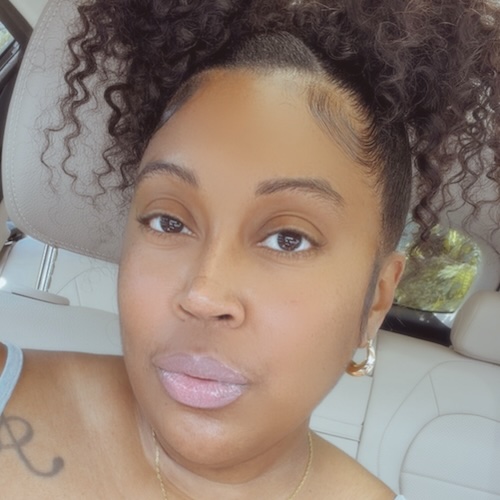
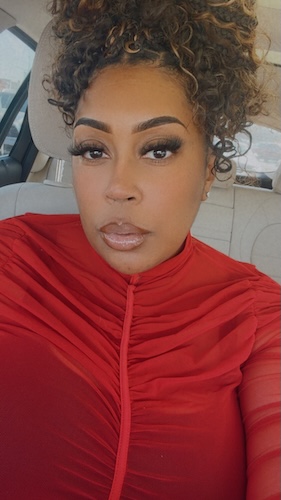
Ashley was 36, working as an assistant property manager and helping raise a close-knit circle of siblings and godchildren, when she experienced pelvic pain sharp enough to stop her speaking mid-sentence. She assumed it was her cycle at first. When it didn’t let up, she started a months-long search for someone who would take it seriously: an OB-GYN appointment that got canceled, an ultrasound that showed nothing, a suspected blocked fallopian tube that led to a surgery that didn’t fix anything. The pain kept coming back, worse each time.
Interviewed by: Taylor Scheib
Edited by: Chris Sanchez
It was a CT scan, ordered almost as an afterthought during an unrelated appointment, that changed everything. Scrolling through her results alone on a Friday night, Ashley saw the word “lesion” and, having lost her grandmother to breast cancer, recognized it as a word that mattered. The scan showed lesions in her pelvis, on a rib, and on her hip. By the following Monday, a trip to urgent care for the pain turned into a doctor telling her she had cancer. She was admitted to the hospital, where a bone marrow biopsy confirmed multiple myeloma, a blood cancer she says she’d never even heard of. One of her care team told her it typically affects people decades older than she was.
Her treatment plan moved fast: radiation to her bone lesions starting the week of Thanksgiving, then chemotherapy, with a stem cell transplant planned for June. Radiation brought exhaustion and nausea. Her first chemo infusion triggered an allergic reaction. That turned a few hours into an all-day hospital event and led her care team to switch her from an infusion to weekly injections. In the middle of treatment, she also discovered a new heart rhythm problem, one serious enough that she declined to move forward with a stem cell transplant until it was resolved. She and her new oncologist ultimately chose to delay the transplant altogether.
That new oncologist came from a tip from a nurse, a 30-minute online consultation, and, as Ashley describes it, an entirely different level of care. It was one that treated her as a person in her 30s rather than applying advice built for a typical patient in their late 60s or 70s. After eight cycles of chemotherapy, Ashley rang the bell in September, marking no active disease. She is not having a stem cell transplant for now; her doctor has a maintenance plan and a backup plan (CAR T-cell therapy) in place if her numbers change.
Today, she’s found community through the Multiple Myeloma Research Foundation and a carefully chosen set of online support groups, is preparing to walk in an upcoming myeloma walk, and describes the last year as proof that she is far stronger than she knew.
Learn more about Ashley’s multiple myeloma story by watching her video or reading the edited transcript of her interview:
- Persistent, unexplained pain is worth pushing on, even when early tests come back clear. Ashley went through a canceled OB-GYN appointment, an ultrasound, and a surgery to remove what doctors believed was a blocked fallopian tube before a CT scan finally showed what was actually wrong. Her case is a reminder that being told that they don’t see anything isn’t the same as there being nothing there.
- A confirmed diagnosis, even a devastating one, can bring its own kind of relief. Ashley describes feeling relieved to finally have an answer after months of pushing for one, even though multiple myeloma was the furthest thing from the answer she wanted. Getting an answer and wanting that answer are two different things, and both can be true at once.
- A second opinion changed the entire shape of her treatment. Ashley’s decision to consult a different oncologist, prompted by a nurse’s recommendation, led directly to her current plan to delay a stem cell transplant she says she would otherwise have gone through without needing it yet. She frames it simply: Getting more information before a major medical decision can’t hurt you, and it might change everything.
- Being younger than the typical patient shaped nearly every part of her care. From doctors basing advice on guidance meant for patients decades older, to feeling out of place in some corners of the myeloma community, to weighing fertility preservation against a treatment timeline, Ashley’s age at diagnosis affected almost every decision she made.
- Sharing her story, on her own terms, changed how she saw herself. Ashley kept her diagnosis private on social media for months before deciding to walk publicly, under her own name, in a myeloma walk. She describes that decision as the moment it clicked that she didn’t have to hide what she was going through, and that people she didn’t previously know personally showed up for her once she let them in.
Ashley’s Diagnosis Facts
- Name: Ashley J.
- Age at Diagnosis:
- 36
- Diagnosis:
- Multiple Myeloma
- Symptoms:
- Extreme pelvic pain
- Fatigue
- Treatments:
- Radiation therapy
- Chemotherapy

This is not medical advice. Please consult with your healthcare provider to make informed treatment decisions.
- Ashley’s Diagnosis Facts
- Diagnosed with multiple myeloma at 36
- Work, family, and cookouts: Life before multiple myeloma
- When pelvic pain stopped me in my tracks
- A trip to urgent care turned into a multiple myeloma diagnosis
- Finding my voice: Self-advocacy through months of being dismissed
- The bone marrow biopsy: “Pain that trumped labor”
- Admitted to the hospital, waiting for answers
- Hearing “multiple myeloma” for the first time
- Radiation, then chemo, then a stem cell transplant: The plan
- Fertility, money, and an impossible deadline
- An allergic reaction on the first day of chemo
- A heart problem changed the plan
- Meeting the “Doogie Howser of medicine”
- Why getting a second opinion might be the most important decision you can make
- Ringing the bell: Choosing to delay the stem cell transplant
- Living with the fear of multiple myeloma recurrence
- Learning what “CAR T” means
- Finding community in the multiple myeloma world
- Sharing my multiple myeloma story out loud
- What I learned about my own strength
- Hear from people living with multiple myeloma
Diagnosed with multiple myeloma at 36
My name is Ashley. I was diagnosed with multiple myeloma in November of 2025.
Work, family, and cookouts: Life before multiple myeloma
Life was work and family, and fun, of course. I managed to balance it all. I was an assistant property manager. I’d been with the company I was working for almost four years, and I was on track to become a property manager within the company. I spent a lot of time with my family. I have godchildren, I have a ton of siblings, and my family is very close-knit. We did the cookouts. We did different events within the area as a group. That was just life for me.
When pelvic pain stopped me in my tracks
Pelvic pain was the one that really stood out. Probably the first sign that I ignored was the fatigue, because I figured I was just tired and I wasn’t getting enough rest. But the pelvic pain hit, and I went, “Wait a minute. What is this?”
It wasn’t a consistent pain. It would come and go, but when it came, everybody around me could tell it came because it stopped me in my tracks. If I was moving, I was stopping, grabbing my stomach, and clenching. If I was talking, I was stopping in whatever it was that I was saying. It was bad.
At first, I said, “Oh, well, maybe it’s cramps, maybe it’s from my cycle. Okay, I’m getting older, things change.” But once it became more persistent, I was like, “No, this is not that at all.” And I started reaching out to my doctors.
The search for a doctor who would listen
That was a long process. I actually made an appointment with an OB-GYN because it was pelvic pain; to me, that was the doctor I was supposed to see. My doctor is a very popular doctor within the network. I had an appointment, and on the day of the appointment, it got canceled. I waited a month; the appointment got canceled, and I said, “Okay, let me see if there’s another doctor available.”
I made an appointment with another doctor within the network, and they told me, “Oh, well, I don’t see anything. Follow up with your doctor.” And I responded, “Well, that’s what I tried to do, but she hasn’t been available.” So then she saw that I wasn’t letting up, and she said, “Okay, I’ll order a vaginal ultrasound.” I said, “Okay,” and went and did that. They came back and said, “We don’t see anything.” I made another appointment, finally saw my doctor, and she did the normal exam and said, “I don’t see anything. I might want to schedule you for another appointment so we can look a little deeper; that way I can have more time.”
In between all of that, I saw other doctors, and I assumed it was my fallopian tube causing the pain. They had already told me I had a blockage within my fallopian tube, so at that point, I scheduled a surgery to have it removed. After it was removed and the time frame in which they said I should feel normal went by, the pain came back, and it was even more intense. That’s when I ended up seeing my doctor.
Ironically enough, I had scheduled an appointment with my primary doctor, who was in the same building, on the same day, after that appointment. While I was in there with her, the pain hit. She saw it and said, “It can’t hurt for me to order a CT scan.” I said okay, because I trusted her; I’ve been with her for years.
Within my network, sometimes it’s hard to get appointments at locations that are convenient and times that are convenient. My job was demanding, so missing certain periods of the day was hard to schedule. When I was looking at the availability, the appointments were at 4 a.m., an hour away, which was not conducive to doing what I needed to do, so I kind of put it off.
But I started feeling worse, and I woke up one day feeling horrible. I called out, and something told me to log in, and they had an appointment that morning for that CT scan.
Seeing “lesion” on my phone, alone
I made arrangements to have somebody go with me, because I didn’t really know what they were doing when I got there. They ended up injecting me with dye and all that. I went and did it on a Tuesday, Veterans Day. By Friday evening, my results had come in. I was at an appointment, and I glanced at my phone, and I went, “Oh, a cyst,” and I just kept scrolling. I know I’ve had cysts on my ovaries before, no big deal. And I saw something that said “lesion.” But because I was walking into the appointment, I closed the phone and didn’t dig deep into it.
When I got home, something told me to go back and look again, because the lesion kept weighing on me. I had recently lost my grandmother to breast cancer, so the word “lesion” was not foreign to me. I was like, “No, that’s not the same thing.” But I sat there and read it, and I’m like, “Okay. It’s saying they see lesions in my pelvis, there are lesions on my rib, and there are lesions on my hip.”
This was a Friday night. I didn’t really tell anybody. I needed to process it. But my sister and I had made a promise to one another that, with health stuff, with things in life, we would try to protect each other from things. And she said, “You have to stop not telling me stuff,” so I sent her a text and said, “Hey, don’t freak out, but I think this is what it’s saying. I have an appointment with my primary on Monday, but I want to make you aware.”
My youngest sister’s birthday was Veterans Day, the 11th; she was turning 17. We’d all planned to take her out with her friends bowling that Saturday. I was moving slower than usual, and my sister noticed it. We tried to discreetly talk about it, but we couldn’t. By Sunday, you would have thought I was maybe 63 and not 36, because I could barely move. I did one of those “I’m going to go back to sleep and see if I feel better when I wake up.”
A trip to urgent care turned into a multiple myeloma diagnosis
I indeed did not feel better. I felt worse. So I said, “Okay, well, let me go to urgent care… they’ll give me something for the pain, they’ll send me home, they know I’m supposed to see my doctor tomorrow.” I was sadly mistaken.
They came in and were asking me questions, and I said, “Well, I did this, and I saw this, but I don’t really know what it means.” The first doctor came in and said, “Oh, we’re going to make sure that we take care of you. We’re going to get you straight,” because at this point I was in so much pain that I was crying. She gave me something for the pain, and she was giving off signs that something was wrong, but she hadn’t said it.
When she finally came back, she wasn’t by herself. She had a nurse. And they’re like, “Oh, do you have somebody that you can call?” And I’m like, “For what? What am I calling somebody for? I came in because my hip hurts.” And they’re like, “Well, you have cancer.” And I’m like, “What?” I sat there, and I don’t think I gave them the reaction they were looking for, so it kind of made them a little nervous. Then they insisted I call somebody.
Calling my family from the hospital
I didn’t want to freak my mom out, because we had recently lost my grandmother to cancer. Everybody was still processing that. We were also still grieving the murder of my younger brother. So in my mind, I was like, “Let me figure out exactly what’s going on before I pull her into this.” I thought about calling my father, who was actually out of the country; I believe, in Spain, he’d gone to a football game overseas with my stepmom.
I called him and said, “Hey, Daddy, they’re making me call somebody. Don’t tell anybody; I don’t want my mom to find out.” And he’s like, “What?” It wasn’t making sense to him. He said okay, and I said I’ll send you a text and let you know what’s going on. He had my location, so he knew where I was. We’d been texting about other things while I was there; he just didn’t know what was going on.
I told him they were sending me to the hospital, and he wasn’t fully processing it either. So we got off the phone, and I guess he told my stepmother, who freaked out and called my mother. I had shot a text to my aunt, and she knew I was going to urgent care. I told her, “This is what they’re saying, and I don’t know what’s happening next. They’re telling me I’m going to the hospital.”
My mom started texting me. That’s how I found out she knew. And she was on the way.
That’s how my diagnosis came into play. At that point, they still wouldn’t say “multiple myeloma,” but they said “cancer.” They had an idea. They wanted to admit me to the hospital to fast-track everything, because I was like, “I don’t want to stay; I want to go home, give me some medicine, let me go home, I’ll talk to my doctor, we’ll figure it out.” And they said, “No. If you go to the hospital, we can get everything done back to back and get you a diagnosis. If you go home, you’re waiting for different appointments, and it’s going to drag out.” So I was transported to the hospital.
Finding my voice: Self-advocacy through months of being dismissed
I knew that if I let it go, they would let it go. I’ve seen how so many people don’t advocate for themselves, and then they end up dead. I knew that something was wrong. I knew my body enough to know something was wrong. And I have health insurance for a reason: to use it. So that’s what I was going to do, and I just wasn’t letting go.
Even the people around me who saw what I was going through said, “You need to figure that out.” They encouraged it, because so many people just push it to the side. I’ve had family members who ended up with different types of cancer. My grandmother’s sister was the type who didn’t go to the doctor, and it wasn’t until the very end of her illness that they found out, because she ignored the symptoms and didn’t advocate for herself and go to the doctor.
It was frustrating. There were many days I was frustrated because I wasn’t getting the answers I was looking for. I was going and seeing other doctors, taking my lunch break, purposely scheduling appointments near my job so I could take my lunch break. “Okay, well, maybe if I run up here and talk to this doctor, maybe they’ll say something that puts me on the right path,” and that’s not what was happening. So ultimately I said, “I need to go back to the people who are familiar with me, even if it takes a little longer to see them.”
Pretty much. You’re going to work, providing the level of customer service to residents that the company had set for us. I’m still managing a team; I’m still people’s supervisor. So there were days I just did not feel like it, did not want to be bothered, did not want to be talked to; but I had no choice.
The bone marrow biopsy: “Pain that trumped labor”
The worst feeling I have ever felt in my life was the pain after the bone marrow biopsy. It trumped labor. It trumped contraction pains. I’ve had a ruptured fallopian tube, and that was bad pain. This was worse.
The biopsy itself, because you’re awake, you feel the pressure along with the pulling. You hear them talking. There’s that level of anxiety because you’re alone; you don’t know. When they did my biopsy, they went from my back first, and then they flipped me over and did the biopsy on my hip. It was definitely something I don’t look forward to having to ever do again. I probably will, just because of the type of cancer I have. But for the time being, I’ve managed to duck and dodge it.
Admitted to the hospital, waiting for answers
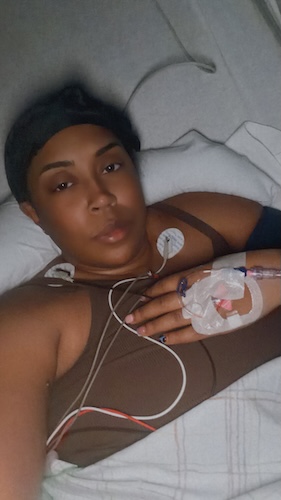
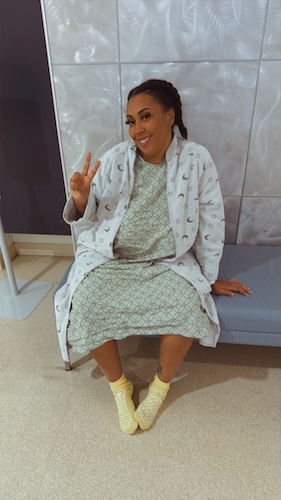
I was admitted on a Sunday and was there until Saturday. I had a roller coaster of emotions, but for the most part, I held it together because I knew that if I freaked out, my family would freak out, so I kept this brave face for them. I was still processing it, so it wasn’t really fully hitting me.
As far as having that procedure done, I hadn’t had a lot of surgeries, so it was something I was nervous about because I didn’t really know what it was. I also told myself I wasn’t going to get on the internet and go down that rabbit hole. I only went off what the nurses and doctors told me. It wasn’t as bad as it sounds, but it was painful.
Even in the midst of being in the hospital, the night after that procedure was the first night I let them give me the real drugs, and that was even after declining them at first. As time went on, they came back, and I was like, “You think I can still have the morphine?” The pain was still bad even with the morphine; it didn’t knock me out immediately. It’s not something I wish on anybody, but it’s necessary.
Hearing “multiple myeloma” for the first time
My first reaction was: What the hell is that? When they came in and explained the diagnosis, they’d kind of known from the beginning. I think that Monday they said, “We think it might be this, but we’re not sure,” because first of all, I’m 36, and the average age for myeloma is 65 and higher. So that already threw them off a bit. But based on what they’d been seeing from my labs, they thought that’s what it was, though they wouldn’t come out and say it until Friday. (EDITOR’S NOTE: According to the American Cancer Society, multiple myeloma is most commonly diagnosed in older people; most people with it are at least 65 years old. The average age of those diagnosed is 69. Less than 1% of diagnoses are in people younger than 35.)
It went fast. It kind of went in one ear and out the other. Thankfully, when the doctor came in and explained it, my mother was there, my aunt was there, one of my best friends was there, and my father was on FaceTime, so I had all these people to hear what I was hearing and not receiving or processing. My aunt was writing it down, taking notes like she was the courtroom stenographer, so I had that to go back and look at when I had questions.
But it was overwhelming, because it was something I had never heard of. I’ve heard of breast cancer, colon cancer, lung cancer; all those kinds of things. But multiple myeloma is something I had never heard of. So for them to tell me that’s what I had, I asked her, “Are you sure?” And she’s like, “Yeah, that’s what you have.” I was just stuck, because I didn’t know what to feel, how to feel, and I didn’t know if I really wanted to accept what she was saying.
Alone at night, the multiple myeloma diagnosis finally hit
At night, for the most part, was the only time I was by myself. Even the first night, I wasn’t by myself. My aunt slept in a chair with me there. I finally had to tell them, “Y’all go home; you don’t have to come every day,” because I knew I wasn’t going to be able to process it or sit in it with people around.
It finally just hit me. I wasn’t doing anything. I might have been scrolling on Instagram, absolutely nothing related to what I had going on. And something like a switch just went off, and I’m like, “Whoa, wait a minute, I have cancer. And I don’t know what to do, how to do it.”
I didn’t know how I was going to move forward, because everything with me, for the most part, has always been calculated. I’ve always been in control. And I realized I was no longer in control. This was something I couldn’t calculate: what was going to happen next. I couldn’t choose which way it was going to go. I couldn’t run it through my mind with two or three different scenarios and say, “If this happens, I’ll do this, or if this happens, I’ll do that.” I kind of just had to sit back and say, whatever the doctors say is what I’m going to do, and accept that this is what’s been wrong with me all this time, and I’m finally getting what it is I’d been begging for months to get figured out.
Relief and dread, all at once
I was relieved that I had an answer, but it was not the answer I was looking for at all. It was the furthest thing from my mind as the answer. Truthfully. It never once crossed my mind. If I had bet money, I would have lost it. If they’d said, “Do you think it’s this or cancer?” it was always going to be “this” versus me saying cancer. And every time, I would have lost money.
Radiation, then chemo, then a stem cell transplant: The plan
The doctor who gave me my diagnosis was also within my network, and she said, “I can refer you to a doctor closer to where you live,” because we were in Virginia and I live in Maryland. I talked to my family about it, and they said, “She’s the one who’s already been here,” so I decided to stick with her initially. It just made sense. She already knew what was going on. She had already run down the plan for what was going to happen.
So when I say things went fast, they went fast. That was maybe Thursday or Friday. She came in and said, “You have multiple myeloma; this is what it is, the plan is radiation, then chemo, and then a stem cell transplant.” And I’m like, “Wait, what? When can I go to work?” Because that’s what I’m thinking the whole time: When can I go to work?
It still wasn’t clicking in my head that last week was the last time I was going to go to work for a while. Because that’s normally how I deal with things. I throw myself into work. So I’m like, “Let me out of here so I can go to work, and I’ll figure the rest out.” But that’s kind of how I went. I stuck with her; she already had it mapped out, and I started radiation the following week, the week of Thanksgiving.
Three weeks of radiation
I believe it was three weeks’ worth, every day. I was tired, I was nauseous, and I did not have an appetite. Thankfully, I lived literally next door to one of my best friends, so she made sure I was okay. At the time, my godson was three. She had to treat me like a three-year-old and sit us at the table together and say, “Here’s your food. You all need to eat,” because I wasn’t eating; I didn’t want to do anything. She’s like, “You need to drink water.” And he’s looking at me like, “Drink your water. Mommy said drink your water. Mommy, Ashley’s not eating her food.” And I’m like, “Neither are you.” I was arguing with a toddler.
But at the same time, I was forcing myself to do the best I could. It was rough. I even talked to the doctors. They had to give me nausea medicine, different things to try: taking a pill before I go for treatment versus when the nausea hits, so it’s already in my system and I can tolerate the treatment. So it got better. But it got bad for a period where I literally lay on the couch and slept, got off the couch, got in bed, and slept. I didn’t go anywhere, didn’t do anything.
Fertility, money, and an impossible deadline
Between the radiation and the chemo, because of my age, and because I did not have any living children, I talked to the doctor about possibly preserving my eggs. She had to do the procedure to remove the cyst they’d identified on the CT scan. But ultimately, I couldn’t afford the medications my insurance wouldn’t cover. It ended up being about $8,000 worth of medicine that I needed, and the window of time was really short. At that point, I had maybe a week to a week and a half to come up with $8,000. I hadn’t been to work, I hadn’t received any disability money, and it wasn’t something I even felt comfortable going to my family about: “Hey, I need this money for this medicine to possibly retrieve these eggs, to go save them and possibly use them later.” Because I’m not married, it wasn’t guaranteed it would even be successful, and it wasn’t guaranteed that even if it was successful, I would use them. So I just kind of had to let that one go, and say, “I’m just going to have to make the best of what it is.”
I went into chemo with an open mind, because it’s what was going to help me. The biggest thing with the chemo, though, was I kept asking: Is all my hair going to fall out? I was worried about my hair. It did not.
An allergic reaction on the first day of chemo
I went to my very first day of chemo and had an allergic reaction to the treatment. I think I’m the poster child for being allergic to everything. At this point, if it could go wrong, it went wrong with me. Thankfully, my aunt was there, because with chemo they give you the Benadryl and all the different allergy medicines, and my tolerance for medication is not that great, so the Benadryl knocked me out and I was asleep. But she saw that in my sleep, I was squirming, messing with my ears, so she woke me up. The nurses had said if I felt anything, let them know, but because I was asleep, I wasn’t aware that I was feeling those things. She woke me up and asked, “Are you okay?” And I’m like, “My ears itch, my throat feels funny.” She tells the nurses, and they’re like, “Oh no!” And they’re all in a frenzy, and they inject something into my IV. They said, “You’re having a reaction to it.” My heart rate was through the roof, so they didn’t want to let me leave. They stuck all the things on to do the EKGs. What should have been a few hours turned into an all-day event for chemo. They ultimately ended up changing me from the five-to-six-hour drip to getting weekly injections.
A heart problem changed the plan
Initially, the plan was chemo and then a stem cell transplant. Things did not go that way for me. Even documenting my journey, I came across a video where I said, “It’s the four-week countdown for treatment,” and it was not. I thought I was going to be done in May; I’ll celebrate my birthday, I’ll be good, and then I’ll go do the stem cell transplant.
In the midst of that, I discovered I had issues with my heart. My heart rate would increase randomly. It got to the point where I didn’t feel comfortable agreeing to a stem cell transplant, not knowing what was wrong with my heart, because with a stem cell transplant, they tell you there’s a chance you could die from it. Knowing I had something going on with my heart, and knowing they already said it’s something you can die from, it was absolutely not happening. (EDITOR’S NOTE: The National Foundation for Transplants says that five-year survival rates for autologous transplants, which use a patient’s own pre-extracted stem cells, run around 50% to 60%. For allogeneic transplants, which involve stem cells from other people, five-year survival rates can range from 40% to 70% depending on the disease, the age of the patient, and the donor match.)
Meeting the “Doogie Howser of medicine”
In the midst of all of that, I changed oncologists. I was released to be able to go back to work; I found a position, and I went to a different treatment location. One of the nurses at the treatment location that was closer raved about how good this doctor was. She said, “Even if you’re unsure about switching, you can set up a consultation and just talk to him.” She called him the Doogie Howser of medicine. She said, “He’s young, he’s up to date on new technology, up to date on the latest treatments.” I went, “Okay, it can’t hurt to talk to him.”
It was over Zoom. I only talked to this man for maybe 30 minutes, and I was sold. It was his energy, it was his empathy, it was his knowledge; it was just everything. I said, “Yeah, let’s do this.” And his level of care was completely different from what I’d experienced. I switched to him in mid-to-late April. I’d started chemo in January, so I had January to March with the same oncologist, going about an hour away for my treatments. In that time, I’d only talked to my oncologist in person once from November until April. The nurses would send me messages, but it wasn’t the same.
When I switched to him, he said, “Okay, I’m scheduling an appointment for four weeks from now.” I asked what for, and he said, “Because we need to follow up, I need to see what’s going on.” That was foreign to me. So when I say it was completely different, it was completely different. Walking into the treatment center, the center I switched to has a bad rep in the area just because of the location. But those nurses, those ladies, and the one man on that floor were amazing. They took care of you, made you feel welcome when you walked through the door, and they knew your name. The energy was exciting; it didn’t make it sad.
I looked forward to seeing them each week. I looked forward to my meetings with the doctor, because he was asking questions. I would look things up and ask, and he’d be able to give me the answers. So I wasn’t going down those deep rabbit holes. One of the things he told me was, “Don’t get caught up in the Facebook groups, don’t get caught up going down the rabbit holes, nobody’s situation is the same, and you will scare the heck out of yourself.” It just made the experience so much better.
A general oncologist who understood younger patients
I believe he’s a general oncologist. However, during his training, he had worked with multiple myeloma, so he was very familiar with it. One of the things I liked about him was that I was not his youngest patient. Most doctors had never worked with somebody in their 30s, so just treating myeloma with me was different for them, because they’re looking at it as if they’re treating somebody who’s already a senior citizen. The advice they’re giving me, the things they’re telling me I should and shouldn’t do, are based on what they’d tell somebody 65 or 70, versus me being in my 30s. Whereas, because he’d dealt with somebody younger than me, he knew what it looked like to be in your 30s and deal with myeloma.
Why getting a second opinion might be the most important decision you can make
It could be a matter of making the most important decision of your life, because had I not been open-minded, I would have gone through a stem cell transplant that I don’t need right now, just based on what one person told me.
My father is a businessman, so he’s always taught me: “Don’t go with the first quote or the first contract that’s presented to you. You should always get at least three and then weigh your options. You don’t go with the cheapest, but you don’t necessarily go with the most expensive person either. You look at what everybody is offering you and make your decision based on that.”
This last doctor was my third oncologist in the process. So I was listening to what my dad said, but at the same time, I felt like there was more I could be given or taught, so I was open to it. It couldn’t hurt. Listening to other people’s perspectives, it can’t hurt you. It doesn’t cost you anything. It might cost a copay for some people, but if it’s a matter of saving your life or helping you make the best decision within your diagnosis, it’s absolutely worth it to get all the information you can. There’s always going to be somebody else who knows something different, or something more, that can help not only me but everybody else. Keeping that open mind is necessary if you want to make the best decision for yourself.
Ringing the bell: Choosing to delay the stem cell transplant
I’m in remission. I rang the bell on September 5th. I have no active myeloma after eight cycles. It was probably not active prior to me completing the eight cycles, but we confirmed, once I completed them, that it is not active. I was actually supposed to have the transplant in June, so it was a matter of me talking to different people, weighing my options, and saying, “Wait a minute, let me step back, let me slow this down a little bit.” (EDITOR’S NOTE: Dr. Saad Usmani of Memorial Sloan Kettering Cancer Center says that multiple myeloma is currently not curable, but doctors can manage it effectively for years. Treatments can bring the disease into remission. However, in some patients, it can return.)
One of the things I asked was, “What if I don’t do the transplant, then what happens?” And they said, “We’ll keep treating you; you’ll keep going through chemo.” And I said, “Okay, then let’s do that. Let’s slow this down a little bit.” A lot is going on in my life and my family right now that made it not conducive.
The transplant required me to relocate to another city over an hour from where I live. It was outpatient, and it required having somebody with me 24 hours a day. So I was looking around and thinking: Who is going to be able to do that?
I have siblings as young as 17, so my mother still has to be a mother. She can’t just pack up and come with me to Baltimore. She still gets up and goes to work. My sister has a family, so she can’t just leave her job, her husband, and her kids. My dad and my stepmom are both running successful businesses, putting my two brothers through college, and taking care of my grandfather, who has dementia. They don’t have 24 hours, seven days a week, to give.
My aunt and her husband have a business, and they said, “Okay, we can kind of pitch in.” My uncle had a stroke in January, so what was good for us in November and December, when we first discussed it, was no longer the same once that happened. My cousins are close-knit. They have children; they have businesses. They were trying to figure out how we could make it work, but it just wasn’t working in that time frame.
So we pushed it off to reevaluate later, after we figured out what was wrong with my heart, because I said I needed my heart fixed first. I didn’t schedule that procedure until July. That’s how I was able to push it off. As we went along and I kept progressing, the doctors said, “Maybe we don’t need to do that.” And I’m like, “Okay, because I was scared, and I didn’t want to do it anyway.”
Living with the fear of multiple myeloma recurrence
My doctor, Dr. Saxton, is amazing. Before I rang the bell, he met with me alone. This was probably the first time other than our initial meeting that it was just him and me, because my aunt had been at every appointment. I didn’t know what he was going to say. I knew everybody was so excited about me ringing the bell that I didn’t want anything he said to ruin it for everybody who had supported me.
He went through it: “This is the plan: you’re young; it could come back; it’s not active right now. I’m not saying it’s going to come back tomorrow; I’m not saying it won’t come back next year. I don’t foresee it coming back for at least another four to five years. But we’re going to put you on a maintenance plan for the next three months; we’re still going to monitor your labs every month, and at the first sign of your numbers changing, I’m putting you in for what’s called a CAR T-cell procedure.” (EDITOR’S NOTE: The National Cancer Institute describes CAR T-cell therapy as the genetic engineering of a patient’s own T-cells, which protect us from disease by fighting germs, to target and attack cancer cells.)
I said, “Oh. Okay. So we already have plan B lined up.” Being forward-thinking, like myself, he already knew what to tell me before I even had the opportunity to ask the what-ifs. That made me feel so much more comfortable, because he already had the plan; he knew where he was sending me.
I was still just thinking, “Wow, I don’t know what to do with myself, because this has been my routine.” But I’m grateful; that’s the best way to describe how I feel. I’m grateful because I’ve talked to so many people with this diagnosis who’ve been going through it for years and haven’t been able to experience remission. So I’m grateful, I’m blessed, I’m thankful… all those other words that go in that category. That’s how I’m dealing with it, and I’m just going to take it day by day.
Learning what “CAR T” means
I didn’t even know what it was. I said, “CAR what?” I’d heard of it; I’d seen different names. Ironically, before ringing the bell and going to see him, I’d done an event with the Multiple Myeloma Research Foundation. The local news station does these big trips in the area where they go to different places, and everybody comes out and has a good time while they do a live broadcast.
A few of us from the foundation went out and passed out fliers. Of course, because my family is so close, they came too. We had signs; they had T-shirts; it was a big deal. One of the other guys there, who I was meeting for the first time, said he’d been diagnosed in 2020 and was getting ready to have a CAR T. I said okay, acted like I knew what he was talking about, and told myself I’d Google it later. When the doctor brought it up for me, I said, “Oh. Okay, so this must be the real deal.”
Finding community in the multiple myeloma world
You have to use discretion first and foremost, because nobody’s experience is the same. I’m also a lot younger than most people within the community. Ironically, I found out a family member had been diagnosed with it a month before I was. She’s older, so I was like, “Okay, so this is a real thing.” That was even before I joined the groups. I didn’t join Facebook groups until April, and that was only because a cousin of mine passed away, and the day she passed away, her best friend got her own myeloma diagnosis. She didn’t know I had it. She said, “I think this is what it is, and I don’t know.” I said, “Oh, I have that.” She was like, “What?” I said it so casually it kind of threw her. She asked, “Do you mind if I tell my husband and children?” I said, “I don’t care,” because I’d been nonchalant about it the whole time, and most people forget I have it. She said, “I’ve joined all these groups; you should join this one, you should look into this.” I said, “You got diagnosed today, and you’ve been in these groups for a week?” Okay, maybe it’s something I can take from it.
I joined one or two and just scrolled and read. Some people I thought were crazy. Others were sharing resources, and some I could relate to, because they were taking the same medications and experiencing the same side effects I’d been experiencing. I was like, “Okay, it’s not just me; this is normal.” After a while, I started commenting on things. One particular group did weekly check-ins: How are you feeling? What’s something you’re excited about? What could have been better this week? Is there something you want to celebrate? That made me want to actually interact, because it wasn’t sad. That’s what I’d thought these groups would be: a bunch of sadness, people moaning and groaning, oh woe is me, I have this problem, or my husband is going through this, and I’m his caretaker.
It was depressing most times, but I found the right groups and the right people who celebrated each other’s wins, wanted to know what was going on, and were encouraging even while going through it themselves. It was very important. It got to the point where I felt comfortable enough to post things that were a little more personal to me.
Sharing my multiple myeloma story out loud
On social media, I don’t use my real name. So for me to post that I’m participating in the Multiple Myeloma walk at the end of this month, with my picture on the flier and a QR code linking to my team page where you can read my name and my story… that was a big step for me. I battled back and forth: I don’t know these people, but they seem cool; they’ve been very encouraging, they’ve given me things to try, things to do, so I’m going to do it.
And I got people reaching out who said, “I can’t walk, but I’m very interested. Can you give me more information on this organization?” I got messages from people who said, “I don’t have anybody in my family I can walk with. Can I join your team and walk with you?” And I said, “Absolutely.” That made a world of difference to me. It made something click that I don’t have to hide what I’m going through, and that I should share my story, because it might make a world of difference for somebody else.
What I learned about my own strength
I thought I knew my strength, but I’ve learned that I am much, much stronger than I thought I was. I couldn’t work, but I have not gone without. It taught me to put my pride to the side. I fought tooth and nail with my sister about posting a GoFundMe. I was like, “Absolutely not, I’m not getting on the internet and begging people for anything.” But I had to shift my perspective. It helped me change how I think. I let her put it up, and my community, my family, people I don’t even know personally, poured into me and made it so I didn’t go without anything.
My strength showed me how strong I was, and it realigned my way of thinking about things. I used to be closed off about things like this. But now I say, “Okay, let me open it up a little bit more, because I don’t know everything, and there may be something I’m missing.”
This interview has been edited for clarity and length. The views and opinions expressed in this interview do not necessarily reflect those of The Patient Story. This content does not replace professional medical advice.
Inspired by Ashley’s story?
Share your story, too!
Hear from people living with multiple myeloma
Real experiences with diagnosis, treatment choices, side effects, and life beyond multiple myeloma — in their own words.

Leave a Reply