
From Multiple Tumors to a Liver Transplant: How Keaton Survived Rare Bile Duct Cancer (Intrahepatic Cholangiocarcinoma)
Keaton was diagnosed with intrahepatic cholangiocarcinoma (ICC), a rare and aggressive bile duct cancer, in March 2025 at just 35 years old. He had no idea what the disease even was. What followed was a year-long experience that took him from a Colorado emergency room and Memorial Sloan Kettering to UT MD Anderson and a living donor liver transplant at Houston Methodist — all while raising a toddler and refusing to accept a prognosis that said he’d be on treatment for the rest of his life.
Interviewed by: Taylor Scheib
Edited by: Chris Sanchez
Keaton’s bile duct cancer symptoms were easy to dismiss: mild heartburn, GI discomfort, and a dull ache under his right ribs that lingered just long enough to prompt an ER visit. What he didn’t expect was an ultrasound revealing multiple liver masses, the largest nearly the size of a grapefruit, and a biopsy notification on MyChart that changed everything in an instant. The diagnosis was bile duct cancer (intrahepatic cholangiocarcinoma), a rare disease with a median diagnosis age of around 70. Keaton was young, active, and had a 16-month-old son at home.
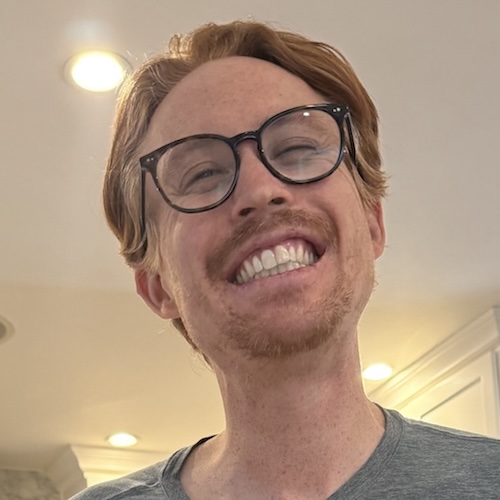
He and his wife, Tori, moved to Connecticut within weeks of diagnosis so Keaton could access a specialist and begin standard-of-care chemotherapy. When a scan showed his tumors had actually grown despite three months of treatment, it became clear that a different path was needed. Digging through his own genetic testing results, Keaton and Tori identified an NRG1 fusion mutation, present in only about 1% of all tumors across all cancer types. A monoclonal antibody drug, zenocutuzumab, existed for this exact mutation, but multiple oncologists across the country told him to “keep it in the back pocket.” He refused to accept that answer. His team at UT MD Anderson was the only one willing to pursue it.
After insurance denied the drug at $77,233 per infusion, Keaton and his family paid out of pocket and fought for approval every single day for a month. After just one infusion, his CA19-9 tumor marker dropped from 4,000 to 500. His first scan showed tumors shrinking by more than 50%. That response, combined with a critical referral to Houston Methodist‘s transplant team and the extraordinary generosity of his cousin, who volunteered as a living donor, made a curative liver transplant possible on March 31, 2026. Keaton is recovering, and planning to climb Mount Rainier in August, and raising $100,000 for the Cholangiocarcinoma Foundation. His message to other patients is clear: you are the CEO of your own care.
Watch Keaton’s video above and read through the edited transcript of his interview below to learn more about his bile duct cancer experience.
- Subtle symptoms matter. Keaton’s cholangiocarcinoma presented as mild heartburn, burping, and a dull abdominal ache, easy to dismiss as diet issues in an otherwise healthy, active person. Trusting your body and following up is always worth it.
- Self-advocacy can be the difference between life and death. When Keaton’s own genetic testing revealed an NRG1 fusion mutation that his oncologist had overlooked, he and his wife researched the targeted therapy available. They refused to take “keep it in the back pocket” as an answer from multiple institutions. His persistence led to the treatment that made his transplant possible.
- Patients are the CEO of their own care. Arming yourself with information, seeking multiple opinions, and asking hard questions are not disrespectful; oncology experts we work with say they are essential.
- Rare doesn’t mean impossible. Houston Methodist was the only transplant center in the country willing to evaluate Keaton as a candidate. Finding the right institution for a rare diagnosis can make options available that simply don’t exist elsewhere.
- Community and family can be curative forces. Keaton’s cousin stepped up without hesitation as a living donor, describing it as something she felt she was “meant to do.” The living donation allowed Keaton to avoid the wait for a deceased donor, a time he may not have had.
- Keaton went from a young dad who admitted he wasn’t fully appreciating the Colorado outdoors around him to a man planning to summit Mount Rainier and raise six figures for a patient advocacy organization — finding purpose not despite his diagnosis, but through it.
Keaton’s Diagnosis Facts
- Name: Keaton H.
- Age at Diagnosis:
- 34
- Diagnoses:
- Bile Duct Cancer (Intrahepatic Cholangiocarcinoma)
- Mutation:
- NRG1 fusion
- Symptoms:
- Mild heartburn and gastrointestinal discomfort
- Persistent low-grade abdominal pain
- Treatments:
- Chemotherapy: gemcitabine, cisplatin, FOLFOX
- Monoclonal antibodies: durvalumab, zenocutuzumab
- Radiation therapy: Y-90 radioembolization
- Surgery: liver transplant
This is not medical advice. Please consult with your healthcare provider to make informed treatment decisions.
- Keaton’s Diagnosis Facts
- My life before diagnosis: An active young family in Colorado
- Early symptoms and the decision to go to the ER
- My bile duct cancer diagnosis: The moment everything changed
- Starting first-line treatment, moving to Connecticut, and progressing on chemo
- Discovering that I had a rare NRG1 fusion mutation and fighting for the right bile duct cancer treatment
- My response to the new bile duct cancer treatment: The tumors shrank more than 50%
- A living donor transplant: How my cousin saved my life
- Sixteen days post-transplant: Recovery and looking ahead
- Processing “no evidence of disease” after my transplant
- Finding new purpose: Helping others and climbing Mount Rainier
- Hear from people living with bile duct cancer (cholangiocarcinoma) and other rare kinds of cancer
My life before diagnosis: An active young family in Colorado
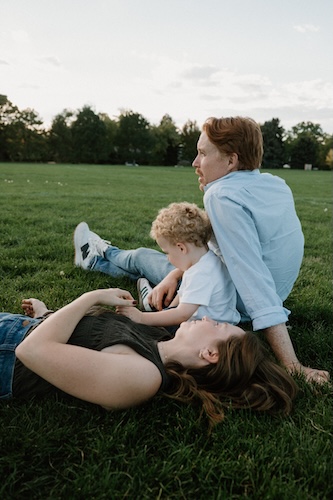
My son was about 16 months at that point, and he was keeping us very busy. I had just been laid off about six months before my son was born. That actually turned out to be a blessing in disguise, because I got to spend the first nine months of his life just being with him, being his dad. And I’m really grateful for that.
We were just a normal family, both working, taking care of our kid, and not appreciating the outdoors in Colorado as much as I do now, post-diagnosis. We go to a personal trainer a couple of times a week together. I love to cook. That’s one of my things, so our diets were pretty good. We eat vegetables; that’s an important part of our diet.
Early symptoms and the decision to go to the ER
If I look back and think really hard about what was going on, there are things that I could point to and say, “That was probably a red flag.” There were a lot of GI symptoms, a lot of heartburn with everything I would eat, a lot of burping. Just little things like that that I kind of wrote off as, “I need to eat better. I need to take better care of myself.” I just wrote it off because I was young and healthy, and I didn’t think much about it.
And then one day I had some weird abdominal pain, kind of below my ribs on my right side. I thought, “That’s weird.” And then it kind of stayed there for about 24 hours. It didn’t go away. I said again, “That’s really weird.” And it wasn’t a significant pain; I’m talking 2 or 3 out of 10, just enough to be uncomfortable enough for me to notice it. I was doing some Googling, and it seemed like a gallbladder thing or some type of infection, and they’d probably want to do an ultrasound to figure out what was going on.
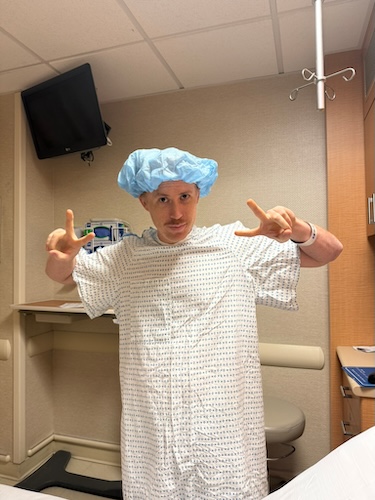
So I decided to go to the ER on March 13, 2025. They did an ultrasound, and then the doctor who was working with me in the ER came back in with his boss, and I was like, “Oh, that’s not good.” They said, “We did the ultrasound, and we discovered some giant masses on your liver. Yeah, there’s one that’s the size of a grapefruit, and then you’ve got a couple others that are lemon- and lime-sized.” I was pretty shocked.
They said it’s really uncommon for them to see a primary liver cancer in someone my age who doesn’t have a history of severe alcoholism. They said, “Usually when we see something like this, it’s starting somewhere else and spreading to the liver.” So there was a period of time there — a couple of days — where I was just thinking my entire body was covered in cancer and I had a few weeks to live.
My bile duct cancer diagnosis: The moment everything changed
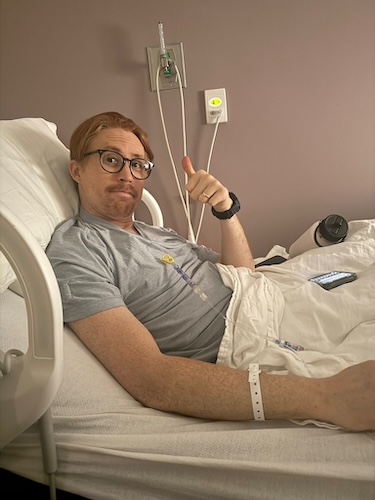
That was not a fun period. They did a CT scan immediately after, and, thankfully, they didn’t find any evidence of disease outside my liver. But there were these giant masses — almost an 11-centimeter mass on my liver, and the other one was almost seven, six centimeters — and just throughout my entire liver, just covered in cancer. That was pretty shocking. They ended up keeping me in the hospital overnight to do a biopsy the next day, and then we waited four days for the biopsy results.
I was in the bathroom getting ready for bed on a random Tuesday night, and I got a little notification: “Hey, you’ve got a new test result in your MyChart.” I opened that up, and I saw “adenocarcinoma, likely pancreas/biliary origin.” And I had to Google what the word “adenocarcinoma” meant. Cancer. So I walked back out of the bathroom, and I looked at my wife, and she looked at me, and we both kind of knew exactly what was going on. And that was a rough night. A really rough night.
Processing a life-altering bile duct cancer diagnosis
I think I’m still working through it. Compartmentalization has been key. I did that a lot before cancer — you could almost label it as sweeping things under the rug. Now it’s shifted to more of compartmentalization. It’s like this thing that’s happening to me is too much to really process right now. So we’re going to put this in a box over here, and we’re going to do what we have to do right now in order to move on to the next phase.
When you look back on it, cancer is a lot of just sitting around and waiting, right? But when you’re in it, it feels like you are constantly moving and constantly going from one thing to the next. It’s a lot to wrap your head around — especially going from being, I thought, a normal, healthy guy, to now somebody who’s fighting for his life with bile duct cancer, a cancer I had never heard of before. It’s a really weird shift. And I think a lot of it is still in that box of, “we’ll deal with this later.”
And the crazy thing is — later is now. I don’t have bile duct cancer anymore. My doctor said that to me the other day. Sure, there’s always the chance that something microscopic is in my blood and they didn’t get it all out. But today, I don’t have cancer anymore. And that is crazy, because when all of this started, I was literally told by my first oncologist, “You’re going to be on treatment for the rest of your life.” And what I took from that is that I’m not going to be living a very long time. And I had a 16-month-old son. I tried to come to terms with that diagnosis. But at the same time, I was like, “That’s not true. I have my son, I have my wife, and they need me, and this is not taking me out.” Maybe that was delusional, because this cancer is aggressive and the prognosis is not great.
Navigating marriage, parenting, and early decision-making after my diagnosis
Our kid, luckily, was young enough at the time where we didn’t really have to sit him down and explain what was going on. He’s two and a half now. He’ll be three in July. He still doesn’t fully grasp what’s been happening. He knows that Daddy goes to the doctor a lot and gets a poke. And even now, the other day he was asking us why we have to be in Houston. And that’s the stuff that really gets me, because he had to uproot his life too. He left his friends — we had this little Montessori school in Colorado — and he had to leave his friends and his teachers and come out here with us. And he doesn’t understand what’s going on. That part’s been hard.
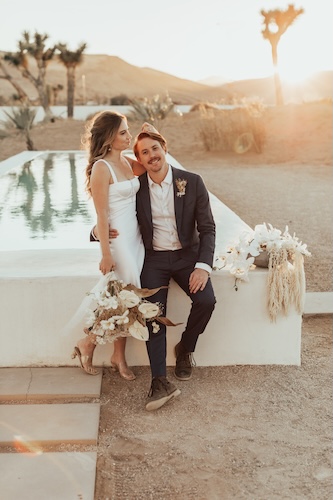
In terms of my relationship with my wife, I think we both went into fight mode. She’s got a background in healthcare — she’s got an MPH — so she knows more than I do about the healthcare industry and how to navigate it. From the get-go, she was helping me schedule appointments. I think I talked to four or five different oncologists in that first week, just trying to figure out what type of cancer I had. And we started to hear some of the same things — bile duct cancer, cholangiocarcinoma. It was good to have a label, something we could say, “Okay, now we know what it is, we can fight it.” We did a lot of Googling, a lot of online research.
Is it stressful and really hard to read some of these things online? Yes, it is. And it’s not good for my mental health, and it’s a lot of coming face-to-face with the possibility that it may not turn out so well. But I’m also the type of person who loves to have the information. I like to know what I’m up against. And it’s also a little empowering to arm yourself with this information and get a better understanding of what you need to do to win.
Seeking multiple second opinions and finding a bile duct cancer specialist
In the beginning, it was just about getting information and trying to figure out, “Okay, you think this is a good idea? Great. Let’s go talk to somebody else. How do they think we should do it?” A lot of the oncologists we talked to early on were not specialists in bile duct cancer or cholangiocarcinoma. We were lucky enough to get connected with a patient advocate in Baltimore whose specialty is finding the foremost expert in whatever disease you have, anywhere in the world, and getting you connected with them. That’s what ended up getting us connected with my first real oncologist in New York City at Memorial Sloan Kettering.
Every conversation was just a little bit more information, and that was really important to us because we had never heard of this disease before. If it had been some other cancer that’s more common, I understand there’s a playbook: “You do this, and we see really good results.” We kind of have that with cholangiocarcinoma, too, but I didn’t respond to first-line treatment at all, so it’s helpful to have all of that information.
Starting first-line treatment, moving to Connecticut, and progressing on chemo
Within two weeks of diagnosis, my wife Tory and I were on a flight to New York for our first meeting with my first oncologist. That was kind of an intro appointment — to establish care. We did a CT scan, blood work, all of that. So we actually moved to Connecticut for three months so I could start care with him in New York City.
I used to know a guy named Colonel Reeve — he’s an Army Ranger, total badass — and he used to say, “The worst thing you can do is nothing.” So in those early moments, that was in the back of my mind. You have to do something, especially when you’re dealing with a rare, aggressive cancer. You cannot just sit around and wait. His recommendation was what he called standard-of-care chemotherapy, which is gemcitabine, cisplatin, and durvalumab as the monoclonal antibody. So we would do chemotherapy and durvalumab one week, then just chemotherapy the next week, and then week three would be a break. The plan was to do that three times and then do another scan.
At this time, too, I was also changing pretty much everything about my lifestyle. I became a vegan. I started juicing three times a day. I eliminated sugar, processed foods, and anything that came out of a bag or a box. I was very conscious about what I was eating.
Doing all of that in combination with chemo and immunotherapy, and moving across the country, and in this mindset of “I’m going to do whatever it takes to survive” — and then we got a scan in June. Diagnosed in March, scan in June. And this scan showed progression. My tumors actually got bigger after three months of chemotherapy and the monoclonal antibody, and this entire change in my lifestyle, all of this diligence I had been putting in. And just to think that all of that was doing nothing — I was mad. I was angry.
Ultimately, I think it was a good thing that it didn’t work, because after that June scan, we were like, “We need to switch things up. We need to be way more aggressive with my treatment and start thinking outside the box. Because this playbook that they’ve created for cholangiocarcinoma — that’s not working for me.”
Connecting with a transplant survivor and setting the North Star goal
In a lot of ways, that scan was like a kick in the backside — a motivator. Like, “You’re doing all this stuff, but you’re going to have to fight a little bit harder if you want to see any kind of results.”
During that time in Connecticut, I also got connected with a patient mentor through the Cholangiocarcinoma Foundation — someone who had gotten a transplant and was alive five years later. From the moment I met him and heard his story, that was kind of my North Star. I was like, “This guy’s alive. This is what he did. I’m going to do that.” I went into every conversation with oncologists talking about my goal: transplant. And most of them were kind of like, “Yeah, okay — you have 11-centimeter tumors, you’re nowhere near transplant, let’s think about this later.” And I was like, “No, I’m not thinking about it later. We’re thinking about it now. This is the goal.”
Discovering that I had a rare NRG1 fusion mutation and fighting for the right bile duct cancer treatment
Tory and I went back and looked through my genetic testing, and we realized I actually do have a targetable genetic mutation — it’s called the NRG1 fusion mutation. It’s an incredibly rare genetic mutation, present in only about 1% of tumors across all cancers. We discovered this mutation and also discovered that there is a targeted therapy for it. We went back to my oncologist and said, “Hey, what about this?”
He wanted me to start second-line chemotherapy — FOLFOX or FOLFIRI — which is really harsh on the body, has a lot of side effects, and doesn’t make people feel great. We were like, “Hey, what about zenocutuzumab as an option?” What we were told was, “Yeah, maybe, but let’s keep it in our back pocket.” And we asked, “Why would we keep this in our back pocket if it’s potentially more effective than chemotherapy, with fewer side effects and better progression-free survival?” We kept getting told, “Let’s keep it in our back pocket.”
So in July, I spent the month basically traveling the country — went to Boston, went to LA, to USC, UCLA, went to MD Anderson, went to other doctors at Sloan Kettering — just trying to find somebody who would work with me and try this new drug. Pretty much all of them said the same thing: “Let’s keep it in our back pocket.” And I was like, “Okay, you’re not my doctor. I’m trying to be aggressive with my treatment. I’m trying to do whatever it takes. And this is what I think we need to do.”
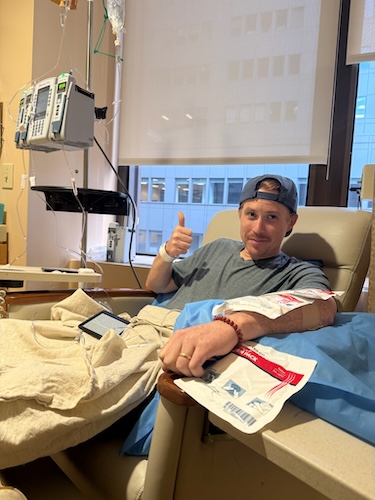
My doctor at MD Anderson was the only doctor who was like, “Yeah, I’ll work with you. This might be a fight with insurance, but we’ll do it.” So we moved my care to MD Anderson. I was able to go back home to Colorado and was flying to Houston every two weeks. I started this new targeted therapy on July 24th.
My response to the new bile duct cancer treatment: The tumors shrank more than 50%
After just one infusion, my CA19-9 — which is a tumor marker for GI cancers like cholangiocarcinoma — was about 4,000 when I started this treatment. After one infusion, it went down to 500, and it kept going down from there, to the point where it was almost in the normal range.
My first scan after starting this treatment showed that my tumors were decreasing in size by more than 50%. And that was a crazy thing to see. It was so validating — I had this feeling that this is what we needed to do, and everybody said “No.” I just kept pushing, and it worked.
Not only did it work, but it worked with zero side effects. I felt like a normal human being after months of chemo. I felt normal. I was able to start working out again. I was able to start climbing mountains in Colorado again — things I thought maybe I would never get to do again.
I’m no doctor, but I think therapies like this are the future of cancer treatment in a lot of ways.
Being the CEO of my own bile duct cancer care: Advocating for myself as a patient
I’ve never liked other people telling me what to do. I’ve always been very stubborn. There are a lot of times in my life during which that hasn’t exactly worked out well for me. But this is a situation where you almost have to be stubborn. I mean, sometimes doctors give good advice, and they have good ideas. But for me, it was always about this: I’m putting my trust in somebody I really don’t know that well, and I’m just hoping they’re going to leave no stone unturned, evaluate every possible treatment option, and go down every rabbit hole. And they’re just not going to do that. I’m just one patient, and they have hundreds of patients.
I’m the CEO of my own body. I need to understand what’s going on and what my options are. A lot of that doesn’t come from them; a lot of times, they won’t even bring up what my other options are. But if I go in, if I Google and read what’s online and use ChatGPT and all these other tools, and really understand what I’m up against and what my options are, I think we can have a better conversation between my doctor and me. We both have the full picture, and we’re able to make better decisions together.
The path to my liver transplant
According to the NCCN guidelines, if you have cholangiocarcinoma, transplant is an option if you meet certain criteria: (1) disease stability for a period of about six months; your tumors have to be shrinking or stable; (2) tumors that are three centimeters or less in size; and (3) no extrahepatic spread; it has to be all isolated to your liver. Those three criteria are what qualify you for a liver transplant.
MD Anderson doctors actually go to a liver clinic with Houston Methodist transplant teams every two weeks, and they talk about patients and refer them through a pipeline to transplant. My doctor knew from day one that it was my goal, and he was like, “I want to help you get there, but we’re still a ways off.” My tumors were still pretty big, about 7 or 8 centimeters at that time, albeit shrinking.
Houston Methodist is one of the places in the country that is pushing the boundaries on who can qualify for a transplant. At any other transplant center in the country, I would not have been a candidate. I was actually told by Massachusetts General, my hospital in Colorado, UCHealth, and a few others that I was not a candidate for transplant. To my knowledge, Houston Methodist is the only place in the country that would consider me a transplant patient.
More steps to my liver transplant
I had been taking the new therapy since July, and my disease was stable and shrinking during that period. I was able to get referred over to Houston Methodist and start the evaluation process in November, right before Thanksgiving, going through about two weeks of extensive medical testing to see if my body was healthy enough to go through the surgery, make sure there was no spread, and confirm I was a good candidate. They determined that I was.
Right after Christmas, we packaged everything up and sent it off to insurance. And then I got a scan in early January that showed something confusing: my biggest tumor was still shrinking, my second-biggest was stable, but we were seeing really tiny lesions starting to come back in the liver. We were thinking, “we can’t say for sure this isn’t working anymore, but we might be reaching, or past, peak effectiveness.” That’s a really scary thing to hear after you’ve done all this work, gotten to this point, been evaluated, and been approved. And then insurance denied the transplant.
It was one of those situations where time is not on my side. We need to get this done immediately. If the cancer spreads outside my liver, a transplant is off the table. That could mean my only curative treatment option is gone. So in January, I had conversations with my oncology team in Houston and at MD Anderson, and my team back home in Colorado at UCHealth about what more we could do. We decided to continue the targeted therapy and add FOLFOX — another systemic therapy on top of that, to make sure nothing was spreading or growing anywhere else.
I also said, “What about Y-90 radiation?” which is a really cool procedure where they inject millions of microscopic beads into your hepatic artery. Those beads go to your liver and basically attack the tumors from the inside with radioactive material. My oncologists said, “Let’s hold off on Y-90.” I said, “I’m going to do it anyway.” And I did.
So I did Y-90, the zenocutuzumab, and FOLFOX — started FOLFOX in January, did the Y-90 in early February — and got another scan in early March that showed everything was stable. A little bit of shrinkage in one of the tumors, but everything else stable.
A living donor transplant: How my cousin saved my life
During that time, my cousin was also being evaluated as a living donor throughout February and into early March. We got the call at the end of February/early March that she was approved as a living donor. And this is what saved my life.
I was able to do a living donor transplant as opposed to waiting for a deceased donor — we got the call, we were able to schedule the surgery for March 31st, and I didn’t have to wait. I didn’t have to get to a point where my body was too sick to handle the surgery, and I didn’t have to wait for my cancer to spread.
How it came about: One of the things we do as a family is get a big house in Palm Springs for Thanksgiving. We all go, all the cousins, Grandpa, everybody. And spend about a week together. Of course, we were talking about my cancer and about the evaluation process. From day one, she was like, “Sign me up. I’ll do it. I’ll be a living donor.” She was the first person to sign up. And she said multiple times, “I don’t know what it is, but I’ve just had this feeling my whole life that this is something I was meant to do.”
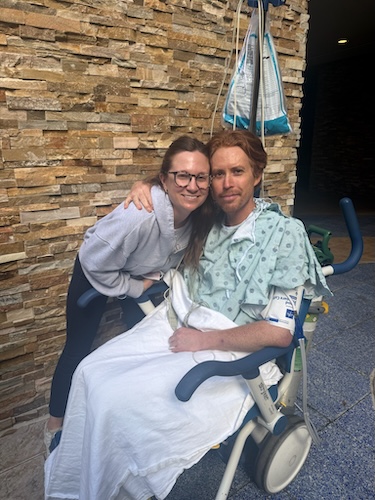
She actually has a son about nine months older than my son. When we came out here for the surgery, we all rented a big house in Houston. Her son, my son, everybody running around playing together. She’s downstairs right now, and we’re just in this house recovering together.
How a living donor liver transplant works: The surgical reality
A lot of people don’t know this, but your liver is one of the two organs in your body that will regenerate itself. The other is your skin.
What happens with a living donor liver transplant is that they take up to 65–70% of the donor’s liver. Your liver has two lobes, a right lobe and a left lobe. The right lobe is the larger of the two. So they took the right lobe from her, removed my entire liver, and connected her right lobe to my arteries and everything. She still has her left lobe, which will eventually grow back to its original volume within a few months.
They basically removed my whole liver, put part of her liver into my body, and connected everything, all the arteries together. You’re going from an artery to a smaller vein, like a tree trunk to a tree branch. In order to do that, they need to get other veins from what was described to me as a “vein fridge,” a fridge that they have at the hospital, full of people’s veins. They get a bunch of veins that are significantly or exponentially smaller, and they kind of Frankenstein this thing together so that it all fits and flows.
I was hooked up to a bypass machine, a tube going in here that would connect to my artery. As your liver filters your blood, when they remove your liver, you have no way to filter your blood. So it’s basically like a dialysis machine; the blood would go out through another incision in my groin area and just kind of circulate. I don’t think they put my own blood back in because it was technically cancer blood, so I think they were giving me new blood and taking out my old blood. And then once they removed those clamps, everything was put together; the liver just starts working immediately. It just knows what to do. And it’s the craziest thing to think about.
Sixteen days post-transplant: Recovery and looking ahead
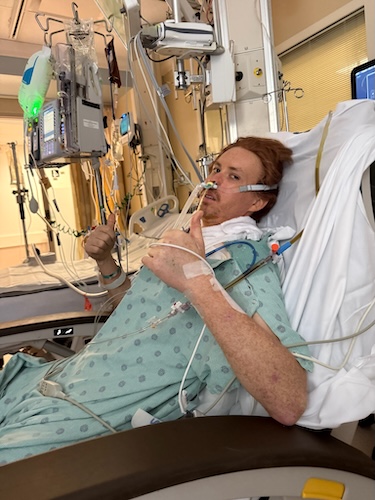
Recovery has so far been a lot of naps. It’s exhausting to regrow an organ and recover from a surgery like this. There’s a lot of fatigue. The incisions have actually been the easiest part of this whole recovery process. It’s everything else that happens around the surgery that has made recovery a little bit challenging, like being stuck in a hospital bed; you kind of get hunched over, so you get back problems. Your stomach is starting to relearn how to digest things, and your whole GI tract is learning how to work again.
I use the analogy: imagine you’ve got a basketball team that’s been playing together for 35 years, and then all of a sudden you get this new young player in there. He’s got a lot of skill and talent, but he hasn’t been playing with this team for 30 years. You’ve got to figure things out, learn the plays, and all of that.
I also don’t have a gallbladder anymore; they take that out when they take out your liver. So things like fried food and really fatty foods are a little bit harder for me to digest now. We’re still dialing in the medication doses with my anti-rejection meds. There are side effects to that. But none of this is anything close to something to complain about for me, because I’m alive. And I get to be around for my son, for at least a little while longer. And that’s what it’s all about.
Processing “no evidence of disease” after my transplant
I’m not letting myself process it yet. I’m still being cautious, because I know there’s always a chance that something small got through. I’ve got a couple more tests to do; one of them is a ctDNA test to make sure there’s no cancer in my blood. I’ve got more scans. But I keep going back to the fact that part of this whole evaluation process before transplant was making sure there’s no cancer outside my liver, and they really checked.
Theoretically, if you remove the cancer, there’s no more cancer. I’m hesitant to say that I’m cancer-free or that I don’t have cancer anymore. But my doctor said it to me the other day, and that was the first time I heard it. I don’t think I’ve fully processed that yet.
Finding new purpose: Helping others and climbing Mount Rainier
I think sharing my story on social media and hearing from thousands of people, thousands of people who didn’t even know me, who for whatever reason leave these messages of support and love — it’s like when my son was born, I felt this sense of clarity and purpose. I thought, “I am put on this earth to be this kid’s dad. That’s my calling.” And in a lot of ways, I feel that same clarity right now. My purpose is to help as many people as I can with my story, whatever that looks like.
I’ve been given this opportunity to do something good with all of this, and it’s an opportunity a lot of people don’t get. I still feel like my purpose is to be my kid’s dad. That’s always going to be there. Now I’ve got this new purpose as well, and that feels pretty cool. It feels like a new story that I get to write, one that I’m in control of.
My next step is raising awareness about this disease and raising money for the Cholangiocarcinoma Foundation, an organization that really helped me when I was first diagnosed. I’m planning on climbing Mount Rainier in Washington in August of this year. I’m trying to raise $100,000 for the Cholangiocarcinoma Foundation, and I’m about halfway there right now. If people are interested in donating, they can visit the link in my bio on social media.
This interview has been edited for clarity and length. The views and opinions expressed in this interview do not necessarily reflect those of The Patient Story. This content does not replace professional medical advice.
Inspired by Keaton’s story?
Share your story, too!
Hear from people living with bile duct cancer (cholangiocarcinoma) and other rare kinds of cancer
Real experiences with diagnosis, treatment choices, side effects, and life beyond bile duct cancer (cholangiocarcinoma) and rare cancers — in their own words.
Leave a Reply