
How Alicia Pushed for Answers When Her Ocular Melanoma Spread to Her Liver
Alicia was 18, just a few weeks into her freshman year at UCLA, when she started noticing things were off. She couldn’t see out of the corner of her eye. She kept losing her balance, once falling down a flight of stairs, which had never happened to her before. She’d also dropped 15 pounds in two months. “I just thought, well, it’s finals. It’s 3 a.m.,” she says. “Of course my vision is going to be going. I didn’t realize it was as serious as it was.” It was her partner and family who pushed her to get it checked, alarmed when she mentioned the vision changes. A dilated eye exam found a detached retina and a shadow behind her eye. In December 2016, doctors diagnosed Alicia with ocular melanoma, a tumor taking up about a third of her left eye.
Interviewed by: Tory Midkiff
Edited by: Chris Sanchez
She had a choice: remove the eye or treat it with brachytherapy, a procedure in which a radioactive gold plaque is placed on the eye for several days. Alicia chose brachytherapy. She wanted to keep as much of her vision and depth perception as she could. She was on track to become a doctor, wasn’t yet sure whether she’d go into a surgical specialty, and wanted every option open to her. At her three-month follow-up, the tumor had shrunk down to scar tissue, an outcome she says her oncologist had never seen.
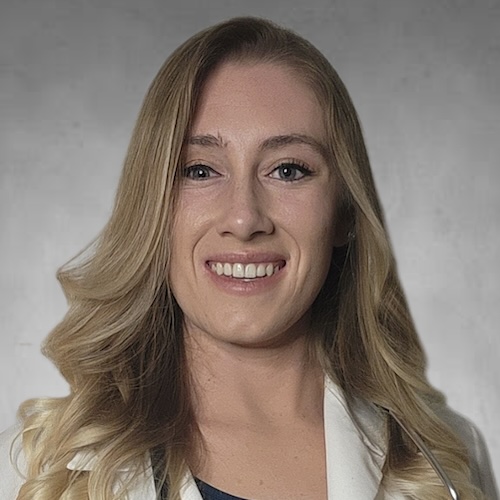
She stayed in school, finished her degree in three years, and went on to earn a master’s degree. This year, she graduated from med school and matched into radiation oncology.
In early 2025, a routine surveillance scan picked up two small spots on Alicia’s liver. Her mutation, she’d learned from her original biopsy, is a late-metastasizing marker. In most cases, it doesn’t spread within the first five years. Eight years out, her oncologist told her she was “basically in the clear.” But Alicia had a gnawing feeling something was wrong. She went to her primary care doctor and asked for a different oncologist. The new doctor ordered more imaging and a biopsy, which confirmed metastatic melanoma in her liver.
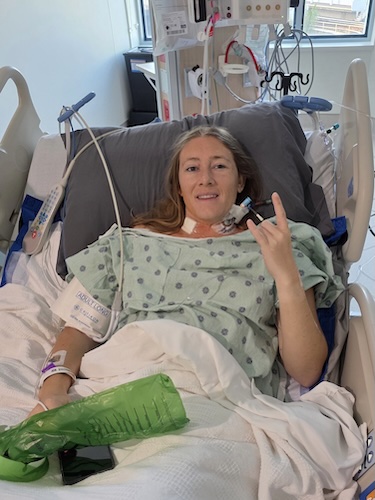
Alicia has since completed her first liver treatment called melphalan (Hepzato Kit), a new procedure that sends chemotherapy directly to the liver, then filters most of it out before it goes to the rest of your body. The procedure required an ICU stay. She also went through fertility preservation, pushing her care team to fit it in before treatment started. The egg retrieval and the liver treatment ended up just three days apart. A week after that, she started residency. She has another chemo treatment ahead, hopefully her last for now, followed by dual immunotherapy.
Living with the fear of recurrence changed how she lives. She stopped waiting for “when I get older” and started doing the things that scared her, traveling on her own and leaning on the people around her. It forced her, she says, “to really embrace my life in a way that I’m actually really grateful for.”
Watch Alicia’s video and read through her edited transcript to find out more about her metastatic ocular melanoma experience.
- Alicia’s symptoms didn’t look like cancer to her. Losing peripheral vision, falling down stairs, and dropping 15 pounds in two months all seemed explainable until the people around her reacted with alarm and asked her to get checked.
- Alicia chose self-advocacy when an oncologist told her she was “basically in the clear” at eight years out. She knew her melanoma carried a late-metastasizing marker, meaning it’s known to show up years down the line rather than early, so she asked her primary care doctor for a different oncologist. The new doctor ordered the imaging and biopsy that confirmed metastatic disease.
- Alicia pushed her care team to complete fertility preservation before starting focused liver chemotherapy. At 27, having kids someday mattered to her. Her care team fit fertility preservation in before starting liver-directed chemotherapy, and they made it work, just three days apart.
- The fear of recurrence pushed Alicia to stop putting things off. She stopped waiting for “when I get older” and started traveling every year, to England, Costa Rica, Bali, and Japan, calling the things that she’d done that previously scared her, “some of the most healing experiences that you’ll ever have.”
Alicia’s Diagnosis Facts
- Name: Alicia M.
- Age at Diagnosis:
- 18
- Diagnosis:
- Ocular Melanoma
- Staging:
- Stage 4 (Metastatic)
- Biomarker:
- Late-metastasizing marker
- Symptoms:
- Peripheral vision loss
- Loss of balance resulting in falling
- Unexplained 15-pound weight loss
- Treatments:
- Radiation therapy: brachytherapy (gold plaque)
- Chemotherapy: melphalan
- Upcoming dual immunotherapy
This is not medical advice. Please consult with your healthcare provider to make informed treatment decisions.
- Alicia’s Diagnosis Facts
- Starting at UCLA with a dream of becoming a doctor
- Losing my peripheral vision, falling down stairs, and dropping 15 pounds in two months
- Hearing the word “cancer” for the first time
- Brachytherapy: Four days with a gold plaque on my eye
- Choosing radiation oncology after experiencing it as a patient
- How the fear of ocular melanoma recurrence pushed me to travel and live now
- When liver lesions became metastatic ocular melanoma
- Advocating for myself and switching oncologists
- The metastatic ocular melanoma diagnosis was worse because I knew what was coming
- The official diagnosis: Ocular melanoma taking up a third of my left eye
- What I would tell 18-year-old me
- Why support groups felt scarier than helpful at first
- The numbers aren’t everything: Looking beyond survival statistics
- The doctor who cared for my family shaped the doctor I want to be
- Hear from people living with ocular melanoma
Starting at UCLA with a dream of becoming a doctor
I’m Alicia. I was diagnosed back in 2016, and back then I was just starting my undergrad. I was in my first quarter at UCLA, and I was really excited to just get started with college and work towards my dream of eventually being a doctor. It was very early on at that point.
Losing my peripheral vision, falling down stairs, and dropping 15 pounds in two months
I started to notice that I was having times where I couldn’t really see off to the side, like I was losing my peripheral vision. I couldn’t see when I was trying to shave. I had weird lapses where I would be losing balance, or I fell down the stairs, which for me never happened. And even though I was on my phone that time, it was abnormal for me to ever lose my balance. So I had stuff like that where I just kept getting injured.
And then I was losing a lot of weight, which I attributed to the stress of starting a new program. I didn’t think much of it because there’s always that freshman 15, and I lost 15 pounds in a matter of two months, which was really abnormal for me.
My family encouraged me to seek care for my vision changes
I don’t think I actually connected the dots that the symptoms were related until quite a bit later. I mentioned the vision changes to my partner and my family at the time, and I got a lot of stress responses back. And I guess that’s what made me take it a lot more seriously, because I just thought, “Well, it’s finals. It’s 3 a.m. Of course my vision is going to be going.”
A dilated eye exam revealed a detached retina and a shadow
So I went in just for the vision changes. At that point, they checked my eyes. They did a dilated eye exam, and they found that my retina was detached. And they saw a little bit of a shadow of something they didn’t know was a tumor yet at that point. So then started the whirlwind of exams.
From that time, the doctor sat me down and told me, “Hey, we suspect there’s a tumor behind your eye. We think that that is cancer, and we need to get you into all the next appointments and further imaging.” And so the next couple of weeks were just a series of labs and CT, MRI, every imaging modality you can imagine. And then rushing me to a referral at USC, because they had an ocular melanoma specialist there that is phenomenal. She’s really, really great. And luckily I had a lot of people advocating on my behalf to get that all done very, very quickly.
Hearing the word “cancer” for the first time
I was there with my mom. And I think for me, it was almost reassuring, because I knew something was wrong, but I didn’t really know what. And that was kind of the moment that it made sense. And for my mom, I think it was a lot harder. I can’t really speak for her, but it was definitely more of a shock. And I think she spent time trying to comfort me. As for me, I wasn’t really scared yet, because I didn’t really know what was coming.
Weeks of scans and labs that were all brand new at 18
Well, I was very lucky to have my family there to help and set up all the appointments, but it was really like every single day for a few weeks that there was some kind of appointment, some specialist that I was seeing, some kind of imaging. And they all have contrast, and they’re taking blood, and all of these things kind of make you feel awful on top of the fact that you’re already trying to deal with the diagnosis. So it’s all kind of scary.
A lot of those imaging modalities I had never had before, because I’m young. I hadn’t gone through any screening. I was 18 at the time, and so all of it was brand new to me. And all of it was a little overwhelming.
Staying in school while ocular melanoma became a waiting game
For me, it was really important to stay in school and to have something that I was actively working towards, and feeling like I was making a difference and making forward progress. Because a lot of cancer, you know, past your initial treatments and diagnosis and all that, it’s a big waiting game. And I think that dichotomy from being rushed in for original treatment and all your diagnostics, to just having to wait three months and seeing what happens, is a really hard transition to deal with if you don’t have something else going on in your life, if you don’t have something that you’re working towards. Because then you’re just sitting around anxious and wondering, “Is the cancer growing? Did it handle it? Am I going to have to go back in and start this all over again?”
So that part of it was really scary, and it helped a lot for me to stay in school. I took a quarter away from work, and my boss was very understanding of that and just told me to focus on my health. I’m so appreciative of that. And then I was able to go back three months later, and then I had both to help keep me busy and keep me working towards my dream.
Working toward medicine: UCLA, a master’s, and medical school
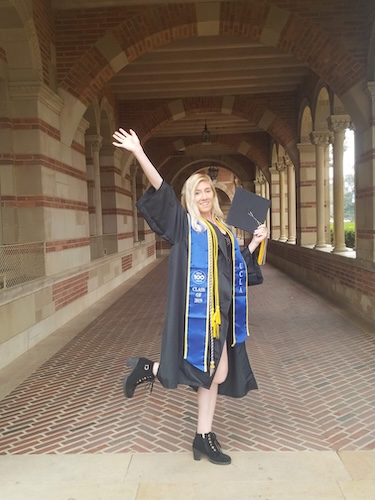
I went to UCLA for my undergrad, graduated in three years, and then I went on to do my master’s in medical physiology, because it got me a little bit closer to medicine and got me a little bit more exposure. But it was right in the middle of COVID, so it wasn’t reasonable to be shadowing or in a clinic or anything like that at that time.
Once I finished my master’s, I went on to get accepted to med school at Midwestern University in Arizona. So that’s where I spent the last four years. And I just graduated this year.
Brachytherapy: Four days with a gold plaque on my eye
So for the original ocular melanoma diagnosis, we did brachytherapy. That involved them putting a gold plaque on my eye. And it was on this inside part of my eye here, so it was not super visible, but you could see a little bit of a gold shimmer on my eye when they had it on.
They left that for four days and then removed it. And they have to have you awake for the procedure somewhat. You’re in a twilight so that you can respond to commands and you can look around, because you need to be able to move your own eye while they’re doing the procedure. So those are a little scary, but you’re given meds to help calm you down a little bit.
And then after that, it was just a lot of imaging for the retina and making sure that it was indeed shrinking. We had a three-month follow-up, which is the first time that you know whether or not the cancer is shrinking or continuing to grow or anything. And luckily that appointment went very, very well. And we found that the tumor, amazingly, had shrunk down to nothing. It was just scar tissue at three months, which is not something my oncologist had ever seen. So that was really exciting, and it was a good sign.
The three-month scan: Only scar tissue left
I was just so excited that my body had kicked cancer’s a**. And, you know, it’s scary to not know what’s coming next and how much it’s going to affect all of your plans. And I knew even then that I wanted to be a doctor, and I didn’t want that getting in the way.
My oncologist and I had a lot of discussions about what that might look like for me when deciding on a treatment plan, because you can do the brachytherapy, or you can actually have the eye removed. And I was really concerned about keeping my eye, both for future impressions, because everyone notices if you have a fake eye, but I also wanted at least a little bit of my vision and a little bit of my depth perception. Because I wasn’t sure if I would go into a surgical specialty when I went to med school, or just in general be a little bit more hands-on.
I was still deciding which way I wanted to go. I ended up going for radiation oncology, so that’s what I matched into. So I’ll be starting that next year once I get through my transition year. But it’s a mix of being a little bit more interventional and doing a lot more hands-on things, and still having a lot of clinic time and being able to care for patients in that regard. And then being able to contour and create the patient plan in detail outside of your normal clinic time.
And even though I didn’t know what all that would entail quite yet, I really, really wanted all my options available as a future physician, to make sure that my ability wasn’t limited and that I never had to second-guess my own ability while I was treating a patient if a mistake was made. I never wanted to be responsible for hurting somebody else because of my own abilities.
Choosing radiation oncology after experiencing it as a patient
I didn’t know about radiation oncology before I went through treatment. I knew about oncology, obviously. I’d had a best friend that died of brain cancer when I was in first grade. And then I’ve had a lot of family and friends that have been afflicted with cancer. So it was very personal to me, and I knew I wanted to go into it from a really young age.
But I think finally getting exposure to radiation oncology, and seeing how much it can help, and how few side effects I had from the treatment, just unlocked this whole new world of treatment that I wasn’t aware of. And I’m excited to share it with my patients.
How the fear of ocular melanoma recurrence pushed me to travel and live now
I think the fear of recurrence was always kind of present, but it changed my life in a better way than I anticipated. It made me a lot more aware of the time that I had left, and the time that I might be wasting. And I didn’t want to miss opportunities just because, you know, we all say, “Oh, when I get older, I’ll do this.” And I didn’t know if there would be a “when I get older.”
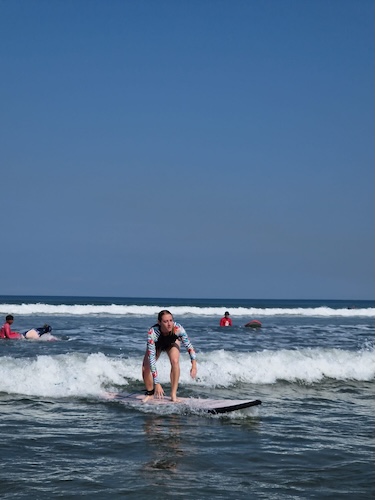
So it encouraged me to start traveling a lot earlier. I did my first study abroad trip back in 2017, like a year after I was diagnosed. And they finally were like, “Hey, you’re going to have to do your surveillance every three months, but as long as you come back after that, then you can go to England. You can go enjoy your life.” So that was my first time being abroad by myself, and I really, really loved it. And ever since then, I’ve taken a lot of chances to try to travel, like once a year. I’ve gone to Costa Rica, to Bali, to Japan, and I just absolutely love it.
I think the fear of recurrence forced me to do all the things that I would have been putting off, and to do all the things that I’m scared of. And it forced me to really embrace my life in a way that I’m actually really grateful for.
When liver lesions became metastatic ocular melanoma
April of this year was when I found out that the cancer had metastasized to my liver. Previous to that, I had just not really been feeling myself. I knew something was a little off. I was more fatigued than usual. My labs were a little abnormal, but nothing that threw up any alarms for any of my doctors. I just had this gnawing sense that there was something wrong, and I couldn’t really explain it. And the labs didn’t show it either.
So I went in to get follow-up imaging, like I always have, every six months. And they found two small lesions on the liver originally, like a year ago, I think, from this point in April. And they just kind of brushed it off, like, “These are usually benign. We’ll keep an eye on it, but nothing really happens.” We did imaging again in six months. The lesions had still grown incredibly slowly, at a rate that, again, didn’t throw up any flags. They still thought they were probably benign, but I was starting to get a lot more concerned.
So then in April, another lesion popped up, a third one, and that was visible. And at this point they declared it as a metastatic disease. They finally said, “Yes, they’ve grown enough.”
There are enough lesions there that it is growing in what’s considered a miliary pattern. And they decided to do the liver biopsy. So the liver biopsy then was done in April, and that’s how we confirmed that it was metastatic melanoma, not some benign condition.
I found out when I was in Japan. I wanted to go enjoy my trip before we came back to the whirlwind of exams. But as soon as I got back, we were back into genetic testing, into more imaging.
I was about to graduate from med school, and I knew I was moving to Florida. So that was kind of tricky to navigate, because now I had to get in with a new doctor while trying to get all of my diagnostics done in a different state. And I knew I’d be switching insurance. So that’s kind of where we were up to, basically, June of this year.
Advocating for myself and switching oncologists
When we originally found the lesions on MRI, about a year before April or a little more than that, at that point I had gone to my oncologist and said, “Hey, I’m really concerned that there’s more to this. I really feel like we need to do more imaging. We need to look into this.” And I got a lot of pushback from that oncologist. I was told, “Well, you’re eight years out. You’re basically in the clear.” And specifically the kind of mutation that I have, which we found on the biopsy, it’s a late metastasizing marker. So it’s not going to metastasize in the first five years in most cases, unless you find it really late. And so I went back to my primary care, and I said that I didn’t feel like I had a good relationship with this doctor. I don’t feel like I was listened to. “I need a different oncologist.”
And that new oncologist took it seriously, did more imaging, and did the biopsy. And I mean, she was advocating for me so well, like calling everyone personally from the office while I’m sitting in front of her. She did a phenomenal job, and she got me in incredibly quickly.
So I’m glad that I trusted myself. And I would definitely tell anyone that’s going through this: if something is not right, you need to advocate for yourself. Your doctors need to know, because even if they’re an amazing doctor, it might not hit their red flags. And no one knows your body the way that you know your own body. So even if you’ve treated oncology your whole life, you might miss one of those things.
And so I think it’s really important that patients do advocate on their behalf, and they know who to reach out to, bring it up again, ask for a new doctor if you’re not vibing with the one that you have. And I don’t think anyone takes that personally. Every doctor wants to take care of their patients, but sometimes it’s just not the right fit.
The metastatic ocular melanoma diagnosis was worse because I knew what was coming
When I saw the biopsy result, when we were in Japan, I immediately broke down. I wasn’t ready for what was next. And I knew what that was like because of the first time. So I think that getting the metastatic diagnosis was way worse than the original diagnosis, because you know what’s coming. You know what to expect and how much you have to go through.
And especially now, having spent six months working in oncology clinics as part of my med school curriculum, I walked so many patients through the same kind of journey. Every step of the way, every medication that needs to come, how scary those procedures are. And you talk to them about all the side effects. So I think it was really personal, and I had a much deeper understanding the second time around. And I was definitely not ready for it at all.
But I think that I had much more confidence in handling all of the appointments, and knowing who to call, how to deal with insurance, because I’ve worked with insurance myself now. I’ve seen the clinic side of things. I’ve got a lot of people in my network that advocate for me and reach out to whoever I need.
My community has been so amazing to me. So I definitely was a little less scared from that aspect, because I knew I would be taken care of by the people around me. I was a lot more supported by friends and family than I was the first time, and I think a lot more people knew what was going on. And I chose to be more open about it this time, because I didn’t want to go through it alone.
The first time was pretty isolating, and I didn’t really share it, because I didn’t want people to see me differently, or think that my cancer was somehow an excuse for anything going on with my school or with my job or anything like that. I wanted them to just see me first. Not the cancer patient. I wanted to be able to stand in success in my own right in whatever I did. And this time, I think I already had the chance to prove myself. I already got into the specialty of my dreams. And I had all these people that already trusted me, respected me, and wanted to help. And it was just really relieving to be in a very different place than I was the first time.
Treatment, ICU recovery, and fertility preservation in the same week
Once I got the results of the biopsy, I got established here in Florida. And originally I was looking at doing something a lot more targeted, like histotripsy or embolization. And the more scans that we did, the more we realized there were probably more tumors there, and that probably wasn’t the best first-line approach.
So now I’ve already had my first hepzato [melphalan] treatment, which is like isolated liver perfusion, so isolated liver chemotherapy. And it requires an ICU admission afterwards, because they have to monitor your blood pressure and make sure that you’re stable. Because they have to run all of your blood through this outside ECMO machine. So they kind of reroute your entire system and bypass your heart and lungs to do the procedure. So it’s very scary, especially being a medical professional. I know all the ins and outs of what can go wrong with that. But the first one went very well, and I recovered within a few days.
I’ve also gone through fertility preservation to make sure that I could still have kids later on, even though I have chemo in my system. Being a very young patient, you know, I’m now 27, I still care a lot about being able to have kids, and it’s not something that’s come up for me yet. So that was very important for me to consider, and something I really pushed with my team to get taken care of before I started treatment.
So that was a lot of hormone therapy for like two weeks, and then an extraction procedure. And the melphalan and the extraction procedure were only about three days apart. So it was a bit of a rough week, to say the least. But I was still able to start residency about a week later. They just pushed back my start date a little bit.
So I have another melphalan treatment coming up, which hopefully will be my last for now. And then I’ve got some immunotherapy as well. We’re doing like a combined dual immunotherapy.
Starting residency a week after liver-directed chemotherapy
Residency has been going great. I’m lucky to start on a more chill outpatient rotation. So I’m not seeing people that are high acuity or really sick, just a geriatric population that I get to connect and laugh with, and just help them manage chronic conditions. And that’s been really rewarding, to get to spend some time there while I’m still recovering and handling all my appointments.
It gives me a little bit more time to do what I need to do with my insurance and medical stuff, while still getting to feel like I’m making a difference in people’s lives. So that’s exciting.
The official diagnosis: Ocular melanoma taking up a third of my left eye
So I got the official diagnosis back in December of 2016. At this point, it was an ocular melanoma, and it was isolated to the eye. It was taking up about a third of my left eye.
Luckily, it had not spread anywhere at that point, so the brachytherapy was enough to handle that.
What I would tell 18-year-old me
If I had to look back and talk to 18-year-old me with that original diagnosis, I would tell her to trust the process and to not give up all the things that she loves in her life. Take the risks. Go do the things that scare you.
I kind of learned that over a few years, but I think I could have taken advantage of that right away. Because all of those things that scare you are also some of the most healing experiences that you’ll ever have, and they give you so much hope and so much life while you’re dealing with something that is really just overwhelming and life-changing.
So I think I would just remind her that it’s okay to share that with people, and they’re not going to judge you for it. And to lean on the people close to you, because I’m not sure that I did that enough the first time. I’ve done it a lot this time, and it’s really helped.
Why support groups felt scarier than helpful at first
I tried joining some support groups right when I was first diagnosed. I think it was scarier than it was helpful. And most people who are diagnosed with ocular melanoma are significantly older as well. So there weren’t a lot of people my age that were in those support groups. Unfortunately, it was hard to connect with them at the time. And they’re probably in a very similar situation to me, where they’re having a hard time finding their people.
I think it’s a lot easier to find your groups on Facebook or through patient advocacy groups now, but it wasn’t as widely known ten years ago.
Ask for help, especially with finances and insurance
I would just remind patients to trust their physicians, to trust themselves, to trust when something’s not right, to speak up for themselves. And really just lean on the people around them. Don’t be scared to ask for help, especially from a financial and insurance standpoint.
I think some people delay care or get really scared to engage with the system at all. And there’s a lot more help out there than you realize. There are a lot of patient advocacy groups. There are a lot of charities, even at the hospitals that you’re getting treatment at. They have financial assistance programs. They have clinical coordinators that will help walk you through it. I think if you’re scared and you’re overwhelmed and you don’t know which direction to go, ask for help, because there’s always somebody that’s there to help you. And we’re just not aware of the resources a lot of the time as you’re first starting.
So I think that’s probably the biggest advice that I could give to someone: make sure you find your patient advocates within the hospital and outside of the hospital, and ask for help, especially with finances. That way you don’t end up delaying care over it.
The numbers aren’t everything: Looking beyond survival statistics
I guess the thing that is scariest with this particular diagnosis, that I would want people to know, is that the numbers aren’t everything.
When you see a research study, and it shows a mortality rate that is incredibly high and a low life expectancy, you really need to look beyond those numbers. And really, your treatment, especially if you have metastatic disease, is to buy you time. It’s to get you the next ten years, so that someone else comes out with the next treatment, the next one gets approved, and then you keep fighting.
I don’t think that those research studies that show life expectancy are telling the entire picture. Especially with ocular melanoma, with it being an older patient population, people that are diagnosed at 75 have already reached the expected life expectancy for a normal, healthy person. Some of them might have passed within ten years anyway. That doesn’t mean that’s going to be your story.
So look beyond the research. Don’t let the numbers scare you. I think that there’s a lot more hope out there than what we see in just those studies.
The doctor who cared for my family shaped the doctor I want to be
You know, I think that this diagnosis has helped a lot when it comes to caring for patients. Especially because, when I was first diagnosed, I had a physician: she was my ocular oncologist who did a great job at taking care of my family as well, not just me. She really noticed how nervous they were and how helpless they were feeling, and made sure to include them in the treatment plan, giving them little tasks to do, and just really helping calm their nerves as well as my own.
So I think going forward, when I think of my own career, I think of physicians like that, who took a lot of their own time to comfort the patient and the family and make people really feel comfortable. Because a cancer diagnosis, with all of the treatments and diagnostics that come with it, has so many steps that can be overwhelming and scary. I think people just taking the time to humanize that, and really explain what’s coming next and what to expect, and allow people to have a space to have emotions even within those appointments, is incredibly healing and important.
Anytime that I can do that for my patients, I want to. I love being able to connect with them. And cancer patients are some of the most incredible, resilient people that you’ll ever meet, and surprisingly positive given their situation.
So I love connecting with them, and I think it makes my career choice a lot more rewarding.
This interview has been edited for clarity and length. The views and opinions expressed in this interview do not necessarily reflect those of The Patient Story. This content does not replace professional medical advice.
Inspired by Alicia’s story?
Share your story, too!
Hear from people living with ocular melanoma
Real experiences with diagnosis, treatment choices, side effects, and life beyond ocular melanoma — in their own words.
Leave a Reply