
“Love is a Choice”: Gray’s Cancer Caregiver Perspective on His Late Wife Samantha’s Metastatic Breast Cancer
Gray shares his cancer caregiver experience supporting his late wife, Samantha, who had metastatic breast cancer. She was just 22 years old when she was first diagnosed in early 2019, after feeling a lump in her breast. Because of her age, cancer wasn’t initially considered, and it took time before a biopsy confirmed the diagnosis and revealed that the cancer had spread to one of her ribs and her lymph nodes. Despite the sobering staging, Samantha achieved no evidence of disease after a lumpectomy, radiation, and hormone therapy, and she and Gray made the intentional decision to have a child. Their daughter was born in December 2022 in Alaska, where the family had relocated for Gray’s job.
Interviewed by: Taylor Scheib
Edited by: Chris Sanchez
The breast cancer returned in 2023, this time in Samantha’s spine and in many more locations than before. Faced with vertebral compression fractures and debilitating back pain, Samantha needed emergency spinal surgery in Alaska before she could even begin addressing the recurrence. The family moved back to Virginia to be near her established care team and their support network. Through the next two years, the couple navigated highs and lows, including new treatments, good scans, and setbacks, with Samantha leading the way and Gray anchoring himself in her steadiness.
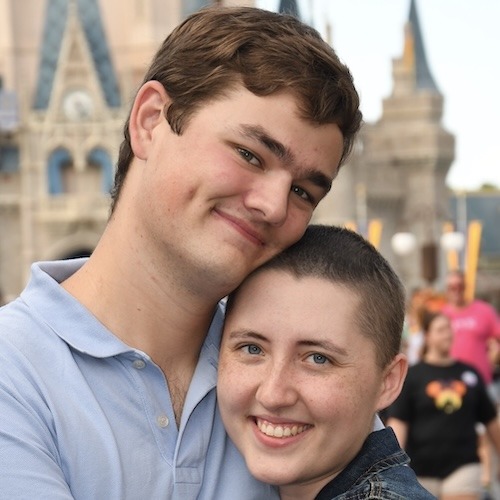
The final months brought compounding complications: heart failure likely related to earlier chemotherapy, new brain metastases, and growing liver involvement. The cascade of events unfolded rapidly, including a holiday trip to Disney World, a Christmas hospitalization, and a heart rate of 220 beats per minute at the hospital entrance on New Year’s. Samantha passed away in the first days of January 2026, at 29, in the ICU.
Gray speaks openly about what it means to be a cancer caregiver, a widower, and a young father all at once. He reflects on Samantha’s character, the role of faith in how they both faced her illness, and how he is now raising their daughter with honesty, hope, and the inheritance of everything Samantha built. Gray maintains Samantha’s YouTube channel, where he carries on her legacy. His message to others who are grieving, or facing a similar experience, is rooted in the same foundation that carried Samantha through: “Comfort comes from the Lord.”
Find out more about Gray’s and Samantha’s story in Gray’s video and the edited transcript of his interview.
- Love, at its core, is active and chosen. Gray’s transformation from grieving husband to present, intentional father reflects how love is not simply something you feel. It is something you choose and practice, especially in the hardest moments.
- Young-onset stage 4 breast cancer is real and underrecognized. Samantha was 22 when she was diagnosed, and her age initially led clinicians to rule out cancer: a critical reminder that breast cancer can and does affect people in their twenties.
- A cancer caregiver’s emotional experience is its own, and it matters. Gray describes how his mind went immediately to “the darkest possible conclusions” while Samantha focused on the treatment plan. Both responses are valid, and couples facing serious illness benefit from space to process differently.
- Choosing to have a child during cancer treatment is deeply personal, not reckless. Samantha made an informed, values-driven decision to pause hormone therapy and become a mother. There was no clinical certainty either way, and there was no regret: only love.
- Serious illness can deepen a relationship rather than diminish it. Gray and Samantha’s experience with cancer required them to have conversations about death, commitment, and what matters most; conversations many couples never have. That depth became one of the most meaningful aspects of their marriage.
- Name: Samantha M.
- Age at Diagnosis:
- 22
- Diagnosis:
- Metastatic Breast Cancer (De Novo)
- Staging:
- Stage 4
- Symptom:
- Appearance of lump in breast
- Treatments:
- Surgeries: lumpectomy, spinal stabilization surgery
- Chemotherapy: doxorubicin
- Radiation therapy
- Hormone therapy
- Antibody-drug conjugate: trastuzumab deruxtecan
- Targeted therapy


This interview has been edited for clarity and length. This is not medical advice. Please consult with your healthcare provider to make informed treatment decisions. The views and opinions expressed in this interview do not necessarily reflect those of The Patient Story.
- How Samantha and I met: A love story that started in the marching band
- Samantha’s first breast cancer diagnosis at 22 and what stage 4 really meant
- The breast cancer recurrence in 2023: shock, despair, and finding a plan
- Becoming a father while being a cancer caregiver, and watching Samantha become a mother during cancer
- The final year: Treatment changes, heart failure, and a crisis at Christmas
- Cancer in the liver, tumor lysis syndrome, and cascading complications
- Faith, peace, and grieving with hope as a cancer caregiver
- Samantha’s age, the cruelty of young-onset stage 4 breast cancer, and becoming a young widower
- What made our marriage strong: Love as a choice, not just a feeling
- What I loved most about Samantha: “Uncommon common sense”
- Raising a three-year-old without her mother: Honesty, hope, and hard conversations
- How I’m carrying on Samantha’s YouTube channel and legacy
- The greatest lesson Samantha taught me in my cancer caregiver role: How to love people
- My message for those who are grieving
How Samantha and I met: A love story that started in the marching band
Samantha and I met in 2015 when I started school at the University of Virginia. I joined the trumpet section of UVA’s Cavalier Marching Band. Samantha was already there — she was a year ahead of me in school — and we didn’t start dating until a little over two years later. Through all sorts of drama and the kinds of things that happen in college, we spent time together, and people started assuming we were dating. To make a long story short, we basically decided, “Why not?” So I took her out on a date, one date led to another, and so on.
We dated through my third and fourth years of college, which was her fourth year of college, and then through law school as well. I started law school at UVA in 2019 after I graduated from undergrad, and then I proposed to her in the summer of 2020. We were married in March of 2021. That following year, I got a job in the state of Alaska as a law clerk for a judge, because we had decided, ultimately, we’ll settle down, do something normal, something boring — but for now, with a clerkship being something I knew I wanted to do and something that only lasts about a year anyway, we thought, “Where’s the coolest place we could do that?” We picked Alaska, found a judge up there who wanted to work with me, and we moved there.
Before we moved to Alaska, Samantha got pregnant, and she gave birth in December of 2022 to our daughter. She was born up there in the middle of winter in Alaska, in a blizzard, snow blowing everywhere.
Then, in 2023, my cancer caregiver story started when Samantha started having back pain. It was that fall that we found out that it was because her cancer had come back. We moved back to Virginia. Over that time, I was looking for jobs. I found one in Richmond. We moved back to Central Virginia, so we were near family, near her oncologist, and her cancer team, who already knew her from her previous diagnosis and previous disease. We had a lot of great resources at our disposal, so things ended up working out really well — with work and with her cancer — as well as they could in that period.
So we’ve been all over the place. We have a daughter, and we’ve got a lot of family all around us. We’ve been on all sorts of adventures — traveled a lot, visited family all over the place, and went to Europe. We drove to Alaska when we moved there and saw just about everything you can on the way. We’ve been from one side of the country to the other and just done all sorts of things. We packed a lot into a little under five years of marriage and a little over seven years of dating.
Samantha’s first breast cancer diagnosis at 22 and what stage 4 really meant
She was first diagnosed in 2019, toward the beginning of the year — I think it was February or March, somewhere in there. She had felt a lump in her breast. In fact, I hugged her, and she felt something in her breast. She got it checked out. It took them a while — they did some biopsies and tests. They were saying, “Oh, it’s a cyst” or “it’s an infection,” this or that, because at that time she was 22 years old. So they weren’t really thinking about cancer.
Eventually, they did a biopsy, checked it, and it was cancer. Then they found it in her rib — sort of toward the base of one of her top ribs, kind of in the back — and in some of the lymph nodes. It being outside of the breast and outside of the lymph nodes, in another part of the body like the rib, made it stage 4. But it was a very early stage 4. They zapped that spot with radiation.
There were other spots as well — a little bit of surgery, a little bit of radiation, a lumpectomy in the breast — and then she was on hormone treatment for a couple of years. At that point, for a couple of years, there was no evidence of disease. That was the case until her cancer came back in 2023, with a break in treatment during which she got off the hormone therapy and got pregnant.
The breast cancer recurrence in 2023: shock, despair, and finding a plan
My initial reaction as her cancer caregiver was despair, because it wasn’t just back — it was in a lot more places than it had been previously. If you look at a chart of her tumor markers, which are not dispositive of anything but are a good indication of general cancer load in the body, the highest point by far was right when her cancer came back in 2023. That was higher than any point on her treatment up until and including her death. Her tumor markers never reached the levels they were at that point. So that was the moment at which there was, at least hypothetically, the most cancer in her body and in the most places — but it still looked like it was just in the bones.
I was always more bothered by bad news than Samantha was. My mind immediately went to the darkest possible conclusions. But then she could bring me back from that: “Well, it’s in a lot of places, but it’s just in bones. We can treat that with this, and that with this. We’re moving back to Virginia. I’ve got my doctor there. He’s great. We’ve got the team — the medical oncologist, the radiation oncologist, the breast surgeon. We’re good friends with them. We’ll make a plan. We’ll figure stuff out.”
For me, I was immediately thinking about death and pain and all of those things. She was thinking about what treatment was like, and what it had been like being on hormone therapy in particular, because it just took away things from her — she just didn’t feel herself completely and wasn’t able to do everything she wanted. So she was worried about what the treatment would do, and I was worried about what not doing the treatment would result in. But she could talk me back from that.
But the first thing we were really worried about wasn’t even the cancer — it was her back. The cancer metastases in her spine had destroyed and crushed her vertebrae. She had to have a back surgery to stabilize those, and just to deal with the pain so that she could move in the first place, before we could even think about treating the cancer. So we got that done in Alaska. Then she had to get on a plane and go back to Virginia while I finished packing the house to move. I had to come to Virginia and start my new job so that we had health insurance to pay for these things. Her parents were taking care of her during that time. Then, within a month or two, things worked out. She felt better. She was on a new treatment plan. Our furniture came. She moved into the house, and we were together, and we were dealing with it. From there, all the way through the next two years or so, it was highs and lows — good news, bad news, no news, just waiting, all over the place.
Becoming a father while being a cancer caregiver, and watching Samantha become a mother during cancer
It was amazing to see Samantha become a mom. She’d been very clear about wanting to be one right from the beginning — she’d always wanted to be a mom from the time she was a little kid. She was tremendous at it. She was a fantastic mother — patient, kind, and understanding — and she raised a wonderful daughter with the work she could do in three years. I’m shocked by how much she got done, how much she raised our daughter, and all the work that it takes to replace that.
It was a great moment when she was pregnant and when she had the baby, because cancer didn’t take that away from us. Neither of us had any regret, even entertained regret, about that. It’s true that she had to come off her hormone therapy at a time when there was no evidence of disease — and hadn’t been for over a year — to have a baby. You can argue about the clinical results. No one has tested that exact situation, and some people have done it successfully, some haven’t. Whether or not that contributed to her disease, there is absolutely no regret there. It was what she wanted to do. And if she couldn’t do that — if she couldn’t be a mom — then, you know, what was the point? What was it for? What was she fighting cancer for, if not for her daughter and for her family?
She was very clear-eyed about what stage 4 cancer ultimately does, and there was no regret, no wish that she had been more self-protective. Because that’s not who Samantha was. And I don’t regret it either. Even having lost her, I absolutely am glad to have my daughter.
The final year: Treatment changes, heart failure, and a crisis at Christmas
I sort of think about the final year as one unit of progression. Starting in January or February of 2025, she had been on a treatment that wasn’t particularly working. They found that out with the first scan and switched her to a new treatment — trastuzumab deruxtecan. The results were great. About a year ago at this time, we were celebrating really good results — there was almost nothing still visible on the scans. The treatment had wiped out a lot of things, and we were in good shape. We were on vacation in Europe around this time last year and had gotten good news right before it.
From there, she was on that treatment through the summer and into the fall. There were one or two more good scans. These were every three months or so. Then it was creeping up a little — you could see it in the tumor markers in her bloodwork every week. But there hadn’t been scans yet, so we were guessing: okay, things are coming back, and there will be another change. Then we switched to something similar in the fall, and it didn’t really do all that much.
Then in December of 2025, we hadn’t yet had a scan on the new treatment, and we went on a trip to Disney World — somewhere Samantha loved to go — and she was having a lot of swelling in her legs, her arms, her extremities, and her abdomen, just retaining a lot of water. We were trying to figure out what was going on with that. We came back in for her next treatment around Christmas time, and the doctor thought she was probably in some sort of early heart failure — her heart was failing to maintain what it needed to do, and that was causing the swelling. That was probably a result of either the adriamycin chemo she had had back in 2019, or the more recent treatments like the trastuzumab deruxtecan or things that went along with it. She was admitted to the hospital through Christmas — I think we left on Christmas Eve. She got a little better and received some heart treatments.
But she was still very swollen. A couple of days later, she was feeling really bad and was going to go in for another checkup. We called the doctor; he said, “Let’s admit you again, keep an eye on you, stay until you’ve got all the excess fluid off — we’ll do diuretics, monitor your intake, and completely fix this.”
But at that time, she had had a head MRI just a few days before. As we were driving to the hospital, Samantha got the results on her phone through her patient portal and found out there was cancer in her brain — something we had never even had to deal with. There was also cancer in her liver from her most recent PET scan. That’s really what they were worried about as the immediate threat.
Cancer in the liver, tumor lysis syndrome, and cascading complications
We talked about that while we were in the hospital before Christmas, that we were going to get on a new treatment to attack the cancer in the liver. There had been cancer in her liver before, and it had grown. Back when we had the bad news in January of 2025, there was some in her lungs and in her liver. Then things had tended to get better. It popped back up toward the end of her time on the trastuzumab deruxtecan — in her liver, but not in her lungs. On the new treatment through December, the liver spots had gotten smaller, but there were more of them. So we were starting a new treatment to focus on the liver.
The agenda when we got back into the hospital around New Year’s was: fix the heart with diuretics, and once the heart was stable enough to handle chemo, do a new chemo for the liver. But while we were walking into the hospital, her heart just started racing. She had to stop and take a break on a bench 50 feet from the hospital entrance. We got into the hospital, put her in a wheelchair, and I took her in to check in for another scan — I think a CT scan. They couldn’t do the scan because her heart rate was something like 220 beats per minute. Her blood pressure was relatively low throughout this whole time.
She stayed in the hospital for a few days. They gave her medicine to take care of her heart rate and to help her heart, but those medicines also reduce blood pressure, so she could sometimes get them, sometimes couldn’t. They were still worried about the excess fluid. They eventually gave her the chemo, and it had good results — but then that resulted in a large amount of electrolytes in her system, which is a result of something called tumor lysis syndrome. Basically, you kill so much cancer that you release everything contained in the cancer cells — all these electrolytes, which can harm your kidneys. So now they were talking about dialysis. They didn’t ultimately do that; they just kept an eye on it. Things got under control. The numbers were trending in a positive direction for about five days.
And then all of a sudden things just kind of turned around. Her blood pressure was very low — too low for her to receive any of her medications. They took her into the ICU and tried various things to increase her blood pressure, but they just weren’t having any luck with that. Her heart was too weak to handle the other things she needed, and that was resulting in a buildup of other chemicals in her blood. There was probably hemolysis — damage to her blood cells — and all of these things were the result of a cascade.
It could have been the cancer in her liver growing. It could have been the tumor lysis syndrome contributing. It could have been her heart. But all of those things combined. The sort of positive way the doctors try to spin things just got a little less positive over the course of a few days. And so there was no point at which any of the news was really surprising — it was all sort of the logical conclusion of the thing before it. But it became clear, in the first days of January, that she wasn’t going to survive.
She was in the ICU. They intubated her — there was a chance she could have gone into cardiac arrest just from being intubated, but she didn’t. We said goodbye. “I love you.” All of that. She was intubated, and then she was unconscious for the next 24 hours or so. But that was it. There was really nothing they could do at that point. She was in the ICU with four stands, four or five pumps on each, pumping everything they had. At a certain point, the blood pressure they were measuring was, as I understand it, just the pressure of the pumps from the machines. Her heart just couldn’t keep up.
Faith, peace, and grieving with hope as a cancer caregiver
I’ve got no concerns about Samantha’s soul. I know that she loved the Lord. I know that she was saved — that she believed in Christ and repented of her sins. I was there when she was baptized. I was there when our daughter was baptized. Samantha was baptized in our church in Alaska. Our faith became, from that point on, an increasingly important part of our lives, to the point where there is nothing that is not subordinate to Christ. All things will be destroyed or perfected. Her faith shaped how she lived, how she chose to have a daughter, and how she chose to fight her cancer.
“I grieve with hope” is a phrase our pastor used at Samantha’s funeral, and I think it’s an apt one. We understand that she is with Christ — she is not gone permanently. She is rejoicing with her Savior. Ultimately, we will join her there.
It’s hard to be without her here, of course. But my grandmother used to say, “God knows,” and He does. It’s hard that we don’t always. But ultimately, you have to find comfort in the Lord and in His Word, because that is where true comfort comes from — the only place.
Samantha’s age, the cruelty of young-onset stage 4 breast cancer, and becoming a young widower
She was 29.
I don’t really know what the ultimate results of this happening so young will be, especially as compared to if it had happened when we were older. I don’t know that any more than my grandfather — who lost his wife a few months ago — knows what it’s like to lose someone you’d been married to five years instead of 65 years. I’m sure someday I will understand how it has affected me, but I don’t know yet.
That said, I chose to marry Samantha and continue dating her despite her diagnosis. It resulted in us having a lot of conversations that a lot of people don’t have — sometimes before they’re married, this soon after they’re married, or sometimes ever. We had a strong relationship as a result of tragedy. We knew each other very well for people married for five years. We had an extraordinary connection because we had worked through so much in a relatively short period of time.
I think being young means there will be a future without her, in the sense that there wouldn’t be if we were much older. Our daughter will grow up without her. I don’t know what that future looks like. I hope and pray it will be beautiful. I don’t know what will be in it. I don’t know who will be in it. I don’t know where it will be. But I am trusting that God has a plan for that future.
There is more to rebuild than there would be otherwise. But also, in a sense, the fact that Samantha built so much in the time that she had is extraordinary to me. I feel indebted to her — she invested so much in my life and in our daughter’s life that she won’t get to reap the rewards of. And she invested it knowing that she probably wouldn’t.
She worked while I was in law school, and now I have a job where I can support the family, build things, invest — and in a sense, pay her back, though that’s not really how it works. We were married. Everything was one. But she’s not here to provide for our daughter, and I can do things for her that she can’t. So in a sense I’m rebuilding, but in a sense I am resting on what’s already been built. Samantha doesn’t get to reap those rewards. But she knew that. And she would have done every bit of it the same — knowing this, she would have invested the same amount.
What made our marriage strong: Love as a choice, not just a feeling
People say, “Oh, you had such a great marriage,” and I don’t disagree — she was a singularly exceptional woman, and I was incredibly blessed to have her. But our marriage wasn’t tested against decades and decades like many are. It was tested against harder things. Time itself can be hard, and time is the one thing we didn’t have to test against.
The reason it was as successful as it was is not because of any particular compatibility match. It’s the same reason I know our marriage would have been similar in 50 or 60 years — because we were married, and that was it. The commitment was: we decided we would be married. I decided at some point, yes, she has cancer, but I’m going to marry her, and there’s no going back from that decision. There’s no second-guessing it. You just live in it, and it’s tremendously rewarding when you do.
They say love is not a feeling — it’s a choice. And we chose it. Samantha definitely chose it. She knew how to engage in the act of loving her family. It was work — in particular, her work — that made our marriage what it was. I’ve got no doubts that it would have been very different in the decades to come, but if anything, more beautiful.
What I loved most about Samantha: “Uncommon common sense”
I tend to call it just common sense, but it’s not actually all that common. She had an extraordinarily developed sense of it. I could read some fancy academic book in college, law school, or a church reading group, get all excited — “Oh, I’ve never thought about things this way! If you put together these complicated ideas, you get a view of the world like this!” I’d explain it to Samantha and think I’d done well. And she’d say, “Yeah, of course. I thought everyone knew that.” Not because she’d read it in some book, but because she could just see it.
She had this incredible intuition — for people, for the way the world is, for the Lord. She could just know, and she could just live in it. And she employed that in so many things. The list is endless. It goes from baseball — she loved baseball, she was the family scorekeeper through her brother’s Little League days, to the point where umpires would come to her to check the score when they had forgotten — to her work in computer science, and of course as a wife and a mother: How do we deal with this issue with our daughter? How do we schedule this week? Can we do this trip? Can we afford this? She had a great sense for it all.
Now I find myself without that check. I make decisions that seem right to me, then I’ll run them by someone — “I’ve made these plans; we’re doing this this week” — and they’ll say, “Well, that doesn’t make any sense for these five reasons.” Those aren’t mistakes Samantha would have made. She just got it. Whatever it was, she just got it. And that was incredible.
Beyond that, she was kind and patient in a way that I have tried to cultivate but have not approached. She was just an extraordinarily beautiful person, inside and out.
Raising a three-year-old without her mother: Honesty, hope, and hard conversations
Navigating it with our daughter — telling her, explaining it to her as a three-year-old — has been by far the most difficult part of all of this. And I think Samantha would see it the same way: Samantha not having her daughter is the most difficult part.
I decided from the beginning I would navigate it with complete honesty. I explained to her that her mother had died. I explained why, to the extent a three-year-old can understand it. If she asks me a question, I tell her the truth. I think that will serve her well in the long run.
She doesn’t get it completely, but she asks questions and acts in a way that demonstrates a remarkable understanding — for a three-year-old — of what’s happened, of the permanence of what’s happened, as well as the eternal hope in it. I explained that her mother is with Jesus in Heaven, and she asks questions about that, and I answer them to the best of my knowledge. But it will be years of understanding, of learning. There will be difficult things as she goes through school, where she doesn’t have the same things other people have. But I have every hope that she will understand it as well as I do — which is an imperfect understanding — and that she will be able to get through it with all the help that she has.
How I’m carrying on Samantha’s YouTube channel and legacy
I knew from the beginning that her YouTube channel needed an update — that the conclusion of this story, to the extent it has concluded, needed to be shared. It took me a few weeks to put it together and get through all the other priorities, but I put out a video in January on the channel explaining what happened in some detail, because I remembered it more freshly then. I wanted to get things down — play by play through the hospital — because I knew I’d forget some of the details. I knew that the people who had followed and supported Samantha, the 40,000 subscribers, deserved an update, because they were important to her. It was important to her to help anyone who had questions that could be addressed by her circumstances. She wasn’t giving anyone advice — she was just explaining what her experience was, with the hope that it would help people.
I’d love to add more to the channel. I found at least one video on her computer that she had filmed but hadn’t uploaded yet — so anything I find like that, it’s going on the channel. It’s going to take a while because I don’t have a lot of time between my daughter, my family, and my job. Running a YouTube channel — which Samantha put so much care and effort into — is not my main priority, but it is a priority. There may be more videos with me if there are questions that need to be addressed. I might do some kind of Q&A. But I’ll take care of it eventually; it’s not something I have the time for right now.
I’ve been reading the comments and posts on Samantha’s various videos as YouTube shows them to me. I think I’ve read most, if not all of them, which are overwhelmingly positive, of course. I am overwhelmed by the support that Samantha has had on that channel, but not particularly surprised.
I’m certainly going to leave the channel open. I’m certainly not removing anything from it. That was Samantha’s work. She enjoyed doing it, and I’ve got no intention of limiting the reach of what she did. She would always say, “If you don’t see videos from me, don’t worry — I’m just out living my life.” That was true right up to the end. No news is good news — with one exception, that was the case. And so that’s the case now, because I’m living my life too, in a certain manner of speaking, and I’m going to keep doing that.
The greatest lesson Samantha taught me in my cancer caregiver role: How to love people
Samantha taught me a lot about how to love people — her, our daughter, her family.
She brought a lot of people into my life who I love like family, or who are my family, and she expanded that.
Understanding how to take pleasure in serving them, in loving them, has been one of her greatest gifts.
My message for those who are grieving
Comfort comes from the Lord. Read scripture, pray, go to church, talk to God — because He is the only one who has the power to heal what you’re going through.
He’s the only one with dominion and control over it, and He has a plan.
Inspired by Gray’s story?
Share your story, too!
Cancer Caregiver Stories
Gray M., Spouse of Samantha, Breast Cancer Patient
”They say love is not a feeling — it’s a choice. And we chose it. Samantha definitely chose it. She knew how to engage in the act of loving her family.”
…
David Garrigues Ronda, Spouse of Laurent Gemenick, Bladder Cancer Patient
“Talk to family, talk to friends. Ask for help. Don’t be alone. And above all, don’t miss any doctor’s appointments.”
…
Lung Cancer Caregiver Series Episode 2: Stephen and Emily Huff’s Candid Conversation
“We talked, and I remember saying, “What if we have kids and what if I die?” And you were like, “What if you live?”
…
Emily Huff, Spouse of Stephen, Lung Cancer Patient
“Emily’s the reason why I’m alive today. The treatments have kept the cancer at bay, but she’s the one who’s kept me living, breathing, and enjoying life.”
…
Blair D., Spouse of Brain Cancer Patient
“Find other people who are going through the same thing you are. This journey is very isolating and very lonely.”
…
Nat G., Spouse of Bladder Cancer Patient
“You have to become selfless as a caregiver. You have to assure that person that you are there for them.”
…
Leave a Reply