
Stage 4 Pancreatic Cancer (Adenosquamous Carcinoma), Rare Mutations, and a Miracle: Barbara’s Story
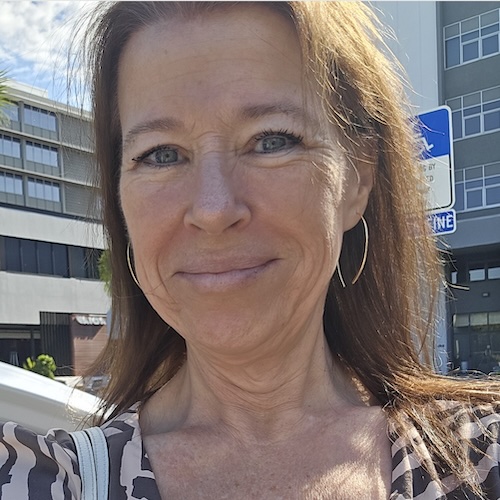
Barbara was living an active, healthy life in Crete, hiking canyons and eating a Mediterranean diet, when she began noticing a subtle but persistent fatigue. Later, she learned that it was an early sign of stage 4 pancreatic cancer (adenosquamous carcinoma) that had spread to her liver and duodenum. At first, she chalked up her exhaustion and difficulty keeping pace on hikes to age and long walks. In hindsight, she recognized that her loss of energy was her body’s way of signaling something serious. When abdominal and back pain wrapped around her torso in a tight C-shaped band and simple foods like yogurt became impossible to tolerate, her family urged her to seek urgent care rather than wait weeks for a gastrointestinal appointment.
Interviewed by: Nikki Murphy
Edited by: Chris Sanchez
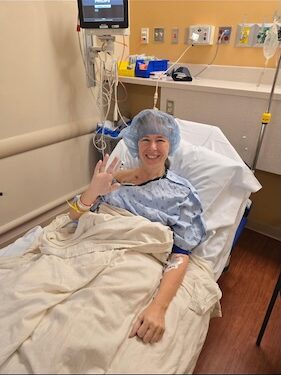
At her local hospital, Barbara underwent CT scans from head to pelvis, an endoscopy, emergency procedures to stop internal bleeding, and blood transfusions. Doctors worked intensely to stabilize her and uncover the cause. They discovered a large tumor on the tail of her pancreas, measuring 8.7 by 6.7 centimeters. Eventually, they diagnosed her with stage 4 pancreatic cancer with metastases to her liver, specifically adenosquamous carcinoma, which is one of its rarest forms. While some physicians quietly warned her family that she might have only one to two weeks to live, her sister insisted they not discuss timelines, allowing Barbara to focus on each immediate step rather than on predicted limits.
Barbara and her family sought multiple opinions, ultimately building a team that includes her local oncologist and specialists at Moffitt Cancer Center in Tampa. Comprehensive genetic and hereditary testing revealed biomarkers and mutations, including PMS2 and KRAS Q61H, that gave her access to a combination of standard chemotherapy plus a monoclonal antibody. After three months on this regimen, her scans showed a 49% reduction in her tumors and extended her estimated life expectancy from months to 18 months. She describes this outcome as nothing short of a miracle.
Today, Barbara structures her goals in stages: first eight months, then 18 months, then two years, as she works toward the possibility of reaching the five-year mark. She leans on social media, family, and organizations like the Seena Magowitz Foundation for connection and education, while investing deeply in mental resilience through meditation and mindset work. The physical disease is real and demanding. However, the mental work, including choosing hope, believing in miracles, and fighting for herself so she can still show up for others, has become her greatest source of strength.
Watch Barbara’s video above and scroll down for the edited transcript of her pancreatic cancer story.
- Subtle, persistent fatigue and new abdominal or back pain can be early signs of pancreatic cancer, even in people who appear very healthy and active.
- Seeking urgent care, getting thorough imaging and endoscopy, and listening to trusted loved ones can be lifesaving when symptoms escalate quickly.
- Comprehensive genetic and hereditary testing can uncover biomarkers, such as PMS2 and KRAS Q61H, that may open the door to more advanced treatments, clinical trials, and extended survival.
- While you cannot control every physical outcome, investing in your mindset, support network, and information can restore a sense of agency amid uncertainty.
- Barbara’s experience shows a powerful transformation: from fearing her imminent end to witnessing a 49% tumor reduction and redefining her future through incremental goals, hope, and belief in miracles.
Barbara’s Diagnosis Facts
- Name: Barbara C.
- Age at Diagnosis:
- 56
- Diagnosis:
- Pancreatic Cancer (Adenosquamous Carcinoma)
- Staging:
- Stage 4 (Metastatic)
- Mutations:
- PMS2
- KRAS Q61H
- Symptoms:
- Diminished energy levels
- Extreme back and abdominal pain
- Treatments:
- Chemotherapy: oxaliplatin, capecitabine
- Ablation therapy
- Monoclonal antibody: pembrolizumab
This is not medical advice. Please consult with your healthcare provider to make informed treatment decisions.
- Barbara’s Diagnosis Facts
- Stage 4 pancreatic cancer diagnosis and introduction
- When I first noticed something was wrong
- Severe pain and the emergency room visit that led to the pancreatic cancer diagnosis
- Hearing I had adenosquamous carcinoma, an extremely rare form of pancreatic cancer
- Hereditary risk, PMS2, and KRAS Q61H
- My current treatment routine and side effects
- How pancreatic cancer changed me physically and mentally
- Advice for someone newly diagnosed with pancreatic cancer
- Hear from people living with pancreatic cancer
Stage 4 pancreatic cancer diagnosis and introduction
My name is Barbara. I was diagnosed with stage 4 pancreatic cancer, adenosquamous carcinoma, that metastasized to my liver. I also have a tumor due to pancreatic cancer in my duodenum. I was diagnosed on New Year’s Eve 2025.
Life before pancreatic cancer: Healthy, active, living in Greece
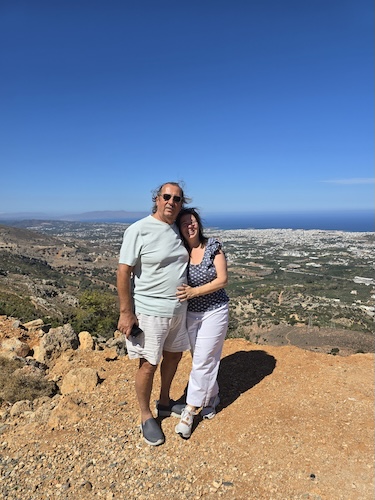
I was living in Europe six months before my diagnosis, on the island of Crete in Greece. My life was full of hiking, eating the Mediterranean diet — lots of olive oil, feta cheese, lamb, chicken, potatoes, tomato — everything that you can think of, even the desserts. But it really was a life of health. I hiked every other day. It was not unusual for me to hike ten kilometers. So yeah, my life before my diagnosis was a normal, healthy, active life.
When I first noticed something was wrong
I noticed a few months before my diagnosis that my energy level was different. It diminished, not knowing that it was cancer. It just was different. Something was off with my energy level. But that’s really what I noticed.
In hindsight, I can look back and think, okay, that’s what was going on, but at the time, I never would have guessed that I had cancer. I just thought, okay, maybe some of these walks are too long, the hikes are too long. With my age, I wasn’t sure. But in hindsight, I can see that a few months beforehand, my energy level had been affected.
How fatigue changed my day-to-day life
I went from hiking up mountains — and mountains in Greece are not so tall, but they’re tall enough — and canyons, to being unsure if I could do it again. As a matter of fact, when I hiked seven kilometers towards the end, I struggled. My son had to help me, virtually pull me, to continue. That was unlike me. It was unusual. And I thought, “Okay, maybe it’s my age.” I wasn’t sure.
So it did affect my daily life in the sense that I spent more time lying down on the couch, just thinking that I was tired. I wasn’t doing my daily cleaning in my home. In hindsight, I noticed that that was due to the cancer, but at the time, I would never have thought that it was cancer-causing.
Onset of abdominal and back pain after returning from Greece
I started having abdominal and back pain after I came back from Greece. I returned to the United States just before Thanksgiving. We had a normal Thanksgiving dinner, and then my birthday was a few weeks later.
Right around that time, I noticed that my back had been bothering me a little bit. Even in Greece, it had been bothering me a bit, but it became pronounced once I came back to the United States. I just thought, gosh, something was odd.
Then it started to creep around my lower tummy area, just below my belly button, almost like the shape of a C, wrapped from my back all the way to my belly button. So much so that again, no energy, but this time it was obvious that something was wrong because I had zero energy, and I would be on the couch all day. Then I knew that there was something really wrong. That’s what led me to make an appointment with a GI doctor.
Severe pain and the emergency room visit that led to the pancreatic cancer diagnosis
It was a tremendous amount of pain. I couldn’t eat. I couldn’t eat a bite of yogurt; it hurt so much. It was more than when I gave birth to my son.
My daughter-in-law, who also works in the medical field, knew that something was wrong and said to me, “Boy, you really can’t wait two weeks to see a GI doctor. You really need to go to the emergency room. This is a NICU-level situation in terms of urgency.”
So they scooped me up — my family, my husband, my son, and my daughter-in-law — and they took me to the emergency room at the local hospital in the small town that I live in. When I arrived there, they started doing tests for everything to see what was wrong. I had a plethora of physicians and specialists who were checking everything. That’s when they found that I had pancreatic cancer.
Hospital tests, internal bleeding, and fighting to stay alive
I had quite a few things done: CT scans of my brain, my chest area, my stomach, and my pelvic area. I had an endoscopy done because I was bleeding. My hemoglobin levels dropped to a six, so they were rushing to give me blood transfusions. I had two of them.
I had a procedure done in an emergency where the GI physician came in and characterized where the bleeding was in my duodenum. They stopped that bleeding. The doctors were trying very hard to keep me alive. They were doing their job, and I had so many different specialists. Some of the other things were more CT scans.
It was really hard because I was feeling so much pain. When you feel this kind of pain, you forget about your surroundings and what’s around you, which was my family. I had my family members travel to come and support me.
Now, when I hear them talk about what they saw, it’s frightening, because they were pulled out of the room and told, “Your sister and your wife, she only has one to two weeks. We really need to face this. We really need to talk to her. This is what we’re looking at.” My sister said, “There’s no way that you can tell her this. No way. You cannot tell her that.” She was begging the physicians not to talk about the time I had left, as far as the longevity of life. And they didn’t.
It’s a really good thing that they didn’t do that, because I had no idea that this conversation took place with my family until a few weeks ago, actually. So it was really, really hard — everything involved with myself and the physicians, with them doing their job, me not really understanding because of the pain. It was a tremendous amount of pain. And then my family on the opposite end, seeing what’s going on. It was frightening.
Hearing I had adenosquamous carcinoma, an extremely rare form of pancreatic cancer
The doctors knew then that I had pancreatic cancer because the size of my tumor was so large. It was 8.7 cm by 6.7 cm, so it was a large tumor on the tail of my pancreas. Also, it’s an extremely rare case of pancreatic cancer.
After they did liver biopsies, they were able to understand what type of pancreatic cancer I have, and the one that I have is the rarest of the rare. What makes it rare is the word “squamous.” Typically, you’ll see “adenocarcinoma.” When the doctors were explaining it to me, I could see that it was difficult for them to even say it to me — that you have pancreatic cancer. They told me the size, and then they mentioned the word “squamous.”
I didn’t know what that meant. They said that it’s one of the rarest forms of pancreatic cancer that you can have, and they said that they have a challenge ahead of themselves. So I found out a few days after I was in the hospital. I was diagnosed with pancreatic cancer a few days after I entered the emergency room.
My emotional reaction: Fear, research, and facing the statistics
I was scared, very scared. The fear didn’t last very long at first because I thought, “Okay, I was unlucky.” So the fear turned into trying to think logically — whatever I knew or thought was logical. I thought, “Okay, I can beat this.”
It was fearful, but the fear didn’t last very long because I thought, I’m going to fight this. But then the fear came back when I understood the statistics. In my quiet time in the hospital room, I went on my phone, and I went down the rabbit hole of researching. I think that’s when the fear really set in — understanding the statistics of the type of pancreatic cancer that I have.
It was extremely fearful, to the point where, as the pain subsided, I had another procedure to help with the pain. I had a celiac plexus block done that helped with the pain in my stomach. Once I had that done, and it did help, I was able to eat a little bit of yogurt. I was able to start eating again.
But then I would have doctors come in and say to me that I should think about hospice, or that it’s the responsibility of my oncologist to let me know that I might not have that much longer to live. I was hearing this from physicians — different types of physicians, not from an oncologist. So the fear started to set in again. I thought, maybe I don’t know what’s going on. I don’t know how big a problem this is. So then fear set in again.
Getting multiple opinions and finding my oncology team
The hospital that I live near is a small-town hospital, and they did a fantastic job. AdventHealth Waterman saved my life. The different doctors did what they needed to do to get me ready for the next big challenge.
The first oncologist that I saw at the hospital, I still see today. He’s a local oncologist, but my family and I came to the decision that we needed to get a second opinion. I started to look at where the best place to go is. There are a lot of really fantastic places, but one that we looked at was MD Anderson in Texas. We completed the paperwork and everything we needed to do to go see them.
However, I became ill again. I was too weak to travel there. That led to another fantastic place that was closer, in Tampa, which I don’t live too far from, a few hours away — the Moffitt Cancer Center. So I got a second opinion from the Moffitt Center.
To this day, I have the same oncologist that I saw at the local hospital, and I also have my oncologist at Moffitt Cancer Center in Tampa. That’s who I see. That’s who’s handling my care, and I am very fortunate for that.
Biomarkers, genetic testing, and access to pembrolizumab
I had genetic and hereditary testing done. The testing included 81 genes, and the cancer facilities found out that I have some biomarkers that put me in a position to take standard chemo in addition to pembrolizumab.
This was the treatment plan that Moffitt came up with, and that’s what I’ve been taking now for the last three months. I’m really fortunate because the mutations that I have had opened up the possibility of my life being extended by six to eight months. That’s what I knew three months ago.
However, now that I’ve been on standard chemo plus pembrolizumab, I had my three-month CT scan exam just recently, and it was great news. My CT scan showed a 49% reduction of my tumors, plural. That has now extended my life expectancy to 18 months.
I believe in miracles. I don’t think I ever really understood what a miracle meant. Of course, it’s easy to say, “Oh, I believe in miracles,” but when it really happened to me and to my family, it helps one understand what a miracle really means. I have to say that my situation turned out to be a miracle.
Hereditary risk, PMS2, and KRAS Q61H
One of the genetic tests was a hereditary test, and it showed a marker — a hereditary marker that can increase the chance for me to get colon or uterine cancer. No one in my family has had either of those or pancreatic cancer for that matter. Neither on my mother’s side nor my father’s side. I’m the first person who has had pancreatic cancer.
Knowing that, my family can elect to get tested themselves, because having that gene, there’s about a 50% chance it will be passed down to my son. Some of the genetic testing that I had done, not necessarily hereditary, showed mutations that allow me to now go into pembrolizumab and possibly clinical trials. I’m not in any clinical trials at this moment, but it does open up the door of possibility for me.
I tested positive for the PMS2 gene and the KRAS mutation, KRAS Q61H.
My current treatment routine and side effects
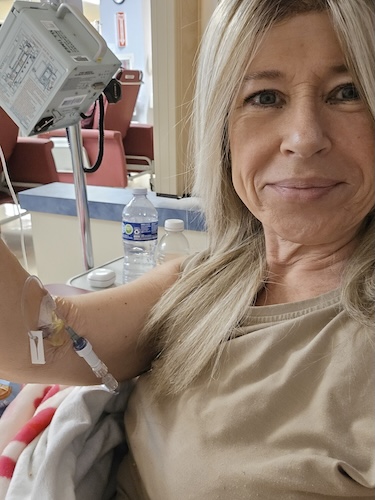
I had a port placed in my chest that would help me get chemotherapy. I just wanted to make a point about that. I ended up having a clot in my right jugular that rushed me to the hospital. I couldn’t swallow, so we rushed to the ER, and that port catheter somehow caused that, so the port was removed. Now, when I get chemotherapy, I get it in my arm through IV.
Early on, I was driving a couple of hours each way to Tampa, to Moffitt Cancer Center, to get my treatments for my standard chemo plus the pembrolizumab that I receive. Now I go to the local infusion center to get treatments. It makes it much easier. It’s ten minutes away versus two hours.
I go every three weeks. Every other week, I take a cancer pill, and that’s every other week. My body’s tolerating it quite well, except for after I get an infusion. I’m tired — extremely tired, exhausted, as if I ran a marathon — for four to five days. I’m fortunate because that’s really the only side effect that I’m feeling from the treatment itself.
The protocol right now, because I had a 49% reduction of my tumor, is to remain where I am, taking the same medicines as long as I don’t have any other issues. Then they would drop one of the medicines, continue the others, and then eventually just stay on the pembrolizumab. That’s if everything goes as planned.
Planning for clinical trials, backup plans, and long-term goals
Since we’ve had a really good response with standard chemo and pembrolizumab, we’re going to continue with what’s working for me. I’m definitely responding well.
If that takes a turn, then I am speaking to other centers, other physicians, putting a plan B and plan C in place, just in case this takes a turn without me knowing. I am in the process of putting plan B and plan C in place. So we’re going to stick with what we’re doing.
There is a trial that is ongoing now that seems to be working at MD Anderson, but I’ve had a response already, with my tumors shrinking, so we’re okay with that. There is another trial that may be two years down the road that’s specifically for KRAS Q61H, the one that I have. But that’s several years down the road.
The key for me is to try to make it to eight months. That’s my first goal. My second goal is in 18 months. Then the third goal after that is to get to that two-year mark. In my mind — and in that rabbit hole that I go down on the computer and with the physicians — once you get to that two-year mark, it’s a little bit easier to make it to that five-year mark.
We’ve learned that having pancreatic cancer is not a death sentence, as people may have thought in the past. They’re really coming a long way with it. I am living proof of what a miracle is.
The hardest part: Grieving a future version of myself
I think the hardest part is wanting to become a grandmother one day. My son is young, so I have many years to wait. I think playing the waiting game for that — I feel like maybe in one way I was cheated.
I don’t want to feel that way. I don’t want to feel like I’ve been cheated out of life because I know some people have more struggles than I do. But if I set that aside, I think that’s the most difficult for me, to realize that that’s a possibility. That is the most difficult thing for me — to accept that possibility.
How pancreatic cancer changed me physically and mentally
Physically, it’s been a big change. I’m not as physically active as I was before, and that’s been difficult in the sense that I’m more conscientious and thoughtful about going out and participating in activities with others, because I don’t want to slow anyone else down. In that sense, it’s been difficult.
Emotionally, or with my mind, that was one of the biggest challenges that I had and that I work on. I’m really proud of it because I remember my father telling me, “Barbara, pancreatic cancer is one of the cancers where it’s okay if you ever have to take any medication for depression, because it’s a big one. It’s a tough one.”
I remember saying, “Dad, I’m going to pay attention to what you’re saying to me and really put some thought into that.” After I hung up, I thought to myself, “I’m taking quite a bit of medicine already. I don’t want to add another one to my list.”
I thought, “I have got to figure this out. What do athletes do? What do folks in the military do? What do they do when they’re in boot camp, when they’re down, and they don’t have a choice? They have to get back up mentally. I said, I’ve got to figure out what they do so that I can do that.
I spent quite a bit of time trying to figure that out — spending time meditating, learning how to meditate, listening to sounds, certain things that would help me with that. I was able to do it, and it helped me a lot.
So, as regards the physical part, I can only do so much. But as for the mental part, I think the sky is the limit. I have some control. I have more control over the mental part of it than the physical, and that’s great.
Finding support through social media, family, and positivity
I find support through social media. I decided to let folks know about my medical situation through social media, and my presentation of that is positive. I only focus on positivity through social media, and that’s been tremendous.
As a matter of fact, I had a lady reach out. She had been following me, and I found out she lives locally. Now we’re walking together, and she said, “Gosh, you’re such a miracle, and you’re such an inspiration. I just can’t believe it.”
So I have folks like this reaching out to me. That’s one source of support. My family is another. They’re extremely supportive. I talk to my family on the telephone — the ones who live long distances. I talk to friends in Greece.
I think social media and family have been really big for me. The most important thing has been my attitude and outlook, which have been extremely positive, understanding that there are people with more struggles than I have. If I can help one person, that’s success. And I have succeeded, because I’ve helped more than one.
What people don’t understand about living with stage 4 cancer
I think I would want to narrow it down to two things. One of them is that a diagnosis isn’t a death sentence.
The second thing is that it’s really hard to understand measuring life in days, weeks, and, if you’re lucky, maybe months — or, again, if you’re lucky, years. It’s hard to describe that. It’s hard to feel that unless you are diagnosed with something like this — unless you are diagnosed with a terminal illness.
It’s hard to describe that to somebody. Now I’m a different person. I look at time, and time is measured. I think this, and the outlook of being positive, are the two things that are important and that have changed me.
Balancing fear and hope for the future
Fear, I don’t think, goes away. It doesn’t go away. I balance them both with positivity.
I have to understand how to continue to strengthen my mind so that I continue to have hope, and that’s through educating myself from other people’s successes on the power of the mind, in order for me to continue to be hopeful. Positivity is everything, and educating myself in that.
Why I keep fighting for the future
In the beginning, my reason to fight was my son, and it was my family. It was all the things that I think would be normal to feel. It’s not that now.
Now it’s really for me. I know that I have to fight for myself so that I can be there for others. So I focus on hope and on doing the things I need to do that are positive for myself. I am fighting for myself. In turn, I get a great reward because others will benefit from it as well.
Advice for someone newly diagnosed with pancreatic cancer
I would say to them the very thing that I would have wanted to hear from someone else like them. Through the pain — physical pain or emotional pain — you have to get to that next level, because that’s not all there is. That pain cannot rule your mind or your body. There’s more to it than that.
The patients, the knowledge, have to help that person somehow dig deep and fight to get to that next level. That next level may be something so simple. It may be within a day. It may be that their pain subsides for two hours, and then they have relief, and they realize, “Oh, I want to fight for life.”
But I was there. I was ready to give up on life. I can’t believe that, but I was. So I would say, don’t let the feeling of wanting to give up be the time that you decide it’s right to do so. It’s not. I would tell people to dig deep, go through this awful pain, because you’ll end up like me on the other side.
How I want my story to impact others: Believing in miracles
I would say to believe in miracles. To me, that’s such a big word. I don’t know how it is for others, but I would like my story — the message — to be that you really have to believe in a miracle.
Even though you might think you know what a miracle is, unless you’ve had a terminal illness before and fought it, then okay, you understand it. But if you’ve never had that and this is your first time with the fear, the pain, emotionally — or maybe not even the pain, just emotionally what you’re going through — finding out that you have cancer or any cancer, but especially pancreatic cancer, there is life ahead for you.
I would want folks to know to believe in a miracle you haven’t seen yet — because it’s there. You have to be patient and push through it.
The Seena Magowitz Foundation and the power of patient community
Something that really helped me is this organization called the Seena Magowitz Foundation. Every month, they have free sessions for newly diagnosed patients, an hour and a half long, with a psychologist and people who have pancreatic cancer, who have lived with pancreatic cancer for five years or longer.
They have been a huge part of my hope and learning, because when you speak to somebody who’s had pancreatic cancer for 14 years or five years or 20 years, it starts to turn things around. These folks are heavily involved with clinical trials and doctors. They provide free Zoom second opinions. Sometimes the cost could be expensive for others.
I have to say, I didn’t know if I should talk about that, but to me, it was a huge help. I’m going on at 5:30 today. It’s every month. They do other sessions for caregivers. They have things for caregivers that are free, and it’s an hour and a half long, so it’s a good chunk of time. It’s amazing. It’s absolutely amazing.
The Foundation has affected my life. They really have. It’s a really good example — versus me just talking about it — because they’ll have other people in front of them that they see who are living five years, eight years, ten years. People newly diagnosed with pancreatic cancer need to understand that.
This interview has been edited for clarity and length. The views and opinions expressed in this interview do not necessarily reflect those of The Patient Story. This content does not replace professional medical advice.
Inspired by Barbara’s story?
Share your story, too!
Hear from people living with pancreatic cancer
Real experiences with diagnosis, treatment choices, side effects, and life beyond pancreatic cancer — in their own words.


Leave a Reply