
At 19, Every Nurse Told Taylor She Was Too Young for Rectal Cancer; She Wasn’t
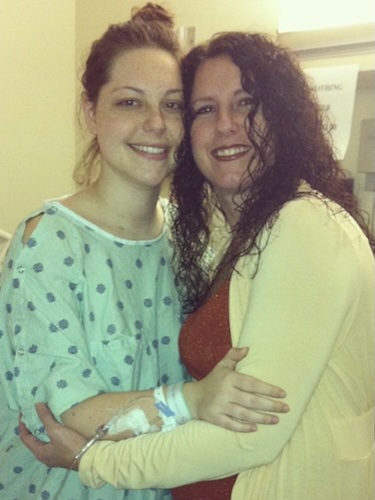
Taylor was a typical 19-year-old. She’d just finished her sophomore year at Purdue and was taking a summer chemistry class, applying to internships, and planning road trips with her college friends. Then, over the course of about two and a half weeks, irregular bowel movements and blood in her stool led to a diagnosis of rectal cancer and turned her life upside down.
Interviewed by: Taylor Scheib
Edited by: Chris Sanchez
She was scheduled for a colonoscopy, but before that appointment, Taylor passed a significant amount of blood, almost like a blood clot, in the middle of the night. She and her mom went straight to the emergency room, where a painful digital exam found a mass. Doctors expedited the colonoscopy.
Days later, sitting with both parents and her stepdad, with her father phoned in from South Carolina, she watched a doctor lay out images from her scope and say they’d found a malignant tumor. Taylor was diagnosed with stage 3C rectal cancer. Because her doctors were stumped as to why a 19-year-old had developed this cancer at all, they ran genetic testing and discovered she had Lynch syndrome. This hereditary condition raises the risk of colorectal, uterine, and ovarian cancers, among others. Neither of her parents carried it; hers had developed spontaneously.
Her care team at the University of Chicago recommended an aggressive clinical trial: six weeks of radiation alongside continuous chemotherapy, followed by three more months of chemotherapy infusions every two weeks. Before starting radiation, she had a separate surgery, called an oophoropexy or ovarian transposition, to relocate her ovaries behind her liver and spleen to protect them. She also met with a fertility clinic to weigh freezing eggs or embryos before deciding, at 19, that she wasn’t ready to make that call.
Then came a 14-hour robotic surgery to remove her entire large intestine and 5 feet of her small intestine. She had originally opted against an ileostomy, which disconnects the end of the small intestine and connects it to a new opening, or stoma, in the abdomen, through which feces exit. At 19, she wanted to protect her body and her sense of normalcy. Once her Lynch syndrome diagnosis raised the stakes on recurrence, she chose the ileostomy after all, calling it the choice that let her keep living.
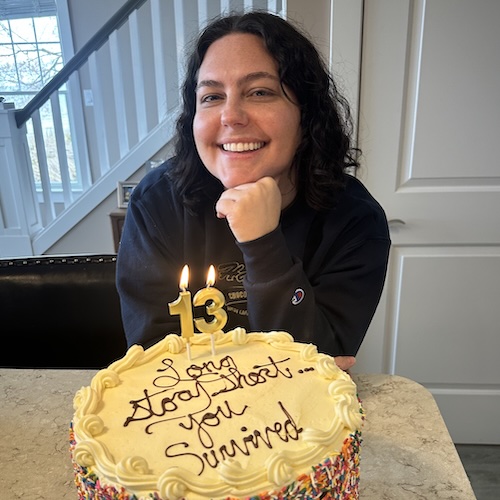
At 25, Taylor had a hysterectomy due to her Lynch syndrome. She meets with a genetic counselor annually and gets scans every one to two years to monitor for new cancers related to Lynch syndrome. Thirteen years later, Taylor is married. She’s celebrated her 5-year and 10-year milestones with friends in Napa and France.
For more on Taylor’s story, watch her video and scroll down for the edited transcript of her interview.
- Knowledge is power; even at 19, information helps with self-advocacy. A conversation with her nurse roommate about Crohn’s disease symptoms was what pushed Taylor to tell her mom something was wrong and to schedule a colonoscopy before her symptoms escalated further.
- Genetic testing helped Taylor reach more answers. Because her doctors couldn’t explain a rectal cancer diagnosis at her age, they ran a genetic test, which found Lynch syndrome and changed the course of her surgical plan.
- A decision made under one set of facts can shift under new ones. Taylor initially declined an ileostomy, then chose it once her Lynch syndrome diagnosis changed what survival would require.
- Fertility decisions don’t have to be resolved on the spot. Taylor met with a fertility clinic twice, years apart, and ultimately chose not to freeze eggs or embryos, deciding adoption was the right path if she and her husband want children.
- A body that’s been through a lot can still carry you forward. Thirteen years into living with an ileostomy, Taylor credits it with giving her a second chance at life, even on the days it’s uncomfortable.
- Sharing your story can be the thing you need most. Taylor couldn’t find another 19-year-old with rectal cancer while she was in treatment, so she now shares her own story so someone else doesn’t feel as unrelatable as she did.
Taylor’s Diagnosis Facts
- Name: Taylor M.
- Age at Diagnosis:
- 19
- Diagnosis:
- Rectal Cancer
- Staging:
- Stage 3C
- Symptoms:
- Irregular bowel movements
- Rectal bleeding
- Treatments:
- Clinical trial: radiation therapy and chemotherapy
- Chemotherapy
- Surgeries: ovarian transposition (oophoropexy), total proctocolectomy with ileostomy, hysterectomy
This is not medical advice. Please consult with your healthcare provider to make informed treatment decisions.
- Taylor’s Diagnosis Facts
- Life before my rectal cancer diagnosis
- When my symptoms started
- “We found a malignant tumor”
- Leaning on family while staying in control
- The clinical trial for my rectal cancer
- Holding on to hope
- Choosing the ileostomy
- Finding out I had Lynch syndrome
- Protecting my fertility
- My hysterectomy
- Living with an ileostomy
- What monitoring looks like today
- A different vantage point on life
- Why I share my story
- Life 13 years after my rectal cancer diagnosis
- Hear from people living with rectal cancer
Life before my rectal cancer diagnosis
I was your average 19-year-old. I had just wrapped up my sophomore year at Purdue and was taking a summer chemistry class and applying to internships. I went to the Indy 500 with my friends, went camping, and planned adventures with my college friends. That was life, until these symptoms took place. Then my life just completely deteriorated.
When my symptoms started
My symptoms came on quickly. I was having irregular bowel movements and blood in my stool. At first I thought maybe I was just a little backed up and gave it a few days, but it persisted for over a week.
One of my roommates was a nurse, and we’d been talking about Crohn’s disease and diverticulitis. I assumed I might have Crohn’s just from those conversations, and that’s what pushed me to tell my mom something was off and that maybe I should schedule a colonoscopy. If I hadn’t had that information, I probably would have just thought, something’s off; we’ll figure it out eventually.
We scheduled the colonoscopy. Then one night, while I was waiting for the appointment, I passed a significant amount of blood, almost like a blood clot. That was the moment the alarm went off in my head. I woke my mom up and told her what had happened, and we went straight to the ER. That’s where my story really begins.
The night everything changed
It was late at night. I described my symptoms and the blood clot I’d passed. They did a digital exam, and I remember it being extremely painful. They could feel a mass in my rectum just from that exam, and I could tell everyone in the ER was on high alert. Given my age, flags were being raised, though I wasn’t quite sure what they meant yet. They expedited my colonoscopy, scheduling it for just one or two days later because they knew I needed proper screening.
Looking back, I was living in this young, naive world where cancer wasn’t really a thought. It felt so foreign to me, especially colorectal cancer. I’d only ever associated it with people over 50. In no way did I think this could be cancer. I was convinced I had Crohn’s.
Waiting on the results
I remember waking up after the colonoscopy. Doctors have a way of already sensing something without being able to tell you until the test results are in front of them. I sensed something was off because I had plans to drive cross-country with a college girlfriend to Massachusetts, where I grew up, to see my friends from home. When I mentioned the trip, the doctor told me to hold off on making any plans until we had my results.
I was 19, so my first thought was, who are you to tell me I can’t go on a vacation? I was bummed, but underneath that, I think I already knew bad news was coming. I was just trying to stay optimistic that it wouldn’t be too serious.
“We found a malignant tumor”
I drove to the doctor’s office with my mom and my stepdad, which felt a little odd to me at the time. When we got there, we phoned in my dad, who lived in South Carolina. My brain was spinning. Why is everyone involved in this? I was still thinking it wasn’t that big of a deal.
The doctor who performed my colonoscopy laid out images from the scope and said, “We found a malignant tumor.” From that moment, it felt like something out of a movie. There was an immediate ringing in my ears. People were talking, but I couldn’t really hear them. I was physically present, but I was lost in my own world. At some point I came back to reality, in the middle of their discussion, and I interrupted and said, “Wait, do I have cancer?” He said yes. Then I fell back again, flabbergasted. I had no idea a 19-year-old could get rectal cancer.
I later learned the doctors believed I had likely had cancer for about three years, which would put its start around age 16. I reflected on those years and couldn’t find anything in my bowel movements or symptoms significant enough to have stood out to me at the time.
“You’re too young to have cancer”
The following day they rushed me to get CT scans and MRIs. Every single nurse said the same thing: you’re too young to have rectal cancer. Even in the radiation room, surrounded by breast cancer patients in their 30s, people would say, you’re too young to have cancer.
It kept reminding me: yeah, I am too young to have cancer, but I have cancer.
Leaning on family while staying in control
I did feel like a kid again, especially being in a medical world I had no familiarity with. I needed to lean on my parents for health insurance and for scheduling appointments, because I didn’t know how to do any of this yet. It was all new territory, and I’m fortunate they were able to support me with that admin and mental load.
At the same time, I’m someone who is very headstrong and does things my own way, and I think my parents knew they had to leave the decisions up to me. It was my body. I needed to make the choices that would move me through this diagnosis. They were going to be with me every step of the way, but ultimately, I was the decision-maker in the room.
The clinical trial for my rectal cancer
My doctor who performed the colonoscopy recommended me to the University of Chicago, and within about three days I was meeting with my surgical team, who presented my options. They were firm about how aggressive my cancer was and that we needed to move fast. They believed my best chance at a fulfilling life was a clinical trial they were running, and I agreed to it.
The plan was six weeks of radiation with continuous chemotherapy. My chemo bag became my best friend. I wore it in the shower, I slept with it, I brought it to the bathroom with me. It was attached to me for six weeks straight. After I finished chemo and radiation, I did another three months of chemotherapy: every two weeks I would go in for an infusion, then go home with the chemo bag until a home nurse came to remove it a few days later.
After those three months, I had my surgery: a 14-hour robotic procedure where they removed my entire large intestine and five feet of my small intestine. I had six to eight weeks of recovery time, then had to complete two more cycles of chemotherapy.
Holding on to hope
There wasn’t a lot of time to process everything emotionally. I fell into a mode of: give me the facts, give me the research, give me the evidence, and I’ll make an educated decision on what gives me the best chance of survival. I didn’t really process my emotions until after surgery. Staying factual was a coping mechanism that helped me get through the appointments, the infusions, the radiation.
What I did feel, clearly, was that I didn’t want to die. I wasn’t ready. There was so much more I wanted to experience, do, and see. My doctors were so good at feeding optimism into me. They gave me hope, and they made me feel like I had a real chance at living, which is remarkable considering how aggressive my cancer was. I held onto that hope: that I was still going to get the chance to see what I wanted to see and do what I wanted to do.
Putting college on pause
The one emotion I did process during this time was grief.
I was grieving my teenage years, my college years. I couldn’t go back to Purdue for what would have been my junior year. The doctors told me I had to take the entire year off to focus on my treatment plan since it was so aggressive, and that I needed to put all of my energy toward beating cancer. That was the hardest part for me emotionally.
I loved my friends at school, I loved my life at school, and I had to put it on pause, literally, so I could focus on living.
Choosing the ileostomy
At my initial consultation, my surgeon laid out two surgical plans. One didn’t involve an ileostomy, though he noted it would increase my chances of the cancer coming back. The other involved getting an ileostomy.
I initially agreed to the plan without an ileostomy. I was so young, and I wasn’t ready to change my lifestyle and my body that way. It felt like a lot to take on, and I didn’t want it. My doctor was behind me 100 percent and said that was a fine course of action if that was my decision.
Then came my Lynch syndrome diagnosis, discovered a few months into my treatment plan. That was a profound discovery, and my doctors were fairly blunt with me: if I wanted a real chance of surviving beyond the next ten years, the best option was to get an ileostomy. I chose survival.
It wasn’t what I wanted, but the facts were point-blank, and if that’s what it would take for me to live, I was going to choose it.
Finding out I had Lynch syndrome
Given my age, my doctors were stumped as to why I had rectal cancer at all, so they ran a genetic test.
I tested positive for Lynch syndrome, a genetic disorder that predisposes you to various types of cancer, most prominently colorectal cancer. Women with Lynch syndrome also have a high chance of uterine and ovarian cancer, along with lower but real chances of pancreatic, stomach, and small bowel cancer.
Because Lynch syndrome is genetic, they tested my parents. Neither of them had it. There’s about a 1 percent chance of developing it spontaneously, and that’s what happened with me. My dad had actually been convinced he was a carrier, since my brother had also had cancer at 24, and he figured two out of three of his kids having cancer meant he had to be passing something down. I remember feeling really grateful it wasn’t from either of my parents, though I don’t think I fully processed the impact of the diagnosis until much later.
I met with a genetic counselor, who told me what living with Lynch syndrome would involve, including needing a hysterectomy at some point before 40. I found myself having a lot of conversations around fertility at a young age, both because of Lynch syndrome and because of my cancer diagnosis in general. I always felt too young to be having those conversations.
Protecting my fertility
Part of my treatment plan involved radiation to the pelvic region, and my doctors were very concerned about preserving my ovaries so I wouldn’t go into early menopause. Before starting radiation, I had a surgery to tuck my ovaries behind my liver and spleen. They’re still there today. I kept them intact even through my hysterectomy, which makes for a funny moment whenever I get an ultrasound. I have to direct the radiologist up toward my liver and spleen because they keep looking too low.
The doctors also wanted to talk about fertility, since radiation and chemotherapy would reduce my ability to have children. So there I was, 19 years old, meeting with a fertility clinic with both of my parents in the room. They told me preserving my ovaries, through egg freezing, would have about a 20 percent chance of success, while preserving an embryo would have about an 80 percent chance. They sent me home with a book on picking out a sperm donor. They gave me the information they needed to give me, but it felt like an incredibly wild decision to be making. At 19, I wasn’t even thinking about having kids, and suddenly I had to decide: Do I want to freeze my eggs? Do I want to freeze an embryo with a donor I don’t know? Do I even want kids in the future? I felt frozen. Ultimately, I decided against freezing embryos or eggs. I just didn’t know what I wanted yet.
I revisited the decision at 24, back at the fertility clinic with my now-husband, who I was dating at the time. At the end of that appointment, a doctor said something like, “Bye, kids,” meaning no harm by it, but it stopped me. I looked at my husband and said, “Oh my God, we are kids trying to make this decision.” I still didn’t know what I wanted.
I ultimately decided I didn’t want to put my body through anything more. The egg retrieval process would have required double the usual number of eggs because of my genetic disorder, and I was tired of giving my body up to be part of the research and the process. We decided that if we want kids down the road, we’ll adopt. I’ve always walked out of those fertility appointments not feeling very optimistic.
My hysterectomy
I got a hysterectomy at 25, younger than what’s typically recommended for someone with Lynch syndrome.
I was having a lot of difficulty getting biopsies on my cervix because of scarring from my radiation treatment, so I opted to move up the timeline. The risk of a future uterine or ovarian cancer was eating away at me, and I was stressed about it.
Getting the hysterectomy gave me peace of mind.
Living with an ileostomy
I’ve had my ileostomy for 13 years now. Overall, it’s relatively normal. I don’t have major disruptions in my life, and I’m able to do everything I was doing before. Of course, there are days or weeks where I wish I didn’t have it, where it’s cumbersome, or I have a bowel obstruction, and it’s painful. But overall, it’s the reason I’m here. It saved my life, and I appreciate it. It’s given me a second chance at life.
I remember when I woke up from surgery, my doctor came in the next morning to check on me, and I was so mad. I was basically yelling at him, telling him to reverse it, even though the surgery is irreversible. I told him I wasn’t happy with my decision. He smiled at me, and I remember thinking, are you kidding me? He said he was so happy to see me have a normal reaction. He told me I’d been so headstrong and factual leading up to the surgery that he had started to worry about me, and he was relieved to finally see some emotion. It was a very real conversation.
After that, there was a whole learning curve. It was complicated, emotional, and hard. But now, 13.5 years later, I know there will be good days and bad days, and overall, I’m here, fulfilling dreams that once may not have been a possibility. My body has been through so much, and it’s still standing. Because I got the ileostomy, I’m able to live this life.
What monitoring looks like today
Since my hysterectomy, the amount of monitoring I need has actually gone down, which has been a relief.
I still meet with a genetic counselor annually to stay up to date on any new research or findings related to Lynch syndrome, and I get different scans every one to two years.
A different vantage point on life
It feels strange to think about how long ago this all happened, since I’m still fairly young. Oddly, I think the silver lining of my diagnosis is that it’s given me a vantage point on living life that’s different from most people my age.
It forced me to decide how I want to live and how I want to show up for myself and for other people. Without that experience, I don’t think I’d have this mindset, and I’m really grateful for it. I feel like I get to live a more fulfilling life younger than most people do.
Rectal cancer diagnoses in young people are rising, and I have mixed feelings about that. I feel sorrow that more people have to go through this at such a young age. A cancer diagnosis is isolating on its own, and getting one young is especially isolating, since there aren’t many people around you who understand.
At the same time, I think it’s important that we’re talking about it more now, telling people to check on changes in their stool, to schedule a colonoscopy if something’s off. None of that was talked about in 2012, when I was diagnosed. I think it’s important that people in their 20s know they can get colorectal cancer, and I think that awareness is making people more vigilant about their health.
Why I share my story
Sharing my story is the gift I’m able to give.
I was so isolated during my treatment. I was 19 with rectal cancer, and I didn’t know any other 19-year-olds with it. The few people with colorectal cancer I met were in their 70s. I felt unrelatable, like no one actually understood what I was going through.
By sharing my story now, I want people to feel like they aren’t alone. Someone else’s experience will still be different from yours, but you’re not alone in it. I’m trying to give back what I was looking for and couldn’t find: someone like me who was going through this.
Life 13 years after my rectal cancer diagnosis
When people ask about my biggest accomplishment, I always say: beating cancer, or having cancer. I don’t think I can ever top that.
It was such an intense experience, and I took it on. I had incredible support and incredible doctors, but I’m the one who got through it. It reminds me how resilient I am, and when I have a moment of self-doubt, I go back to that: Taylor, you had cancer, you went through intense decisions at a young age, and you’re still here.
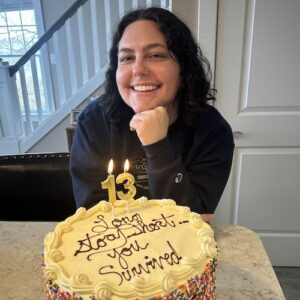
Life now is more beautiful than I could have ever imagined at 19. Thirteen or fourteen years ago, I didn’t know if I would make it to the five-year mark. I did, and I celebrated with 20 of my closest friends in Napa. I didn’t know if I would make it to the 10-year mark. I did, and I celebrated with ten friends in France.
I’m not the same person I was before cancer, and I love who I am now. I have a distinctive vantage point on how I want to live.
At one point I was measuring my life in hospital visits, treatments, and surgeries. Now I’m so much more conscious of how I want life to feel. If I hadn’t gone through cancer, I don’t think I’d be living this fully.
This interview has been edited for clarity and length. The views and opinions expressed in this interview do not necessarily reflect those of The Patient Story. This content does not replace professional medical advice.
Inspired by Taylor’s story?
Share your story, too!
Hear from people living with rectal cancer
Real experiences with diagnosis, treatment choices, side effects, and life beyond rectal cancer — in their own words.

Leave a Reply