
From Rib Pain to the OR: Tracy’s Pancreatic Cancer Experience and the Whipple Surgery That Changed Everything
Tracy is a retail manager, mother of two, and a pancreatic cancer patient whose experience began with a symptom that’s easy to dismiss without other factors: an uncomfortable rib pain near her sternum. Starting in mid-July 2025, she saw her physician, had blood work and an ultrasound done, and consulted her naturopath, yet every test came back clear. For months, the pain neither worsened significantly nor disappeared, and life kept moving. It wasn’t until late October that everything accelerated.
Interviewed by: Taylor Scheib
Edited by: Chris Sanchez
When the pain began radiating into her back and jaundice appeared almost overnight, Tracy went to the emergency room on Oct. 25, 2025. A CT scan revealed a cyst on the head of her pancreas. A subsequent needle biopsy confirmed what the medical team suspected: pancreatic adenocarcinoma, the most common kind of pancreatic cancer. She received her diagnosis while sitting alone by the window of her hospital room with a cup of coffee, while her husband was 10 minutes away.
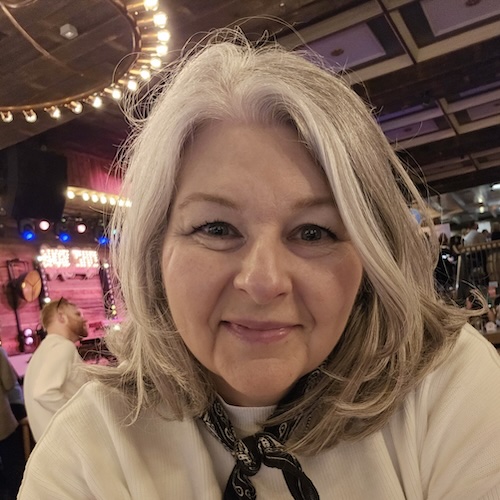
Just 17 days after diagnosis, Tracy underwent a Whipple procedure, one of the most complex operations in abdominal surgery. Her tumor, approximately 2.5 centimeters and located at the head of the pancreas, was removed along with a portion of her stomach, her bile duct, and her duodenum. Of 29 lymph nodes removed for assessment, 11 came back cancerous. Because the cancer was found near the edge of the removed tissue, radiation was added to her treatment plan. Tracy also required a blood transfusion due to bleeding near the major blood vessel connected to her liver, which her surgeon had to shave carefully during the procedure.
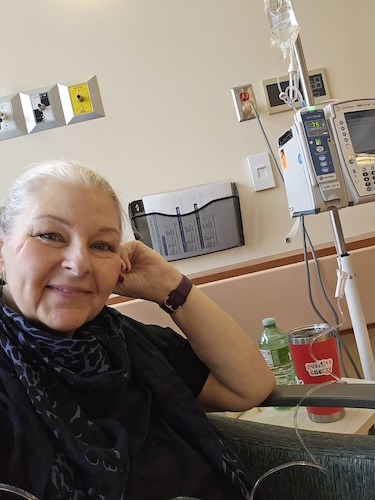
After surgery, Tracy began FOLFIRINOX chemotherapy in mid-January 2026, but the regimen proved too aggressive. Her liver enzymes spiked to dangerous levels, she was hospitalized for eight days with severe diarrhea, and her liver grew to 21 centimeters in length as the drug failed to metabolize properly. Her team switched her to gemcitabine and capecitabine, a combination she tolerates with significantly better quality of life, though delayed treatment cycles due to low blood counts have remained part of the process.
Throughout it all, Tracy has remained anchored by her husband, her two sons, and a growing community of support: cards from her support system, porch drop-offs from family, and daily video calls from loved ones far away. She describes herself as a changed person who’s more present, more forgiving, and more certain than ever that self-advocacy and trust in one’s own body are non-negotiable. “Be kind to yourself,” she says. “It’s a process.”
Watch Tracy’s video above or read the edited transcript of her interview to find out more about her pancreatic cancer story.
- Persistent atypical symptoms deserve follow-ups. Tracy’s pancreatic cancer didn’t immediately present with the “classic” warning signs such as changes in stool or urine color, and jaundice. For months, rib and sternum pain were the only indicators. Once the classic sign of jaundice showed up, her diagnosis came quickly.
- Patients have the right to demand respect and communication from their care team. When a floor physician withheld information and was dismissive, Tracy named the problem directly and asked to be treated as a partner in her own care. That kind of self-advocacy is not confrontational; it’s necessary.
- Early surgical eligibility for pancreatic cancer is uncommon and, when possible, life-changing. Because Tracy’s tumor was located at the head of the pancreas, it caused symptoms relatively early and was caught while still operable. The Whipple surgery that followed led to the discovery of 11 cancerous lymph nodes, findings that directly shaped her entire treatment plan.
- Treatment plans change, and that does not have to mean failure. When FOLFIRINOX proved too toxic for Tracy’s system, her team switched to gemcitabine and capecitabine. Adjusting a regimen because the disease or the body requires it is sound medicine, not necessarily a setback.
- A strong support network is a clinical asset, not just an emotional one. Tracy’s husband, her sons, her extended family, and even strangers mailing postcards from Japan gave her reasons to get out of bed on the hardest days. Community is part of healing.
- Cancer can quietly reshape a person for the better. Tracy describes herself as more present, more gentle, and far less willing to tolerate what doesn’t matter anymore. Her transformation, from a high-speed retail manager to someone who reads cards by her credenza and notices new restaurants from a moving car, is a testament to what life on the other side of diagnosis can look like.
Tracy’s Diagnosis Facts
- Name: Tracy R. T.
- Age at Diagnosis:
- 55
- Diagnosis:
- Pancreatic Cancer (Pancreatic Adenocarcinoma)
- Staging:
- Stage 3
- Symptom:
- Pain in the right rib area that radiated to the back
- Treatments:
- Surgery: pancreaticoduodenectomy (Whipple procedure)
- Chemotherapy: FOLFIRINOX, gemcitabine, capecitabine
- Radiation (upcoming)
This is not medical advice. Please consult with your healthcare provider to make informed treatment decisions.
- Tracy’s Diagnosis Facts
- Early pancreatic cancer symptoms: What snuck up on me
- Getting the pancreatic cancer diagnosis: The CT scan and biopsy
- What is a Whipple surgery? My pancreatic cancer operation explained
- Starting chemotherapy: Side effects and switching regimens
- What keeps me going through pancreatic cancer treatment
- How pancreatic cancer changed my perspective on life
- My message: Gratitude and resilience
- Hear from people living with pancreatic cancer
Early pancreatic cancer symptoms: What snuck up on me
I didn’t have the typical red flags: the stool color, the urine color, things like that. I just had a lot of rib pain, right around my sternum in the front. It started in mid-July 2025. It was just uncomfortable. I made an appointment with my physician, went in, had some blood work done, and had an abdominal ultrasound. Everything came back clear. I thought, “But I’m still not feeling great. I’m a very healthy woman. This is not right.” But I had no other symptoms. I thought, “Is it just my mind? Is it a torn muscle? Is it maybe some way I moved?”
I then had my ultrasound and blood work results sent to my naturopath. I wanted a second set of eyes on it — somebody I really trusted — and she said, “No, everything looks fine. Everything looks good.” So I went through the month of September feeling not great, but with no other symptoms. It didn’t get any worse; it didn’t get any better. I have Barrett’s esophagus — I’ve had it for many, many years — so I have a gastroscopy every two years. My gastroscopy was coming up in October, and my doctor said, “Okay, we’ll just get it checked out then. No problem.”
The middle of October came up, and I had to change my appointment. We lost my mother-in-law on the 12th of October. My appointment was on the 14th of October, so it was very difficult. I rebooked for the first week of November. But then, gradually, over the next week and a half, it got a lot worse. The pain started radiating through my back — my tumor was pressing against one of my nerves under my ribs.
We were at a concert on October 22nd, a Wednesday night, and we actually had to leave. I said to my husband, “I’ve got to go. We can’t stay. I’m sorry — I can’t sit. I’m in so much pain.” Thursday morning, I had a call with my physician, and she said, “If the pain gets any worse, or doesn’t get any better over the next 24 hours, I want you to make your way to the emergency room.” That’s exactly what I did. Friday morning, I headed to the emergency room. I was there all day and did not get a room until 9 p.m., which — I know that’s our emergency system, and I understand urgent care.
One thing I found really interesting: on Thursday evening, I said to my husband, “Does my skin look a little yellow to you?” And he said, “No, you’re not yellow.” I said, “No — I am yellow. It’s not my makeup. I haven’t changed my makeup. It’s yellow.” As soon as the doctor walked into the emergency room to see me, the first thing she said — because, of course, in the emergency room, with the bright lights, the white walls — she looked at me and said, “Oh, you’re really jaundiced.” My bilirubin had peaked at about 135. She said, “Okay, we’re going to get you on some meds. Let’s get you admitted.” And that’s where that initial escalation of symptoms came from.
How my pancreatic symptoms affected daily life — physically and mentally
I’m very lucky — I am a retail manager. I have a bustling store and a high-performing team. What I noticed was that I just threw myself into my work and kind of forgot about the pain. I really didn’t think about it during the day, but I would think about it at night when I got home. It was evident on that final Thursday night before I went to the hospital — I got the foam roller out on the floor and started to roll out my back. I thought, “Maybe this will finally help me.” But I got to the point where I just mentally blocked out the pain. Aleve was my best friend — though I later found out I shouldn’t take Aleve. Any over-the-counter painkiller. It was just whatever I could do.
Work really allowed me to mentally block it out, but it did affect my day-to-day work because I couldn’t be on my feet for nine hours a day. I had to take breaks. I had to go to the back and sit down for ten minutes. That was a big piece of it. But mentally? No, you just keep going. You plug away.
I didn’t get the back pain until the last week and a half. That’s when I thought, “Maybe it’s kidney stones — this is like my kidney area.” But I thought that would have shown up on an ultrasound. It’s wild with pancreatic cancer — there are so many different symptoms. What I tell people, what I’ve explained to my friends, is: just be aware of how your body feels on a good day. If something doesn’t feel right, you trust yourself, and you go with that, and you push until you get an answer. You need to be an advocate for yourself.
From rib pain to back pain: How the symptoms progressed
It happened very quickly. Through September, I really didn’t experience anything except that sternum area — it was uncomfortable to even wear a bra because it was pushing right against that area. But then that last week and a half, it was like, “Oh my God.” I’d get up in the morning and feel okay — and that’s another thing they said: when you’re sleeping and lying down, you feel more pressure. It did keep me up a few nights. Because it was all on my right side, if I lay on my right side, I’d wake up. So I always ended up on my left side.
But I didn’t have an extended period of that. It was really from around the 15th of October to the 24th of October. I said, “No, I can’t go on like this. I can do the sternum pain — maybe that’s a muscle — but my back? I can’t do the back.” I’m on my feet nine hours a day. I’ve got a household to run when I come home. When you’ve got a bad back and you’re taking over-the-counter pain medication every day, there’s something wrong. That’s not normal. That’s when you need to push a little bit harder.”
Arriving at the emergency room: The decision to seek care
I actually went to work on the Friday morning before the ER — I went in before my store opened, just to make sure everything was set up for my team for the weekend, because I figured I’d probably be admitted. When I got to the hospital, I sat in the waiting room and looked around, thinking, “Oh God, there are some people here with a hangnail. Should I be here? Maybe I should have just gone to urgent care.”
When I met with the triage nurse, she called my number and asked, “How long have you been in pain?” I said, “Oh, since July.” She looked up from her keyboard and looked at me. I said to her, “Please don’t give me that look. I’ve been in contact with my physician. I spoke to my physician yesterday morning. She knows everything that’s going on. She told me to come here this morning. That’s enough. I’m not here to play games today.”
When the doctor came in and saw that I was jaundiced, she said, “Let’s get you on some painkillers right away.” They gave me an IV. That’s when I called my husband. They had put me on a pink wristband — a high-priority color. I said, “I think you need to come.” He drove over — we’re only ten minutes from the hospital — and he stayed there with me all day. When I was admitted that night, they did a CT scan as well. We didn’t know what was going on. I thought, “It’s okay. I’m in good hands. At least I’m in the hospital. They’re going to take care of my pain.” And they did.
Getting the pancreatic cancer diagnosis: The CT scan and biopsy
They did the CT scan on Friday night and discovered a small cyst on the head of my pancreas. My gastroenterologist happened to be on duty that weekend for clinical rounds. He came in to see me on Saturday and said, “Tracy, everything’s good. We’re going to get you in. Sometimes, a cyst on the pancreas is like a little scab. If you’ve had pancreatitis or some discomfort, it’ll scab over and take time to wear off. We’ll go in on Monday. I don’t have a procedure booked on Monday, so we’ll do the procedure for you — your full gastroscopy — and we’re going to put a little stent in there just to open up that little cyst, that little bile duct where the cyst is, just to let the bile flow again.” I said, “Okay, no problem.”
On Sunday, he came to see me again — everything looked good, pain was under control. I was in a private room. The food was good, for a change, in a hospital. On Monday afternoon, around 3:00, I went down to have my gastroscopy done. They did an endoscopic ultrasound at the same time. I lay on my stomach, and they ultrasounded my back while doing the gastroscopy, and on that little cyst, they did a needle biopsy at the same time.
On Tuesday, I got a call from a clinic. I normally never answer my phone — my phone is always on silent. I didn’t recognize the number, so I thought I’d let it go. But something made me listen to the voicemail. It said, “It’s the surgeon’s office. We’re just calling because we got a referral for you.” I thought, “What? I just had a needle biopsy yesterday.” Nothing really clicked. I called them right back. I said to the receptionist, “Can you please tell me a little bit more?” She said, “I can’t — I’m just reception.” I said, “Okay, no problem. If I need the appointment, I need the appointment.” That was around the 27th or 28th of October. She scheduled me for the following Monday — November 4th — to see the surgeon.
The medical doctor on the floor came around on Wednesday to check in on me. She said, “Oh, we’re going to do a CT scan on your lungs.” She never explained why. The doctors were being very cautious with what they shared because the biopsy hadn’t come back yet — but I think they knew. I said, “I’m here, and I know I’ll get a CT scan much faster as an inpatient than as an outpatient. Keep me until you can get my scan.”
Thursday, my husband came — he was there every single day — and we went and had my CT scan done. Friday morning, before my husband arrived, the doctor doing her rounds came to see me. I’d had words with her on Thursday about the way she was treating me. I said, “You need to treat me with respect. You need to fill me in on things. If I’m asking you a simple question, I don’t need to know everything — I just need the answer to that question.”
She sat down in the chair beside me. I was alone, and I regretted not saying, “Can we wait until my husband gets here?” He was on his way. Instead, I said, “Just give it to me.” I sat on the edge of the bed. She said, “The biopsy came back — it came back very quickly. It’s showing cancerous cells in your pancreas.”
I went, “Okay.” I remember I started to cry, but I felt like I couldn’t cry — I was almost in disbelief. I said, “It’s okay. I’ll get through it. I’ve got a great support system. I’m good.” She said, “You are so strong.” She actually hugged me before she left the room. She said, “Can I hug you? So many patients come in here — they Google everything. They have so many questions for me.” I said, “What am I Googling? I don’t know what’s going on, so there’s no point in Googling. Google is not my doctor. I trust my physicians. I trust my surgeons.”
I called my husband. I was sitting with my coffee that morning in my room by the window. He started to tell me a funny story about something that had happened in the car on the way over. I started to cry and said, “I just need you to come. Like now — I need you here now.” When he walked in, I told him. He had the same response I did. He said, “It’s okay. We’re going to get you better. We’re going to get through this. It’s okay.”
Even now, I haven’t had a full breakdown. I’m still in denial, I think. I still don’t think I have cancer. After I was diagnosed, I went to TikTok — because everybody goes to TikTok — and there are some great stories on there. Everybody shares stories about how it’s okay to have a meltdown, have a day when you just cry all day. I still haven’t experienced that. I don’t think I’ve had five minutes of it, actually, because after my surgery, it was too painful to cry. I couldn’t cry through 34 staples, that’s for sure. But I just haven’t felt the need. I express it in other ways. I go silent. I haven’t had a meltdown, and I don’t think I will — because I still don’t think I have cancer.
Telling my sons and family about the pancreatic cancer diagnosis
My oldest son was the more difficult one to tell. My younger son — he’s 26 or 27, he lives here, I see him often. My older son was in Colombia at the time, and that was really hard. I had to tell him over the phone. But my kids know I’ve always been positive with them. I don’t hold back. I don’t sugarcoat anything, but I always flip it to a more positive note.
The way I framed it — and the way I think I still look at it, and I think this is part of why I’m in a little bit of denial — is that I’m so grateful I was a candidate for that surgery. My tumor is gone from my body. I said to my son, “It’s okay. It’s good. I’m having surgery next week on the 17th. We’re good.” He came home before I had surgery, and it was hard because he was on FaceTime with me when I first told him — I just melted. My boys are my heart and soul.
After FaceTiming with my younger son, I got off and immediately called my older one, right then. They both took the information very differently — it’s the way they process things. I’m good with that. I’ve always encouraged them to be individuals.
There were a lot of people who were hard to tell. My dad was another one. When you share it with family you love and care about, you never want to hurt anybody. You never want anybody to worry. But they know that if I said tomorrow, “I need you to come home,” he would be on a plane tomorrow. But he’s almost 29 years old. It’s time for him to fly, to spread his wings — and he is doing that. He’s incredible.
What is a Whipple surgery? My pancreatic cancer operation explained
My tumor was contained to the head of my pancreas — that’s why I had symptoms relatively early. The reason there’s such a low survival rate with pancreatic cancer is that it usually starts in the tail, and by the time it gets to the head, by the time it’s caught, it’s too late. I’m very grateful. My tumor was about 2.5 centimeters in diameter — the size of a golf ball — but it was primarily contained to the head of my pancreas.
So they removed the head of my pancreas. They removed about 20% of my stomach. They removed my bile duct and my duodenum. They would have removed my gallbladder, but I had “evicted” it 13 years ago. Then they reattached everything to make sure it all fit properly together and that everything flowed — and stapled me up with 34 staples.
It’s an experience I’ll never forget, but I’m very grateful for it because it’s made me so much more aware of my body. Not many people are candidates. When I had my surgery, it was at a teaching hospital, so there were students present, which I love. One of the students was from Mexico, and my doctor was explaining to him post-op. She said, “Do you remember all the bleeding we had? It was quite swollen in the area. I had to shave the portal artery a little bit.” That’s why a lot of people aren’t eligible for the Whipple — their arteries get wrapped around the tumor in the pancreas. A lot of people will do chemotherapy first and hope the tumor shrinks enough so they can have surgery.
Because of that arterial involvement and blood loss, I needed a blood transfusion. One of my surgical margins is still a little tight — that’s why I’m going to do radiation, to take care of that. I’m okay with that. While they were in there removing my tumor, they also removed 29 lymph nodes to assess. Eleven of them came back cancerous. That’s why we’re being aggressive with the chemotherapy. But it makes me feel grateful that I was eligible for that surgery — because if I wasn’t, how would they have ever found the lymph nodes? I think about that every day. And that’s why I think, ‘I don’t have it. I’m good.’
The emotional reality of the morning before surgery
I was diagnosed on October 31st. I saw the surgeon on November 4th. I had my surgery on November 17th. It was just bang, bang, bang, bang, bang.
The morning I went in for surgery — I’ll never forget it. My husband and I were in the room. They did my blood work, and he reclined my chair. I was in my hospital gown and everything. He pushed a button, and literally, my chair went clunk. I said, “Did you just push the eject button?!” I was laughing. Did I know I was just about to have an eight-hour surgery? No — I had no clue what I was getting into.
When it hit me was when I got up from that chair in the waiting area outside the OR and walked into the OR room. Those big bright lights. I sat on the edge of the bed, and I was still okay — but all of a sudden, one of the anesthesiologists held me by the front of my shoulders, and I could feel another one at my back, and I could see the bustling of people around me. That’s when I realized: “Okay, this is bigger than me. I’m going to need an army here.” That’s when it hit me.
A couple of days before, at the pre-assessment for the surgery, the assessment nurse said, “Oh, you can check out the Whipple Pathway — it’s a website.” I pulled it up and flipped through the first two pages of diagrams. I turned my phone off and said, “No, thank you. Don’t want it.” I knew it was an eight-hour surgery. I knew I’d need a blood transfusion. That’s it. Don’t want to know anymore. But I think that was the shock moment — “Oh, okay. This is real. This isn’t just pretend. This isn’t just a gastroscopy I’m going in for. This is big.”
When I saw the surgeon — she’s absolutely amazing, incredible — she started talking about a Whipple surgery. As soon as she said “Whipple,” something clicked. I thought, “Oh — that’s nothing.” I had a girlfriend who had that done three years ago, and it turns out it was my surgeon’s partner who did it. And then I found out I have another girlfriend who had a Whipple done by the same surgeon eight years ago. I thought, “I have enough information. They survived. They’re good. They got through it. I can get through it.”
Also, I think it was the speed with which everything happened. November 4th — consult. November 17th — surgery. No time to think. Between those 13 days, I had to get everything done for Christmas. Life goes on.
Starting chemotherapy: Side effects and switching regimens
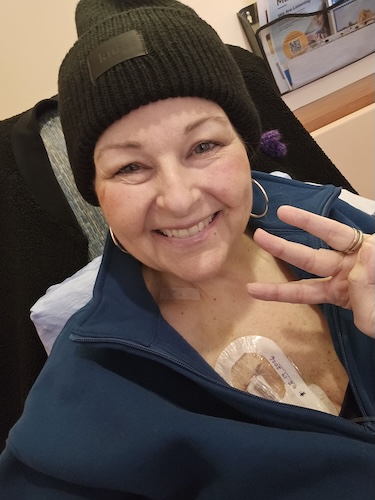
We started mid-January on FOLFIRINOX. If you know anything about chemotherapy, that’s the kitchen sink — it’s pretty heavy. It’s not pleasant. My liver enzymes were extremely high; they were spiking. My white blood cell counts, my platelets — everything was dropping, but my liver enzymes were spiking. I was also hospitalized for eight days due to severe diarrhea. It was just too hard on my body.
They did a CT scan while I was hospitalized. They found that a normal liver for a woman my age would be about 14.5 centimeters in length — mine was 21 centimeters in length. My body could not metabolize the FOLFIRINOX properly. We decided to back off. I saw a liver specialist, and she said, “As soon as you come off the chemo, it’ll back off. You’re fine.” It had appeared as fatty deposits on the liver, not swelling. I said, “Certainly not from my diet — I eat very well.”
Being on FOLFIRINOX, given every 14 days, I was deferred three times across five cycles. In three of those cycles, I was deferred for a week. That’s when you learn to throw that calendar out the window and say, “I’ve got to trust the process.”
Two weeks ago, we started on gemcitabine and capecitabine. Gemcitabine is an infusion, and capecitabine is a pill I take at home. That’s given three Mondays in a row, then a week off. Last Monday, I was deferred again — my levels were too low. I thought, “Oh, again.” But I do find it’s a lot easier on my body. I feel better. I haven’t been able to drive a car since January because I’m too lightheaded — I keep telling my doctor, and she says it could be a side effect — but I feel good. I just want to get behind the wheel of a car and have that freedom.
Yesterday, they did a dose decrease of 25%, and I was able to get my infusion. Hopefully, I’ll get it next Monday and the Monday after as well. I see the liver specialist again next Monday. We’ll continue until the end of June or mid-July — depending on how many more deferrals I get — and then we’ll do radiation for 28 days straight.
What keeps me going through pancreatic cancer treatment
My husband keeps me going. Honestly, he is my rock. He has not missed a single appointment. He drives me wherever I need to be. If I say I want chicken wings at 8:00 at night, he gets me chicken wings. I’ve had massive food cravings — I’ll see something on the Food Network or on Instagram and say, “This is what I want for dinner tonight.” He’s off to get it.
Besides that, I get daily calls from both my kids. I FaceTime with my son in South America every day. My other son calls every day. My husband is here with me all the time — he works from home. He’s the one who, if I’m in bed until 10:00, will quietly open the door and say, “Okay, Mama — time to get up. Let’s go.” He’ll bring my heating pad downstairs. It’s the little things. I feel like I need to hold it together because he’s holding it together — and I know it’s hard on him.
Losing my hair during chemo: My experience and mindset
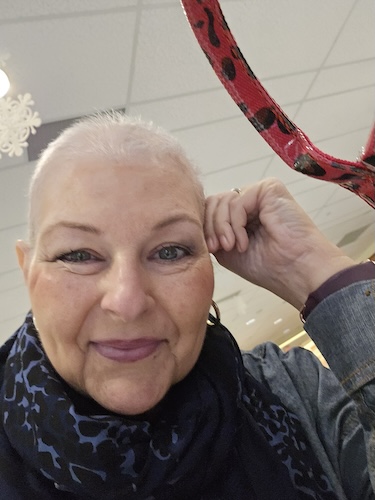
It was right after my first infusion, back on January 15th. I was combing with a wide-tooth comb because I was told that with FOLFIRINOX, you don’t lose much hair — maybe 25 to 30%. My hair was long, gray, short in patches, pink, purple at times — it just never defined me. I was using the wide-tooth comb, and it was coming out in handfuls in the sink. I thought, “What am I doing? This is ridiculous.” I think it affected my husband more than it affected me.
I got to the point where I said, “It’s just everywhere. It’s a mess. It’s done.” I never once thought about a wig. I don’t want a wig. I don’t care. Put my makeup on, put my earrings on — I’m good. I had a thick ponytail that was like the size of a two-year-old’s, and I thought, “This is not working.” I had a toque on all winter, and I’d take it off, and there’d be handfuls of hair inside it. I said, “I can’t do this.” So we got rid of it. I’ve got bigger fish to fry right now.
How pancreatic cancer changed my perspective on life
I’m used to such a fast pace on a day-to-day basis. There are many days now when my phone never leaves my bedside. I find I’m more present. We’ll be driving down the street, and I’ll say to my husband, “Oh, that’s a new restaurant that just opened.” He says, “How did you see that?” I just do. I look at people differently. I’m a lot gentler with people — but I also don’t put up with nonsense anymore. I don’t have time for that. My time is ticking.
I’m more forgiving and a lot softer and kinder with people. I truly think it’s because — and I’m going to get emotional saying this — during this whole process, I have received endless care packages. My husband went to the mailbox yesterday and came back with four cards. They’re all over my credenza. I got postcards from Japan — from friends I haven’t spoken to in years. It’s the kindness of others that also changes you.
Every card I get, I read. I’ve even shared a video about the cards — because it’s one thing to get a message on Facebook or Instagram, but an actual physical card? I’ll walk by them sometimes — they’re all lined up — and I’ll just pick up one or two and read as I walk by. It keeps me going. And I’ll think, “I wonder how they’re doing” — and then I’ll reach out. It’s been very different. Very different.
My message: Gratitude and resilience
I’m a completely different person. I go sit in the waiting room, and if I have to wait an hour, I have to wait an hour. I just look around at people and try to figure out their stories. I’m grateful for that — because I’ve spent the past 15 years just go, go, go: nine hours a day from open to close, responsible for hitting numbers. Now it’s, “I’ve got nowhere to be. I’ve got nothing to do. I’m enjoying right now, in this moment.” I like this person I’ve become mentally. She’s different — a lot softer, a lot more fragile than I want to admit. But she’s tough, and she’s going to get through this.
I had such a good experience from my diagnosis in the hospital, all the way through chemo: every single one of my doctors, every single nurse. I know all the nurses’ names now in the oncology unit. I call them by name because I think it’s important to acknowledge people.
And I think the last thing I would say is: give yourself grace. Be kind to yourself. Don’t be so hard on yourself. It’s a process. It changes you — not just physically, but mentally. It changes the way you look at others, the way you treat others. You don’t take anything for granted anymore.
I have an amazing family. My husband and my boys, my brother, my sister-in-law, my niece and nephew — though they’re just germ bugs right now, so I haven’t been able to hug them since before Christmas, with my white blood cell count being so low. They do porch drop-offs and wave at me. And my dad, my stepmom, my mom. If you have that support behind you, you can get through anything. I can get through anything.
This interview has been edited for clarity and length. The views and opinions expressed in this interview do not necessarily reflect those of The Patient Story. This content does not replace professional medical advice.
Inspired by Tracy’s story?
Share your story, too!
Hear from people living with pancreatic cancer
Real experiences with diagnosis, treatment choices, side effects, and life beyond pancreatic cancer — in their own words.



Leave a Reply