
A Bulging Neck Vein and a Midnight ER Visit Led to Kelsey’s Stage 4 Non-Hodgkin Lymphoma (Primary Mediastinal B-Cell Lymphoma or PMBCL) Diagnosis
Kelsey was eight months postpartum with her second daughter, working as a nurse navigator in a high-risk breast clinic, when her husband noticed something new: a bulging vein at the base of her neck. She felt fine, so she didn’t think much of it. A few weeks later, she started noticing shortness of breath and a dry cough, both of which she chalked up to being an exhausted mom of two under two. Neither symptom seemed serious enough to explain what was coming: a diagnosis of primary mediastinal B-cell lymphoma (PMBCL), a rare form of non-Hodgkin lymphoma.
Interviewed by: Taylor Scheib
Edited by: Chris Sanchez
The path there wasn’t straightforward. A middle-of-the-night fainting spell sent her to a doctor who told her the bulging vein was normal. Kelsey pushed back, and an ultrasound eventually found a blood clot in her neck. Her doctor still wasn’t concerned enough to delay an upcoming flight, telling her to take an aspirin and go. That evening, a MyChart notification showed the clot had spread to three veins, and Kelsey drove herself to the emergency room.
A CT scan that night found a 9-centimeter mass in her chest. Kelsey read the word lymphoma on her hospital chart before any doctor had the chance to tell her, sitting by herself in the middle of the night. A biopsy confirmed primary mediastinal B-cell lymphoma, and a PET scan showed two additional small spots, one in her lung and one in her small bowel, leading to a stage 4 diagnosis. Four days after her ER visit, she started chemotherapy.
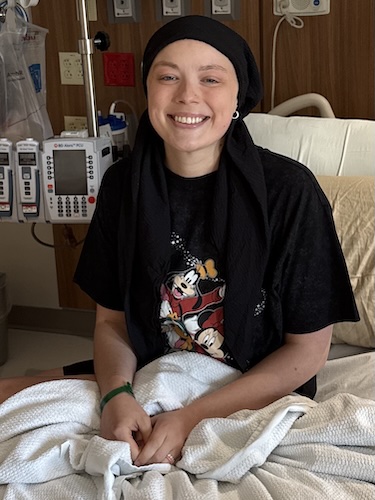
Kelsey has now completed four of six planned rounds, each involving a continuous 96-hour IV infusion. After the mental toll of three inpatient hospital stays, she and her oncologist worked out a plan to shift to outpatient treatment, and she now stays near the treatment center in a rental home during each round instead of a hospital bed. She’s shaved her head and leans on dark humor and a strict routine to get through the hardest days. A mid-treatment PET scan recently showed no evidence of disease, a milestone her oncologist called a very good sign heading into her final two rounds of treatment.
Watch Kelsey’s video and scroll down for the edited transcript of her interview for more about her story.
- Kelsey’s first warning sign was a bulging vein her husband noticed in her neck, weeks before she had any other symptoms.
- When her doctor called the bulging vein normal, Kelsey pushed back and kept asking for imaging, a decision that eventually led to finding a nine-centimeter mass in her chest.
- She learned she had cancer by herself in the emergency room, reading the word lymphoma on a hospital chart notification before any doctor had the chance to tell her.
- A mid-treatment PET scan showed no evidence of disease after just three rounds of chemotherapy.
- Kelsey found that the unknown of a new diagnosis was harder to carry than the treatment itself once she had an actual plan in front of her.
Kelsey’s Diagnosis Facts
- Name: Kelsey S.
- Age at Diagnosis:
- 30
- Diagnosis:
- Non-Hodgkin Lymphoma (Primary Mediastinal B-Cell Lymphoma or PMBCL)
- Staging:
- Stage 4
- Symptoms:
- Bulging jugular vein
- Vasovagal fainting episode
- Shortness of breath
- Dry cough
- Treatments:
- Chemotherapy
- Filgrastim
This is not medical advice. Please consult with your healthcare provider to make informed treatment decisions.
- Kelsey’s Diagnosis Facts
- Diagnosed with non-Hodgkin lymphoma (primary mediastinal B-cell lymphoma or PMBCL) at 30, eight months postpartum
- Life in the trenches of two under two, one month into a new nursing job
- Reading “lymphoma” on MyChart alone in the ER at 1 a.m.
- Getting to “I’m going to be okay” after a stage 4 non-Hodgkin lymphoma diagnosis
- Survivor’s guilt, a summer indoors, and “Mama, hair gone”
- Am I just built this way, or did non-Hodgkin lymphoma make me tougher?
- How having non-Hodgkin lymphoma will change the nurse I go back to being
- You can do hard things, and you will get through them
- Hear from people living with primary mediastinal B-cell lymphoma (PMBCL)
Diagnosed with non-Hodgkin lymphoma (primary mediastinal B-cell lymphoma or PMBCL) at 30, eight months postpartum
My name is Kelsey. I am 30 years old.
I was diagnosed with non-Hodgkin lymphoma, specifically primary mediastinal B-cell lymphoma, on May 20th of 2026.
Life in the trenches of two under two, one month into a new nursing job
When I was diagnosed, I was eight months postpartum. I had my second child in September of 2025, so she was eight months old, and we also had a two-year-old. So I was in the trenches of two under two, and sometimes I joke that that’s what gave me cancer, because it was stressful.
But all jokes aside, I was in the trenches, and I was on maternity leave from my previous nursing role. I’m a nurse. I was working postpartum labor and delivery for two years, and then had my second child, went on maternity leave, and ended up not returning to that position. I actually got a job in a cancer center. Ironically, I was, and still am, a nurse navigator in a high-risk breast clinic. I started that job April 20th and was diagnosed with cancer on May 20th, exactly a month later. So that’s kind of what I was up to before.
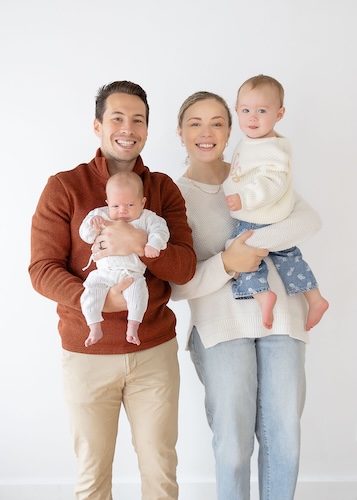
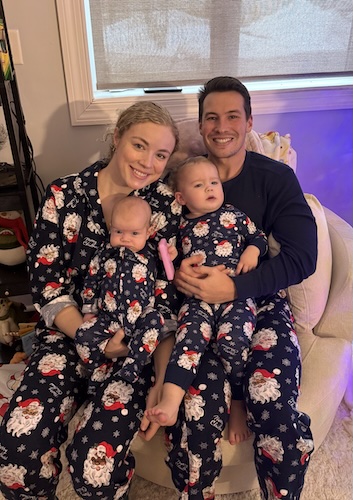
I’m married to my husband; he’s a strength coach, and we have our two daughters. Before all of this, I was on maternity leave for about seven months. But before that, I was working as a nurse, and then had just started a new role as a nurse before getting cancer and having to take another leave. So that was kind of what I was up to.
A bulging jugular vein, a middle-of-the-night blackout, and a doctor who wasn’t worried
At the end of April, actually, it was basically when I had started my new job, my husband noticed that I had a bulging jugular vein right here in my neck. That was not normal. It had never been like that. It was sticking out, and he noticed it, and he was like, “What is that? Why is it doing that?” I was like, “I have no idea; I didn’t even notice it.” I didn’t really take him very seriously right away.
Looking back, maybe I should have actually done something about it. But hindsight’s 2020, right? Because I was feeling fine, I wasn’t having any symptoms. I was like, “Oh, maybe it’s just… I don’t know.” So that was the end of April.
And then, I’d say maybe a week or two after he had noticed it, I had a vasovagal episode in the middle of the night. I woke up feeling really nauseous, felt like I was going to throw up. So I got up, tried to go to the bathroom, and I made it halfway to the bathroom, and I basically passed out. I fell to the ground and could not get up. I was still conscious. This was at midnight, so my husband was sleeping, and I had ringing in my ears and blurry vision. I was like, “This is not good.” So then I was able to get up and go to the bathroom, and within a minute I was fine.
So I was like, “That’s weird.” And then I came back to our bedroom and told my husband what happened. He’s like, “Okay, you need to go to the doctor, like now.” Again, I still waited. I wasn’t gonna go to the emergency room for that, because again, I was feeling fine after that. I was like, “Oh, that was just a strange syncopal episode.”
So then the next day, I didn’t have a primary care provider at the time, because the only medical history I had was having babies. So I was like, I can’t call my OB for this. So I got in with the first provider that had an appointment, which ended up being not that same Friday but the next Friday. So it was May 8th, got in with him. And I don’t want to say that he didn’t take me seriously, but there were signs that he wasn’t really taking me seriously.
Basically, he was like, “Okay, you’re a 30-year-old healthy woman, why are you here?” So I told him about the jugular vein, and I told him about that episode that I had. He wasn’t that concerned, to be honest. He did consult with vascular surgery about it, and they told me that it was just a bulging jugular vein and that it’s normal. And I was like, “This isn’t normal, this is not normal.” Obviously, with my healthcare background too, I was like, “No, we need to do something about it,” because I was having a lot of anxiety about this.
So basically, because I was having anxiety, he was like, “Okay, we will do a CT with contrast.” The next day, he called me, “I changed my mind; I want to do an ultrasound because it’s less invasive.” So we got an ultrasound scheduled, which had some issues, so I didn’t get an ultrasound until May 19th. I initially saw him on May 8th, got the ultrasound on May 19th, on my lunch break at work, because it was around 1 p.m., and went in. It was the same building I was working in, so I just walked over there and got the ultrasound on my neck.
The ultrasound tech knew something was wrong, but she couldn’t tell me what it was, because she did both my right and left sides, and she was like, “Your right side looks great; but your left side — something is wrong.” But she couldn’t tell me what it was. And now, looking back, after sharing it on TikTok, I’ve had a lot of ultrasound techs in the comments say she should have immediately sent me to a doctor, because I ended up having a deep vein thrombosis or DVT in my neck. So I had a blood clot, and I didn’t know that at the time, obviously. So I did the ultrasound, went back to work, left work, and at 4:30 my provider called me. The results still weren’t back, but he still was not convinced that it was anything concerning. He said it wasn’t a blood clot.
We were supposed to get on a flight two days later; this was a Tuesday and we were supposed to fly to Asheville, North Carolina for one of our friends’ weddings on Thursday morning. So I was like, “Am I okay to fly? We don’t have the results yet. I think it’s a blood clot. I know I’m not supposed to fly with a blood clot; what do I do?” And he told me to take an aspirin and get on my flight on Thursday. So I went to Walgreens, got aspirin. Again, this was 4:30. Went home, had dinner with my family. Then I got the notification on my chart around six, six-thirty, that my results were in. So I was like, okay, I’m obviously going to look. And it said DVT in three different veins, not just the jugular, also the subclavian and one other. I’m like, this isn’t good. So I told my husband, “I’m going to take myself to the ER because I’m not waiting around for this.” So then I went to the ER, and that was around 7 p.m. I got there, told them, my chart tells me I have a blood clot, and I don’t know why. So they got me back right away, obviously suspecting maybe a pulmonary embolism. A provider came in right away, and they did all the labs, got an IV in, and did an X-ray. The X-ray was fine, so I was like, okay, we’re good.
And then they had to get an IV in me and do a CT with contrast, and that’s when they found a nine-centimeter mediastinal mass, like the size of a grapefruit, just sitting right here on my chest. And then that’s when I spiraled. I was like, “What the heck!” So by the time I had the full workup, the CT results came back, and I finally talked to my provider, it was like midnight. But he was amazing.
He called my oncologist, who I have now, and they wanted me to come that night, but I was like, mentally, I cannot, because one, I don’t want to take an ambulance there, and two, I cannot drive myself right now. So I called my parents, I called my sister, my best friend, my mother-in-law, and my husband, obviously, and was like, “Hey, I probably have cancer.” And obviously their response was like, “What?” So my mother-in-law and my best friend drove up that Wednesday morning. I went home at like 2 a.m. I don’t think I slept, honestly. And then my husband and I took our two kids to daycare early that morning, and then we were driving two hours to the hospital where I get my treatment now. And we met with the oncologist, and that’s kind of when the whole thing started.
They had an inpatient bed ready for me. He was basically there right away; it was around 10 a.m. And that’s when he was like, “Yes, it is lymphoma; we don’t know what kind yet.” And then he told me, based on the symptoms I was having and the mass in my chest, that it was non-Hodgkin lymphoma. So that same Wednesday, that morning, I got a biopsy and a PET scan; I think that was it, maybe one other thing. Oh, I got a PICC line put in, because they didn’t want to do a port right away, given the size of the tumor. He didn’t feel comfortable doing it for round one. So I got the biopsy, the PET scan, and the PICC line all in the same day. So that was just a whirlwind, like, “What’s going on? This is real now.” So that was Wednesday.
The biopsy results came back Friday, which was actually very quick, and it came back as primary mediastinal B-cell lymphoma. They had also, with the PET scan, found the mass in my chest, and then two additional spots, one on my lung and one on my small bowel. They were each about one centimeter. So he really wasn’t too concerned; obviously, had I not gone in, it would have kept growing, and things could have been much worse, but I was diagnosed with stage 4 based on that, and it was just those three tumors. And then I started chemo the next day, on Saturday, May 23rd.
So from May 19th to May 23rd, a span of four days, I got a cancer diagnosis and started chemo in less than a week. And so that was my first round of chemo, Saturday to, I think, Wednesday. So I was in the hospital for a week that time, a full week, seven days. And now we’re on round four.
Looking back: The shortness of breath and cough I chalked up to being a tired mom
Honestly, besides the bulging jugular vein and that fainting episode, I did not have any symptoms until about the beginning of May, probably, which is when I started feeling some shortness of breath that I just chalked up to being out of shape postpartum, because I was not working out. But I was getting to the point where I was just walking around my house and getting winded. I was like, that’s odd. But also, again, I’m out of shape, whatever.
And then probably about a week prior, I started having a dry cough, and just from nursing school, you know, that’s not normal either. But again, I just, I don’t know. Did I ever think I had cancer before reading the results on my chart? Absolutely not. That never once crossed my mind. So yeah, I’d say honestly, shortness of breath and the cough were the only two symptoms I was having, aside from the vein that you could see. So when I got the results, it was just a huge shock, because never once did it cross my mind until I read it out loud.
So yeah, my symptoms were very minimal. I did not have any of the typical B symptoms that Hodgkin patients have, like night sweats, fatigue, and weight loss — maybe fatigue, but again, I was in the trenches of two under two; I was always tired. You’re always tired when you’re a mom; there’s no beating that. But yeah, I never had any night sweats or extreme weight loss, no appetite changes, nothing. So I felt relatively normal aside from a few weird things that were happening, but again, never chalked it up to being that I have cancer.
Reading “lymphoma” on MyChart alone in the ER at 1 a.m.
I found my results out on MyChart. I don’t know if we’re going to get into how I got the diagnosis, but basically I was in the ER, got my results, and saw that I had lymphoma. My first immediate reaction was, “I have cancer, I’m going to die.” That was literally the first thing that popped into my head. And I was like, “I’m never going to see my kids grow up.” I’m gonna get emotional, because it was just a crazy feeling.
Just seeing that you have cancer without having a provider tell you, I can’t even describe the emotions I was feeling. But honestly, yeah, the first thing, I literally was like, “I’m gonna die. My life’s over. I’m gonna die tomorrow,” literally, is what I was thinking. It’s just crazy.
So then the ER provider came in, and he was like, “Obviously, this is scary.” He is an emergency medicine provider, not an oncologist, so he probably doesn’t see it often. He was amazing. Great bedside manner. He really made me feel better about it. And the nurse that was in there with me made me feel better too. She was like, “You don’t know if it is lymphoma; it’s just suggested.” And I’m like, “Well, a radiologist read it,” whatever. But I know they were just trying to make me feel better in that moment. At this point it was like 1 a.m. on a Tuesday-slash-Wednesday morning. I had been in the ER for like six hours alone, because my husband was with our children, sleeping. So yeah, I think as far as emotions, I was all over the place, but that was my initial reaction, like, “My life is over; what do I have to start planning for my kids and my husband to be a widow?” And then after that, I went down the rabbit hole of lymphoma and what the prognosis is. I honestly did not know. I knew it was Hodgkin versus non-Hodgkin lymphoma, but I didn’t know that there were like 80-plus different subtypes of lymphoma. (Editor’s Note: According to Memorial Sloan Kettering Cancer Center, there are more than 70 different types of lymphoma.) So I was like, “Well, which one do I have?” And then in the back of my mind I was like, maybe it’s not lymphoma.
It’s probably something else that’s terminal. You just have all of these what-ifs: what if this doesn’t work, or what if this works? So yeah, emotions were obviously very high. I immediately called multiple people and was like, “I have cancer,” and they’re like, “What?” And again, this is like 1 a.m., so I’m waking my family up, and they were all like, “What the heck is going on?”
So, yeah, I did not cope well right away, obviously. But as the next two months went on, I mean, obviously it’s still not easy, but I have gotten a lot better. I’ve been able to mentally process it more, having a care team that is like, “You’re gonna be okay, this is the treatment plan, these are your scans, all your labs are looking how we want them to look.” They’re not great; I’m a cancer patient, obviously they’re not going to be normal. But my oncologist has been great about reassuring me, like, “This is exactly what I want to see with this type of cancer as you’re progressing.” So I’m doing better now.
Very isolating: Getting the MyChart notification before any doctor could tell me
Very isolating. My nurse wasn’t in there. No family, no friends, nothing. And just going back, I was like, “Oh, my results are in, let’s see if I have a pulmonary embolism or PE,” which I know isn’t good either. And so when I read it, and it said no evidence of PE, I was like, perfect. Then I kept scrolling to my heart area, and that’s when it said “nine-centimeter mass” that was actually wrapping around my aorta. So then I’m like, “Jesus Christ, I’m gonna die right now; I have a tumor on my heart — what is happening?” So yeah, it was very, very isolating, very traumatic.
If I ever have to go back to an ER, God forbid, I will be bringing someone with me. So yeah. But then once those results did come in, my nurse was great, staying with me and talking me through it, being very supportive. But people on my TikTok were kind of arguing in the comments about how MyChart shouldn’t be available to you, and then some people are like, “Yes, it should.” I’m kind of indifferent about it. Had I not gotten the MyChart results about my blood clot, I wouldn’t have gone in, and I probably would have gotten on a plane.
Maybe not, though, because my doctor would have called me the next day. But I am grateful that I do have access to that. But it’s different when you’re not expecting a cancer diagnosis, and you’re alone in an ER, and a provider doesn’t even have time to tell you. Which again, I know that’s my fault for looking; I know I can turn that off, but I’m not the type of person that wants to turn that off.
For my biopsy results, I saw the notification come through, but I did not look at it, because part of me was convinced that it wasn’t going to be non-Hodgkin and I was going to read something totally different. So my doctor was able to walk me through that. And then same with the PET scan, he actually had the results before I did, so I didn’t look at that either. But now I still have MyChart on my phone, because I want to look at my labs; I want to see how things are doing. So I’m kind of indifferent about having access to it. I know everyone has different opinions on it, but I just thought that was funny, because people were arguing in my comments.
And I’m kind of information-driven. I’m at the point where I know I have cancer; some results might not be good, some will be good someday, so I feel confident opening it. And I know that my oncologist is great; he calls me like five minutes after I get my labs drawn, so he’s basically telling me before I can even look myself. So that’s helpful.
Getting to “I’m going to be okay” after a stage 4 non-Hodgkin lymphoma diagnosis
Sometimes I still don’t even think that I’ve fully processed it. In the back of my mind, I’m always like, I’m not going to be okay. There’s always just going to be that lingering feeling. I’d say it’s like 75% that I’m usually good, but there’s always going to be that lingering feeling.
But I think, again, having a care team that can explain everything to you, face to face, and answer all of your questions, is good. I have a lot of questions because I’m down the rabbit hole on the internet every day. I think that was good and bad for me in the beginning, because you do come across negatives — not good outcomes with any type of cancer, obviously, but specifically with mine, I read a lot of positive stories. But again I was like, that’s not going to be my story; everyone else is okay, I’m not okay. But I had so many people reach out to me and say, “I know it’s hard right now, but things will get better; you’re going to get more of an understanding of what your treatment plan is like.”
It’s going to suck, you’re going to be okay, and I did not believe them. Now I’m two months in, and I’m like, okay, now I get it, now I get what everyone means. Yes, the beginning is the hardest part. Getting the diagnosis, the unknown, is truly the hardest part. And just like in the beginning, I was like, there’s no way that’s the hardest part; there’s no way. And again, now two months in, I’m like, okay, yeah, that definitely was the hardest part, just not knowing how things were gonna go.
And so now, yeah, I feel like I’ve got a grasp on the type of cancer I have, the prognosis, the treatment plan, and my care team obviously being there and answering any questions I have, which has definitely helped. And then obviously the support of all of our family and friends has been overwhelmingly great; so many people reach out asking what they can do for us. Sending us money for groceries and DoorDash and meals and lots of gifts. It’s been overwhelming, in a good way.
Cancer care in a rural community
The ER and hospital system that I was at does not have the resources to treat this type of cancer. Even though we have a cancer center, they don’t have the type of resources to treat this specific type of non-Hodgkin. So yes, I travel two hours and 20 minutes every third week for treatment.
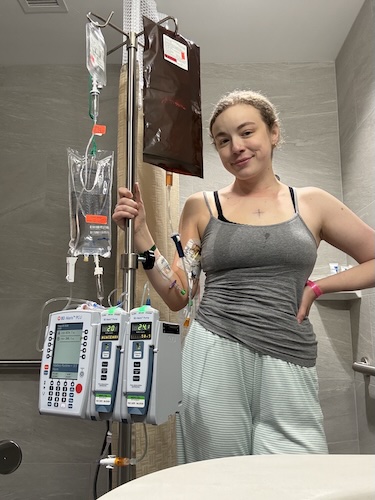
That initial diagnosis, my husband drove; it was two hours, and we were there for a week. That’s kind of when I got my treatment plan: “You’ll be here for a week every time.” And with my chemo, I’m connected from Monday to Friday, 96 hours continuous, which was also kind of like, what, I’m gonna be connected to an IV pump for an entire week getting continuous chemo, which is just terrifying. But again, now that I’ve been in it a few times, it sucks, but I’ve gotten used to it. So I go home for two weeks, and then I come back every third week, and I have six rounds scheduled, and now I’m currently in the middle of round four. So I think, honestly, I wasn’t really thinking about myself; I was more thinking about how the heck we were gonna do this with basically two under two, and we live five hours from all of our family and friends.
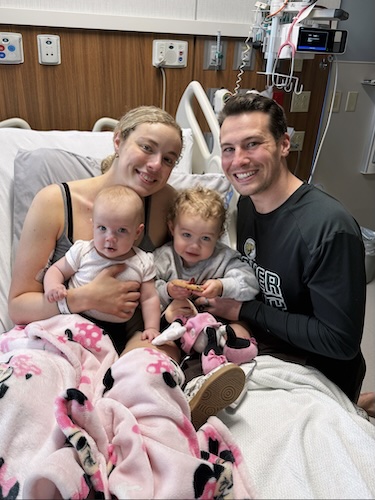
We have friends where we live now, but you don’t want to ask for help; I don’t know, it’s a weird feeling. Obviously our friends and family have been great, but I think the biggest thing was how my husband and I are going to be able to take care of two kids while I’m undergoing treatment. But we’ve got a system down; it works really well.
My mother-in-law comes to our house every treatment week, helps my husband with the girls at home, and then my mom travels with me to treatment, so she’s here with me now; she’s been here every week of treatment. Luckily, she got approved for leave too, so she’s getting paid; I got approved for leave, and I’m getting paid to do this. So yeah, I think that was the biggest concern: my kids and how this is going to affect my husband; he still needs to work.
But getting a plan in place has been the best for us, and friends and family have been so helpful, offering to come help whenever needed. So that transition was hard in the beginning, but now that we have our system down, it’s more of our routine now.
Moving from an inpatient bed to an Airbnb: “I’m about to be a flight risk”
I do still have to stay here in Fargo and go get my bag changed out every 24 hours, so I don’t get to go home. But I’m not in a hospital.
So the first three rounds, yeah, I did inpatient chemo. Then after that third round, I talked to my oncologist and said, “This mentally is not good; I’m not doing well.” And he had brought up outpatient in the beginning, but he knew I lived two hours away and didn’t think it was feasible for me to drive back and forth every day, which makes sense; that’s four hours of my day. So we worked out a system to stay in the area, do outpatient, and now I just go to the clinic every day and get my bag changed out. So I’ll go there later this afternoon.
But honestly, that was one of the biggest reliefs for me, the fact that I don’t have to sit in a hospital anymore. I can do this now. So we’re just staying at an Airbnb, and he’s like, “Do you want to pay for one?” And I’m like, “Yes, I do. As much as I love you guys here, it’s just mentally taxing; I’m about to be a flight risk if you don’t let me out of here.”
This is our fifth day, and it’s gone by so much faster. I think it’s Thursday already; I get to go home tomorrow. If I were in the hospital right now, I think I’d be itching to get out of there. And so it just feels more at home. I have more freedom; I can go outside. It’s hot as hell here, so I’m not going to go outside right now. But my mom and I went shopping yesterday, and it just felt normal. I don’t feel like I’m a cancer patient; I have my port and everything in my little bag, but no one cares. So I just feel more normal not having to sit in a hospital bed. But again, I know that’s not the same for everyone.
So I have a lot of guilt going through this process, especially seeing on social media that people are not doing as well as I am. So I get a lot of survivor’s guilt, almost, that I’m tolerating treatment better than others. It’s a weird feeling.
Survivor’s guilt, a summer indoors, and “Mama, hair gone”
I feel bad because it’s summer. My kids, I mean, they’re young still, so they’re not going to remember this, which is thankfully fine because the backyard works for them; we have plenty of toys, but it’s just that I wanted to have a fun summer with them, and not that we’re not having a fun one, but I do feel like it has been relatively boring. And I know they don’t feel that way, but I do.
Luckily, with my routine, I know how I’m going to feel. I’m in the doing-rounds part now; I typically don’t feel great from Saturday, Sunday, Monday, kind of Tuesday. Day five is when I start feeling better. It’s been the same ever since round one. So I know I’m going to feel bad for the first five days, and then I’m going to be okay, and that’s kind of when we do more things.
So I don’t know, it’s also been a lot of emotions, obviously, but just so many different things. Why did I have to get cancer in the summer, when my kids can actually go out and do things, versus being stuck in the house in the winter? Obviously there’s no right time to get cancer, but those are just the things you think about.
And again, my husband has told me many times, “Our kids are not gonna remember this.” My daughter knows I don’t have any hair; she reminds me every day. She’s like, “Mama, hair gone.” Yep, still gone. It’s just so funny, it’s so humbling, and it’s cute. So I’m just thinking about, once my hair does start growing back, what is she going to say, like, “Why is your hair growing back now?” And I don’t know if she’ll remember that; she’s two, so you never know what their first memory is going to be.
And so those are the things I think about: is she gonna remember this, what parts of this is she gonna remember, I hope she doesn’t remember any of the bad stuff, maybe just the good stuff. Obviously, I’ll share my story with my kids when they get older and can process it all, but you just think about a lot of weird things when you have cancer.
The side effects I’m managing during non-Hodgkin lymphoma treatment
I’d say during treatment weeks, the constipation can get kind of bad, just because of the chemo meds I’m on, but luckily we’ve got stool softeners on board, so we’re good there.
Tomorrow’s Friday; once I’m done with my chemo bag, they give me the filgrastim shot. I don’t know if you’ve heard of it, but it basically boosts your white blood cell count after chemo. I get that, and it goes off 24 hours after and causes really bad bone pain, like very horrible bone pain. I underestimated it when people were telling me it was going to be a side effect; I was like, “I’ll be fine.” It’s awful, and it’s awful for like 24 to 48 hours. So that’s a really bad side effect that I have.
And then just the fatigue and tiredness. I feel nauseous during treatment, but I don’t feel nauseous at home, which I’m really grateful for. Again, they have all the meds you need on board if you need them; if you ask for something, they will give it to you. So I take Zofran here during treatment, but I don’t really ever need it at home, which is good. But I’d say the biggest thing is fatigue for those first five days; I’m taking four-hour naps, which again is hard when you have kids, because I feel bad taking naps and leaving my husband to fight for his life with our kids. But he knows I need it; he knows I need the rest, and we have daycare too, so we have a village and it’s been great.
But I also sometimes feel guilty sending them to daycare when I’m just at home. But I’m at home doing nothing, so it’s like if they were there, we’d all just be miserable. So sending them to daycare, getting their energy out, and they love going to daycare. I can get rest while they’re there, and then spend time with them in the evenings when I’m finally feeling better.
Luckily, I have not had any pushback from anyone. Everyone’s like, “I don’t know how you’re doing it.” I’m like, “Me neither; I’m just doing it. We just do it.” Literally, I have no choice, you know, you don’t have a choice, you just have to do it, you have to get through it. And we’re almost at the finish line.
Shaving my head before chemo could take my hair from me
I’d say from the beginning, when I first met with my oncologist, that was literally one of my first questions. I was like, “Am I going to lose my hair?” And he said yes, and I just was bawling, because I used to, and probably still do, have a lot of really naturally curly hair. And again, back to the guilty thing, I never really liked my hair my entire life, and now I’m like, I’m going to lose it all. I’m like, why did I never appreciate my hair, and now I’m going to lose it? So, lots of emotions.
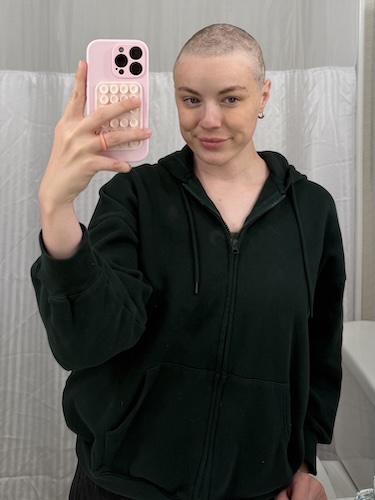
Everyone tells you it’s going to grow back. I know it is, but it’s going to be a process. I’m going to look so different. My hair was down, like way past my shoulders, to my chest. But honestly, trying to think of the specific day, I think it was day 15 after round one; it started coming out in clumps in the shower, and I’m like, “I’m not doing this to myself.”
Hell no, I’m not gonna just keep having these clumps of hair come out in the shower; it’s traumatizing. So two days later, I told my husband, “We’re shaving it tonight.” And I recorded it; our two girls were with us, so they saw it all. I don’t know if they’re gonna remember it, but we have a video if they ever want to watch it.
Posting it on social media, people were like, “I would never think to do that; I would never be that brave to do it.” Part of me was like, I wasn’t really thinking about being brave in the moment. I’m going to record this because, one, I want to look back on it in five years, ten years, when I’m in remission, and think back to that time of my life. But also put it on the internet for people that are going through the same thing, because with the type of chemo we’re on, it’s inevitable to lose your hair, and I don’t think people realize that right away.
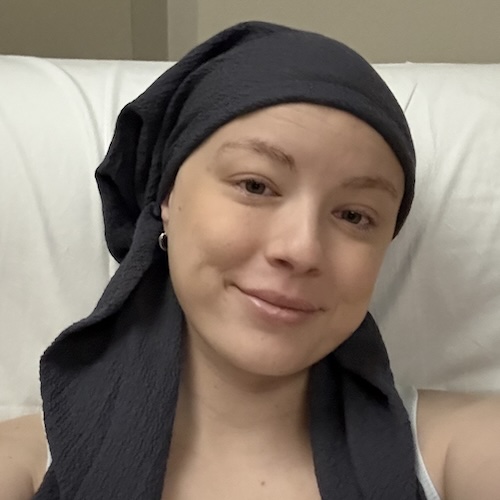
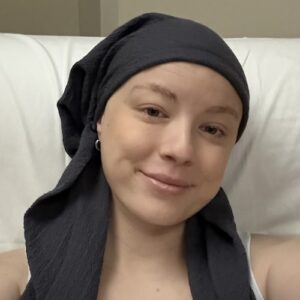
So I think just showing them that, yeah, it sucks, but honestly, being bald is not that bad. Showers are really quick. I don’t have to do my hair anymore; I don’t have to spend money on hair products, especially as a curly girl. I was spending loads of money on products, and I don’t have to do that anymore. And I haven’t even bought a wig yet; I just wear these head coverings because it just feels weird, I don’t know.
So yeah, it was definitely a lot of emotions. I can’t even say I wish I would have done it sooner because I did it really quickly afterwards. But I think just the thought of it is worse than actually doing it and just getting it over with. I felt great; I was like, “Alright, I’m bald, this is great.” My hair is still in our backyard, in a little jar; my husband put it in his garden bed, basically, so I can look at my hair every day outside in our backyard, where it’s beautiful out there.
If I could tell someone who is probably going to have to shave their head, just do it. And being bald is great; it’s not that bad. Obviously it’s not my choice, but again, it is what it is; you have to just kind of roll with the punches while you’re in treatment. My eyebrows are starting to thin, which is what I was really not hoping for, but hoping that they can hang on until I’m done with chemo.
Am I just built this way, or did non-Hodgkin lymphoma make me tougher?
I think people that know me would probably say, “Yes, I’ve always been that way.” But looking back, I guess again, that’s just how I am.
But now, having cancer, I can’t control getting cancer, and now I have it, so I’m just going to do what I have to do to get over it. Why am I going to sit here and — I don’t want to use the word feel bad for myself because that’s not what I mean — but I’m not going to sit and feel miserable and feel horrible and feel sorry for myself when I could just be making the most of this awful experience, basically. And because I don’t have any control, if I sit here and do nothing, my cancer’s not going to go away. So I need to do what I need to do to get rid of it.
And just having a positive mindset is kind of what everyone has been telling me they’re so inspired by. But it’s like, I don’t want to have any other choice, basically. Again, I have no control over it, so why not make the most of it?
I cope with dark humor, and it helps me get through.
Learning I’m stronger than I ever thought I’d have to be
I’d say I’ve learned that I am definitely stronger than I ever thought I would be.
You don’t think you’re ever going to get cancer in your lifetime. Being on social media, you see it all over, and it’s like, that is never going to be my life. And then it happens to you, and you’re like, what the heck.
So I have learned, yes, I am a lot stronger than I ever mentally thought I would be. And I learned that I can do hard things, which is just weird, talking about yourself in that way. But I can say that I am going to be free of cancer, and that I am stronger than I was before this.
I think it’s probably going to hit me more at the end, after everything. And I’ve told my husband, I’m 100% going to need therapy after this. I can only do so much by myself, but with the support of our friends and family, it’s great. Coping with it by myself, but getting some professional help is okay.
Just to be able to talk through my experience a little bit more in depth with people that might not necessarily understand it, but know how to get it out of me, I guess, is kind of what I’m getting at. So I’m kind of mentally preparing myself for the end of treatment, and looking back and being like, “Holy cow, I did that, now what?”
And I’ve seen this on social media: what’s life after cancer like, and I don’t know the answer to that yet. So that’s kind of in the back of my mind too: what is our life going to look like after this?
I know you have a lot of follow-up scans and stuff like that; obviously that’s going to be my life too, but I’m going to go back to work, and this is just going to be something in my past almost. That is just weird to think about, and I think it’s probably just all going to hit me at once, and I might need some professional help for that.
Two months later: “It still doesn’t feel like I have cancer”
Over two months later, now wrapping my head around it, it still doesn’t feel like I have cancer. But I’m doing relatively well.
I started sharing my story on social media, and I really do think that has helped me process it and realize that I’m not alone. I’m also helping others who are not alone in this journey. So many people have cancer, which is heartbreaking.
But it’s been very therapeutic. I’ve felt a lot of comfort and been less stressed about it, I guess. But I can’t speak for everyone, because everyone’s cancer journey is different.
I’ve had a really good prognosis from the start, which obviously, in the back of my mind, I’m like, no, there’s no way. But my oncologist has been very open about it, saying this is a very treatable cancer, you’re going to be okay, it’s going to suck, but you’re going to be okay.
So keeping that in the back of my mind has been helpful.
How having non-Hodgkin lymphoma will change the nurse I go back to being
I was a nurse who had never gone through any type of traumatic medical experience. And now that I have had one, especially working with cancer patients, I might not have the same cancer as them, but I can understand how they’re feeling. Again, everyone’s story is different, but just being able to relate to those patients is helpful, like, we both have cancer.
Especially in the beginning, it’s all of the unknowns: what type of cancer do I have, what’s a biopsy, what’s a PET scan. I feel like I’ll be able to answer those types of questions for them, when two months ago I would have had to Google it. Now it just comes off the brain.
So, yeah, I do think that this experience will help me be a better nurse for sure, and I do want to be a better nurse too.
Before, when I left for maternity leave with my second kid, I was experiencing so much burnout that I was thinking of not even going back to nursing. And then I found that job that was daytime hours, thought it was going to be better for my mental health, and then a month later I got cancer, and now I’m all like, “Do I go back?”
And now I will go back; I know I will. We’ll just kind of see how it goes, but I think part of me is going to be like, “Yeah, I need to go back and be that resource for people who are going through the same thing that I did.”
You can do hard things, and you will get through them
I’d say in the beginning the unknown is the scariest part, but you will get through it. It’s not going to be easy, but you can do hard things, and you will get through them. That is kind of the biggest takeaway I have from all of this.
And the things that you cannot control, don’t worry about them. If they’re not under your control, don’t worry about them.
I still have a hard time believing that too. But with my scans and my labs, it’s like, you can’t control it, so don’t worry about it. And it’s easier said than done, obviously, but just know that you can do hard things and you will get through it.
A mid-treatment PET scan comes back clear
I will share that on Monday, I got a mid-treatment PET scan and found out that everything is gone.
So I’d done three full rounds, got my PET scan on Monday, and my oncologist came in. He showed me my scan, and everything’s gone, which is crazy. In the beginning, he even told me that this chemo works very well and very fast, and he wasn’t worried. I know, it’s like, okay, yeah, whatever, “I believe you,” but I don’t. He said that typically after round one of this chemo, it’s like 80% gone, so he wasn’t surprised that it was gone, but everything’s gone.
I have a little bit of scar tissue in my chest, but essentially I’m in remission right now. And hopefully I can say that in two more months once treatment is over, so I’ll still finish six rounds, but yeah, it’s kind of crazy.
It still doesn’t feel real. And again, I’m still just having those guilty feelings. I’m telling people, “I made a video saying I’m in remission, but it’s like I’m still a cancer patient, you know.” I don’t know, it’s just a weird feeling. Obviously I’m celebrating it, but there’s that thought in the back of my mind, “What if it comes back? Then what do we do?”
And my oncologist said, “Don’t worry about that.” He actually was very reassuring; he said, “I typically don’t see someone in complete remission halfway through, so this is a very good sign.” So yeah, it’s been a lot of emotions, good and bad this week, obviously more good than bad. But I think now, seeing that, knowing it’s working, knowing I’m tolerating treatment, is going to get me through September and really push through.
It’s something I’ve always struggled with. I’ve had just some anxiety about all the what-ifs; I’m always thinking about the what-ifs. And so now it’s a little bit worse, knowing that anything that hurts, I’d be suspicious, like, “That’s cancer, you know.” But being able to see it on a scan, and comparing it to my first scan, and physically seeing that it really is gone, is great. Now it still needs to be gone in September. So I think that’s something I probably will struggle with for probably the next year, two, three, four, forever, probably, honestly.
But yeah, so that was a very good start to the week, obviously, and I think that has gotten me through the rest of this week, but also will push me through to get through the rest of it.
This interview has been edited for clarity and length. The views and opinions expressed in this interview do not necessarily reflect those of The Patient Story. This content does not replace professional medical advice.
Inspired by Kelsey’s story?
Share your story, too!
Hear from people living with primary mediastinal B-cell lymphoma (PMBCL)
Real experiences with diagnosis, treatment choices, side effects, and life beyond PMBCL — in their own words.

Leave a Reply