
Steve Thought His Fatigue Was Just Age; It Was Stage 4 EGFR+ Lung Cancer
Steve spent years working full-time in construction. In the summer of 2024, he started noticing low energy that he chalked up to long days walking on rebar and standing on concrete. He has lived with asthma his whole life, so come fall, when he experienced difficulty breathing and had a dry cough, he didn’t think much of it. He certainly didn’t think stage 4 EGFR+ lung cancer. A doctor’s visit first pointed to chronic obstructive pulmonary disease (COPD) and an inhaler, but that only helped once.
Interviewed by: Tory Midkiff
Edited by: Katrina Villareal
Over the following weeks, Steve’s breathing worsened during an out-of-state family trip and he developed a deep, unrelenting ache in both shoulders that over-the-counter painkillers couldn’t touch. When he started coughing up pink-tinged fluid, his wife told him he needed to go to the hospital.
Over five days, after X-rays, CT scans, an MRI, a bronchoscopy, and a thoracentesis draining fluid from around his lung, doctors told him only that it looked like there were malignancies. A biopsy confirmed stage 4 metastatic lung cancer that had spread to his spine, pelvis, and liver, with an EGFR exon 19 deletion, a mutation he had never heard of and had no way to explain.
His oncologist laid out two paths: Without treatment, he was told he had about six months. With treatment, he could start with the targeted therapy medication osimertinib alongside a chemotherapy regimen of carboplatin and pemetrexed. The chemotherapy was brutal. Steve experienced high fevers, swelling, and eventually an anxiety response severe enough that he needed medication to get through treatment days. After eight or nine cycles, his oncologist felt that osimertinib alone was doing enough of the work and stopped the chemotherapy.
Scans taken every three months show the lesions in Steve’s spine and pelvis have resolved, and one remaining spot on his lung may be nothing more than dead tissue. He still manages fatigue and skin side effects, but has been able to get back to daily activities now that his pain has lessened. He leans on his wife, sees a counselor, and has started a YouTube channel to reach other EGFR-positive lung cancer patients who might feel as isolated as he once did.
Watch Steve’s video or read the edited transcript of his interview to find out more about his story:
- Steve’s early symptoms all had an ordinary explanation on the surface. Fatigue, breathlessness, and shoulder pain looked like his job, his age, and his asthma acting up. It took a buildup of fluid around his lungs, or pleural effusion, severe enough to send him to the emergency room before doctors ordered the scans that found his cancer.
- An EGFR exon 19 deletion mutation opened the door to a targeted therapy that changed his prognosis. His oncologist paired osimertinib with chemotherapy at first, then scaled back to the targeted therapy alone once it was doing the job. This treatment path was built specifically around his tumor’s biology, not a one-size-fits-all approach.
- Steve went from a construction inspector who couldn’t imagine sitting still to someone building a YouTube channel around his diagnosis. He wanted other people with a rare mutation to feel less alone with it than he did in those first isolating months.
- Steve draws a hard line between treatment and cure, and it’s what keeps him grounded. The targeted therapy is treating his cancer, but not curing it. That’s a distinction he holds onto, so he can focus on how he feels today instead of how long he might have.
Steve’s Diagnosis Facts
- Name: Steven H.
- Age at Diagnosis:
- 52
- Diagnosis:
- Non-Small Cell Lung Cancer
- Staging:
- Stage 4 (Metastatic)
- Mutation:
- EGFR exon 19 deletion
- Symptoms:
- Fatigue
- Shortness of breath
- Dry cough
- Deep shoulder pain
- Pleural effusion (fluid buildup around the lung)
- Coughing up pink-tinged fluid
- Treatments:
- Thoracentesis
- Targeted therapy (tyrosine kinase inhibitor): osimertinib
- Chemotherapy: carboplatin, pemetrexed
- Bone-strengthening injection (for spinal lesions)
- Calcium supplementation
This is not medical advice. Please consult with your healthcare provider to make informed treatment decisions.
- Steve’s Diagnosis Facts
- Working full-time in construction until a trip to the ER revealed stage 4 lung cancer
- Learning about the EGFR exon 19 deletion and starting targeted therapy with chemotherapy
- What I wish I knew before my first oncology appointment
- Managing fatigue and skin treatment side effects while reinventing daily life
- Leaning on my wife and staying mentally positive through chemotherapy
- The $20,000-a-month cost of treatment and where to find copay assistance
- Hear from people living with metastatic EGFR-positive lung cancer
Working full-time in construction until a trip to the ER revealed stage 4 lung cancer
Before things started, I was working full-time in the construction industry and I was very busy doing inspection work. My last job was at the San Diego International Airport. It was a brand-new terminal then and a huge job. I was there for a few years. My wife was busy too, working full-time at school, taking her master’s degree in social work. You get used to the daily routine of working and enjoying the time off when you can.
In the summer of 2024, I started to notice that something wasn’t right. It started with lower energy. I was 52 at the time. I’ve always had physical jobs. I was walking around on rebar and standing on concrete all day long, so that was pretty tiring and I excused it away. I’m a little older and it’s a lot of work and walking. The terminal building was about a third of a mile and I was going back and forth. When I’d get home and have a nap, I generally got my energy back and started to feel a little better.
But then towards the fall, things started to get progressively worse. I still experienced the fatigue, but it was also getting harder to breathe. I have asthma and I’ve had it my whole life, so having breathing issues wasn’t unusual. I take a daily inhaler, so I was used to that routine, but this was different. It was harder to breathe in general. It wasn’t the same. I couldn’t put my finger on how different it was, but I knew it was different.
Towards November, I started to get a bit of a dry cough. I went to my doctor in early December and she said, “You’ve had asthma. You’ve probably have COPD.” She gave me an inhaler, which I tried one time and it helped, but it didn’t work after that. The holidays were coming up and we were planning a trip out of state, so I thought I’d see my doctor when I got back.
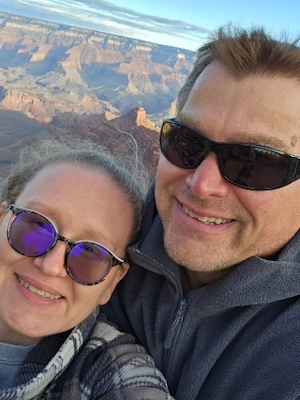
My wife and I were going a few states over to Mississippi from California. She said, “How would you feel about coming back through the Grand Canyon?” That sounded neat, but it was out of the way, and you have precious time from the time you get off to the time you go back to work. I wanted time to unwind, knowing how tired I was and everything.
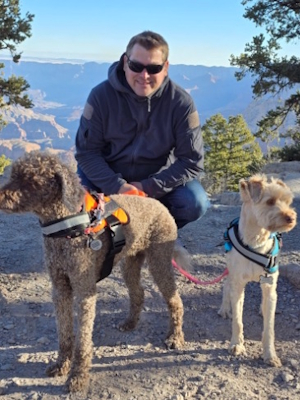
Then a weird thought crossed my head: What if I never get to see that? That should have been a clue to me that something wasn’t quite right. We did it anyway. We brought our dogs. We went out of state, came back, and went through the Grand Canyon. It’s spectacular, of course, but the breathing issue got substantially worse. I don’t know if it was the higher elevation, but I could not catch my breath. After a little brisk walk, I was wiped out. I would say that was another red flag, but I didn’t understand.
Around that time, both of my shoulders were sore and achy. It wasn’t unusual soreness, like when you strain your arm; it was deep, deep, deep. Normally, if you hurt your arm you can find a position that feels good and there’s some relief. But it didn’t matter what position my arm was in; it always hurt. I was taking over-the-counter painkillers to take the edge off.
After that trip was done, I went back to my doctor, and she said, “You know what, I’m not too sure what’s going on here, so I’m going to order an X-ray and a CT scan.” Unfortunately, that was booked out about six weeks. I got the X-ray done around four or five weeks later.
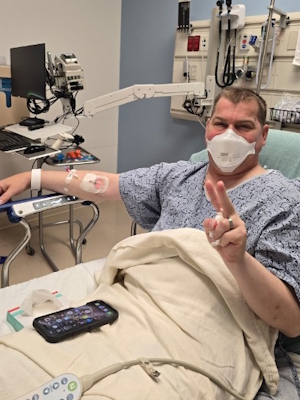
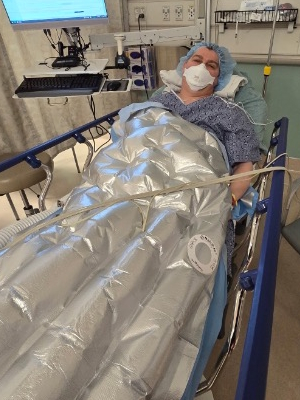
On Presidents’ Day, February 17, 2025, I was lying on the couch, wiped out and exhausted. I was coughing up pinkish fluid. My wife looked at me and said, “You don’t look good. You need to go to the hospital,” so I did. I got in there and I was admitted for five days. During that time, I had multiple X-rays, CT scans, an MRI, and a bronchoscopy. For three days or so, I didn’t know what was going on with me, and the doctors and nurses weren’t saying much.
Where I get my care, we have an app, and some of the results started to come in and that was pretty shocking. It was on the fourth or fifth day that they were tiptoeing around it and said, “It looks like there are malignancies.” The shortness of breath was caused by a fluid buildup in the pleural cavity, so after the bronchoscopy, they did a thoracentesis, drained the fluid from the pleural cavity, and pulled about 400 cc of fluid. It was pretty wild and surreal.
You know that cancer is out there. You know it’s real. You know that people suffer from it. But until it happens, you’re not prepared. I don’t think anybody is, really. When I got the thoracentesis, I told them, “Let’s do this again in a couple of days,” because I could actually breathe again. He laughed and said, “Well, hopefully you won’t be getting this again.”
They did a PCR test of the biopsy samples of my lung and pelvis. That’s when they found out that it was metastatic lung cancer that had spread from my lungs to my spine, from the base of my neck all the way down to my pelvis. There were some lesions on my liver too. It had spread pretty badly.
Naturally, the question was why. How did this happen? We found out it was the EGFR exon 19 deletion. I’d never heard of an exon 19 deletion. I didn’t know what EGFR was. I was lost and didn’t understand.
Scrolling through medical jargon in a patient app, not knowing what “malignancies” meant
When I was a kid, I essentially grew up in the hospital. I had bad asthma, so being in the emergency room and being hospitalized for a week, two weeks, or even three weeks was not unusual for me. I was focused on getting better.
I wasn’t given any medication at the time, other than getting the thoracentesis and being on nebulizers every four hours. My breathing got better, so at first I thought it was some sort of infection, which is what they were leading me to believe. They thought it might have been walking pneumonia, because there wasn’t anything definitive. They were testing me for staph infections and a type of fungus that’s big in the desert of San Diego. I think they called it desert fever or something like that. There were all kinds of ideas about what it could be. There was a lot of unknown, but I wasn’t too worried at first.
It was only when I started seeing things pop up in the app. I didn’t have any context for what this was. I can decipher medical jargon okay, but it wasn’t enough for me to put the pieces together. At one point, they thought I had mesothelioma, when you’re exposed to asbestos. I was thinking, “Where have I worked where I was exposed to asbestos?” It was only after I talked to oncology three weeks later that I found out that it wasn’t the case. There was a lot of confusion at that point. Of course, there was some degree of, “Did I do something?” Some people would ask me if I smoked, and I didn’t.
The strange moment I thought, “What if this is cancer?”
I had an inkling. In December, I thought, “What if this is more serious than I’m thinking? What if it is cancer?” I didn’t know what cancer was, but it’s kind of like intuition or something popped in, and I didn’t explain it away. I thought it was a possibility, I suppose, but I didn’t give it too much serious thought.
It was unusual for me to even have that thought. What are the odds that somebody would have an ailment and think, “What if this is cancer?” It’s a pretty serious place for your mind to go.
Hearing about the possibility of malignancies from the thoracic surgeon
He hinted at it and was very delicate about it. He said, “It looks like malignancies.” I was in tears and so was my wife. She stayed with me the whole time and slept on the couch while I was in the hospital bed. Without any context, we were thinking, “How bad is this?” We didn’t know what stage it was. We were feeling pretty helpless at the time.
Learning about the EGFR exon 19 deletion and starting targeted therapy with chemotherapy
When I had my bronchoscopy, they put me on what I think was called twilight sedation. I was still awake, but I started to cough and convulse during the process, so they had to stop the procedure. I had to come back for another one under general sedation for them to do the biopsy. They wanted to do it as quickly as possible.
From there, it was about three weeks until my appointment with my oncologist. By the time I got out of the hospital, it was towards the beginning of March. That’s when he said, “This is what it is.” I asked him, “When did this happen?” He said I probably had this for about a year. I tried to think: What happened a year ago for a sudden mutation to happen? I was trying to make sense of it.
With EGFR, there could be no cause. It could just be a mutation. Cells mutate all the time. Most of the time, your body deals with them, but sometimes it doesn’t. I don’t think there’s enough data to explain why this happens. But once he explained it to me, I had a little more peace of mind to some degree, knowing that at least I had a treatment option.
He presented two options. He said that if I did nothing, this was going to continue, and I probably had six months. Luckily, there were options. He wanted to follow the FLAURA2 clinical trial, which is a combination of chemotherapy and osimertinib, a TKI inhibitor. I went through that treatment initially for six cycles, and he continued it until eight or nine.
Unfortunately, that chemotherapy was rough for me. The first three treatments weren’t too bad. It was a piece of cake. I was a little tired. But I guess it builds up in your body. I would go through cycles where I’d get chemo, and within the next couple of days, I’d have a high fever. I was in the emergency room with a fever of 103°F, and they had to bring the fever down. I experienced edema and swelling. Luckily, I didn’t get any nausea because they gave me a lot of meds for that.
The side effects got increasingly worse with chemotherapy. At some point, he said enough is enough; the osimertinib was doing its job. It was pretty tough. But I count myself lucky that it was only what it was, because some people do not respond well to chemo. I was on carboplatin and pemetrexed at the same time, every three weeks.
Interestingly, after about the third or fourth treatment, I started to develop anxiety from getting treatment. I knew that I would get sick after treatment, so my body would respond, and I would start to sweat. I didn’t understand why I was feeling that way. It was a reflex of fight or flight, so I had to be on some medication to calm me down.
Moving to targeted therapy alone and managing bone loss from cancer in my spine
Other than having to be on supplements to keep up my platelet count, the only treatment I’m on now is osimertinib. Because of the lesions on my back, they suggested I be on medication to rebuild my bones. The cancer had eaten away at the bones of my spine, so there’s a risk of a fracture or damage. I also have to keep my calcium levels up. There’s a supplement for that as well, because the injection pulls calcium from the blood to try to rebuild the bones and you don’t want to be calcium deficient.
What I wish I knew before my first oncology appointment
Lung cancer is not rare by any means, but the cause is rarer. My biggest advice is to have support. My wife was fantastic. My family was supportive of me. My work was too. Even though I couldn’t go back to work, they were incredibly supportive. They told me to come back when I’m ready to come back and they’ll be ready for me. Having that support is critical.
I didn’t reach out to support networks at all. I didn’t feel like it was for me to be part of a group. I saw a counselor, for sure, which definitely helped.
If I had advice for anybody going through this, at the very beginning, get as much information as you can on the subject, but be careful about what you absorb. The internet could be full of things. You don’t want to be taking advice that isn’t intended for your situation. I got advice from friends telling me to take certain supplements or medications that weren’t appropriate.
Everybody needs to do their own research. However, trust the source, trust your oncologist, and get a second opinion if you’re not sure. I count myself very lucky that my oncology department took the time to answer those questions for me. I’d be there for 30 to 45 minutes at a time, asking questions to try to understand and wrap my head around it. Being strong and having support is critical.
Wearing a face mask in public and explaining an EGFR mutation no one expects from lung cancer
It’s funny when I talk to people about this. I’ll be wearing a mask and people ask, “Why are you wearing a mask? Are you sick or something?” When I say I have lung cancer, the next question is always, “Did you smoke?” No, I didn’t. People want to wrap their head around why. When I was with my oncologist, I wanted to know why too. There wasn’t a definite answer for why the mutation happened.
I worked at an airport and we were breathing jet fumes all day long. Could it be that? I have no idea. There’s no way to know. When it was explained to me, there were a lot of unknowns about it. It’s different when you have a definitive cause, like mesothelioma. For example, you worked on a ship where there was asbestos pipe and you were in maintenance, so you were probably exposed there. With the EGFR mutation, there isn’t that kind of understanding of why it happens. You have to get your mind past the why and try to deal with what you need to do now.
Managing fatigue and skin treatment side effects while reinventing daily life
I still deal with energy issues, where I’m tired, so I take it easy when I can. I try not to push myself, but I also know I shouldn’t just sit on the couch and watch TV. Get out there and walk as best as you can. Take your dog out for a walk. I try to push myself a little bit to not be complacent.
Fatigue was a big issue. Skin issues were an issue too. It may sound weird, but I had ingrown fingernails or toenails. The medication affects your skin. You get rashes and things like that, so you’re managing the side effects. But I’m pretty lucky that my side effects aren’t too bad compared to other people. They’re manageable.
I’d love to go back to work. I miss doing that work, but when you’re in my situation, you’ve got to reinvent yourself. I’m in the process of finding out what I’m going to do. How am I going to be helpful to my family? One of the things I want to do is try to help other people who are dealing with what I’m dealing with. I want to share my knowledge and experience, and hopefully they can find some kind of strength, if that makes sense.
Starting a YouTube channel to fight the isolation of a rare mutation
I want to hopefully let it flow and be myself, and hopefully give people some form of connection, so that they can realize that they’re not alone. There’s somebody else out there dealing with something very similar. It was isolating for me. Even after the diagnosis, I didn’t know anybody else who had this type of disease. It was a very strange feeling.
It’s not that uncommon, but it’s uncommon enough that I’ve never worked with anybody who said they had an EGFR mutation too. There’s some degree of isolation. I’ve accepted it a lot better now and my question has become: What can I do to be positive about it and help other people?
The medication is a treatment. It’s not a cure. Luckily, there are other forms of treatment after osimertinib. Thankfully, I had that treatment, because it saved my life without a doubt. But going forward, I take it day by day. I try not to think too much long-term, not because I think my time is short on this earth, but because it’s very much about being in the moment and being aware of what’s going on in your body. If things aren’t going right that day, try to address it and get help if you need it.
Scans every three months show my spine and pelvis lesions have resolved
I get a scan every three months, a CT scan with contrast. My first scan was in the hospital, and then three months after that, there was no significant change. At six months, which was around the middle of chemo and osimertinib, there was definitely a change. Then at nine months, there was a significant reduction.
There’s still one main tumor in the lung, but the oncologist said that might be dead tissue; we don’t know. The lesions on my spine and my pelvis have essentially resolved. What more could you ask for? Right now, I still deal with back pain to some degree, but nowhere near what it was before I was diagnosed.
I used to do oil changes on my truck and my wife’s car, and it was excruciating to be on my back. I couldn’t even describe the pain I was in. Now I can lie on the ground and do a little bit of things without being in major pain. Between then and now is night and day. I’m so grateful that the treatment is working.
Leaning on my wife and staying mentally positive through chemotherapy
There’s always going to be things that will come up. My wife was fantastic. She would cook meals and make smoothies for me to try to build up my immune system. She would do little things to try to boost my energy, because at the beginning of chemo, I lived on the couch. I didn’t have any energy at all.
When going through treatment, the best thing you can do is try to stay mentally positive, because your mind and your attitude can define how the treatment’s going to go. I’m not going to say I didn’t have bad days, because I definitely had them. There were days when I was in tears. But you have to push. You have to dig deep and go.
The question about a wheelchair ramp that led him to a hospital social worker
When I was about to leave the hospital, somebody asked me about how I was doing and whether I needed a wheelchair ramp at home. I looked at them, perplexed, thinking, “What do I need a ramp for?” However, there’s something to be said for that. If I could give anybody some advice, it would be to connect with a social worker, especially if they’re in the medical field.
Let’s say you’re working and then you can’t work anymore. Now you’re going to be faced with short-term disability. You might be faced with issues around Social Security. If you’ve never navigated that before and you’re sick at the same time, you’re going to need some help.
If your healthcare provider has social services available to you, it’s like a network. Social workers work together. They’ll find resources for you and be able to connect you with the people you need to connect with. But you have to ask, because they’re not going to volunteer that information.
Initially, they’re trying to get you stable at the hospital, get you home, and get you the medication you need. But on the other side of it, especially the mental aspect of it, social work is absolutely critical. You should be connected to those services and reach out to them.
Getting through disability paperwork with my wife’s help
I didn’t think of it until my wife, who is in a master’s of social work program, came home and said, “I wonder if there are any social workers in the hospital who can help you out.” Sure enough, I had to navigate the system, which took about a week or two. But when I finally connected with somebody, I thought, “Wow, I wish I had had this from the beginning. That would have been helpful.”
The $20,000-a-month cost of treatment and where to find copay assistance
Luckily, I have coverage for osimertinib. Out of pocket, if you were to pay for it, it’s about $20,000 a month, so having insurance is pretty critical. However, the manufacturer has programs if you can’t afford it. If you can’t afford the co-pay, you can get co-pay assistance. Don’t be discouraged by the cost if you don’t have good insurance, because there are other options out there.
This interview has been edited for clarity and length. The views and opinions expressed in this interview do not necessarily reflect those of The Patient Story. This content does not replace professional medical advice.
Inspired by Steve’s story?
Share your story, too!
Hear from people living with metastatic EGFR-positive lung cancer
Real experiences with diagnosis, treatment choices, side effects, and life beyond stage 4 EGFR+ lung cancer — in their own words.

Leave a Reply