
Jake Thought His Itching Was a Skin Condition, But It Was Stage 4 Hodgkin Lymphoma
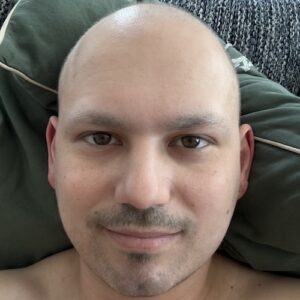
The itching that came before Jake’s Hodgkin lymphoma diagnosis started on his legs, mostly at night. It felt like little bugs were crawling up his leg and, over a few months, it spread across his body. He thought it was a skin condition. A dermatologist suggested contact dermatitis, a rash from something touching the skin, but the creams only made things worse. Then came a cough he blamed on bronchitis after a cold. Jake was 29, in his final year of psychiatry residency, and in what he thought was the best shape of his life.
Interviewed by: Tory Midkiff
Edited by: Chris Sanchez
The turning point came when Jake felt a large bump above his collarbone. He knew from medical school that a large lymph node in that spot can be a warning sign of cancer, so his mind instantly jumped to that. His husband, an internal medicine physician, called a hematologist-oncologist who agreed it was concerning. An ultrasound was inconclusive, but a CT scan showed a mass in his chest. A biopsy confirmed Hodgkin lymphoma in September 2025.
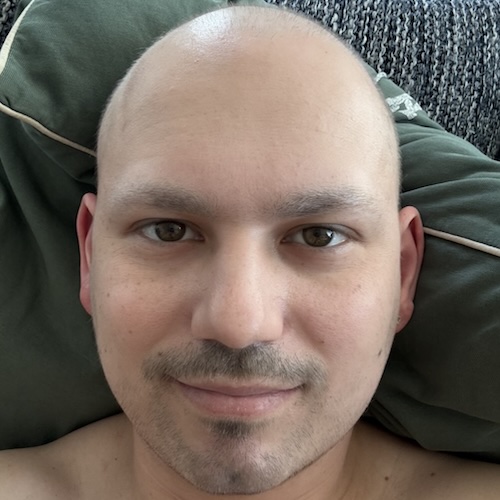
Jake was told it was stage 4. As he understands it, stage 2 was considered first, then changed because the chest mass was bulky and the cancer had reached the node above his collarbone. “It was very, very scary when they first said those words and those numbers,” he says. On a clinical trial his oncologist recommended, he had four cycles of chemotherapy plus immunotherapy from October through December 2025. Within days of starting treatment, his cough and itching went away completely.
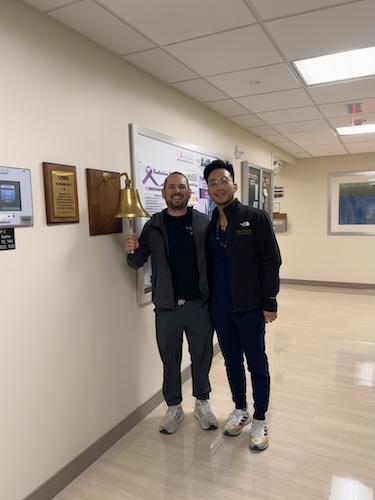
Next came 23 radiation treatments to his neck and chest over five weeks, ending with ringing the bell. Today, Jake is in remission. Dead tissue from the large mass can still light up on his PET scans, which highlight active cells, so his team may switch to CT scans. He talks openly online about mental health care, because even as a psychiatrist, he still found himself having difficulty navigating uncertainty and anxiety.
For more on Jake’s Hodgkin lymphoma story, watch his video and read the edited transcript of his interview.
- Symptoms that seem unrelated can share one cause. For months, Jake treated his itching and his cough as two separate problems, partly because his family has a history of skin issues and allergies. A lump above his collarbone tied everything together for him, and within days of starting chemotherapy, both symptoms disappeared.
- A clinical trial isn’t always an experiment with something brand new. Even as a physician, Jake pictured a trial almost as being part of an experiment. Hearing what his trial was actually studying, and why his oncologist recommended it, made it feel not as novel and scary as it might initially sound.
- A reassuring scan doesn’t always look clean. Dead tissue from Jake’s large chest mass can still light up on his PET scans, even with no symptoms. Sitting down with his oncologist to understand the findings is what turned a frightening result into one that might be reassuring instead.
- Knowing how anxiety works doesn’t make anyone immune to it. Jake treats anxiety for a living, and he still had to try extra hard to deal with the uncertainty of diagnosis, treatment, and scans. That experience is why he now talks openly online about mental health care during cancer, and why he tells people it’s nothing to be ashamed of at all.
- Cancer can take over the calendar, but it doesn’t have to take over the person. Jake was once completely consumed by chemo cycles, medications, and logistics. Taking an occasional afternoon for friends, piano, or a book reminded him that he was still the person that he had been at the start.
Jake’s Diagnosis Facts
- Name: Jake R.
- Age at Diagnosis:
- 29
- Diagnosis:
- Hodgkin Lymphoma
- Staging:
- Stage 4
- Symptoms:
- Generalized itchiness
- Progressively worsening cough
- Enlarged lymph node above the clavicle
- Treatments:
- Chemoimmunotherapy through a clinical trial
- Radiation therapy
This is not medical advice. Please consult with your healthcare provider to make informed treatment decisions.
- Jake’s Diagnosis Facts
- Final year of psychiatry residency and planning a cross-country move
- Generalized itching and a cough that wouldn’t clear
- Feeling an enlarged lymph node above my collarbone
- From an inconclusive ultrasound to a Hodgkin lymphoma diagnosis
- A mix of fear and relief: Hodgkin lymphoma, not a metastasis
- The support system that lifted a huge weight off my shoulders
- Four cycles of chemotherapy and immunotherapy, day by day
- A doctor turned patient, talking about mental health online
- In remission and why my PET scans still light up
- How my oncologist brought up a clinical trial
- What I’d tell myself the day cancer was suspected
- Advice for the newly diagnosed: There’s never a bad question
- Hear from people living with Hodgkin lymphoma
Final year of psychiatry residency and planning a cross-country move
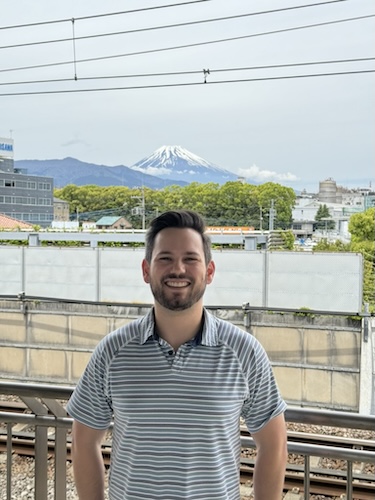
In the months leading up to my diagnosis, life was actually looking really good and exciting. I was thinking that things were going so well, which is ironic looking back on it.
I was in my last year of psychiatry residency, which was the culmination of all my years of schooling, training, and everything. I was doing just electives, catering to my interests at the end of my training. I was exercising a lot, getting super into bouldering and rock climbing. I was starting to plan a cross-country move as well, so there was just a lot going on in my life.
This really came out of nowhere. It was a total shock and surprise to me and my family. That’s where I was at before the diagnosis popped up.
Generalized itching and a cough that wouldn’t clear
It can vary so much from patient to patient, which can be really interesting. For me, in retrospect, the first thing is that I developed generalized itchiness. It started with my lower extremities, on my legs most likely, especially at nighttime. I was just getting really itchy. I thought I had some sort of skin condition going on. I have dealt with allergies in the past, so I thought maybe it was something environmental after we went on a trip.
But it slowly spread to the rest of my body. And over the course of a few months, it progressively got worse. I went to a dermatologist. They weren’t exactly sure what to make of it. They thought maybe at first it was contact dermatitis or something like that. But the creams that they gave me only made things worse, actually, which was maybe the first red flag in retrospect.
And then, especially in the month or two leading up to the actual diagnosis, I did develop a cough. To be fair, I think I developed a cold a couple of months before the diagnosis, and I thought I had bronchitis resulting from that, like the cold having trouble clearing out of my lungs. I thought that was what was going on.
But as more and more time passed, I was thinking, “Oh shoot, this cough hasn’t gotten better. If anything, it’s gotten worse.” And that was another red flag that something else was going on.
Why the itch and the cough seemed unrelated
For quite a while, I was thinking of them as unrelated.
I was thinking I had this skin thing going on, which is not necessarily unsurprising considering my father has a lot of skin-related issues. There are a lot of allergies and autoimmune issues in my family. And then I just had this cough that slowly started, and the timeline was just a little bit confusing, so I didn’t really think that they were linked at all.
My skin thing was at least stable. The cough started a bit later. So I really was not thinking they were related whatsoever.
What the itching felt like, especially at night
Unfortunately, generalized itchiness can be really uncomfortable.
Just the sensation that almost sometimes like little bugs are crawling up your leg and you have to itch to make it go away, or just like when you’re out on a really hot day and your clothes are sticking to your skin, you feel like you have to pull and just scratch to get more comfortable. It felt like that all over.
At night is when it was at its worst. Sometimes I actually woke up in the middle of the night because I was scratching my leg without even realizing it. Unfortunately, it was quite uncomfortable. It wasn’t the most severe pain or discomfort by any means that I’m sure others have experienced with other skin conditions, but it was this mild, ongoing discomfort that was not adequately being relieved despite many months going by.
Feeling an enlarged lymph node above my collarbone
I’m actually fortunate in a few ways. I basically got really lucky, honestly. I’m not sure if I would have connected the dots as soon as I did.
I was walking across our medical campus, going from one hospital to another. It was a really hot day. I was just wiping sweat off my body and felt a very large bump above the collarbone. In medical school, I had learned that a collarbone or supraclavicular lymph node that is on the big side is concerning for potential underlying malignancy. In that moment, my mind actually jumped to that as a possibility. And then that’s when I started thinking, “Oh, shoot. These general vague symptoms might actually be related to something underlying.”
My husband is a physician as well, and he’s actually in adult internal medicine. So I went home hoping for reassurance or something like, “Oh, am I overthinking this?” But then he instantly was on the same page as me. In medical school, we learned that this is a concerning spot to have such a big lymph node, and that was what tied everything together.
Quickly connecting with a hematologist-oncologist
I’m really lucky that my husband took the reins and reached out to folks in our medical community to see if we were overreacting. Is this something that we should be escalating more quickly and taking very seriously? Because we were still unsure.
Technically, on paper, other than being a bit itchy and having this cough, I felt pretty good. I was still exercising. For all intents and purposes, looking at me, you wouldn’t know that something like this was going on.
He was able to connect with the hematologist-oncologist that I eventually ended up pursuing care with. Over the phone, when they were chatting, he pretty much instantly was like, “Oh, I agree with you. This is concerning. Let’s get you into the clinic.” I got really lucky that things moved on the faster side in my case.
A lymph node biopsy in interventional radiology
Very early on, one of the most important things to confirm the diagnosis was getting a biopsy, so I went to the interventional radiology suite. Luckily, they were all really friendly and accommodating, because it was quite a scary experience.
I had never had quite an invasive procedure before. All things considered, it went smoothly, but they basically did take a biopsy from this lymph node, which confirmed the diagnosis of Hodgkin lymphoma on pathology.
From an inconclusive ultrasound to a Hodgkin lymphoma diagnosis
I think I had a strong suspicion prior to getting it confirmed on biopsy.
At first, my primary care doctor ordered an ultrasound of the lymph node. We were hoping for reassurance that this was related to a cough from an infection I had, and maybe it was just inflammatory. But the ultrasound was inconclusive and resulted in me getting a CT scan of my neck and chest. That’s when they partially visualized that there was some sort of mass, basically the lymph node mass, but also in my chest. And after that, the biopsy was obtained. We basically at that point knew that something was happening. We just didn’t know the exact type of cancer. But the biopsy result itself was technically the first time that we said, “Okay, confirmed. This is indeed a type of cancer.”
It was really terrifying. Very emotional. I actually had a big trip planned with my family, and we had to cancel the trip and completely rework our entire schedule. I felt very overwhelmed, partially because I was rather close to graduation and had a few important requirements and things left to get done. And I was just like, “Shoot, how am I going to graduate on time, make this move happen, and finish all these requirements?” It was very, very overwhelming in the moment.
But luckily, I’m very fortunate to have such a supportive husband, family, and support network through my friends and other colleagues. Everyone was really amazing. I’m so, so grateful for their support, which really helped me zoom out and just take things one day at a time.
Diagnosed with Hodgkin lymphoma at 29
I had actually just turned 29 about a month before the diagnosis was made.
All this moved very fast. September 2025 is when all this played out.
In the best shape of my life, ironically enough
I was actually totally shocked.
In the months leading up to my diagnosis, separate from any symptoms going on or anything, I had been thinking, “I’m actually in really good shape, and this is exciting. Hopefully I can keep it up even when we move and get busy.” I was really into bouldering and rock climbing at that time.
I was actually thinking I was in the best shape of my life, ironically enough.
A mix of fear and relief: Hodgkin lymphoma, not a metastasis
Pretty much immediately after the biopsy results were confirmed, it was this weird mixed feeling of not quite relief, because it was still a very terrible situation, but there was technically concern that what if this was another type of malignancy, and this was maybe a metastasis from something else.
So it was very, very scary, but it was this interesting mix of feelings. Relief was peeking through because Hodgkin lymphoma is fortunately very treatable, especially if caught relatively early before it spreads to other parts of the body. It really just depends on the individual situation.
But in my case, I was fortunate enough to be connected to care very quickly, and we had a plan come together relatively quickly to start chemotherapy plus immunotherapy. All things considered, the timeline moved really fast, and I was able to get into care pretty soon after the diagnosis was confirmed.
How my Hodgkin lymphoma staging was explained
I do believe the staging was a little bit confusing and nuanced. To this day, I think it’s a bit of a judgment call up to the oncologist. With blood cancers, the staging can be different compared to solid tumor cancers. My understanding is that oftentimes in solid tumor cancers, it depends on where the primary mass is and where it has spread to in the body. With blood cancers, many different factors go into it. I’m not an oncologist or hematologist myself, so I don’t understand fully the nuance in how they go about it with each type of cancer.
In my case, it sounds like there was a consideration of stage 2 at first based on where all it was in my body, but because the mass in my chest was on the bulky side, or rather over a certain number of centimeters, plus the fact that it went to this lymph node, they made the determination of stage 4 based on these various specific criteria that are rather specific to Hodgkin’s, if I understand correctly. It’s a bit nuanced. It’s very individualized, as I understand it. (EDITOR’S NOTE: The American Cancer Society explains that Hodgkin lymphoma is staged according to a patient’s medical history; the presence or absence of drenching night sweats, suspicious weight loss without trying, and persistent and sometimes intermittent fever, collectively called B symptoms; a physical exam; biopsies; imaging tests including chest X-rays, CT scans, and PET scans; and sometimes bone marrow aspirations and biopsies.)
Luckily, stage 4 in blood cancer doesn’t necessarily mean the same thing as stage 4 in a solid tumor cancer. There are different nuances and indications for different treatment algorithms, and so I’m happy to learn even more about it and provide more information moving forward. But that’s my preliminary understanding.
It was very, very scary when they first said those words and those numbers, but then they were like, “Just to zoom out and look at the big picture, this is going to help us guide treatment planning. It doesn’t necessarily mean that you’re in a situation that is drastically different from stage 2 or 3. It’s just very nuanced and depends on the individual.” So, very interesting stuff indeed.
Seeing the biopsy results: Patient portal or phone call?
Because my husband and I are both physicians, we were primed to be looking out actively for the results. I’m trying to remember the specifics of that moment, because so many things happened in such a short time.
I do remember my fantastic primary care physician calling me, saying, “Oh, the CT scan showed that there is something there. Unfortunately, we have to further work this up with a biopsy.”
When the biopsy results were obtained, if I remember correctly, we were able to visualize it in the patient portal and take a look. My husband may have pointed it out to me and confirmed the diagnosis. I do believe we got a phone call. I’m just not completely confident right now whether the phone call came first or if we had already seen it in the chart. I do think that they had maybe released it to us with the understanding that we were already primed. Basically, we had suspicion that it was Hodgkin lymphoma, and I think they may have released it with that in mind.
But to be honest, that’s a blurry time in my memory. There were so many things happening so fast. I’m not completely confident. Either way, it wasn’t a total shock in the moment. Luckily, we had been primed. We actually hoped it was lymphoma rather than metastasis of another cancer, and we were just waiting to specify the type and everything, so luckily it worked out in that regard.
The support system that lifted a huge weight off my shoulders
I felt so, so lucky, and still feel lucky to this day, that everyone, including my husband, my immediate family, my extended family, my friends, and my colleagues in my program, was extremely understanding and supportive.
Everyone would tell me, “Please take your time. We’re going to figure out whatever logistics we need to, but we need you to take care of yourself first and foremost.” And that really lifted a huge weight off my shoulders and was really valuable. I feel really, really fortunate.
I know many different people who develop cancer are in different walks of life. They might have various things going on. I was luckily in a place where I was able to lean on my support systems. I was actually a chief resident in my program at the time. My co-chief residents were also extremely supportive and were saying, “If you need to take time, we’re going to cover and do whatever it takes to make sure that you’re not stressed out more than you already are.”
So I got really, really, really lucky in that regard. And I want to say thank you so very much to everyone for their support during that time.
Four cycles of chemotherapy and immunotherapy, day by day
I know that chemotherapy and immunotherapy regimens can vary quite a bit depending on the type of cancer, the staging, and the grading. There are many factors that play into it, and it’s very much individualized, as I understand it.
In my case, I did four cycles of chemotherapy. Generally speaking, what that looked like was on day one, I had pretty much an 8- to 12-hour day of many different infusions and things like that. Day two was a shorter day, but somewhere in the 4- to 6-hour ballpark of infusions. And day three, same thing. I think it was a bit longer than day two, maybe 6 to 8 hours of infusions, somewhere in there.
On day four, I took some medications at home that were to help my body not react to some of the agents. I took high-dose steroids by mouth, just at home. On day five, generally speaking, I was feeling relatively okay. It felt like a quick breather before the “crash” settled in. And for me, days six and seven were the crash, where my body was extremely fatigued. I was just sleeping all day. I did have a fair amount of nausea going on, but luckily, I had medications as needed to help with the nausea and other potential side effects.
Day eight or nine was when my body started to make a comeback, and I just slowly recovered from there. I had approximately three weeks between day one of each cycle. Day one would start, all these days of infusions would happen, and then about three weeks later was when the next cycle would start, if that made sense. And I did that approximately four times.
I do believe there was one delay somewhere in the middle where it pushed things back by a week. I was actually relieved, because I had a little bit of extra time to recover. It’s not really affecting things, big picture. I think that was just due to Thanksgiving and holiday time-off-related things. But generally speaking, from about October through December 2025, I did those four cycles and then had a few weeks entirely off before coming back in January to check on how things were going and proceed from there.
Chemo fatigue and a fall during the first cycle
The first time that I fully crashed, maybe it was because I didn’t exactly understand what fatigue at this level could look like, or perhaps I just didn’t know exactly how my body would react, but I actually had a fall the first time that the fatigue fully settled in after the day the first cycle was ongoing. I think I just got up super early in the morning to use the restroom, and I was just really, really out of it, feeling so exhausted that I was guiding myself to the bathroom carefully, and on the way back at some point, I must have fallen.
Luckily, my husband was there to help me get back into bed and everything, but I just felt so exhausted and drained. It was almost like I could barely even move my limbs to get back into bed. The fatigue is extremely real. It feels like all the energy has been zapped out of you. You feel very heavy and like you can barely even move, and all you want to do is sleep. That’s probably the most I’ve ever slept in my life, during those first few days of the first cycle.
After that happened, luckily I didn’t hit my head or anything like that. It’s possible I actually had a mild rib fracture, either from that fall or from how much I had been coughing. It’s a little bit unclear. I do think it’s possible it was from that fall when I was trying to get back into bed the first time the fatigue fully hit me.
It was a bit scary, but I would have rather it happened early on, when I was still with it enough to make sure I was taking steps for it to not happen again, essentially.
Why my oncologist added 23 radiation treatments
In my case and my understanding, it was just my oncologist’s intuition based on my exact presentation. He is very experienced in dealing with Hodgkin lymphoma, having treated patients with it for many, many years, so I think he can zoom out and look at the big picture, the course of illness, if you will.
Very early on, he had wondered, because of the size of the mass and the fact that there was this potentially necrotic center, or rather, in the middle of this very big mass, the tissue had trouble getting adequate blood supply and most likely died, and that is risky in terms of potential secondary malignancies developing, and basically, in general, potential for other stuff to be going on, and it’s hard to know exactly what’s going on in the center of such a large mass. So very early on, he had clocked that this might be something we want to irradiate, to be on the safe side and cover everything now rather than have something happen down the line. At least that’s my impression, based on how he described it and explained his thought process to me. (EDITOR’S NOTE: The American Cancer Society says that radiation can be given after chemotherapy to treat Hodgkin lymphoma, especially in cases where patients have large and/or bulky tumor masses just like Jake did.)
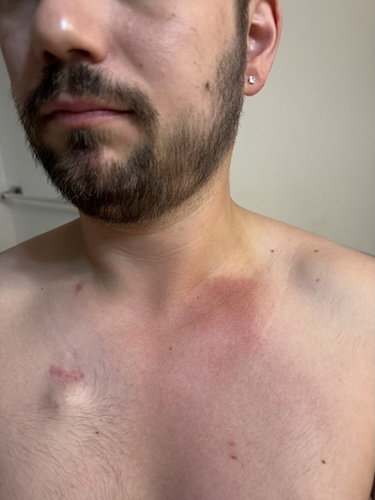
All that said and done, what that meant was I went through 23 fractions of radiation therapy, once I had recuperated a bit after the chemotherapy. That roughly started in late January or early February, and it took about five weeks of going in basically Monday to Friday, first thing in the morning. Very luckily, the sessions were short. I didn’t feel anything at all. But over the course of that month or so, I did develop a reaction on my skin. It almost looked like a sunburn from basically being radiated to the neck and chest area.
Those were the last steps in my treatment protocol. Luckily, it was a lot more tolerable than chemotherapy, but it was still a whole ordeal, going first thing in the morning every day. Luckily, I was able to ring the bell at the end of that treatment, which was pretty fun and felt very accomplishing. It was very satisfying at the end of the radiation therapy, knowing that hopefully this will be it if all goes well.
Counting down to ringing the bell
Especially in the throes of chemotherapy, early on in cycles one and two, I was just trying to think ahead, thinking, “Oh my gosh, I can’t believe I have to do more of these cycles.”
At one point, there was also a question of whether it would be four versus six cycles. And that uncertainty, I just had a lot of trouble navigating that and being like, “How am I going to go through this so many more times? How am I going to plan searching for a job and moving across the country as we originally wanted to, when I don’t even know exactly how long this is going to be going on for?” Luckily, it was on the shorter side in my case.
I just took things one day at a time. Getting into radiation, I felt like I was counting down every single time. “Okay, only 20 sessions left.” “Only 15 sessions left.” That really helped me approach it and just make the whole thing feel more approachable. Getting to the end and being able to ring the bell was extremely satisfying. It felt very final. It felt very accomplishing. I felt like I had reached quite a huge accomplishment at the end, and it felt really, really good.
The itch and the cough went away within days of starting chemo
Funny enough, when I first met my oncology team, they were like, “We’re so sorry to hear you’ve been itching and coughing,” because at that point, we already knew that obviously it was all connected. In those couple of weeks between knowing that it was perhaps cancer and actually starting treatment, that was when the itchiness and the cough became their worst, which I guess makes sense, so it was really annoying.
I was trying to take various medications to help suppress the cough, and it just was not quite cutting it, largely because there was this big mass basically pushing into the pleura around my lung. There’s only so much you can do other than trying to get the mass to shrink.
Pretty quickly after starting chemotherapy, the cough and the itchiness actually entirely went away. We’re talking just a few days, which was pretty remarkable. I was not excited to be going through chemo, but I was very excited that those symptoms went away so fast. It was very interesting how these symptoms were quite severe, and then very quickly, they just went away all of a sudden.
That was definitely one of the more satisfying things that happened early on, thinking that it must be working if these symptoms are instantly going away. That was reassuring, despite not feeling my best otherwise in the moment.
A doctor turned patient, talking about mental health online
It was like a perfect storm. I’m someone who has always found social media to be really interesting and a way to connect with different people online, stay in touch with old friends, whatever that might look like for somebody.
I happen to know a few people in my sphere who had dipped their toes into the water of posting about medical content. I just had a fair amount of time when I was wrapping up electives for my program, but my duties as chief resident had calmed down, and coupled with some of the time off that I had as I was finishing some of the treatments, I just started brainstorming and thinking, “Oh, this could be a really interesting approach to a social media account, the perspective as a doctor who has turned into a patient.” I was also reflecting a lot on the fact that there is very much a mental health piece linked to all of this. A lot of people, unfortunately, are still dealing with the stigma against seeking mental health treatment.
Especially patients who have cancer diagnoses, they’re actually at increased risk of mental health stuff going on, basically. I just wanted to start the conversation and let people know that even as a doctor myself, it’s really something that is extremely important to engage your support system, get into mental health treatment if necessary, and that it’s nothing to be ashamed of at all. (EDITOR’S NOTE: The National Cancer Institute says that patients with cancer can experience varying degrees of anxiety. The anxiety they experience may increase as the disease progresses or as their treatments become more aggressive.)
Even as a psychiatrist myself, it’s really, really important to be taking care of your mental health and not putting that to the side, even though it’s, of course, overwhelming to be going through treatment. But at the same time, patients need to try to be honest with themselves about how they can best engage their support systems and get extra mental health care if needed. I just thought it was a really interesting space online to dip my toes in the water and see who else out there might be interested in having conversations about it and fighting the stigma altogether. It’s been really satisfying. It’s been a really supportive online community.
It can be really tough. Even as someone who treats folks for various mental health things that might happen, and intellectually understanding that I might have increased anxiety and things like that, especially when navigating the uncertainty of such a diagnosis and treatment and what might come next. Despite me understanding how I can best navigate those types of symptoms and things, I still found myself really having to try extra hard to navigate these feelings of anxiety and the uncertainty. It can be really, really difficult; even as somebody who, technically speaking, should know how to easily go about this, it can still be really, really hard. I just wanted to throw it out there for people to discuss and understand that it’s definitely not an easy fight, but it’s one that you don’t have to do alone.
Going from the doctor’s side to the patient’s side
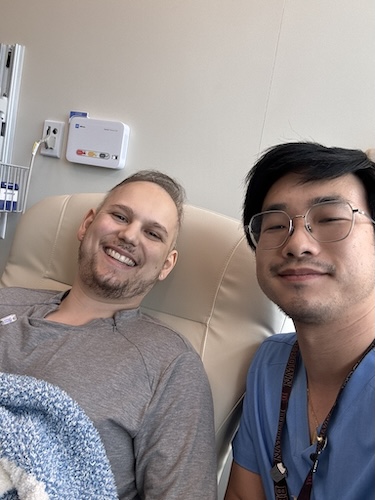
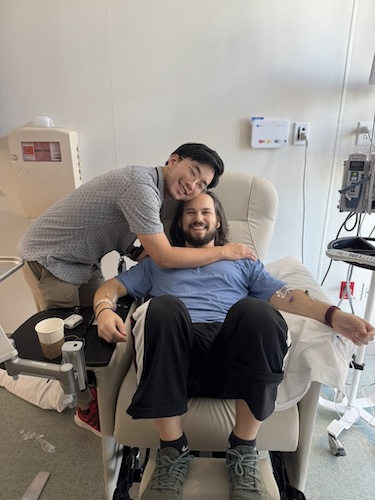
I had been technically a patient before, in terms of just going to routine annual physicals and things like that. Although I wasn’t formally hospitalized in the inpatient setting, I was going to these infusion centers, very much being set up there for many, many hours.
It felt like I was in the hospital, and it was really, really interesting being on the patient experience side of things. It was very new for me, and I had to keep reframing things in my mind, as far as the need to detach a little bit and let them do their job. Because it’s very easy to get wrapped up in the medicine, treatment algorithm side of things, wanting to know exactly what’s happening and what’s coming next. I was learning how to let go a little bit and trust that these are people that have experience in their own field, and just riding it out as best as I can, one thing at a time.
It can definitely be tough, knowing that there are all these different possibilities of how things can play out and starting to think ahead down these different rabbit holes, essentially, and just thinking, “Nope, we need to zoom out. Look at the big picture. One day at a time. Trust that your team is doing their best for you. Know that they have your best interests in mind and that they’re doing what they think is right, and trust the process.”
Easier said than done, of course.
In remission and why my PET scans still light up
I’m in remission now. The treatment has definitely been effective. Everything has shrunk. However, these scans that we use to survey how things are going over time are not perfect by any means. In particular, PET scans, which look at metabolic activity, for example, tend to light up the cancer cells very early on and that’s generally straightforward as a screening tool. Unfortunately, it becomes a little bit more nuanced and imperfect as things progress.
For example, in my case, I had a really large mass with that necrotic center, and dead tissue being cleared out by the immune system can light up on these PET scans. Even though things very much look like they’re heading in the right direction, I have zero symptoms, and my oncologist is pretty confident that things are good, we can’t know for sure with a “negative scan.” Rather, if I get a PET scan, it seems stuff will still light up, potentially indefinitely. There’s no way to really know for sure. The PET scan becomes a little bit of a less helpful tool in a case like mine moving forward.
For that reason, we may be switching to more straight-up CT scans to know if things are getting bigger or not. My most recent scans have looked promising, although not perfect because of that residual stuff lighting up. Everyone is optimistic. I’m optimistic as well. I’m not super worried about it. It’s just confusing. Everyone always asks, “When is the next PET scan? What’s the PET scan looking like?” It’s hard to describe that, technically, this stuff still lights up, but it’s actually still a good sign, and we just have to learn how to best survey with maybe different tools moving forward.
We’re still actively sorting that out, but still feeling optimistic about everything. I know it’s a little confusing and nuanced, but that’s where we’re at right now. It really hasn’t been so long, all things considered. Maybe with time, the PET scans will be more clear-cut. For now, we might switch up the type of scan, and I’m still figuring that out right now.
Scan days and living in the gray area
The way I’m speaking about it now and how I feel about it is definitely not how I was feeling going into some of these scans, especially before I understood all of this nuance.
It definitely was quite frightening going into the scan, thinking that, hypothetically, things could be worse. So it is something that I very much had to zoom out of, look at the big picture, engage my support systems, and take things one at a time.
It was definitely frightening, but I just trusted the process. As I said, my oncologist seemed really comfortable and confident throughout. So I was just like, “You know what? I need to trust his confidence and that he did what he thought was best. I’m just going to go through the motions and hope for the best.”
When I saw the results of the scan, definitely a lot of uncertainty and fear popped up again. It was important to meet with him and best understand the nuances of these findings and how these scans aren’t necessarily perfect over time, and that technically it was reassuring results, despite there still being stuff lighting up, and learning how to navigate that gray area, I suppose.
How my oncologist brought up a clinical trial
It was his recommendation. The regimen of chemotherapy and immunotherapy I received was actually already well established in a different country as being extremely effective in stage 4 Hodgkin in cases like mine. At least that’s my understanding. And basically, they wanted a study in the US on the books to have this potentially be one of the first-line treatments in situations like this.
Even though it is a clinical trial, it’s not like it was completely new, groundbreaking stuff. It’s stuff that had been established previously, and they just wanted to have more studies to show ongoing effectiveness. He felt very confident that this would work well. Of course, it was definitely up to me. I decided to enlist because he felt it would be the best thing for me in that moment, and that’s how it played out.
What I thought a clinical trial meant and what I learned
In my mind, a clinical trial generally meant, “Oh, this is a completely novel agent or treatment, and that there might be unexpected findings. You might be part of an experiment, almost.” Even as a physician, that’s how it felt sometimes. I’m sure some of them are more in that direction, especially if it’s a completely novel agent. You have to start somewhere when you get to human trials.
It was a little bit refreshing to hear that this is already established as being effective, and we just want to make sure that we’re increasing the number of people who can have access, if all goes well. That’s the perspective that I was trying to approach it with. It’s not as novel and scary as it might sound on paper. It’s actually just that hopefully we’ll be able to help more people get access to this good treatment, if all goes well.
Fitbit data, food diaries, and lab work on the clinical trial
They actually gave me a Fitbit and I was able to keep it after treatment. It tracked my heart rate and some stats about how much time I was in bed versus walking around, and other activities like that. Especially during chemotherapy, I would log what I was eating daily.
It was very much a rough estimate, of course, especially because my schedule was sporadic depending on how I was feeling. But I was trying to track which macronutrients and how many calories I was consuming, do food diary tracking and track my health via some objective data points. Of course, I was getting lab work pretty much every time I was going into the hospital.
That’s the bulk of what it looked like. There would also be follow-ups from time to time, even to this day, to see how things are going. My understanding is that they probably follow for the first few years after everything has been said and done. If all is still working well, I believe by the five-year mark or something like that, they might eventually stop with all the formal surveillance stuff. At least that’s my understanding of it, tentatively. (EDITOR’S NOTE: The National Cancer Institute explains that follow-up periods after treatment ends can vary depending on the disease and treatments. Participants in clinical trials or studies can also be subject to these follow-ups, both during the studies and after they end.)
What I’d tell myself the day cancer was suspected
If I could go back and tell myself, prior to knowing exactly what was going on, but perhaps knowing something was wrong, I would tell myself, “Hey, take things one day at a time. Things are going to be okay. You’re really fortunate to have such a good support system. Definitely lean on them. Don’t hesitate. It’s going to be a tough road, but just take things one day at a time, and everything will be okay.”
Advice for the newly diagnosed: There’s never a bad question
I was fortunate that things moved pretty quickly. One thing that I’ve been reflecting on quite a lot is that there is a lot of uncertainty early on, once a patient identifies there is something in the realm of cancer happening, but they don’t know which type.
“I don’t know how far it’s spread. I don’t know what treatment is going to look like.” A lot of folks sit with this uncertainty for many weeks at a time before they can get to that first appointment or that first biopsy. Things in medicine are quite busy, and depending on insurance and other logistics, unfortunately, that uncertainty can go on for quite a while. I felt fortunate that, for me, it was a faster timeline, and I really, really feel for folks that are in the dark for an extended period of time.
For those folks, I say engage your support systems. Try to just think about one day at a time and not imagine the worst, if possible. Have folks around you to talk about those uncertainties and fears. Reframe everything, knowing that your team is going to do their best to help you out, and to just take things one day at a time, even when it can feel quite overwhelming.
In general, just don’t be afraid to ask questions to your treatment team, even if something might seem rather simple or straightforward, but it’s still something that you want to have clarity on. I never think there’s ever a bad question. It’s always worth asking, just so you can have some extra peace of mind. Your treatment team will always understand that you’re dealing with quite a lot. I don’t believe there’s ever going to be a bad question.
Don’t lose yourself: Playing the piano, reading books, and spending time with friends
It’s important to try not to lose yourself too much in the midst of all this going on.
At one point in time, I was definitely completely consumed: “When is my next chemotherapy cycle starting? How do I orient my meds so I’m not feeling poorly? How do I navigate taking time off and logistics and getting finances in order while all this is going on?” It’s important to also take a moment to just breathe. Do something that you enjoy. Not always be completely consumed by all this stuff.
In my case, every once in a while, I would just be like, “You know what? I’m just going to take an afternoon.” I’d try to either just hang out with friends or maybe do something mindful, like playing piano or reading a book, or just trying to distract myself with other things.
It’s important to let yourself engage in hobbies that you enjoy. Give yourself that space in which, even though it’s a lot and you’re going to be overwhelmed and all consumed by this on some days, you can still live your life.
Remember that you’re still the person that you always were, even though you’re dealing with something difficult right now. Take some time to be mindful and try to take your mind off it every now and then. You deserve that time and space.
This interview has been edited for clarity and length. The views and opinions expressed in this interview do not necessarily reflect those of The Patient Story. This content does not replace professional medical advice.
Inspired by Jake’s story?
Share your story, too!
Hear from people living with Hodgkin lymphoma
Real experiences with diagnosis, treatment choices, side effects, and life beyond Hodgkin lymphoma — in their own words.




Leave a Reply