
Young Mom, Big Diagnosis: Shannon’s Story of Stage 4 EGFR+ Lung Cancer with TP53 Mutation, and Her Life on Targeted Therapy
Shannon was 35, a newlywed, and a busy mom of three when persistent neck pain and a stubborn cough led to a diagnosis of metastatic EGFR-positive lung cancer with a TP53 mutation. Just weeks earlier, she and her husband had celebrated her birthday and held their dream destination wedding in Puerto Rico, and were settling into life as a blended family. An MRI of her cervical spine revealed multiple tumors, including one so large it cracked her C1 vertebra. Further imaging showed a 10.8-centimeter tumor that covered much of her lung and had spread to her hip.
Interviewed by: Nikki Murphy
Edited by: Chris Sanchez
In those first days, Shannon describes feeling outside her own body, as if she were watching someone else’s life fall apart. A local oncologist confirmed that it was likely lung cancer. Within days, she was connected to specialists at a major cancer center, where tests revealed two genetic mutations: EGFR and TP53. That information opened the door to targeted therapy but also came with uncertainty. Most of the available data was based on much older patients, making it hard to predict her prognosis as a young, otherwise active parent.
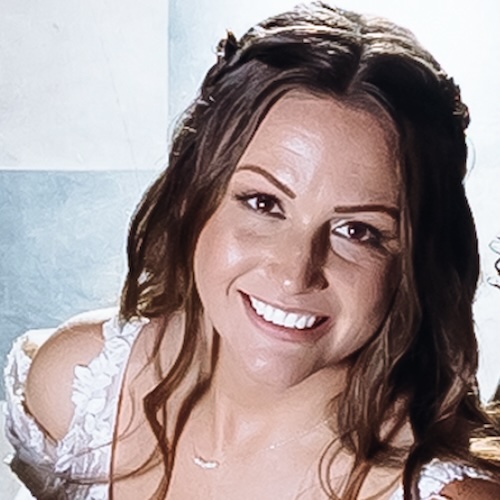
Shannon’s treatment started with intensive radiation therapy to her spine and hip, requiring a rigid mask and immobilization for her hour-and-a-half sessions that she did five days in a row. The radiation severely burned the lining of her throat, leaving her unable to eat solid food for about five weeks. Chemotherapy added another layer of difficulty, including a terrifying allergic reaction to an anti-nausea medication and deep bone pain that made walking feel like her bones were being squeezed from the inside. During this time, infections like norovirus, pneumonia, and Mycobacterium abscessus delayed her chemo, but did not derail her determination to stay on the plan.
Today, Shannon is considered to have no evidence of active disease. Scans show a shrinking cavity where the lung tumor once was, and she now takes a daily targeted therapy pill designed to keep any remaining cancer cells at bay. She experiences fatigue and an intense sensitivity to cold, but has returned to many parts of daily life: jogging alongside her daughters, working at school, and showing up for family routines. She talks openly about learning to accept help, set boundaries, use intermittent FMLA when her body demands rest, and see cancer as a chronic condition she manages so she can be here “as long as possible” for her three girls.
Watch Shannon’s video above or read the edited transcript of her interview below to find out more about her experience with EGFR-positive lung cancer with a TP53 mutation.
- Listening to your body and seeking answers when symptoms such as a persistent cough or neck pain do not improve can lead to earlier imaging and a clearer diagnosis.
- Even with advanced, metastatic EGFR-positive lung cancer with a TP53 mutation, targeted therapy can shrink tumors, reduce visible disease, and help some people return to many of their day-to-day activities.
- Treatment side effects can be life-altering, from severe throat pain and bone pain to infections and medication reactions, and none of that is the patient’s fault; it’s a reflection of how tough the treatments and the cancer’s response can be.
- A strong support system composed of partners, parents, siblings, friends, and coworkers can become a true village, helping care for children, cover daily tasks, and remind you that you are not a burden.
- Accepting help and setting boundaries are not signs of weakness; they are essential skills for protecting energy, honoring your body, and staying in treatment on your own terms.
- Shannon’s experience shows a powerful transformation from feeling completely disoriented and afraid to seeing cancer as a chronic illness she actively manages, grounded in her commitment to do literally whatever it takes to be here for her daughters.
Shannon’s Diagnosis Facts
- Name: Shannon M.
- Age at Diagnosis:
- 35
- Diagnosis:
- Non-Small Cell Lung Cancer (NSCLC)
- Staging:
- Stage 4 (Metastatic)
- Mutations:
- EGFR
- TP53
- Symptoms:
- Persistent neck pain
- Lingering cough
- Treatments:
- Radiation therapy
- Chemotherapy
- Targeted therapy
This interview has been edited for clarity and length. This is not medical advice. Please consult with your healthcare provider to make informed treatment decisions. The views and opinions expressed in this interview do not necessarily reflect those of The Patient Story.
- Shannon’s Diagnosis Facts
- My diagnosis of EGFR-positive lung cancer with TP53 mutation
- Hearing “cancer” for the first time and feeling like I was outside my body
- With my sister and specialists, I confirmed my treatment plan for EGFR-positive lung cancer with the TP53 mutation
- Intensive spine and hip radiation, and claustrophobia while having the mask on
- Reaching no evidence of active disease and maintaining with targeted therapy
- Living with targeted therapy long-term, and reframing EGFR-positive lung cancer with a TP53 mutation as a chronic disease
- My hopes for the future and doing literally whatever it takes
- Hear from people living with lung cancer
My diagnosis of EGFR-positive lung cancer with TP53 mutation
My name is Shannon. I have lung cancer (specifically EGFR-positive lung cancer with TP53 mutation). I was diagnosed on April 23, 2025.
Blended family life and dream wedding before diagnosis
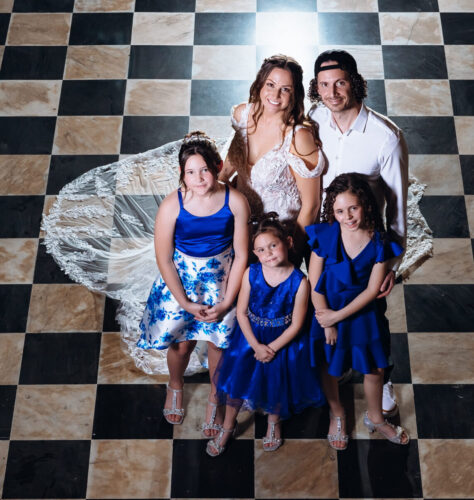
Life was pretty great. I was previously divorced. I have two amazing kids from the divorce. And then I met my now-husband. He has a daughter, so we were a blended family. We had finally figured out all of our dynamics. We got married on March 18, 2025. It was an incredible wedding. We got married in Puerto Rico, and it was everything you could imagine it would be. It was the best day of my life. But my neck hurt a little bit, so I went to the doctor. And on April 23rd, I was diagnosed with cancer.
And it was also my birthday. I turned 35 on April 15th. So everything was just one thing after another. March 18th was the wedding, then our honeymoon, then my birthday, then cancer. We took “for better or for worse” very literally.
Being a young mom and staying active with three girls
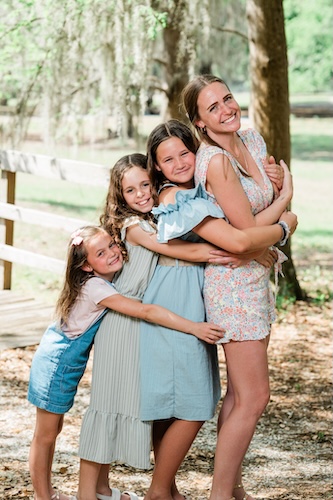
I think first and foremost, I am a mom. I think that’s my greatest title. I have three beautiful girls, ten, nine, and six. So we stay very busy, and a lot of the time I’m just their driver to get places. I try to stay active. I’ve been jogging a little bit. I like hanging out with my husband, and I have the most amazing village, so I have a lot of friends and family close by.
Persistent cough, neck pain, and repeated use of muscle relaxers
In September of 2024, I kept getting sick. I kept having a cough, a lot of mucus buildup, and just not feeling great. And then everything had gone away except for the cough. The cough remained, and I went to the doctor, and I said, “Hey, I still have this cough. It’s probably been a month and a half, and it’s not going away.” So they gave me a cough suppressant, and it worked, and I didn’t have the cough anymore.
Then, in October, probably late October, I started to get a little pain in my neck, and I thought I had slept on it or worked out wrong. I thought I had done something, and I went to the doctor, and she gave me a muscle relaxer. I took the muscle relaxer, and it didn’t relax any of my muscles. It wasn’t working. I went back, and she gave me a better muscle relaxer, one that was supposed to do more. I took that one, and it also didn’t work. That was December.
So I went back in January, and she gave me a third muscle relaxer that also didn’t work. I was like, “There’s something; this isn’t working. I don’t know what to do.” But our wedding was coming up, so I kind of put it off. At this point, it was pretty severe pain. I try not to exaggerate pain, but I would say it was probably like a 7 or 8 on a scale of 1 to 10.
It was impacting my daily life. I couldn’t turn to the right. I couldn’t interact normally. I couldn’t pick my kids up. I couldn’t interact with them like I usually do. So, right after the wedding, right after our honeymoon, I went right back to the doctor, and I said, “Listen, I need an MRI or CT scan. There’s something else going on, and the muscle relaxer isn’t working.”
So she agreed and said, “I’ll give you a CT scan.” I went and got it, and then had an MRI of just the cervical spine. I had a tumor on C1 and C2. They were combined, and the tumor was so big that it had actually cracked C1. Then I had a tumor on C4 and C6. Because there was a tumor on C6, when they scanned down on the MRI, they saw the top of my lung. Immediately after that, they said, “Hey, we actually can’t let you leave yet. We’re going to send something over to the doctor, but I think we’re going to do a CT scan and take some more pictures.” So, of course, I was like, “What do you mean? This was supposed to just be a muscle. What do you mean?” So they did a CT scan, and they found that most of my lung was covered in cancer.
It was 10.8 cm, so pretty big. And then when they went down, they also saw, just by happenstance, that it had also metastasized to my hip. So they did a scan on that as well. That was all on the same day. That’s when I found out everything, and I freaked out. I was with my husband, thank God. So my husband went with me for the MRI, where they found the cancer here, and then the cancer in my lung.
From there, we started calling everybody that we knew to try to get somebody to help us because I didn’t know what I was doing. My husband had contact with a surgeon, and the surgeon knew an oncologist. It was a Wednesday, and the oncologist got us in on that Friday just to explain the results because I didn’t know what I was reading. I didn’t understand any of it. They explained everything on Friday, and then by the following week, I was able to get in with Moffitt Cancer Center. They’ve been incredible. That’s kind of how my journey started. Then I had radiation for a week.
Hearing “cancer” for the first time and feeling like I was outside my body
So I knew, because we had gone to the surgeon’s oncologist friend. It wasn’t my oncologist that I have now. It was just a random oncologist that we were able to get in with. He pulled up the pictures, and he started pointing to all of the different masses. I was like, “What do you mean? This was supposed to be something easy. This was not supposed to be — holy moly, this is not supposed to be like this.”
He started talking about it, and to be completely honest, I don’t remember a lot of what he said. My husband was there, so he caught most of it. When we left, it was one of those moments. “So now what? What do I do? What just happened?” He used the word “cancer.” He said it was most likely lung cancer, but he wasn’t sure because, I guess, there’s testing involved with that, and they have to make sure that that’s the primary.
I felt like I was kind of outside of my body. It felt like I was just watching it happen to somebody else. It didn’t feel like this was my life. This wasn’t my story because I was just so happy. I had just gotten married. This isn’t me. It was one of the only times my husband cried, and when he started crying, I was like, “No, this is really bad.” Then we were able to get an appointment with Moffitt the following week.
Specialist team at Moffitt and the official lung cancer diagnosis
The first oncologist that I saw was the one who handled my spine. That’s who I saw first because they assumed that that was probably the primary. Then my case got moved to thoracic for my lung, when that was determined to be the number one.
But there were so many tests in between that it was hard to really wrap my head around it. It was more so just doing what they told me to do because I didn’t know what else to do. As I said, it was kind of disassociating. I just said, “Okay, whatever, this is what we have to do. Okay, this is what we do.” They told me that we would have to do radiation, all of that stuff.
I think the first time that I heard the words “lung cancer,” I was sitting in the room, and my mom and my husband were both there. I said, “So what is it?” And he said, “It’s lung cancer, and it’s not great.” I was like, “Cool.” That’s the only part I do remember. I know there was a lot more to it, and I know that they asked really good questions. My mom’s in the medical field, and my sister’s in the medical field, so they’re both really good at asking medical questions. But I didn’t even know what to ask. I didn’t know what that meant or what anyone was telling me. So that’s kind of where that part is.
Genetic testing results, my prognosis, and limited data in young patients
Originally, we weren’t sure what kind of lung cancer it was, if there was a mutation, or if it was just straight-up lung cancer, or what was going on. We had to do that testing. That testing came back, and I found that I had two genetic mutations that are common-ish. Although they’re not the rarest, it’s not great either. So we needed to make sure that we could treat those two to improve my quality of life and better my prognosis.
The problem is that most of the people who have this lung cancer are older, and that’s the data set they have. So there’s not really a whole lot to go off of for a prognosis. It’s basically just: we have this medicine, this medicine will work. He gave me the timeline for those aged 80-plus, but then I asked him if that was because of the cancer or because they got sick and weren’t able to recover because they were weakened from the cancer. That’s pretty much what he said. A lot of times, it’s that their immune system can’t handle getting sick on top of everything else. He didn’t really give me an accurate timeline for me because my body has been able to fight off a lot more since I’m younger.
I lost my father to lung cancer, but learned it’s not hereditary
This is wild, and I’m probably going to say it wrong, so bear with me. My dad died from lung cancer when I was 18, but he was an avid smoker. He had six weeks, start to finish, from his prognosis because it had already traveled to his brain and liver. It was everywhere. So he didn’t do any testing, any scans, anything. It was just, “Okay, that is what it is.” He had six weeks, and then he passed.
They assumed that because he was a smoker, that’s what had caused his cancer. I’ve also learned that my own cancer is not a genetic mutation passed down through my family. That’s the way that they described it. It’s a genetic mutation in that my genes were mutated somehow, but it’s not something that runs in my family line. It’s not hereditary.
I have two gene mutations. One is EGFR, and the other is TP53.
It’s tough because when you’re 18, you just want your dad, right? You’re like, “Why didn’t he fight harder? Why didn’t he do something?” All of those things went through my mind. I went through radiation, and it was the worst experience of my life. At the end of it, I ended up going, “Okay, I get it. I get why he didn’t want to go through all of this because it’s awful.”
I said multiple times — and I don’t know if it’s something you’re supposed to say — but I think if my kids were older, I don’t know if I would have made the same decisions because it was awful. I didn’t eat for five weeks, and my throat was swollen. It burned the inside lining of my throat when I had the radiation because it was to my spine. So everything was burned through, and I couldn’t eat, and I couldn’t drink, and everything was painful. It was pretty bad. So I think I have a new level of understanding of where my dad was coming from. But I also feel like, as a mom, you fight, and you do whatever you have to do for your kids. So here we are.
With my sister and specialists, I confirmed my treatment plan for EGFR-positive lung cancer with the TP53 mutation
I did not go off and get other opinions, but I did seek my sister’s opinion. My sister’s an ER nurse, and she’s very well known in North Carolina, and she has a lot of contacts. So it was more about making sure that this was the right, or the correct, treatment plan for this type of cancer. She had talked to a few doctors and did so much research on her own, and it came back that the number one treatment plan would be exactly what my doctor had talked through.
Intensive spine and hip radiation, and claustrophobia while having the mask on
The treatment plan was: first, we would do radiation on the tumors in my spine and my hip. Later on, I did another scan. I asked if we could do a full body scan just to make sure that we were getting all of the tumors, and they happened to find one in my left femur as well. They did radiation on my spine and my hip. They did not radiate my arm or my femur; those were just found later when I asked for a full body scan
For my treatment plan, I started with radiation, and then they talked about going to chemo. Then there would be a pill that I would take — they called it targeted treatment. It’s not immunotherapy; it’s a targeted treatment. That would be something that I’m on for life.
So first we did the radiation, and because it was on my spine, I had to wear this mask. I’m really claustrophobic. The mask comes down and sits on the face, and they bolt it in around your face, and you can breathe out of one nostril. It was an hour and a half, five days in a row, of this mask and of the radiation. You can feel the heat on the back of your neck, of it just lasering — I guess going through your spine to hit those pieces. They also targeted my hip. I was in kind of a cot, I guess, but it was surrounding my body, so you can’t move there either. It was very frightening. It was an awful experience, but they were very professional. They handled it well. Then I had four rounds of chemotherapy after that, once every six weeks.
Chemo allergy, anaphylaxis, and five weeks without eating
I did the week of radiation. A week after the radiation was my first chemo session. When they brought me back for the first chemo session, they had given me an anti-nausea med that I was allergic to and didn’t know about. As they put it through the IV, as soon as it touched my body, I swelled up, turned red, and couldn’t breathe. They had to stop it immediately. I had a flood of doctors and nurses, and it was really scary. I looked at my husband, and I said, “I can’t breathe. I’m going to die. Please help me.” That was the last thing that I remember. So that was the first chemotherapy session.
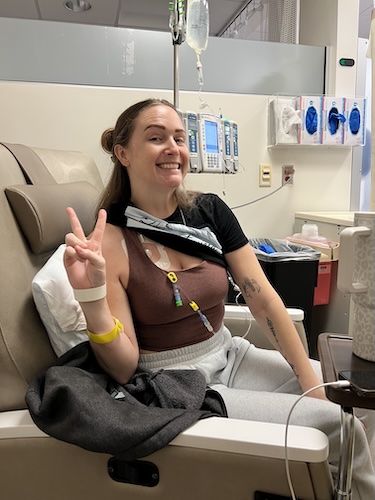
After that, the anti-nausea med went on my list of things not to take, which was a little bit challenging because it was supposed to be one of the really good anti-nausea meds. But we dealt with that. Then, as the weeks went on, the radiation started to kick in, and my throat started to swell. The radiation burned through the lining, so that hurt on top of just being totally exhausted from the chemo. It was a lot.
I was supposed to have my next chemo session, but I ended up in the hospital because the pain in my throat was so intense. I got some medicine for that to just kind of get me through, and it took about five weeks for me to be able to eat solids again. I was on what was supposed to be a soup diet, but even if it was anything but broth, it felt like it was ripping my throat. Even the broth was hard to do, but it was a lot better than anything in it.
Four rounds. I finished them in December.
Debilitating bone pain, exhaustion, and sensitivity to cold
I was very lethargic. There were some days when I literally could not get out of bed. It felt like my bones were hurting, and I don’t know if that sounds weird to say, but it was like in my bones, and I couldn’t do anything about it because you can’t put cream on it, you can’t take certain meds, you can’t do a whole lot of other things. Nothing touched it. It was just painful, and it hurt to walk. I walked with a hunch for a while, like a limp. I think that was probably my worst side effect, the pain in my bones.
Also, I’m really susceptible to cold now. Everything makes me cold, and I’m cold to my bones. It’s not something that I can deal with by putting on a jacket.
It felt to me like somebody was tearing back the skin, tearing back all the things, and then just squeezing my bones. That’s what it felt like, as if they were right on top of my bones, just trying to squeeze them as hard as they could.
Leaning on my husband, mom, and community while parenting through treatment
I have an amazing support system. My husband is incredible, and he was able to take on a lot. My mom lives like 20 minutes from us, so she was able to be with the girls. I work at an elementary school, so I was able to have the summer off, which, thank goodness, was when the majority of all of this happened — over the summer. I was able to have a lot of people come and help with the girls. They were still able to do things over the summer, even though I wasn’t able to be there for it. I had a lot of help.
Norovirus, pneumonia, Mycobacterium abscessus, and delayed chemo
It was a really incredible feeling. I had done my two treatments, and after my second treatment of chemo, I thought that I was just tired from the chemo, which is understandable. But I wasn’t getting better. Then I was vomiting every day, and I was getting sick, and I couldn’t get out of bed. It was getting really bad, so we ended up at the hospital.
Within a month, I had the norovirus. I had pneumonia with a partially collapsed lung. Then they found that I had a Mycobacterium abscessus infection, which I guess is one of the worst types. So I was on treatment for all three of those things, and chemo was held off for a while because of all of that.
My final two sessions of chemo were more toward the end of the year, and I was able to finish in December. It was a relief, and it felt like more of a relief because I had been through all of the other things, too, with the mycobacterium infection and all of that stuff, and that prevented me from getting the chemo. It felt more protective — now I was able to get my chemo, I was back on the treatment plan, I was doing what I was supposed to be doing, and it felt like I finally made a step toward progress.
Reaching no evidence of active disease and maintaining with targeted therapy
Right now, I’m considered to have no evidence of active disease. All of my tumors — they can’t seem to see anything. There is a hole in my lung that’s 3.8 cm now. It started at ten, and now we’re at 3.8, and there’s no tumor. But what the doctor said is that there may be a couple of those cells just kind of out and about in that hole, and that’s what the medicine, the targeted therapy, addresses. It makes sure that it doesn’t get worse, that they don’t form a tumor, and that it keeps them at bay. So what I have going forward is just the medicine.
Living with targeted therapy long-term, and reframing EGFR-positive lung cancer with a TP53 mutation as a chronic disease
It was a huge shock. At first, I thought that it was a life sentence, which I guess technically it is. But now that I’ve had time to process it, I look at it more as a chronic illness. It’s something that I address every day. It’s something that I make sure I take every day, but as long as I’m taking it, I’m okay — as long as it’s working, obviously.
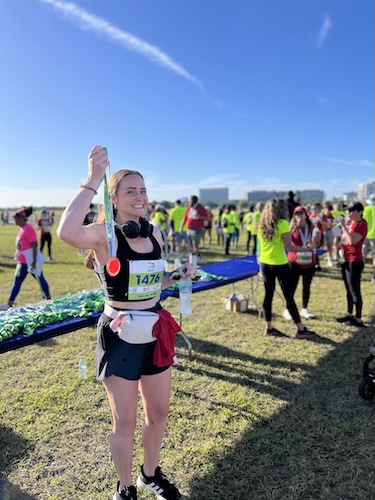
It has been great. All of my tumors are gone. I mean, obviously, it’s successful. I’m trying my best to focus on the positive, and the positive is that it’s working and that I get to be here for my girls. The side effects are minimal. I’m more tired than I was, and the cold is still a problem. But apart from that, it’s pretty much back to normal. I’m able to interact with my girls. I’m able to carry my youngest. I started jogging. I’m able to run next to them when they’re on their bicycles. We go to the park, we walk the dogs, and we go to the pool. All of those things are pretty much back to normal now.
Redefining independence, accepting help, and building a village for my girls
I think EGFR-positive lung cancer with TP53 mutation has changed every single part of how I view myself and my life. My life is completely different from what it was before cancer. I’ve always viewed myself as a very independent person, and this journey has not only made me more dependent, but I also have to ask for help. I have to be okay with not being able to do everything, and I physically can’t do everything.
Knowing that I have the village’s support, knowing that these friends have all shown up and been incredible with my girls, I think it’s been a blessing in disguise, to be honest, because now the girls get to have these amazing relationships with people other than me. It’s not just me doing everything, and they get to see what a community looks like, what a village looks like. I think that actually means more than they realize in this moment.
Intermittent FMLA, energy conservation, and learning to say no
There are some days that I’m on intermittent FMLA. There are days that I just physically cannot get out of bed. It depends on whether I’ve gone for too long without giving myself a break. I’ve noticed that if I don’t have a day on the weekends where I can just be in bed all day, the next week is usually pretty difficult. So I’ll have to ask somebody to take the girls to school or to help with dinnertime, or if they want to go to the park, to have somebody who can bring them there. Those kinds of things are definitely still things I can’t do.
I think the other thing is being able to say no more often, and that’s been huge for me too — setting boundaries in the best way. But it’s also so frustrating because I didn’t have to do that before. I was able to do all of those things. So it’s finding my new norm and finding what works for everybody to make everybody happy.
Young, “looking great,” and facing judgment for using a handicap placard
I think it’s hard, especially when you’re younger and you have cancer, because on the outside everybody always says, “But you look great.” I’ve lost 30 pounds, and I’m able to jog again and do other things. So, “What’s the problem?” is a lot of what I hear. Why is there still that intermittent FMLA if you’re able to do all of those things?
It’s hard to describe, because some days I can do all the things, be a part of everything, work full-time, and so on. But there are some days that I just can’t. I have a handicap placard — it’s a temporary one — because there are some days that I just physically can’t walk from point A to point B. I’ve had a couple of people who are like, “You don’t need that. That’s for people who are actually handicapped,” that kind of thing.
It’s hard. One, it’s hard to use it because I want to just park at the back of the parking lot and walk as everybody else does. Two, when you get out and you get that confrontation, then it’s like, you know what, I’m just going to go home. I don’t want to have this conversation. I don’t want to fight for something that just because you can’t see it, doesn’t mean it’s not there.
Especially when I’m with the girls, and we have to run into Publix or something. You have all these kids, you’re young, you’re able to do all these things, but you’re not seeing what’s happening on the inside. There was a point in time when I was solely in a wheelchair because I couldn’t walk places. It’s hard. If I don’t show up, who will? I feel like somebody’s gotta say, “This isn’t okay. You can’t treat people like this.” I know it’s not just me.
Regular scans, bloodwork, and cardiac monitoring on targeted therapy
I do scans every three months. The mycobacterium — I’m almost done with that. I have one more sputum culture left, and as long as that’s negative, I’m done with the mycobacterium. From that point on, it would just be every three months that I get a scan, and every month I get blood work done to make sure that everything’s still doing what it should be doing.
When I had the mycobacterium, my liver levels went up with the antibiotics that I was on because they were pretty heavy antibiotics, so they wanted to monitor that. I do an EKG every month because of the targeted medicine that I’m on. Sometimes that messes with your heart. So I have to do an EKG and blood work monthly, and I have scans every three months.
Scanxiety, balancing fear and hope, and wearing a ring for my girls
A lot of those emotions. I feel like every single time I go in, I think about the worst, and then I think about the best thing that could happen, and then I hope to be somewhere in the middle. That’s the goal. Okay, if we can’t have the worst and we can’t have the best, just somewhere in the middle where I can keep on keeping on. That’s pretty much the way that I approach it.
I have a ring that I wear for my girls every time I go in. It’s the only one that I wait till the last minute to take off. I just hope that everything’s okay.
My hopes for the future and doing literally whatever it takes
I want to be here as long as possible. I just want to be here for my girls. I want to see them graduate. I want to see them get married. I want to see them have families. That is the goal. Keeping up and making sure that I’m following everything the doctor says.
I know that a lot of people push homeopathic treatments — “Why are you doing chemo, it’s such a hard thing?” If it’s something that can keep me alive and keep me going for my girls, I’m going to do literally whatever they say.
Take a breath, find a therapist, and let your village help
Take a breath. It’s easier said than done, I know — but just take a breath. Maybe talk to someone. I had a really good therapist. She’s incredible. Talk to somebody who’s outside of the situation.
And give yourself grace. I think that’s the hardest one for me. A lot of the time, I feel like a burden, or I feel like I’m asking too much. But my therapist said — and I think this is a great takeaway — “If you don’t ask, they don’t have the opportunity to help you.” They all want the opportunity to be part of your village. So I think that would be my biggest takeaway: please reach out. These people want to support you. You’re not a burden, and you are worthy.
Inspired by Shannon’s story?
Share your story, too!
Hear from people living with lung cancer
Real experiences with diagnosis, treatment choices, side effects, and life beyond lung cancer — in their own words.


Leave a Reply