
14 Years Later and Still Here: How Katie Smith Has Survived an ‘Inoperable’ Glioblastoma Brain Cancer
Katie first noticed her left arm feeling heavy while drying her hair and that her left fingers couldn’t keep up with her right. The timing, she was a new mother of two, not someone who expected a brain cancer diagnosis. Yet those subtle, easy-to-dismiss symptoms ultimately led to the discovery of a 4-centimeter brain tumor and a life-altering experience with glioblastoma, the most aggressive form of brain cancer, that Katie has now lived with for nearly 14 years.
Interviewed by: Taylor Scheib
Edited by: Katrina Villareal
Katie Smith’s path to diagnosis was anything but straightforward. She had none of the textbook symptoms: no seizures, headaches, or dizziness. A chiropractor initially attributed her weakness to a pinched nerve. It was only through her own persistent self-advocacy that she pushed for a neurologist referral and, ultimately, an MRI that revealed a mass in her brain. The moment her doctor called, everything changed.
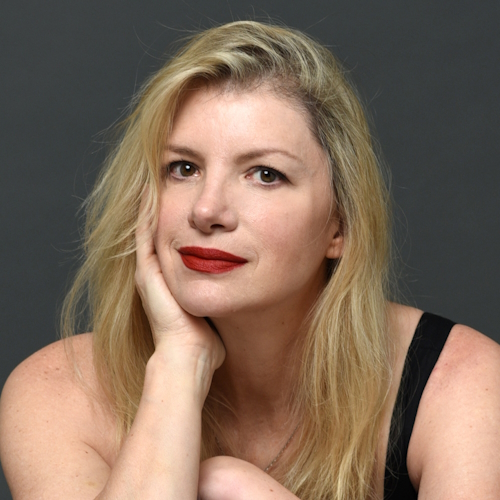
What followed was a years-long experience that tested the limits of medicine, her body, and her resolve as a mother. Her first surgery at Cedars-Sinai was halted mid-procedure when surgeons discovered the tumor was fully embedded in her motor cortex, making removal impossible without permanent paralysis. A pathology report confirmed grade 3 anaplastic astrocytoma, and later, grade 4 glioblastoma.
She endured overlapping radiation and chemotherapy, along with severe brain swelling that caused as many as 12 seizures per day. Through it all, she was raising a toddler and a young child, often unable to drive, unable to be alone, and navigating profound physical and emotional losses.
A second craniotomy at the University of California, Los Angeles (UCLA) in August 2013, one Katie describes as one of the bravest things she has ever done, succeeded in fully removing the tumor. Recovery required relearning how to walk, swallow, and speak. The premotor cortex damage meant that nothing is automatic anymore and that every movement requires a conscious command.
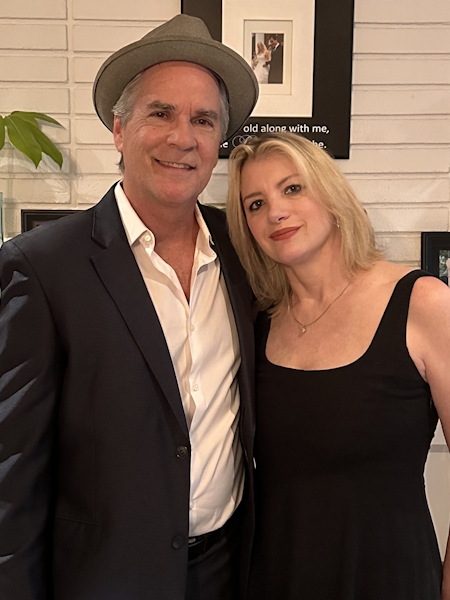
Nearly 14 years after her diagnosis, Katie channels her experience into mentorship through Imerman Angels and into her memoir, “Welcome to Katie’s Brain: A Brain Cancer Survivor’s Story,” the book she wished had existed when she needed it most. Her story is a testament to what radical self-advocacy, humor, community, and a survival-first mentality can make possible even in the face of a terminal diagnosis.
Watch Katie’s video or read the edited transcript of her interview to find out more about her story:
- Atypical symptoms deserve attention. Brain tumor symptoms don’t always present as seizures or headaches. Persistent, subtle neurological changes, like one-sided weakness, tingling, or reduced fine motor control, are worth pursuing, even when they seem easy to explain away.
- Patients who ask questions and push for answers can meaningfully change the course of their diagnosis and treatment. Katie referred herself to a neurologist, sought three independent surgical opinions, and flagged inaccurate surgical recommendations, all of which shaped the outcome of her care.
- A treatment not working is the disease’s resistance, not your failure as a patient. When the treatment stopped working, those were the limits of the available treatments, not hers.
- Control what you can, release what you can’t. Facing a diagnosis that strips away independence, Katie found agency in nutrition, integrative approaches, laughter, and community. Reclaiming even small areas of control can be a powerful tool for managing the psychological weight of a serious illness, a truth that applies to every patient, regardless of diagnosis.
- Survivorship is its own complex experience. When the tumor was removed, the celebration around Katie didn’t match what she felt inside: The grief of lost function, the ongoing surveillance, and the fear of recurrence. Survivorship with lifelong cancer diagnosis requires its own support, not just the support given during active treatment.
- Katie found purpose using storytelling for patient advocacy. Katie transformed a decade of raw personal blogging into a memoir and a mentorship practice through Imerman Angels, who also happens to be a partner of The Patient Story. Her evolution from an isolated, frightened patient to a guide for others with grade 4 brain cancer represents one of the most powerful forms of patient advocacy.
Katie’s Diagnosis Facts
- Name: Katie Smith
- Age at Diagnosis:
- 41
- Diagnosis:
- Glioblastoma
- Grading:
- Grade 4
- Mutation:
- IDH1
- Symptoms:
- Left arm heaviness and weakness
- Reduced fine motor control in the left hand
- Intermittent tingling in the left fingers
- Treatments:
- Surgeries: craniotomy (twice)
- Radiation therapy
- Chemotherapy: temozolomide (Temodar), CCNU
- Monoclonal antibody: bevacizumab (Avastin)
This is not medical advice. Please consult with your healthcare provider to make informed treatment decisions.
- Katie’s Diagnosis Facts
- My life before diagnosis: Marriage, motherhood, and a new baby
- Early warning signs: Subtle symptoms before receiving my brain tumor diagnosis
- Receiving the diagnosis: A phone call that changed everything
- Why getting multiple opinions on a brain tumor is so important
- When brain surgery fails: An inoperable tumor and waking up with no answers
- Managing cancer treatment with young children
- A second brain surgery: Finding courage for another craniotomy
- Long-term survival with grade 4 glioblastoma
- Survivorship and ongoing fear
- Talking with my children about cancer
- Writing a brain cancer memoir: The purpose behind “Welcome to Katie’s Brain”
- Hear from people living with brain cancer
My life before diagnosis: Marriage, motherhood, and a new baby
Before I was diagnosed, I had been married for about 10 years. I had a six-year-old son and I had just had my daughter. She was 15 months old when I was diagnosed. I was in mommy mode and new-baby mode. It was all-consuming.
Early warning signs: Subtle symptoms before receiving my brain tumor diagnosis
The actual symptoms started happening after my daughter was born. I noticed that when I would dry my hair, as I was holding up my hair dryer, my arm would feel heavy, as if I couldn’t hold it up. Then I noticed that I couldn’t move the fingers in my left hand quickly. Compared to my right hand, there were things that I couldn’t do fast. That’s when I started to freak out and thought that something was wrong. I told my husband, “There’s something wrong. This isn’t normal,” so I referred myself to a neurologist.
It’s not a typical symptom for brain cancer. A typical symptom would be a seizure. I think that’s how most people find out they have a tumor. I never had a seizure. I never even had a headache. No dizziness, nausea, or any typical vertigo symptoms. I never thought in my wildest dreams that I would have a brain tumor.
Tingling and weakness: What the early symptoms felt like
The tingling would happen once in a while. I’d brush my fingers of my left hand across my steering wheel and they’d tingle a little bit. It was very intermittent. The weakness was like a tired, heavy feeling. It’s easy to brush those things off, and most people would.
I recently had a baby and I was carrying everything on my left side: my baby, my diaper bag, and my purse. I thought I could have a pinched nerve in my neck or there was something wrong with my shoulder, so I went to a chiropractor and he said, “Oh yeah, that’s typical. I can fix that.” But it just got worse. It never got better. That’s something I couldn’t ignore anymore.
Googling my symptoms and facing the unknown
I became immediately terrified. It was very obvious to me that there was something wrong with my left hand because it was so different from my right hand. I don’t know if my husband was as scared. He tends to minimize things and I tend not to. When you start Googling “weakness in one limb,” only three things come up: amyotrophic lateral sclerosis (ALS), multiple sclerosis (MS), and brain tumors. I had no symptoms of a brain tumor, so my mind started spiraling out of control. I thought I had ALS or MS.
Navigating the healthcare system: Getting a neurologist referral and an MRI
I’m a very proactive person. I’m good at advocating for myself. I went to my primary care physician and said, “I want to see a neurologist.” They sent me a referral, and I went to see a local neurologist. I was telling him about my symptoms and he said, “Let’s get an MRI of your brain and your spine, because those are the two areas where it would likely be causing problems.” We had to wait for a few weeks for that referral to go through. In that time, I was just freaking out.
I finally got my appointment for the MRI. They first did the scan of my spine, and that came back okay. My doctor and I had agreed that because I was still nursing my daughter, we wouldn’t do any contrast dye. He said if something came back worrisome, we could always go back and do it with the dye.
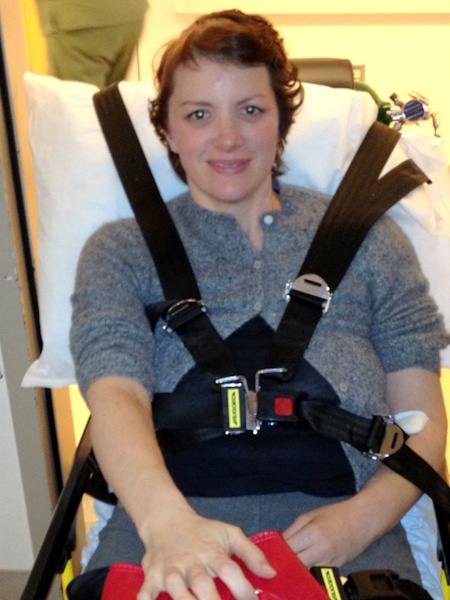
When I was in the middle of my brain scan, they came in and said, “We have to use the dye.” I said, “No, I’m not doing that. I’m nursing my daughter.” They said, “We have to.” I was bolted to a table, so I couldn’t move. My mind was spinning, and I was crying and freaking out. Not only could I not nurse my daughter, but there was something wrong with my brain. It was scary.
Receiving the diagnosis: A phone call that changed everything
The plan was to take the film to my doctor’s office on Monday. But as I was waiting in the room for them to bring me my film, and they came out and said, “Your doctor’s on the phone.” I knew right then that it was bad. He was on a mission, calling me from another state, so I knew it was bad. He got on the phone and said, “You have a mass in your brain.”
My mind shut down and I went blank. I had no idea what to say. The first and only question that came to me was: Is it in an operable location? That was the only thing that came to my mind at that moment. He said yes. I asked, “How big is it?” He said 4 centimeters, like the size of a golf ball or a small lemon.
They handed me the films. I went out to the parking lot and looked at this tumor. It looked huge. I couldn’t believe how big it looked compared to the size of my regular brain. I was in shock. It was a terrifying, surreal experience. I had to rush home because my husband had to pick up my son from school, my daughter was napping, and we literally had this exchange in the driveway: a quick hug, “I have a mass in my brain,” and that was it. It was very surreal.
Researching brain tumor types while waiting for a diagnosis
While my husband was picking up my son from school, I was Googling again, looking up what different kinds of brain tumors there are. You’re hoping for the best, like a meningioma, which is benign and not cancer, but you’re looking at the worst, which is glioblastoma, grade four, and the most aggressive, most deadly kind, and everything in between.
I was going, “God, I hope I have a meningioma.” And then, “What if I have grade 4 glioblastoma?” Then you have 12 to 18 months to live, which is worse than ALS, actually. My worst fears were now coming true. I called my parents and told them what was happening, and they were predictably freaked out. I had to wait until Monday to talk to a doctor. My husband and I had nothing to go on because we didn’t know what it was.
The neurologist said, “I’m not equipped to deal with this. I’m just a local neurologist.” He referred me to a couple of neuro-oncologists. I decided I was going to get three opinions. I went to City of Hope, UCLA, and Cedars-Sinai.
Why getting multiple opinions on a brain tumor is so important
I’ve had a lot of medical issues in the past. I’ve had four miscarriages, and I’ve been through a lot of bad experiences. I’ve seen the worst, so I’m very proactive about getting multiple opinions. What’s the strategy going to be? What do you think it is? What’s the best-case scenario? That was a no-brainer.
In the beginning, it looked like a typical noncancerous, low-grade glioma: circular and encapsulated. It wasn’t all crazy with little spindles coming out of it. It looked low-grade, and they all agreed. But until you get in there and get a biopsy, you don’t know what it is.
I was somewhat informed before I went into these appointments. One of the surgeons said that I would have to be awake. I knew that wasn’t true because it wasn’t in my speech area, and they only do that for speech. I immediately crossed him off my list.
My insurance was in a dispute with UCLA, but I still got an opinion. I liked the doctor there, but I couldn’t have my surgery there. I ended up having surgery at Cedars-Sinai. After multiple MRIs and what they call functional MRIs, the surgeon told me he thought that he could get 95% of the tumor out, which was not ideal, because that leaves 5% that could just continue to grow. That was disappointing.
When brain surgery fails: An inoperable tumor and waking up with no answers
When I decided to have surgery at Cedars-Sinai, it went quickly. Within the first office appointment, they had set up surgery for literally three weeks from then. They said that they could take out 95%. The surgery was supposed to be four hours; he came out two hours early and told my family he couldn’t take it out. He said, “Don’t let anyone ever touch this tumor. It’s completely in her motor area.”
Before, he said it was in my premotor area. Motor area means if they take it out, you’re permanently paralyzed on that side. Premotor means you’ll have some paralysis, but it would be temporary or minor, and you can potentially get it back. He said, “It’s all in her motor area. Don’t touch it.” I was having seizures during surgery, whereas I had never had a seizure before.
I was absolutely devastated waking up from brain surgery and finding out that they couldn’t take out any of it. I was completely lost. What do I do now? It’s one thing to have a brain tumor. It’s a whole other thing to learn you have an inoperable brain tumor. Two totally different things.
I had a wonderful oncologist at Cedars-Sinai who came in smiling and said, “Everything’s going to be great.” His attitude and bedside manner were so great that he made me feel good. He said, “There are things we can do. You’ll do this, this, and this,” so there was a plan moving forward, which was great. We still didn’t know if it was cancer. We found out four more days later, after their tumor meeting. It was a grade 3 anaplastic astrocytoma, which was an aggressive cancer. That was devastating. Now we knew that chemotherapy and radiation all had to happen quickly.
Managing cancer treatment with young children
It’s tough to keep a positive attitude. Cancer’s a full-time job; that’s how I describe it. I had to receive radiation five days a week for six weeks. I needed someone to drive me because you can’t drive yourself. I was also taking chemotherapy. I had a one-year-old child and a six-year-old child. Luckily, we had lots of friends and family step in to help with food deliveries and people to drive me to radiation.
After surgery, I started having regular seizures, which were horrific. I couldn’t be alone. I lost all my independence. I couldn’t drive. I couldn’t take care of myself or my children. I don’t lose consciousness during my seizures, so I’m completely awake the whole time. I don’t fall and hurt myself, but it’s painful and scary. You’re out of control of your body. You can’t communicate. It’s horrifying. And that started a whole issue with PTSD.
Receiving chemotherapy for brain cancer
The kind of chemotherapy you get for brain cancer is different from any other kind, because it has to pass through the blood-brain barrier. Not everything can get to your brain. The one they use now is temozolomide (Temodar). The standard treatment is radiation, temozolomide (Temodar), and surgery.
Because my surgery wasn’t successful, I started radiation and chemotherapy concurrently. The chemo is a pill. Gradually, I started becoming allergic to it. I started breaking out in hives all over my body. By the end of four and a half to five weeks, I had to stop taking it. I never even got the full amount of chemo I was supposed to take, which was definitely worrisome. This was the gold standard treatment, and I wasn’t able to take it.
They tried the chemo used before temozolomide (Temodar), which was CCNU. It worked okay for about two rounds. Then my white blood cell count started to plummet. My brain also started swelling because of the radiation. The thing about the brain is that there’s no lymphatic system, so if the tumor is dying, it’s shedding cells, and there’s nowhere for them to go. My brain swelled so much that the midline started shifting, and the tumor looked like it had tripled in size. Was it growing out of control or swelling? Every day, I don’t know what’s happening. I became paralyzed on my left side. I was dragging my leg. My arm was hanging dead at my side. My face was drooping. I couldn’t do anything.
They eventually said, “We have this drug called bevacizumab (Avastin). It’s used to bring down the swelling.” I said, “Let’s try it.” They listed all the horrible potential side effects, which included stroke. But what else was I going to do? If I let the swelling continue, they said the paralysis could be permanent. I agreed to do the bevacizumab (Avastin). They said, “It’ll work immediately or it won’t work at all.”
Thankfully, it worked immediately. I got my movement back. I got my hand back. I was walking fine. The swelling went down. But it also destroyed my voice. There’s always a give and take. Once the swelling went down, we could see how much my tumor had shrunk, which was about 25% and that was great.
But the seizures continued. Sometimes I was having up to 12 a day. Some were stress-induced and panic-induced, but there were also some big ones. I fell in a restaurant and was on the ground for 10 minutes having a seizure. My oncologist said, “I don’t like how this is going. I think you need to go to UCLA. I think they can take it out.” That was amazing news.
A second brain surgery: Finding courage for another craniotomy
We went to a brain tumor conference that UCLA holds once a year. I met with the doctors, asked questions, and felt comfortable. We decided to schedule a surgery there. It was so scary to schedule another brain surgery because you could die during surgery or after surgery. There are so many things that can go wrong. Probably one of the bravest things I’ve done was to go in for another craniotomy. But I did it on August 8, 2013, a year after my first one, and thankfully, it went well. They were able to take out the whole tumor.
What a craniotomy involves: The procedure, recovery, and lasting effects
It’s a big deal. The first time, I didn’t even know what had been done. I woke up with scabs on my head and thought, “Why do I have a scab in the middle of my forehead?” They screw a metal halo onto your head, and the screws go into your skull to keep your head from moving. They cut a big circle around your skull and take it off. When they’re done, they put it back in. I have plates and screws you can feel under my skin. They don’t tell you this stuff ahead of time, because I think it would freak you out if you knew everything they do.
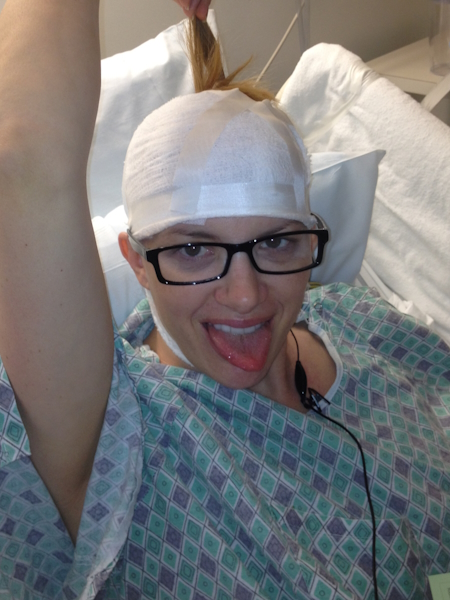
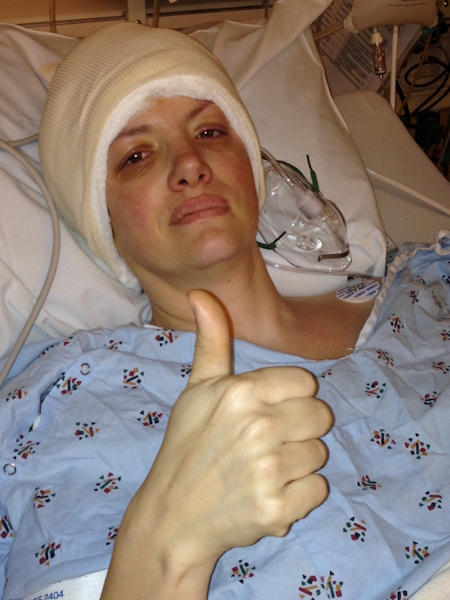
Because this was the second surgery, I woke up in a lot of pain. It was extremely painful. They put on what looked like a hard turban-like wrap to prevent swelling. It was squeezing my head, and it was so tight it was killing me. I started screaming and asked them to loosen it.
I woke up and was partially paralyzed because they took out part of the premotor area. The premotor area is what initiates movement and makes things automatic. There’s no automatic for me anymore. I can’t use my hand without thinking about it. I have to tell my hand, “Go pick this up. Open your fingers. Close your fingers.” When I walk, I still drag my leg a little bit. I have to tell it, “Lift. Lift your foot.” Otherwise, I’ll trip over little cracks on the sidewalk.
I was walking around, bumping into walls because I had no proprioception. I didn’t know where my body was in space on the left side. I couldn’t swallow when I woke up because part of my throat was paralyzed. I was getting thickening powder put into all my liquids so I wouldn’t choke. I had to use a walker. I had to relearn how to walk, how to swallow, and how to talk. My tongue couldn’t keep up when I wanted to speak quickly, so I would stutter quite a bit.
I went straight from the hospital into inpatient rehab. For me, being the person that I am, it wasn’t enough therapy. I was getting maybe two hours a day. I wanted therapy all day, every day. I wanted to get better and go home to my kids. I checked myself out and started going to places where I could get more therapy done.
Long-term survival with grade 4 glioblastoma
The second craniotomy increased my likelihood of surviving 100-fold. Your best prognosis is if you can have a full resection. I was lucky because they thought I’d had my tumor for 10 to 30 years. It was a very slow-growing, non-aggressive tumor. And I had a particular genetic marker called IDH1, which made it a slower-growing tumor. They have new therapies for that particular marker, so I’m very grateful for that.
After my second surgery, they found out my cancer was grade 4. There were grade 3 cells in it, but it was also grade 4, which is glioblastoma, my worst fear. Again, so lucky they were able to get it out. Sometimes you don’t always know from a biopsy what’s going on in there. It was important to find that out, and thank God they got it out.
Survivorship and ongoing fear
When you go from a place of having an inoperable brain cancer to now not having this tumor in my head anymore, everyone around me was celebrating. Yet I’m sitting there going, “Wait a minute. I still feel the same. What happens now? Who am I if I’m not the woman with brain cancer?” All the food deliveries and driving stops. All the people are gone. And now I’m just here, like a bird that’s been kicked out of the nest.
Now I have to go for MRIs every two months to see if it’s growing. They say it’s not a matter of if, but a matter of when. When it’s not growing, you get a two-month reprieve before you start worrying again. Once you’ve gone six months without recurrence, you go every three months. I’m now going every nine months. They said I can go once a year, but it makes me nervous, because if it does start to grow back, which it’s known to do, I want to catch it early.
This is a recurring cancer. It’s considered terminal no matter what. I asked my doctor recently, “Is this what I’ll likely die of?” He said, “Yeah. So you’re never free from it. It’s more of a chronic disease.” I still have to deal with paralysis, being on seizure medication every day, and the side effects of that. The fear of having seizures, even though I’ve been seizure-free now for a long time, is still there. There are so many things I can’t do anymore. I can’t ride a bike, roller skate, jump on the trampoline, or swim in the ocean. My life will never be the same as it was pre-diagnosis ever.
Talking with my children about cancer
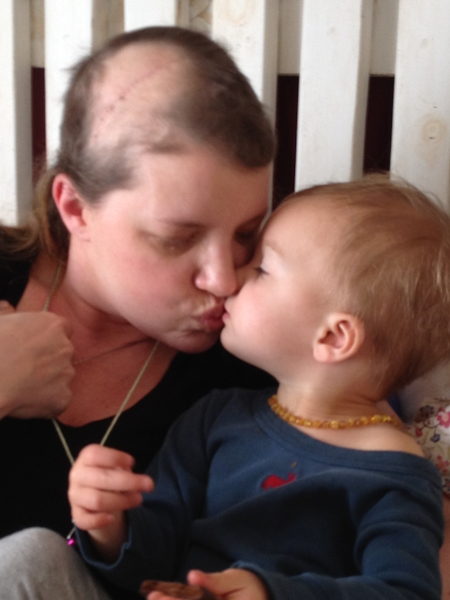
After so long, it’s become blasé to them. My daughter was only one and a half when I was diagnosed, so she didn’t internalize a lot of what was going on. She knew that mommy was in bed a lot. We’d climb into bed together, eat Cheerios, and watch cartoons, because that’s all I could do. I tried to keep things as normal as possible. I decided that whatever I did with my son, I was going to do with my daughter, no matter what. My doctor said, “Take lots of photos and videos, because sadly, you don’t know if you’re going to be around,” which is painful to think about.
My daughter and I have talked over the years. She remembers, even at such a young age, having to stop breastfeeding overnight. That was something we mourned together. We cried about it when she was about four or five. I was grieving over the fact that I couldn’t braid her hair. To me, that was terrible. I cried for years about that. It seems so silly, but it was important to me to have a daughter and be able to do her hair. I could never do her hair, and that sucks.
My kids are very compassionate. They have character. They’ve had to struggle, not with themselves, but with watching me. I think people who have it too easy don’t build character. While I was sick the whole time, I kept a blog and talked about everything going on with me every single day. It was very cathartic for me. Eventually, 300 people started reading it. I turned that blog into a book. My daughter recently read it, so she learned everything that I went through. Now this little tiny baby gets to see and hear, in my voice, everything I went through. That was cool.
Writing a brain cancer memoir: The purpose behind “Welcome to Katie’s Brain”
It was a 10-year process, which included three years of active blogging and then editing, because it was so raw. I’m very vulnerable and open in it. I have no filter at all. There are embarrassing stories, funny stories, and tragic stories. When I was blogging, I’d get such incredible support and feedback from people. I felt like I had 300 close friends offering their support. Honestly, it was selfish. I needed it at the time.
Now, having this book out, when people who are going through it read it, I think it’s great because it tells them all the things I did that were bad decisions, and all the things I did that were smart. It tells them about the raw emotion and what you’re going to go through with this diagnosis.
This is the book I wish I had when I was diagnosed, because there was nothing like that, because people don’t survive. I never wanted to join a support group for brain cancer because the group’s going to be so small. Every week, someone’s likely not going to show up because they passed away. That’s not what I wanted. I wanted positivity, support, and survivor stories, and so this book is the book I wish I had.
Turning pain into purpose
When I was first diagnosed, I was desperately seeking survivor stories. I didn’t want to hear sad stories. When people would say, “My uncle had brain cancer and he died,” I’d say, “Don’t tell me that. I want to talk to survivors.” My mentality is I’m going to survive this. I Googled brain cancer survivor stories. I focused on websites that talk about survivors.
I’ve also become a mentor for other people with brain cancer. There’s a community called Imerman Angels where they match you with other people who have your exact same kind of cancer. I have mentees right now that I’m talking to on a regular basis, people diagnosed with grade 4 brain cancer, because they need those survivor stories as I did.
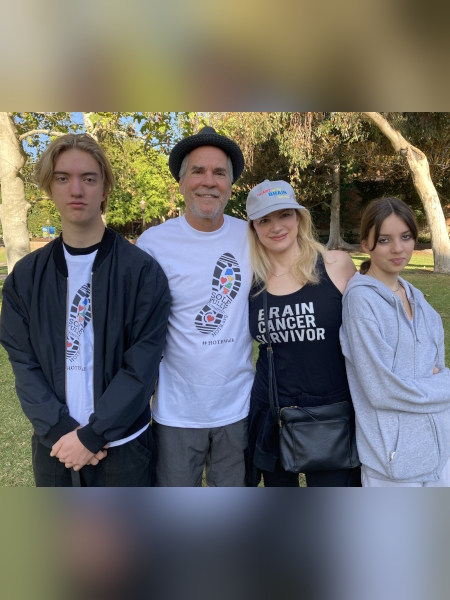
I was able to see my son graduate from high school, which was incredible. I never thought I’d live to see my kids grow up. Not everyone who has brain cancer gets to live past two years. The average lifespan is 12 to 18 months, and three years is considered long-term survival. Here I am, almost 14 years later. It’s a freaking miracle. If I die from this, I die from this. But I’ve gotten to see my kids grow up. And that’s the best gift ever.
This interview has been edited for clarity and length. The views and opinions expressed in this interview do not necessarily reflect those of The Patient Story. This content does not replace professional medical advice.
Inspired by Katie’s story?
Share your story, too!
Hear from people living with brain cancer
Real experiences with diagnosis, treatment choices, side effects, and life beyond brain cancer — in their own words.

Leave a Reply