
Two Years of ‘It’s Just Anxiety’ Before an X-ray Found Stage 4 Hodgkin Lymphoma
For two years, Rhea’s body kept telling her something was wrong, and almost no one believed her. She had leg pain so severe some nights it felt like a heart attack, crushing fatigue, night sweats, and a menstrual cycle that vanished for a year and a half with no explanation. She saw roughly 20 doctors during that stretch. Most sent her home with the same word: anxiety. It would be 18 months before a doctor looked at an earlier X-ray and saw a tumor before she’d have a Hodgkin lymphoma diagnosis.
Interviewed by: Taylor Scheib
Edited by: Chris Sanchez
Rhea was in her early 20s, married to her husband on active military duty, and living what should have been an ordinary young adult life. Instead, she cycled through emergency rooms, a cardiologist, a heart monitor she wore for weeks, and test after test that came back inconclusive. She says she believes her age, and to a lesser degree her gender, played a role in how seriously her symptoms were taken.

The answer had been sitting in her medical records the whole time. During a middle-of-the-night ER visit for leg pain, a doctor pulled up an X-ray from a year and a half earlier. It showed a tumor between her heart and chest wall. No one had told her it was there. From there came a tangle of insurance referrals, a PET scan, and an urgent recall to the hospital that turned into a two-week stay: a chest wall biopsy, 600 milliliters of fluid drained from around her heart, a 10.4-centimeter tumor, an ICU stay, and a port placement, all within the same admission.
Rhea found out she had cancer through her patient portal before a doctor called to tell her. Her hematologist-oncologist confirmed it soon after: stage 4 Hodgkin lymphoma, which by then had spread from her neck to her ankles and into her pelvis, explaining the missing periods no one had been able to account for.
She was treated with six cycles of AVD chemotherapy along with immunotherapy, 12 treatments in total. She also had goserelin injections to help protect her fertility, since there wasn’t time to freeze her eggs before starting treatment. She was able to avoid radiation. Hair loss hit her hardest emotionally; the bone-deep pain and nausea, she says, she tolerated better than expected.
Today, Rhea has no evidence of disease. She still sees specialists across fertility, hematology-oncology, cardiology, and now endocrinology every few months, and gets PET and CT scans twice a year. She’s planning to join the Air Force and eventually train as a physician, and spends her time streaming and making art. Her advice to anyone being dismissed by doctors: Keep going back.
Find out more about Rhea’s Hodgkin lymphoma story by watching her video and reading the edited transcript of her interview.
- Rhea’s tumor showed up on an X-ray a year and a half before anyone told her about it. It wasn’t until a different ER doctor pulled her full medical history that the finding surfaced and by then, the cancer had already reached her chest wall.
- She lived without a period for a year and a half before diagnosis, and no one could explain why. It turned out the cancer had spread to her pelvis. Once she saw her own PET scan, the missing piece clicked into place, and she describes that as one of the biggest reliefs of the whole experience.
- Being dismissed as anxious for two years didn’t make Rhea doubt her own body, even when almost everyone around her did. She kept coming back to the same point: Anxiety doesn’t explain physical symptoms that don’t change. That instinct, to trust what her body was telling her over what she kept being told, is something any patient fighting to be believed can hold onto.
- Losing her hair affected her more than any other cancer treatment side effect. She’s candid that this isn’t the profound reaction people expect from a cancer story, and that honesty is exactly what makes her account useful to someone else bracing for the same loss.
- Rhea felt more isolated once she was told she had no evidence of disease than she did during active treatment. Going from several appointments a week to being told to simply live her life left her without a script to follow. It’s a side of survivorship that doesn’t get talked about enough, and her experience names it directly.
- Her plan for the future took shape during and after treatment, not despite it. She talks about needing to plan even though anything can change at any moment, which is as much a philosophy for living with a chronic, watchful aftermath as it is a specific career goal.
Rhea’s Diagnosis Facts
- Name: Rhea G.
- Age at Diagnosis:
- 20
- Diagnosis:
- Hodgkin Lymphoma
- Staging:
- Stage 4
- Symptoms:
- Debilitating leg pain
- Severe chest pain
- Heart palpitations
- Amenorrhea
- Intense night sweats
- Treatments:
- Pericardiocentesis
- Chemotherapy: AVD
- Immunotherapy
- Hormone therapy: goserelin



This is not medical advice. Please consult with your healthcare provider to make informed treatment decisions.
- Rhea’s Diagnosis Facts
- Two years of being told it was “just anxiety”
- Twenty doctors, X-rays, and a heart monitor that may have shown more than I was told
- Finding out I had cancer through MyChart, before a doctor called
- My approach to coping: “You can’t control it, so why stress?”
- Six cycles of AVD chemotherapy, immunotherapy, and goserelin shots
- Being told, “Get your affairs in order,” then being told I was cured
- Building a future: Nursing school, the Air Force, and a plan to become a physician
- Scans every six months and a body that keeps finding new problems
- Fitting doctor visits into a full life
- What two years of being dismissed taught me about myself
- “All you can do is advocate for yourself”
- My final piece of advice: “It’s all about mindset”
- Hear from people living with Hodgkin lymphoma
Two years of being told it was “just anxiety”
It felt like blood was rushing from my heart down into my leg. I thought I was having a heart attack every night. My symptoms went on for about two years.
Living at my parents’ house, we grew up in a very rural area, so there weren’t any hospitals nearby. My parents were the type of people who wouldn’t take you to the doctor for things they thought were nothing. But I saw around 20 doctors within those two years just trying to figure out what was happening. The emotion came from them saying they didn’t think it was anything. Some people told me it was anxiety; some people told me maybe I had medical anxiety, like some kind of disorder, or that I was just overworking myself because I worked out.
To me, anxiety isn’t going to bring on the same symptoms every time. There was nothing causing me to be anxious; it was obviously very physical. To be told, “I think you’re just anxious because you’ve been dealing with this a long time,” was basically what they’d tell me. And I’d think, okay, so fix it? What do you mean?
I had night sweats, but I’d had night sweats my entire life, so I didn’t know if that was a symptom of cancer. Hodgkin’s, or at least mine, was slow-growing, so I kept wondering: how long has this actually been going on? I don’t know.
Twenty doctors, X-rays, and a heart monitor that may have shown more than I was told
Most of them were emergency room doctors. They’d send me through X-rays, CT scans, MRIs, blood work, all of that. One of them referred me to a cardiologist who thought maybe something was wrong with my heart. That cardiologist put a heart monitor on me. I wore it for two or three weeks; it was one of those where you press the button every time you feel like your heart’s doing something, and they read the signal. I did that, went back to see him, and he said they didn’t see anything. He summed it up as anxiety too, though I later learned there had actually been a lot recorded on that heart monitor. I just feel like because of my age, they weren’t taking it seriously.
Pretty much all of it was age. And then sometimes there were factors brought up about pregnancy, periods, things like that. I’d say I experienced a little bit of gender discrimination too, but it wasn’t as prominent as the age discrimination.
Very frustrating. Now that it’s over, and I’ve been through it and spoken about my story on multiple platforms, I just don’t understand why it can’t be taken seriously from the start.
An X-ray from a year and a half earlier had already shown a tumor between my heart and chest wall
It was another one of those nights where I had bad leg pain. I couldn’t walk, and I told my husband I needed to go to the ER. He carried me to the car because I couldn’t even take a step, carried me into the ER, and I told them I felt like I was about to pass out or something. I was in the ER for about four hours. It was an emergency room doctor who decided to go over all of my medical history, and there was an X-ray they had taken probably a year and a half before that showed a tumor sitting between my heart and invading my chest wall. He asked me, “Did anyone ever tell you about this?” And I said no.
I honestly didn’t know what to think. My husband and I just looked at each other. Our coping mechanisms are the same; we both just laugh. So we were looking at each other like, “Are you serious?” And then the ER just said, “You should probably get this looked at,” and let me go. I was like, so where do I go from here?
A jigsaw puzzle of insurance referrals, a PET scan, and a two-week hospital stay
It was super frustrating, and honestly such a jigsaw puzzle to even remember all of it. At the time, with the insurance I had, they wanted me to go back to the cardiologist so he could write out that he couldn’t treat this tumor, since they had already referred me to someone else. So I went back to him, told him about the tumor, and he wrote that he didn’t treat this. And I sent that back to my insurance, and from there, they immediately referred me to a cancer unit, which they originally told me was just for a certain type of scan, like PET scans. So I didn’t think anything of it. They said they just wanted to get it looked at, make sure it wasn’t growing, see if it was cancerous, that kind of thing. Meanwhile, everyone around me was telling me it couldn’t be cancer, throwing out Google searches, “Maybe you have this.” I was like, “Please stop.”
From there, I was scheduled to get a PET scan before a biopsy. Honestly, it was sometime in November 2024. I went in, had the PET scan done, went home, and before I even pulled into my driveway, I had a doctor calling me, telling me to come back, that they wanted me to stay overnight and get the biopsy the next day. They wouldn’t tell me why. They just said, “I think it’s important that you get this now.”
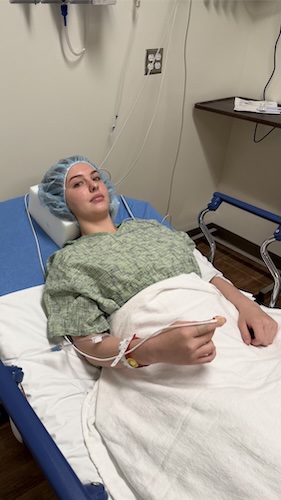
So I went up to the hospital; they checked me in, and they said, “You’ll be here for one night.” I ended up being there for about two weeks. I got a chest wall biopsy, and I had a lot of fluid drained off my heart, because that’s what was wrong with my heart. I had 600 milliliters of fluid in the sac around my heart, along with a 10.4-centimeter tumor, and the two were kind of sitting together in one spot.
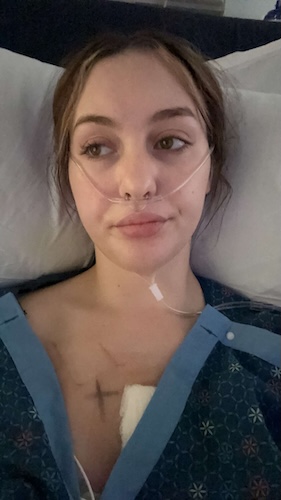
I ended up in the ICU because they’d put a catheter in place to drain the fluid off my heart. I couldn’t handle all of it happening at once. I had my port put in during that same hospital stay, so I went through four different procedures total, all while they weren’t letting me eat because they didn’t know if they’d need to do more. I went about a week and a half just on IV.
It was pretty bad. For someone who had no medical history before that and never needed to go to the doctor, it was the biggest shock ever, and I didn’t know how to handle it, so I just laughed. I’d text my family and say, “You probably wouldn’t want to come up here and see me right now.” It was bad.
Finding out I had cancer through MyChart, before a doctor called
Just knowing what was going on, and at least getting treated for it, was very reassuring. But the whole time I was in the hospital, they wouldn’t give me real answers about what was happening. I didn’t even find out I had cancer until after I was released from the hospital, once they said I was stable and could be out of the ICU. I went home and rested for about two days before I got MyChart results, and I actually found out through MyChart that I had cancer before a doctor even called me. So I was sitting at home thinking, “Okay, what do I do now?” Then I ended up meeting my hematologist-oncologist, who’s actually great, very nice, and the one who told me it was stage 4, so at least I didn’t find out the severity of it alone.
I get it for blood tests, but if I’m about to find out that I’m seriously ill, please don’t send me the results.
Hearing “stage 4” and finally knowing I wasn’t “crazy”
I’m pretty sure all I said when he told me was, “Oh.” I couldn’t even think of anything else to say. He’s actually a really goofy guy, surprisingly, and a younger doctor. He was showing me my PET scan results and said, “So this is where it is,” and it was basically neck to ankle at the time. It was everywhere except my head and my feet. And he said, “We’d classify this as stage 4.” I just said, “Oh, really? Yeah, I guess I’d think so.”
But surprisingly, throughout the diagnosis, I never really had bad anxiety. And once I got an answer, I don’t think I ever really cried about it again either. It was more calming, even though I knew the treatment was going to be horrendous. I was just happy to finally know what it was, and to know I wasn’t crazy.
The missing piece: How cancer in my pelvis explained a year and a half without a period
For those two years, for the longest time, it was just summed up as anxiety, or they’d acknowledge there was a problem but not treat it. I forgot to mention one of my other main symptoms too — which is uncommon; I haven’t met another woman who’s had this — but my cycles completely disappeared for about a year and a half before I was diagnosed. They couldn’t tell me why. Of course, they did the whole “Are you pregnant?” I said no, I’m not pregnant. And they’d say, “Maybe you’re just anxious, and that’s why your period stopped.” I was like, for a year and a half? That’s crazy.
But it was actually because the cancer had spread to the left side of my pelvis and was growing lesions there, and that’s why my cycle had stopped, which was probably the biggest relief once I saw the PET scan and saw where it was. I was like, “I guess my body just hasn’t been working right for the longest time,” but it was cancer. I finally got a lot of answers for why things were happening and why I was so tired. I used to beat myself up because I was usually so consistent with things, and then finding out this was out of my control and that I wasn’t lazy was the biggest relief on top of everything else.
My approach to coping: “You can’t control it, so why stress?”
I’ve had a lot of medical professionals tell me they rarely see someone handle things the way I do. And I think, “I feel a little special, thank you.”
But that’s just how I’ve always coped with everything. You can’t control it, so why would I make it 10 times worse for myself by stressing about it?
Six cycles of AVD chemotherapy, immunotherapy, and goserelin shots
I did six cycles of AVD chemotherapy plus immunotherapy, so it was 12 treatments total. Compared to some people, I’m thankful for that, because it sounds like a lot to someone who hasn’t been through it, but it actually isn’t the worst.
I didn’t have to do radiation, which I’m so thankful for. I went through a long consult with a lot of different doctors to make sure I didn’t need it, and they said it would be very pinpoint radiation if I did, but they said they don’t see a reason to do it, because of the risk involved. They said if it comes back, that’s something we could look at then.
Besides that, I also did goserelin shots because the cancer had spread to my pelvis. We didn’t have time to freeze my eggs because of how severe it was. They wanted me to start chemo the next day. So I was put on goserelin, which wasn’t fun at all. It’s just a shot, but it’s the biggest shot you’ll ever get. It’s the worst. And they’ll only give it in your stomach.
Bone-deep pain, nausea, and a hydration “cheat code” for getting through chemo
My biggest thing with side effects was nausea and hair loss, and a weakness that went deep into my bones; it wasn’t overall fatigue, it was specifically bone pain.
Towards the end of chemo, I found a bit of a cheat code: I’d chug a bunch of water the day before and the day of treatment, and I’d recover faster by staying hydrated. But I tolerated the chemo well considering how bad my disease was. It consistently got better, which was the main thing, obviously. I was able to cope with the side effects pretty well, in my opinion.
Thirty inches of hair, gone before chemo even started
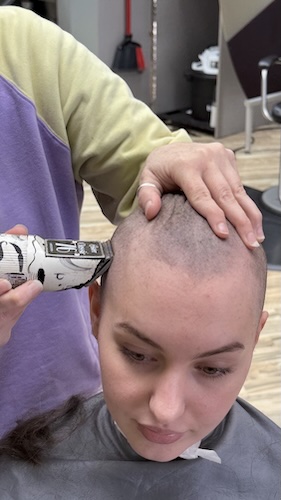
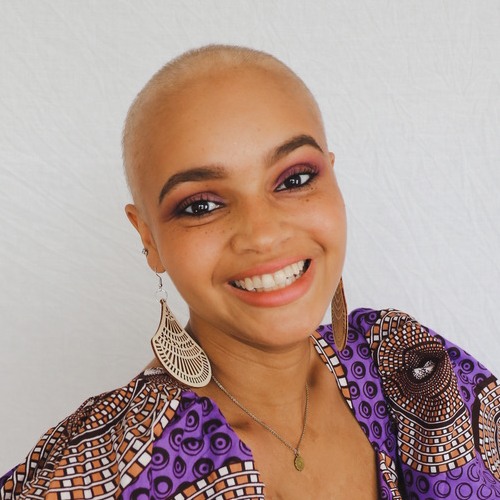
The stress of knowing I was going to lose it made my hair start falling out before I even started chemo. I’d literally have chunks coming out. Once I started chemo, it all just started falling. I got to the point where I decided I was just going to shave it. I think it was after my first treatment; I was like, “I’m just shaving it.” I can already see it happening; I don’t want to watch it fall out.
So I went and got it shaved. My husband shaved his head too. He also keeps his head shaved because he’s in the military, but it was very sweet of him to do it with me. I had probably about 30 inches of hair before I shaved it off. I’d been growing it since I was a kid, so it was heartbreaking, to say the least. It took me a long time to feel confident again because of the hair loss. I don’t know if this sounds self-centered, but I struggled more with my appearance changing than I did with the actual treatment I was going through.
Watching my hair grow back curly, gray, and then dark again
Even now, it’s just hitting my shoulders. My hair wasn’t very curly before chemo. It was pretty straight; I had what I think is called the Irish curl, where it was curly underneath but straight on top. Now it’s curly everywhere. That’s been a process.
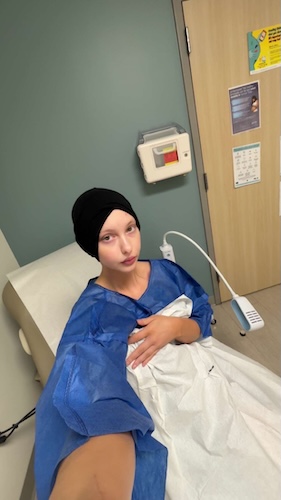
I wore beanies for a long time. I didn’t like the regrowth process, because it came in a little patchy. At one point, when it started regrowing, I actually shaved it again because it wasn’t growing in right. My color was coming in almost clear, so gray and light; it felt see-through, and that was really stressing me out. So I shaved it again, and it grew back in really dark. Before that, my hair was lighter, more of a red-brown, more red than anything. Now it’s more chocolate.
Learning to love a changed body
Growing up as a teenager, it was always difficult to appreciate what I looked like, because of the internet and comparing yourself to everyone else. So going through chemo and basically being stripped of everything I thought was beautiful was difficult, and it made me look inside myself and appreciate inner beauty more than anything.
As far as appreciating outer beauty, that had a lot to do with my husband, reassuring me that everything was fine and always being there for me. And for self-love, it was just the fact that I’d been through everything and needed to be a lot softer on myself.
Looks aren’t everything. Even now, five years ago, I wouldn’t have gotten on this camera with three pimples on my face. I wouldn’t have done it. But now I’m like, so what, it doesn’t matter. Literally anything can change. I learned that. So I really don’t care anymore.
Being told, “Get your affairs in order,” then being told I was cured
Honestly, I was super skeptical. I didn’t believe it, because it had been going on for so long.
When I had just started chemo, a doctor told me it would be wise to get my affairs in order, just in case. I thought that was insane. Why would you say that to me? So going from being what some considered dangerously ill to basically being cured, having no evidence of disease, was an intense feeling. But I actually felt more isolated being cured than I did during treatment, because I thought, “Where do I go from here?”
I went from having three or four doctor visits a week, my whole schedule full of things I had to do, to suddenly being back out into the world. “Figure it out!” I didn’t know what to do.
Building a future: Nursing school, the Air Force, and a plan to become a physician
Honestly, it’s just been trying to figure out what I want to do.
I even talked to my oncologist about it, because I was thinking about going back to nursing school. He told me he thinks I’d be a good fit for higher education, actually becoming a physician. I thought that would be really cool, but it’s really expensive. So I’ve been talking to friends, and I plan on joining the Air Force and using that to pay for higher education, serving as a physician in the military. That’s the plan, to start in 2027. They just want me to be in remission for a certain amount of time first. I’ve already spoken to a recruiter and all that.
Besides that, I kind of just do my own thing. I enjoy streaming on Twitch, and I make artwork. I did artwork throughout chemotherapy just to have some pocket money, since I could still work that way. I’d make portraits for family and friends. I try to work out now, though I’m not very consistent. I’m still super tired; it’s like a chronic fatigue that no one can figure out what to do with, so I just deal with it.
Besides that, it’s a lot of planning for the future, because I feel like you have to plan, even though anything can change at any moment; at least I tried. I had a plan.
Scans every six months and a body that keeps finding new problems
For PET scans and CT scans, I get those every six months, unless I feel like I need one sooner, which has definitely happened a few times. Recently, I had a lymph node in my neck that was swelling up, and they wanted to do a biopsy, but I ended up just getting the whole thing removed.
It feels like every time I get something checked, something new pops up. It’s a constant thing. Even now, I had the blood vessels inside my nose cauterized because they kept bleeding. I have to get a sleep study next month because they want to see if I need a septoplasty to fix my nose. After all, for some reason, it’s all changed shape — kind of a zigzag on the inside now; I don’t even know what to call it. So it’s just always something new.
I’m still seeing one of my specialists basically every month: either fertility, hematology-oncology, cardiology, and now endocrinology too, because I’ve had problems with my thyroid. It’s always something. I keep thinking, the Air Force is never going to take me if you all keep finding something new; please stop.
Fitting doctor visits into a full life
I don’t know how I do it; I just kind of fit it in there.
A lot of my stress relief comes down to complaining to my husband, “This sucks! Anyway, I’ve got to go see so-and-so doctor today. I’ll see you in a couple of hours,” and then I come back and just do my thing again.
It’s just fitting it in, I guess. You can’t really control it. And they’re funny about it too; if I miss an appointment, they’ll message me in MyChart, like, “Why didn’t you come today?” And I think, I’ll be there. It’s not like I can ignore it.
What two years of being dismissed taught me about myself
Probably just that I can handle a lot.
Growing up, I felt like a very isolated teenager. I didn’t have a lot of friends. I ended up finishing middle school and high school through an online program. I was just in my room, playing video games. I went from having such bad anxiety that I wouldn’t even go into a grocery store without music playing, feeling like everyone was looking at me and I couldn’t do it, to constantly being treated and having no sense of privacy at all, because you go into surgeries and they’re just stripping you down, putting you in a gown.
At first I thought, “This is insane.” But I got used to it pretty fast, because it’s like you either do it and survive, or you let it do its thing and see what happens. And even then, survival isn’t guaranteed; you just have to do what you think is best. But yeah, it was a huge change.
“All you can do is advocate for yourself”
All you can do is advocate for yourself.
If you seriously feel like something’s wrong, even if every time you go you’re dismissed, eventually you’ll find someone who takes you seriously. Hopefully, it won’t take two years as it did for me, but eventually, there was a doctor who was concerned enough to look over my medical history and find out there was something wrong. That, and my husband constantly telling me, “Hey, you need to go,” because he believed me.
About a year before I was diagnosed, my dad passed away, and I remember thinking about all the little things he used to say, like, “The wheel that squeaks the loudest gets oiled first.” I’d think about that. He always told me if you don’t go after something, it’s never going to happen. So that’s part of why I kept going back.
My final piece of advice: “It’s all about mindset”
Honestly, again, with self-advocacy, you just have to keep going at it. Eventually you’ll get an answer, and you don’t get an answer by sitting still.
If you’re currently going through it, all I can say is that you’ve got this. It’s all about mindset, because I feel like the mind is more healing than any medication could be. That’s my advice.
What I want younger patients on social media to know
A more modern-day perspective for younger people online, especially if you’re on social media. I was very open on social media about what I was going through, and not everybody is going to be constantly accepting. I did lose friends during treatment because they didn’t know how to be around me anymore, and honestly, that was completely okay. Some people were mean online. I had people send me insults, people I didn’t even know. I literally had someone DM me that I was a “Make-A-Wish kid.” I was just like, okay.
But when it comes to social media, just be prepared that not everyone is going to be compassionate. Some people just aren’t, and there’s nothing you can do about it, I guess. Always bad with good.
This interview has been edited for clarity and length. The views and opinions expressed in this interview do not necessarily reflect those of The Patient Story. This content does not replace professional medical advice.
Inspired by Rhea’s story?
Share your story, too!
Hear from people living with Hodgkin lymphoma
Real experiences with diagnosis, treatment choices, side effects, and life beyond Hodgkin lymphoma — in their own words.



Leave a Reply