
When the Lump Wasn’t Nothing: Selina’s Stage 4 Parotid Gland Cancer Experience
Selina was diagnosed with stage 4 parotid gland cancer (mucoepidermoid carcinoma of the parotid gland) after years of feeling unusually exhausted, getting sick more often and more intensely than those around her, and living with a mysterious, slowly growing lump beneath her ear. (Editor’s Note: The parotid glands are the largest salivary glands and are located in front of and below each ear.)
Interviewed by: Nikki Murphy
Edited by: Chris Sanchez
Even before cancer, her health had already been complicated by Graves’ disease, an autoimmune disease affecting the thyroid, in her early 20s. It required radioactive iodine treatment, heart medications, and lifelong thyroid hormone replacement. By the time she should have been celebrating a carefree 21st birthday, she was instead navigating specialists, side effects, and a body that never quite played by the rules.

Selina’s life moved forward with new jobs, a relationship, and then a surprise pregnancy during the COVID-19 pandemic. The lump under her ear quietly changed from a painless, “movable” spot that doctors initially dismissed, into something sharper and more insistent. Ear pain, shooting sensations, and the lump’s steady growth finally led to a referral to an ENT, scans, and an “undefined” biopsy that neither confirmed nor ruled out cancer. Surgery in February 2023 revealed the full picture: the tumor was the size of a grape, wrapped around her main facial nerve, and pathology confirmed stage 4 parotid gland cancer; specifically, mucoepidermoid carcinoma of the parotid gland with spread along that nerve.
Selina underwent targeted radiation to lower the risk of recurrence and improve her quality of life. Her treatment left her profoundly fatigued, with a painful radiation “sunburn,” hair loss along the treated side of her head, and lasting changes in taste and sensation. Chewing became nearly impossible, her tongue felt half numb, and foods she once loved became sources of nausea. At the same time, she was parenting a two‑year‑old, improvising low‑energy activities from bed, and relying on her husband’s help, while worrying constantly about the kind of mother she could be through all of it.
Post‑treatment, Selina describes realizing that the end of radiation was not the end of cancer. Ongoing scans, new lumps, temporomandibular (jaw) joint or TMJ pain, and the ever‑present question of recurrence mean she lives with cancer as a “long‑term roommate.” Yet, through therapy, coaching, and eventually sharing her story publicly, she has begun to reclaim her voice, redefine her limits, and offer other patients something she often lacked herself: honest connection and the reminder that no one has to carry this experience alone.
Watch Selina’s video above or read her interview’s edited transcript below to find out more about her parotid gland cancer story.
- Listening to your body, even when tests are “undefined” or symptoms seem easy to brush off, can be critical, especially with rare cancers like parotid gland cancer.
- The end of treatment is not the end of cancer; Selina’s life after radiation is about adapting to lasting changes in her body, energy, and sense of taste, while staying present for her son.
- A universal truth in this experience is that cancer can feel profoundly lonely, even with supportive people around you. Finding “your people” who truly understand can make it easier to keep going.
- Selina’s transformation includes moving from a sheltered, private person who kept her earlier radiation experience quiet to a young mother willing to write, speak, and share her story so others feel less alone.
- Framing care around quality of life, rather than cures alone, helped Selina focus on boundaries, pacing herself, and redefining what it means to “show up” as a parent and as a person living with stage 4 parotid gland cancer.
Selina’s Diagnosis Facts
- Name: Selina P.
- Age at Diagnosis:
- 27
- Diagnosis:
- Parotid Gland Cancer (Mucoepidermoid Carcinoma of the Parotid Gland)
- Staging:
- Stage 4 (Metastatic)
- Symptoms:
- Appearance of a small, movable, eventually painful lump that would sometimes produce a “crackling” sensation when touched
- Persistent earache
- Treatments:
- Surgeries: parotidectomy, lymphadenectomy
- Targeted radiation therapy

This is not medical advice. Please consult with your healthcare provider to make informed treatment decisions.
- Selina’s Diagnosis Facts
- Introduction and diagnosis
- Life before parotid gland cancer symptoms, and early health issues
- My surgery day and pathology results
- My fears before starting radiation treatment
- My radiation treatment plan and side effects
- Follow‑up scans, surveillance, and other health monitoring
- The hardest part of my parotid gland cancer experience
- Why I share my parotid cancer story
- “Scanxiety” and coping with surveillance stress
- My advice for others living with cancer and uncertainty
- Hear from people living with head and neck cancers
Introduction and diagnosis
Hi, my name is Selina. I’m from San Diego, California, and I was diagnosed with stage 4 parotid gland cancer — mucoepidermoid carcinoma of the parotid gland.
Life before parotid gland cancer symptoms, and early health issues
Life before my diagnosis was hard — before, during, and after cancer. Before cancer, I was tired all the time. I did not know why. If I got sick, I was sick longer than the normal time span. If I drank or did social activities, I would feel a lot more impacted compared to those around me. I never knew why. But I still tried to enjoy my time with my family, my friends, and doing activities.
Back then, in my 20s, I was okay. I was working and going to school. I was homeschooled for high school, so it is not like I had an eventful childhood. I was a very sheltered child. Then I started working on a military base. From there, I started working in a dealership. For high school, to graduate, working was my credit, so I started working at almost 17.
After a few years, I got a new job and started working at the car dealerships around the end of 2015. I got medical insurance and all that through my work, so I started going to the doctors. Within my first year of working that job, I noticed things that led to my diagnosis of Graves’ disease. I noticed I was shaking. I was just always so skinny, and I went to the doctors. They diagnosed me with Graves’ disease and gave me radioactive iodine treatment to kill my thyroid. I was on heart medication to slow my heart. After that, I was on hormone replacement therapy for the rest of my life. So, while I was 20 or 21, by the time I was 21, I had already gone through all this medical treatment.
I did not get to enjoy my 20s and go out or do what other people do. People turn 21, and they go drink. I was on heart medication. After I got through it, for my 21st birthday, I did a mud run. I ran my way to my first beer at the end, but I did not drink it because I was on heart meds. After I went on hormone replacement, I just went about my life. I kept working and went back to school. I was planning on joining the military.
I ended up meeting my husband in 2018, and we got together in 2019. Then I got pregnant. When 2020 came around, during the COVID pandemic — around the time I met my husband — that is when I noticed a lump in my ear, below my parotid gland. Because the chances were so low of my having a baby, they said it was just high risk and very unlikely, I guess. So I thought, “Okay, I am not really thinking about kids,” and I was focused on joining the military, anyway.
So when I met my husband, I told him about my health issues. And when I got pregnant, it was kind of a surprise. I was sick with the flu, and I did not feel good. I went to the doctors, and we both found out at the same time that I was pregnant.
From there, I had our son during COVID. I tried to go back to work, but then went back to not working because my husband is in the military. It was hard childcare-wise because we did not have a lot of support from people to help us at the time. Then my health insurance switched, and I saw a new doctor. I told them that I had a baby, I had Graves’ disease, all of my history, the whole shebang, and I told them that the lump was bothering me. The doctor just gave me earache medication and said, “We will just see how it goes.” This was in 2022.
I got married in April of 2022, and I started seeing the doctor in May or June. From there, we went on our honeymoon, our family honeymoon with our son, in September of 2022. I did not feel good the whole trip. I could not really enjoy it. When I came back, I told the doctor, and she sent me to an ENT. One thing led to another, and I started seeing different doctors back-to-back and getting different scans. They did a biopsy. It came back unfounded, so it did not confirm or deny cancer. The ENT doctor who did my surgery for my cancer said the best way to find out is to continue with surgery and go from there.
My parotid lump and worsening symptoms
The lump started painlessly. It just felt like when I moved my neck up and down, I would feel something move. I would feel it move, and I thought, “This bothers me.” It would make a cracking noise when I would move my neck or turn a certain way. I would touch it, and I could hide it, push it back in under the bone or whatever, and I did not think anything of it. I thought, “Okay.”
The first doctor, before I got married, said, “It is nothing, it is movable.” I let that be the answer because I did not want to keep following up. After my first health diagnosis, I did not want to go through another health thing. By the time I got to my second doctor, in 2022, it started hurting. When I touched it, it hurt. I would feel a sharp pain, sometimes consistent, sometimes not. It felt like an earache — ear pain and a shooting pain where the lump was.
By the time it got to the size of a grape, it was still movable. It started tiny and then grew to the size of a grape. The way I describe it is like when you grab your kneecap, and you move it, it moves just slightly, and that is how the lump was moving. Even with them touching it and with the scans compared over a series of time, it grew steadily over time. The biopsy showed “undefined.” It did not define whether it was cancer or not cancer. That was the weirdest part of it all.
My surgery day and pathology results
My surgery was scheduled for February 7, 2023. Before the surgery, when I talked to the doctor at the pre-op appointment, he went over the biopsy again and said it was undefined. He said there were two options. If it was not cancerous, then it was fine, and I would be done and not have to worry about it. But if it were cancerous, that would be a whole different conversation.
A part of me wanted to have that conversation then. He said, “Are you sure? I think it is fine.” He was being positive. He is a good doctor. I said, “No, I want to know.” He told me that I would need to do radiation or chemo. It just depended on what kind of cancer it was. I did not understand any of these words, but I thought, “Hopefully it is nothing, and I can get on with my life.”
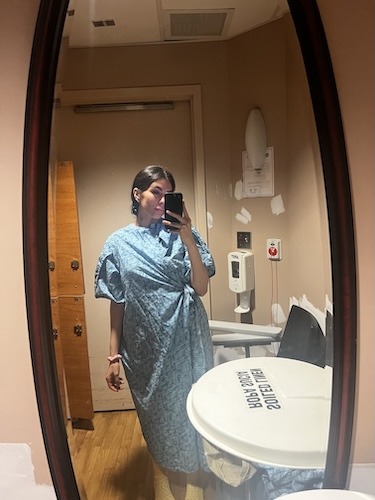
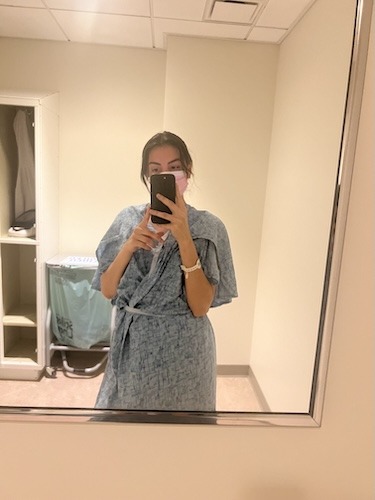
On February 7, 2023, I had my surgery. I remember going in and waking up, and he was asking me to smile to see if I had movement in my face. I did not know until a week later, on February 14, Valentine’s Day. He started talking about radiation. I had no idea. I thought, “What are you talking about?” He said, “Your husband did not tell you?” because I guess it did not register with my husband either that I had stage 4 carcinoma, parotid gland cancer. I said, “What? What does that mean?”
The doctor said the tumor was the size of a grape, and it wrapped around my main facial nerve. They had to remove the tumor, but they also took out more tissue outside the tumor range to see if it had spread anywhere else, like on my neck. They had to do a fat graft and a nerve graft. That is why now, when I smile, my face pulls differently, or I do not have any sensation in the side of my face right here. It feels numb, and my ear does not feel like my ear.
The doctor said the only option for me is radiation. I have a chemo‑resistant cancer, and radiation is the only option. The best thing they could do for me is give me a better quality of life. The radiation would increase my odds or statistics or whatever. So we did the radiation.
Understanding stage 4 parotid gland cancer and ongoing surgeries
He mentioned the cancer was stage 4, which meant that it had spread to my facial nerve. They did take out some lymph nodes, but nothing cancerous showed up in them. I do have to see him again in September this year because I have more swollen lymph nodes and an adenoma in my neck. He has to remove them.
Ever since my first diagnosis — even since my birth, actually — I have had one to two surgeries each year. This last year, in October, was my last one, but I am still going to have future ones because they keep checking and digging in there to make sure everything is okay.
My emotional reaction to hearing “stage 4 parotid gland cancer”
In that moment, I do not think I processed it. I just thought, “Okay, the next step. This is what I need to do. This is where I need to go.” I felt like I was on autopilot the whole time. When I think back, it did not really register with me. It just felt like another thing to do.
I had done radiation before, but it was iodine pills, so it was quite different. I thought, “I have done this before, it is fine,” but it was different, and it was not fine. I did not understand it.
I just thought, “Cancer is here. What do I need to do?”
My fears before starting radiation treatment
Yes, I was scared.
The first time I did radiation, I thought, “Okay, I can do this.” This time, I also had to raise my son. I think I was scared for the version of myself as his mother. Sure, I had done this before, but this time I was learning how to survive this while also learning how to be a mother. That was the fear I had — how I was going to do these two things and get through it okay.
I was scared of how I was going to show up for him. I was scared of whether I was going to be tired all the time, whether I was going to be present, and whether I would be able to function throughout the days without him seeing me fall apart.
My radiation treatment plan and side effects
When I spoke to the doctor about treatment options, my only option was radiation. My cancer is chemo‑resistant, and that is all I could do because they had already done the surgery for it, and they found out during the surgery that it was cancerous and had spread to my facial nerve. Because it had spread there, they suggested radiation. Otherwise, they would have just let it live there and seen what happened. I went through with the radiation because I did not want to take my chances.
I did not get a second opinion. I trusted this doctor. He is very good at what he does. I did ask my primary doctor for her advice. They said he is one of the best doctors in San Diego and one of the best doctors I could have had to do my surgery and treat me, so I did not get a second opinion. He was good.
Experiencing 30 days of targeted radiation
I did 30 days of treatment, not including weekends, every day Monday through Friday. It was targeted radiation therapy.
At first, it felt easy, but then it got harder as it got closer to the end. Mostly, I felt tired. That was the biggest thing. I would just feel tired. I drank a lot of water.
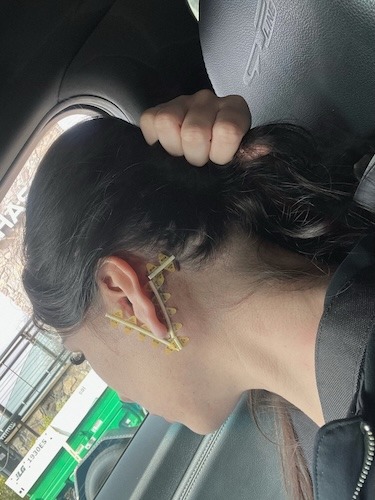
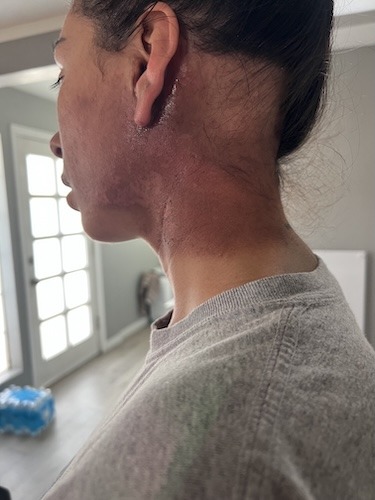
Toward the end, it started burning my skin. It turned red. It felt like I had a very bad sunburn. I lost my hair in the back of my head, on the side from the ear to the middle. It felt draining. It just felt draining. My hair falling out and my skin turning red were the main side effects.
I guess it does not happen to everyone, but it happened to me.
Parenting a toddler while I was having radiation
My son was two at the time. Most of my days looked like finding activities to do with him that would not require me to get out of bed. I would read, sing, or put something on and have him draw, or watch TV shows with drawings or little dances. I still pushed through because I had to. I had very little help.
Eating did not help because of my jaw. I lost half the feeling in my tongue and my taste buds in my tongue. Everything I liked before, I do not like now. I was mostly on smoothies. All I could drink was smoothies because chewing became impossible toward the end. It was hard doing things, but I still did them. I still took him places with my husband, and my husband helped me chase him around.
Finishing radiation and adjusting to a new normal
At the end of radiation, I felt weak. It felt like I needed to get back to being healthy again, so I could have more energy to keep up with my son and do regular activities without my husband having to help me 24/7 or having to call someone just to go somewhere with my son.
I started getting back into exercising. I had a coach who is also a melanoma skin cancer survivor, so she understood how I was feeling and what I was going through. She was one of the first people I talked to. She helped me get back on track with working out.
I used the cream the doctor prescribed for the radiation “sunburn.” I waited for my hair to grow back. It felt like I was not done. The end of treatment was not the end of cancer. It felt like a whole new thing I had to navigate — a body that did not quite work the same, and the quiet awareness that my body is both home and a hazard. I had to figure out what I could actually eat now because everything I liked before radiation, I did not like anymore. I had heard people say that radiation changes your taste buds. I thought, “No,” but it did. There are a lot of things I cannot eat anymore because they make me feel nauseous.
It was about navigating the change and figuring out who I was after all that, and also navigating being more present. That was my biggest concern — being more present for my son.
Follow‑up scans, surveillance, and other health monitoring
After I finished radiation, they did blood tests and scans. Immediately after treatment, I had them every other month. I was seeing my oncologist and the ENT doctor. I would see one in one month, then skip a month, and see the other the next month. I was seeing them more often. As the next year came, I kept getting scans too.
The first year after my parotid gland cancer diagnosis in February, with radiation in April and May, they continued scans through the end of the year. As the next year came, they moved it to every three or four months — tests every three months and seeing both doctors, one in one month and the other the next month.
Now I am at every six months, so I see each doctor every six months. My scans, as of last year, went to once a year. They did one last year and should do another one this year. That is it. They are just monitoring it. That is all they can do for me — just give me a better quality of life.
From there, I went to different appointments. Because of my jaw, I had TMJ. My jaw clicks and hurts, so I had to get treatment for that. I have also had other lumps in my breasts. I know it is head and neck, but I also had lumps in my breasts that were monitored, and they are benign. I had to follow up with breast oncology because breast cancer runs in my family, but not this cancer, the one I got. I was always concerned about my breasts. I did not have breast cancer. I got cleared last year. They monitored me for two years because I had two lumps. They took out one and monitored the other, but the other one is steady, so I got cleared for that.
Aside from that, I see an endocrinologist for my first radiation — Graves’ disease and thyroid. It is monitoring all around. For my cancer, they said that is it: there is radiation, and if it comes back, there is nothing more they can do. They said the radiation put the cancer to sleep. As long as the bear stays hibernating, then I am okay. That is it. It is just about a better quality of life.
I feel like I did not get that many options with my cancer. They said, “This is your only option, and all we can do is improve your quality of life.” Unless they see another lump come back in that same spot, they are not concerned.
I will be monitored for five years. I am in my third year, so I have two more years.
Living with the possibility of recurrence
I believe I asked my oncologist whether they would do radiation again if it comes back.
He said, “Let’s just hope it does not come back,” because if radiation did not work the first time, it would not work the second time.
As of now, it is working, I guess, since I am still in remission.
The hardest part of my parotid gland cancer experience
The hardest part is people thinking I am okay now just because I finished treatment, I rang the bell, and I am “okay.” There are some days I feel like my cancer has become a long‑term roommate. Some days it wins and some days it does not. Some days I feel steady, and some days I feel like I am barely pulling through, even though others do not see it. I look fine. I function more normally.
I think the hardest part is learning my boundaries for myself. If something is too much for me, I should not do it. I try not to push myself to show up or to appease other people, and I try not to hold on to how I was before. It is a lot different now.
The hardest thing to grasp is that I am not the same as I was before — how I function and how my body works. My body does not quite work the same. Accepting that has been hard.
Cancer is lonely. Even if you have people around you and support — and I have done therapy and talked to my coach, who is my training coach and also my life coach — and even though I have found some people who have had cancer, it is still lonely. Even though we talk to each other and I have learned from them, it is still lonely. You feel like it is just you against the world, or your cancer against whatever else people assume about you.
How parotid gland cancer changed my sense of self
I feel like I am still figuring that part out.
When I first got diagnosed, the year before, I lost two people in my family. I was navigating that as well as navigating cancer. The whole time it was happening, I do not think I processed it.
Even now, I am still figuring out who I am after it all — the in‑between between before and now and during. There are things I used to do that I do not do now, and now I speak out more and am more open about my experience. I do not know why, but I am more open now.
Why I share my parotid cancer story
It started with a magazine that takes submissions. I wrote for them, thinking my writing would only live online. I thought, “No one is going to know I wrote that about my cancer experience or how I was feeling.” I did three submissions. They put two on their website, and one got picked for their magazine. With that came reading my story in front of over 250 people. I was shocked. I did not want to do it because I grew up homeschooled for high school, and I felt like a very sheltered child. Opening up and talking in front of people was something I did not want to do, but I did it. I do not think I did the best, but I think I did well being in front of people.
After hearing people’s reactions to my stories — my feelings, how it resonated with them — I felt like, “Why keep this to myself?” When I first went through radiation when I was 20, I never told anybody about it. I just popped this radiation pill and moved about my life, and took medication for the rest of my life for my hormones. I thought, “I am okay.” This time, I realized that it is not how it works. Other people are going through these things, and they do not talk about it. They do not have community, or they do not know how to find their own.
I have always liked reading, writing, and drawing, and that is the best way I can articulate how I am feeling. I can say I am angry but happy, or sad but grateful, on paper so easily, and talk about my experience without sugarcoating it. After I did the writing and the speaking event and saw how it resonated with people, it pushed me to do The Patient Story. I thought maybe there are other people out there with a similar diagnosis. I have only met one person with the same cancer as me. She has had it longer. I met her at that event. That was the first time I ever met someone with the same cancer and diagnosis; she had it for a longer period. Maybe there are others like that, and maybe they will see this and talk about their story or find people who relate to what they are going through.
During my treatment, I did therapy. My therapist suggested cancer support groups. But as a young cancer patient, I did not feel like I belonged. It was mostly older people who were terminal, with a month or so to live. I know mine was stage 4, and my only option was radiation, and if it comes back, it comes back, but they did not tell me I was terminal. I did not feel comfortable sharing in those groups. It did not feel right. It did not feel like it was for me. I stuck with therapy. I stuck with my coach.
It was not until the last year or two that I started seeing cancer support groups online for young adults. I have been reading people’s stories. That is what compelled me to write my own. I thought, “No one is going to see this. Maybe they will, but it is on a cancer foundation website. If they see it, it will help somebody.”
“Scanxiety” and coping with surveillance stress
I get a lot of what they call “scanxiety.” I feel tightness in my chest every time I have an appointment. I feel like a nervous wreck. I think, “Okay, I am getting in there.” What helps is the staff — the nurses or the people who get you in. When they are kind, they say things to distract me. They start talking about something random. They do not know why I am there. They make a joke or talk about something that is not the weather, just something random. I try not to think about it.
When you are sitting there in the machine, and it is making noises, I focus on my breathing and wait for the news to come back. In that moment, on the day of the scan, it feels like, “Okay, I got through this,” but afterward, I feel like I am not over it until my doctor tells me I am okay. When he tells me, “Scans are good,” it is like my chest unclenches and I can take a deep breath. I feel like, “I am fine.”
Even to this day, there is always that voice in the back of my head saying, “But what if it is not fine?” That comes from knowing I have these two things that I need surgery for. They did scans and said they looked fine, but my scans for my cancer also looked fine. That still bothers me. I try to keep myself distracted — read, write, do activities, and go about daily things.
My advice for others living with cancer and uncertainty
Do not feel like you have to carry it alone. There are people out there. There are people you can talk to. You just have to find your people — people you feel comfortable with and safe with, safe with your feelings and your experience. It does not necessarily get better, but I feel like it does get easier, especially when you know there are people around you who can relate.
If you do not have those people now, I hope you find them, or I hope they find you. Some people are more closed off. I was a very sheltered, introverted child, and that still shows up now. Once you put even just the slightest bit out there, and it reaches somebody, it makes you feel good. It did for me.
Knowing that it reached someone and that my story, my voice, mattered — even if it was just to one person, even if only one person related to it — made me happy. I thought, “Okay, I am not alone.”
This interview has been edited for clarity and length. The views and opinions expressed in this interview do not necessarily reflect those of The Patient Story. This content does not replace professional medical advice.
Inspired by Selina’s story?
Share your story, too!
Hear from people living with head and neck cancers
Real experiences with diagnosis, treatment choices, side effects, and life beyond head and neck cancer — in their own words.


Leave a Reply