
Two Cancer Diagnoses in 14 Months: How Jeff Advocated Through Stage 3B Colorectal Cancer Treatment
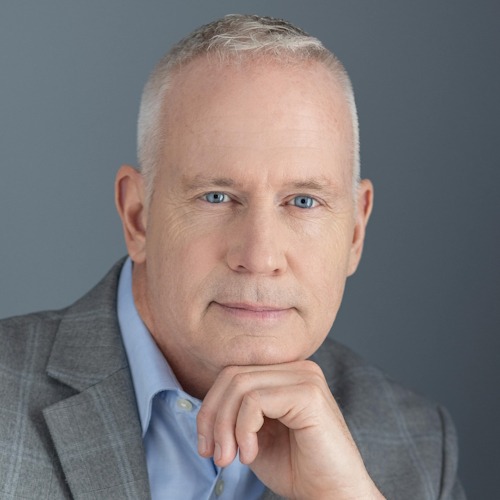
Jeff, a nonprofit CEO and Ironman triathlete, went in for a routine colonoscopy screening in August 2023, expecting to check a box. Instead, his doctor discovered a significant mass, resulting in a diagnosis of stage 3 colorectal cancer (stage 3B), 14 months after completing treatment for prostate cancer. Jeff had no obvious symptoms; colorectal cancer was found only because he followed his regular screening schedule after polyps were detected in previous colonoscopies.
Interviewed by: Nikki Murphy
Edited by: Katrina Villareal
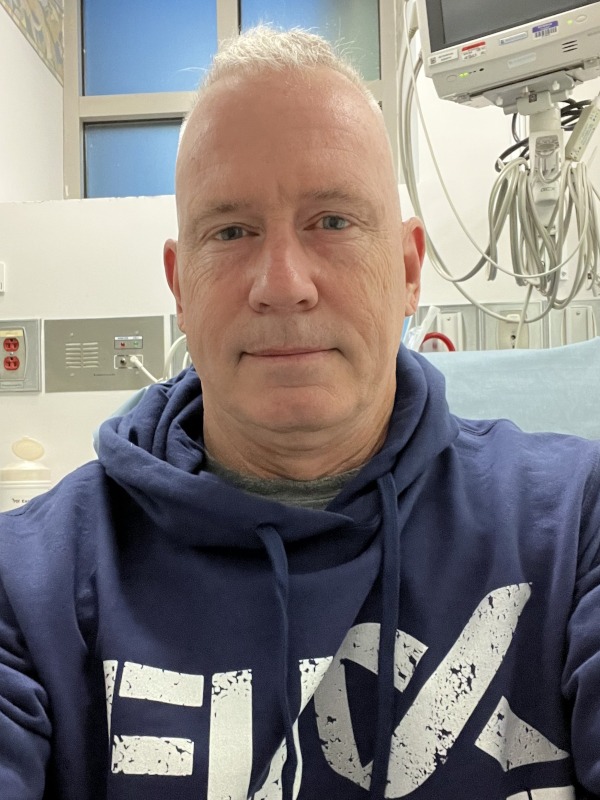
The period between diagnosis and starting treatment felt like being in an emotional valley, knowing something was seriously wrong but not yet having a clear plan forward. For Jeff, having a structured treatment plan made all the difference for his mental health. He chose NYU Langone, where he’d been treated previously, and was accepted into the JANUS clinical trial, an aggressive experimental regimen combining radiation, oral chemotherapy, and infusion chemotherapy.
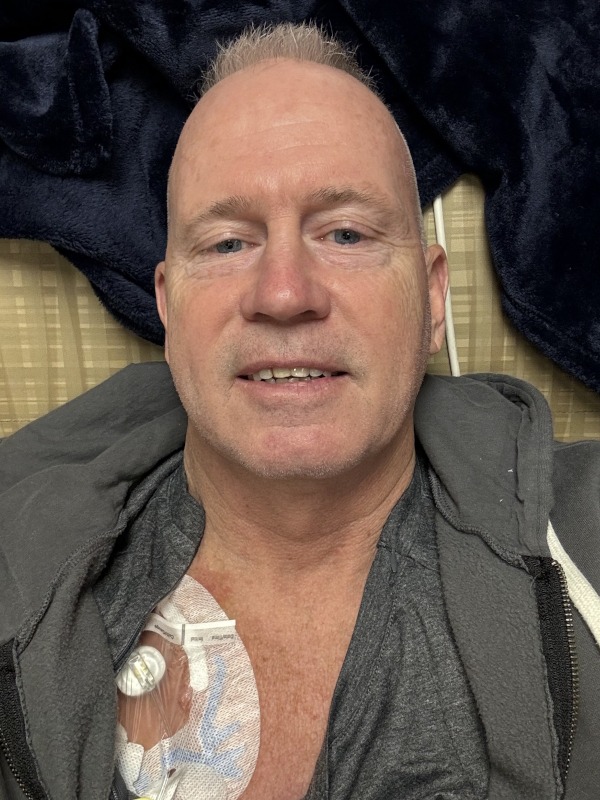
Jeff’s treatment included 27 days of radiation, 27 days of oral chemotherapy pills, and eight biweekly infusions over nearly three months. The side effects of chemotherapy were cumulative, which started mild but intensified over time: neuropathy, cold sensitivity, fatigue, and taste changes.
Two-thirds through treatment, his oncologist suggested stopping due to dropping blood counts and mounting side effects. Jeff refused, comparing it to stopping at mile 18 of a marathon. He persevered through the full regimen, continuing to work and even spending 16 hours at an amusement park with his children while on chemotherapy.
Now, two years after treatment with no evidence of disease, Jeff undergoes surveillance scans every four months. He’s been public about his experience, hoping to reduce stigma around colorectal cancer and prostate cancer, and encouraging routine screening. His perspective shifted dramatically from planning future accomplishments to reflecting on his legacy, from “I have to run five miles” to “I get to run five miles.” Jeff emphasizes the importance of self-advocacy, building support systems, and continuing to live fully despite scanxiety and the lasting effects of treatment.
Watch Jeffrey’s video or read the edited transcript of his interview to find out more about his story:
- Routine screening saves lives. Jeff had no symptoms, but caught stage 3B colorectal cancer through scheduled colonoscopy screening after previous polyps were found.
- Having a treatment plan provides crucial mental stability. The emotional valley between diagnosis and starting treatment is challenging; a clear action plan helps reduce anxiety.
- Clinical trials advance cancer care for everyone. Jeff viewed participating in the JANUS trial as both potentially beneficial for himself and as a meaningful contribution to future patients.
- Self-advocacy is essential throughout treatment. From questioning insurance decisions about radiation equipment to refusing to stop treatment early, speaking up can directly impact care quality.
- Cancer transforms identity and perspective. Jeff shifted from a helper focused on others to someone learning vulnerability, deepening relationships with male friends, and appreciating each day with profound gratitude.
- The waiting period between knowing something is wrong and getting answers is difficult for patients. Support systems and honest communication make this valley more bearable.
Jeff’s Diagnosis Facts
- Name: Jeff R.
- Age at Diagnosis:
- Mid-40s
- Diagnoses:
- Colorectal Cancer
- Prostate Cancer
- Staging:
- Stage 3B (Colorectal Cancer)
- Symptoms:
- None; diagnosed through routine screening colonoscopy
- Treatments:
- JANUS clinical trial: radiation therapy + chemotherapy (oral and infusions)
This is not medical advice. Please consult with your healthcare provider to make informed treatment decisions.
- Jeff’s Diagnosis Facts
- Introduction
- No obvious colorectal cancer symptoms before diagnosis
- Colonoscopy day and hearing “significant mass”
- How long the waiting period lasted and choosing NYU Langone
- Getting the stage 3B colorectal cancer staging
- Facing a second cancer 14 months after prostate cancer
- Enrolling in the JANUS clinical trial
- The cumulative side effects of chemotherapy and fighting for the best care
- Living with constant appointments and scanxiety
- Navigating relationships, marriage, and parenting during treatment
- How cancer changed my identity and public storytelling
- Advice to men carrying the emotional load alone
- My message to others facing cancer
- Hear from people living with colorectal cancer and prostate cancer
Introduction
My name is Jeff. I have two diagnoses. I was diagnosed with prostate cancer in April 2022 and with stage 3B colorectal cancer in August 2023.
My life as a nonprofit CEO and triathlete before cancer
I run a large health and human services-focused nonprofit that serves about 35,000 people a year, so my days are pretty full.
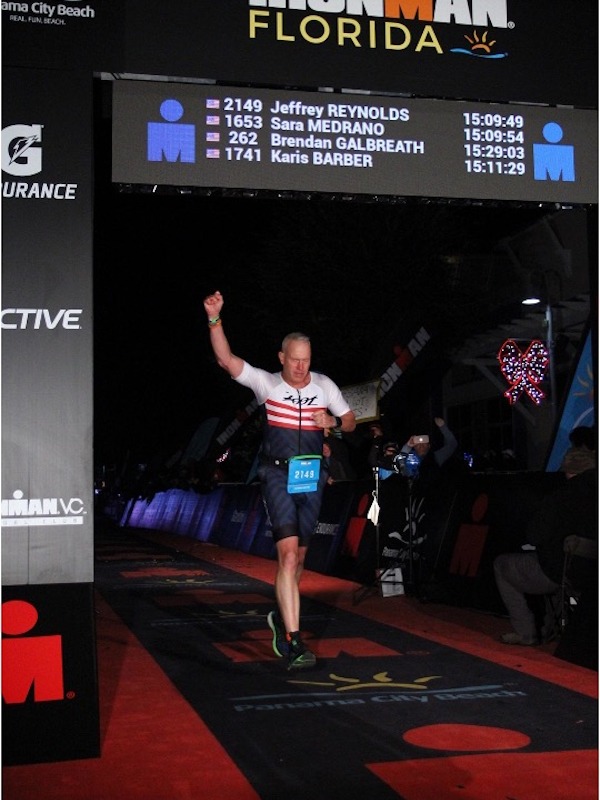
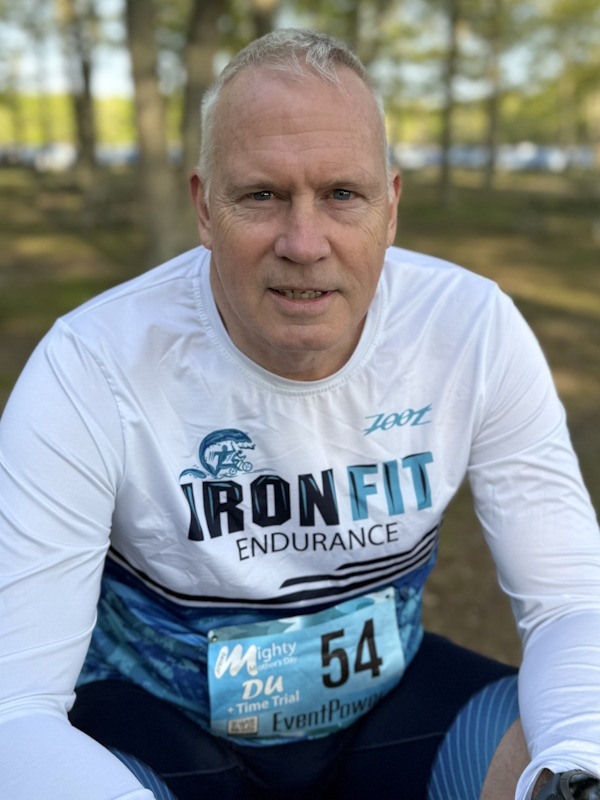
In retrospect, probably as part of a midlife crisis, I took up triathlon in my mid-40s. I started out running. Then, when a 5K wasn’t enough, I started running 10Ks, then half marathons, and eventually, full marathons. Then it wasn’t enough to be mediocre at one sport. I needed to suck at three things, so I took up swimming, biking, and running again, moving up the distances to the full Ironman distance, which I did in November 2021, right before my prostate cancer diagnosis.
It relates to how life looks in that I trained in two sports pretty much every day, particularly during the in-season.
No obvious colorectal cancer symptoms before diagnosis
I’ve played this through in my mind a thousand times. I have a very close friend who passed away who was also a triathlete, and I asked him, “Are you sure you didn’t have symptoms?” He said, “Oh, I did.” But he chalked those up to his workouts, to a life spent on a bike and running, and beating the heck out of his body.
When he had irregularity and/or blood, he said, “It’s because I just ran 26 miles. You’re going to bleed, right?” I didn’t experience those symptoms.
Because of a previous diagnosis, I was an evangelist for routine testing and screening, so I went in for a colonoscopy on schedule, fully expecting, “I’m checking a box here. I should do it, so I’m just going to go.” As I look back now, even in retrospect, I can’t think of symptoms that appeared and then disappeared, or anything abnormal.
What we know about colorectal cancer is that very often, you can suffer symptoms and not necessarily know. For example, you don’t always see bleeding. You don’t always know the deal. But I can’t recall anything. I had no suspicion of having any issues whatsoever and just went for the colonoscopy because it was on the schedule. I wanted to model the good behavior around routine screening and detection.
Previous colonoscopies and polyp findings
I had had one or two prior colonoscopies. They found polyps the first time around, so I was on an accelerated schedule. I don’t remember if it was a three-year or a five-year schedule, but I wasn’t on the 10-year schedule.
The doctor found polyps and said, “We grabbed some polyps. We always find polyps. Nothing I’m worried about.” We didn’t even wait for the biopsy to come back for him to give me the all clear. He said, “You’re good, but we took them out and here’s the preventative value in taking them out.”
I may have skipped a year because of the COVID pandemic and nobody was doing colonoscopies for a period of time. But it was either my second or third colonoscopy and on a somewhat shortened schedule because of the polyps the first time.
Colonoscopy day and hearing “significant mass”
It was August 8, 2023. Everything was normal leading up to it. I went in and had the best sleep of my life, which is how I sell getting colonoscopies. I came out of it, and the nurse said to me, “The doctor’s going to come in and see you,” which I didn’t think was atypical because the doctor is the one who debriefs you. It’s not necessarily the recovery room nurse.
He came in, and I’ll never forget it. I knew the minute he walked in. I thought, “Oh, this can’t be good at all.” He said, “I found a couple of polyps,” then raised his hands and said, “And I found a significant mass.” The only thing I could think to ask was, “Well, how significant?” And he said, “It’s very significant. You need to get a referral on the way out.”
I walked back to the waiting room. You can’t drive yourself to colonoscopies, which is a whole other topic, but my then-girlfriend, now wife, was sitting there. I looked at her and said, “It’s not good.” Then she heard me at the desk asking for an oncology and a surgical referral.
In minutes, we were out in the bright August sunshine, like nothing had happened, with birds chirping and everything else. I guess my senses were on fire because I remember walking out into the sunshine and feeling like, “What now? What do we do? What does this mean? What’s going to happen?” There were so many questions.
The emotional valley between “something is wrong” and a clear plan
On the way home, I tried to talk myself out of saying, “Oh no, this is a big deal.” When I arrived home, I got on the Peloton to try to ride away from all of this, and the doctor called to check on me. I thought, “They don’t call to check on you after a colonoscopy unless this is a big deal.”
As some may know or have experienced, you’re in this valley between knowing something is significantly wrong, but you haven’t been staged yet. You know that it’s significant, but there’s a gap between the time you know something’s wrong and the time you get the definitive diagnosis and the tumor staged, and the time you begin treatment. That valley is a rough period of time.
Most people, including myself, fill that time by Googling every word in your MyChart, joining online forums (which are not the best place to get information), and thinking through all the possibilities, hoping to get in to see a medical professional so you can ask all your questions.
How long the waiting period lasted and choosing NYU Langone
The wait was for a couple of weeks. The interesting part of this is that I have two friends who are both CEOs of regional hospital systems, and one was a very close friend. I called him and said, “Okay, so here’s the deal,” and he said, “That’s a pretty big deal. If you want to come to us, I’m happy to help you out.” My other friend said the same thing.
I wound up going with NYU Langone, a hospital system where I didn’t know anybody. The nice thing was that I didn’t have to know anybody. They handled my treatment for prostate cancer, so I was very comfortable with the treatment team from the day that I met them.
I called around and did my due diligence. They got me in pretty quickly, but even 10 minutes is a long time, particularly in an environment where you get your test results immediately. The staging happened pretty quickly, but you have all the anticipatory grief of knowing that we don’t yet have the plan.
For me, having a plan made all the difference in the world. I deal with things very logically, and I thought, “If we have a plan, I will be good.” Being in no-man’s land is a rough place to be, but having a plan and a team in place made a big difference to my mental health.
Getting the stage 3B colorectal cancer staging
I had already gone through all of the worst-case scenarios, including a stage 4 diagnosis. I still didn’t know a heck of a lot about this. It wasn’t my first rodeo with cancer, but I didn’t know a lot about colorectal cancer.
I thought, “Stage 3B sounds pretty close to 4. Is there a C, D, and E?” I was hoping all the letters of the alphabet were there. The most jarring part was the initial diagnosis because he knew off the bat that this was cancer and that it was a pretty big deal.
Having the staging actually gave it some definition for me, which was less traumatic than the initial diagnosis, where he said, “This is significant. This is a thing.” At that point, to me, cancer was cancer. I was imagining the worst-case scenario. It wasn’t exactly the worst-case scenario, so I was happy to know what we were dealing with. But that first inkling there was a problem was the jolt and the shock to my system.
Facing a second cancer 14 months after prostate cancer
Two diagnoses in about 14 months. I finished treatment for prostate cancer in July 2022 and I got this diagnosis in August 2023.
After getting through the first cancer diagnosis, I rallied. My doctor said, “You can’t run,” after I had prostate cancer treatment. I said, “All right, so can I walk?” He said yes, and I walked 200 miles in the month after my treatment. Then I ran the New York City Marathon that November. I was back. I did a commercial for the Prostate Cancer Foundation and became the evangelist for routine screenings because I didn’t fit any of the profiles and didn’t have symptoms.
It was like, “Oh, back again, and this one was more serious.” I’m not a big sports guy, but I know the three-strikes rule. I thought, “Wow, this is two strikes in 14 months. What is going on?”
We did a lot of genetic testing to figure out if there was something else going on that lined me up in this way, after having a lifestyle that’s pretty healthy. I certainly learned that health and fitness aren’t exactly the same thing. In fact, they’re different. It was like, “Wait a minute. I thought I just got through this. Now you moved the finish line and I’ve got to do this all over again.”
Based on my first diagnosis, I thought I had a sense of what cancer treatment looked like. It turns out I had no idea. The second round of treatment would involve radiation therapy, oral chemotherapy, and, as part of a clinical trial, chemotherapy infusions over the course of almost three months.
Reading MyChart, facing mortality, and big life questions
The downside of MyChart is that you get to see everything in your medical chart, including all the notes they’ve written. I was very relieved at times when I saw that they believed I was oriented in terms of time, person, and place. I was relieved they judged my prep to be excellent on some occasions.
But I also saw that, after every visit, there was a note that said I was counseled about the possibility of my mortality related to this diagnosis. That resonated with me. I didn’t have to see it in black and white to know it, but it prompted me to reevaluate a whole bunch of things.
There are questions in life that linger for a lot of us. Generally, when you get to midlife, you start resolving some of those: What do I believe happens when you die? Do I believe in God or a higher power? How have I lived my life? What’s my legacy going to be like? What will my children do without me? What will people say about me when I’m gone?
Maybe I should have wrestled with them sooner, but for whatever reason, I didn’t. I thought, “I’m an Ironman. I’m going to live forever,” so I had to wrestle with all of those things in a pretty short amount of time. I didn’t start from scratch, because I’ve got enough life experience and professional experience to have thought some of these things through.
Legacy, time, and talking to my children
It almost changes the tense. Overnight, I went from, “What are the things I want to accomplish in my life?” to “When I look back, what have I accomplished? What does that legacy look like? What do I want it to be and what has it been?”
It also puts a point on everything. You should do all the things you want to do in life because you don’t know how long you have. I suspected that I would get through this and all would be okay, but there are no guarantees. When people around me would say, “Oh, you’re going to be fine,” I was the militant, confrontational one who would say, “How do you know that? My oncologist won’t guarantee me that. My surgeon won’t guarantee me that. How do you know I’m going to be fine?” That always made for an uncomfortable exchange.
It prompted a reevaluation of a whole bunch of things. There are moments that just resonate with you. I won’t forget telling my kids both times about the diagnosis. In both occasions, I held the information until I knew the game plan because I didn’t want to say, “Hey, guess what? Dad has cancer; I don’t know what’s going to happen.”
I wanted to be able to say, “Dad has cancer, and here’s exactly what’s going to happen.” The second time, my daughter, who is now 18, said to me, “When did you find out?” She knows you don’t put a plan in place overnight. I told her. Then I went on to say, “Look, I will keep you in the loop. If things don’t go as planned or there’s a recurrence or something happens, I will tell you.” We didn’t have to speak the part where she said, “Yeah, like you told me about this right away,” but it was there.
You wind up remembering some of those conversations in very vivid detail. I don’t think they’ll ever leave. I don’t think that’s a bad thing. There are lots of folks who say there’s a ton of post-traumatic stress disorder (PTSD) that often accompanies these types of diagnoses and treatment. I would say yes to that, particularly around scan times. But there are also some good things that come out of it.
I hate the phrase “no evidence of disease” because cancer leaves behind plenty of evidence, whether it’s the side effects associated with chemotherapy and other treatment regimens, the psychological side effects, or the anxiety that goes along with routine screening. There’s plenty of evidence left behind.
Genetic testing results and the role of randomness
I had genetic testing, but nothing came back. The irony is that they spend an hour and a half counseling you and asking you questions, and then when they find nothing, all you get is an email that says, “We found nothing. If you want to talk, call us.”
I called them and said, “So you found nothing?” They said, “Right, we found nothing,” and that was the end of the conversation. I don’t know if that’s better or worse. Genetically, I’d rather they didn’t find anything just in terms of my children and their children. But it does defy explanation.
For me, as someone who’s very rational, I want to know cause and effect. What happened that caused this? To the best of my knowledge, I don’t live over a toxic waste dump. My eating habits are not perfect, but they’re pretty good. I don’t smoke. I don’t use alcohol excessively. As I track back, I think, “How did this happen and why? And why twice?”
My doctors said, although somewhat unsatisfyingly, sometimes it’s just bad luck. Sometimes this is the way it happens. It’s random. It’s by chance that you got this versus something else. This is just the way it goes. It’s a little unsatisfying, but it is what it is.
Enrolling in the JANUS clinical trial
Almost immediately, they said to me, “We think this is a radiation-chemotherapy kind of deal. This is not uncommon; it’s a pretty well-worn regimen.” I said, “So why am I talking to a surgeon?” They said surgery might be what follows afterward.
The treatment team is led by my oncologist. Very quickly, they said, “Given your health profile, your age profile, and your ability to withstand this regimen, we think you’re perfect for the JANUS clinical trial.” It’s a pretty aggressive round of chemo.
I know they can’t manipulate the results, but had I not gotten in, I would have been pretty devastated. When they said, “We’re going to pitch you for this. There’s a team meeting in New York City,” I stressed out because I wanted to be in the experimental group.
I thought of it in three ways. First was: If this doesn’t all work out, then I’m making a pretty significant contribution, and that’s what I’ve done my entire life in terms of helping people. I would want to help the next person who deals with this diagnosis. The second thing was: It might actually work, which would be awesome. I know it’s experimental and I know the limits of clinical trials.
The third thing, which you probably don’t hear very often, was that I felt it leveled the playing field. I thought, “I’m a research subject. You now need me as much as I need you, so we’re on equal footing.” They were more than accommodating; I didn’t need to pull that lever. But to me it felt like, “Now we’re in this together.”
I hoped to get into the experimental part of this, and I did. I was ecstatic when they called and said, “Hey, guess what? You’re in, and you’re in the experimental group,” because I would have felt like I was missing out if I’d gotten fewer drugs.
When I went into the clinical trial, we started almost immediately: 27 days of radiation with weekends off (I’m not sure why we took weekends off because cancer doesn’t take a weekend off, but we did), oral chemotherapy, and then chemotherapy infusions.
They spent a lot of time talking to me about the potential side effects, of which I probably only heard about half. As folks who are familiar with this will tell you — and I want to say this upfront — my cancer experience is my cancer experience. Cancer experiences vary, and I’m not trying to speak for anybody other than myself.
The cumulative side effects of chemotherapy and fighting for the best care
I’ve had at least two people say to me, “I had surgery, but I didn’t have chemotherapy, so it’s different.” Regardless of the treatment choice you make or what’s best for you, cancer is cancer, and a treatment experience is a treatment experience. Whether or not you had chemotherapy, not having chemotherapy doesn’t make it any less real or any less traumatic.
I realized very quickly, which they said a million times but I didn’t hear, was that chemotherapy is cumulative and the side effects are cumulative. Literally after the first infusion, I was eating pizza while other people were shivering under their blankets. Fast-forward to eight weeks later, I’m the guy shivering under the blanket and not eating anything.
All in all, it was a pretty interesting experience. There are lots of folks who criticize their healthcare practitioners. I wish I could find something to criticize, but they were excellent.
I did need to battle with my insurance company at least once. I got a call right before I started radiation and they said, “We’re going to change your location, literally up the block.” I said, “Okay, not a problem, I’ll be at the new location.” On a whim at the end, I said, “Just curious: Why are we changing it?” The receptionist said, “It’s a different machine. One is a 3D machine, the other is a 2D machine.”
I said, “Why are we switching?” She said, “Your insurance company wanted you to have the 2D machine.” I said, “I don’t know a lot about radiation delivery systems, except that 3D sounds better than 2D. Maybe we should have a broader conversation about this. Can you get the doctor on the phone? We can do a doctor-to-doctor call with the insurer to ensure this is the best possible decision.”
We did. Within 10 minutes, I was back on the 3D machine. Had I just said, “Okay, I’ll see you at the new location in the morning,” it might not have changed the outcome, but it was a small shift that, had I not been on top of everything, might have resulted in a different line of sight for the radiation and less precise treatment, which has side effects. For me, it emphasized that you’ve got to be on your guard and be ready, willing, and able to advocate for yourself, even when you’re not sure that you need to.
Why I joined a clinical trial and refused to stop
I think folks worry about unproven treatments and the danger associated with them. The reality is that cancer care has evolved in a significant way in the past 20 years. I’m not sure what the future holds, given federal funding restrictions and cutbacks, but one of the only ways it advances is by people who are willing to take the chance on new and exciting treatments and make that contribution.
For me, it was easy. As I said, I would have been devastated if I didn’t get in, so I was pretty happy that I got in for a whole bunch of reasons. I think folks look and say, “I don’t want to try the experimental. I want to try what works.” Cancer treatment has evolved. There’s still a long way to go in terms of treatment advances. Your ability to contribute to that and for them to try these things out in the human body is significant.
The reality is, if you begin to have a negative reaction, you’re going to be pulled off that in five minutes. In fact, about two-thirds of the way in, my doctor said to me, “Your blood counts are dropping, your side effects are starting to mount, and you’re complaining more about the neuropathy. We’ve gotten a lot of the benefit that we would get. Now we’re starting to feel the downside. There’s a tipping point where those two things begin to balance out. I think we’re there. Maybe we should think about stopping.”
I said to him, “There is zero chance I’m stopping.” He said, “I figured you would say that.” I said, “It’s like stopping at mile 18 of a marathon. You told me this was going to be tough. You told me it was going to suck. I’m going to persevere through because, at the outset, you told me this was my very best chance of survival. And don’t you also need the data? So let’s do this.”
We finally compromised. He cut back the dosage a bit, but I continued until the end. In any of these trials, I don’t think any investigator is going to put you in a position where there are significant compromises to your health, safety, and well-being.
My radiation therapy, oral chemotherapy, and chemotherapy infusion schedule
I had 27 days of radiation and 27 days of oral chemotherapy, and then a short break to assess how everything went. After that, it was a total of eight bi-weekly chemotherapy infusions.
I went in for the entire day, got two of the chemotherapy drugs, and then had a take-home pump for two days afterward. I sat there all day on Thursday, usually did work on Thursday until the end, and then carried the pump home on Friday. I went to have it disconnected late on Saturday.
Neuropathy, fatigue, and staying active during chemotherapy
I had all sorts of weird side effects. I had hypersensitivity to cold. I did this during the winter months in New York. If I reached for the car door handle, it felt like an electric shock. It’s the same sensation when I get things out of the refrigerator.
I developed neuropathy in my feet, which hasn’t gone away and probably won’t go away. I’m a runner. I exercised during treatment, which made a huge difference psychologically and, I think, physically. When I got back into running at first, it was a bit challenging. The neuropathy has gotten a little better, though.
There was nausea, weird spots on my face when I would wake up, and irregularity. Chemo does weird things to your body, sometimes unexpected stuff. I would wake up with a big blotch on my face, take a picture, and send it to the doctor. By the time he got back to me, it was gone. It does weird things to your body.
I had lots of fatigue and changes in appetite. Everything tasted like metal. Nothing tasted good. Having said that, I was probably the only person in the world who gained weight while on chemo. Everything tasted lousy, but I still ate, in part because I was so paranoid about losing weight and getting into that spiral.
The side effects got progressively worse. When we started, I thought, “I don’t know why anybody complains about this; this isn’t that hard.” Sure enough, you reach a threshold and think, “All right, now I feel these things, and it’s weird.” Most of them go away almost as quickly as they started, but not all of them do. The neuropathy isn’t gone and certainly some of the psychological stuff isn’t gone.
No evidence of disease and ongoing surveillance
Nobody used the word “remission” with me. It was, “There’s no evidence of disease right now as far as we can tell.” It was very guarded and very clear language. After my first round of chemotherapy and radiation, there was significant shrinkage of the tumor, so there was almost nothing left. They said, “We’re still going to go forward with the infusions because that’s important in terms of a sustained response,” and we did.
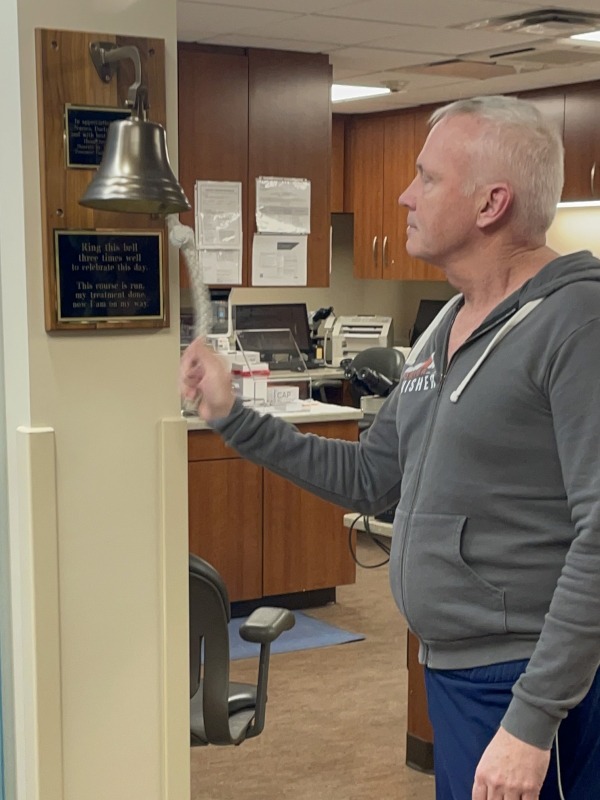
During the treatment break, I knew that we weren’t in the clear, but we were in pretty good shape. By the time I was done with the regimen, they didn’t check in between. I wanted to check after every infusion to see if it changed, but it doesn’t work that way. I had to wait about four weeks after we finished. Then they said, “You’ve got the all clear.”
Now the schedule has changed a bit. I’m two years out from treatment, and the schedule shifted from every three months to every four months. Part of that is driven by routine follow-up. Some of it is driven by the clinical trial and the need for data. Although it’s generally two days of pretty intrusive tests and anticipation leading into them, I’m confident that if cancer decides to make another appearance, they’re going to know very quickly and we can do something about it.
Living with constant appointments and scanxiety
There was a huge number of medical appointments. I don’t want to say it was inconvenient because that sounds bratty, but it turns your entire life upside down. You have these steady reminders of another doctor’s appointment tomorrow, or that you’re going to the oncology unit and have three appointments in a day.
It’s the constant, steady reminders. Still, to this day, if I get a headache, I’m convinced it’s a brain tumor. I get a respiratory infection and think, “It metastasized; it’s in my lungs now.” Every ache and pain sets off that thought process. Fortunately, I have the coping skills to dial that back. That’s my immediate reaction, but I can talk myself back out of it.
There’s anxiety that goes along with scans. I do a lot in my work where I interact with other people. At an event, two different people said to me, “How are you feeling? Are you okay?” There’s a part of me that wants to say, “Yeah, I’m fine. I moved on from all that.” There’s another part of me that understands they have needs, too.
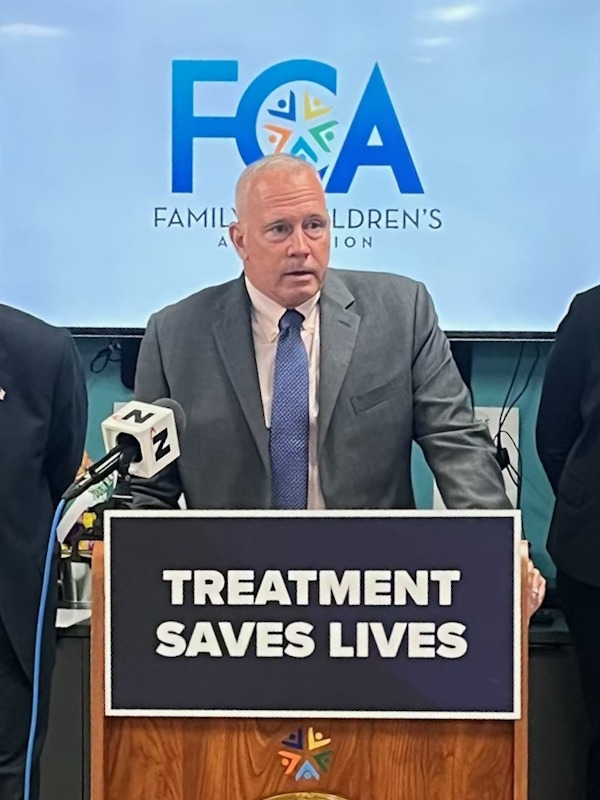
I’ve been very public about this from day one. I wrote a book about it. My social media is filled with it. I’ve invited people into that space to have those conversations. It’s interesting that my identity is now so linked with cancer. I don’t know that I want to escape it, but there are times when I could use some time off from it.
I’d say the hardest things are the stress on my family and the unknown piece of it. Going into this, I was the Ironman triathlete, the guy who had it all figured out. I’m in health and human services. Locally, if your kid overdoses at 4 a.m., I’m the guy you call. I do a lot in the addiction and mental health space. If you’ve got an aging parent struggling with early-onset dementia, I’m the guy who has all the answers and can put you in the right direction.
Suddenly, I’m the one Googling all my test results. It was a huge role reversal. I’m much more comfortable being in the helper role than studying the faces of my doctors to figure out if they’re telling me the truth and Googling my test results.
Navigating relationships, marriage, and parenting during treatment
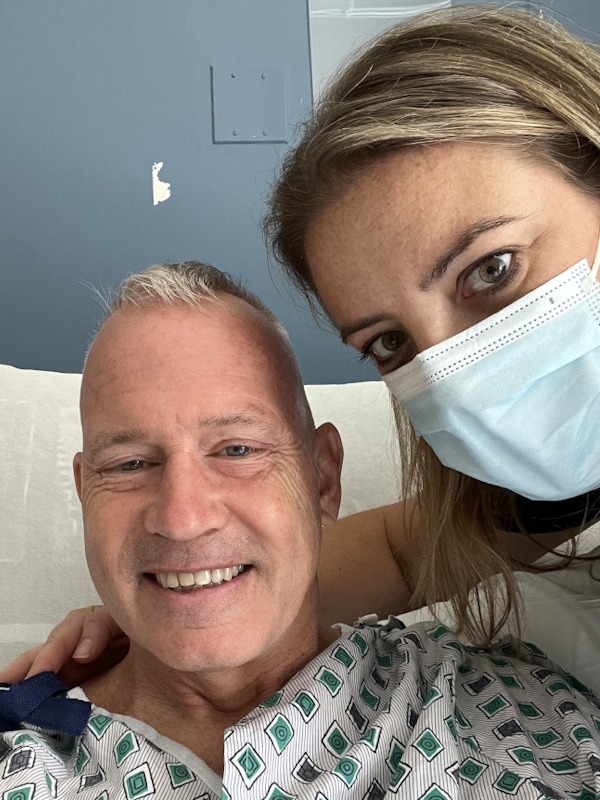
It was helpful and stressful. My wife had been dating me for about six months when I got the first diagnosis. I said to her, “You didn’t sign up for this, and if you need to tap out, I completely get it and understand.” Fortunately, she didn’t take me up on that offer and said, “Are you crazy? That’s not going to happen.”
The second time, I thought, “All right, you really didn’t sign up for this.” We got married subsequent to the second diagnosis. She stood by me and went to every medical appointment. As smart as I think I am, there were times when I’d get home and say, “He said this,” and she’d say, “He didn’t say that.” Or I’d say, “They never told me this,” and she’d say, “They actually did. Twice.” It was incredibly helpful to have that extra set of eyes and ears, and to be able to check in and say, “When he said that, do you think he meant…?”
With my kids, there was a time when I brought them to Universal Studios because that was their desire. I literally spent 16 hours in an amusement park while I was on oral chemotherapy. My kids didn’t know yet. We had just started. I thought, “It’s my daughter’s birthday. Let’s get through the trip, and then I’ll tell them.” I wound up telling them around Thanksgiving. This was in October; I was on oral chemotherapy while spending 16 hours at an amusement park.
As exhausted as I was, I thought, “I didn’t think about cancer for a long time. And when I did think about cancer, I thought, ‘No, I’m still doing the important stuff, so f*** you, cancer.’” Family was a big support. I ran into lots of people in treatment rooms who didn’t have the same support systems, and I think it’s a lot harder if you don’t.
How cancer changed my identity and public storytelling
I think a lot about identity, and in some ways I use identity to hem myself in. When I did Ironman, I became known as the triathlete. That became part of my identity. I wanted to be the guy who does hard things. One of the things I love about triathlon is it gets you comfortable with being uncomfortable. There’s no way around it.
We live lives that are completely engineered for our comfort, from heated car seats to being able to order food on an app. Our food is engineered for comfort. That discomfort and learning to be okay with it was something I built up during triathlon training, and it became part of my identity. Having that as my identity meant that if I showed up at a 7 a.m. meeting, someone might say, “You probably already ran five miles this morning,” and I could, with glee and pride, say, “Yes, I did. In fact, I did six.”
During cancer, you don’t have that same ability. I was very public about both diagnoses because I wanted people to know: If this could happen to me, it could happen to anybody. Now, if you look at my LinkedIn profile, it says mission-driven CEO, which is my work identity. My athletic identity is there. I do a lot of public speaking. I rapidly identify as a two-time cancer survivor, almost as a demonstration that I do hard things and I’ve been through stuff, so I’m ready, willing, and able to talk about resilience.
Having said that, I also struggled with labels. People especially do this with men: If you’re going through treatment, you’re a warrior; once you finish treatment, you’re a survivor. We assign these labels. There was a part of me that loved the warrior label because I thought, “Yeah, I do hard things.” There was another part of me where there were times I thought, “I don’t feel like a warrior. I feel like a guy who wandered onto a battlefield looking for a restroom. I didn’t ask to be on this battlefield.”
Some of those terms are tough to deal with. I was very public about it because I wanted people to know you can survive hard things. For folks out there who are struggling, it’s possible to get through. I was not great about work-life balance when it came to navigating treatment. I didn’t miss five minutes of work. I’m not sure that’s the best example for folks going through a cancer journey, but for me, it was an affirmation that I can still do all the things I did before and I’m not going to let cancer get to me.
If I worked in construction or manual labor, it absolutely would not have happened. That’s not everybody’s journey; it’s what I needed as a coping mechanism to say, “I’m still okay. I’m still doing important things. I’m still doing my life’s work. I’m still able to show up.” Cancer changes you forever. Some people want to put it behind them and not talk about it. Others have a few people close to them who know. Others are public. I chose the public part.
I already had a platform to talk about things like opioid addiction, alcoholism, and mental health. It seemed hypocritical not to talk about what was happening in my life. I’ve talked about other people’s lives. I haven’t struggled with opioid addiction. I worked in HIV and AIDS for 20 years. I don’t have HIV. I’ve been happy to talk about other people’s problems and listen to other people’s secrets and keep those secrets. I shouldn’t be keeping my own when it comes to this, because the awareness might raise people’s antennae around the importance of routine screenings and taking care of themselves.
Since I’ve been public about my story, dozens of people have come to me and said, “I just got diagnosed. Can you spend an hour with me?” I’m happy to provide that ongoing support, particularly for men. I always say to guys, “I got the two most embarrassing cancers a guy can get.” Anything below the belt still has a stigma, similar to the way breast cancer did 20 years ago. Because God forbid we talk about reproductive health or rectal health. Men specifically are reluctant to talk about those things.
I know a guy who had a prostate cancer diagnosis between three and six months before he told his spouse. That’s craziness. The fact that there are people walking around carrying this on their own shoulders without the support of a loved one seems tragic to me. In attaching myself to my cancer identity, my hope is that I help other people.
Advice to men carrying the emotional load alone
It’s the same advice we give to men about mental health issues. If you bottle it up inside, it eats at you. It messes with your head when you consider that stress and emotional turmoil can help fuel cancer. It doesn’t cause cancer any more than sugar does, but when you think about the impact of stress and turmoil on your immune system, it messes with your mind to say, “I have cancer; that’s stressing me out. Stress isn’t good for my body or my immune response. Am I giving cancer an unfair advantage by worrying about it too much?”
As men, we walk around believing, “We can hold it together. We’re strong. We’ve got this,” which is not a winning formula for finding peace and health. One of the things that changed very dramatically for me was my relationship with other guys. I probably have four or five close guy friends I’ve known for 30 years. In the middle of this, they started saying, as we finished lunch or dinner, “I love you,” saying goodbye after lunch.
It started with one person doing it and then became a recurring theme. It wasn’t the drunk back-slapping “I love you, man.” It was heartfelt and genuine. The first time it happened, I got into the car, looked in the rearview mirror, and thought, “I must look sick because he thinks I’m checking out. He thinks this was our last lunch.” I didn’t know what to say, and I couldn’t understand why it tripped me up so much and why it was so hard to say it back, or even if I wanted to say it back.
God knows I’ve said it to plenty of women, and maybe didn’t even mean it. But when a guy says it, I’m freaked out and wondering if I’m going to die or what the deal is. I had to think through my relationship with other men. It created a different level of trust and intimacy with my male friends. We see each other more now. We’re more honest about our feelings.
I’ve always been one of those guys who are pretty open. I ran a men’s consciousness-raising group. I’ve been involved in domestic violence groups that deal with perpetrators, so I have experience in that space. But it did change my relationships with other men. Guys who get diagnosed have a variety of coping mechanisms. Sometimes it’s to bottle it all up and keep it to yourself. Sometimes it’s to share it with other people.
In something like this, your ability to get support is absolutely critical. One of the things I like about NYU Langone is that they made sure that a social worker came around to talk to me. That person was about 25 and fresh out of school. I said, “Come here, let’s talk.” The dietitian came. The clergy person came. I sent that person away saying, “It’s not time yet. I’m good.” But they made sure they sent around the disciplines so that I didn’t have to reach out and call a social worker. She came around and said, “Are you doing okay? Are you feeling stressed?”
The dietitian came around, and I thought, “I know a little bit about diet,” and she engaged me. I was sitting there, so I didn’t have to seek out a dietitian. She came and talked to me while I was trapped. The more we can infuse those services into the overall medical regimen so that folks don’t have to go outside and see another specialist, the better off we’re going to be. When it comes to men’s health, the more we talk about it as men, the more understanding we’ll have.
Scanxiety, MyChart, and mental rehearsal
I play it as most people do. I don’t think about it much until we’re about 48 hours out from the scan. In those cases, I go back to the same places where I was getting treatment and where I’ve been scanned a thousand times before.
The good thing is you get the test results almost immediately. You can pop into MyChart and see what’s going on. I don’t have to wait three days for a doctor’s appointment. You get faster answers, which, for me — again, not for everybody — is very helpful.
I’ve played through in my mind a million times: What happens if the cancer comes back? Logically, my doctors will come up with a new plan that will likely include surgery. We’ll try that. In all likelihood, that stands a pretty good chance of working. If it doesn’t work, they’ll try something else. I have full confidence that I’m in the best possible hands medically.
If that still doesn’t work, they’ll tell me the treatment didn’t work, and I will keep on pressing and say, “How long do I have?” They’ll give me that number, and then I’ll completely ignore it and blow through it.
It’s almost like I run beside those fears every few months for a little while. We’re running side by side, and then I leave them behind and say, “My worrying about this is not going to change the outcome in any way. The only thing I can do is go to my scans, exercise, try to give myself the utmost advantage if cancer comes back, and just live my life.”
One of the things I always wanted to do was go on a safari to South Africa. I thought, “We’re doing that. We’re going.” And we did. I finished the last round of edits on the book while on safari in South Africa. I got married since then. I’ve taken on new projects. I’ve done a fair amount of public speaking on cancer, survivorship, and resilience. I’ve done a bunch of men’s retreats. I’ve decided I’m going to live my life, prioritize family, do all the things I can get done, and continue to show up for the scans.
New goals, Harvard, and building organizational resilience
I’m a big fan of continuing education. I just finished an executive education course at Harvard Business School. I’m continuing to advance the organization I’m with. We’re launching new programs focused on teen mental health, gun-violence prevention, and family support services. There’s been a big resurgence in alcohol use. In the middle of an opioid crisis, alcohol feels like no big deal, but it kills more people than opioids do. I’m launching new programs along those lines.
I’m doing more writing and speaking. I speak a lot about resilience and things you can do to build your personal resilience in the event something happens to you, and also how to build organizational resilience. The organization I run is 142 years old. Both times I was diagnosed, my board chair was among the first to know, besides family.
The second time, I said, “This is a bit of a different ballgame, but I think I’m going to be okay. But if I’m not, we don’t have a backup plan. I’m the guy. I have a senior leadership team, but none of them are at the point where they could jump in and take over together. They might get us through some stuff, but so much of our funding and what we do is based on my personal relationships and experiences and my position in the space that I worry about the organization. God forbid something happens, I don’t want to leave things that way. We need to start talking about how we build in succession planning and redundancy.”
At some point, there’s going to come a time when I’m going to want to go do something else, or I’m going to get run over by an ice cream truck. I’m not worried about cancer, but something else could happen. It’s prompted me to think about where I build in redundancy, how I spend my time, what I want to do, where I can have the biggest impact, and how I make sure I’m prioritizing not only my family, kids, and wife, but also taking care of my health moving forward. Maybe I’ve become a little more selfish in that way.
I’ve become acutely aware that we all have this invisible countdown clock that runs above our heads, and we don’t see it. It’s probably a good thing we don’t see it, but it’s there. Both diagnoses reminded me that I’m not going to live forever. All the things you wanted to do, you should do because you have today and you have your health. I have far more gratitude than I ever did before.
I have a triathlon coach. My wife used to say, “What’s your workout today?” I would say, “I’ve got to go run five.” It’s no longer, “I’ve got to go run five miles.” It’s, “I get to go run five miles.” When I was sitting in that infusion room, I saw the nurses and doctors on break running up and down the block. I thought, “I would kill to be able to run that distance.” I exercised consistently during treatment. Now I have my health back, at least for a period of time and maybe for a long time. As long as I have it back, I’m going to make the best possible use of it.
My message to others facing cancer
Keep going. If you’ve experienced a diagnosis, regardless of what your journey looks like, regardless of what your prognosis looks like, or what stage you’re in, keep going.
Regardless of where you are in that journey, take time for yourself. Whether you are someone who’s been diagnosed or a caregiver, you’ve got to take time for yourself; otherwise, you’re of little value to somebody else.
I’ve always preached self-care. Where I work, we have a staff of 360, with lots of social workers, and I’ve always said to them, “Unless you take care of yourself, you’re of zero value to anybody else, so please do that first.” The same thing goes for caregivers and people who are walking the road through cancer. Take care of yourself.
Inspired by Jeffrey’s story?
Share your story, too!
Hear from people living with colorectal cancer and prostate cancer
Real experiences with diagnosis, treatment choices, side effects, and life beyond colorectal cancer and prostate cancer — in their own words.

Leave a Reply