Brittany’s Stage 4 Liver and Bile Duct Cancer Story
Interviewed by: Taylor Scheib Edited by: Chris Sanchez
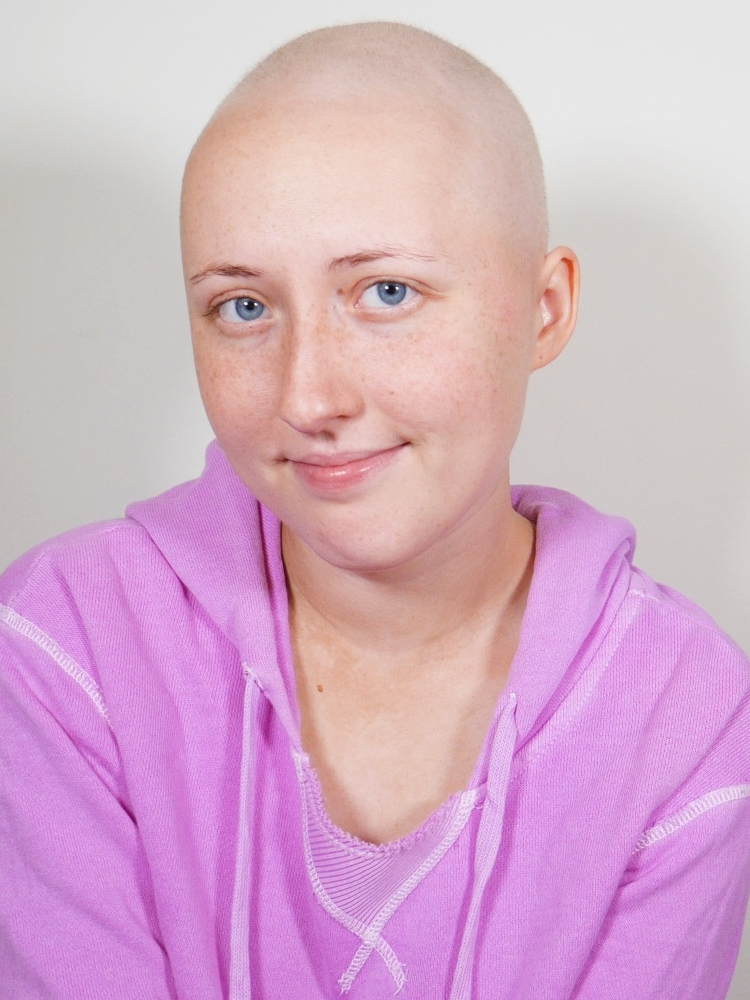
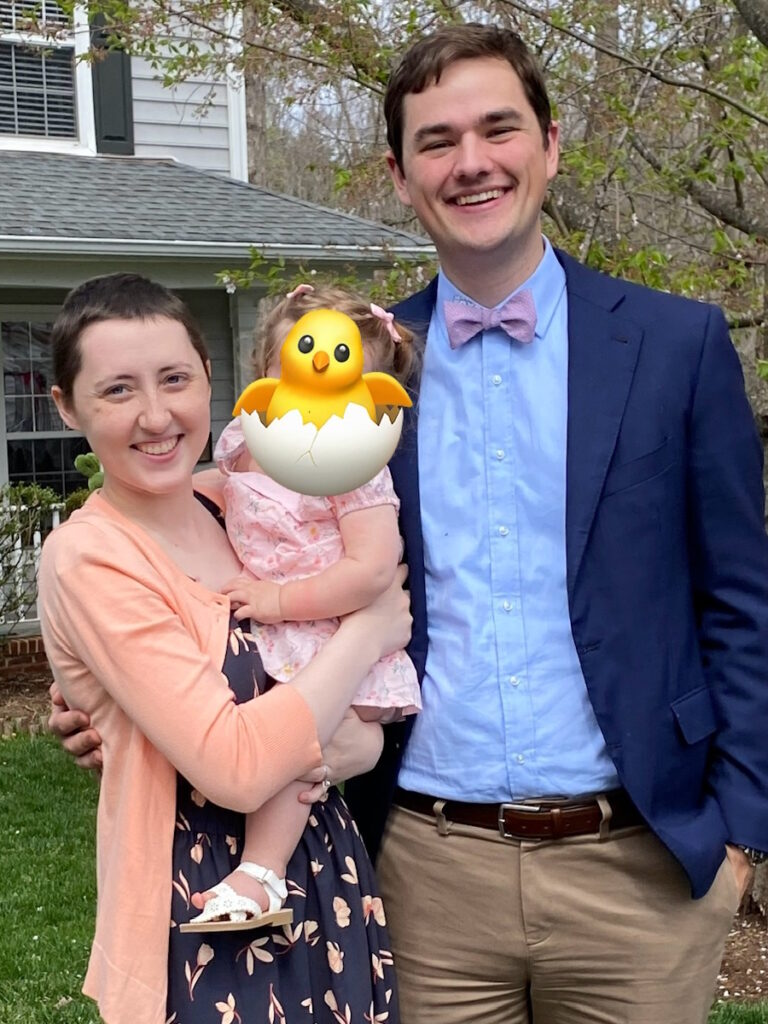
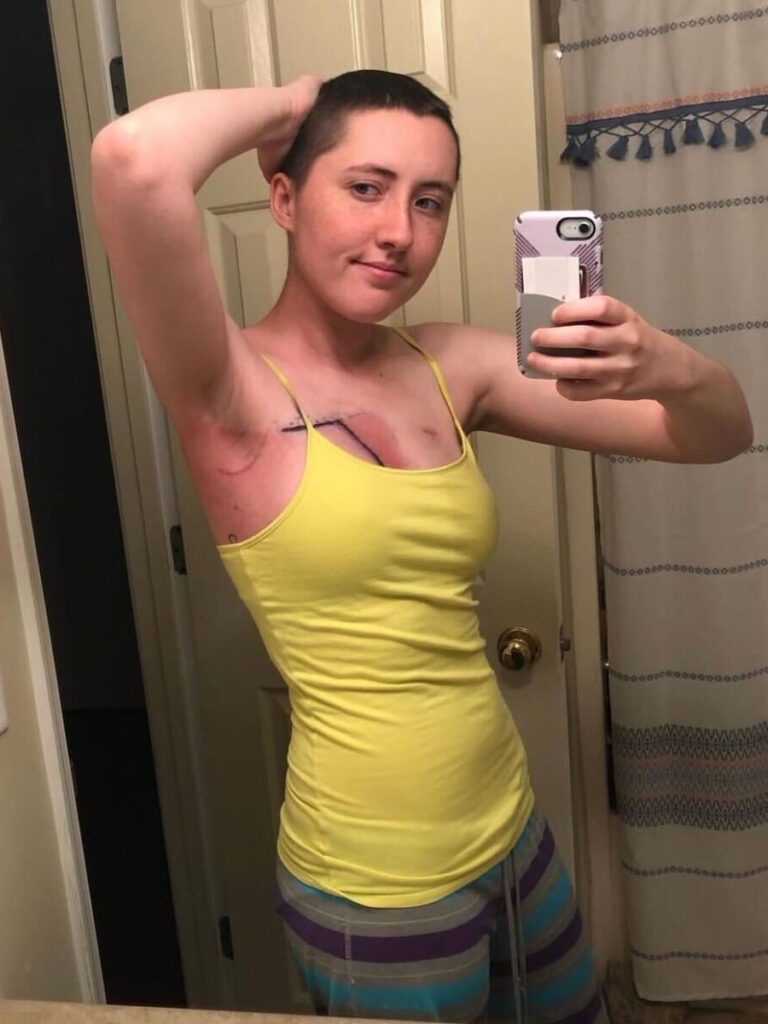
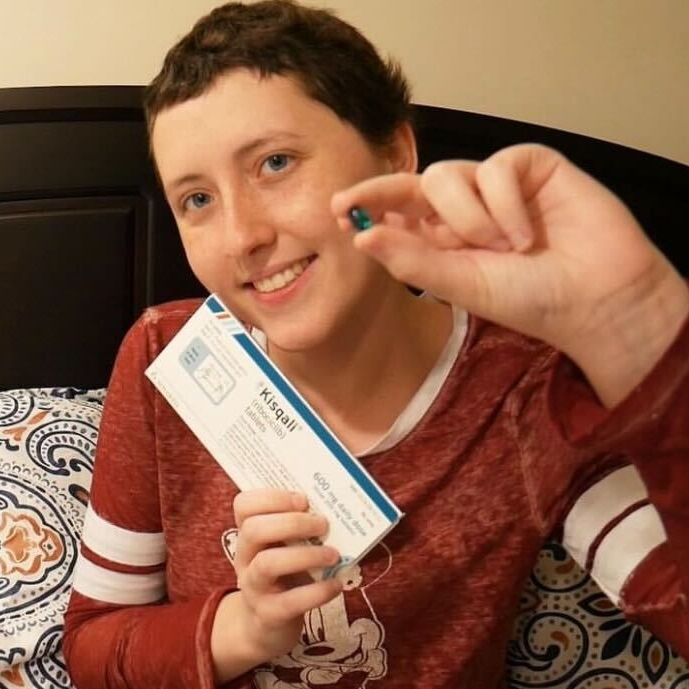
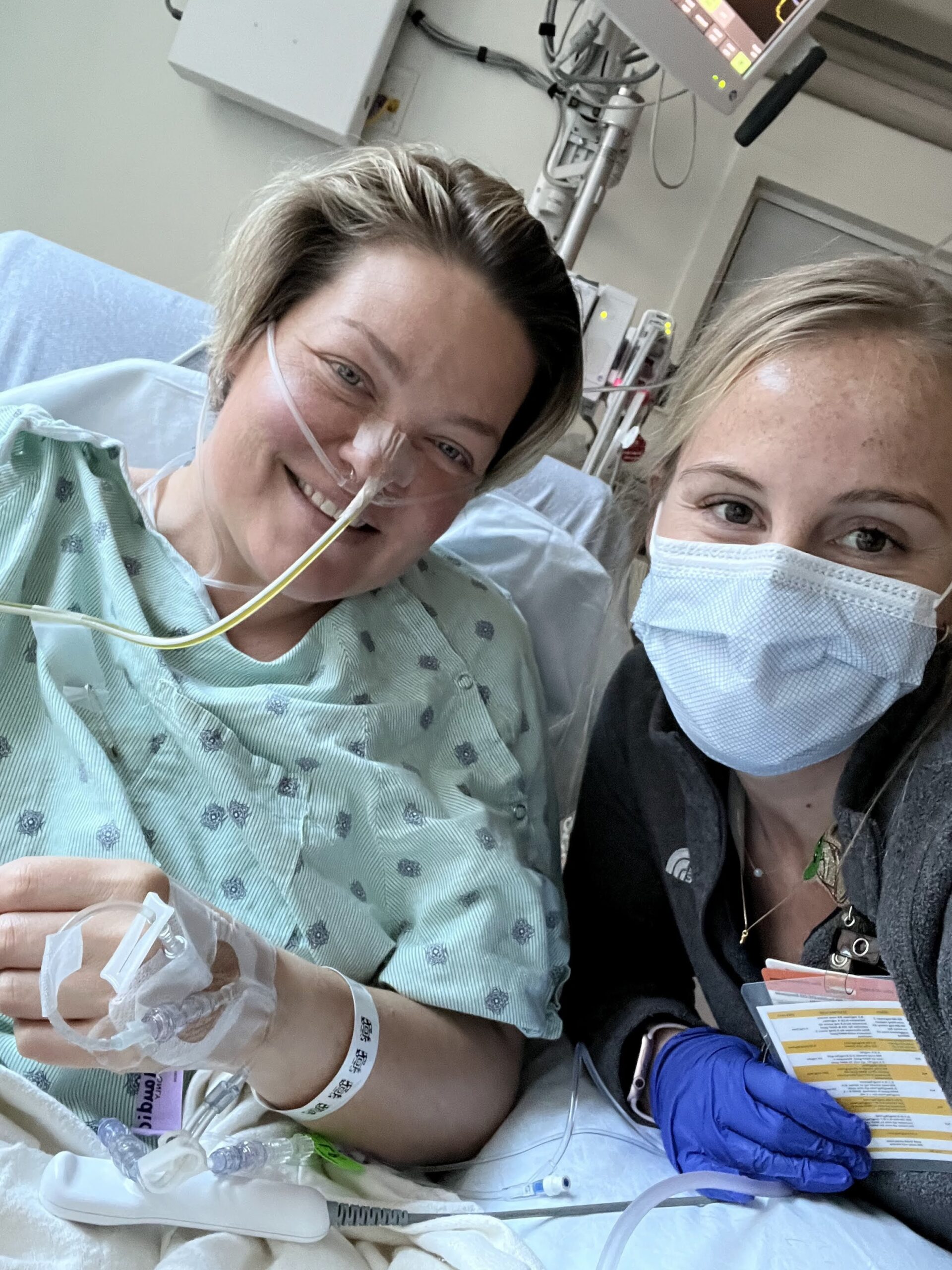
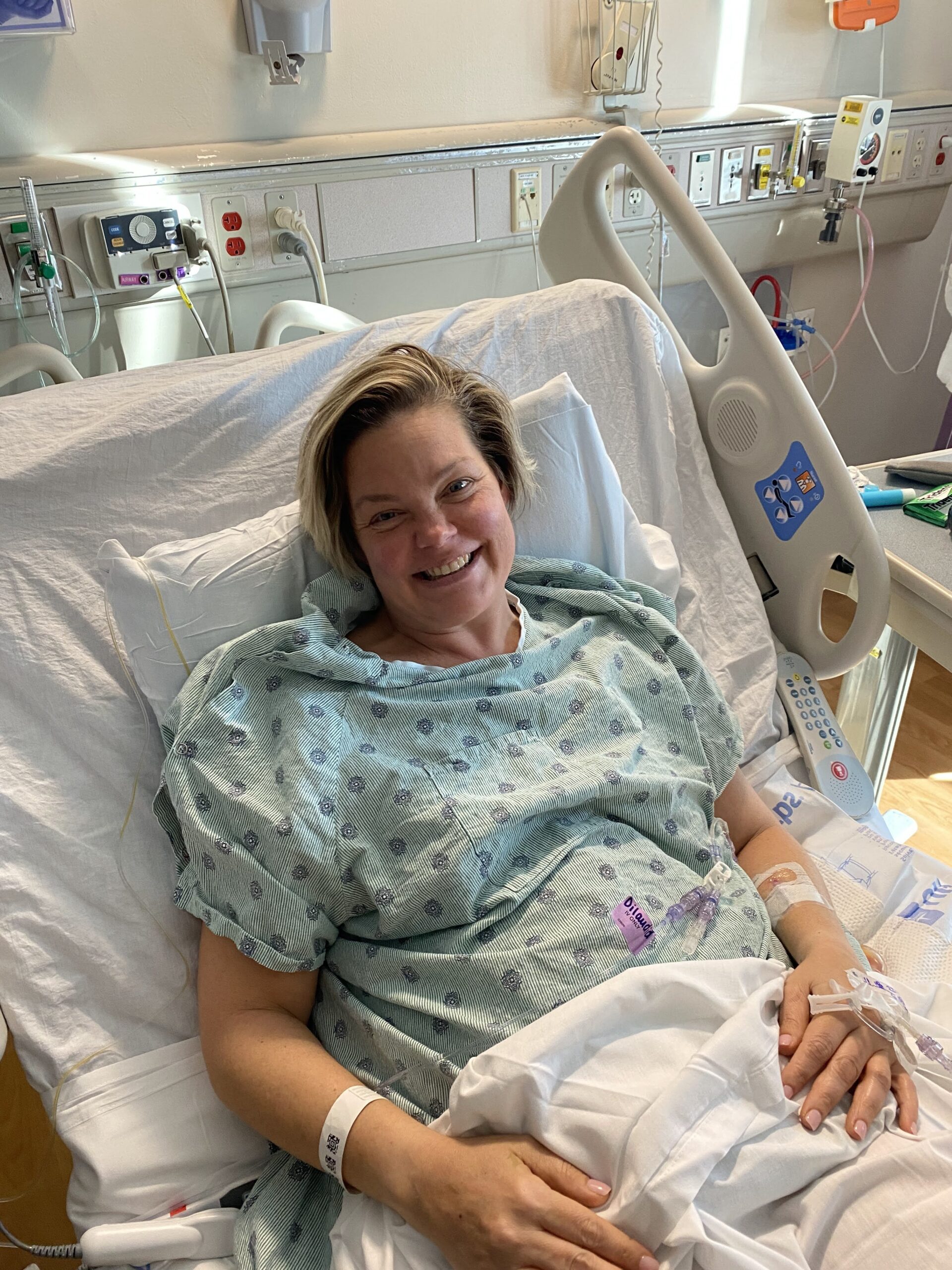
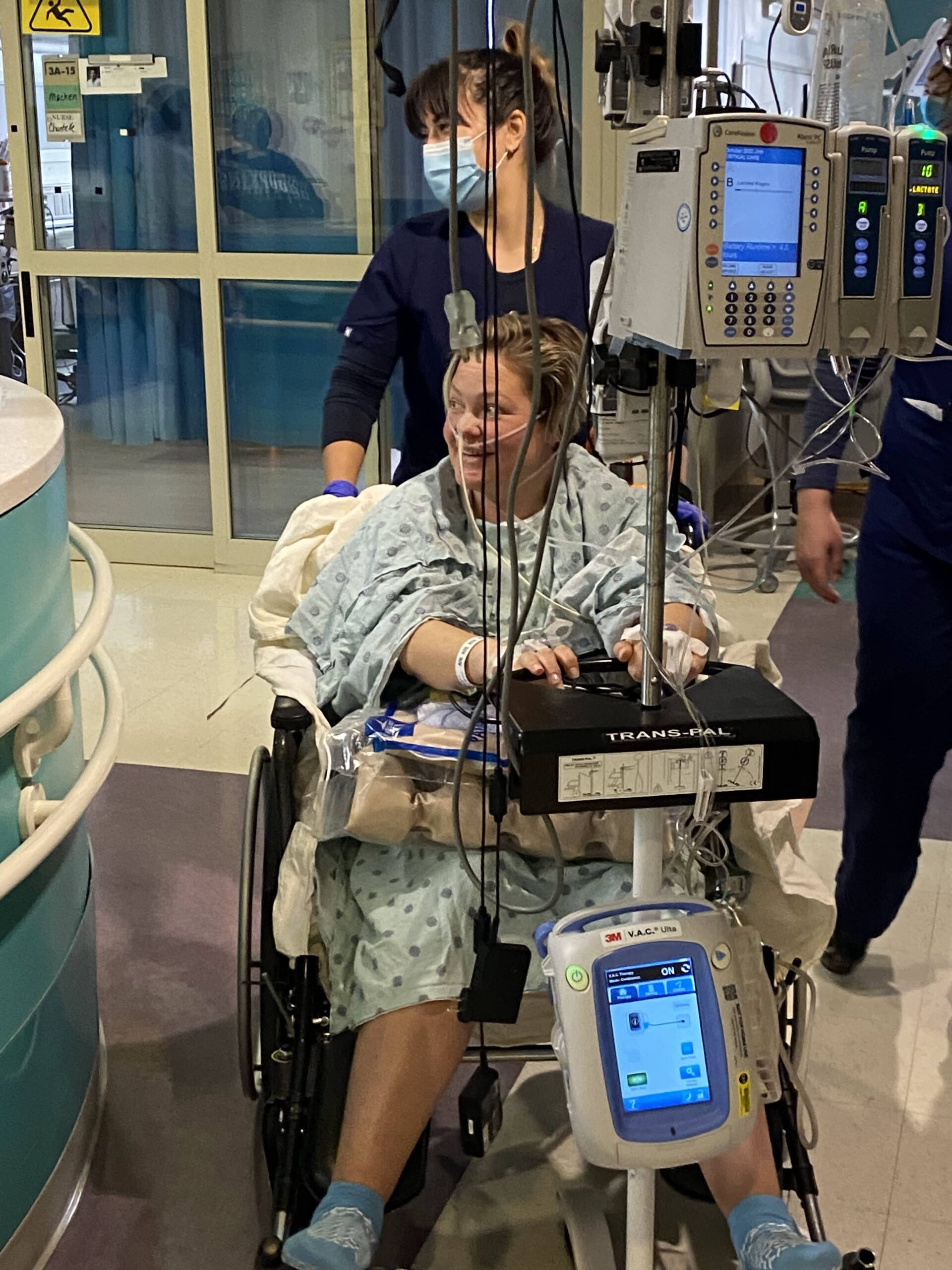
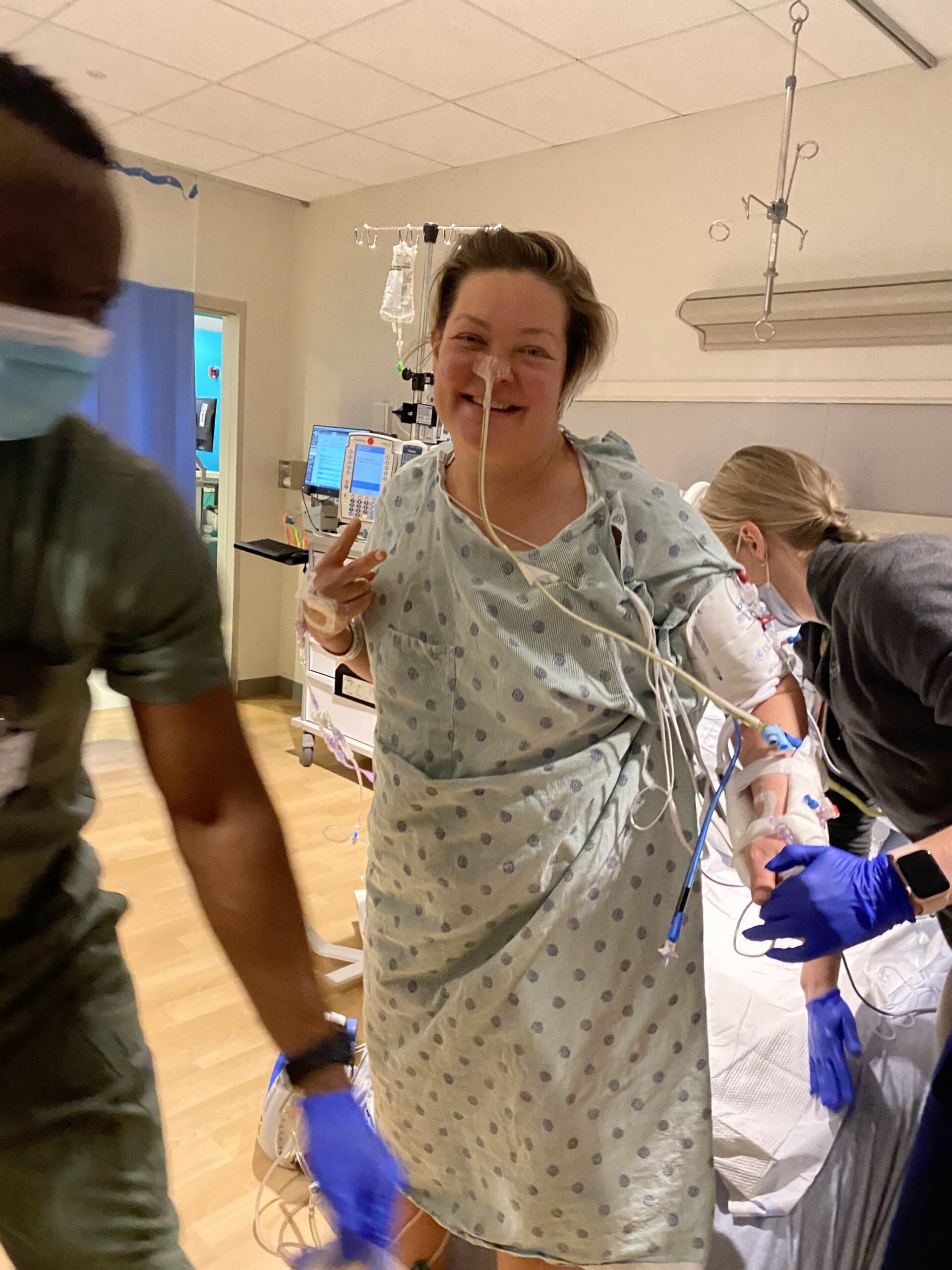
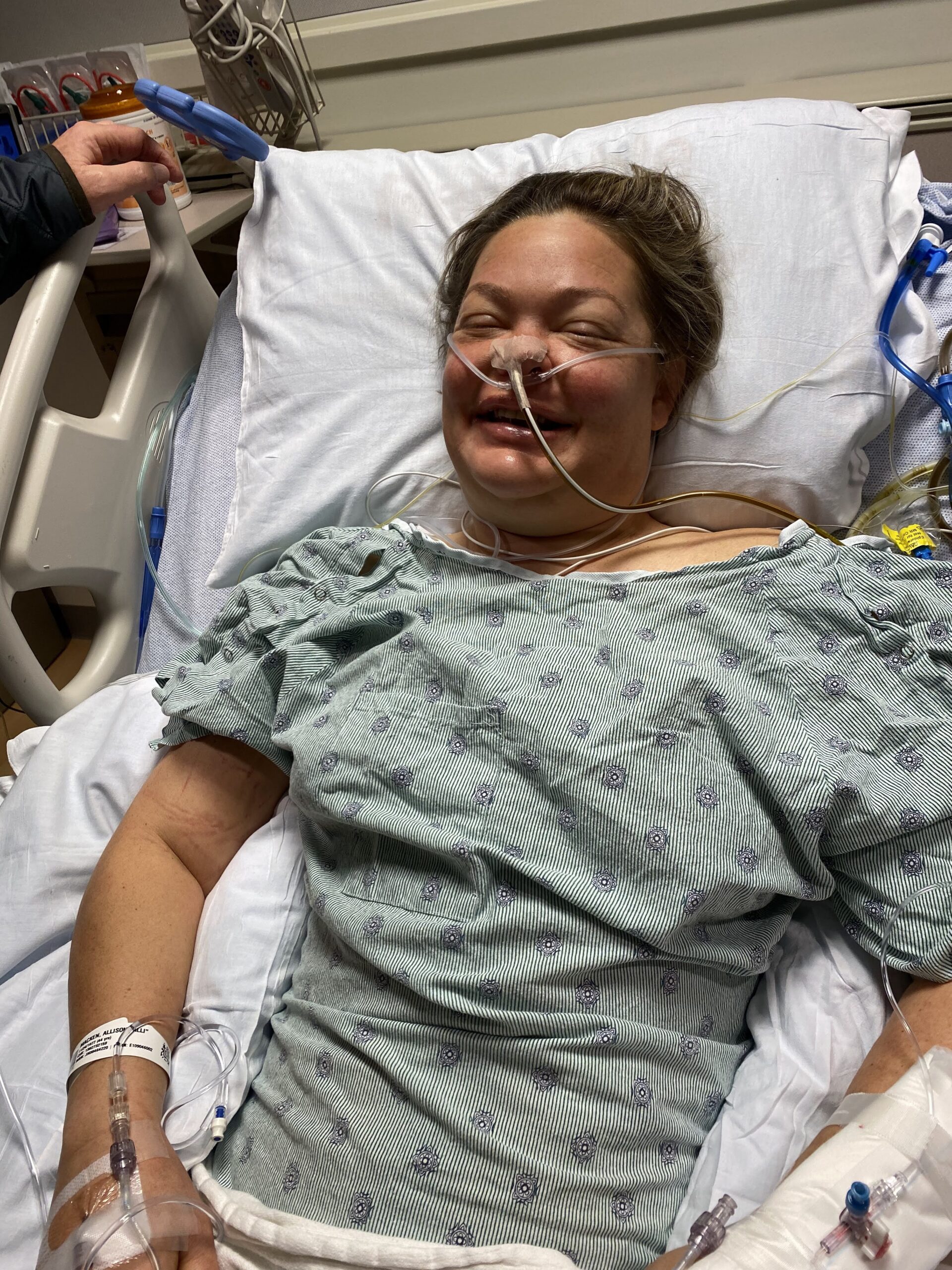
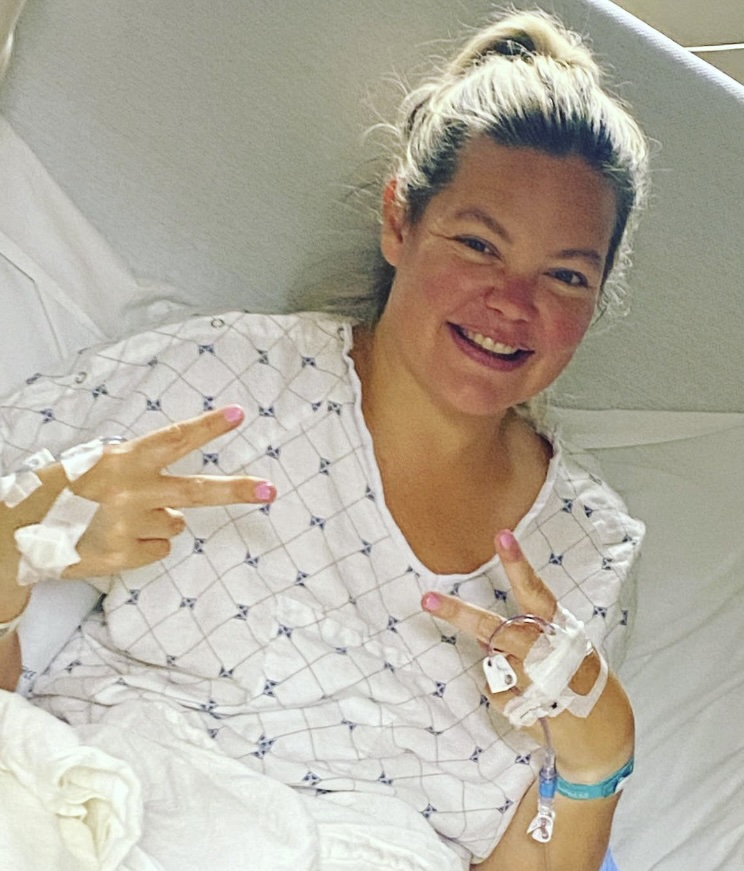
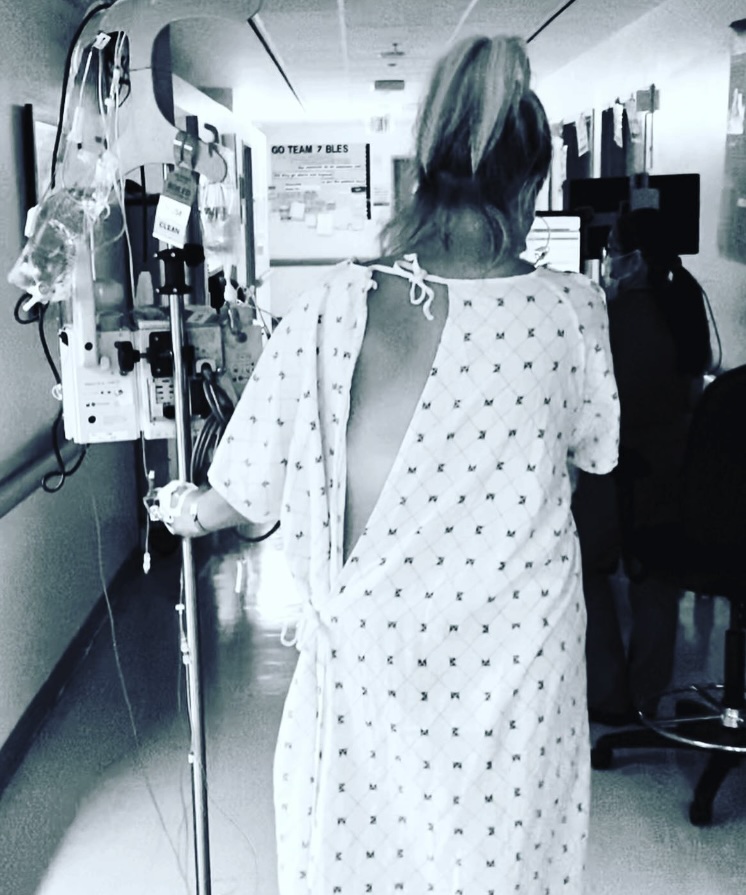
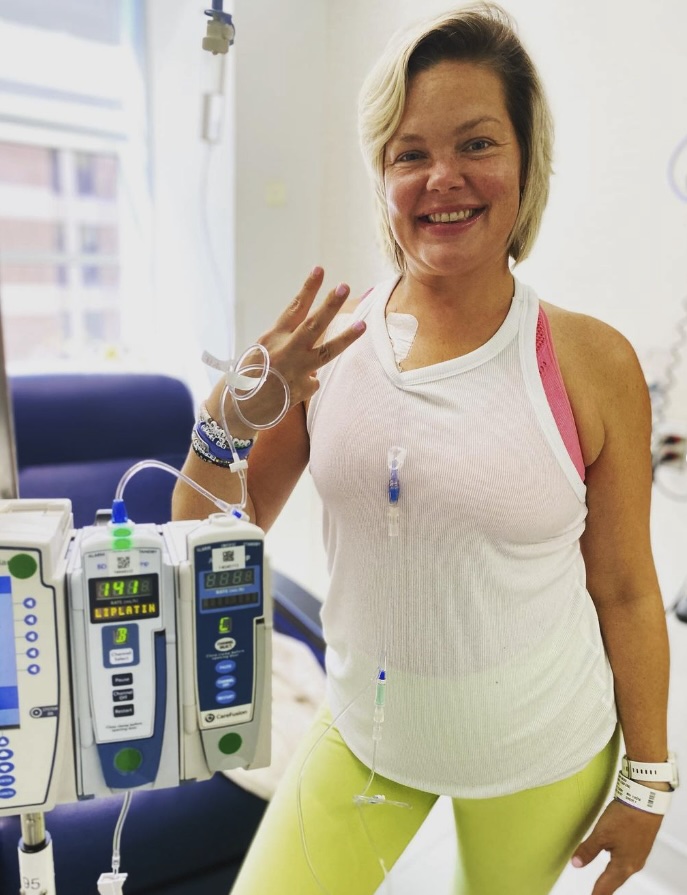
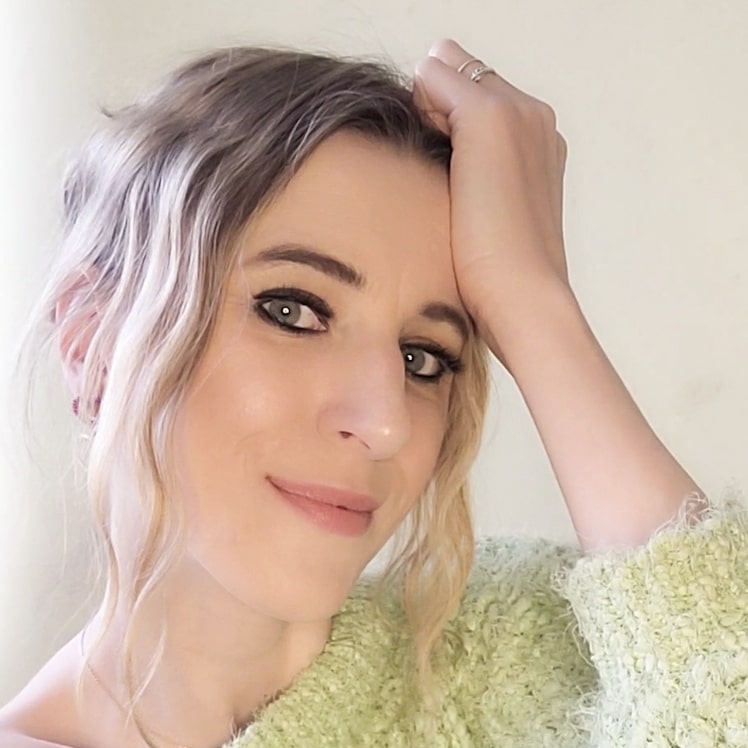
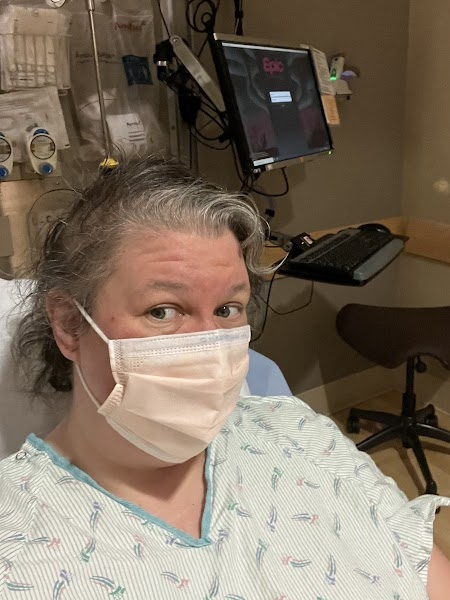
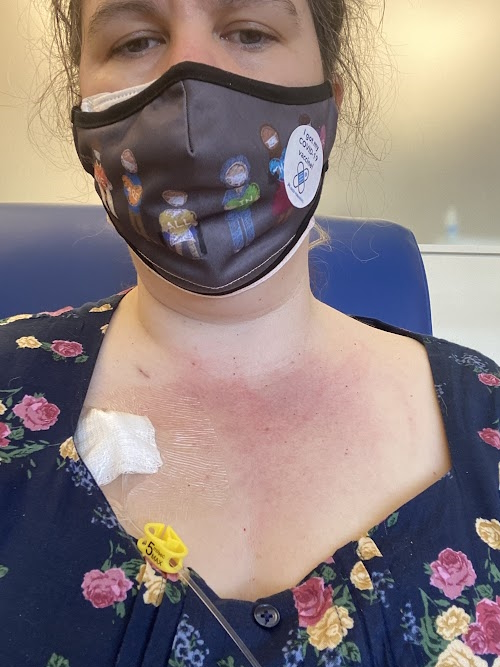
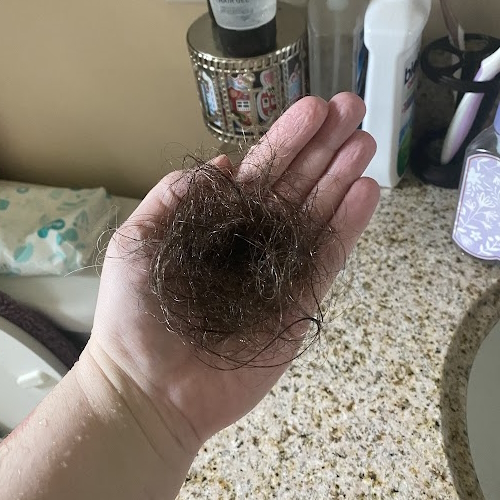
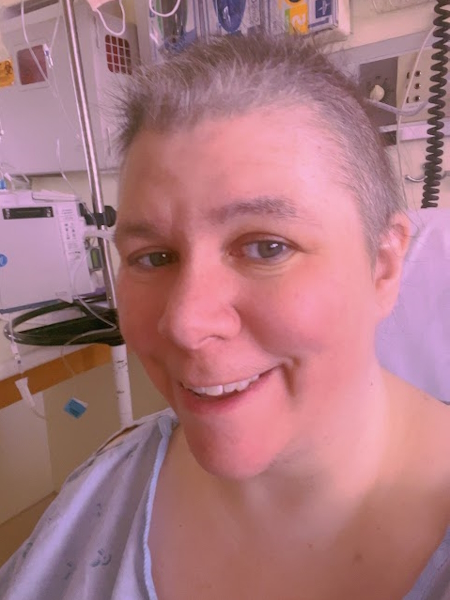
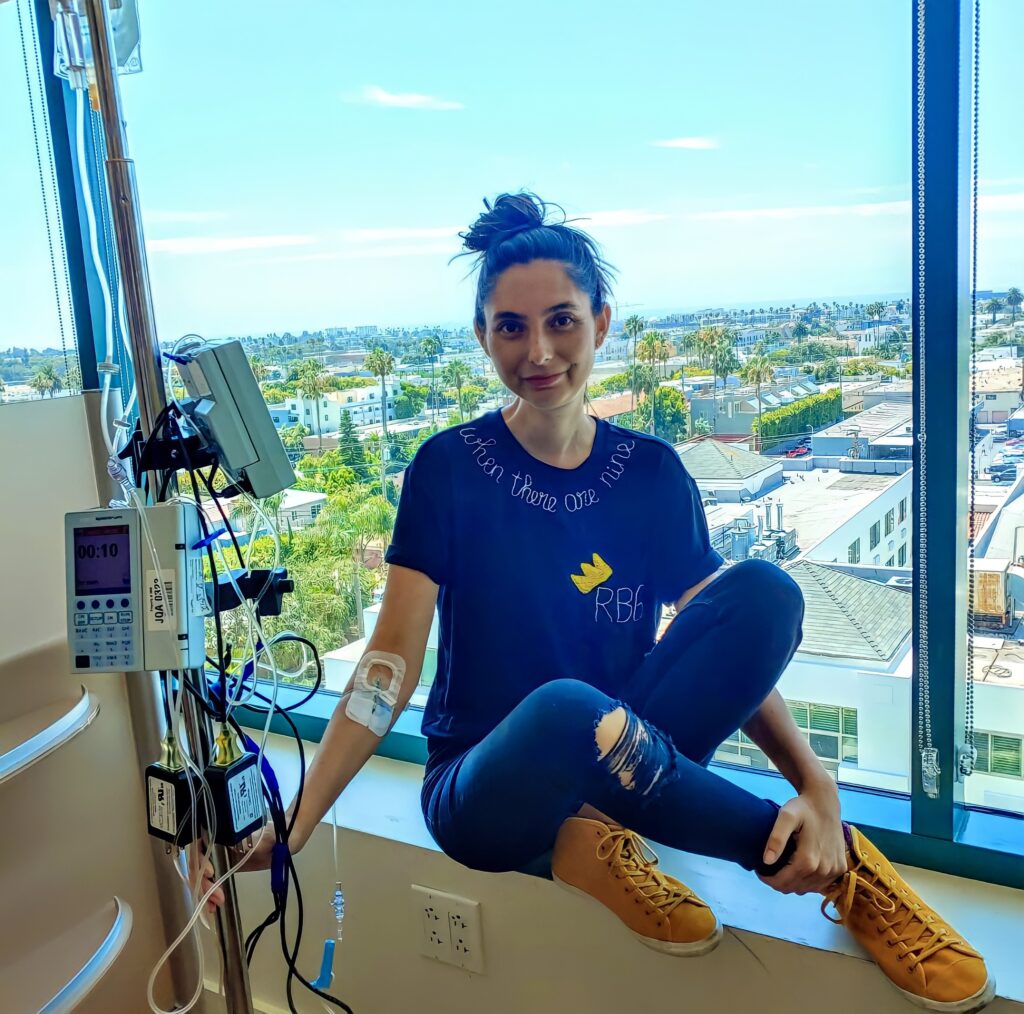
Brittany, a nurse who works in surgical oncology and a proud mother of 2, was diagnosed with stage 4 hepatocellular carcinoma (liver cancer) and cholangiocarcinoma (bile duct cancer). She is now officially “no evidence of disease” (NED) thanks to surgery and immunotherapy.
Brittany’s story starts about 3 years ago, when all of a sudden, she stopped menstruating. A pelvic ultrasound failed to turn up any potential cause. In September 2021, she began to lose appetite and her weight began to drop, and she ended up losing a total of 15 to 20 lbs. Her PCP ran a full array of lab tests, but they all came back normal.
In January 2022, Brittany started experiencing bad pain in the upper right quadrant of her abdomen. She rushed herself to a hospital where she had more lab work done and, this time, a CT scan of her chest, abdomen and pelvis as well. Once again her tests failed to turn up anything–but the CT scan found a 10cm mass on her liver.
Brittany transferred to a larger hospital where she spoke with a specialist in liver surgery. A few days later, he and his team operated on her to remove the diseased portion of her liver (which amounted to 60% of the organ). However, they found out that her gallbladder had also been affected and portions needed to be removed too, and moreover discovered lesions on her lungs. Further testing finally revealed the true nature of her cancer, and the lesions on her lungs determined that it was stage 4.
Though Brittany’s doctors were optimistic about her chances, they were also realistic, given that liver cancer is not easy to treat and that cholangiocarcinoma is known to be extremely aggressive. But Brittany was determined to beat the odds and overcome her cancer.
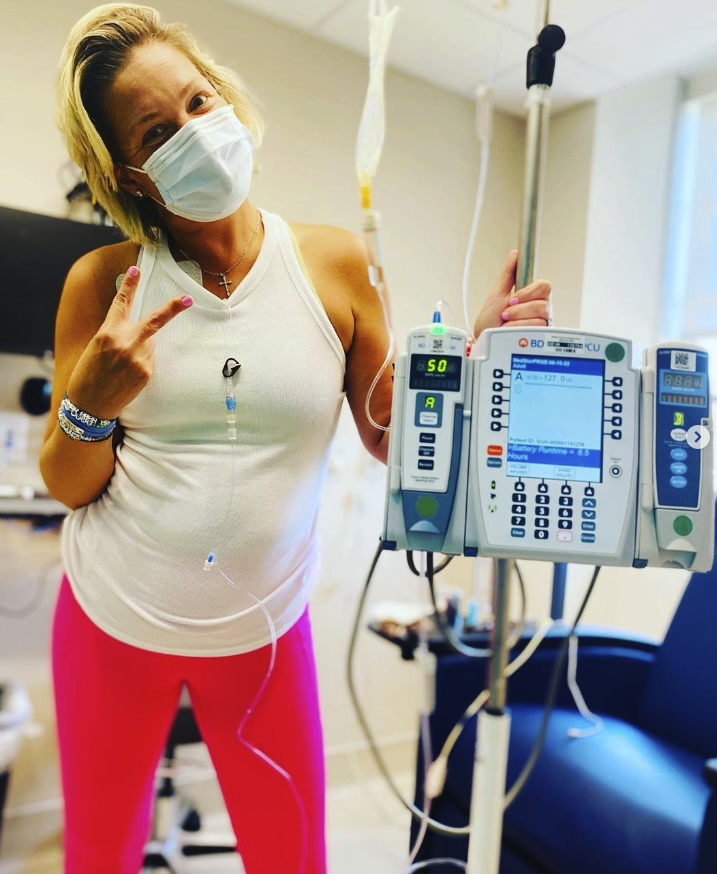
Brittany began to undergo immunotherapy in April 2022. Her cancer responded favorably to the treatment; her liver has been cancer-free since the resection, and all lung lesions have disappeared.
Brittany’s last treatment was administered in December 2022. Since stopping treatment, she has gotten a CT and MRI with lab work every 3 months; these have recently been spaced out to every 6 months for surveillance.
Brittany would like to share that her experience has definitely changed her life. She refuses to take things for granted any longer, makes sure to enjoy every moment, and is intent upon giving back as much as she can. She also urges fellow patients to take full charge of their own healthcare, to educate themselves fully, and to be their own advocates. “Don’t believe the statistics!” she adds — they’re really just numbers.
Name: Brittany B.
Diagnosis:
Hepatocellular carcinoma (liver cancer) and cholangiocarcinoma (bile duct cancer)
Staging:
Stage 4
Initial Symptoms:
Amenorrhea
Unexplained weight loss
Loss of appetite
Pain in right upper quadrant of abdomen
Treatment:
Surgery: removal of portions of liver and gallbladder
Immunotherapy
This interview has been edited for clarity and length. This is not medical advice. Please consult with your healthcare provider to make informed treatment decisions.
The views and opinions expressed in this interview do not necessarily reflect those of The Patient Story.
Interviewed by: Taylor Scheib Edited by: Katrina Villareal
Nick’s symptoms began a year or two before his diagnosis, including changes in bowel habits, size, and consistency, blood in the stool, and abdominal pain, which he initially attributed to aging or irritable bowel syndrome. After experiencing fatigue and escalating pain, he went to the ER where he was diagnosed with diverticulitis and sepsis. Despite initial treatment, he required a laparoscopic washout due to a perforated colon and subsequent complications, including an abscess.
During a follow-up colonoscopy, doctors found a mass, which was later confirmed as adenocarcinoma. He underwent a sigmoid resection, removing part of his colon. While clear margins were achieved, 19 of 49 lymph nodes tested positive for cancer.
Nick began CAPOX chemotherapy, experiencing severe side effects like fatigue, neuropathy, and an acne rash due to the addition of Avastin (bevacizumab). When they noticed an elevation in his tumor marker and growth in his lymph nodes, he was switched to Keytruda (pembrolizumab), an immunotherapy, to reduce the cancer to a manageable level.
Nick emphasizes the importance of mental health support to manage anxiety. He advises listening to your body, advocating for yourself, and using support systems. He encourages seeking thorough medical evaluation for unexplained symptoms and finding strength in support groups, hobbies, and loved ones, stressing perseverance and finding reasons to keep fighting.
Name: Nick S.
Diagnosis:
Colorectal Cancer
Staging:
Stage 4A
Initial Symptoms:
Change in bowel habits, size & consistency
Blood in stool
Abdominal pain
Fatigue
Treatment:
Surgery: sigmoid colectomy
Chemotherapy: CAPOX (capecitabine & oxaliplatin),
Immunotherapy: bevacizumab, pembrolizumab
This interview has been edited for clarity and length. This is not medical advice. Please consult with your healthcare provider to make informed treatment decisions.
The views and opinions expressed in this interview do not necessarily reflect those of The Patient Story.
My symptoms started a year or two before diagnosis. It started with a change in bowel habits, size, consistency, some blood in the stool, and abdominal pain.
Introduction
I’m a stage 4A colorectal cancer fighter. My wife and I live in Chippewa Falls, Wisconsin. We have a wonderful 28-year-old daughter.
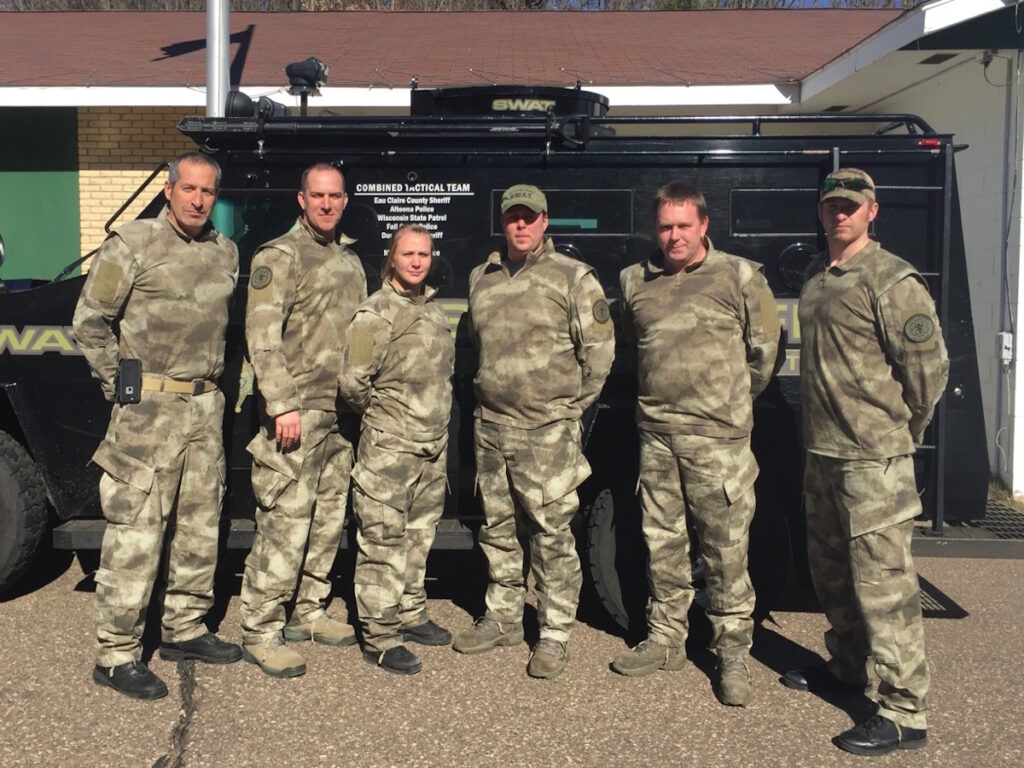
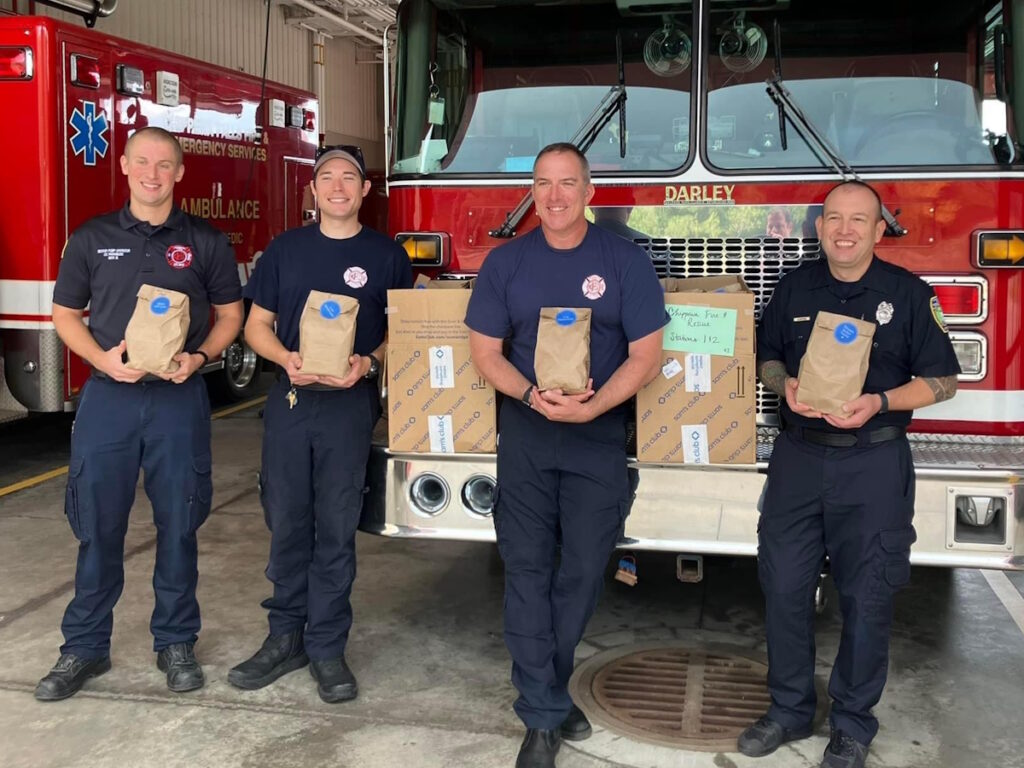
I’m a full-time firefighter and critical care paramedic. I’ve been doing firefighting for about 16 years and paramedicine for about 13 of those 16 years.
Pre-diagnosis
Initial Symptoms
My symptoms started a year or two before diagnosis with stage 4A colorectal cancer. It started with a change in bowel habits, size, consistency, some blood in the stool, and abdominal pain. I had some acid reflux type of reactions that my wife and I chalked up to aging and not being as healthy as I could be. My wife has irritable bowel syndrome and I thought some of it was IBS because some foods would trigger some reactions in me.
I was working full-time for the department for about a decade and a couple of years later, I decided to change over to a neighboring department. For these jobs, we have to pass a physical agility test.
I have been working by myself daily. I was in pretty good shape. The test is a pretty rigorous test to be able to do what we do. I was 48. I was doing this at an older age than the 20-year-olds they were usually hiring.
I was diagnosed with diverticulitis and sepsis, so they started me on antibiotics right away.
A couple of months later, we responded to a house fire. At some point, my battalion chief pulled me off the line and said, “You look wiped out. I’m going to sit you out for a little bit to catch your breath.” I felt a little tired, but, again, I was getting a little older.
I sat out and went back in for another round. This time, the chief was on the scene and said, “Nick, take your gear off. You don’t look good. Go back to the ambulance. You’re going to be doing rehab, making sure everyone else is doing okay, but we don’t want you going back in.” I thought something was weird.
I called my wife to meet me in the ER. I didn’t know what was going on. I’ve got bad abdominal pain. I haven’t slept. I’m going to go get checked out.
Diverticulitis & Sepsis
I was diagnosed with diverticulitis and sepsis, so they started me on antibiotics right away. They weren’t sure if surgery was going to be necessary, but they transferred me to another hospital. At that point, I was stable.
When I got transferred, I met with a thoracic surgeon and started to realize that things were serious. He said, “We’re not going to go in right away. We’re going to keep an eye on you tonight. Hopefully, things will subside with some more antibiotics and some steroids, if we have to. But we’re going to keep an eye on you and evaluate you. We’d like to avoid surgery.”
The next day, when they were getting my vitals, the nurses said, “We see you’re slated for surgery.” That turned into a laparoscopic washout. They found that I had a perforated colon in the sigmoid area, the area right before the rectum, but that had healed itself.
All of a sudden, I heard the doctors say, ‘That’s not good.’ I remember seeing a black mass on the screen.
They went in through a couple of small incisions, washed everything out to make sure there was no fecal matter, and stitched me back up. I had a couple of surgical drains. I was in the hospital for five or six days and then I was sent home to heal.
I ended up getting readmitted a couple of days later because I had some drainage coming from my drain sites. After a CT scan, they found I had an abscess. I believe E coli was one of the culprits. There was something else too, so they needed heavy-hitter antibiotics.
After another two weeks of antibiotics, the PICC line was removed. I met with the surgeon and everything was looking great. He said, “Let’s do a follow-up colonoscopy to check how the diverticulitis is.”
Colonoscopy
I wanted to sleep through it. I was joking with them and we were all relaxed when all of a sudden, I heard the doctors say, “That’s not good.” I remember seeing a black mass on the screen. He tried advancing past it and I said, “Ow,” but I didn’t feel it. I said “ow” instinctively. He said, “We can’t get past this mass. We’re going to pull out.” The tone changed. You could have heard a needle drop in that procedure room.
They wheeled me back into the recovery room where my wife was waiting. On the way there, one of the nurses handed me a polished stone that had the word “hope” stamped on it. I didn’t think that choked me up, but I carry it wherever I go. In hindsight, it meant a lot and drove home the seriousness of the situation. We didn’t know exactly what was going on, but something wasn’t right. I have enough medical training and field experience to read the room and know it wasn’t good.
The doctor eventually came back in and said they couldn’t diagnose it yet. They took a small sample to send off for testing to confirm what they thought it was. He wouldn’t say whether it was cancer or not.
The good news was they got the tumor with clear margins. They felt it hadn’t spread far…
Diagnosis
Getting the Biopsy Results
I was waiting for the results at home. When I finally got the notification on my phone, I checked it and it said adenocarcinoma. Now we know what we’re dealing with. It’s cancer of some sort. I never thought about it as a possibility.
Treatment
Sigmoid Colectomy
During the colonoscopy, he said we were going to have surgery because what it was had to come out. He referred me to surgery right away. Luckily, it was the same surgeon who performed my earlier surgery who I trusted with my life.
I met with him about a week later. They were going to do an exploratory surgery until they knew exactly what it was in there and then do their thing.
I remember being in the room when my mother-in-law came out too. My wife was there, of course. They wheeled me in, put in the IVs, and told me to start counting back from 100. I don’t think I hit 95. Hours later, I woke up in my hospital room with a slightly sore throat. They performed a sigmoid resection. I can’t remember how much of my colon they took out, but I didn’t require an ostomy, thankfully. They were able to resect it and reconnect it right away.
The good news was they got the tumor with clear margins. They felt it hadn’t spread far, at least in the tissue of the colon. But the surgeon sampled some lymph nodes right next to the tumor site. They took out 49 and 19 of them tested positive for cancer.
I stayed positive. The whole reason I’m in this fight is my family.
CAPOX Chemotherapy
At that point, I was referred to oncology. I met with my oncologist. His nurse was a former ER nurse who I was familiar with and seeing a familiar face went a long long way.
He explained what he planned on doing based on the CT scans. They saw some inflammation in other lymph nodes and they weren’t sure if that was post-surgical. They wanted to do another CT scan to check, but they were happy about the margins being clear. I was staged at 3C then. It metastasized a little bit past the point of origin but not very far.
The first day of chemo was going to include labs and a CT scan to see where we were at. The plan was to do CAPOX: capecitabine, an oral medication, and oxaliplatin, an IV medication. I would do the oral chemo for two weeks and then on the third week, I would go in for the IV chemo. They would do labs on those days to make sure everything was okay.
Unfortunately, the doctor didn’t like what he saw on the CT. He wanted to get a little more defined imaging, so he set me up for a PET scan and delayed the chemo. A couple of days later, we came back to start chemo again and get the PET scan read.
The doctor confirmed that it had spread to the lymph nodes in the abdominal area, along my aorta, and up to my left shoulder. It had spread a lot further than we thought it had.
I felt like every time we made a plan to move forward, we were getting kicked back a couple of steps, but I stayed positive. The whole reason I’m in this fight is my family. I believe that someday, this cancer will get me, but I’m not going down without a fight. I’m stubborn, so it’s going to be a long fight. I won’t go down without swinging.
I have a four-day weekend so I tried to time my infusion, so I had a couple of days to recover post-infusion and feel somewhat human before returning to work.
Side Effects of CAPOX Chemotherapy
Chemo wasn’t fun. It knocks you out. I felt fatigued on the first day. For probably a week and a half, when you start getting the infusion, you can’t drink cold drinks. It felt like swallowing glass shards. A lot of fatigue and neuropathy kicked in.
I didn’t like being out in the cold and I love ice fishing. You’ll catch me outside at -20°F on a normal day, but with chemo, not a chance. I had to be bundled all the time.
My eyes were always drying out, so they hurt a lot. I had insomnia, joint pain, and muscle pain.
They added Avastin (bevacizumab), which is an immunotherapy, to my chemo routine. That caused a bad acne rash on my back from the waistline up to my neck. The doctor had never seen nor heard of it, but we can only attribute it to Avastin.
Working While in Treatment
I was able to go back to work full-time as a firefighter. I have a four-day weekend so I tried to time my infusion, so I had a couple of days to recover post-infusion and feel somewhat human before returning to work.
My work was very accommodating. We’re firefighters, so we don’t sleep all day, but the chief said if I needed to rest, I could go to the dorm, which I appreciate. I never took him up on it. I tried to stay with my brothers and sisters training or doing calls, and that worked great.
I was going to be on treatment for the rest of my life. I might get some time off if we get no evidence of disease at any point, but it will come back at some point and I’ll have to go back on treatment.
Switching to Immunotherapy
The initial plan was for six months or eight cycles of chemo and Avastin. Unfortunately, because of the restaging, I was going to be on treatment for the rest of my life. I might get some time off if we get no evidence of disease at any point, but it will come back at some point and I’ll have to go back on treatment.
My tumor marker was through the roof when this all started and it was dropping with chemo. We were seeing shrinkage in the lymph nodes. Chemo sucks, but it’s doing what it’s doing, so we stayed very positive.
When we got to cycle six, we noticed my CEA was going up a little bit. We were doing CT scans every three months and we noticed some growth in the lymph nodes. The doctor said, “We’re going to stop the chemo. It’s not working. You can only receive so much oxaliplatin before it becomes completely ineffective. This saves us a couple of cycles where if we need to go back to it, we can go back to it. We’re going to switch over to an immunotherapy called Keytruda (pembrolizumab).”
The side effects of immunotherapy are supposed to be much less than chemo and I’m all for that. I switched from chemotherapy to immunotherapy in August 2023. I still have very slight neuropathy every now and then in my toes and my fingertips. Nothing debilitating but a reminder that I was on chemo at one point and that probably won’t get any better or any worse, hopefully.
Keytruda is a half-hour infusion. Side effects are minimal. Between cycles two and three, while we were camping, I noticed that my resting heart rate was higher than it should be. I was not exercising as much and a little out of shape, but I shouldn’t have a resting heart rate of 130-140 beats a minute. I was sweating a lot without doing anything, so I couldn’t figure it out. I talked to the oncologist and they ran some thyroid tests.
One of the known side effects of Keytruda is thyroid burn. It’ll cause hyperthyroidism until the thyroid burns out and then it’ll cause hypothyroidism.
The support of my family, my work family, and my friends is what gets me through this.
Treatment Plan
We want to do Keytruda for 18 more months. It’s a two-year plan. We’ll see what it does and go from there. Hopefully, the response brings everything down to normal levels, I won’t have evidence of disease, and I can ride that out for a while.
Fingers crossed, maybe Keytruda is the cure for colon cancer, but realistically, I don’t think so. I think it’ll be a lifetime battle, but it’s going to be a long life. The support of my family, my work family, and my friends is what gets me through this.
Managing Scanxiety
As a paramedic, I’ve dealt with patients with panic attacks and anxiety. Anxiety’s a real thing. A lot of times, it doesn’t seem like it with the patients you’re dealing with, but now that I’m put in that position, it’s a real thing. I’ve dealt with it even before cancer through another set of unfortunate circumstances and luckily, I have a great support group in place.
We see a lot of things as paramedics and firefighters, so after a while, you realize things aren’t normal. I had to start paying closer attention to my mental health. I started seeing a therapist and she’s great. She taught me how to deal with stress, anxiety, and my feelings.
What we go through as cancer patients is not something most people go through nor is it something they understand.
Stay strong and recognize that the stress is real. What we go through as cancer patients is not something most people go through nor is it something they understand. Take a deep breath. Listen to what your mind and body are telling you.
Your feelings are valid. Don’t try to brush it off and try to be strong by pushing your way through it. Rely on your support team. If you have a therapist, talk to that therapist.
Most oncology teams come with a social worker. Use that resource. Rely on your family for strength. Tell your spouse what you’re feeling even when you don’t want to. Sometimes talking about it gets it out there and puts it away, as opposed to it weighing you down.
What helps me is retreating home, spending time with family, or staying busy with work. Rely on your hobbies if you have any. If you don’t, find some. I’m a big fisherman. I love fishing. You could put me on a lake and even if I couldn’t catch a fish for days, I would be in my happy place. Find something that helps you disconnect from the cancer and what you’re going through.
Words of Advice
For anyone who might be experiencing symptoms that you’re not quite sure of, listen to your body. Talk to your doctor. Advocate for yourself. If you feel something’s not right, push for tests to try and figure out what’s going on. The answer, “We don’t know what’s wrong with you,” is not acceptable. Push to find answers.
For cancer warriors who are going through this, keep going. You’re not alone. There’s support beyond your family, friends, and coworkers. There are a ton of support groups online. There are social workers available. There are platforms like The Patient Story.
You’re not in this alone. Some days, it may feel like it. Some days, I get down in the dumps, but I find something to get me back up. I find a reason to keep going. There are a million reasons to keep going and even if you find just one, that’s all it takes.
Listen to your body. Talk to your doctor. Advocate for yourself.
Samantha’s Stage 4 ER+ PR+ HER2+ IDC Breast Cancer Story
Interviewed by: Taylor Scheib Edited by: Katrina Villareal
Samantha’s journey with stage 4 breast cancer began in March 2019 when she was 22. Living in Virginia with her husband and young daughter, she first noticed a lump in her breast. Initially dismissed by her primary care physician and an ultrasound tech as an infection, a biopsy eventually confirmed her cancer diagnosis. Despite the initial belief that her cancer was at stage 1, further tests revealed it had spread, making it stage 4 breast cancer.
Her treatment plan involved chemotherapy, which she had to stop early due to severe neuropathy, followed by a lumpectomy, radiation, hormone therapy, and targeted therapy. Despite significant side effects, she managed to maintain no evidence of disease (NED) for some time. After two years of hormone therapy, Samantha decided to take a break to try for a baby, which led to a successful pregnancy in April 2022.
However, during her pregnancy, she and her family moved to Alaska. While there, Samantha’s cancer recurred, causing severe back pain due to lesions in her spine and pelvis. Unable to travel back to Virginia without stabilizing her spine, she underwent surgery and later radiation before returning to her oncologist for a new treatment plan. She joined a clinical trial involving a new radium drug for bone metastases but had to leave it due to mixed results.
Samantha then resumed hormone therapy and targeted therapy with different drugs than before. Throughout her treatment, she emphasized the importance of careful decision-making, the support of her family, and maintaining a positive outlook.
Name: Samantha L.
Diagnosis:
Breast Cancer
Invasive ductal carcinoma (IDC)
ER+
PR+
HER2+
Staging:
Stage 4
Initial Symptom:
Lump in breast
Treatment:
Chemotherapy
Surgeries: Surgery: lumpectomy, spinal surgery (fractured vertebrae)
Radiation
Hormone therapy: anastrozole & letrozole
Targeted therapy: abemaciclib & ribociclib
This interview has been edited for clarity and length. This is not medical advice. Please consult with your healthcare provider to make informed treatment decisions.
The views and opinions expressed in this interview do not necessarily reflect those of The Patient Story.
I went to my regular doctor who said it was nothing. I was so young that it couldn’t be breast cancer.
Introduction
My husband and I live in Virginia and have a 1-½-year old daughter. I was diagnosed with stage 4 breast cancer at 22 in March 2019.
Pre-diagnosis
Initial Symptoms
It was the day after Valentine’s Day. My husband and I weren’t married yet. He was my boyfriend at the time. My mom loves to celebrate Valentine’s with the family. The celebration had ended and we were watching TV. He hugged me from behind and squeezed me tight. When he did, I felt some pain in my left breast. I realized there was a lump.
PCP Appointment
I went to my regular doctor who said it was nothing. I was so young that it couldn’t be breast cancer. They told me to put a warm compress on it, but that didn’t do anything. They put me on antibiotics thinking it was an infection and, of course, that didn’t help.
They finally sent me for an ultrasound and the ultrasound tech looked at it and said, “This looks like an infection. You’re 22 and I’ve never seen breast cancer in a 22-year-old, so that’s not what it is. But just in case, you can get a biopsy if you want.”
Getting a Biopsy
I almost left the hospital and went home without doing anything about it. He said it wasn’t urgent, but there was an opening so I got the biopsy done.
When you’re 22 and recently graduated college, cancer is not on your mind at all.
Diagnosis
Biopsy Results
The results revealed abnormal cells, so I had to go in for a second biopsy. That was the one that told us that I had breast cancer.
Reaction to the Diagnosis
When you’re 22 and recently graduated college, cancer is not on your mind at all.
My breast surgeon called me on the day the abnormal cells came back and said, “You need to come in again.” I went in and that’s when she started to prepare me that it could be cancer. She ended up calling me when she found out that it was.
She told me she cleared out an appointment for me at the end of the day and that we should get more information about the hormone receptors at that point. She scheduled an appointment so that I could talk to my family and get all of our questions written down before the appointment.
Treatment
Discussing the Treatment Plan
I didn’t know anything. I thought it was stage 1. I went through it in stages, always thinking that it was the least concerning thing. I don’t think there’s a big shock. It came about over time as we had more questions and learned more about it.
She was suspicious right when I walked in. She wanted to check the lymph nodes under my arm because that’s the first place cancer spreads. My boyfriend, my parents, and a friend who’s a doctor came to the appointment with me. They all had questions and wanted to help me and know everything. They went into a separate room and she took me back and did the biopsy under my arm.
When we went back, she laid out a plan. It was March and she said we should be done with all active treatment by Christmas. She said the standard is chemotherapy and then surgery, which was going to be a lumpectomy or a mastectomy, and then radiation. Since my cancer was hormone-positive, I would be on hormone therapy for some years after.
The spot was more contained. They said it was probably cancer because the chemo shrunk it. Then we realized I was stage 4 breast cancer.
Chemotherapy
There were a few hiccups. I had to stop chemo early because Taxol (paclitaxel) was causing neuropathy in my fingers. It got too bad and my oncologist didn’t want permanent nerve damage to happen. I was a little bummed about stopping Taxol early because it made me feel like I wasn’t doing everything that I could, but it’s what happens when your side effects get too bad.
Originally, all of my doctors wanted me to do a double mastectomy because I was young. Younger women tend to choose a double mastectomy because it gives people peace of mind to make sure all of the breast tissue is removed and there’s no place for cancer to grow.
I had a scan where they saw a spot in one of my ribs. They weren’t positive it was cancer and it was in a weird location that they wouldn’t be able to biopsy it. We talked to neurosurgeons about removing it, but we weren’t sure if it was cancer.
When I had chemo and scans again, the spot was more contained. They said it was probably cancer because the chemo shrunk it. Then we realized I was stage 4 breast cancer.
Lumpectomy
At this point, mastectomy isn’t going to matter too much because the cancer has already spread past the breasts. If I do a lumpectomy, the recovery time is shorter so I could get started with radiation immediately after. They wanted to do radiation on the rib to target the spot that was seen in the scan since it couldn’t be removed with surgery.
I ended up doing a lumpectomy, which is weird because when you think about cancer when you don’t have it, you think you’d do the most drastic option possible. But when you’re faced with your options, you’re not always picking that for yourself and your situation.
Radiation
After the lumpectomy, I did radiation and finished that in November.
My case wasn’t as bad of a stage 4 breast cancer case, so we were hopeful that I was cured at that point and that getting pregnant would be fine.
Hormone Therapy & Targeted Therapy
I started hormone therapy and targeted therapy after radiation and did that for two years. Since I had radiation on that tiny spot on my rib, I had no evidence of disease (NED) on scans.
I was having a lot of side effects with hormone therapy and targeted therapy. Being NED for so long, I didn’t even know if these therapies were doing anything or just making me miserable. It was causing a lot of physical and mental side effects that were the hardest time in my life so far. Way harder than chemo, radiation, and the rest of it.
I wanted to stop early. My oncologist wanted me to get to three years, but I could only make it two.
Fertility Post-Treatment
I wanted to try having a baby so I asked him. He cited some recent studies about women who had breast cancer, stopped hormone therapy after two years, took a break, got pregnant, and then went back on treatment. The chances of their cancer reoccurring didn’t increase. Some people had their cancer come back and some people didn’t, but getting pregnant didn’t affect that.
However, the study was for stage 3 and below and not stage 4 breast cancer. Since I only had a tiny spot of cancer and it wasn’t in multiple places throughout my body, my case wasn’t as bad of a stage 4 breast cancer case, so we were hopeful that I was cured at that point and that getting pregnant would be fine.
I got off hormone therapy and targeted therapy. I started in November 2019 and ended in October 2021. I wasn’t having periods the whole time and then my cycles returned to normal. I felt amazing. I think it was because I wasn’t on hormones anymore. Then I got pregnant in April 2022.
You can’t let the fear of cancer coming back control your life. You can’t make every decision based on whether your cancer comes back or not.
Pregnancy was great. I still had all of the same pregnancy side effects, like nausea, but I was so used to being nauseous from treatment that it didn’t affect me. I just felt good that I wasn’t on medication. There were lingering side effects from both chemotherapy and targeted therapy. I still have hot and cold sensitivity in my fingers, toes, ears, and teeth. I have dry eyes.
It can be difficult because people don’t want their cancer to come back. They don’t want their child to be left without a mother. That’s the main worry people have. My philosophy on it is that you’re not a statistic. You don’t know what could happen in your life and you can’t let the fear of cancer coming back control your life. You can’t make every decision based on whether your cancer comes back or not.
If I can, then I will. If I feel good, then I’m going to do this or that. It’s not a decision that I made easily. My husband and I talked through it and we spoke to our doctor about it. We did what was best for him and what was best for our family specifically. It’s not for everybody. You have to figure it out for yourself.
There are all these medical questions that you need to ask your doctor, but it can be a good thing and possible. There’s a lot of new research coming out. You don’t have to be afraid of having hormones in your body after having hormone-positive cancer.
Moving to Alaska
In the middle of my pregnancy, we moved to Alaska, so we were away from my oncologist for a while. I was still keeping in touch with him, but we were hopeful that I was cured since I had scans that showed no evidence of disease for so long after my daughter was born. I was breastfeeding, so we didn’t do a lot of monitoring because I was still feeling good and there were no new symptoms.
Several lesions throughout my spine and pelvis were found on the MRI.
Cancer Recurs
We were on a mountain one day taking family photos when I collapsed to the ground. My back hurt so bad that I couldn’t get up. Five guys had to carry me to the car. I went to the ER that day and eventually had a scan. The results showed a fracture in my spine because there was cancer growing in it, crushing the vertebrae, and causing the pain. Several lesions throughout my spine and pelvis were found on the MRI as well.
I couldn’t get on a plane to fly back to Virginia because they were worried that if something shifted, I could be paralyzed, so I needed to have surgery to stabilize my spine before moving back. We couldn’t even think about treating the cancer until that happened. It was scary because we weren’t doing anything to address the cancer.
I had surgery in the middle of August followed by a very painful recovery. I was already in a lot of pain beforehand, but I needed two weeks of recovery. When we got to Virginia, I met with my oncologist and came up with a new plan.
New Treatment Plan
They thought I needed radiation on the vertebra that had the fracture because there were other spots throughout my spine and pelvis, but that was the biggest and causing the most problems. We did three rounds of radiation on that first.
My oncologist knew that hormone therapy and targeted therapy made me miserable, so he gave me three options. He said I could go on hormone-targeted therapy, I could take a chemo pill called Xeloda (capecitabine), or I could get on a clinical trial.
I couldn’t start the trial until 14 days after my last radiation, so for two weeks, I wasn’t doing anything and I could feel things getting worse.
Joining the Clinical Trial
He was excited about the clinical trial because it used a new radium drug targeting bone metastases. It was already an approved treatment for prostate cancer with lots of success and this trial was testing it on metastatic breast cancer patients. We went with that because he said it could eliminate what’s in my bones.
The problem was that I didn’t know which group I would be in. They were going to tell me, but I was either going to be in the group getting chemo or in the group getting chemo and the radium drug.
That was a stressful time because there was a period when I had to wait to get approved for the trial. I couldn’t start the trial until 14 days after my last radiation, so for two weeks, I wasn’t doing anything and I could feel things getting worse.
I ended up in the radium arm of the trial, which was good, and I did that for a while. It helped with my pain a lot and decreased some of the markers in my body.
I ended up having to go off the trial because my scan showed mixed results. Some areas were better, but some areas were worse. I think it’s because my original scan was in September and not right before I started the trial. There was that two-week period when things got worse, but there’s no way of knowing if that was it or not.
Hormone Therapy & Targeted Therapy
After the trial, I talked with my husband and my family and decided that I was going to give hormone therapy and targeted therapy another try. My oncologist recommended trying a different drug than what I was on before, so that’s what I’m doing now. I’m on anastrozole and abemaciclib, which is slightly different from the letrozole and ribociclib that I did in 2019.
The whole point of stage 4 treatment is to find a treatment that you can tolerate for the rest of your life.
Treatment Decision-Making
People don’t realize how much thought is put into treatment-decision making. You think about it for days, weeks, and months, talking it through and talking to doctors. I think that experience was good because it led me to my decision and made me realize that I’m exactly where I should be.
Having a Strong Support System
I have a supportive husband and family who help talk through things with me. I think about things a lot, pray all the time, and try to get the wisdom to make all these decisions in a way that’s going to be the best for myself, my husband, and my daughter.
It’s not just about patience. It takes a lot of work and it’s not something that you make a split-second decision about. There’s a lot of thinking and praying.
The whole point of stage 4 breast cancer treatment is to find a treatment that you can tolerate for the rest of your life. When we went to a new center, found out all the information, and talked with my oncologist more about whether this was realistically going to be the best option for me, that’s what made us think that this is what’s going to be good.
It wasn’t just me. My husband was so afraid of me being on it again. He knew how much I suffered when I was on it. It affects both of us. Going on it for the second time around was nice. It was working better. I don’t know if it’s because I went through a pregnancy, I’m older, it’s a different drug than before, or if I have a different mental attitude towards it.
If I didn’t have a baby who was so dependent on me, I don’t think I would’ve even considered going back on hormone therapy.
Everything happens for a reason. Some people thought it was a dumb decision for me to get pregnant, but having her is what made me do this treatment in the first place. If I didn’t have a baby who was so dependent on me, I don’t think I would’ve even considered going back on hormone therapy. I would’ve done the chemo pill. It could have worked, but it could not have worked. Having her around gave me this huge drive to live for as long as possible. It’s what made me even try it again in the first place. I wouldn’t have even known that it would be better this time around.
A cancer diagnosis is harder on the family than on the person going through it. Your family loves you. A lot of family members feel like they’re being pushed away and that they’re not wanted. My instinct is to do that because I don’t want to put a burden on them. But at the end of the day, it’s important that they’re there. The best thing that a family member can do is be there and listen. What to say and do is going to be different for everybody, but being there is a good place to start.
Words of Advice
Don’t wait. If you want to do something, do it. You never know when your life is going to dramatically change. I didn’t realize how much I enjoyed picking up my baby and rocking her to sleep then all of a sudden, it’s taken away from me.
When we moved to Alaska, people asked why we were going. We had an opportunity, so we’re going to move to Alaska for a year. We probably could never do that again because now I need all this treatment so I’m back in Virginia where my original team is.
If you want to do something, do it while you can because you never know when you’re physically not going to be able to do it.
Don’t wait. If you want to do something, do it. You never know when your life is going to dramatically change.
Interviewed by: Taylor Scheib Edited by: Chris Sanchez
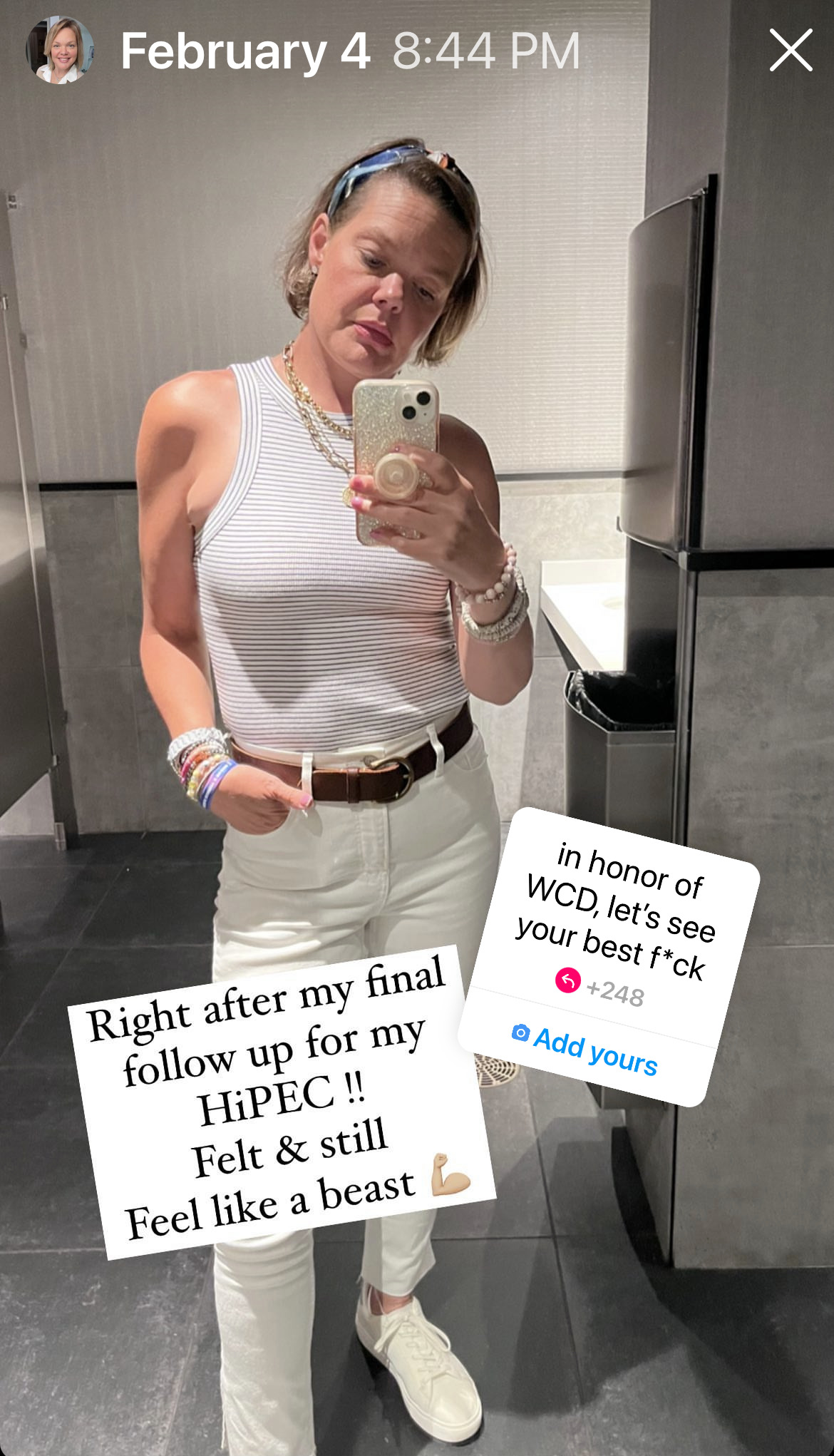
Nine years ago, Alli was diagnosed with colon cancer, but what she actually has was appendix cancer–and she only found that out many years later. She is currently NED, or “no evidence of disease,” and in her words, “It’s taken a lot to get here.”
Alli had initially experienced intense abdominal pain, which had been diagnosed as appendicitis. Her appendix was successfully removed, but its “angry” appearance led her doctors to send it to pathology for a closer look. It was initially diagnosed as colon cancer because it behaved like colorectal cancer. She then underwent surgery to remove a portion of her colon.
Alli was declared NED and enjoyed 7 years of being cancer-free before she experienced what seemed to be a recurrence of her colon cancer, but her doctors finally determined that what she had was actually stage 4 appendix cancer.
Alli is sharing her story not only to stress the importance of proper diagnosis and treatment as well as advocating for oneself, but also to help shift perspectives regarding stage 4 cancer and how it may not necessarily be a death sentence; to establish the importance of properly listening to one’s body; and to reframe healing after cancer as an opportunity to build a better, more complete version of the person one used to be.
Name: Alli M.
Diagnosis:
Appendix cancer
Staging:
Stage 4
Symptoms:
Severe abdominal pain
Treatment:
Surgery (right hemi colectomy, appendectomy, HIPEC)
Chemotherapy (adjuvant chemo in 2014; after recurrence, 6 rounds of oxaliplatin with avastin and xeloda)
This interview has been edited for clarity and length. This is not medical advice. Please consult with your healthcare provider to make informed treatment decisions.
The views and opinions expressed in this interview do not necessarily reflect those of The Patient Story.
Interviewed by: Taylor Scheib Edited by: Katrina Villareal
Amy initially noticed a slight change in her stool consistency, which persisted despite normal test results. After a year-long delay due to the COVID-19 pandemic, a colonoscopy revealed a 6-cm mass in her colon. Although the initial biopsy showed no cancer, surgery confirmed cancer in the tumor center and 11 out of 21 lymph nodes. It was stage 4 colon cancer.
She began treatment with FOLFOX, experiencing severe side effects like jaw pain, cold sensitivity, and neuropathy. Despite completing the regimen, a slight increase in CEA levels prompted further tests. A CT scan and MRI revealed cancer in her liver, leading to a relapse diagnosis. Unhappy with her initial oncologist’s pessimism, she sought a second opinion and switched to a more supportive doctor.
Her new oncologist initiated FOLFOXIRI, which shrank the tumors but wasn’t enough to eradicate the cancer, leading to surgery and an ablation. When the cancer resurfaced, she joined an immunotherapy clinical trial. The difference between chemotherapy and immunotherapy was substantial, providing her with a significantly improved quality of life.
Throughout her stage 4 colon cancer journey, Amy emphasized the importance of a supportive medical team, listening to her body, advocating for her health, and maintaining movement and proper nutrition during treatment. She also stressed the need for open communication with healthcare providers about side effects and health concerns.
Name: Amy L.
Diagnosis:
Colon Cancer
Staging:
4
Symptoms:
Slight change in stool consistency
Treatments:
Chemotherapy: FOLFOX, FOLFOXIRI
Clinical trial: immunotherapy
This interview has been edited for clarity and length. This is not medical advice. Please consult with your healthcare provider to make informed treatment decisions.
The views and opinions expressed in this interview do not necessarily reflect those of The Patient Story.
What might be normal for somebody else might not be for you. If there’s a change, it’s important to talk to your doctor about it.
Introduction
I’m from the Seattle Pacific Northwest area and I was diagnosed with stage 4 colon cancer.
Pre-diagnosis
Initial Symptoms
I only had one symptom, which was a very small change in my stool. It became slightly looser, but it wasn’t consistent. For most people, that might not be a big deal, but I hadn’t changed my diet. The first time I noticed it was when I had just come back from Spain and I thought it was from traveling. I gave it a few weeks, but it wasn’t getting better.
PCP Appointment
I listened to my body and talked to my doctor about it within a month of this first symptom. My doctor at the time thought it was food sensitivity. They did autoimmune testing for Crohn’s and celiac disease, but those came up negative. They did an allergy panel to see if I developed any new food allergies. That came back normal. I also had my first CEA test, but I had no idea what that was and that also came back normal.
I was blessed to have a doctor who was very proactive and didn’t ignore my symptoms. They knew that I knew my body. What might be normal for somebody else might not be for you. If there’s a change, it’s important to talk to your doctor about it.
Unfortunately, they couldn’t get me in for a colonoscopy. They did the fecal immunochemical test (FIT) test. They did all these tests and everything was coming back normal.
He recommended me to a dietician who started looking at what I was eating and what we could change that might explain the stool change. My doctor said that since everything’s coming back normal, he wanted to do due diligence to make sure that there’s nothing they might be missing. He said, “Let’s get you in for a colonoscopy.” That was in the end of 2019.
They called in and said my procedure was non-essential and not COVID-related, so I needed to be put on hold… Unfortunately, I ended up waiting for a whole year.
Getting a Colonoscopy
They were booked back a few months. I wasn’t considered urgent. Nobody thought I had cancer. I was 39. They said they’ll get to me at the end of January or early February 2020. Then the COVID pandemic happened.
A week before my appointment, they called in and said my procedure was non-essential and not COVID-related, so I needed to be put on hold. They would call when they could make it happen again. Unfortunately, I ended up waiting for a whole year.
During that year, I was furloughed, so I was staying at home. My symptoms went away, which confirmed to me that maybe it was something I was eating since I wasn’t eating out.
By January 2021, I got a phone call asking if I wanted to schedule my colonoscopy again. I almost said no and that I didn’t need it anymore because the problem had gone away, but a little voice inside me told me to go ahead and do it. The “worst” thing that they could tell me is that nothing’s going on. I had nothing to lose, so I told them to go ahead and schedule it. They scheduled me for the first week of February 2021.
I didn’t have any other symptoms, like pencil-thin stools, bloating, or pain. Nobody was looking for cancer, especially colon cancer. Most people who get colon cancer are in their 70s and 80s. The first oncologist I had even told me that I was the youngest patient he ever had. Most of his patients were 60 and older, so it wasn’t on anyone’s mind that I could have cancer.
When I did the prep for my first colonoscopy, it was worse than the colonoscopy itself, but it’s a small drop in the bucket out of all the days in my life. On the day I came in, everything proceeded as normal. I got onto the table and they told my husband that the procedure could take up to 30 to 45 minutes. He couldn’t stay with me, so he dropped me off and left.
They put me in twilight sedation so I’m out of it, but the doctor’s voice and tone cut through. She turned to her nurses and said, “Where is her husband? Get him back here right now. Call him. We need him back here right now.”
She didn’t say anything, but because of her tone, I knew something was wrong. I felt my heart dropped to my stomach. I was half awake and the anesthesiologist was trying to put me back to sleep because my eyes were open and I was starting to ask questions. I didn’t feel anything, so it wasn’t traumatic.
The biopsy results showed there was cancer in the center of the tumor and 11 of 21 lymph nodes.
Diagnosis
Biopsy
When they wheeled me back into a curtained area, my husband was already there waiting for me. The doctor came and said they found a 6-cm mass in my colon.
I waited for the biopsy results to come back and when she finally called, she said they biopsied the tumor, but there was no cancer. However, they were extremely concerned given the size. It was either going to turn into cancer soon or there would be cancer in the center and not on the outside, so they wanted to get me in quickly. Everything was indicating that they had “caught this in time” and that I would just need surgery and might not even need chemo.
Surgery
They scheduled the surgery within three weeks of that conversation. They were on top of it and wanted to get it out.
The surgeon came in to talk to me. The biopsy results showed there was cancer in the center of the tumor and 11 of 21 lymph nodes. The tumor hadn’t broken through the colon, like they usually see with more advanced cancer, so they were not expecting to see cancer in my lymph nodes. He was very shocked it was stage 4 colon cancer.
I made an appointment with a doctor at Fred Hutchinson Cancer Center to get a second opinion because I wanted to know more.
Oncologist Appointment
My mom was an ER nurse. She also has leukemia, so she hasn’t worked while dealing with that. My mother-in-law is a hematology-oncology nurse at the Mayo Clinic. I’m fortunate to have knowledgeable people who helped me through the next process.
They referred me to my regular oncologist and said he’d go through my stage 4 colon cancer treatment plan. I had a meeting with him and it went okay, but I ended up switching. He told me that I would need clean-up chemo or adjuvant chemotherapy. Everything looked fine. He wasn’t hugely concerned.
Treatment
FOLFOX Chemotherapy
They said I was going to do FOLFOX (folinic acid, fluorouracil, and oxaliplatin) and then we would do a CT scan. They did a CT scan right after the colonoscopy where they found the mass, but they didn’t find anything else. He said it’ll be good.
Getting a Second Opinion
I made an appointment with a doctor at Fred Hutchinson Cancer Center to get a second opinion because I wanted to know more. I knew nothing. Is FOLFOX the standard treatment? What were my treatment options for stage 4 colon cancer?
Different doctors have different preferences and I wanted to ensure I was getting all the information. I made an appointment and brought all of my medical records to make sure. The doctor said they would do the same treatment.
I had a very rare side effect where I had jaw pain… This was a rare side effect of oxaliplatin.
Side Effects of FOLFOX
I did 12 and it was terrible. Before my second round, I had a very rare side effect where I had jaw pain. It was the most excruciating pain I’d ever experienced in my entire life. It radiated from my jaw back up around my neck and felt like somebody had put my head into a vice.
They didn’t know what was going on. I didn’t find out until I switched oncologists that this was a rare side effect of oxaliplatin. They sent me to a jaw specialist to make sure there wasn’t something else going on. I spent the rest of my treatment switching back and forth between morphine and oxycodone because the pain was so horrific.
On top of the nausea and hair loss, the cold sensitivity was bad. I like my drinks either really hot or cold. I don’t like lukewarm drinks. Chemo, especially oxaliplatin, made everything taste like pennies and dirt. I’m a big water drinker and I couldn’t drink water because the taste would make me gag. I started drinking electrolyte drinks to mask the taste. I don’t like sugary drinks, but I needed to get fluids in me so I don’t end up in the hospital. You have to do what you have to do to survive, I guess.
I also developed bad neuropathy in my hands and feet, and that came on suddenly. I was doing fine, but by cycle 10, the pain in my feet started to get bad. I was having trouble gripping things. I couldn’t wash the dishes. I would pick something up and drop it.
When the CT scan results came back, they found something in my liver… they didn’t think the cancer had come back, even though my CEA was up to 5 or 5.5.
Post-Treatment Follow-Up
After they finished, they did my scan and didn’t notice anything, so they sent me on my way and said they’d see me in six months. I wanted to see him in three, but he said he didn’t think that was necessary. I said I did, so he scheduled me for a three-month visit, which ended up being fine.
During my six-month visit, my CEA went up to 2 and that was my first flag. My CEA was still perfectly normal, but my CEA had never gone above 1.7. When I had the appointment with my oncologist, I told him this was concerning for me and he said it was a little concerning for him too. It’s a little bit of an increase, but it could still be normal, so he scheduled a blood draw after four weeks.
In four weeks, my CEA was 4.6 and that was abnormal for me. It was still within the normal range because anything under 5 is still normal, but I thought it was concerning. He said we could do another blood draw in four weeks.
By this time, it was around July and he said I wasn’t due for my CT until October. I said I didn’t want to wait until then.
Relapse
When the CT scan results came back, they found something in my liver. They thought it was a lesion because they said cancer usually looks like billiard balls but this looked like a zucchini. At that point, they didn’t think the cancer had come back, even though my CEA was up to 5 or 5.5, so something was going on.
They did an MRI and the results looked more like cancer. When they did a PET scan, the results looked even more like cancer. The biopsy confirmed it.
He said, “It’s looking more like it could be cancer.” They hadn’t done the biopsy yet at this point. He said, “If it’s cancer, there’s only a 20% chance you’ll make it to old age. That’s what the statistics tell us.”
I needed a doctor who I felt was on my side. I needed someone who I felt was going to fight for me.
Reaction to the Relapse
I walked out, got in my car, closed the door, and broke down crying. I was done with this oncologist. This is a horrific journey in itself. I needed a doctor who I felt was on my side. I needed someone who I felt was going to fight for me. I don’t care what the statistics say. There’s always somebody that’s on one side or the other.
Looking at Statistics
When you get these statistics, they mean something to doctors and researchers, but they don’t mean anything to people personally because you don’t know which side of that line you’re going to fall on. You could have the worst diagnosis and still survive.
I didn’t want to hear the statistics not because I was blind to it but because I knew it didn’t matter to me. The doctors are guessing which side of the line I’m going to end up on and I don’t want to hear their guess. I wanted to know if my treatment was working and if not, what my next steps would be.
She noticed the lymphatic system near my kidneys was getting larger so they thought that there was cancer there.
Switching Oncologists
I went back to the oncologist from whom I got a second opinion and she’s fantastic. She’s the best decision I ever made. One of the first things she did was get all of my scan results. She called my former doctor, requested all of my scan results, and sent them to a couple of different specialists so they could look at all of them. My new oncologist is on top of it and doing CT scans every eight weeks.
She noticed the lymphatic system near my kidneys was getting larger so they thought that there was cancer there. My first oncologist hadn’t even looked at that and it was one of the first things she noticed. It confirmed to me that I made a good decision.
I have this bad luck of getting things that look favorable but don’t end up being favorable. When I had my relapse, they looked at it and said I had a single liver lesion, which isn’t common. At that point, I was still considered curable.
Relapse Treatment
FOLFOXIRI Chemotherapy
She put me on FOLFOXIRI (folinic acid, fluorouracil, oxaliplatin, and irinotecan). I did FOLFOX a few times, but it wasn’t shrinking, so they added irinotecan and it started to shrink.
I went back on the full treatment for six months with very low node shrinkage but with slow growth.
Side Effects of FOLFOXIRI
I was miserable on oxaliplatin. It was terrible. I was sick all the time. The neuropathy in my hands had gotten better, but my feet had gotten worse. I could still do stuff with my hands, but my feet are pretty bad. I also had cold sensitivity, like not being able to eat cold food. Breathing in cold air was like breathing in shards of glass. My oncologist said they didn’t see any shrinkage with oxaliplatin, so she decided to remove it.
I had treatment until February 2023. It was shrinking and looking good, but it wasn’t going away, so they wanted to do surgery to remove the lymph system that had cancer in it. They did an ablation on one spot.
My oncologist wanted to do the ctDNA test to see if I had circulating tumor DNA in my blood. Four weeks later, that came out positive.
She said they usually wait 8 to 10 weeks before doing the first scan post-treatment, but she wanted to go ahead and do an MRI six weeks after surgery. She wanted to make sure because it looked like there was residual cancer.
Unfortunately, my liver lit up. They did a PET scan and there are a couple of spots now. I went back on the full treatment for six months with very low node shrinkage but with slow growth.
The difference between immunotherapy and chemotherapy is like night and day.
Joining a Clinical Trial
I started with an immunotherapy clinical trial in December 2023. The difference between immunotherapy and chemotherapy is like night and day. I’m not sick and tired all the time, so I’m able to go out and do normal activities. I feel like I’m able to have more of a normal life. It’s been fantastic, but I’m still fighting.
This is why it’s important to have a doctor who’s on your side. As soon as my recurrence happened, she went ahead and signed me up for every single trial that they offered. She didn’t ask me because she knew that these trials could have a year’s wait list. She figured that wherever I was, at least I was on the wait list. If a spot opened up, we could have a conversation about it.
When it comes to treatment, you do have a say. Your doctor may have a recommendation, but you have a say in what your treatment plan is going to be. You can tell them if you want an alternative.
A lot of people are intimidated, so they don’t want to tell their doctor what to do. It’s important to remember that your doctor is working for you. Find someone who’s working for you. My oncologist definitely was working for me.
Future Treatment Plans
My cancer is still growing. At any time, I can say I want to try something different. My oncologist and I have had those conversations. Because I’m on a trial, it’s not going to last forever. Unfortunately, I can’t be on this for the next five years. Having been off chemo, I’m hesitant about going back to it. I wanted to find out if there were non-chemo options we could explore, so we’ve talked about other options that are on the table.
With cancer, a lot of times, people sit and suffer in silence so by the time symptoms start rearing their big ugly heads, it’s often in the advanced stages.
Words of Advice
Know your body and trust your body. If something changes and there’s no warrant for that change, talk to your doctor. Don’t talk to your friends. Don’t go to social media. For everyone else, it might be normal, but if it’s not normal for you, it does warrant a conversation with your doctor. If it turns out to be nothing, you’re not out that much. I don’t think any doctor’s going to be mad that you wasted their time coming to them with your concern. Get rid of that fear. Know your body and know what’s normal for your body.
If anything comes up abnormal, don’t be afraid to go to your doctor and advocate for yourself. Tell them you want to find out what’s going on. With cancer, a lot of times, people sit and suffer in silence so by the time symptoms start rearing their big ugly heads, it’s often in the advanced stages.
People ignore the early symptoms. Maybe they’re busy, maybe they’re afraid, but I think primarily it’s because people think it’s not a big enough issue to warrant seeing a doctor. If it’s not normal for you, speak up and say something. The best thing that could happen is they tell you it’s nothing. The worst thing that could happen is they tell you it’s something, but maybe they found it before it’s something big and problematic.
Interviewed by: Taylor Scheib Edited by: Chris Sanchez
Elizabeth was diagnosed with stage 4 colon cancer on March 14, 2019, and, after chemotherapy and surgery, was declared NED in July of the same year. On the first of July 2024, she celebrated her 5th year of being cancer–free.
Elizabeth has something of a long history of cancer, having lost her mother to non-Hodgkin lymphoma just over 4 months after she was born; having been diagnosed herself with adenocarcinoma of the submandibular salivary gland, which very rarely affects children, at just 2 years old; and having had a basal cell removed from her face at 25. She has also had a long history of stomach issues. Her colon cancer was discovered when her condition worsened to the point that a CT scan became necessary.
Elizabeth has learned a lot from her experience, and is eager to share her story with other patients in the hope that she may be able to offer both guidance and reassurance.
Name: Elizabeth W.
Diagnosis:
Colon Cancer
Staging:
Stage 4
Symptoms:
Irritable bowel syndrome (IBS)
Small intestinal bacterial overgrowth (SIBO)
B12 deficiency
Hypoalbuminemia
Treatments:
Surgery (removal of left side of liver and small portion on the right)
Chemotherapy (oxaliplatin and xeloda)
This interview has been edited for clarity and length. This is not medical advice. Please consult with your healthcare provider to make informed treatment decisions.
The views and opinions expressed in this interview do not necessarily reflect those of The Patient Story.
I’m so grateful to be able to share my story with other people who will be able to watch this and know that there is a light at the end of the tunnel, or that there are things that they can do to help themselves.
Introduction
Hi, my name is Elizabeth. I work in the TV industry.
On March 14th of 2019, I was diagnosed with stage 4 colon cancer.
After surgery and chemotherapy, I was declared NED (no evidence of disease) later that same year.
On July 1st, I will have been 5 years cancer-free.
History of Cancer
I have kind of a long history with cancer.
Ten days after I was born, my mom was diagnosed with non-Hodgkin’s lymphoma of the bowel. They gave her 2 years to live, but she made it to just 4 months after her diagnosis. Bone marrow transplants, which is what they do now, had not started yet. They actually started 2 years after she was diagnosed.
When I was 2, my dad noticed that I had a lump in my neck. I’d been born with a cyst under my tongue, so he thought that that’s what it was. It turns out that I had adenocarcinoma of the submandibular salivary gland. I believe I was the first child or one of the first children, at least, to be diagnosed with that type of cancer. It’s way more common in adults.
At 25, I had a basal cell removed from my face. So I joke that I’ve had cancer about 2 and a half times because a basal cell, it’s technically skin cancer.
Pre-diagnosis
So I always sort of had stomach issues. My sister and I, whether it was lactose intolerance or whatever, we’d get stomach aches. And very commonly for us, we would eat something and then we would almost immediately go to the bathroom. It was just something that we always did. And I didn’t really pay that much attention to it because I tested negative for celiac multiple times.
I went to a GI in my early 20s when I moved to L.A., and I tested negative for celiac twice. They gave me an irritable bowel syndrome (IBS) diagnosis, which is just a very blanket diagnosis of any sort of stomach issues.
I then started to get really bad stomach issues, later in my 20s and into my 30s. And at one point I was in Europe, my sister was coming to meet me, and I was in so much pain she had to bring me xiaxin, which is an antibiotic.
I would feel better on the antibiotic for a little bit after, and then the issues would just come back. Nothing seemed to make them go away permanently. As for my sister, she had done a round of vaccine for her stomach issues and they had just gone away.
I went and saw a GI because I was having trouble finishing going to the bathroom. I would go to the bathroom and I would feel like there was more that needed to come out, but I would have to sit and wait for a little bit for it to come out.
So the GI did an exam and he said, everything seems fine, but, I’d like to do a colonoscopy to rule out Crohn’s or colitis. And then he also did a bacterial overgrowth test.
So I got a call from my insurance that said that he was leaving the network the next week, and that I would have to find a different GI to do the colonoscopy. So I got a new referral to another GI. He looked at everything that the previous GI had done. He said, you have IBS with bacterial overgrowth because I tested positive for SIBO.
Then he wanted me to take an antibiotic every night for 6 months to a year. And what he said to me after that was, this is what I think is wrong with you, and I’m never wrong. I didn’t like that answer.
My work in TV keeps me filming about 8 months a year. Every hiatus in the spring, I would go see another doctor. So I got another referral to another GI. I went and met with her in Santa Monica and she said, I don’t think it’s Crohn’s or colitis, but we can rule it out by doing a colonoscopy. But she also said, well, you aren’t having symptoms right now, so let’s just wait until your symptoms come back. And it was my first time as an adult that I went an entire year without any symptoms.
That all changed on March 1, 2019, when I was at work. I will never forget it.
It was a Friday evening. I was standing in front of the house where we were going to film, and I felt like I had pulled a muscle in my side. And I remember saying to one of my friends at work, like, it feels weird because I didn’t do anything that would have caused that feeling. And from that day onwards, I started getting shooting pains from my left side towards my middle, and they would become more frequent and more painful as the weeks went on.
On March 11th, I was at work and I started to just feel ill as well. I took the next day off and went to see another GI. He did all these different tests, and he noticed that my blood work from January, from my physical, revealed that I had very low B12 and very low albumin, and nobody had followed up to do additional testing.
The GI said, you know, we’re just going to run some tests. I would like to do a colonoscopy. You probably have a mild Crohn’s and colitis. So the same thing that everyone else sort of thought was or wasn’t what I had.
Okay, well, I have a month left of work. Is it possible to do it when that’s when that’s done? And he said, oh yeah, of course, no problem. I said, as long as it’s not life threatening. He said, oh no, nothing like that.
The next day, I woke up in the most pain I’d ever been in—I was in so much pain that I could not stand up straight—and I drove 35 miles to Santa Clarita to go to work. But everyone at work was like, you have to go home.
My doctor called me and he said the inflammation levels in my blood were so high. He said, you have to have a colonoscopy on Friday (this was a Wednesday). I was talking to my parents and my dad, who’s a pediatrician, decided he was going to fly down because of how much pain I was in.
My GI initially had told me to start taking fiber on that Tuesday. And then on Wednesday, when he called me, he said, don’t take fiber, switch to Miralax instead. My first bowel movement post-Miralax on that Thursday was covered in blood, and it was the first time I had ever had blood in my stool.
I reached out to him and he said, that’s perfectly normal. It’s what we would expect because of the levels of inflammation in your blood. I wouldn’t worry about it, he said.
Discovery and Diagnosis
However, my GI and my dad had spoken on the phone and they decided they were going to send me for a CT test. So that Thursday, March 14th, I drove to UCLA to have my CT exam. My dad was flying in and was going to meet me at UCLA.
I had the CT exam, and when I was done, my dad showed up. I was still in pain and extremely nauseous. We drove to Rite Aid to buy something, but I was feeling so bad that I couldn’t leave the car; my dad had to run in.
When I got home I immediately ran into the bathroom and started throwing up. But in the middle of all that, my dad walked in with my cellphone on speakerphone because my doctor had called back.
The doctor says, I’m so sorry, but you have a tumor in your colon and spots on your liver and you have to go to the hospital.
And my dad whispered, it’s happening all over again. Because my mom had non-Hodgkin’s lymphoma of the bowel. It wasn’t connected through cancer, but it was in roughly the same location.
And then my doctor called me back, he was able to get me a bed. Just go to UCLA, he said. I packed and we drove over.
We arrived at UCLA and got settled. The next morning, they brought me in for the colonoscopy.
If you have a blockage in your colon, no matter what stage you’re at, if it’s bad enough, they’ll do an emergency surgery and just take out that part of the colon right away. They were successful and were able to place a stent.
The next day I met Dr. Agopian, who ended up being my liver surgeon. He had a refreshingly different approach from the others I had spoken with. He walked into my room by himself, sat down at the screen, and turned it to face me.
Dr. Agopian pulled up my scan and he said, you have three spots on the left side of your liver and one on the right.
Dr. Agopian said, I want to take out the whole left side of your liver and this spot on the right, it’s right on the edge. We’ll just cut it out. And then he looked at me and he said, let’s cure this thing. And he added, well, we’ll do a few rounds of chemo and then if it’s the same or better, you can have surgery.
Reaction to My Colon Cancer Diagnosis
So after I was first told I had colon cancer and spots on my liver, I remember sitting on the floor and there were a few first thoughts.
My friend Stacy was diagnosed with breast cancer when she was pregnant with twins, and she passed away before they turned two. At their first birthday, she had said to me that she had bone spots. I remember calling my dad and asking him what that meant. My dad had said to me that any time cancer leaves its origin, it’s only a matter of time.
So when he said I had liver spots, my first thought was, oh, I’m going to die. And then my dad left to go call my stepmom. I sat on the floor and my first thought was, this is so stupid. I just was like, I can’t. It just didn’t make any sense.
And then on the way to UCLA, I don’t remember if we really said anything. I remember having conversations with myself, and I was just sort of going through all of the things that I’d done. I’ve traveled a lot. I’ve been to all seven continents, like you’ve lived, you’ve had a really good life.
And we get to UCLA and headed to my room. The woman said that they were going to do a biopsy and colonoscopy in the morning, and so they were going to do 3 tap water enemas that night. My dad went to find lodgings for the night and my stepmom was going to fly in the next morning. So I was all alone in the room.
I just remember sitting in that hospital room and basically knowing already that I had stage 4 colon cancer. It’s a very strange thing because no one had confirmed anything yet and I didn’t have a biopsy, but I already knew.
For a period of time, I was explaining what was going on, but the minute that I would have to say I have stage 4 colon cancer, I would just lose it. And so I didn’t tell. A few people, like those from the show that I was working on, showed up in ways that they didn’t have to. They had always been extremely loving and caring towards me.
But Dr. Agopian made a real difference. He was the first person that sat down and explained things in a way that was practical and straightforward. Okay, here’s plan A, here’s plan B, here’s plan C. These are the options. These are the things that we can do. And I felt so disconnected from everything that was going on until this man walked down and just said, this is what’s happening. This is what we’re planning on doing.
He for me was like a light, like a beacon of hope that nobody else presented. And I held on to that so tightly because nobody was giving me anything else.
Treatment
I was in the hospital from Thursday to Sunday. I only stayed in the hospital as long as I did because I kept getting fevers at night. They couldn’t find any infections. They couldn’t figure out what my fever was caused by, either; there wasn’t anything else going on. I basically had to stay until I stopped getting fever.
And then I got better and was released. My parents initially told me to come to Northern California, where they live, because they knew the head of oncology at UCSF and they’re like, you’ll come up and do this at home. But I said, thanks but no, I’m not leaving my house. If I go home to do this, my entire existence revolves around me being sick, away from all of my things and my cat and so on.
So they gave me the names of a few different oncologists and reached out to their friend at UCSF for referrals to UCLA as well. They came back with two of the same three names. And after a couple of initial calls I finally got to talk to an oncologist, and my sister and parents flew down to meet him.
Chemotherapy
I had my first round of chemo on April 2019 and ended in November 2019. I took oxaliplatin and xeloda.
After that, I did a scan. I had been told, if my scans were good, we would cancel the chemo appointment. If they’re bad, then I’d need to stay and do another round of chemo.
And I had asked my doctor because the liver surgeon had said it just has to be the same or better. And I said, how often is it the same or better? He said 75%. I think it was 70 or 75% are the same or better on oxaliplatin and xeloda after three rounds. But I was taken aback when I got a phone call and was told that my appointment had been cancelled, my doctor was taking a leave of absence, and I had to find another doctor while he was gone.
So I paged my nurse practitioner, and I said, well, I want my scan results. And she said, oh, your colon cancer tumor, you can’t even really see it anymore. And all your spots shrank.
I then called the liver surgeon’s office, Dr. Agopian’s office, and was told that he wouldn’t be back until Wednesday. But then I got a phone call back and was told that I was going to have surgery and that I needed to meet Dr. Agopian and my colon surgeon on Friday.
I immediately called my friend who lived in Hawaii, and I scheduled a flight to Hawaii on Saturday, right after the meeting with the doctors, because I wanted to have a bikini vacation before they cut into my stomach.
Surgery
So during the Friday meeting, we scheduled my surgery for July 1st of 2019.
There was an initial concern about the date; my dad went, oh, it’s July 1st. It’s the day in every hospital where everybody moves up a level. A lot of people don’t have surgery on July 1st. But it turns out that none of the doctors assigned to me would be affected, which was great.
I underwent the surgery as planned on July 1, 2019.
Remission
One or two weeks later, I went in for my follow up appointment with Dr. Agopian. He came in and he said, is anyone giving you your pathology yet? I said, no.
And he said, the cancer cells in your tumors, they’re all dead. At that point I’d had 3 rounds of chemo out of the 8 that I was supposed to have, and I just sort of went, oh, okay.
And then a day later, I came in to see my colon cancer surgeon and he walked in and goes, Agopian stole my thunder. And they were like so excited. But again, my oncologist was gone and so I didn’t quite have that conversation.
I went to a new oncologist and he’s going through my file like he hadn’t even looked at it yet. And he was just like, oh, this is good, this is good.
And then he goes, you’re in remission. I called my sister after and I was like, didn’t sink in and it didn’t feel real. And then finally when my oncologist came back and said, you know, they say NED, which is no evidence of disease.
I finished my colon cancer treatment in November of 2019. I dropped the oxaliplatin because I had a allergic reaction on round 6 and broke out into hives. So I just did the xeloda for my last few rounds.
I got scanned every 3 months, and then it went to 4 months. And on July 1st when I go in to see my oncologist, for my 5 year scans, I then get a say in how long we’ll have a discussion of how often we’re going to do the scans versus the Signatera, which is the blood test where they can test for tumor markers in your blood.
… you will not always feel [bad] because in the first round you don’t know when it’s going to end and you feel like it’s never going to end.
Lessons Elizabeth would like to share
Radical Hope
During the course of my treatment, one of her friends had said it was really interesting because she was having conversations with one of her friends who was a doctor, and what the friend had said to her was, there’s no reason not to have radical hope.
So radical hope sort of became my thing.
I’m not religious. I don’t believe in God. But that being said, there is still a sense of whatever happens, happens, and what’s meant to be will happen. So that always gets very complicated for me.
The Possibility of Death
I was just very practical about it. Like most people don’t survive a stage 4 diagnosis. The statistic I think is, 12 or 14% of stage 4 colon cancer patients are alive 5 years after their diagnosis.
If you are a stage 4 cancer patient and you are friends with other stage 4 cancer patients, most of them are going to die. That was a really hard thing to deal with. And then I also struggled a lot because people kept saying things like, you’re the strongest person I know. If anyone can beat it, you can. And every time someone would say that to me, I’d be like, oh, I’m definitely dying.
It’s such a weird pressure because what if I die? Then have I let all these people down? Was I not as strong as they thought I was?
I’m not a warrior. It’s not a battle. It’s a disease. I didn’t sign up for this. I’m not a soldier. I think Norm McDonald said, um, when you die, the cancer dies with you.
I always appreciated that because I think that people mean well, again. But, like, I’m not a warrior. I’m not out fighting. I’m on my couch watching Parks and Recreation, trying not to throw up.
Putting up a strong front
It’s this idea that you have to be this strong front to everybody. And it’s like, no, we’re tired.
Like we’re tired and we’re cranky and we’re annoyed and like, I was so hot and people, very lovely people kept sending me blankets and I was like, I just, I’m so hot. And one of the main side effects of oxaliplatin is that you can’t eat, drink or touch anything cold. I had a very high cold sensitivity, so I was always having to drink hot drinks, hot chocolate, hot apple cider, hot water and lemon.
The last thing that I wanted was to be wrapped up in a blanket. But I really appreciated everybody that sent them to me.
If I am miserable on top of how terrible it is, what’s the point then? So I’m going to try to have the best time, like you’re going to try to make the best out of a bad situation. And it’s hard to do.
But I had incredible people that stepped up and came and took care of me, and there was so much good that I got to experience.
Reaching out, giving back
I recently donated my hair. I did it when I was diagnosed, also because with colon cancer, with the main chemo, you don’t lose your hair. But I was so overwhelmed with all of the love and the gifts and the things that were coming to me. I donated my hair after my first round of chemo, and then just 5 years later, I donated it again.
Any time that I felt like I could give back in any way, that was really important.
People are nice to you because you have cancer. Everyone seemed to go out of their way to offer things. And I think that’s also the other thing, it was really difficult for me to ask for specific things.
So everybody stopped checking in on me and it was like, oh, because everyone said, I don’t want to bother you. And I just would say, it’s not about like telling someone you’re thinking of them or, hey, I’m going to stop by with, you know, X, Y, or Z. I think those are sort of things that are super helpful.
And for me to be able to share as a stage 4 patient, to give hope to other stage 4 patients, that there’s someone in front of them who is going through it, who went through it somewhat recently and is okay. And that can be a little bit of pressure of like, I get nervous that if I do have a recurrence, I’m somehow letting everybody down.
It feels like a very strange space to live in. But again, things like this. I’m so grateful to be able to share my story with other people who will be able to watch this and know that there is a light at the end of the tunnel, or that there are things that they can do to help themselves.
I think that everyone’s experiences are going to be different. The fact that colon cancer is now the number 1 cancer death for men 20 to 40, and it’s the number 1 cancer death for men and women combined 20 to 40. And we still aren’t doing colonoscopies for people. I think that that’s the big thing that needs to be addressed.
Access to colonoscopies, access to Cologuard, access to things that are clearly needed because the number of people that reach out to me, women in their 20s on Tech Talk who will message me and say, I made my doctor do a colonoscopy, they said they weren’t going to find anything. They did a colonoscopy. They removed precancerous polyps and they said, you saved my life. And I think that the price of a colonoscopy, the access to health care, all of these things, it’s going to cause so much more issues because the number is rising. It’s something environmental. My geneticist says they don’t know what it is.
And for people that were born in the 80s and 90s, I just think that access to colonoscopies needs to be a bigger thing on everybody’s mind. I will also say that I did call my doctor’s office of the gentleman who said, this is what I think is wrong with you, and I’m never wrong. I spoke to the office manager because I wanted to make sure that he knew that he was wrong.
Mental health struggles
The big thing that people don’t sort of warn you about is that everyone’s around you and it’s very structured. And then once you finish, you don’t have that anymore. And that to me is when my mental health tanked.
I really struggled as my friends were starting to pass away from treatment, being a former stage 4 cancer patient who doesn’t have cancer any longer. But maybe it’s Schrodinger’s cancer, right? You don’t know until the day you have the test and the day you have the test. You know that that day you didn’t have cancer. That can be very difficult.
I started to have panic attacks and had to stop working on the show that I was working on because my mental health got so bad. Actually, I had a panic attack so bad I couldn’t drive for about six weeks. I didn’t think I’d be able to work again.
My primary care doctor at the time wouldn’t prescribe me anti-anxiety meds. He wanted me to rule out anything medical. So I went through endocrinology, ENT, cardiology, neurology. I had a brain MRI to make sure I didn’t have cancer in my brain. I saw every doctor under the sun. But the problem is, they were all specialty. They come in, they do their test, and if it’s not them, they just leave. So I was just constantly feeling abandoned by all of my doctors and my primary care doctors.
And then finally I made it through all the different doctors. I was feeling suicidal and was really struggling. It was really upsetting that no one was sort of listening or paying attention and feeling really guilty because I survived. I couldn’t live the way that I was feeling, the way that my brain felt. I couldn’t sustain that and I felt like nobody was paying attention. To anything other than their specialized thing. And so I had guilt on top of everything else. My brain just felt like it was fighting me all the time.
And the mental health aspect of chemo as well, which my friend Megan called black cloud days when you were having a bad day. I was talking to someone and I kept saying, it’s okay to have a black cloud day. And her husband kept saying, but we’re always going to look for the sun. And I was like, but you have to allow yourself to sit in what feels bad sometimes.
The better we felt, the worse we felt mentally during our cycles, because the better you felt physically, the closer you were to going back and having another round. You physically felt better, you were able to do more things, but you knew that the better you felt, the worse you were about to feel. And so I think that the structure of how you can help somebody who’s going through chemo and everybody is going to need something different.
Resources that can help
I think that whatever little thing you can hang on to and help you find your people, you should explore.
ColonTown is a great resource on Facebook. And TikTok has become another big thing for me. I created a TikTok account to spread awareness for colon cancer and young people, but also the idea of struggling with mental health after your cancer finishes because nobody talks about it. There isn’t as much support for that. There’s support when you’re going through it.
UCLA has free psychiatry, psychology services. You can get a therapist, and I had a great one. Not enough attention is paid to your mental state after your treatments are finished. And so that’s always been a really big thing for me, which is, people say, oh, but you’re better now. And it’s like, you’re never fully better. It never goes away.
I should also say that I craved oranges, and I learned later that oranges are an anti-nausea food, and pregnant women drink them and people on boats when they’re getting seasick.
Solutions
I had a meeting with a psychiatrist who I just saw to prescribe me meds that I should have been given six weeks earlier. And within two weeks it completely changed everything in my life. And I also now have a new primary care doctor who is lovely.
I’m wearing my Chadwick Boseman T shirt. It’s all of the lost potential of a human being that colon cancer took away. Like colon cancer took away massive potential not only from Chadwick himself, but from every person that that passes away.
And I think that the struggle of having cancer, of dealing with cancer, and then dealing with its aftermath is something that is really important, and I would love to figure out a better way to sort of platform all of that.
I’m going on a beach vacation with my sister and her friends, next week to celebrate five years, I have my scans on the 28th.
I’ll meet with my oncologist on the first, and it all seems like a fever dream, because when you first get diagnosed and when you’re in it, it feels so far away.
“Snowboarding”
When I went in for my first round of chemo, I sat next to a man who was a couple years older than me. His colon cancer had spread to his esophagus. And I was so scared and so unsure of what was coming and what to expect. And he was on his 5th round.
He sat there and walked me through everything that I could expect. He talked about the cold symptom called broken glass syndrome. If you eat or drink anything, even walking too quickly, the air that you inhale is too cold and it can set off different things. He just talked me through everything in such a gentle, sweet way.
I have shared with every single person that I have talked to about this because a lot of people reach out on TikTok or on Instagram, I have many conversations with strangers who have just been diagnosed, or have friends or family that have just been diagnosed, and I walk them through everything like he did for me.
What he said was, on my good weeks, I go snowboarding. And so in my first round when I was having my worst day and I felt like I couldn’t do anything and I couldn’t move, and I felt so terrible in my head, I just kept repeating, he went snowboarding.
He did not go snowboarding feeling like this. So you will not always feel like this because in the first round you don’t know when it’s going to end and you feel like it’s never going to end. And so I just kept saying in my head, he went snowboarding. And that to me was the hope that I would get better.
Historias de Cáncer de Pulmón ROS1 Positivo (ROS1+), Etapa 4
Sepa que si está buscando en Google los pronósticos de supervivencia pronosticadas para el cáncer de pulmón en etapa IV es mejor no prestarle atención. La mayor parte de esa información está desactualizada.
Estos nuevos tratamientos, ya sea terapia dirigida, inmunoterapia o vacunas personalizadas, etc. están cambiando drásticamente las tasas de supervivencia. Entonces, tenga algo de esperanza y positividad. Yo soy una prueba viviente de que esas predicciones no siempre son verdaderas.
Lisa Goldman
Nombre: Lisa Goldman (45 años)
Diagnóstico:
Cáncer de pulmón ROS1 positivo
Etapa 4
Primeros Síntomas:
Tos persistente (meses)
Poco de sangrado al toser
Fiebre alta
Sudoral dormir
Diagnósticos Erróneos:
Gripe común
Bronquitis
Vías irritadas (para explicar el sangrado al toser)
Resumen: Me diagnosticaron con un resfriado y bronquitis durante meses. Cuando por fin me dijeron que era cáncer tenía tres costillas rotas por toser tan fuerte, sudores nocturnos, fiebre, y estaba tosiendo un poco de sangre. Me habían realizado múltiples radiografías cuando debería haber recibido una tomografía computarizada de baja dosis. Eso habría mostrado el cáncer.
Rara vez me enfermo o voy al médico, pero había tenido un resfriado persistente y tos durante varias semanas, así que finalmente decidí ir al médico. Odio tomar medicamentos, incluso antibióticos, porque prefiero guardarlos para cuando realmente los necesito.
Me tomó mucho tiempo, probablemente un mes, hasta que fui a urgencias durante un fin de semana y mi amiga me dijo que era hora de ir a pedir antibióticos o algo.
Así que eso es lo que hice. Fui a urgencias que estaba abierta los fines de semana y me hicieron una radiografía rápida de mis pulmones. Me dieron antibióticos y jarabe de codeína para la tos.
Dijeron que la radiografía se veía totalmente limpia. Esto fue en octubre de 2013. En ese entonces estaba muy bien físicamente, enseñaba cinco clases de spinning a la semana y todo tipo de clases de ejercicio, comía de manera saludable y todo eso. Empecé a tomar los medicamentos y no mejoré, de hecho, empeoré un poco.
Luego, un par de semanas después, fui con mi doctora primaria a mediados de noviembre y le dije que la tos había empeorado. Ella escuchó mis pulmones y me hizo un examen rápido y dijo que creía que era una especie de bronquitis. Entonces me recetó un antibiótico diferente y un inhalador. Ese fue el primer inhalador que había tenido en mi vida.
Nunca había tenido asma ni alergias ni nada por el estilo. Ahora que lo pienso, debí haber preguntado acerca del tratamiento ya que en vez de indagar más me dieron un tratamiento para algo de lo que no tenía antecedentes. Sin embrago, eso fue lo que pasó.
Regresé a casa con mi inhalador y algunos otros medicamentos y seguí el tratamiento algunas semanas, pero no vi mejoría alguna. Regresé a principios de diciembre y fue otra vez la misma rutina: me subió el nivel a un inhalador más potente, agregó esteroides y aún así no funcionó.
Empecé a toser sangre a mediados de diciembre. No eran grandes cantidades, solo pequeñas gotas de vez en cuando. Pero aún así quería irme a revisar.
No era color rojo vivo, sino más como un tono oscuro entre naranja y café. Fue un poco, nada alarmante que me hiciera tener que ir corriendo a urgencias, pero sí llamó mi atención como si fuera una señal de que debía revisarme bien porque algo andaba mal.
Fui con mi doctora y me dijo que el sangrado era debido a que tenía las vías respiratorias inflamadas ya que tenía ya meses con una tos severa. Me dijo que no me preocupara y que me fuera a casa y disfrutara mi descanso.
En ese tiempo mis hijos estaban en sus vacaciones de invierno e íbamos a ir a visitar a mis padres a Palm Desert en el sur de California. Por último me dijo que si al volver, en enero, seguía teniendo molestias entonces me harían otros rayos-x para ver que todo estuviera bien.
Sin embargo, las cosas empezaron a empeorar con rapidez. Empecé a tener fiebre alta y mucho sudor en la noche, además de la tos con la que ya tenía varios meses.
Dicha tos era tan mala que tiempo después nos enteramos de que tenía tres costillas rotas por todo el esfuerzo. Mi madre me dijo que fuera por uno rayos-x de inmediato y así lo hice. Ahí en Palm Desert fui al hospital.
Ahora que ya sé más al respecto sé que basado en los resultados de esos rayos-x debieron ordenarme una tomografía computarizada de inmediato.
No lo hicieron. En vez me dijeron que, a pesar de que había unas cosas anormales en el resultado, ellos creían que era una neumonía. Me dieron medicamentos más fuertes y me dijeron que unas semanas después, al regresar a casa, me hiciera una tomografía.
Mark, un amigo de la familia que es doctor y que también estaba de visita en casa de mis padres durante ese período, me dijo que algo no cuadraba.
Él no es ni oncólogo, ni pulmonólogo, sino gastroenterólogo. Nunca mencionó el cáncer, solo me dijo que no tenía sentido que después de haber estado con un tratamiento tan fuerte por tanto tiempo no hubiera tenido mejoría alguna, al contrario.
Me dijo que dejara de buscar respuestas con médicos generales y que fuera directamente con un pulmonólogo.
Ya estábamos por regresar a casa, así que no tenía sentido buscar ayuda médica en Palm Desert. El día que volvimos fui a ver a un pulmonólogo.
Me veía perfectamente bien, pero al escuchar mis pulmones y hacerme una lectura de oxígeno que salió alrededor de 70 cuando lo normal es entre 90 y 100, me envió de inmediato al hospital a que me hiciera una tomografía.
Al terminar fui de nuevo con el pulmonólogo en el piso de arriba. Sacó los resultados y me mostró todo. Mis pulmones aparecían completamente blancos en la imagen lo cual es malo.
Sin embargo, él nunca mencionó la palabra cáncer. A mi tampoco me pasó por la mente ya que no me consideraba como la estereotípica paciente de cáncer de pulmón. Me dijo que tenía que hacerme una biopsia pero me lo dijo tranquilamente para que no me asustara.
Por suerte, mi amigo Mark iba a viajar al Área de la Bahía en esas fechas, así que le dije y estuvo presente. Justo al salir de la biopsia me diagnosticaron y Mark estuvo ahí conmigo y con mi esposo y pudo ayudarnos a facilitar la conversación con el médico.
El cirujano fue directo en cuanto al diagnóstico.
Espero que otra gente tenga mejores experiencias. Al despertar tenía a mi esposo a mi lado y a un amigo que es doctor: Mark.
Al pie de la cama estaba el cirujano que había hecho la biopsia a quien había conocido solo una vez en una cita pre-biopsia. Obviamente había estado ahí mientras me empujaban hacia el quirófano, pero nunca desarrollé una relación estrecha con él.
Sin embargo, ahí estaba al pie de mi cama a las 8pm un Viernes, cansado, queriéndose ir a casa. No lo culpo. Simplemente me dijo: “Parece ser un cáncer de pulmón, etapa 4. En un rato vendrá un oncólogo a verte. Buena suerte. Buenas noches.” Y así como así se fue.
¿Qué sentiste cuando te diagnosticaron?
Haber sido diagnosticada con algo que no había investigado antes y de lo que no sabía mucho fue abrumador. Estaba en shock.
Ni siquiera conocía a alguien que hubiera pasado por algo como esto y tampoco me sabía los términos médicos más básicos. Nunca antes en mi vida había sido anestesiada.
Creo que tenía miedo de ir a casa pero no entendía porque era inseguro. No entendía muchas cosas. Tener a Mark ahí fue una bendición.
Al terminar la biopsia me mandaron a casa, pero Mark estuvo ahí discutiendo con ellos ya que sufro de taquicardia (pulso acelerado).
En ese entonces ni siquiera sabía lo que significaba taquicardia. Al fin de cuentas terminé quedándome en el hospital una semana ya que Mark los pudo convencer.
Aún pienso en lo que hubiera pasado si me hubieran mandado a casa en esas condiciones. Además, yo estaba conectada al oxígeno y me enviarían a casa sin él. Terminé necesitando oxígeno por aproximadamente dos meses.
Una vez que me enviaron a casa simplemente cargaba con mis tanques de oxígeno. Estoy verdaderamente agradecida de haber podido tener a Mark ahí presente.
¿Cómo fue estar con un tanque de oxígeno todo el tiempo?
El hospital se encargó de hacer todos los arreglos. Ellos tienen contrato con un proveedor que va a la casa y monta el compresor. Es una máquina parecida a un aire acondicionado pero portátil.
Tenía una manguera larga que me permitía moverme dentro de la casa, pero al ser muy ruidosa decidimos ubicarla en la sala para que estuviera alejada de los cuartos. Era como tener una correa.
Fue entonces que tuve una larga manguera por toda la casa, ya fuera en la sala, cama o comedor. Siempre estorbaba, la gente tropezaba con ella, se atoraba en las puertas…un dolor de cabeza.
No obstante, al menos no tienes que estar cambiando un tanque constantemente, sino que la máquina se encarga de comprimir el oxígeno de la casa para que lo puedas respirar.
Cuando quería salir de casa, lo cual no sucedía con frecuencia en ese tiempo debido al problema con el oxígeno, usaba un tanque portátil que empujaba.
Eventualmente conseguimos uno pequeño que estaba dentro de una mochila que podía llevar en mi espalda a todos lados.
Siendo honesta, todas esas cosas me ponían nerviosa, así que las primeras semanas prefería permanecer en casa.
Te sorprendiste porque jamás habías fumado.
Lo aprendí de la manera difícil. A pesar de que ya había escuchado el año anterior de un paciente más joven que fue diagnosticado con cáncer de pulmón, seguía pensando que era extraño. Para mí era uno de esos casos en un millón.
Sin embargo, una vez que me diagnosticaron y empecé a indagar más y a conocer a otros pacientes me di cuenta de que no era lo que creía. El cáncer de pulmón está aumentando en los que nunca han fumado, está aumentando en las personas más jóvenes y está aumentando en las mujeres.
El paciente típico ya no es aquel fumador que consumía dos cajetillas al día. Según las estadísticas que he visto, alrededor del 20% de los pacientes recién diagnosticados son fumadores activos. Eso deja al 80% que no lo son.
Una gran parte de ellos son ex fumadores; aproximadamente el 60%. Pero muchos de los ex fumadores dejaron de fumar hace décadas, por lo que no se consideran fumadores.
¿Quién sabe? Para algunas de esas personas su historial de tabaquismo tal vez tiene que ver con su diagnóstico de cáncer de pulmón. Sin embargo, para algunas de ellas tal vez no.
Nunca hemos examinado eso debido al estigma y las suposiciones de que el cáncer de pulmón siempre se debe al tabaquismo.
¿Cómo escogiste a cual hospital ir?
Lo que sucedió fue que al ir a hacerme la biopsia nadie me había advertido. El cáncer ni siquiera había sido discutido. Así que pensé que solo iba a someterme a un procedimiento ambulatorio y luego nos ocuparíamos de lo siguiente basado en los resultados obtenidos.
Cuando me desperté me ingresaron en el hospital inmediatamente y me dijeron que cáncer de pulmón de etapa IV y que tenía que comenzar el tratamiento de inmediato. Así que el día siguiente me hicieron varios estudios y después comencé la quimioterapia allí mismo en el hospital, 24 horas después.
No tuve tiempo de buscar médicos u hospitales y de elegir a dónde quería ir. Todavía no sé cómo sucedió. El oncólogo simplemente apareció y me dijo lo que tenía que hacer y que si no seguía el plan al pie de la letra no funcionaría.
No me dieron opciones. No fue hasta tiempo después que me di cuenta de que tuve suerte ya que el oncólogo hizo un muy buen trabajo.
¿Te cambiaste con un especialista en cáncer de pulmón?
Comencé a investigar y me di cuenta de que mi doctora era una oncóloga general. Pensé que tal vez sería bueno acudir a un oncólogo torácico que se especializara en cáncer de pulmón ya que descubrí que había salido positiva en el estudio para detectar una mutación genética llamada ROS1 positiva y quería estar con alguien que tuviera otros pacientes con el mismo diagnóstico.
Empecé a buscar en los hospitales de UCSF y Stanford. Pedí segundas opiniones y al final, después de unos meses, me moví a Stanford. Sin embargo, no me encantó.
¿Qué te hizo regresar al otro hospital más pequeño?
Creía que si iba a Stanford todo iría de maravilla. No es que los médicos no sean brillantes, es solo que me sentí más como un paciente más.
Creo que el énfasis en la investigación ahuyenta al cuidado del paciente y es por eso que me cambié a un hospital comunitario en el que las enfermeras sabían mi nombre. Tenía el número de teléfono de mi oncólogo y menú respondía si necesitaba algo.
No es que los médicos de Stanford no respondan, pero definitivamente no es el mismo tipo de acceso. Hay muchas capas que tiene que atravesar para llegar al médico y el médico no está en la clínica muy a menudo. A veces tan solo un día a la semana.
Al final regresé con un oncólogo general en un entorno comunitario pero habiendo establecido relaciones en los centros académicos para poder consultarlos antes de tomar decisiones importantes sobre mi tratamiento. Para los laboratorios del día a día o incluso las exploraciones de horarios regulares, fue mucho más cómodo para mí estar en ese ambiente.
¿Algún consejo sobre la relación paciente-doctor?
Tuve dificultades al tratar de entablar una buena relación con mi oncólogo y equipo médico debido a toda la presión. Muchas veces se les transmite un mensaje a los pacientes que dice que deben abogar por sí mismos, que deben presionar y que deben hacer investigación propia; y lo hago, pero también busco ser respetuosa.
Ellos son expertos. Yo no tengo un título médico. Además, aunque me da pena admitirlo, uno quiere caerle bien a la gente. Uno quiere que su médico se preocupe por usted y que sonría cuando ingresa a la sala.
No quiere que haga muecas y que diga ‘esta persona está constantemente discutiendo, presionando y cuestionando.’ Ha sido todo un proceso aprender a equilibrar eso.
Abogo por mí misma, pero también trato de mantener cierta deferencia y construir una relación. Así que mi consejo es encontrar la combinación correcta, buscar una segunda opinión y crear un equipo.
Está el doctor al que veo rutinariamente, pero si tengo preguntas es posible que haya otro doctor mucho más especializado que tenga respuestas que me puede ayudar aunque no sea mi doctor primario.
Busqué a ese tipo de personas y las metí a mi ‘equipo’ en el cual también tengo el contacto de otra gente que juega otros roles importantes. Incluso tengo un terapeuta que veo para todo lo emocional porque eso no lo hace un oncólogo.
Lo que más busco en un doctor es que sea alguien que me escuche y que acceda a trabajar con las otras personas que conformar mi equipo. Descubrí que un médico que quiere estar a cargo y no quiere que nadie más me proporcione información no me funciona.
Mi sugerencia para otros pacientes es buscar médicos que tengan experiencia pero que también estén dispuestos a escuchar a otros.
Tratamientos y Efectos Secundarios
¿Escogiste tu tratamiento?
No me dieron opciones. Supongo que tuve la opción de no firmar para acceder al procedimiento, pero fue todo. Básicamente el oncólogo vino y me dijo que era relativamente joven y que como estaba sana y en forma creía que podría tolerar una prescripción de quimioterapia agresiva que debíamos empezar cuanto antes.
Me recetó Cisplatin, Avastin y Alimta. El Cisplatin es tan tóxico que tienen que tratarlo con una gran cantidad de solución salina antes y después para lavar los riñones, por lo que en realidad se convierte en un proceso de 12 horas.
Quimioterapia de mantenimiento: Bevacizumab (Avastin) + Pemetrexed (Alimta)
4 ciclos
Ciclo = 3 semanas
Entre 6 y 8 horas en un día
Terapia dirigida: Crizotinib (Xaltori)
¿Por cuántos ciclos de quimioterapia pasaste?
Pasé por cuatro ciclos de quimioterapia con Cisplatin, Bevacizumab (Avastin) y Pemetrexed (Alimta). Cada ciclo duró tres semanas. La infusión era el primer día y tomaba aproximadamente 12 horas. La primera se administraba ahí mismo en el hospital.
Normalmente toleraba la primera sin problemas. Cómo saben que el Cisplatin es difícil de tolerar, te dan toda clase de cosas antes y después de la infusión.
No solo me dieron esteroides, también me dieron Zofran y otra droga llamada Emend que ayudaba a prevenir las náuseas. Tomaba todo tipo de cosas para poder facilitar el proceso.
Para la quimioterapia de mantenimiento hicieron lo mismo pero sin el Cisplatin. Seguían siendo cuatro ciclos de tres semanas cada uno, pero el primer día la infusión era mucho más corta; entre seis y siete horas. En total, estuve en quimioterapia por ocho meses.
¿Cuales fueron los efectos secundarios de la quimioterapia?
La náusea es la que más recuerdo. Lo peor son los efectos secundarios de los medicamentos que atacan los efectos secundarios de la quimioterapia. Los esteroides son brutales, interrumpen tu sueño y te afectan emocionalmente.
No lo llamaría necesariamente un efecto secundario de la quimioterapia, sino el efecto secundario del cambio repentino en la vida. Sin embargo, creo que es una parte muy importante del tratamiento.
Además de la receta médica, me gustaría que les dieran a todos una receta para recibir cuidados paliativos y para visitar al trabajador social, al terapeuta o algún tipo de apoyo emocional. Creo que ahí yace la clave para hacerle frente a esto y es directamente proporcional a qué tan bien uno tolera los tratamientos y la calidad de vida.
Hablando más específicamente, el primer ciclo salió bastante bien; no tuve esa náusea. El segundo también, pero estas cosas se acumulan. Ya para el cuarto lo estaba sintiendo. Recuerdo que apenas pude salir del laboratorio de infusión. Solo hice cuatro rondas con el Cisplatin. Cada tres semanas iba para el siguiente ciclo.
Después pasamos a lo que llaman “quimioterapia de mantenimiento” la cual no tiene Cisplatin. Sin embargo, continué recibiendo Avastin y Alimta lo cual era mucho más tolerable pero aún tenía efectos secundarios. Seguía tomando medicamentos contra las náuseas, esteroides y desarrollé presión alta.
Hay que acomodarse al calendario: La primera semana no debía agendar nada. Solo planeaba estar en casa y pegada al Netflix. Entonces empiezas a mejor y para la tercer semana ya te sientes mejor. Esa era la semana buena y tenía que acomodar todo en esa tercer semana. Esto se repetía cada tres semanas.
Por favor califica los efectos secundarios que tuviste debido a la quimioterapia.
Todos tienen experiencias diferentes. Lisa calificó los efectos secundarios de la quimioterapia con un 8 de 10, lo que significa que ella tuvo una experiencia un poco más difícil.
En cuanto a su experiencia con la quimioterapia de mantenimiento, Lisa nos dio un 6 de 10, lo que nos indica que tuvo una mejor experiencia que con la quimioterapia primaria en la cual si tuvo que recibir infusiones de Cisplatin.
¿Cómo respondiste a la quimioterapia?
Dependiendo de los síntomas y de cómo me sintiera era como me agendaban las citas para los escaneos. Tuve buena respuesta al Cisplatin, así que rápidamente empezamos a ver cambios positivos en los exámenes.
Nunca tuvimos resultados perfectos, pero los resultados fueron increíbles al punto que después de dos ciclos de quimioterapia pude estar sin tanque de oxígeno. Fue algo estupendo. Por lo general siempre era la persona más joven en el laboratorio de infusión, pero también era la que tenía peor aspecto porque tenía el tanque de oxígeno y la manguera en la nariz.
Cuando iba al baño tenía que cargar con el poste de la infusión, el tanque y todos los cables que siempre se enredaban. La quimioterapia fue muy efectiva, pero no es tolerable a largo plazo. Después empecé la quimioterapia de mantenimiento y los síntomas empezaron a reaparecer.
La tos volvió y las exploraciones comenzaron a mostrar que el cáncer regresaba. Después de ocho meses claramente ya no estaba funcionando.
Afortunadamente, descubrí antes que mi cáncer mostró una mutación ROS1 positivo. Sabíamos que había un medicamento de terapia dirigida que podía tomar para eso, así que cambié a ese tratamiento.
¿Se te cayó el cabello?
Me dijeron que se caería. Por lo general el Cisplatin hace que los pacientes pierdan su cabello. Me lo corté la primera vez y fue entonces que empecé a buscar pelucas. ¡Son bastante caras!
Me arrepentí de comprarlas porque mi cabello adelgazó pero nunca se cayó por completo. Todavía están en mi armario sin usar.
Probablemente me hubiera enfocado más en ello si se me hubiera caído por completo, pero como no sucedió decidí enfocarme más en otros detalles mucho más importante y en cómo le diría a mis hijos. El diagnóstico indicaba que el tratamiento duraría aproximadamente nueve meses, así que el cabello en verdad no era algo importante.
¿Cómo te enteraste de la terapia dirigida?
Me hicieron la biopsia en el Hospital El Camino, el hospital local aquí en Mountain View. El procedimiento se realizó el 10 de enero y más tarde descubrí que a partir del 1 de enero de ese año fue cuando comenzaron a probar todas las biopsias de cáncer de pulmón que se realizaron a través del laboratorio de patología para revisar la mutación ROS1.
Entonces, sin que yo tuviera que pedir las pruebas genéticas, ellos ya habían instituido un proceso en el que lo hacían automáticamente unos días antes de mi biopsia.
Pasaron algunas semanas para que los resultados llegaran, así que no lo descubrí hasta después de comenzar la quimioterapia. Como ya habíamos iniciado el tratamiento decidimos continuarlo hasta que dejara de hacer efecto.
Desde muy temprano supe que tenía ROS1+ y que había una terapia dirigida. El problema era que la terapia dirigida no había sido aprobada por la Administración de Drogas y Alimentos (FDA en Inglés), por lo que el oncólogo general del hospital con quien había estado trabajando nunca había usado ese tratamiento en mi tipo de cáncer porque para eso tenía que ser aprobado primero.
Entonces, al investigar por mi cuenta, descubrí que los resultados habían sido tan buenos que la FDA había acelerado el proceso ya que la compañía ya estaba en las últimas fases del proceso de aprobación.
Inclusive el seguro ya lo estaba aprobando para algunos pacientes. Así que le pedí que me lo recetara y lo sometiera a la aprobación del seguro para que lo tuviéramos disponible. Mi doctora se mostró dudosa así que tuve que abogar por mí misma.
¿Tuviste que abogar por ti misma?
Sí porque la doctora me quiso tranquilizar diciendo que si la primer quimioterapia no funcionaba entonces podíamos probar otros tipos. Yo le dije que no quería hacer eso y que había escuchado cosas muy buenas sobre la terapia dirigida, así que prefería tratar eso.
En ese momento, ¿cómo te sentías?
Mi médico me dijo que tenía cáncer de pulmón etapa IV, pero pero nunca me dio un tiempo restante de vida. Evité buscar cosas en Google al respecto. Finalmente, después de un tiempo, agarré confianza y lo hice, pero no es algo bueno. No obstante, los datos que uno encuentra están desactualizados ya que las terapias dirigidas están cambiando las tazas de supervivencia dramáticamente.
Soy el tipo de persona que necesita saber más. Algunos pacientes prefieren no saber nada y tener a alguien cercano encargándose de todo eso y que solo les diga lo que necesitan saber, pero yo necesitaba saberlo directamente.
Hice mucha investigación por mi cuenta. A veces es difícil de leer, pero creo que entre más esté uno informado mejor.
¿Tuviste efectos secundarios por la terapia?
Cuando me cambié a este tratamiento fue más difícil incluso que la quimioterapia porque me causaba más náuseas. Recuerdo que durante meses me tendía en el suelo de mi cuarto para tratar de combatir los mareos.
No tuve semanas malas. Simplemente mi cuerpo se ajustó después de un tiempo. Fue constante; sin altibajos. Me siento agradecida porque llevo ya casi cuatro años tomando el medicamento. Hay algunas cosas crónicas. Tengo un edema y náuseas constantes.
Simplemente es algo de la vida diaria a lo que debo acostumbrarme. En este caso hay ciertas cosas con las que vivo y que nunca se van, mientras que con la quimioterapia hay días buenos y días malos.
¿Cuánto tiempo llevas con el tratamiento de píldoras?
He sido muy, pero muy afortunada. Empecé con la terapia dirigida llamada Xalkori en septiembre de 2014. Me dijeron que los el medicamento haría efecto entre 12 y los 18 meses, pero ya estoy por llegar a mi cuarto año tomándolo.
Claramente soy una excepción, lo cual es genial, pero también es estresante porque sé que estoy ganando la lotería de momento pero puede ser que pronto se termine.
No conozco a mucha gente. Cuanto más avanzo, menos gente conozco que ha durado más que yo. Conozco a mucha gente que está tomando este medicamento, pero ya no digo: ‘Quiero ser como esa personas que lleva cuatro o cinco años con este medicamento.’
Ahora soy yo a quien todos están mirando. Esa es mi lucha particular ahora mismo; ¿cómo me enfrento a eso ahora? Me siento bien por el momento y por suerte no tengo síntomas que me estén causando gran preocupación. Este ha sido el período más largo sin escaneos que he tenido desde mi diagnóstico.
Mientras que anteriormente me hacían escaneos cada dos o tres meses, el año pasado cambiamos a cada cuatro meses por un par de ciclos. ¡Esta es la primera vez que llevo seis meses sin escaneo así que estoy muy feliz!
Vida Fuera del Tratamiento
¿Cómo le hablaste a tus hijos acerca del cáncer?
Llegué a casa con oxígeno y enferma y mi madre básicamente se mudó durante meses. Fue un cambio radical. No había esconderse de los niños, para bien o para mal.
No necesariamente creo que haya sido peor, porque es un lugar extraño en el que estoy ahora donde parezco normal, pero sé que todavía estoy enfrentando una situación muy aterradora. Eso es algo extraño para mí, para no ver a los niños pequeños.
En cierto modo, tener esto tangible: está esta cosa, es real y puedes verlo, creo que ayuda a procesar. Ayuda a todos a enfrentarlo y lidiar con eso.
He tenido amigos que fueron directamente a la terapia dirigida y es como, oh mamá estaba enferma y ahora está mejor y cuando empeoraron, fue como otro trauma.
Así que mi familia no tuvo esa experiencia. Tuvimos que enfrentarlo de frente. Definitivamente me puse en contacto con terapeutas y trabajadores sociales para ayudarnos a descubrir cómo ayudar a los niños a lidiar con esto. Aún así, hace más de cuatro años, seguimos visitándolos.
No es tan constante. No es tan intenso como lo fue en el primer año, pero sigue siendo algo que forma parte de nuestras vidas. Tratamos de hacerle frente. Tenemos una biblioteca de libros y herramientas, herramientas para la ansiedad, desde libros para colorear hasta bolas de estrés y juegos.
Todo este conjunto de sistemas de apoyo, ya sean sus maestros en la escuela o los terapeutas que hemos contratado o los médicos que lo saben, cosas así.
¿Cuál es tu consejo para otros padres?
Creo que es depende del niño. Tienes que tener un cierto nivel de deferencia y dejar que el niño dirija. No hasta el punto de ignorarlo por completo. Tengo dos hijos: Uno a quien le gusta hablar de eso y conocer todos los detalles, y otro que apenas hace preguntas. Así que me comunico con ellos de manera totalmente diferente.
Al que siempre me pregunta le comparto la información. Con mi hijo que no hace preguntas me aseguro de siempre incluirlo en la conversación poco a poco para evitar que entre en un estado de negación. Creo que conocer a tu hijo es lo más importante.
Busca a los profesionales.
No creo que se pueda hacer sin la guía de un experto, porque es algo que no se aprende hasta que se vive por cuenta propia. Busque a alguien profesional. Si no funciona no se dé por vencido. Todos necesitamos diferentes tipos de personalidades y apoyo.
La primera trabajadora social en el hospital no era compatible con nuestra familia, pero finalmente encontré a la persona adecuada. A veces hay que hacer prueba y error, pero sepa que es algo esencial.
¿Cómo te pusiste en contacto con los profesionales?
Tuve algunas fuentes. El hospital cuenta con trabajadores sociales en el personal, pero esas personas no terminaron siendo compatibles con nuestra familia. El primer año tuvimos trabajadores sociales que estaban en la escuela y eran realmente buenos y muy amables.
El año próximo se cambiaron y el reemplazo no fue igual de bueno, así que terminé investigando, hablando con amigos y familiares. Fue así como encontré gente por mi cuenta que no era parte del hospital.
¿Cuál es tu consejo para pacientes que acaban de ser diagnosticados con cáncer de pulmón?
Mi consejo número uno para cualquier paciente con cáncer de pulmón es que se haga una prueba genética. Sin importar quien sea, e incluso si tiene antecedentes de tabaquismo o si es un paciente mayor, todos deben realizarse pruebas genéticas porque nunca se sabe si su cáncer tiene mutaciones dirigibles.
Si lo hace, sus estadísticas de supervivencia cambian drásticamente.
Su calidad de vida es importante. En mi caso, hay cosas con las que tengo que lidiar día a día, pero en general vivo una vida bastante normal. Llevo a mis hijos a la escuela, tomo clases de ejercicio, viajo; hago el 90% de las cosas que hacía antes.
Es lo más cercano que puedo llegar a mi antigua vida con un diagnóstico como este. Es mucho más normal que con la quimioterapia en la cual tengo que estar pegada a la bolsa de infusión cada tres semanas.
También, busque a su gente.
Una vez que recibe un diagnóstico positivo de una mutación genética, o si es negativa, vaya y busque a gente con su misma condición. Hoy en día hay grupos de todo tipo. Entre más específico sea el grupo mejor ya que entre más se informe mejor será el resultado.
SI encuentra a ese grupo estará inmediatamente puesta al tanto de los estudios clínicos y tratamientos, conferencias, efectos secundarios, etc. Será mucho más fácil conseguir esa información en vez de buscar por cuenta propia entre miles y miles de bases de datos.
Lo que en algún momento se conocía como incurable está cambiando.
Existen nuevos tratamientos como la immunoterapia y la terapia dirigida que, aunque no son curas del todo, le otorgan al paciente muchos más años de vida que los que tendrían hace diez años.
Existe una población que ahora sabe que vive con una condición como esta pero que sigue con su vida. Yo ya no estoy pegada a mi tanque de oxígeno sin salir de mi casa, sino que vivo mi vida.
Al principio es difícil salir al mundo porque aunque te ves normal y la gente te trata de manera normal, tu sabes que por dentro estás lidiando con algo y a veces no te sientes bien o estás inestable emocionalmente. Es un proceso y toma tiempo ajustarse.
Es lo que pasa tras haber vivido una experiencia que realmente desestabiliza el ambiente al que uno está acostumbrado; uno sabe lo repentino que es y como te afecta y eso te deja traumado.
No es lo mismo saber que todos vamos a morir algún día y decir, por ende, que hay que vivir cada día al máximo, a haber vivido una experiencia que literalmente te puso entre la vida y la muerte y tener que vivir con eso cada día.
¿Cómo lidiaste con el estrés emocional?
Creo que estoy mejorando en eso. Honestamente, abrazo la vida y digo, está bien, esta es mi situación. Muchas personas tienen cosas difíciles con las que viven, ya sea que vivan en un lugar devastado por la guerra o en la pobreza o con un diagnóstico serio; todos tenemos nuestras luchas y en este momento esta es la mía.
¿Qué voy a hacer para seguir viviendo mi vida y seguir buscando mis planes a futuro? Lo que hice fue planear un viaje para seis meses después. Se me hizo algo un poco raro pero me estoy acostumbrando.
¿Qué fue lo que más te ayudó?
Hago todo tipo de cosas. Muchas de ellas me las recomiendan una y otra vez, como la meditación. No me gusta meditar pero lo intento.
He hecho todas las otras cosas fáciles como conseguir libros para colorear y libros divertidos para leer, revistas, todo tipo de cosas para calmarme. Depende de los gustos de cada quien, pero tener pelotas para el estrés, plastilina, libros, series de TV; todo ayuda.
Creo que es genial y divertido, pero en realidad se trata más de un cambio de mentalidad. Hay que aceptar el lugar en el que estoy y que puede ser que esté ahí por un tiempo. Eso me permitió vivir mi vida día a día.
Tomó mucho tiempo, conversaciones con amigos, terapeutas y muchos libros encontrar la manera de seguir viviendo con mi condición.
La familia es una parte importante de este viaje.
El cáncer no solo me afectó a mí; le afectó a toda mi familia. Y aunque todos me han apoyado mucho, todos han tenido sus procesos también.
Estoy segura de que fue, y sigue siendo, aterrador para mi esposo enfrentar la posibilidad de perder a su pareja y de tener que criar a nuestros hijos como padre soltero. De igual manera mis padres siguen angustiados por la posibilidad de perder a su hija.
No me puedo poner en sus zapatos, pero noto que todos hemos pasado por esto de maneras distintas y a cada quien nos ha afectado de manera personal.
El apoyo llegó de aquellos que ya habían pasado por traumas.
Me sorprendió un poco ver qué amigos aparecían y qué amigos no. No los estoy juzgando, simplemente muchas veces dependía de si habían tenido alguna experiencia con este tipo de diagnósticos.
Tengo dos amigos que habían perdido a un padre por esclerosis amiotrófica lateral (ELA). También tengo una amiga cuyo esposo fue diagnosticado con cáncer apenas unos años atrás. Ellos tenían un marco de referencia para enfrentar la mortalidad y lidiar con un trauma de esta magnitud.
Los amigos que no tenían ese marco de referencia simplemente no entendían lo que necesitaba o deseaba o qué límites eran apropiados o inapropiados. Es interesante ver cómo se desarrolla eso.
Es difícil porque, por un lado, creo que uno debe de salir de la zona de confort ya que tiendo a ser introvertida y se me dificulta pedirle ayuda a la gente. Así que aprecio cuando alguien es un poco más agresivo y toma la iniciativa antes de que yo les pida cualquier cosa.
El apoyo también llegó de lugares inesperados.
Creo que depende de la relación que uno tenga con esas personas. Había personas con las que no tenía una relación estrecha que se acercaron conmigo.
Una mujer que era mi estudiante en unas clases de acondicionamiento físico que enseñé se acercó, pero en verdad no la conocía muy bien. Fue muy generosa y me trajo comida junto con otra gente. Así o hizo de nuevo otras varias veces y un día me dijo que si quería salir a caminar para platicar le dijera.
Me contó que ella perdió a su esposo por un cáncer cerebral.Gracias a eso nos volvimos más cercanas. En situaciones como esta es mejor no ser agresivo. Hay gente con la que uno se conecta debido a que ellos entienden dado a que han pasado por experiencias similares.
Lisa’s Stage 4 ROS1+ Non-Small Cell Lung Cancer Story
Lisa is a passionate patient advocate for ROS1+ lung cancer patients after she was diagnosed with stage 4 at just 45 years old.
In her interview, Lisa talks about dealing with the stigma of lung cancer despite being a never-smoker, undergoing chemotherapy and targeted therapy, how she dealt with cancer as a parent, and the kind of support that has been the most important.
Know that if you’re Googling the prognostics or predicted survival curves for stage 4 lung cancer, please set that aside. Most of that information is outdated.
These new treatments, whether it be targeted therapy or immunotherapy or customized vaccines — whatever else is coming out there — are really dramatically shifting survival rates.
Have some hope and positivity because I’m nothing if not living proof that those predictions aren’t always true.
This interview has been edited for clarity. This is not medical advice. Please consult with your healthcare provider for treatment decisions.
Diagnosis
How did you get diagnosed?
Summary: I was misdiagnosed with a cold and bronchitis for months. By the time I was diagnosed, I had 3 broken ribs from coughing so hard, night sweats, fevers, and was coughing up a little bit of blood. I had undergone multiple X-rays when I should have gotten a low-dose CT scan. That would have shown the cancer.
I rarely got sick or went to the doctor, but I had had a persistent cold and cough for several weeks and finally decided to go to the doctor. I hate taking even antibiotics because I want to save them for when I really need them.
I’m not the type to run to the doctor to get those. It took a lot, probably a month, and finally I dragged myself there and went to my first appointment with the urgent care because it was over a weekend, and my friend said just go and get some antibiotics.
So that’s what I did. I went to the urgent care that just happened to be open on the weekends, and they did a quick X-ray of my lungs. They gave me antibiotics and codeine cough syrup to stop the cough. They said the X-ray looked totally clean.
This was in October. I was very physically fit. I was teaching about 5 spin classes a week and all kinds of other exercise classes, eating healthfully, and all that stuff. I took those medications and didn’t get better. In fact, I got a little worse.
What happened at the primary care doctor visit?
Then I went to my primary care doctor in mid-November a couple weeks later and said, “The coughing is getting worse.” She took a listen to my lungs, just did a quick exam, and said she thought it was still just a garden-variety type of bronchitis or something.
She gave me a different kind of antibiotic and an inhaler. It was the first inhaler I’d ever had in my life.
I never had asthma or allergies, anything like that. Now, looking back, I wish I had pushed back a little bit more and said, ‘Why are you not looking further into something and treating something I have no history of?’ But that’s what we did.
I went home with this inhaler and some other medicines and tried that for a few weeks. It wasn’t getting better. I went back again in the beginning of December, and again, same routine. She just upped the level to a more heavy-duty inhaler with steroids, and it still didn’t work.
When did your symptoms worsen?
I started coughing up blood. This was mid-December. I wanted to check in with her. I wasn’t coughing up volumes of it; I was just coughing up a little spot here or there.
It wasn’t bright red. It was dark orange, kind of brownish color. Just a little, tiny bit, not alarming like, “Oh, I really need to get myself to the hospital.” It was just like, “Hmm, I’ve never had that before. What is that?”
I went to the doctor, who said it was irritated airwaves, that I’d been coughing for months now, and it was just inflamed. She said she was not going to worry about it and suggested I go home.
It was the winter holiday, so my kids were out of school. We were going to go to my childhood home to visit my parents.
My doctor said, “Go enjoy your vacation. If things aren’t better when you come back in January, we’ll do another X-ray.” I said okay. I went home to my parents’ house in Palm Desert in Southern California.
Then it started accelerating. I was having high fever and night sweats and coughing horribly, coughing so much that we discovered later I had 3 broken ribs.
My mom said, “Go now and get another X-ray right now.” That’s what I did.
Describe the ER visit
I went into the ER in Palm Desert. They did an X-ray.
Now that I know more about all this, what they should’ve done, based on the X-ray, was sent me for a CT right then and there.
They didn’t. They said they definitely saw something on the X-ray that was not normal, but they thought it was pneumonia. They said, “We’re going to give you some other medications, some more heavy-duty cough medications, and when you get home in a couple weeks, then go get a CT.”
You got a second opinion from a family friend
Mark, a family friend who was a physician, happened to be visiting my parents during the holidays as well. He took one look at me. He’s not an oncologist; he’s not even a pulmonologist. He’s a retired gastroenterologist.
He never used the word “cancer,” but he said, “This is not adding up. You haven’t responded for months to all these medications, and you’re getting worse. Stop messing around with the primary care physician. Right now go call and make an appointment for a pulmonologist.”
Describe the pulmonologist visit
I was going home in a couple days, so at that point it didn’t make sense to seek treatment in Palm Desert. The day I got home, I went to see a pulmonologist.
He took a listen to my lungs and read my O2 (oxygen) level, which was really compromised. I can’t remember. It was maybe in the 70s at the time, and normal is 99 or 100%.
He said, “Go down and get a CT immediately.” That day, he sent me down for a CT. Again, I didn’t appreciate how abnormal this was because I didn’t go to the doctor a lot.
I went right back upstairs to this pulmonologist, whom I had just met, and he pulled up the images of the CT. When he pulled it up, both my lungs were just covered, totally whited out. That’s really bad.
But he never said the word ‘cancer.’ It wasn’t even on my mind because I wasn’t what I thought was the typical lung cancer patient.
He said, “We need to go get a biopsy.” I think it’s something called sarcoidosis. He really downplayed it, so I wasn’t freaking out. We made an appointment for the next week to get a biopsy.
Luckily, my family friend Mark was going to be in the Bay Area. He came with me to that biopsy, and I was diagnosed right as I woke up from the biopsy.
Mark was there in the recovery room with my husband, able to translate the information that was being thrown at us.
The surgeon didn’t sugarcoat the diagnosis
I hope other people have better experiences. When I woke up, I had my husband near my bed, and this family doctor friend, Mark. At the very foot of the bed was the surgeon who’d done the biopsy, who I’d only met once before at the pre-biopsy appointment.
Obviously, as I was being wheeled in, he was in the room, but I never really built a relationship with him. There he is at the foot of my bed. It’s 8 on a Friday night. He wants to go home. I don’t blame him, but he just said, “Looks like stage 4 lung cancer. There will be an oncologist who will show up in your room tonight and good luck. Goodnight.”
And he just left. So it was not great.
What were you feeling when you were diagnosed?
It’s such a shock and so overwhelming and so foreign to be diagnosed with something that I’ve never researched.
I’d never known anybody who had it, knew nothing about it at all, even just basic medical terms. I was out of it.
I had never even had anesthesia before in my life, so I was just waking up from that and a little out of it and the shock of the diagnosis.
I think I was probably scared to go home, but I didn’t understand that it would be unsafe. I couldn’t differentiate between that, whereas having Mark there really helped.
They were ready to send me home after that biopsy, and Mark was there saying, “No, she’s tachycardic (high heart rate).” I didn’t even know what tachycardic meant at the time.
He ended up talking to them and saying, “You can’t release her.” I ended up being in the ICU for a week, so it’s crazy.
I shudder to think of what it would have been like to be sent home in that condition. I was on oxygen. They were going to send me home without oxygen.
I ended up being on oxygen for almost 2 months. When I finally came home from the ICU, I just brought the tanks home with me. I am so grateful that he was there to help.
The hospital set this all up. They contract with a provider, who comes in and sets up a compressor in the house. It’s this thing that looks like a portable air conditioning unit.
I got this really long hose, so I could walk anywhere in the house. It’s like having a leash. It’s a hose from the compressor that’s kind of noisy, so we set it up in the living room so it’s not near the bedrooms.
Then I had this hose going all through the house, to my bed or wherever I was walking in the house. Of course, it’s always in the way, people are tripping on it, getting caught in doors, pain in the neck — but then you don’t have to have a tank that you’re switching out. It’s compressing oxygen from the air in the house.
When I wanted to leave the house, which wasn’t very often in those early days, especially because of the oxygen, I had this portable tank that I could either wheel. Eventually, I got one that was in a little backpack-type thing that I could carry on my shoulder.
To be honest, those almost made me a little bit nervous, so I was a bit housebound those first couple of months.
Treatment Decisions
The diagnosis was out of left field because you never smoked
I learned the hard way. Even though I had already heard the year before of a younger patient who got diagnosed with lung cancer, I still thought, “Wow, that’s so weird.”
I didn’t even have to think it would ever happen to me. It was just, “That’s weird, and these unusual things happen one in a million.” Then when it actually happened to me and I started finding out more about lung cancer and finding other fellow lung cancer patients, I realized this is not what I thought it was at all.
Lung cancer is on the rise in never-smokers. It’s on the rise in younger people. It’s on the rise in women.
It’s not the stereotypical haggard smoker, had a 2-pack-a-day habit for decades. That’s not the typical patient anymore. Here’s the statistics I have heard.
About 20% of the newly diagnosed patients are active smokers. That leaves 80% who aren’t. A big chunk of that, about 60%, are former smokers, but a lot of those former smokers quit decades ago, so they think of themselves as long-time non-smokers.
Who knows? Some of those people, I’m sure their smoking history has to do with their lung cancer diagnosis, but some of them maybe not. We’ve never examined that because of the stigma and the assumptions that lung cancer is only and always due to smoking.
How did you decide which hospital to go to?
When I went in for my biopsy, cancer hadn’t even been discussed. I thought I was just going in for an outpatient procedure, and then we would deal with that, whatever the results were after.
When I woke up, I was admitted to the hospital immediately thereafter and told it was stage 4 lung cancer and that we needed to start treatment immediately.
I spent the next day doing baseline scans, and then they started my chemotherapy right there in the hospital 24 hours later.
I didn’t have time to research doctors or hospitals and pick where I wanted to go. I still don’t even know quite how that happened. An oncologist just showed up in my room and was like, “Here’s our plan, and do as I say, or this isn’t going to work out. This isn’t going to go well for you.”
I wasn’t given options. Later on down the line, I was lucky. It turned out that oncologist who showed up did a great job for me.
As I got my bearings, I started to research and found she was a general oncologist. I wondered if I should get myself to a thoracic oncologist who specializes in lung cancer.
I eventually found out I tested positive for a genomic alteration called ROS1-positive (ROS1+), and I wanted to be with someone who had other patients that had that same diagnosis.
I started looking away from the community hospitals and toward Stanford and UCSF, which were accessible. I did some second opinions there a few months after my diagnosis at both of those places and eventually shifted to one for a few months. Didn’t love it.
Why did you switch back to a smaller hospital?
I had these great ideas of, “Oh, if I just go to [a major hospital], everything’s going to be great there.” It’s not that the doctors aren’t brilliant there, but I definitely felt like a number.
The emphasis on research there overshadows the patient care in my experience, so I ended up shifting back to a community hospital, where the nurses knew my name.
I had my oncologist’s phone number, and he was responsive to me and just accessible. Not that the other doctors aren’t responsive, but you don’t have the same kind of access. There’s just so many layers you have to go through to get to the doctor, and the doctor’s not in clinic very often, one day a week.
I ended up shifting back to a general oncologist in a community setting, but having established relationships at the academic centers so I can consult them when I have to make some major decision in my care. For the day-to-day labs or even the regular schedule scans, it’s so much better for me to be at the community setting.
Advice on building the relationship with your doctor
I struggle with finding the right balance in building the right relationship with my oncologist and my care team because there’s all this pressure.
Constantly, patients are given the message, “You have to advocate for yourself. You have to push. You have to come in with all your research.” I do all that, but also you want to be deferential.
These are the experts. I don’t have a medical degree. This sounds embarrassing to say, but you want to be liked. You want your doctor to care about you and smile when you enter the room and not like, “Ugh, this person’s constantly arguing, pushing, and questioning.” It’s been a process for me to learn how to balance those 2.
I definitely advocate for myself, but I also try to have some deference and build a relationship.
My advice is find the right match but also always, always get second opinions and create a sort of team.
Here’s whom I go to for my regular care, but maybe if I have questions, maybe I have some expert who’s very specialized but wouldn’t be great for my day-to-day care or is even available for that.
That person knows about me, so when I need them, I can reach out. I have other people on the team that fill other roles. I have a therapist I see for my emotional stuff because that’s not what an oncologist does.
The one thing I think is most important for me and the doctor is that they will listen and also agree to work and accept that I have these other people on the team.
What I found doesn’t work for me is a doctor who wants to be in charge and doesn’t want input from me or anybody else. That would be probably a suggestion for other patients is to look for doctors who have expertise but are also willing to listen to others.
Chemotherapy and Side Effects
The Patient Story (formerly OneDavid)
Did you choose treatment?
I wasn’t given choices. I definitely had to sign off permission, so I guess technically I had a choice not to sign. Basically, the oncologist came in and said, “You’re relatively young. You’re healthy and fit, so I think you can tolerate a really aggressive chemotherapy prescription. I want to start as soon as possible.”
Here’s what the 3 drugs are. It was cisplatin, Avastin and Alimta. Cisplatin is so toxic they actually have to infuse you with a whole bunch of saline before and after to wash your kidneys. It’s actually a 12-hour infusion because of the before and after, in addition to the infusion itself. She’s like, “I think you can take it, so we’re going to start that immediately.”
I underwent 4 cycles of chemotherapy with cisplatin, bevacizumab (Avastin), and pemetrexed (Alimta). Each cycle lasted 3 weeks.
The infusion was the first day for about 12 hours. The first was one right there in the hospital, and it takes about 12 hours. I tolerated the first one pretty well.
Because they know cisplatin is so difficult to tolerate, they give you all sorts of stuff before and after you take it. It’s not just steroids, but there’s an extra drug called Emend that you take to prevent nausea. I was on all kinds of things to help ameliorate the difficulty of tolerating the chemo.
For maintenance chemo, they just took out the cisplatin. It was still 4 cycles, 3 weeks each. The infusion was shorter at around 6 to 8 hours on that first day. Altogether, I was on chemotherapy for 8 months.
What were the side effects of chemo?
The nausea’s the one that jumps out in my memory. It’s all the side effects of the things that are supposed to treat the side effects.
Those steroids are brutal. They interrupt your sleep; they make you a little crazy emotionally. Speaking of emotional, I wouldn’t call that necessarily a side effect of chemo as much as a side effect of being thrown a total curve ball in your life, but I think it’s really important part of treatment.
In addition to your prescription for your medications, I wish they gave everybody a prescription to go visit palliative care and to also go visit a social worker, therapist, or some emotional support like that. I think that’s really key to coping with this, and it has actual ramifications in terms of how well you tolerate your treatments and how your quality of life is.
Specifically, the first cycle went pretty well. I didn’t get that nauseous. The second one also, but these things accumulate. By the fourth one, I was really feeling it. I definitely remember barely being able to walk out of the infusion lab by the fourth one.
That triplet with the cisplatin, I only did 4 rounds. Every 3 weeks, I would go in for that. Then they shifted to what they called “maintenance chemo,” and they took out the cisplatin but left me with the Avastin and Alimta, which was much more tolerable but still had side effects.
I was still taking anti-nausea medication and steroids. Then it caused high blood pressure, so I had blood pressure and all these things. You know how it goes.
The first week after the infusion, make no appointments. Just plan on being home pretty much and get yourself a nice Netflix subscription and whatever.
Then you start to feel better, and I was myself by the third week. That was a good week. You live your life on this, ‘Okay, everything I want to do I have to compress in week 3.’ You go through that whole thing every 3 weeks.
Please rate the side effects you got from chemo
Everyone tracks differently. Lisa rates her side effects with chemo an 8 out of 10. This indicates that she happened to have a more difficult experience.
As for her experience with side effects on the maintenance chemo, Lisa rates her experience at a 6 out of 10, making it better than her primary chemo, when she also had to get the Cisplatin drug infusion.
I would go for a scan [depending] on how the symptoms were going and such. The triplet with the cisplatin, I had a good response to, so my scans started improving pretty drastically. I never got to a place where there was nothing on the scans, but it was much improved so much that after about 2 rounds of chemo, I was able to come off the oxygen (tank).
It was quite a sight. I was always the youngest person in the infusion lab usually, but I was the worst looking because I had the oxygen tank. I had the hose in my nose, schlepping the tank around. If I’d have to go to the bathroom, I’d have the pole with the infusion stuff and my oxygen tank.
I was just a mess of cords and whatever. The triplet worked really well, but it’s not tolerable long term. Then I went to maintenance chemo, and the symptoms started creeping back after a few months. I started coughing, and the scans started showing the cancer returning. After 8 months, it was clearly not working anymore.
Luckily, really luckily, I had found out earlier that my cancer tested positive for ROS1. We knew that there was a targeted therapy drug that I could take for that, so that’s when I switched. I’ve been on that ever since.
Did you lose your hair?
They told me I would. Cisplatin typically does make people lose their hair, so I did the whole wig shopping thing. Those are expensive! I regret it because actually my hair thinned quite a bit, but it never fell out completely.
I cut it short, then went wig shopping, and was all ready. Now it’s still sitting in my closet unused. For me, I didn’t end up completely losing my hair.
I probably would have cared more if it actually happened, but when they told me that it came along with all this other news that was more terrifying, I was more focused on what I am going to tell my kids. My prognosis was about 9 months, so the hair was low priority on that scale.
Targeted Therapy
How did you learn about the targeted therapy drug?
I had my biopsy at El Camino Hospital, the local hospital here in Mountain View. My biopsy was done on January 10, and I found out later that starting on January 1 of that year was when they started testing all the lung cancer biopsies that came through the pathology lab there for ROS1.
Without me even having to ask for the genomic testing, they had instituted a process where they did that automatically just a few days before my biopsy.
It took a few weeks for those results to come in, so I didn’t find out until after I started chemotherapy. They decided to keep me on the chemotherapy train until it stopped working since we’d already started that treatment course.
I knew pretty early on that I was ROS1-positive and that there was a targeted therapy. The complication was the targeted therapy was not FDA-approved at that point, so the doctor, the community hospital general oncologist I’d been working with, had never used or tried to use that targeted therapy on my type of cancer because it wasn’t even FDA-approved at that point.
I was doing my own research and had found that it was already in phase 3 trials in the U.S. The results had been so compelling it had been fast-tracked with the FDA. Insurance was already approving it for some patients out there.
I asked her to prescribe it and submit it for insurance approval so we would have it available. She was a little reluctant at the time, so I advocated for myself.
Self-advocacy as a patient
My doctor told me after this chemo not to worry. She was trying to reassure me to not worry and that I had other chemotherapies that we could try.
I was like, “No, no, I really have been hearing great things about this targeted therapy. Let’s look into that.”
My doctor told me I had stage 4 lung cancer, but she never said, “That means you have this prognosis, this many months.” Of course, I avoided Googling that explicitly for awhile.
Finally, I worked up the confidence to do that, and it’s not good. But those numbers are out of date at this point. The targeted therapies are really changing the survival curves dramatically.
I’m the kind of person that needs to know more. I know some patients prefer not to know anything and have kind of a gatekeeper — might be a spouse or just a friend or whoever — sift through that and give them whatever they need to know, but I need to know it myself, directly.
I did a lot of research on my own. Sometimes that’s hard to read, but for me, in the end, knowledge is more helpful rather than less.
Were there any targeted therapy side effects?
With targeted therapy, when I switched to it, I almost had a more difficult time the first 6 months. It made me more nauseous than the chemotherapy. I just remember being on my bedroom floor every morning for months.
I didn’t have the bad weeks. Eventually it evened out, I got a handle on the side effects, and my body adjusted. I didn’t have a bad week then good week. It was consistently. I never got to the lows or the highs. That took some adjustment. I’ve lived with this medication.
Luckily, I feel so grateful. I’ve been on this medication almost 4 years now.
There’s chronic things. I have edema. I have some nausea. It’s totally under control most of the time, but it’s just part of my daily life. There’s these certain things that I live with and am never rid of, whereas with chemotherapy, ironically, there was the good days where the very best days were actually better than the targeted therapy days.
Please rate your side effects from the targeted therapy
How long have you been on the targeted therapy?
I’ve been super, super fortunate. Knock on wood here, because I was put on this targeted therapy called Xalkori in September of 2014. I was told that the median effective time for the drug would be 12 to 18 months, and I’m still on it. I’m approaching the 4-year mark on this medication.
I’m clearly on the outlier end of the spectrum, which is great, but it’s also nerve-racking because I know that I’m kind of winning the lottery, and my number might come up — and not in a good way — at some point.
I don’t know that many people. The further out I go, the less people I know ahead of me. I know a lot of people on this medication, but I’ve gone from looking out and saying, “I want to be one of those people that’s 4 to 5 years on this drug,” to, “Now I’m the one everybody else is looking at, and I’m losing the people ahead of me.”
That’s my particular struggle right now. How do I confront that now? I’m feeling good right now. Luckily, I have no symptoms that are causing me great concern. Of course, that doesn’t always correlate with how the scans go, but I’m optimistic right now.
This is the longest interval for the whole period since I was diagnosed. I was getting scanned every 2 to 4 months, 2 to 3 most of that time. Last year, I shifted to every 4 months for a couple cycles. This is the first time I’ve gone 6 months, so it’s been a big one!
Reflections
How do you talk to your kids about the cancer?
Having a diagnosis like this when you have young kids at home is, in my view, the hardest part of it. The world turns upside down.
I came home on oxygen and sick. My mom basically moved in for months. It was a radical shift. There was no hiding it from the kids, for better or for worse.
I don’t necessarily think it was for worse because it’s a strange place to be now, where I appear normal, yet I know I’m still dealing with a very scary situation. That’s a strange thing for me to wrap my head around, let alone young children.
In a way, having this tangible thing — it is real, and you can see it — I think helps process. It helps everybody face it and deal with it.
I have had friends who went straight into targeted therapy, and it’s like, “Mom was sick, and now she’s better.” When they did get worse, it was like another trauma. My family didn’t have that experience.
We had to face it head-on. I definitely contacted therapists and social workers to help us figure out how to help the kids deal with this. Still, 4-plus years into this, we still have them visit people.
Not as constant. It’s not as intense as it was in the first year, but it’s still something that is very much part of our lives. We try to cope with it. We have a library of books and tools, anxiety tools, from coloring books to stress balls to games.
This whole stable of support systems, whether it’s their teachers at school, the therapists we’ve hired, or the doctors that know about it. Things like that.
Any advice for other parents dealing with diagnosis?
I think it’s different, depending on the kid. You have to have some level of deference and let the kid lead. Not to the extent of ignoring it entirely. I have 2 kids. One that likes to talk about it and know all the details, and one kid that barely asks any questions at all.
I communicate with them totally differently. The one who wants to know the details I share. The one who doesn’t, I don’t necessarily get into the nitty-gritty, but I actually make sure to weave it into the conversation a little bit so we’re not in a denial situation. I think that you have to know your kid.
Seeking out professionals
I don’t think you can do this without an expert’s guidance because you don’t know how to do this until you’ve been through it. There’s no way you can have experience with it.
Seek out a professional. If the professional doesn’t work, don’t give up on professionals. Find another one, because they’re all so personal.
We all need different types of personalities and support. The first social worker at the hospital wasn’t a match for our family, but eventually I did find the right person. It takes trial and error sometimes, but it’s so crucial.
How did you find the professionals?
There were a few sources. The hospital has social workers on staff, but those people ended up not being a match for our family.
We got really lucky. There were social workers at school that first year, and those people were really good. They switched out the next year, and the replacement was not good.
I ended up having to do some research, talking to friends and family, finding people outside the system just privately. It can come from a lot of different places.
What’s your advice to people dealing with a new diagnosis?
My number one advice to any lung cancer patient is to go get genomic testing. I don’t care who you are. Even if you have a history of smoking or you’re an older patient, whatever it is, everyone should get genomic testing because you never know if your cancer is going to turn out to have one of these targetable mutations. If it does, your survival statistics change drastically.
Your quality of life. There are these things I have to deal with chronically, but overall I live a pretty normal life.
I carpool my kids to school. I do take exercise classes. I travel. I do 90% of what I was doing before, so it’s as close to normal life as you can possibly get with this type of diagnosis. Much closer than the chemotherapy, where I’m tethered to the infusion every few weeks and on that roller coaster.
Also, find your people.
Once you know your genomic mutation, if you have one — or even if you don’t, if you’re considered wild type — go find the people with that. There’s groups with everything now.
I’m part of a ROS1+ group. There’s a group for EGFR-positive (EGFR+) patients, for ALK positive (ALK+), for KRAS. There’s hundreds of types of lung cancer out there now. The more specific you can search for and find those communities, the better information you’re going to get back.
You find those people, and you’ll immediately be plugged into all the current clinical trials, who the world experts are, where the conferences are, and the side effects for our medication.
All that great information is going to be at your fingertips really quickly, rather than wading through all the general information about cancer or even just lung cancer. Find your very specific sisters and brothers out there.
What was once considered “incurable” is changing
I have a friend that re-labeled “PTSD” (post-traumatic stress disorder) to “OTSD” (ongoing traumatic stress disorder) because I think the medical field hasn’t quite caught up to the realities of this new category of patients.
Those of us that have been given diagnoses that are what they would call “incurable.” In the past, say, a decade prior, people receiving that diagnosis would probably pass away in less than a year, so it was this dramatic diagnosis with no good treatments, and then the patient would pass away.
Of course, they’d have PTSD, but they didn’t have to go on living their normal lives. They were just immediately plunged into the chaos and panic until it was over.
For those of us living for years with these diagnoses and often on targeted therapy, or now immunotherapy is doing this as well. CAR T is now out there. There are all these breakthroughs that aren’t cures but are extending lives for years beyond what they used to.
There’s this whole new population that has to live with the knowledge that they have this very severe diagnosis and yet proceed with living, right?
I’m not in the crisis stage, where I’m on oxygen and housebound anymore. I’m out in the world living my life while also carrying this invisible burden.
There’s so many ways that that has played out. It’s a whole process that I’m constantly evolving with. For a long time, it felt very strange to be out in the world. I just remember being in line at the grocery store and thinking nobody knows what I’m dealing with.
I look normal. People are treating me normally, but I’m not normal. I might not feel well, or maybe I feel okay, but I have all this emotional stuff.
There’s just all this trauma and knowledge [of] the very vivid recent experience of the rug being ripped from out under your feet and knowing that that could happen at any time in such a visceral way.
As much as people say, “Make the most of today. We all die.” There’s a difference between intellectually knowing that and experiencing that and the trauma of that. Living with that is something that I’m constantly a work in progress trying to figure out how to proceed.
How did you manage the emotional stress?
I think I’m getting better at it. I honestly do embrace life and say, “Okay, I have this.” Lots of people have difficult things they live with, whether they’re living in some war-torn place or in poverty or a serious diagnosis. We all have our struggles, and this is mine currently.
How am I going to go on living my life and planning for things in the future and getting comfortable with that? Like, okay, I’m going to plan a trip for 6 months a way. That blew my mind initially, and now I’m getting used to it.
What has helped you deal with the toughest stuff?
I have all kinds of tools that I use. A lot of them, you’ll hear about over and over again.
If I had a nickel for every time somebody told me to meditate… I suck at it still, like so many of us do. I don’t love meditating, but I try.
I’ve done all the other easy things. Get the coloring books and the fun books to read, the magazines, whatever calms you, whether it’s your favorite TV show, movie, book, or coloring books.
We have this great alternative bookstore in Mountain View called East West, and they have fun things. Stress balls to squeeze, or I have this Play-Doh.
You can spend your money however you want. You can get magic crystal necklaces or mala beads to play with. I have it all in a toolkit like that.
I think that’s great. That’s fun, but really it’s about a mindset and shifting my mindset, accepting where I’m at and the possibility that I could be there for a while, and allowing myself to live my life today.
It took a lot of time, a lot of talking with friends and therapists, reading books, and figuring out how I can proceed with this
Family has been a big part of the journey
Cancer didn’t just happen to me. It happened to my whole family. Everybody’s been really supportive of me, but they all have had their processes, too.
I’m sure it was terrifying. It still is terrifying for my husband to face the prospect of losing his partner potentially and what it would be like to raise kids as a single parent. My mother is obviously distraught at the possibility of losing her daughter — both my parents.
I don’t know what it’s like to be in one of those roles, but I can appreciate that everybody has gone through this. It affects all of us a little differently.
Support came from those who’ve been through their own trauma
I was a little bit surprised at which friends showed up and which friends didn’t. That’s not a judgment on them, but a lot of times it had to do with whether they had some relevant experience of not this diagnosis, [but their own trauma].
I have 2 friends who had lost a parent to ALS. I have one friend whose husband had a cancer diagnosis a few years prior. They just had some frame of reference for facing mortality and dealing with a trauma of this magnitude.
Friends who didn’t have that frame of reference tried to show up a lot of times but just didn’t appreciate what I might need or want or what boundaries are appropriate or inappropriate. It’s interesting how that plays out.
It’s hard because on the one hand, I want to say, “Push the boundaries.” I tend to be introverted. I don’t like asking people for help, so I mostly appreciate it when somebody is a little pushier and just says, “Hey, I’m going to come over with this meal. I’ll just leave it here if you want to talk or don’t want to talk. Come in if you do want to talk.” But they would take the initiative.
Support also came from unexpected places
I think you have to listen to how you’re feeling with that relationship.
There are people I had no relationship with that reached out. There was this one woman. I taught these fitness classes. She was a regular in my classes, but I didn’t really know her.
She reached out. She brought a meal, and a lot of people did that. It was amazing the people that show up are so generous. I didn’t differentiate her from the other people that were dropping off meals. She did it a few more times. Then she asked to go for a walk one day when I was feeling up to it. We did that.
Come to learn, she’d lost her husband to brain cancer. She gets this, so we’ve grown close. If you don’t [know] the person at all, don’t be pushy.
Sometimes, if you know you have that connection, you can understand, You’re getting some symbiotic relationship conversation going. Then keep going with it.
If the person isn’t responding to you, at some point, you have to know maybe it’s not personal. It’s just if I’m not feeling good, I don’t want you stopping by every other day.
Thank you for sharing your story with us, Lisa!Lisa’s Blog