
Taylor Thought It Was Life with Four Kids and Bad Luck. It Was Ewing Sarcoma.
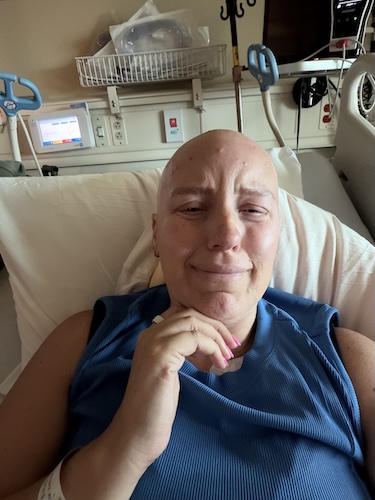
Taylor spent nearly four years chalking up her back pain and fatigue to ordinary life as a mom of four young kids. Then, in December 2025, a trip to the emergency room for bladder retention and blood in her urine turned up a large mass on her kidney. The next morning, surgeons removed the entire kidney and the mass, and pathology confirmed an unusual diagnosis: Ewing sarcoma, a cancer typically found in the bone and most often diagnosed in children. But in Taylor’s case, she was 31, and her cancer was found in soft tissue.
Interviewed by: Taylor Scheib
Edited by: Chris Sanchez
After the oncologist she first saw told her he could not treat her and sent her to find a sarcoma specialist, Taylor and her husband spent three months weighing their options before she started treatment at Huntsman Cancer Institute in Utah. She began chemotherapy at the end of March 2026 on a regimen she and her care team adjusted along the way. They spaced her cycles out from every two weeks to every three, and shortened one portion of each cycle to manage the physical toll. She declined external radiation because of its potential long-term effects near her reproductive organs, choosing instead to pursue additional surgery if it became necessary.
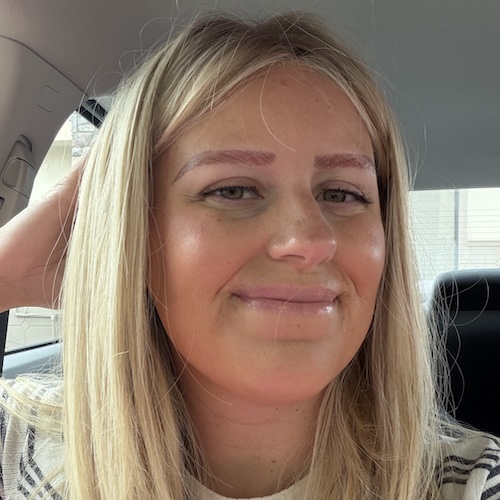
Taylor stopped chemotherapy after eight cycles, short of the 14 originally planned. She told her oncology team that continuing simply didn’t feel right anymore.
Separately, pathology results from her original kidney surgery had shown a residual tumor on her ureter. Taylor pushed for months to have it addressed before her oncologist referred her for a second surgery, now scheduled, that will include intraoperative radiation therapy: a single concentrated dose of radiation delivered during surgery itself, instead of the multiple external sessions standard treatment usually requires.
It’s the same reasoning, due to fertility concerns, that led her to decline external radiation earlier in her treatment. Her surgeon first told her the option existed, two tumor boards at Huntsman reviewed and approved the plan, and the radiation oncologist leading her case is considered one of the world’s foremost specialists in the technique.
Taylor has also questioned the broader standard of care for Ewing sarcoma, which she says is built around pediatric bone cancer cases rather than adult soft-tissue cases like hers. That’s part of the reason she chose intraoperative radiation over the standard approach: she’d rather help establish it as a real option now than see children with the same disease keep going through the harsher version of treatment. Today, she is recovering between treatments, leaning on family in Utah, and preparing for her next surgery.
Learn more about Taylor’s experience with Ewing sarcoma by watching her video and reading the edited transcript of her interview.
- Taylor’s back pain and fatigue were explained away as the ordinary toll of having four kids in five years. As she later learned, Ewing sarcoma doesn’t routinely show up on standard blood work, so even pushing harder for testing sooner likely wouldn’t have caught it until more symptoms appeared.
- When her oncology team recommended 14 rounds of chemotherapy, radiation, and possible additional surgery, Taylor and her husband took three months to understand their options before starting anything. She stopped chemotherapy after eight cycles once continuing no longer felt right for her, and chose additional surgery over external radiation to protect her reproductive health.
- Taylor had spent years helping other women advocate for themselves during birth and pregnancy, long before her own diagnosis. Facing Ewing sarcoma pushed her to turn that same advocacy inward, questioning a standard treatment built around pediatric bone cancer cases and pushing for options.
Taylor’s Diagnosis Facts
- Name: Taylor S.
- Age at Diagnosis:
- 31
- Diagnosis:
- Extraskeletal Ewing Sarcoma
- Symptoms:
- Fatigue
- Back pain
- Bladder retention
- Blood in urine
- Treatments:
- Surgeries: left radical nephrectomy, scheduled ureter resection
- Chemotherapy: VDC/IE (vincristine/doxorubicin/cyclophosphamide and ifosfamide/etoposide)
- Radiation therapy: scheduled intraoperative radiation therapy (IORT)
This is not medical advice. Please consult with your healthcare provider to make informed treatment decisions.
- Taylor’s Diagnosis Facts
- Meet Taylor, diagnosed with Ewing sarcoma at 31
- Chalking it up to four kids in five years: The back pain and fatigue nobody investigated
- Blood in my urine at a birthday party: The night everything changed
- No time to think, just act: Surgery, a shocking diagnosis, and the search for a sarcoma specialist
- Eight rounds of chemotherapy, no radiation, and one more surgery to go
- Skipping the victim mindset: Finding (and not finding) my people in the Ewing sarcoma community
- It’s okay to say no: My advice to anyone facing a cancer diagnosis
- Hear from people living with Ewing sarcoma
Meet Taylor, diagnosed with Ewing sarcoma at 31
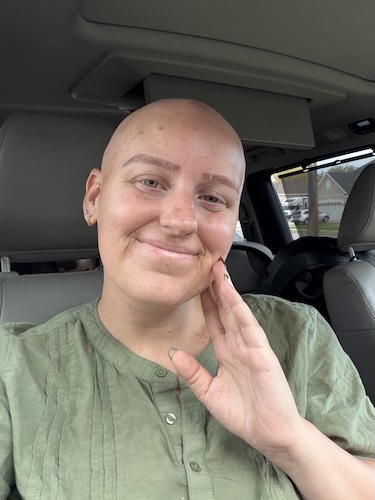
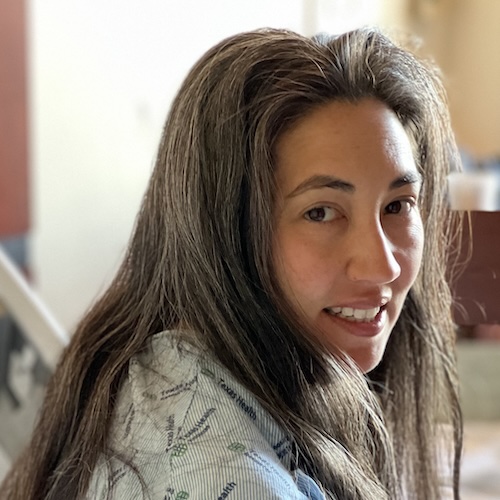
Hi, I’m Taylor. I was diagnosed with Ewing sarcoma in December 2025.
Chalking it up to four kids in five years: The back pain and fatigue nobody investigated
The two main symptoms I had before going to the emergency room were lower back pain and fatigue.
My husband and I traced the lower back pain all the way back to after having my third baby. He’s four now. Right after I had him, I thought the mattress was the issue, so I bought a brand new mattress. It helped a little bit, but I still had major back pain. And then just fatigue.
That got worse and worse over a couple of years, to where, right before I got diagnosed, I pretty much was in bed all day long because I was too tired to get up and move and do things.
Too exhausted to fold the laundry: Living with undiagnosed Ewing sarcoma
The back pain was rough. I would get out of bed and have to push my hips forward to stand up straight. The fatigue was pretty bad as well. My husband thankfully works for himself. He’s an entrepreneur, so he owns his own business, and that gave him a little more flexibility to jump in and take care of the house and make sure he was home to pick the kids up or drop them off at school. But it was pretty brutal.
I was not able to do things that should be normal, like folding a load of laundry without wanting to go lie down, or cooking a meal for my family without feeling like I needed a nap after I finished. It was rough.
I chalked both of those symptoms up to having four babies in five years. That’s a lot on your body. I thought, “The back pain is from a weak pelvic floor, and the fatigue is from my hormones not being where they’re supposed to be, and being depleted of vitamins and minerals, and not eating enough protein or not moving my body enough.” I kept trying to fix those problems, which wouldn’t have helped the symptoms I was having, or the reason I was having them.
Doula friends told me to get blood work done, but I didn’t have the time
My husband knew I was tired and my back hurt. I asked him to buy a mattress at 2 a.m. I was lying there and I was saying, “My back hurts so bad.” I was scrolling, found a mattress on sale, and said, “I’m gonna buy this right now.” And I did.
I chatted with friends too. I’m deep in the birth work world. I’m a doula and was getting ready to start midwifery and jump into that. I was talking to doula friends and midwife friends, and it was the same thing. When I tried to tell them, I’d say, “I’m really tired and my back hurts really bad,” and they’d say, “Well, you just had four babies in five years. You’re going to be tired and your back’s probably going to hurt. Let’s get you pelvic floor PT. Let’s do labs and check your hormones.”
I never did any of that, because I was busy. When do I have time to go do the things to take care of myself? Looking back, I’m not sure that even if I had gone and done any of that, or mentioned it to an OB, a midwife, or a doctor, we would have found the cancer, because it wouldn’t have shown up. I don’t think we would have gotten to it any faster until I had more symptoms. It probably would have been dismissed as being a mom, having four kids in five years. “That’s a lot. Take a break. Do some pelvic floor PT. Take care of yourself for a sec.”
Blood in my urine at a birthday party: The night everything changed
Starting about July 2025, I was even more tired. My husband said I was just lying in bed, and I started to isolate myself from friends. My best friend at the time lived in Texas. To maintain that relationship, we talked every day. We’d Marco Polo and text and all of that, and I pulled away from her big time. We moved to Florida in 2024, so I didn’t have too many established relationships there, but I pulled away from what I did have and just isolated.
Then December came. What actually pushed me to go to the ER was bladder retention. I couldn’t release my bladder, and I knew it was full because I’d had a full jug of electrolytes; I don’t remember if it was 40 oz or whatever size it was. On top of that, I’d had drinks at the birthday party we were at. I didn’t want to go to the bathroom at the park because I was wearing a one-piece and didn’t want to undress in the public bathroom, so I waited until we got home.
I got out of the car, ran to the bathroom, and couldn’t go; like UTI amounts of pee, little drops. I noticed when I wiped, there was blood. I had just finished my period two days before, so I thought, “Oh, maybe it’s period blood.” I grabbed a cup to pee into, to see if it was actually in the urine, and it was. I grabbed my homeopathy books and opened them up, and all the things I was reading said, “Don’t mess with blood in the urine.” If there’s blood in the urine, you probably need some sort of intervention.
I got on my phone and texted my doula and midwife group chat, and said, “Okay, somebody be real with me,” because I’m one to push off my own medical needs. “Do I need to go somewhere?” And they said, “Yeah, I would go get seen.” I asked, “Is this urgent care, or is this emergency room?” And they said, “Taylor, you need to go to the ER.” I figured if 10 girls are telling me to go to the ER, I should go to the ER.
We ended up going, thinking it was probably a kidney stone, or a clot blocking my ability to release my bladder, something like that. I figured they’d just do a CT scan, tell me if there’s a kidney stone or a blood clot, so I was just chilling.
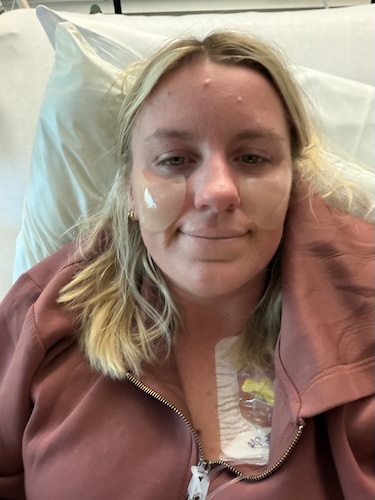
I was taking videos and photos, thinking this would be content for my doula stuff, since I’m in the hospital and I’m never in the hospital. I sent my husband home with the baby. She had just turned one at the time, because my sister was coming up to watch the kids. I’m sitting there, and this poor physician’s assistant has to come in and tell me that on my CT they found a huge mass on my kidney. I don’t even remember how big, but it was so big. She’s like, “We found a mass on your kidney,” and I laughed. They hadn’t said cancer yet; it was just a mass. I started laughing because I thought, “My life has been one trauma after the next. There’s no break.” I just laughed because, of course, it’s not just a simple blood clot or a little kidney stone. Of course there’s a mass on my kidney.
Then she got on Google and started looking it up, and I briefly read over her shoulder, and it was not great. She exited out and said, “I don’t really know much about this kind of stuff, so I’m going to go talk to whoever the doctor in the ER is, and we’re going to try to get you a urology consult. But we might want to admit you, so you can see urology faster than if we sent you home and you tried to get on their schedule.”
I had to call my husband and tell him he needed to come back sooner rather than later. When he got back, I had to tell him, “They’d found a mass on my kidney. We don’t know what it is yet, but they want to admit me so I can see urology.” That sent him into kind of a frenzy, because now, what are we doing with the kids? And it was 10 days before Christmas. Just a chaotic time.
They admitted me, and in that hospital, they had TVs so they could do telehealth while you’re sitting in the hospital bed. It was about 7:30 p.m. and a urologist popped up on the screen. I was a little taken aback. It does give you some warning that someone’s going to pop onto your screen, but that was my first time with that experience. I was like, “Oh, we’re doing this at 7:30 p.m.” He got on and said, “You have some sort of cancer. We don’t know what it is. I can do surgery tomorrow morning, or we can do it next week.”
That felt like a lot to try to figure out. He’s probably going home, and he wants an answer right then, because if he’s doing surgery, he has to be there early the next morning. We agreed to do surgery the next morning, because I probably wasn’t going to go home if I waited until the next week. If I wasn’t able to go to the bathroom, I needed to be on a catheter. I don’t think they would have wanted to send me home for a full week on a catheter by myself. We agreed to surgery the next morning. I was in shock.
I called my grandma. I wasn’t in contact with my parents at the time, so I didn’t call them. I told her, “You can tell them if you want, but I’m not going to reach out to them, because now is not the time to try to rekindle that relationship.” I called all my siblings and told them what was going on.
I had surgery the next morning. I think I stayed about two more days in the hospital and then went home. They took the whole kidney and the tumor. They did it laparoscopically, but cut a bigger incision on my left hip to pull everything out. The urologist said they didn’t have a bag big enough to put it all in. They had to go find a bigger bag for my kidney and the tumor. Then they sent it to pathology, and pathology came back and said Ewing sarcoma.
Then they said, “Hold on. We’re going to send it to Mayo Clinic to verify this, because this isn’t a normal renal cancer, so they wanted to double-check before formally diagnosing it.” They sent it to Mayo Clinic and they came back and confirmed Ewing sarcoma, which is so weird because it’s typically a bone cancer, typically in children. For it to be a soft tissue sarcoma and I was 31 at the time of diagnosis, it was such a random, weird thing to be diagnosed with. (EDITOR’S NOTE: The American Cancer Society describes Ewing sarcoma as a rare cancer of the tissues that make up bone and soft tissue. Most patients with this kind of sarcoma are teenagers, but other people can develop it, too, including children and young adults. Younger patients are more likely to develop Ewing tumors that grow from bones, whereas older patients are more susceptible to extraskeletal Ewing sarcoma: Ewing tumors that develop outside the bones, just like in Taylor’s case.)
No time to think, just act: Surgery, a shocking diagnosis, and the search for a sarcoma specialist
We didn’t have time to talk, because it immediately became an emergency. There wasn’t a lot of time to figure anything out. It didn’t even cross my mind to ask, “Why don’t we biopsy it first?” Or, “Why don’t I spend a couple of days going through my options? What happens if I don’t have the surgery right this second? Can I go home?” There was no time. We didn’t have any time. I didn’t even have time to take in cancer.
I don’t think I cried that first night. We were there on a Saturday night. We probably went in around 3 p.m. And when we got to the ER, there was actually nobody there, so we got to just walk right in. There was no wait for anything, which was a blessing, because I’ve been back to the ER a few times after that and have had to wait for hours.
The next morning, when I was in the pre-op room waiting, the urologist was super late, so I was in there longer than I should have been. It was just my husband and me, with people coming in and out, and a nurse trying to start an IV and it wasn’t working. I said, “Stop trying to poke me. They can do this after I go under anesthesia.” They wanted to start a second IV. I already had one in and she couldn’t get it, and I said, “We don’t need that right now. They can do that in there.” She tried multiple times.
And then the chaplain came in and he was talking to me, and that’s when I cried. That’s when I cried, when he came in and was chatting with my husband and me, and asked me a couple of questions, and that’s when I lost it, sobbing all over again. Then I regained composure.
And then the anesthesiologist came in, opened the curtains, and literally gasped. He’s like, “I knew we were doing a nephrectomy on a woman, so I was expecting you to be 85 years old. Not a 31-year-old.” You didn’t read the chart. It’s probably there, right at the top. He probably just saw “nephrectomy, woman,” whatever, so he was absolutely shocked. That’s when I think I was like, “This isn’t normal. This isn’t a normal situation for someone like me to be in,” and I cried again.
I regained composure, then the urologist showed up, talking about cancer again, and I started crying again. Then they finally gave me the stuff to put me out, and I was like, “Hell yeah, because I don’t think I can cry anymore. Put me out so I can stop thinking about this.”
Then we went home after surgery and just had to wait for pathology to come back and tell us what exactly it was. When it came back, I started going down the Google rabbit hole. Don’t Google. It’s awful. The worst outcomes are right at the top of the search results. I was like, “This is horrible.” I didn’t know what to do, and I was waiting for my first oncology appointment.
I went to that appointment and he just said, “We can’t do anything for you. You need to go to a sarcoma specialist. You need to find a sarcoma center.” I was like, “This could have been a phone call, instead of charging me $300 for this appointment.”
We left that appointment and I was like, “Now what?” He said, “I can give you some recommendations.” At the time, we were living in Florida, so I had Mayo Clinic and Moffitt Cancer Center, which were both close-ish. Mayo Clinic was about an hour away; Moffitt was about three. I didn’t end up consulting at either, though, because we spent three months deciding what we were going to do. I got diagnosed in December, and we spent the next three months deciding what to do.
I came to Utah in January to consult at Huntsman Cancer Institute. By that point, I’d come to the point of “it is what it is.” I’m going to have to do what I’m going to have to do. I’m just going to talk to people and figure out what everybody’s doing. Was surgery enough? Did we get everything out? Because when I talked to Huntsman on the phone, whoever I talked to said, “Oh, if you had surgery and they got everything out, they could probably just put you on scans. You’d just get scans every three months or whatever.”
When I showed up to the consult with the oncologist, she said, “No, you need 14 rounds of chemo, plus probably radiation, and there might be more surgery.” I went into shock at that appointment. I brought my mother-in-law with me, and she took over, asking questions and retaining everything, while I totally zoned out. I was expecting the same thing I’d heard on the phone. I was expecting, “You’re good. You had surgery. Everything’s out. Let’s just do scans and see what happens.”
It’s okay to pause: Choosing not to rush into treatment
I needed it to be a joint decision, because what happens would affect our entire family. After the whirlwind of getting the diagnosis, surgery, recovering from surgery, and then being thrown into, “We don’t have options for you here, you have to go elsewhere,” that appointment is what made me think, “I just need to pause on this for a second.” Because I was getting stressed, anxious, and scared, and was letting that fear take control of my decisions. Everything I was deciding was operating out of, “I’m scared,” instead of “I understand what’s happening and this is where I’m being guided.”
I started buying books. Before my diagnosis, I was very holistic, very natural, crunchy… I wasn’t on medications. I reached for vitamins, minerals, and homeopathy first. When one gets thrown into cancer, there aren’t always a lot of options outside of conventional cancer treatment. It’s chemo, surgery, radiation… There’s not a whole lot, unless you’re willing to pay tens of thousands of dollars, and insurance isn’t going to touch that.
That’s where I needed to pause, because I was being pulled by friends and family. “You need to do chemo. You need to start. Why have you not started? We don’t want you to die.” And I’d say, “I don’t feel like I’m going to die. I feel like what I’m being told when I’m praying about this is that I have time to pause and understand before I jump into a decision.”
I wanted to understand chemo. I wanted to understand radiation. I wanted to understand what I was going to be saying yes to, if that’s what I chose. And if I wasn’t going to choose that, I wanted to understand what other options I had, what that would cost, what the difference was between these paths, and everything. I had so much pressure from family members and people who were like, “Chemo, chemo, chemo. Let’s go. Do you need me to come help you pack? What do you need?” Because at that time, if I was going to do chemo, we needed to move back to Utah to be close to the sarcoma center, so it’s only 30 minutes away, and we have family support. Both sides of our family are here in Utah, aside from my sister, who’s in Florida.
I came at the end of January to meet with oncology at Huntsman. I’m grateful I took the time to understand what I was saying yes to and to make that decision with my husband. I’ve talked to a few other people who have gotten a cancer diagnosis, and the number one thing I tell them is, “Everybody is going to make you feel like you’re going to die tomorrow if you don’t start. It’s okay to pause. Take a few days. Take a week. Take two weeks. Acknowledge the situation you’re in. Pray about it. Figure out what options you have, because you might have more options than what’s immediately being thrown at you. There’s so much out there now with all the studies and new things coming out. You have other options than just jumping right in.”
Eight rounds of chemotherapy, no radiation, and one more surgery to go
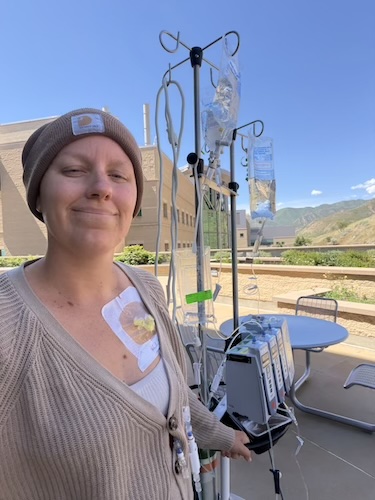
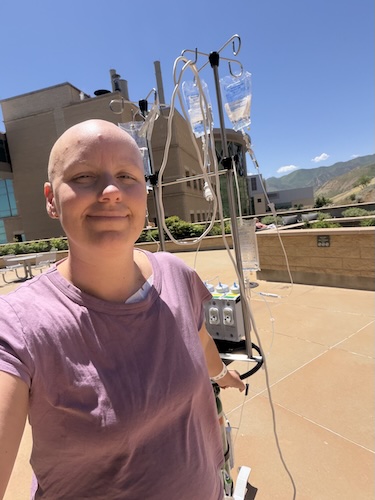
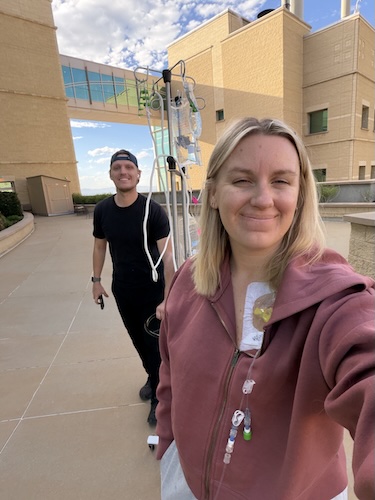
I ended up starting chemo at the end of March, with the initial plan being 14 cycles of VDC/IE chemotherapy: one day outpatient for VDC, five days inpatient for the IE, for every two weeks.
I think it was after the third cycle that I realized I can’t do that every two weeks. It was too much. Even just three cycles in, I was already beat, barely getting out of bed in between, and struggling to eat. I felt like I needed a little more time to let my body function, get nutrients, and be able to move my body a little before going in and doing it again. We moved to every three weeks, which was a little better, and dropped a day from the IE cycle because five days felt like so much. We dropped it down to four days. That was after I took about a month between cycles three and four to recover again and decide to jump back in.
At some point, I was supposed to meet with radiation, and that never happened because I decided I didn’t want external radiation. I didn’t want any of the lifelong side effects that can come from radiation. With it being so close to the reproductive system, I was concerned about what if it hits my ovaries or anything like that. I decided, “I’m just not going to do radiation. If we need to go back in and do surgery, I’d rather do that than radiation.” So I did five more cycles of VDC/IE, so eight total, and then I told my oncologist I was done with chemo. I just didn’t feel like continuing was right anymore. So I stopped and got my port taken out.
I’ve asked multiple times to meet with somebody about doing surgery again. With my initial surgery, they didn’t remove the entire ureter, which is the tube that connects the bladder to the kidney. They took the kidney and left most of the ureter. It isn’t attached to anything anymore, so it doesn’t do anything. When the pathology came back, there was still a tumor margin on the ureter. It’s a tiny little tube, but there’s a little bit of tumor left on it. I’ve asked a couple of times to have surgery again, to remove either the whole ureter or more of it, and that got pushed off a bit, with people deciding it wasn’t necessary. And I said, “For my peace of mind, it’s necessary. For me to feel like everything is out and there’s a smaller chance of any sort of recurrence, I need it out.”
My oncologist finally gave me the referral to surgery. I met with a urologist there and she was hesitant. She didn’t want to do the surgery. She was worried about perforating the bowel. And I said, “What are the risks of perforating the bowel? Is that a huge deal, or is it fixable? What is the issue there?” I didn’t understand, and I still don’t understand why that’s considered high-risk, because she’s since met with two tumor boards about my case, and everybody agreed it would be okay to do the surgery.
When I talked to her on the phone again about the surgery, she said, “I’m going to have to take muscle, tissue, and possibly some bowel.” And I said, “So we can purposely take bowel and that’s okay, but it wasn’t going to be okay because you might have perforated my bowel by accident. But now it’s okay?” So now, I’m having surgery again in November 2026, and I’m actually going to be getting intraoperative radiation therapy. They’re going to lay this jelly pad around wherever they want the radiation to go, and then move me down to the radiation floor, and I’ll get a mega dose of radiation. What would normally be multiple radiation appointments, I’ll get in one, going directly onto the areas that need it, without it having to go through everything else, and it won’t affect anything the jelly pad isn’t touching.
Pushing back on the standard of care: Why I chose intraoperative radiation over the usual protocol
I’ve been teaching women to advocate for themselves when it comes to birth and their pregnancy. I wasn’t great at it at the beginning. I was pretty scared, and I hadn’t had experience with cancer. We’ve had some skin cancer, and my dad has prostate cancer, but we haven’t been in the cancer world at all, so I got a little nervous at the beginning.
Then I read something that was essentially saying that if you’re not advocating for yourself, you’re on the conveyor belt that often leads to death, whether it’s your body being so depleted from treatment or the cancer taking over your body. If you aren’t in control, you just get what they give you. Instead of, “I’ve been reading about this.”
I didn’t even know about intraoperative radiation until I met with the surgeon and she told me about it. Then I met with radiation, and the doctor who will be doing it is considered one of the world’s leaders in intraoperative radiation, but he’s only done 23 cases. If he’s leading this in the world, it’s newer. We don’t know a lot yet about its success. But I kept getting met with, “That’s not the standard of care. The standard of care for Ewing sarcoma is 14 cycles of VDC/IE, radiation, and surgery.”
And I’d say, “But that’s been the standard of care for Ewing sarcoma for 60 years. Nothing has changed in 60 years for doing this.” And they’d say, “It reacts well to chemo. It reacts well to radiation. And I’d think, “There’s got to be something more.” Because I’ve read about the recurrences, even after completing 14 cycles of VDC/IE, doing the radiation, and having surgery. People still have recurrences. It’s obviously not perfect, and I don’t think there’s any perfect solution for cancer at the moment, but not being willing to try something new, something different, and see how it works was something I wasn’t okay with. I wasn’t okay with, “This is just what we do. This is the standard of care. This is what we’re going to do.” I wanted to try something different.
I’m okay with kind of being a guinea pig here and there, with some things. I’m not going to do some crazy new drug, I don’t think, but let’s see how intraoperative radiation works on Ewing sarcoma. Because if that’s something that can benefit future Ewing sarcoma patients or can benefit me again in the future if need be, I’d rather know that now than be scrambling, if there’s a recurrence, trying to find something beneficial.
I think about all the kids with Ewing sarcoma, because that’s the majority of Ewing sarcoma patients. If I was feeling the way I was through chemo and everything, and these poor kids are being put through the wringer, I want to hopefully help them avoid being put through that wringer if possible.
I feel like the standard of care for Ewing sarcoma is based on the kids with bone cancer, not soft tissue. There are different variations even of Ewing sarcoma. We’re just going based on what the majority of cases are and not this can be different. This is different in adults. This is different in women. This is different in soft tissue. Let’s try some different things. Especially if we can try different things in soft tissue, because I feel like bone is definitely more difficult. There are a lot of amputees with sarcoma. If we have people with soft tissue who have this type of cancer that we can try some different things on, because it’s easier to access this area versus the bone, then maybe we can avoid amputations; maybe we can avoid too much chemo, too much doxorubicin.
Skipping the victim mindset: Finding (and not finding) my people in the Ewing sarcoma community
I joined some Facebook groups and a Discord group for Ewing sarcoma. I found an overwhelming majority of the people in some of these groups were stuck in a victim mindset, and I can’t get into that. I can’t do the poor-me thing. I needed to be, “I am strong. I am healed.” I’ve got affirmations up on my wall that I read every morning. I needed to not be stuck in there, so I haven’t found too much of the cancer community.
The Huntsman Cancer Institute has a group for adolescent and young adult patients, up to age 35 or 36, and every time they’ve had some sort of get-together, I was in chemo that day or just getting out of chemo, so I couldn’t go to any of them. I’ve looked at them now that I’m removed, and I have about a month before surgery takes me out again. I connected with one girl who’s having surgery, doing the same thing. She had kidney cancer and is doing another surgery in the same area with intraoperative radiation. I’ve connected with her a bit. I haven’t jumped too much into the cancer community.
I started my cancer account with the hopes of jumping into that community, but the overwhelming majority of what I’ve seen hasn’t been something I wanted to participate in. I’m hoping there are random people here and there, and we’ll find each other eventually. I’ll try to plug into our local Huntsman group and see what’s there.
I do know there’s another kid with Ewing sarcoma in his kidney, in his early 20s, at Huntsman. But they can’t just put us together. I’m like, “Can you just schedule our appointments at the same time, so we end up in the waiting room together?” I could say, “Oh my gosh, you’re the other one with the same thing?” Because there are only 250 Ewing sarcoma cases a year in the US, so for two of us to get diagnosed within the last year, both with it in the kidney, and to be at the same cancer institute, is a little wild. Even if we’re not besties, since he’s about 10 years younger than me and a boy, it’s just, “Oh, we’ve got the same thing going on.”
It’s okay to say no: My advice to anyone facing a cancer diagnosis
It’s okay to pause. It’s okay to find groups and make connections. Ask around and meet with more than one doctor. And it’s okay to say no.
I know I shocked a radiation oncologist by saying no to external radiation again. He was a little surprised, like, “People don’t say no in here. People are usually here because they’re saying yes.” So it’s okay to say no if it doesn’t feel like something that’s in alignment with what you’re feeling.
I do think trusting your gut is a huge thing. I do think there’s an internal system that’s trying to prevent you from hurting yourself or from doing something that might not be good for you.
You’re in charge. You get to make those decisions. You get to say yes, you get to say no, and you get to say when.
This interview has been edited for clarity and length. The views and opinions expressed in this interview do not necessarily reflect those of The Patient Story. This content does not replace professional medical advice.
Inspired by Taylor’s story?
Share your story, too!
Hear from people living with Ewing sarcoma
Real experiences with diagnosis, treatment choices, side effects, and life beyond Ewing sarcoma — in their own words.
Leave a Reply