
Six Months of Explaining Away a Cough That Turned Out to Be Stage 4B ALK-Positive Lung Cancer
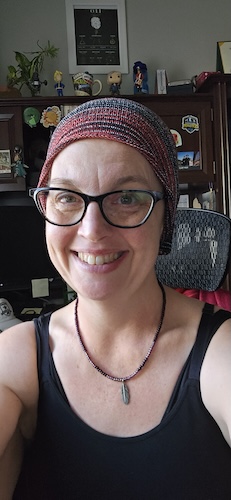
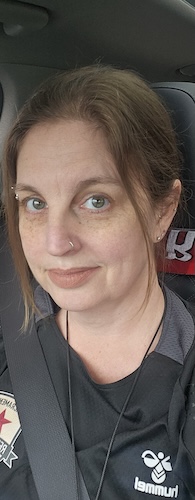
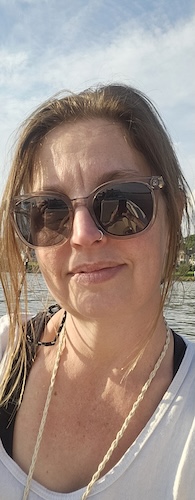
Nay’s first symptom was a lingering cough that showed up in early 2024, not long after she’d fought off both COVID and the flu in the same winter. As a healthy, active youth soccer coach and longtime runner, it was easy to write the cough off as the tail end of a bad flu season, then as seasonal allergies. Over the following months, new symptoms kept arriving one at a time: breathing trouble, a lost voice that never fully came back, and eventually noticeable weight loss. Each one had its own explanation. Looking back, Nay describes it as a snowball that slowly became an avalanche. It wasn’t until much later that the pieces added up and she was diagnosed with stage 4B ALK-positive lung cancer.
Interviewed by: Taylor Scheib
Edited by: Chris Sanchez
Before that diagnosis came, in September, she was waking in the middle of the night, unable to breathe, with a feeling like she was drowning. A first ER visit ended in 45 seconds, with a doctor ruling out a heart attack and sending her home with steroids. Nay and her partner both felt something had been missed. Why hadn’t they done a CT scan? Nay left feeling dismissed. Weeks later, when she started coughing up blood, she knew it was time to go back, and this time a doctor she’d never met before sent her in to be checked for a pulmonary embolism instead.
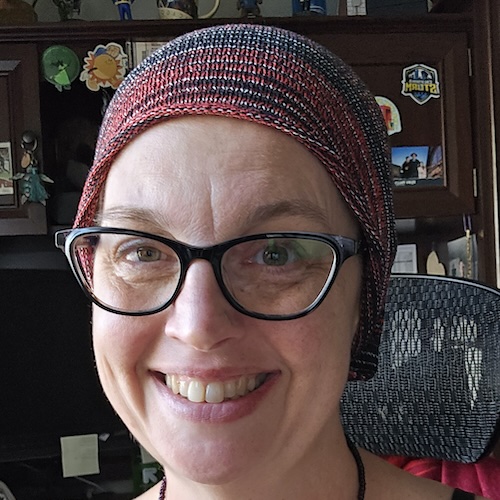
That second visit changed everything. Admitted to the hospital on October 1st, Nay met with oncology within a day, had a biopsy on October 8th, and received a call from her oncologist the following afternoon: she had lung adenocarcinoma. The diagnosis didn’t match anything she thought she knew about who gets lung cancer. Two weeks later, staging confirmed she was at stage 4B, and biomarker testing, ordered proactively before her staging appointment, confirmed she was ALK-positive. Her doctor never once told her a prognosis, only that there were options.
Being ALK-positive opened the door to targeted therapy instead of chemotherapy first. Nay, a scientist by career, had already decided that if she qualified for a clinical trial, she would pursue one. She enrolled in one, a treatment designed to cross the blood-brain barrier and reach the 24 metastases in her brain, including two the size of golf balls. She started the medication on November 5, 2024, and her first follow-up scans showed what her care team described as an exceptional response.
Nay is still on the same clinical trial today. She’s still coaching soccer, still working, and living with a quality of life she calls as good as can be expected. She spends her time differently now, more outside, more present with her partner, her kids, and her pets, and she’s active in the ALK Positive community, where she now helps people newly facing the same diagnosis that once felt impossible to believe.
Learn more about Nay’s story by watching her video and reading the edited transcript of her interview below.
- Nay explained away her symptoms (a cough, breathing trouble, a lost voice, weight loss) one at a time for about six months before recognizing they were connected. She describes watching it build like a snowball into an avalanche.
- After a 45-second ER visit sent her home with steroids, Nay felt dismissed and refused to return to the same hospital. Coughing up blood weeks later confirmed her instinct that something was still wrong.
- Nay’s oncologist ordered biomarker testing before her staging appointment, which meant she learned she was ALK-positive quickly enough to move straight to a targeted therapy trial. She credits that early testing with preventing delays in treatment.
- Nay chose a clinical trial partly because of her science background and partly because the newest generation of targeted therapy built for ALK-positive cancer wouldn’t have the same side effects on her brain. Her first follow-up scans showed what her care team called an exceptional response.
- Nay wants people to know that having lungs is the only requirement for getting lung cancer. She now encourages others, especially through the ALK positive community, to take it seriously when something feels wrong rather than explaining it away.
Nay’s Diagnosis Facts
- Name: Nay T.
- Age at Diagnosis:
- 47
- Diagnosis:
- Non-Small Cell Lung Cancer (NSCLC)
- Staging:
- Stage 4B (Metastatic)
- Biomarker:
- ALK
- Symptoms:
- Persistent cough
- Loss of voice that never returned
- Loss of 30 lbs in six weeks without dieting
- Chest pain and difficulty breathing at night
- Waking up in the middle of the night with deep chest pain and feeling like drowning
- Coughing up blood
- Treatment:
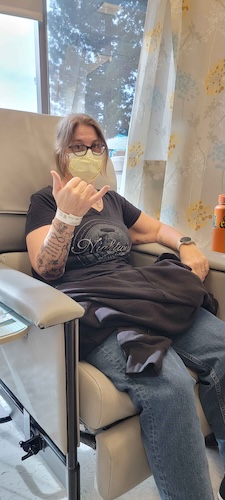
- Targeted therapy: NVL-655, a tyrosine kinase inhibitor, through the ALKOVE-1 clinical trial
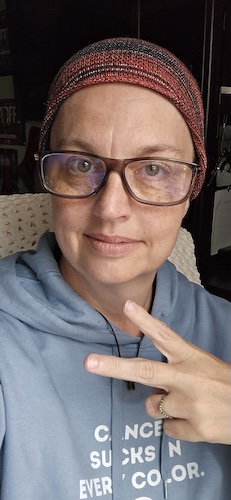
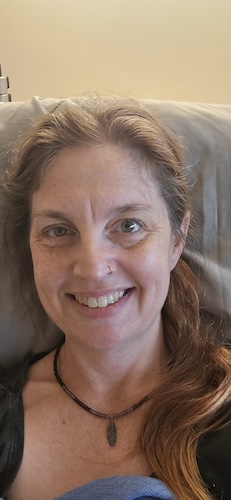
This is not medical advice. Please consult with your healthcare provider to make informed treatment decisions.
- Nay’s Diagnosis Facts
- A cough that wouldn’t go away
- Hearing the word “cancer”
- The night it sank in that I had stage 4B lung cancer
- Biomarker testing and the ALK-positive result
- Why a clinical trial made sense to me
- Living fully with stage 4B ALK-positive lung cancer
- What I want people to understand about lung cancer
- My advice: Listen to your body
- Hear from people living with ALK-positive lung cancer
A cough that wouldn’t go away
My first symptoms started around February or March of 2024. It began as a lingering cough. I had just come off a winter where I’d had COVID, then the flu right after I healed. Several people told me the flu was bad that year and that everyone had this cough, so I didn’t think much of it. It moved into allergy season, and I have seasonal allergies, so I explained it away. But the cough wouldn’t go away no matter what I tried, and it lasted for months.
The next symptom showed up in April: a little bit of breathing trouble. Given the time of year and my history with allergies, I made an appointment with my primary care physician, thinking maybe I just needed something stronger than what I was already taking.
My doctor thought it might be allergy-related, maybe asthma-related since I have some asthma history, so he ordered a pulmonary function test and put me on Benadryl and a rotation of allergy medications. My allergies cleared up, but the breathing never really improved, and the cough lingered, even if it wasn’t as bad.
Then, near the end of May or the beginning of June, I lost my voice at one of my youngest child’s swim meets. I’m a swim mom, and I’d yelled and screamed the whole meet, so I thought nothing of it. Six weeks later, my voice still hadn’t come back. It stayed scratchy and raspy. By the end of August, I still had breathing issues, and I finally had my pulmonary function test.
When the results came back, I asked the technicians if they could see anything, even though I knew they couldn’t officially diagnose me. They said it looked like there was some blockage, similar to what you’d see with COPD or asthma, and that they’d send it to the doctor. I trusted the process and expected an answer.
An avalanche, not a coincidence
In early September, my cough changed, becoming wetter instead of dry and persistent. During the first or second week of that month, I started waking up in the middle of the night unable to breathe, with a feeling like I was drowning. It was terrifying. After about a week of this, I talked to my partner, and we decided it was time to get checked out. That’s when I had my first ER visit.
Before all of this, I didn’t think much of even the cough itself. You get the flu, you get a cough; that’s normal. I was completely healthy. I felt great. I was, and still am, a youth soccer coach, coaching both outdoor and indoor teams, very active. So it was surprising, astonishing even, because cancer wasn’t even on my radar.
Looking back, it was almost like a snowball, almost like an avalanche. You have a cough, and that’s one thing, and then something else adds on, and you can dismiss that too. Leading up to September, I was losing weight, and some of the parents on my soccer team noticed and joked about it. Once it reached 30 pounds in about a month and a half to two months, that wasn’t normal anymore. It wasn’t until mid to late August, about six months into having these symptoms compound on each other, that I thought, something’s there. This isn’t just allergies anymore, and I can’t explain it away with allergies at this point.
My first ER visit
By the time I went to the ER, I’d started having chest pain along with the middle-of-the-night episodes where I couldn’t breathe. We decided to go in one morning. Emergency rooms were busy, so I waited for several hours while they did blood work, an EKG, and a chest X-ray. Then more waiting.
Once we were finally called back after all those tests, I knew in my gut something was wrong. We sat in a waiting room, and the doctor came in. It was literally 45 seconds with a doctor in the emergency room. He said, “I’ve looked at your scan. It looks like you’re not having a heart attack, so I’m going to give you some steroids, and you can go home. I hope you feel better.” That was it. He walked out, and my partner and I looked at each other and thought, are you serious? I already knew I wasn’t having a heart attack. I knew something else was happening.
The nurse brought my discharge papers and prescription, telling me they were glad I wasn’t having a heart attack, and sent me home. That night, I couldn’t sleep because I couldn’t breathe. My partner said something felt wrong, so we called the advice nurse at our regular clinic. The first thing she asked was why they hadn’t done a CT scan. I didn’t know. When I listed everything they had done, I felt so dismissed and so not seen. She suggested I go back for a second opinion, but I refused to return to that hospital. If I went back, I’d get the same doctor, and I couldn’t go through that again. You build up this expectation that a doctor is supposed to help you and really listen, and this one just didn’t.
Coughing up blood and getting a second opinion
About two and a half to three weeks later, I started coughing up blood, and I knew this would send me back to the hospital. It was the morning of October 1st. I remember it specifically. I messaged my primary care physician’s office and said something serious was going on. I saw a doctor I’d never met before, a temporary physician, who took a chest X-ray that came back clear, along with blood work and tests for COVID and influenza. He told me he was sending me back to the hospital to be checked for a pulmonary embolism.
We went home, packed a bag, and I went to the hospital. This time, the standard of care was completely different, even though it was the same hospital. They took me right back, ordered an EKG and a CT scan, and ran all the right tests. I was admitted. The first time I ever thought cancer might be a possibility was the following morning, after my CT scan and another X-ray, when the first visit I received was from the oncology department. They didn’t say the word, but I know what oncology means. I knew this was something very serious.
Hearing the word “cancer”
I was admitted to the hospital on October 1st and put on a waiting list for a biopsy. The team knew there was a mass and that it was on my lung, but they weren’t sure yet what it was. By the time my biopsy happened on October 8th, I already knew it was cancer. The word lymphoma had come up, along with the possibility of lung cancer. I felt like I was in great hands at a comprehensive cancer center, and I appreciated that they were honest with me. That’s all I’ve ever asked of any medical professional: just tell me the truth.
The next morning, I met with the oncologist I’d been working with, and he said we would probably be able to send me home, that it was some kind of cancer, and that they’d be able to do something about it.
The diagnosis call: lung cancer
At 3 p.m. that afternoon, on October 9th, my oncologist called. I was lying alone in the hospital bed when he told me: “You have lung adenocarcinoma.” I was shocked.
To me, lung cancer was something that happened to smokers, or to people with heavy radon or pesticide exposure. I’d never smoked in my life, so there was real cognitive dissonance in hearing it.
Lying in that hospital bed, the first thing I did was call my partner and tell them to come down; we needed to talk. Then I called my mom, because who else do you call? It was shock, literal shock, and it took me a couple of months to really wrap my head around the fact that I was living with cancer.
Telling people I had lung cancer
Telling people I had lung cancer was difficult. At first, I didn’t tell many people, because I don’t really like a lot of people offering to help. I’m very self-sufficient, maybe to a fault. It was a shock to everybody, especially the people who know my history as an avid runner and soccer coach.
People asked if I was sure, and yes, I was very sure there was a mass on my lung. Much like me, they had a hard time wrapping their heads around how someone with my health and history could end up with lung cancer.
What my stage was
I was in the hospital for about a week and a half total, staying a couple more days after my diagnosis. My appointment with my current oncologist was scheduled for October 22nd. I remember sitting in his office thinking, whatever happens, happens; we’ll go with it. He walked in, pulled up my scans, and said I was at stage 4B. I knew what stage 4 meant, but I wasn’t sure what the difference was between A and B. Stage 4B, it turns out, is what culture describes when it says someone is done. It’s very widely spread.
At that point, I’d had a PET scan. I have a morbid sense of humor sometimes, and when I came out of the scan, I joked that as long as it didn’t light up like a Christmas tree, I’d be okay. Sure enough, it lit up like a Christmas tree.
I really appreciate that my doctor wouldn’t tell me my prognosis. That’s usually the one question everyone asks: how long do I have? He never once answered it. My partner even took him aside privately and asked the same question, and the doctor still wouldn’t say, only that we had options. So many options. I took that to mean something, and hearing him focus on options instead of a prognosis made me feel a lot better. That same week, I also found out I had ALK-positive lung cancer, a genetic change in the tumor’s DNA. It was a lot to take in during a single week.
The night it sank in that I had stage 4B lung cancer
Right after that appointment with my oncologist, I called my parents to let them know. I try to keep myself busy and not think too much about things like this; I’ll joke about it, but I try not to dwell on it. A couple of days later, on October 24th, I remember looking around and thinking, all of this could be gone. If this is stage 4B, who knows about tomorrow. I thought about how good a spot I was in with my life: a wonderful relationship, together with my partner for 26 or 27 years, two wonderful children. It dawned on me that I could lose all of it.
I went to find my partner because I wanted a hug. They’re warm and safe. I remember tears running down my face, and he just took me in. I stood there crying in his arms, saying over and over, “I don’t want to die.” It was heartbreaking.
I didn’t know yet what my treatment plan would be. I had some idea of my prognosis, but you never really know. I knew it was bad, and it was devastating; some of the most devastating information I’d ever received. But that night became probably the most pivotal night of the entire experience. I let it all out. When I was done, I blew my nose, wiped my face, and gave my partner a hug.
As I walked out of the room, I heard a voice in my head, probably my own. I kept thinking, I don’t want to die, and then the voice said, “Then don’t. You don’t have to.” I stopped and thought about it, and decided that was the perspective I was going to take. All the memories came flooding back: my doctor telling me there were so many options, that it didn’t have to be chemo, that I was still quite healthy going into this. Yes, it’s cancer, and yes, it’s widely spread, but I don’t have to follow that narrative. I didn’t have to assume the worst was going to happen. I could keep going and do what I needed to do to move forward. After a good night’s sleep, I woke up the next morning ready. From that moment on, I had a much different attitude about it.
Biomarker testing and the ALK-positive result
Biomarker testing came up at that very first appointment. The doctor called and told me he wanted to know exactly what we were working with. He ordered a blood biopsy, I believe through Tempus, just a vial of blood, done around the same time as my full battery of scans. It would test for several variants and biomarkers to confirm what kind of lung cancer this was and which direction to take. He ordered it proactively, well before my staging appointment, and it took about two weeks to get results.
The call confirming I had stage 4B ALK-positive lung cancer came the day after my breakdown.
It all coalesced that day. I’d been off work, staying in touch with my job, and I went in to talk to my supervisor, mostly just to see another human being and give an update on where things stood. A couple of minutes into that meeting, my phone rang. I’d saved the number: the cancer center, my doctor. As soon as it started ringing, I told myself that no matter what was on the other end, I was going to do whatever treatment they thought was best. I had ideas of my own, but stopping was never an option. He’d just gotten my biomarker results back and decided to call me personally.
He told me, “You have ALK-positive lung cancer,” and I thought, that’s great. We started talking about treatment plans right away. He had already presented all of the options to me the previous week, and I’d told him I would consider everything, doing my own research on different websites in the meantime. The biomarker testing was done early specifically because he didn’t want to treat me for the wrong thing. Given how advanced my cancer was, time mattered.
As soon as he told me the result, I asked when I could get into the clinical trial. I’m a scientist by career and have always leaned scientific. The moment I learned there was a clinical trial available, I’d already decided, in that very office, that if I had this type of cancer, I was going to pursue it.
Why a clinical trial made sense to me
I’ve always valued using science and the scientific method to evaluate systems and look at the world. I value education; I have a degree. The way I see it, the people who put together clinical trials are trying to answer a real question, a hypothesis.
The way I look at medicine, it’s really difficult to find something that works universally and works great for everybody. With something like chemotherapy, we already know its effectiveness across the board. A clinical trial exists to open up new options, so patients aren’t limited to treatments that might not work for their specific cancer.
A lot of the misconception about clinical trials is that they’re just a bunch of people throwing something together. In reality, they start with a question: is there a better, more effective way to do this? With ALK-positive lung cancer, some treatments work okay, but researchers wanted something more specific, something that wouldn’t damage other cells and other parts of the body the way a broader treatment, what I call a scorched-earth approach like chemotherapy, does. For my trial, researchers looked at how ALK-positive lung cancer behaves in the lab and built a medication that targets that specifically.
I would much rather have something specific to my type of cancer that does as little damage as possible to everything else around it. For me, that meant taking a pill every day instead of having a liquid treatment moving through my whole body. I believe the companies and teams behind this work are just as invested as patients are in finding the best possible outcome. The fact that they’re willing to dig into something as specific as ALK-positive or EGFR-mutated lung cancer, and find a solution that preserves a patient’s health, is something I really appreciate.
Starting a clinical trial
There are fortunately a lot of different targeted therapies available for ALK-positive lung cancer, so while chemotherapy is always an option, it doesn’t have to be the first one. That gave me real hope. Being able to take a medication with far fewer side effects meant I could have a stable quality of life, and I don’t think my quality of life would have been as good with a more toxic treatment. I had about three or four targeted therapy options before chemotherapy would have entered the picture, and that gave me a lot of hope from a quality-of-life standpoint. I like being happy, and I like being able to keep doing things. After my doctor told me I had ALK-positive cancer, he asked what I wanted to do and laid out my options.
I chose the ALKOVE-1 clinical trial, which tests NVL-655, one of the newest treatments for ALK-positive lung cancer at the time. What I love about it is that it learned from earlier versions of similar medications, the side effects that really impacted quality of life, and the formula was adjusted to reduce those negative effects while keeping the impact on cancer. It also penetrates the blood-brain barrier, the layer that normally protects the brain, which earlier targeted therapies had a harder time doing. I had at least 24 confirmed metastases in my brain alone, including two the size of golf balls, one on either side of my head.
Knowing that, I wanted to make sure my brain would heal. Without my brain functioning well, everything else becomes really hard. All of this gave me a lot of hope. I was fortunately able to get into the trial and started my medication on November 5th, 2024. What continues to give me hope, and the reason I’ve stayed on this trial, is that it’s working; it’s working very well for me. By my first follow-up scans, my care team described my response as exceptional. It was substantially reducing my cancer load, and every scan since has given me more hope. This trial will teach lessons that shape the next medication, too, building on what’s learned from patients who weren’t as fortunate as I’ve been. I’m still on the same clinical trial. It will be two years this coming November.
Living fully with stage 4B ALK-positive lung cancer
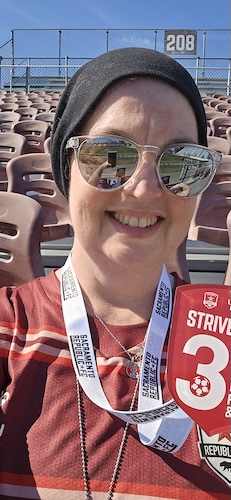
I live more in the moment now. I still coach soccer; my diagnosis came halfway through a season I was coaching, which was difficult, but I’m less worried about the future, about what’s going to happen three weeks or years from now. My quality of life is as good as can be expected. I’m still able to work, and I have some manageable fatigue. I spend a lot of time outside, and I appreciate the moments I have with my partner, my kids, and my pets so much more than I used to. In October 2024, I recognized that now could be all I have, and that’s changed how I spend it.
What I want people to understand about lung cancer
First and foremost: if you have lungs, you can get lung cancer. Leading a healthy life, never having smoked, never having had environmental exposures like radon… none of that means you’re not susceptible to it.
I’ve learned how many people actually have lung cancer. I’m in a support group for ALK-positive patients, and learning everyone else’s stories has helped me understand my own experience better. I’ve also learned about different procedures and treatment options along the way. Because I’ve learned so much, I feel like I can help people who are newly diagnosed. I put myself back to where I was in October: it’s scary, and it’s confusing when you have lung cancer and think, how did I get lung cancer? That makes no sense.
When people join our group, or I meet someone new, I try to let them know there is hope, always, and there are a lot of options for a good quality of life. My partner has been with me through all of this, but there’s still something valuable about having a community of people who understand exactly what you’re going through and what you’re feeling. There are a lot of people out there who are there to help and there to give you hope.
Community and gratitude
I’m part of the ALK Positive community at alkpositive.org, which is where I started. Another woman I talked to, who also had lung cancer, pointed me toward the group. ALK Positive has been great, and they hold an annual summit; I was able to attend the one in San Diego, and just being around so many people like me was incredibly inspiring.
At that summit, I was also able to meet Jim Porter, CEO of Nuvalent, the company behind my medication. I saw him on stage and told my partner I was going to go find him during the break to say hi. When I walked up, I asked if I could shake his hand, and told him he and his company saved my life. Watching his face, I could tell it moved him. I wish more people had the chance to talk to the people who make that kind of difference in their lives. Without Nuvalent’s medication, I wouldn’t have options, and a lot of people wouldn’t have options. And I love UC Davis’s comprehensive cancer center. They’ve been great.
My advice: Listen to your body
What I learned from this whole experience is the importance of listening to your body and paying attention to those little signals. I was able to explain away every single symptom that came up. Afterward, I made a list: the cough was the flu, the weight loss was because I was active, the voice loss was because I’m a swim mom. There were so many things I explained away in my own mind, even though something still felt wrong.
My advice to anyone going through this is: if something feels wrong, take that as a sign to go get it checked out. I often wonder if going to the ER back in April would have made a difference in the condition I was in by October, when I was finally diagnosed. If something doesn’t feel right in your own body, take it seriously. Your body knows you best.
This interview has been edited for clarity and length. The views and opinions expressed in this interview do not necessarily reflect those of The Patient Story. This content does not replace professional medical advice.
Inspired by Nay’s story?
Share your story, too!
Hear from people living with ALK-positive lung cancer
Real experiences with diagnosis, treatment choices, side effects, and life beyond ALK-positive lung cancer — in their own words.

Leave a Reply