A Sharp Pain Before a Family Trip Led to Kathy’s Stage 4 ALK-Positive Lung Cancer Diagnosis
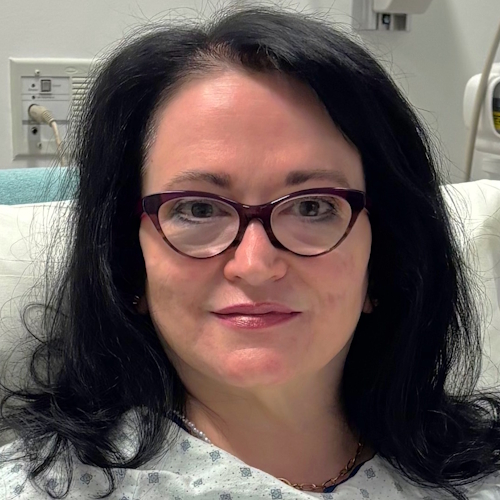
Kathy was in the best physical shape of her adult years. At 56, she was strength training, hiking, and tracking her bone density when a sharp pain sent her to the emergency room four days before a long-planned family trip to Sicily. A chest X-ray and CT scan found a golf-ball-sized tumor in her lung. It was the first sign of what would become a stage 4 ALK-positive lung cancer diagnosis.
Interviewed by: Taylor Scheib
Edited by: Chris Sanchez
The ER doctor delivered the news bluntly, and Kathy and her husband, Andrew, left with a handout that called lung cancer the deadliest cancer of all. It would be weeks before either of them had a real answer.
Getting to the next steps took persistence and a fair amount of luck. A friend who’s a radiologist reviewed a photo of Kathy’s scan and pointed them toward a nurse navigator. An insurance snag ruled out care in Boston, so they turned to Dartmouth instead. There, a PET scan, a bronchoscopy, and an MRI confirmed the cancer had reached a lymph node and six spots on her spine, including her neck, her lower back, her pelvis, and her right shoulder blade. Hearing that it was in the bones was the moment Kathy said she thought she was going to die.
Her care team ran both a tissue biopsy and a companion blood test, and together they found something deeply important: an ALK gene mutation, present in only about 3 to 4% of people with non-small cell lung cancer. That mutation opened the door to targeted therapy instead of standard immunotherapy alone. Kathy now takes lorlatinib, one pill a day.
Months later, Kathy is, in her own words, alive and living, kicking, screaming, crying, and laughing. She’s supporting her husband’s career as an author, watching her son take over the family business she built, and staying connected to a community of other ALK-positive patients she has met along the way. If she could go back and tell herself one thing in that first week, it would be this: None of it was her fault.
Watch Kathy’s video and read the edited transcript of her video. You’ll learn more about her stage 4 ALK-positive lung cancer story.
- Anyone with lungs can get lung cancer. Kathy was actively strength training, tracking her bone density, and monitoring her brain health through a research study when she was diagnosed with stage 4 lung cancer.
- Insurance networks can decide where you’re able to get care. Kathy and Andy were referred to Boston first, but had to pivot to Dartmouth once they learned Boston was out of network.
- Biomarker testing can change a stage 4 prognosis. A tissue biopsy and a companion blood test on Kathy’s tumor found a rare ALK gene mutation, which opened the door to a daily targeted pill instead of standard immunotherapy.
- Finding people with your exact diagnosis can matter as much as treatment. Kathy didn’t expect to feel connected to a cancer community, but attending a national summit for ALK-positive patients gave her a network of people living with the same disease.
- Letting go of self-blame can be part of moving forward. Kathy said the one thing she would have told herself in that first week was that none of what happened was her fault.
Kathy’s Diagnosis Facts
- Name: Kathy B.
- Age at Diagnosis:
- 56
- Diagnosis:
- Non-Small Cell Lung Cancer (NSCLC)
- Staging:
- Stage 4 (Metastatic)
- Biomarker:
- ALK
- Symptoms:
- Jaw pain
- Back pain
- Pain in sacrum
- Unexplained cough
- Loss of voice
- Treatment:
- Targeted therapy: lorlatinib (tyrosine kinase inhibitor)


This is not medical advice. Please consult with your healthcare provider to make informed treatment decisions.
- Kathy’s Diagnosis Facts
- A family trip we almost didn’t take
- A sharp pain in the night
- The symptoms I didn’t connect yet
- Finding the right care team
- Getting to a diagnosis: The PET scan and bronchoscopy
- What I knew about lung cancer before this
- Meeting my oncologist and weighing the options
- The phone call that changed everything
- Starting treatment for stage 4 ALK-positive lung cancer: One pill a day
- Passing the torch: Supporting Andy’s new chapter
- Finding my people: The ALK-positive lung cancer community
- What I’d tell myself that first week
- Hear from people living with stage 4 ALK-positive lung cancer
A family trip we almost didn’t take
We were supposed to leave for a trip I had planned for our whole family, the only trip I’ve ever planned. I spent five to six years gathering documents so I could get dual citizenship for myself, my son, and my daughter. We were going to Sicily, where my ancestors came from. The whole family was going to stay there. It was going to be great.
I had a touch of a cold. I’d taken care of my granddaughter for a couple of days right before we were supposed to leave in four days, and I didn’t want to come down with a full-blown cold before the trip.
A sharp pain in the night
Then I got a sharp pain, right here. I thought, okay, a little bit of shortness of breath, but nothing. I’d had maybe a small cough, not even really a cough, just a little bit of a cold. But I kept thinking: what is this pain? It came on at night and felt almost muscular, but it was really sharp.
I told myself to just breathe and relax. Heart disease runs on both sides of my family, and I remember thinking, if this is a heart attack and I don’t know it… I went to bed telling myself it would be fine.
The next morning it hit me again, hard enough to take my breath away. Andy asked what was wrong, and I told him I just needed a second. He said, “Give you a second for what?” I told him I’d had the same pain the night before, and he said we were going to the ER. I told him it was 6:54 a.m. and the doctor’s office would open in an hour. He said we were going to the ER now. I went, begrudgingly.
The ER visit
At the ER, I felt awful. They took my temperature, and I had a fever, which almost felt like a relief, strangely. At least there was a reason I felt so bad. Then they told me I had COVID. Then they said they wanted to take a chest X-ray, just to make sure everything was fine.
The X-ray showed something, and my blood work showed that my D-dimer levels, a marker that can indicate clotting issues, were very high, which they said could mean unusual bruising. They decided I needed a CT scan too, just to get the full picture; “No big deal,” they said.
While I was waiting after the CT scan, the doctor came back and told me I had a touch of COVID and a touch of pneumonia, and then he told me I had lung cancer. I said, “What?” Andy was right next to me, and we both said, “What do you mean I have lung cancer?” He pulled out his phone, held it up to my face, and said, “Look, there’s a golf-ball-sized tumor in your lung.”
A diagnosis delivered on a phone screen
I was floored. I didn’t know how that could be. We just sat there. A nurse came in to check on me, and he came back and asked if she was sure he had the right chart, because it didn’t add up: I’d never smoked a cigarette in my life. I was in great health. I didn’t take any medication. I’d been physically active for six years. Heart disease and dementia run in my family, and I’d been doing everything I could to stay healthy, and there was a golf-ball-sized tumor anyway.
He told us I’d need to see a thoracic surgeon, and we left with a handout that said I had lung cancer, that lung cancer is the deadliest cancer of all, plus some dietary suggestions. It didn’t say anything about COVID or pneumonia. It just said lung cancer. That was my experience.
I was furious at that doctor for a while. But Andy kept reminding me that he had found it. He did the best job of his life finding this cancer. So all my anger turned into, “Okay, yes, I know, but that still wasn’t right, that presentation.” He gets full marks for accuracy and very few for bedside manner.
I was in the best shape of my life
Our son and daughter-in-law work at a boarding school with a gym the community can join, so we’d go work out there twice a week. We hiked, we swam, we did a little of everything. I’d also been doing strength training to protect my bones. I’m one year into menopause, and after I read the statistics on bone density, I decided I had to take it seriously: eating enough protein, taking creatine, jumping off boxes because impact is supposed to help build bone strength.
I was doing brain training too, because I wanted to keep my mind sharp, along with breathing exercises I’d been doing for the past year and rolling out my lymphatic system, starting at my feet and working up, finding the tightest spots and breathing into them for a couple of minutes at a time.
I felt like I was doing everything right. I’d had a bone density scan and a full workup on my arteries. I don’t take any medication, and I get regular checkups. I’m also part of an Alzheimer’s study through a research hospital, and every three years they do a brain MRI (magnetic resonance imaging) and a PET (positron emission tomography) scan. I’d just had mine in January. Ironically, I ended up having another brain MRI in April, this time to make sure the cancer hadn’t spread there, and I was able to show the doctors my January scan for comparison.
The symptoms I didn’t connect yet
I was feeling great, aside from what felt like a lingering cold. Then, on March 5, I started to decline. Slowly, I developed jaw pain, then back pain, and then my sacrum felt like it was on fire. I didn’t know what was happening. Almost a month later, my voice started to go. I had a strange cough, and then I couldn’t speak like myself anymore. I’m about 95 to 99 percent recovered now, though my voice still squeaks sometimes.
Looking back, I’d also had a little back pain a week or two before all of this, the kind that reminded me of an old ice-skating injury. I thought it was just an old ache resurfacing. It wasn’t until after the diagnosis that everything else came on at once.
Finding the right care team
Thank goodness we have good friends in the medical community. Andy has a friend who’s a radiologist, and he looked at a photo I’d taken of the doctor’s phone, since that picture was all I had. He suggested a few people to reach out to and told us to find a nurse navigator who could help guide us through everything.
We live in New Hampshire, so we thought we had options in Boston or at Dartmouth. We put in referrals to Boston, but found out our insurance didn’t cover an out-of-network hospital there, so we turned to Dartmouth instead, and they accepted us. I still remember that first call to the pulmonologist’s office. The secretary, Jess, made me feel like a person and not just a diagnosis. She told me, “We’ve got you.” Looking back at my notes now, I can see that call was the moment I started to believe I was going to be okay.
Getting to a diagnosis: The PET scan and bronchoscopy
Someone, I’m honestly not sure who, ordered that I get a PET scan. We called around to different hospitals trying to find anyone who could get us in quickly, and one of them came through. I got the PET scan on March 16, and we met with the doctor on March 18 to go over it along with the CT scan, so he could see the full picture.
He told us he couldn’t officially confirm cancer until they had a tissue sample, which meant a bronchoscopy. He also wanted to wait for an MRI to see whether it had spread anywhere else. I’d made sure to get a CD of the PET scan so a doctor could review it, and when I handed it over on the 18th, I was told the CD reader was in the basement and no longer connected to the computers, so he’d call me later that afternoon with the results.
All I knew going in was that I was scheduled for a bronchoscopy to get a sample from the tumor, which was wrapped around my pulmonary artery, in a precarious spot. The hospital had recently added new equipment that let them reach it. We scheduled the procedure and went home exhausted. We live two hours from the hospital, so driving is its own project when you live in New Hampshire.
Later that day, while we were napping, my pulmonologist called. He told us the cancer was in my lung and in a lymph node, and that it had reached six spots on my spine, including near my neck and in the middle of my back. My sacrum was lit up entirely. Then he asked how my right shoulder felt. I said it was fine. He said, “Okay,” and mentioned my right scapula too.
It turned out I lit up like a Christmas tree on the scan. The biggest, most obvious spot was on my right scapula, which explained the intense, radiating pain I’d been feeling. I’d been trying to manage it myself, alternating Tylenol and ibuprofen every four hours, because I don’t normally take medication and didn’t want my body to get used to painkillers before I’d really need them. When I later mentioned this to my oncologist, she asked why I was taking pain pills at all. I told her it hurt. She said, “No, no, you put Aspercreme on it.” I said, ‘That works?”
Hearing “It’s in the bone”
As soon as he said it was in the bone, I was devastated. It felt like, okay, I’m done. I thought maybe if it had just been in my lung, that would have been survivable, but I already knew they couldn’t cut out the part wrapped around my pulmonary artery. Once he said bone, I thought I was going to die.
I know people live with cancer, and with pain, for a long time. But this felt different: I went from a healthy body to feeling myself decline day by day. I kept thinking, if those bones break down and become unstable, I won’t be able to walk; I won’t be able to move. It looked a lot more devastating than good.
What I knew about lung cancer before this
Honestly, I didn’t know much about lung cancer, or about most cancers. I knew a little, the way most people do: someone has cancer, you say you’re sorry, and that’s about it. I’d heard more about breast cancer, since friends and people close to me have had it. What I remembered about lung cancer was mostly the anti-smoking messaging I grew up with, the images of charred lungs meant to scare people out of smoking.
My dad smoked until I was 10, when he had a heart attack. I helped him quit; I would snap his cigarettes, which you’re really not supposed to do to someone trying to quit. He went on to have another whole life after that, even with some heart issues and dementia later on. That was what I knew about lung cancer.
I didn’t know how many healthy people, people who look like me, get this disease. I’m 56, a mom to a 30-year-old and a 32-year-old, and a grandmother. But I’ve since met women in their 30s, my own kids’ age, living with the same disease. I don’t know how long this has been happening without me having any idea.
Meeting my oncologist and weighing the options
After they had the sample, I met my oncologist, who specializes in women and lung cancer. I was so relieved to have her on my team. She sat me down and told me, “Kathy, you have a bad cancer, but we have options.”
I asked her what would happen if we did nothing. She said three to six months. Then she told me there were two potential paths: immunotherapy or targeted therapy, if I turned out to have a mutation. If I did have a mutation and could get a drug aimed specifically at it, that would be the best-case scenario. She also mentioned a clinical trial comparing two drugs, one considered standard of care and another that was showing strong results.
The phone call that changed everything
She walked us through it: immunotherapy might get me another 18 months, two years, maybe three. It felt like we were saying goodbye, just slowly. But she said if I had a mutation and could get targeted therapy, it could be years, though she couldn’t say for sure. We just had to wait a couple of weeks for results.
Those weeks were hard. I was declining daily, and every morning Andy and I would have coffee and cry, then put on music that meant something to us. I wasn’t especially hopeful. I didn’t know what I’d get if I had a mutation, so I read everything about the trial drugs instead and told Andy, if I get this side effect, we’ll know it’s this one, since I assumed I’d end up on one of the immunotherapy drugs.
Then, on April 11, we were sitting outside when the phone rang. It was my oncologist. She asked if Andy was there too, and when I said yes, she told us, “You have a mutation.”
She said her whole office had been cheering for me. I have what’s called an ALK-positive mutation, present in only about 3 to 4 percent of people with my diagnosis. I take one pill a day, lorlatinib, made by Pfizer, at the recommended dose. I have some side effects, but I’m alive, and I’m living and kicking and screaming and crying and laughing. It’s a good day.
Starting treatment for stage 4 ALK-positive lung cancer: One pill a day
A couple of days later, I went to pick up my first prescription, which meant blood work and a full workup to make sure I was okay. I assumed I’d just take a pill and be fine, but then they told me I needed a dental exam too, since one possible side effect involves the jaw.
The dentist found something and sent me to an oral surgeon. I remember thinking, I’m not going to be able to take this medication because of some jaw problem. It ended up being fine, but when you have cancer, everything feels bigger.
Telling people and learning to live with two identities
When I first got the diagnosis, Andy told me I needed to let our friends know, and I didn’t know how to say it. We’d just started getting close with two new friends, Kelly and Joe, and I didn’t want to lead with something so heavy. Kelly ended up texting first, asking if I wanted to get together, and I told her, “I can’t, and by the way, I have stage 4 lung cancer.” I told her if she didn’t want to be my friend anymore after that, I understood.
It’s strange to keep living your life while carrying an identity most people don’t see. I don’t lead with it. It comes up when it comes up, and honestly, it’s gotten a little easier, and even a little funny sometimes, when I get to bring it up on my own terms. There’s a lot of gallows humor in our family.
Passing the torch: Supporting Andy’s new chapter
These days, I’ve been thinking a lot about what comes next. Andy has found a whole new career as an author, and I’ve been so happy to support him and be part of that world. Twenty-five years ago, I helped Andy start our family insurance agency. Our son even worked there at 13 for pocket money. Eventually, our kids went off to build their own lives; our son became a teacher, and our daughter moved to New York, and I ended up running the agency mostly on my own.
After my diagnosis, my son started walking the track with me, since walking was about all I could manage. One day he asked what I planned to do with the agency. I told him I could sell it or let it die on the vine. Then he asked if he could take it over instead. I was thrilled. I’d only ever taken on the agency to help my family in the first place, so passing it to him and getting to support him from the background the way he needs feels like exactly the right next chapter.
The newsletter and a flood of support
Andy has a weekly newsletter for his writing career that’s grown to about 3,000 readers. Not long after my diagnosis, he wrote about what had happened to me. The piece ran on Friday, March 13, under the headline “Sucker Punch.”
He wrote, “Kath had a cold; we didn’t think anything of it. We took her to the ER, and we were sucker-punched with this life-changing news.” He asked people to say a prayer or send good vibes.
The response was overwhelming. More than a thousand people reached out with love for our family. I’m endlessly grateful to everyone who prayed, sent good energy, or did something kind in my name. I’ve stayed in touch with several people I met that way, including others going through hard things with their own children.
My mom told me recently that she hasn’t cried for me once, because she knows I’ll get through this. She pointed to a family friend who was diagnosed with multiple sclerosis at 30, in 1976, when the only treatment available was prednisone, and who was told to get her affairs in order. She had no hope handed to her, yet persevered for decades anyway. My mom said I come from a line of women with great faith, and I believe I’ll persevere the same way.
Finding my people: The ALK-positive lung cancer community
We just got back from a national summit for ALK-positive patients, where I picked up my first-year pin. There were pins for people living with stage 4 lung cancer for over 10 years, and I got to have my program signed by someone 13 years in. I never expected to feel this connected to a cancer community, but the people there are raising funds and doing research themselves, and I wanted to hug them all.
Andy bought plane tickets before we even had a confirmed spot, telling me we’d sit in the lobby if we had to, because he wanted me to meet my people, the same way we go to his writer conferences so he can meet his. There’s a large, active community, both in person and through an online group, where people get real answers to real questions. We feel incredibly fortunate to have found it.
What I’d tell myself that first week
If I could go back and say one thing to myself that first week, or even the day the stage 4 ALK-positive lung cancer diagnosis came through, it would be this: it’s not your fault. You didn’t do anything wrong. You’ll be okay.
I think if I hadn’t gotten to a place where I could believe that, I wouldn’t be able to keep moving forward. You can’t carry that kind of baggage and keep going. It still creeps up sometimes, but I’m in a much better place than I ever expected to be.
This interview has been edited for clarity and length. The views and opinions expressed in this interview do not necessarily reflect those of The Patient Story. This content does not replace professional medical advice.
Inspired by Kathy’s story?
Share your story, too!
Hear from people living with stage 4 ALK-positive lung cancer
Real experiences with diagnosis, treatment choices, side effects, and life beyond metastatic lung cancer — in their own words.