
How a Car Accident Uncovered Carly’s Stage 3B Rectal Cancer
Carly was used to aches and pains that came with running her own event-planning and floral business. So when a head-on car accident in May 2025 shattered her leg in five places, she assumed the fatigue, the digestive problems, and even the rectal bleeding that followed were all part of a long, hard recovery. It took months of symptoms, and a rectal bleed too severe to ignore, before an ER visit and a colonoscopy revealed the real cause: stage 3B rectal cancer.
Interviewed by: Taylor Scheib
Edited by: Chris Sanchez
Looking back, the signs had been there long before the accident: unusual bleeding, elevated calcium levels on a routine blood test, unexplained weight loss she credited to a low dose of Ozempic, and chronic bloating she chalked up to family history. Each one had an explanation that made sense at the time. It was only in hindsight that the pattern became visible.
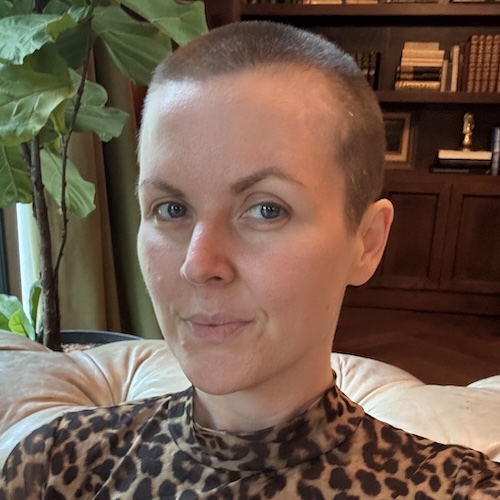
The car accident, and the flood of scans and hospital visits it caused, became the unlikely catalyst that finally led to her diagnosis. When the bleeding became too much to ignore at work one day, after an anxious wait outside the ER, she was admitted immediately. A colonoscopy the next morning found the tumor. The cancer had already begun to spread to her lymph nodes, putting her at stage 3B rather than stage 3, right at what her surgical team described as close to the last possible point before it could have progressed further.
Because the tumor sat close to Carly’s tailbone, removing it entirely would have meant a permanent ostomy, so her care team built a plan around chemotherapy first, then radiation, to shrink it and preserve as much of her body as possible. Complicated further by being uninsured at diagnosis, Carly completed eight rounds of FOLFOX chemotherapy and 28 rounds of radiation, which sent her into sudden medical menopause. Surgery followed in July 2026, after scans showed the tumor had shrunk by more than half. She now has a temporary ostomy, with a reversal expected in the coming weeks.
Nearly six weeks past surgery, Carly is candid that the period after active treatment has been harder to live through than treatment itself. She has been relearning her body, her relationships, and her sense of self, while working through what she calls “cancer ghosting” from people she once trusted. Carly has also leaned hard on therapy, medication, and the people who showed up instead. She’s still afraid of the cancer coming back, but she’s also still here, and Carly wants the next person reading this to know both things can be true at once.
Watch her video and read the transcript of her interview to learn more about her story.
- Persistent bleeding, bloating, or digestive changes deserve real medical attention, even when there’s an obvious alternative explanation. Carly attributed her rectal bleeding to pain-medication side effects for months before doctors found the tumor causing it.
- A traumatic, unrelated medical event can sometimes be what leads to catching a cancer diagnosis in time. For Carly, it was the scans and hospital stay after a car accident that put her on the path to catching her cancer before it progressed further.
- The period after active treatment ends can be harder than treatment itself. Carly found the disconnection from her body, her relationships, and her sense of self more difficult to move through than chemotherapy and radiation combined.
- Not everyone in your life will show up the way you’d expect, but unexpected people sometimes will. Carly’s business partners and some close friends disappeared after her diagnosis, while an acquaintance she barely knew sent her a care package every single week of treatment.
Carly’s Diagnosis Facts
- Name: Carly B.
- Age at Diagnosis:
- 37
- Diagnosis:
- Rectal Cancer
- Staging:
- Stage 3B
- Symptoms:
- Bloating and discomfort
- Hypercalcemia (high calcium levels in the blood)
- Significant and inexplainable weight loss
- Sallow skin
- Severe constipation
- Treatments:
- Chemotherapy: FOLFOX
- Radiation therapy
- Surgeries: tumor resection, temporary ileostomy
This is not medical advice. Please consult with your healthcare provider to make informed treatment decisions.
- Carly’s Diagnosis Facts
- Life before diagnosis
- Looking back: The rectal cancer signs I missed
- The night I went to the emergency room
- The colonoscopy and the wait for answers
- Hearing the word “cancer”
- Building the treatment plan
- The hardest part comes after
- Taking care of myself
- My message to anyone facing this
- A shoutout to caregivers
- Hear from people living with rectal cancer
Life before diagnosis
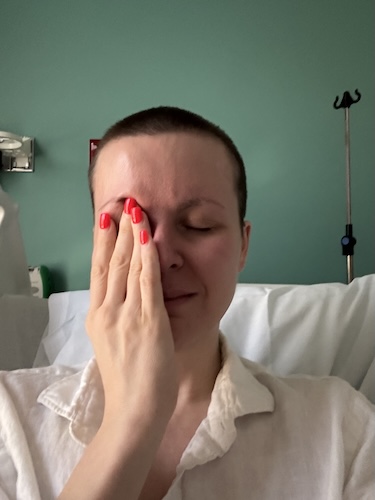
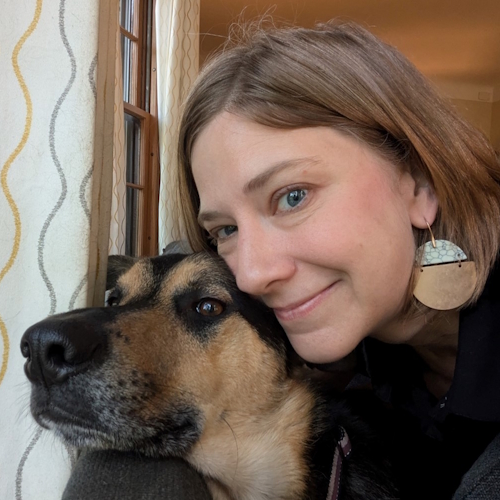
My name is Carly. I was diagnosed with stage 3B rectal cancer in October of 2025.
I am an event planner by trade, so I’m used to being very physical. I’m a florist and an event planner, and it’s a demanding job. With that, I was always used to having aches and pains. I hurt my back in 2023, so I had all these different things going on that I didn’t really think were out of the ordinary.
Then in May of 2025, I was in a head-on car collision that shattered my leg in five different places and required heavy-duty surgery. I wasn’t able to walk for about four or five months. I had a lot of painkillers, and painkillers mess with your stomach. That causes constipation, and constipation can cause bleeding.
While I was in physical therapy, I kept having pain in my back, and we thought it had flared up from the back injury years prior. I kept telling my physical therapist, “This really hurts; there’s something wrong with my back.” She’d take a look at it, and we figured out it was nerve damage or nerve pain.
The back pain just wouldn’t go away. While I was going through the rehab, learning how to walk again, I just didn’t feel good. Even after I was able to start walking, in September of 2025, my skin was a different color. I looked sickly, and I couldn’t figure out what was going on.
The rectal bleeding, which was a huge sign of the cancer, I totally missed. We thought it was from the pain meds and the constipation. Come to find out, the other big marker I had was the back pain, and what that actually was was the tumor pressing on my tailbone. I just thought it was the car accident. There were lots of signs of cancer that we had, but we attributed them all to the accident.
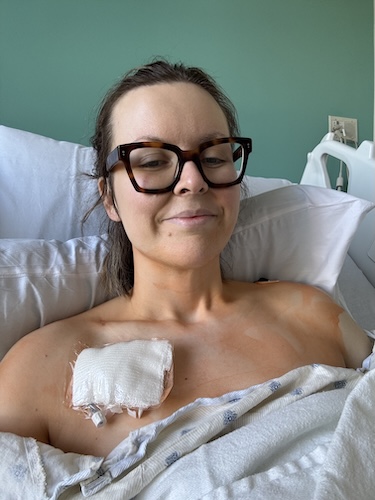
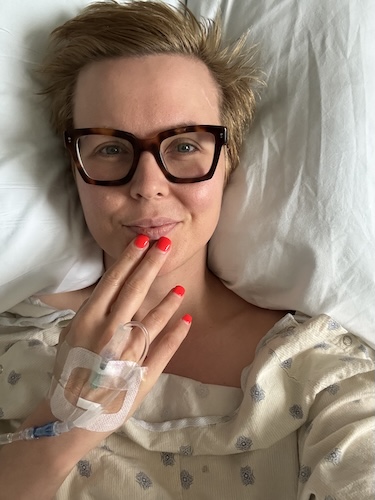
I was able to start putting weight on my leg again in September of 2025. By the end of October, I ended up in the ER because the rectal bleeding had become too big to ignore. They immediately admitted me, which was a surprise to us. We thought, “Wait, you’re admitting me to the hospital for this?” But I think they knew what was going on. I had a colonoscopy the next morning, and they found the tumor.
Looking back: The rectal cancer signs I missed
Looking back now, it’s funny how in retrospect you can see it. The first time I noticed bleeding that was out of the ordinary was probably after I’d hurt my back, so the summer of 2023. I was on vacation, but I took note of it. I went to my doctor, my general practitioner, about a month later, and when they got the blood work back, she said I had elevated calcium levels, which can be an early sign of cancer, so she wanted to rerun the blood work. And with the bleeding I’d had, I thought I should probably tell her about that too. We thought it was something to do with my ovaries, so we ran a bunch of tests, did Pap smears, did all of that, and everything came back clear. I thought I was in the clear.
So that was the first sign, looking back. I also lost a pretty dramatic amount of weight, probably 40 or 50 pounds, in late 2023 and early 2024. It was during the Ozempic phase everybody was doing. I was on a low dose of it, but it wasn’t enough to account for that kind of weight loss. I just thought, “Ozempic is amazing,” and didn’t catch on to the weight loss being anything out of the ordinary. That was a big sign.
And then, I always had trouble with digestion. It’s never been anything new. It’s a family trait. More frequent bathroom visits, having to go more often, a bloated stomach, gas: that was just part of everyday life for me. But now, looking back, I can see that around that same time is when it became chronic. That’s a huge marker I totally missed, not only because it’s something that runs in my family, but because if you’re on social media for more than two seconds, there’s an ad for a product promising to fix exactly that. “Are you bloated and constipated? We have a product for that.” So I was buying all the products, thinking eventually I’d find the one that worked. But looking back, that was one of the symptoms of cancer.
It was easy to blame the car accident
It was beyond easy to blame my symptoms on the accident. There were the Google searches, the AI searches, all of those things: what is this, what is this. And even those came back with, “Oh, that could be a symptom of being on hydrocodone, and hydrocodone causes constipation, and that will cause bleeding.” It had gotten to the point that it was so hard to go to the bathroom, because of where my tumor was, that I had almost a full blockage. And even that was easy to blame on the medications.
I had every reason in the book to dismiss it. Any of those symptoms, I’d think, “Yep, car accident.” I even went to the doctor and told her my digestion wasn’t getting better, and I just felt off. And my skin was sallow; I looked sickly, and I dyed my hair dark because I’m usually blond, and I thought my skin just looked weird next to my hair color. It turns out it was because I had cancer. It was so easy to blame it on anything other than the impossible.
The night I went to the emergency room
I was at work. I had a storefront at the time, and I called my partner and told him, “There’s something seriously wrong.” We’d actually researched how much bleeding is too much bleeding. My bathroom habits had started getting really severe about a month before we went to the hospital. My sister was making fun of me because I have a niece who likes to FaceTime me, and every time she tried to call, I was in the bathroom. It was like that for a month. Even the doctor, when I went to her, thought it was from the car accident: “Your body’s been through trauma; this can be related to your nervous system being out of whack.”
But the bleeding over that month had gotten progressively worse. It was actually a guy who told me that when it gets to the point you can no longer see the bottom of the toilet, that’s when you need to go. Sure enough, I was at work, and we were in the middle of a massive event: 600 people, 60 tables, all of it. I walked out of the bathroom and outside and called my partner. He said he was on his way. I had to go back inside and tell my team, “I know this is the worst possible timing, but I’m leaving. I can’t really tell you why, but I’ll see you later.”
The emotions were disbelief, I think, more than anything. I still didn’t think it was that big of a deal. I called my doctor on the way and was waiting to hear back. I was telling my partner, Chris, “We’ll just wait in the car; I don’t think it’s that big of a deal. This is going to be expensive; I don’t want to go in there for them to tell me to take some over-the-counter medicine.” He told me afterward that he knew I was going inside one way or another; he was just letting me come to the conclusion on my own. We sat outside the ER for probably 30 minutes while I tried to convince myself it wasn’t a big deal. Even when we got admitted immediately, we looked at each other and thought, wait, you’re admitting me to the hospital like this? I didn’t think this was that big of a deal. Apparently it was.
The colonoscopy and the wait for answers
The colonoscopy prep was pretty brutal, and mine was more intense than most because I had a limited time, basically two hours to finish the whole bottle. That night, that was the only thing they had me do. I remember a nurse coming in and asking about my pain level, and I gave some flippant answer, maybe a two. She paused, looked at me, and said, “Why do I get the feeling that you’ve been in pain for so long you don’t even know it anymore?” I told her that was probably a pretty accurate observation. I had just learned to live with it.
The next day I had the colonoscopy first thing in the morning, and they found the mass. They weren’t positive it was cancer right at the beginning. The doctor who came in told me, “I can’t tell you for sure that it’s cancer until we get the pathology report, but this has every sign of being cancer.” Which, of course, is terrifying.
They kept me in the hospital for the bigger tests. In the colonoscopy, they did the biopsy and found other polyps, which they sent off for testing. Then I had a lot of CTs and MRIs. It was all a blur, to be honest. They did the full-body scan, which was interesting because I’d already done those same scans after the car accident, checking for internal bleeding. This time it was about five months later.
It was around 3 a.m. when they finally got me into the MRI and CT rooms, and when I came back down, the nurse asked, “Were you just up there for three hours?” I said I didn’t know; it was all a blur. It was a lot of scans, checking to make sure it hadn’t spread anywhere. They found that it had spread to my lymph nodes, but thankfully hadn’t spread up into my abdomen, to my lungs, or anywhere like that.
It was probably a week between getting out of the hospital and getting the pathology report and seeing the surgeon. That was one of the most agonizing stretches. I was a mess. That not knowing is intense.
Hearing the word “cancer”
I don’t know that there’s a strong enough word to describe it. There’s still that feeling of disbelief, like, is this really happening? I was having severe panic attacks even before going into the appointment with the surgeon I’d been assigned. I was sitting in the car with my partner, and I couldn’t breathe, and he was talking me through it, counting my breaths down, telling me just to try to breathe.
Going into the appointment and hearing that it was cancer, I think the surgeon could see in my eyes that I was starting to dissociate, frantically looking for a way out, thinking maybe this is a mistake, maybe this can’t be it. I’ve told her this recently, because I just had the surgery: how big of a difference she made. She grabbed me by the shoulders, got really close, and said, “Listen, I know that this is the scariest thing that’s ever happened to you. I do this day in, day out, all day, every day, and I’m really good at my job. I’m going to get you through this. I know exactly what to do.”
It makes me emotional just thinking about her, really bringing me back down. Dissociation is probably the best word for that period, because you don’t quite get it yet. You know this is bad, you know cancer isn’t something you want, but it’s not registering yet just how much your life has been turned upside down.
Determination, not just hope
My care team had an amazing bedside manner. I’d describe it as more determination than hope. There wasn’t a doubt of “We’ll see how advanced it is; I don’t want to get your hopes up.” It was: you were going to survive this.
I believe it was my oncologist, or one of my nurses during my first three rounds of chemo in the hospital, who told me, “You’re going to survive this, but you’re going to have to walk through hell to get there.” I remember that phrase.
It was never a question of whether or not I was going to survive. It was more determination: all right, more chemo, let’s do it, because that’s what’s standing between me and getting to the other side of this.
Building the treatment plan
My tumor was very close to the bottom of my rectum, on the posterior side, pressing on my tailbone, which was the pain I’d been experiencing. Because of where it was located, my doctors knew that if they took it out entirely, I’d have an ostomy bag for the rest of my life. So to preserve whatever quality of life they could, the first plan was radiation, because that would shrink it fastest and help with the pain.
But I was uninsured at the time I got diagnosed. Radiation is one of the more expensive cancer treatments, somewhere around $25,000. My doctors were kind and looked for workarounds. I asked if we could wait to start treatment until I could enroll in insurance, since it was outside open enrollment, and they said no: “It’s too far advanced; we can’t sit on this.”
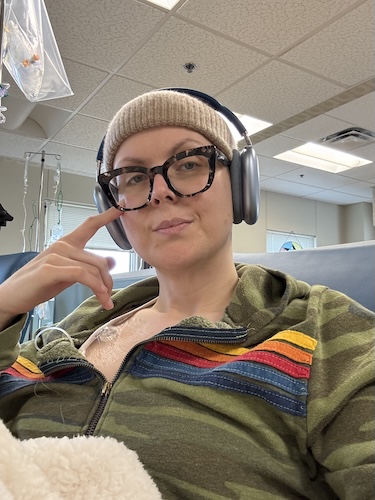
So we decided to do chemotherapy first, partly because, for whatever reason, getting it in the hospital was cheaper than getting it at the cancer center. That’s why my first three rounds were in the hospital.
Eight rounds of FOLFOX
I did FOLFOX, a very intense chemo, a cocktail of three different drugs. It’s intense enough that when I later switched to my radiation oncologist, an older gentleman, he looked over my paperwork and said, “You did eight rounds of FOLFOX?” I said yes. He said, “That’s a lot of chemo.” I said, “Yes, I’m well aware.”
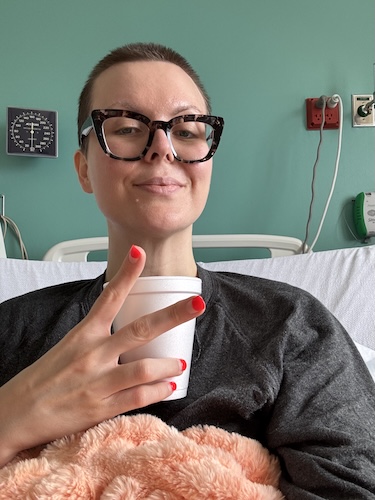
I did eight rounds, every two weeks. I was in the hospital over Thanksgiving, and I don’t think I was in for Christmas itself, but I was back in the hospital the Monday after Christmas. It was intense. It was a lot.
Radiation and then medical menopause
Once I finished my eight rounds, in early March, I started radiation and did 28 rounds. This makes perfect sense now, but I wasn’t expecting it: when you get radiation blasted directly at your pelvis, your ovaries and uterus aren’t fans of that. It sent me into medical menopause.
I was still 37 at the time, so that was a lot, because it wasn’t a gradual decline; it was like night and day, like dropping off a cliff. That was one of the more intense parts of the whole treatment.
Before that, staying calm was a big part of my personality. I’d describe myself as almost stoic: the crazier the situation, the quieter and more determined I get. I put my head down and get through it. Then, all of a sudden, when the medical menopause hit, I couldn’t control anything. My emotions were all over the place. I couldn’t stop crying. I didn’t know what was happening, and it was absolute misery.
The wait, the surgery, and the ostomy
I finished radiation in early to mid-May. Radiation is cumulative, so even after you finish, it keeps working. We waited about ten weeks before I went in for the next set of scans to see how well the chemo and radiation had worked, and then went back to the surgeon to make the plan for surgery. I had surgery in July, this past July, 2026.
The tumor had shrunk. I think we started at around 4.5 centimeters and got it down to just over 2 centimeters, so it had shrunk by more than half, which was amazing. Because of how it shrank, I did have to get an ostomy bag to let the surgery site heal, but now it’s temporary; it won’t be permanent. It’s been almost six weeks since the surgery, and somewhere around the 12-week mark, we’ll do the reversal.
The ostomy itself isn’t as bad as I expected. When I first got diagnosed and was doing as much research as possible, following people on social media, it kept coming up that the period after active treatment is actually harder than the treatment itself. I can’t emphasize enough how true that’s been for me. Talking to my oncologist about it, he said he sees it in a lot of his patients: when you’re in it, you just pull yourself up by your bootstraps and keep going, one foot in front of the other. Once that’s over and your body has a chance to register everything it just went through, he described it like the aftermath people experience coming home from war: your body went through things it should never have to go through, and now it’s catching up with you.
That period, after finishing radiation and before surgery, and even now post-surgery, with the ostomy bag intensifying that feeling, has been real.
The hardest part comes after
The emotions of this period have been the hardest part to navigate through all of this. Keeping myself from falling down the rabbit hole of despair has been a daily effort.
It’s a bit of a cliché at this point, because so many people in the cancer community talk about it: people think that once treatment is over, you’re better, life is back to normal. It’s anything but normal. Trying to find your place within your own life when you feel disconnected from your body, your loved ones, your career: how am I supposed to insert myself back into the life I built when I’m not the person I was six months ago?
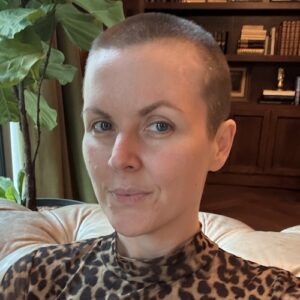
I’m a completely different person now. My priorities are different. My tolerance for people’s nonsense is nonexistent. I can no longer suffer fools. That part has been a lot to get used to, and in a good way.
Taking care of myself
Honestly, it’s really hard. I was talking with a friend last week, and she asked how I was finding joy. I just shook my head and told her the truth: I don’t feel very joyful right now.
I go to therapy, which has been part of my life for most of my adult life. I wasn’t going to my therapist during active treatment, mostly because I didn’t want to talk about it, didn’t want to process it, just wanted to keep my head down and get through it. Once I started going back, it’s been a lot of digging through the emotions. One of her encouragement was that I needed to put a lot of effort into my own mental health, because my partner had to return to work. When I was going through the car accident and then active treatment, he was my full-time caregiver, and I can’t speak highly enough of how much he was my rock through all of it. But once he was back at work, there was suddenly this big hole; I didn’t have someone taking care of my every want all the time. So I’ve really had to prioritize taking care of myself.
Therapy has been a big thing. Before the surgery, I tried to do as much exercise as possible; walking became something accessible for me. Right now it’s harder, because with the ostomy there’s a lot of food I can’t eat; fiber is a no-go, so all the fruits and vegetables I’d normally lean on, I’m not allowed to eat. Right now it’s a lot of pasta and toast, which feels contrary to what I should be doing, but it is what it is.
I’m really trying not to let the anxiety take over. I’ve had plenty of opportunities in my life to go on antidepressants and anxiety medication, and it never felt like the right fit before. With this, it was clear I needed it. I’m on antidepressants and pretty strong anxiety medication, and I don’t know where I’d be without them. Getting rid of the stigma around that was really big for me.
What cancer ghosting looks like
I also worked on surrounding myself with the people who make me feel good, and this is probably the part of the interview where I’ll start crying. Cancer ghosting is real. I didn’t think that was going to happen to me, but it did. People I thought were my ride-or-dies were gone. And people I thought of as acquaintances stepped up in ways I never imagined.
I had someone I barely knew, met a couple of times through work, an artist, whose mom had the same diagnosis and didn’t make it. When she found out I’d been diagnosed, she was in a yoga class and saw my announcement on Instagram, and she said she just started sobbing. She asked what she could do, and every week she sent me a little care package with a different theme: foxes one week, with her own paintings and stickers, cosmic and stars another week. I got one in the mail every single week.
Cancer gave me a lot of clarity about the people who are actually here for me. It’s not that I don’t wish those other relationships hadn’t gone differently, but it made me realize how important it is to nurture the people who are still around. I’ve focused on having those people over for dinner, staying in touch, and especially on the nights I might otherwise be curled up crying myself to sleep, calling a friend and asking them to come over and watch a movie. My partner has been really helpful with that too; when he sees me going down into that dark place, he’ll reach out to my sister or a friend and say, “I think she really needs somebody right now.”
It was actually a New York Times article that came out around the time I got diagnosed, about this exact thing. I remember reading it and thinking, that’s terrible, but that’s not going to be me, because I’d just been through the car accident and my support group had really shown up. And then, when the cancer diagnosis came, a lot of the same people disappeared. My first phone call, lying in bed after getting the diagnosis, wasn’t to my family; it was to a friend. She’s gone now. My business partners, who I considered like parents to me, pulled their investment out of my business and dismantled my storefront while I was in the middle of chemo. That’s why we had to close.
I realized I was a number to people, how much I was worth to them. I still struggle with that. It’s something I talk about a lot in therapy: feeling shame, wondering if I was the bad guy, if I did something wrong. I’m grateful to a therapist who’s helped me work through that and given me literature to help me understand that this says so much more about the people than it does about me.
I think a lot about how, on social media, it’s so easy for conversations about cancer to slide into blame: you got cancer because you did this, or because you didn’t do that. Every actual professional I’ve spoken with or read about will tell you it’s more complicated than that. I know marathon runners who eat clean and do everything right and still end up with stage 4 cancer, and I know people who eat however they want and do no exercise and are perfectly fine.
This particular cancer is on the rise, especially in younger people, so there’s probably some correlation worth understanding. But there’s a difference between trying to figure out what that correlation is and putting the blame on a person. That’s the last thing you need when you’re already dealing with this, to feel like you brought it on yourself somehow.
Finding (and filtering) community online
I’ve never been on TikTok in my life, and it was actually one of my nurses in the hospital who recommended I get on there, because she said the ostomy community on TikTok is very strong. They’re there for people like me who are trying to figure this out, helping you realize you’re not alone, normalizing something a lot of people are uncomfortable with, but that’s now just your reality. I found the colorectal communities really helpful, made some great connections, got a lot of encouragement, and it was a big help to see people who’d made it to the other side.
The flip side was seeing people who weren’t making it. James Van Der Beek, who I didn’t know well but who lived here in Austin, where I live, had the same diagnosis, stage 3, and he died. That’s terrifying. I had to learn to remove myself from it when it got to be too much. There was also Dave Coulier from Full House, who came out about being diagnosed with two different types of cancer back-to-back. When I heard that, I dropped my phone and started sobbing. I was on my way to a chemo appointment, and I told my partner, “I can’t do this again; there’s no possible way.” He had to talk me off the ledge and remind me to focus on the positive: the evidence right now is that your treatment is working, everything’s pointing in the right direction, don’t let yourself focus on the other thing.
My advice, if I have any, is to let that kind of content have its place when it encourages you, but the moment it crosses over into discouraging you, shut it off, put it away. Just being aware of that line is important.
Living with fear of recurrence
What made my cancer stage 3B, instead of stage 3 flat, was that it had begun to spread into my lymph nodes, which is the beginning of metastasizing. We caught it at essentially the last possible moment before it would have gone to a point of no return. When you think about it, that’s really lucky, and I feel grateful. But the flip side is feeling terrified, because I know people in my community who were diagnosed with the same cancer at stage 4. And that fear of it coming back is paralyzing.
I desperately didn’t want to have the surgery. Going in, they had to give me sedatives early that morning just to calm me down enough to get me into the OR. Before that, at my last appointment with my chemo oncologist, I told him I’d been doing everything he told me to do, and I’d hit my breaking point; I couldn’t handle it anymore. That’s when he told me about the PTSD he sees in a lot of his patients, and really empathized with me, but he said if I didn’t do the surgery, he could almost guarantee the cancer would come back, and when it came back, that fight would be a lot harder than what I’d already been through, and it would undo everything I’d already survived.
I don’t know if that fully answers the question, but for me it’s a double-edged sword, and I think learning to live with both feelings has been important. I can be grateful I’m still alive and optimistic about the future, while also admitting I’m petrified of the future, exhausted, angry, and traumatized. All of that can exist at the same time, and none of it has to cancel out the rest. It’s about letting those emotions be what they are and just keep putting one foot in front of the other.
Small rewards for showing up
One of the pictures I submitted for this is a cookie, because after every treatment, every oncology appointment, all of it, I’d go get my favorite cookies.
It was a small reward, a little treat, because I’d done the hard thing one more time. I’d shown up one more day.
My message to anyone facing this
You’re stronger than you think you are.
It’s funny when people tell you that you’re so brave, you’re so strong, and I think, thanks, but I didn’t have a choice. I would have really preferred not to have to be this strong. But I think anyone who finds themselves in this position will find the strength to get through it. It’s within you.
It’s going to be scary, you’re going to have your ups and downs, and you’re going to have to make peace with the fact that there’s a chance you might not make it through it. That’s a real reality for anybody facing any type of cancer. But while making peace with that, and not running away from that part of it, also give yourself credit: you’re stronger than you think you are, and you can do this.
Like a nurse told me, you’re going to survive this, but you’re going to have to give it everything you’ve got. And there are no guarantees. But for me, there are also no regrets. As hard as this has been, and as much as I would never want to go through it again, I know that if I have to face it again, I’ll strap my boots back on and do it again, because life is worth it.
Especially in those dark moments, I read a book called “Joyful, Anyway,” by Kate Bowler. She had the same cancer, but hers progressed to stage 4. I’m so grateful that my doctors listened to me when I went in, because from what I understand, hers wasn’t caught as early. Her whole thing about interviewing people and trying to understand how you find joy in a hard situation: what she came to realize is that the parts of life that are really hard, that really test you, are the moments joy is able to shine through. Even though it’s awful, even though you don’t want to do it, being able to still find joy, to keep showing up, is what those hard parts are for. If you didn’t have the hard parts, you wouldn’t appreciate the good ones.
So give yourself permission to feel the darkness, feel it fully, don’t try to be toxically optimistic like it isn’t happening, but also allow yourself to feel the happiness too, and know that what you’re going through now is going to make the other side that much sweeter. Even if it’s not okay, it’s still going to be okay.
A shoutout to caregivers
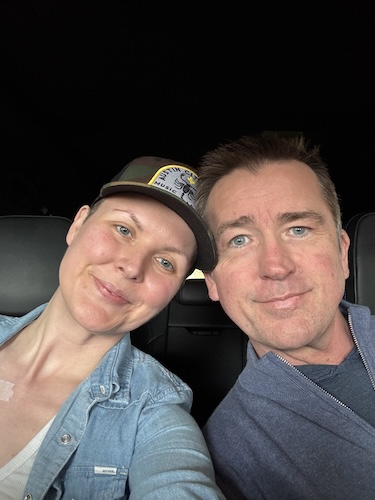
I want to give a shout-out to caregivers. I read a post recently about things people want to tell their partners, and I sent it to my partner, Chris. We’re not technically married; we’re domestic partners, and he had every reason he could have left, and he chose to stay, and he chose to take care of me every day. Even though I look different, act different, and feel different in every way, he stayed.
Caregivers go through it too. They experience the fear, the appointments, the anxiety, and they take on so many of the things you can no longer do: the household chores, everything, especially if there are kids involved. They deserve just as much recognition for going through the hard thing.
I don’t know what I would have done without him.
This interview has been edited for clarity and length. The views and opinions expressed in this interview do not necessarily reflect those of The Patient Story. This content does not replace professional medical advice.
Inspired by Carly’s story?
Share your story, too!
Hear from people living with rectal cancer
Real experiences with diagnosis, treatment choices, side effects, and life beyond rectal cancer — in their own words.

Leave a Reply