
Marisa’s Colorectal Cancer Diagnosis at 37 Led Her to a BRCA2 Discovery
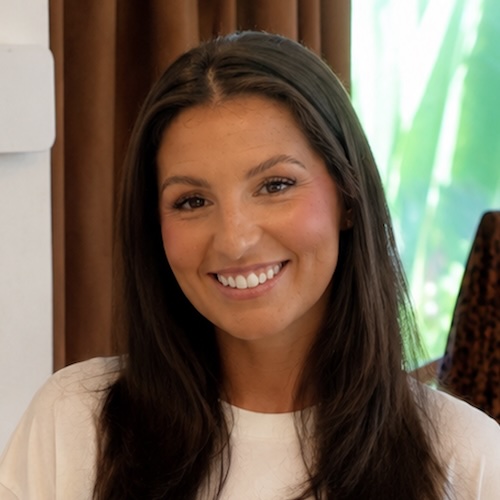
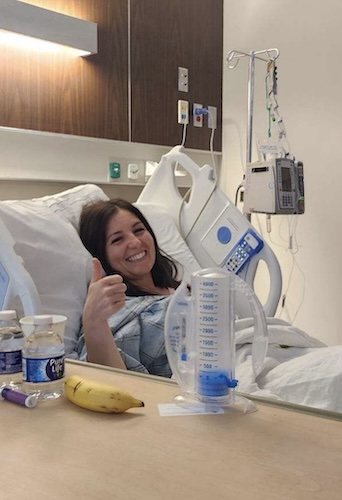
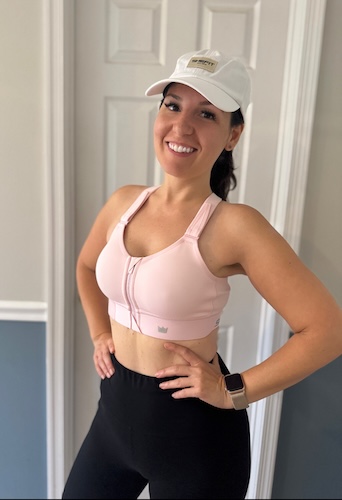
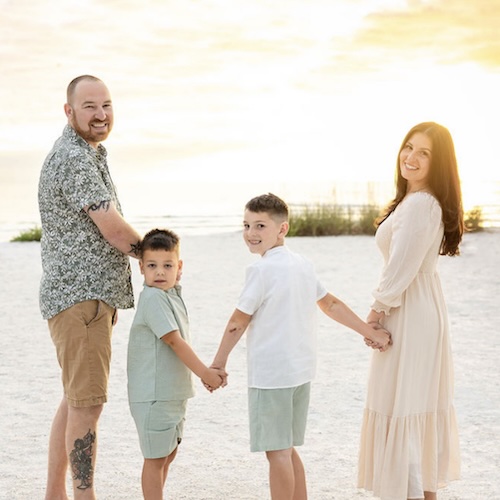
Marisa thought she was doing everything right, focusing on working out daily and eating clean. She was caught off guard when she started feeling stomach pain, bloating, and eventually saw blood in her stool. A dietitian’s suggestion to run a GI map test, followed by a referral to a gastroenterologist, led to a colonoscopy, where doctors found and removed a large polyp. Two weeks later, just a few days before Christmas, Marisa heard the words no one ever wants to hear: It was colorectal cancer.
Interviewed by: Taylor Scheib
Edited by: Chris Sanchez
Scans over the following weeks gave a silver lining: The cancer had been removed completely during the colonoscopy. Doctors also shared that they had removed a separate area of precancerous tissue in her stomach.
Then came even more news: The genetic testing that had been ordered as a routine part of her cancer workup came back positive for a BRCA2 gene mutation, along with a variant of unknown significance in the ATM gene, meaning that it is not clear if this genetic change increases cancer risk or not.
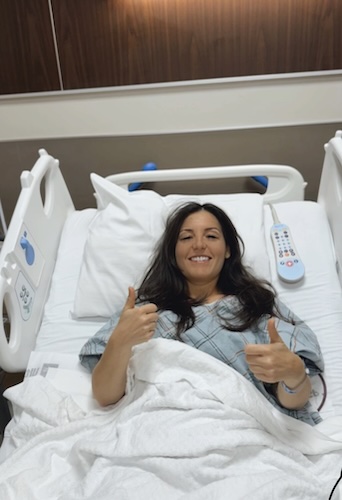
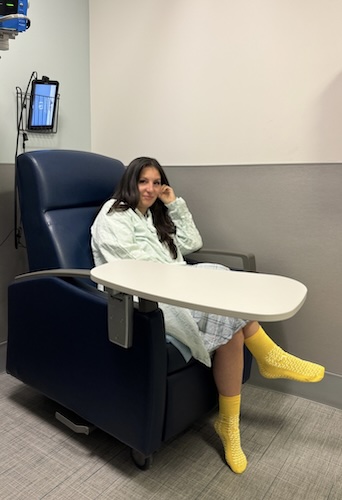
Faced with a choice between lifelong surveillance imaging or risk-reducing surgery, Marisa chose a nipple-sparing double mastectomy, first repositioning her nipples, then removing breast tissue and placing tissue expanders, and later exchanging the expanders for implants. She later had her fallopian tubes removed as part of a hospital study designed to reduce ovarian cancer risk while delaying full removal of the ovaries, and underwent a revision surgery with fat grafting to address rippling in her reconstructed chest.
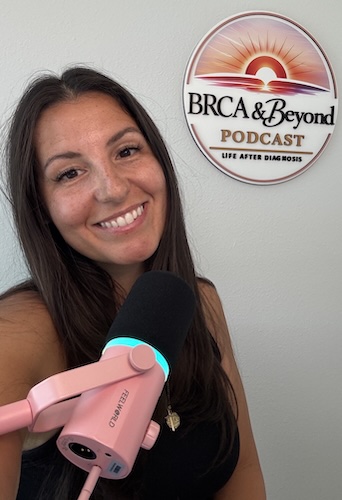
Today, Marisa manages the after-effects of her surgeries, leans on therapy, and has built a podcast and online community for people navigating cancer and hereditary gene mutations.
Watch Marisa’s video or browse the edited transcript of her interview to learn more about her colon cancer story.
- Marisa’s colorectal cancer was found because a registered dietitian, first suggested testing for something beyond diet: A reminder that persistent GI symptoms need to be investigated.
- Her genetic testing results came back with a BRCA2 mutation and a variant of unknown significance in ATM, which reshaped her entire care plan, even though she had no known family history of breast or ovarian cancer.
- Listening to your body, even when nothing seems clinically alarming yet, can be the difference between catching something early and missing it. Marisa’s own hyperawareness of her body, not any obvious warning sign, is what pushed her toward answers.
- Choosing risk-reducing surgery instead of ongoing surveillance is a deeply personal decision with no universally right answer. Marisa’s path, shaped by her own quality-of-life needs, won’t look like everyone else’s.
- Marisa’s transformation from patient to advocate shows how processing a diagnosis doesn’t end at cancer-free. Healing continues through therapy, community, and eventually building a platform to help others going through the same thing.
Marisa’s Diagnosis Facts
- Name: Marisa S.
- Age at Diagnosis:
- 37
- Diagnosis:
- Colorectal Cancer
- Staging:
- Stage 1
- Mutations:
- BRCA2
- ATM (variant of unknown significance)
- Symptoms:
- Intense stomach pain
- Bloating
- Presence of blood in stool
- Treatments:
- Surgeries: polypectomy, precancerous tissue removal, nipple-sparing double mastectomy with tissue expanders, exchange to implants, revision surgery with fat grafting, salpingectomy
This is not medical advice. Please consult with your healthcare provider to make informed treatment decisions.
- Marisa’s Diagnosis Facts
- The first warning signs of my colorectal cancer
- The colonoscopy that found the polyp
- Scans, staging, and learning I was cancer-free
- The phone call that revealed BRCA2
- Choosing surgery for my kids’ sake
- Removing my fallopian tubes and mourning my fertility
- Healing from two kinds of survivorship
- How a podcast idea turned pain into purpose
- What hope looks like after cancer and a genetic mutation
- Hear from people living with colorectal cancer
The first warning signs of my colorectal cancer
My very first symptom started in the summer of 2022, and it started with some stomach pains. Not very frequent at first. And then they progressively got worse. On two different occasions, I was in excruciating stomach pain. I had never experienced it before. I was actually keeled over in the fetal position, which was, of course, concerning.
Then, throughout those several months, I was experiencing bloating. It just felt like a very full, heavy feeling. And ultimately, by about November of 2022, I started seeing blood in my stool whenever I went to the bathroom. It started occurring more often, and more of it. So at that point, like any woman, especially after having children, I chalked it up to maybe hemorrhoids that weren’t discovered during my pregnancy, or stress. But once it became consistent, I knew that something was really wrong.
Living with symptoms while raising two kids
My first symptoms really started with bloating, and it was always on and off for almost a year. So it probably started around fall 2021. I recall thinking, “Could I be pregnant again?” It was that kind of a question, and then every month my answer was, “No, you’re not.” But the bloating was still there. I started to take it more seriously when the pain started becoming a factor and affecting my day-to-day life.
I remember the first time I experienced excruciating stomach pain was on the 4th of July. We had a barbecue to go to, and I turned to my husband and said that I didn’t really feel so good, chalking it up to anything but cancer — I thought maybe I ate something bad, maybe I had dairy, because at the time I was dairy-free. I told him to take the kids, not miss the party, and go hang out. And I was literally in the fetal position on my couch. I had never experienced that before. My husband had never seen me like that before.
Other than that, it wasn’t really affecting my day-to-day. I had kids to take care of — my kids were three and four at the time. Everything was go, go, go. Preschool was just becoming a thing. I didn’t have time to really pause and fully focus on what was going on. It was like, “Hey, that was a really annoying setback; today is a better day, I feel better, now I have to go be a mom, be a realtor at the time, focus on career, focus on everything else.” But then, when I started noticing the blood in my stool, that’s when everything came to a screeching halt: wait, I really need to pay attention now.
Getting answers through my dietitian
It’s actually kind of funny, because I was working with a dietitian at the time. I had just had my son and was trying to get back into fitness and doing all the good, healthy, right things. I was telling my dietitian about the bloating and the symptoms I was having, and we exhausted all the different avenues. We tried cutting things out — let’s see if gluten is the problem, let’s see if certain foods are the problem, what’s triggering this. We couldn’t really find a definitive answer by cutting out certain foods.
So she suggested that I do a GI map test. That is kind of disgusting — you get a kit that comes to your house, and you have to get a sample in the bathroom, without getting too descriptive, and put it in this little vial they give you, and then ship it out. Then, I started gradually noticing the blood in my stool, but it wasn’t to the point of being alarmed. I sent the sample out to the lab, got the results about three weeks later, and they indicated there were traces of blood. I think that was my first “Oh, okay, wait a minute here.”
And then my dietitian said she really thought I should see a gastroenterologist to further investigate. It was when that result came back that everything kind of clicked, and even my body was like, “Hey, we’re going to scream a little bit louder now.” That’s when the blood started increasing.
I give her credit for that all the time — in my life, to say her name. Her name is Taylor Wilson. She’s a registered dietitian in New Jersey. I tell her all the time, “You literally saved my life. I don’t think you understand the magnitude of this.” I made her cry many, many times by saying that to her, but it’s the truth. When we start paying attention to our bodies and really put in the time and effort, no matter what that looks like for you, we start to develop that awareness. We start to understand what our normal feels like and looks like, and when there are abnormalities that pop up — because our body speaks to us all the time — it’s just a matter of whether or not we’re listening.
Why listening to your body matters
I’ve always been very hyper aware of my body — that’s just how I’ve always been my whole life. I was always into fitness. I was always into eating clean, organic. Which is why I was in shock when I received the colon cancer diagnosis. I checked all the boxes. I did all the right things according to the American Cancer Society and all the recommendations we get. But I’m a huge proponent of the importance of listening to your body, really sitting with yourself, understanding what and how you feel when you’re eating certain things.
Some people are like, “Oh, well, I have a sensitivity, whatever, it doesn’t matter.” It does matter how we’re fueling our bodies. There are warning signs all the time — whether it’s a food sensitivity or something as extreme as finding blood when you’re using the restroom. It’s very important. And I think because every single person holds such busy, hectic, chaotic lives, we tend to disconnect from that sense of self in all aspects. And it literally saved my life.
The colonoscopy that found the polyp
Initially, it actually started with my dietitian — we thought it was gut dysbiosis. That’s really the reason we went for the GI map test, thinking there was something imbalanced in the microbiome of the gut. It turned out it wasn’t. So when I went to my GI, I explained everything to her and gave her the results of my GI map test. She immediately wanted me to go in for a colonoscopy. She, too, was kind of questioning the idea of gut dysbiosis, or SIBO — small intestinal bacterial overgrowth. She wanted to know what we were dealing with. I don’t think either one of us really felt that it could have been cancer.
Fast forward to December 9, 2022 — a date I will never forget. I went in for my colonoscopy, and when I came to in recovery, my doctor — the sweetest woman in the whole world, Dr. Shukla at Atlantic Gastro in New Jersey — came to my bedside, put her hand on my arm, and said, “We found a couple of polyps. One of them, which was the largest I’ve seen in my practice, and it took me a while, but I was able to remove it.” She said she’d had to inject certain things and use certain tools, but she was able to surgically remove it. She explained that pathology would get back to me, but she had a little bit of a tone in her voice that kind of told me what I needed to know.
Then, fast forward to three days before Christmas, and I’m called back into her office. I’m sitting down, and I already knew — because of the wonderful patient portals we have access to now — about a week before my appointment. I was trying to mentally prepare, but nothing can ever mentally prepare you for sitting down in a doctor’s office and being told you have a cancer diagnosis. Three days before Christmas, I was told by her again — such a sweet woman — she came right up to me, put her hands on my legs, put her knees right up to my knees, looked me in my eyes, and said, “We found cancer.” She said, “We’re not sure what stage it is. We’re not sure if I was able to remove all of it, but I’m very hopeful, and you’re going to be okay.” I started hysterically crying, naturally.
So I left the office, and now I have to be Santa — I have to wrap gifts in my basement while my three-year-old and my four-year-old are still sleeping upstairs. I have to have this magical holiday that is crucial to toddlers — this is the most magical time of the year; this is what it’s about. Which was a huge challenge, and it was really difficult. It was one of the hardest parts of this entire experience.
Why nobody thought it was colorectal cancer
Cancer never crossed my mind when I was going to the gastroenterologist, or even discussing it with my dietitian or family members. I was 37 years old, I was healthy, and I worked out every single day. I went on nightly walks with my family. I ate right — no fried food, no alcohol, no smoking, to the T. I was this model-health kind of person to look at. Never would I have thought age would be a factor, health would be a factor, or even that family history would be a factor, because I had no family history of colon cancer. It just didn’t make sense.
My father passed away from pancreatic cancer, and my grandmother on my mom’s side passed away from pancreatic cancer. So those things got me going like, “Okay, how can I screen for them later in life?” But colon cancer, never. What’s really crazy is that on my dad’s side of the family — he passed away about 14 years ago from pancreatic cancer — I never had a very strong relationship with his side of the family. Some cousins here and there, but nothing close. So one of my cousins, after I got diagnosed with colon cancer, was someone I reached out to, because now at this point, everyone is asking me for a family history.
And I have little to no information. I knew my grandparents had passed away from cancer, but I didn’t know what, and that was important information. So I reached out to one cousin and told her what was happening — at the time, it was a colon cancer diagnosis, not sure of the stage, hadn’t done genetic testing yet, so we were just dealing with the colon cancer diagnosis and building a family history. My cousin then told me, “Wow, that’s so crazy,” because our other cousin, who’s the same age as me — 37 at the time — was diagnosed with stage 3 colon cancer two months before I received my diagnosis, and was going through treatment. Which floored me, because I’m like, “Well, obviously there’s something here now.” Both he and I had established the family history. Who else had it? We don’t know. We know our parents didn’t. We know our uncles didn’t. Our grandparents did. But who knows how much deeper that goes. So yeah, it was a shock.
Navigating the health care system during the holidays
Because it was so close to the holidays, literally every doctor was on break, and I had to see a lot of specialists at that point. The offices were closed or had limited hours for the holidays, so it was really difficult to navigate. It was challenging because now I’m trying to collect my thoughts. I’m given the cancer diagnosis, but no one’s giving me a stage, no one’s giving me definitive answers, no one’s telling me a treatment. I was kind of in this limbo. And again, trying to still raise two young kids who are on the go, who are happy children and jumping around and want to climb all over mom, and trying to be present for them while holding such a heaviness and such a huge question mark and uncertainty was really, really heavy. It was really difficult to hold.
Then, breaking the news to my mom, to my brother, to my stepfather was another huge difficulty — and that was before I even had answers about what stage I was. It was like, “Here’s the information,” and they had all the questions, and I’m like, “I don’t know, I don’t know, I don’t know.” That was really difficult. So I wasn’t able to see an oncologist until the week after New Year’s, and the only reason I was able to see someone that quickly was that my husband was working in a very large health care system at the time, so he knew people who were able to at least get me a 20-minute consult, squeezed in as soon as possible.
Scans, staging, and learning I was cancer-free
The oncologist had me go through every single poke and prod and scan and image, naturally. It was about a month and a half of that before anyone really had a definitive answer — whether it was just in the colon, if it was in other organs, just everything you have to go through with a cancer diagnosis. By the absolute grace of God, I found out they removed the cancer in its entirety. I did go back for another colonoscopy and an endoscopy to make sure it wasn’t in the upper GI as well, and they found precancer in my stomach. They were able to remove that in its entirety, too, which again is a blessing, because my grandmother on my father’s side passed away from stomach cancer around 1997, I think.
So really, ultimately, it could have been ovarian, it could have been stomach, it could have been liver, it could have been colon — it could have been literally anything. But my stomach really stood out when they said precancerous stomach. I was like, “Oh, okay.” So we found out a lot about myself and my insides during this whole process — probably more than I wish I knew, but it’s a blessing nonetheless, because we can monitor all of it now.
So we found out everything was removed. It didn’t spread; it didn’t start in a different location. And then it ultimately led me to genetic testing. I received the news that I was cancer-free at the very end of February. It was the same week I had my genetic testing appointment. So I was on this high — like, oh my gosh, I’m so grateful, we caught it early, that’s amazing. So I went into the genetic counselor’s office, and they’re going through the slideshow and all of the information, and very naively, now that I look back, I’m going, “Okay, yeah, yeah, yeah, sure, sure, sure” — not thinking it applied to me, because a lot of the things they were talking about were things that, at the time, didn’t connect for us. They were talking about the BRCA gene, ovarian cancer, and breast cancer. No one in my family had had either of those things. So I’m like, “Okay, that’s probably not what I have to worry about.”
They touched on Lynch syndrome, and I’m like, “Okay, but it’s not a strong enough history for it to be Lynch” — Lynch would have shown up a little more frequently than just myself and my cousin over the course of however many generations. So it really didn’t click with me, and very naively, I was like, “Yeah, you want my blood too? Here, take it, I don’t care at this point.” And then I went on my merry way. The week before my oldest son’s birthday, I got a phone call from the genetic counselor.
The phone call that revealed BRCA2
I’m driving, and she says, “I have your results, I want to go over them with you — it sounds like you’re driving, do you want to pull over?” When she said that, I was like, “I’ve been down this road before, literally and figuratively. I know this call, I know this tone.” So I pulled over, and she told me I tested positive for the BRCA2 gene mutation, and I was also VUS — variant of unknown significance — for ATM as well.
She kind of quickly, in a very clinical way — no fault to her, but a very clinical, dry way — said, “So your options are every six months alternating imaging, or you can go for a double mastectomy and a complete hysterectomy. I suggest you go to these doctors, and I can send you an email with your results and my recommendations. Do you have any questions?” I’m like, I have all of the questions, and also, you are crazy for telling me to cut out parts of my body — have a good day. And that’s really where my head was; I was just kind of like, “This lady is crazy.” And that’s exactly what I said to my husband when I called him: “Listen, I received my results, and this is what she said, and I’m writing an email talking about how this woman is insane.” And at that point, it kind of started that immediate sense of dread and worry all over again.
How genetic testing became part of my care
My oncologist actually wrote out a whole bunch of different scripts and referrals — go here, go here, go here, go here. So genetic testing was kind of just one of the boxes for me to check off. I had never heard of genetic testing before. I didn’t even know what a genetic counselor was. I had no idea about anything in this capacity, in this realm. Again, it was just another box I had to check off. I’m like, “Well, the doctor said to get this scan and go here, go there,” so I again went into that office and that appointment very naively, just thinking, “Yeah, it does not apply to me, I don’t really care, take my vial of blood and let me go to my next appointment.”
Processing the genetic mutation and facing new decisions
A lot of crazy things happened in my processing of the genetic mutation. I spiraled. I Googled a lot, which I do not recommend — I actually advise against Googling anything. I sat with myself and tried to process, like, what exactly does this really mean, and what avenue do I want to take. So once I received that information, I went to my OB-GYN, who is someone I knew and trusted — she delivered both of my boys, and she actually turned into a family friend. So I really trusted her. I gave her the information. I went for my first mammography ever, and it’s not a fun experience. Didn’t like it. Don’t recommend it for anything other than clinical purposes.
They were like, “Oh, you have dense breast tissue; we kind of see something a little suspicious.” And I’m like, “Here we go again. Great.” Then they gave me another referral — they wanted to do further imaging. They did further imaging, again through mammography, and got more images and collected more data. They found calcifications, and were still a little suspicious of a certain thing they found in one of the breasts. So at that point, I did an ultrasound, and they still didn’t like what it looked like and wanted to go for a biopsy. The biopsy for me was very traumatic — I cried throughout it, but I think it was also residual feelings from everything else I had just gone through. I was like, “I can’t, I can’t keep doing this.”
So when the doctors said surveillance was one option, I asked, “Okay, well, does that mean that every time we find anything, I’ll be doing all of this?” — and they said, “Yes, that’s basically what we’d be doing.” I felt like I couldn’t live my life in six-month increments. Every time they’d find something, I’d have to go for a biopsy, or every time they didn’t find anything, I’d sit and wonder — did they miss something? I sat with that for a while. My mind was kind of made up on surgery, because I was already going for colonoscopies every two years and endoscopies every two years. I’m like, I can’t — that’s not a quality of life for me.
But the crazy story is that I kept praying on it, and I was like, “God, just please slap me in the face” — an undeniable sign that this is the route I need to go to do surgery. I have an idea, but I just really need you to tell me, because everything else is so uncertain and so unknown. And two things happened in one day that really knocked me over.
The signs pointing towards a preventive double mastectomy
The first thing was, my youngest son at the time was in speech therapy, like clockwork — our appointment was our appointment; we never missed it, she never changed it. She calls me one day and says, “I’m really sorry, I have to move your appointment up a few hours — can you come in?” Yeah, no problem. So we go in. My son goes back to work with his therapist, and I’m sitting in the office speaking to another parent about summer plans. A woman walks in who’s clearly battling something — she has no hair, a bandana on her head, a mask over her mouth — and her son goes back too. So now she’s overhearing our conversation, and she shares with us how her summer plans look different, because she’s diagnosed with stage 3 breast cancer and is going for a double mastectomy that July.
Then she continues to share with us that she was high risk — she was going for mammograms and MRIs, and they missed something. Her husband found the lump, and she wound up being stage 3. And I was like, “Oh, okay, this is like a mirror — this is like my crossroads.” That really stuck with me. Right after I left, I received a phone call from my doctor’s office saying my biopsy came back clear, and if I wanted to go forward with scheduling a double mastectomy, I could do so within the hour. And if that wasn’t enough of a sign, I went to get my eyebrows done later that day, and the woman knew my history, knew what I was going through. She’s looking at her phone and goes, “Oh, my next appointment is actually here early — she’s a three-time breast cancer survivor, do you want to talk to her?”
Absolutely, I do. So the woman comes into the office — she was an older woman, late 70s, I’d say — and she starts sharing with me how her first diagnosis was in the 80s, and she did a lumpectomy, and then capped one breast, and all of these different things. And then she actually raised her shirt and showed me her scars. She had gone flat — she didn’t have her breasts anymore. And she said to me, “If you’re able to do something about it now, do something about it now.” And I was like, “Okay.” The very next day is when I scheduled my preventive double mastectomy.
Struggling with the decision to remove my breasts
I struggled a lot with the idea of removing my breasts. Society defines us as women, biologically, to have certain body parts — to have our reproductive organs, to have our breasts. That’s just definitive of who we are as women. So to have to not only say goodbye to the breasts I’ve had my whole life, but then also have to reconstruct them to be as close to a normal appearance as possible, that was really difficult to accept. It was really difficult to wrap my head around. It’s not normal to amputate healthy organs, healthy breast tissue, because they have a high risk of possibly killing you one day. That was really a hard reality to face, and I struggled with that a lot.
I think — I’m going to get emotional — the most difficult thing that kept entering my head was, would I be able to feel my kids hug me? That’s what I kept going back to, because I was reading and talking to doctors about how you go numb — they take away nerve endings, they take away feeling, you don’t feel anything in your chest anymore. So that’s what I kept going back to, and I’m like, I just want to be able to feel my kids hugging me. That was my biggest concern. And I’m happy to report that I can, and it’s the best hugs ever, still to this day. But that was my big, big struggle, and that was the one thing I kept going back to.
The surgery itself was a really difficult day. It was really hard. I dissociated through a lot of it; I’m not going to lie. It was the fear of what I would feel like waking up — that was my biggest fear. I trusted my doctors, and I built a phenomenal team. I received my care at Mount Sinai. They are wonderful human beings outside of their specialty — just wonderful people, and I trusted them; I literally trusted them with my life. I wasn’t worried about that. It was the after, and what came after that. It was waking up and thinking, no take-backs — that’s what I kept going back to, where it was like, this is the ultimate no-backsies decision. I go in there and wake up, and I can’t be like, you know what, never mind. I wake up, and that’s it — it’s done. There’s no turning back. The decision is final.
Choosing surgery for my kids’ sake
That was my deciding factor. I would give up any body part to spend more years with my kids. That was the no-brainer. I was not going to sit here and have these ticking time bombs on my chest, and just sit and wonder if this scan will be the scan, this imaging will be the one. That was just an absolute no-brainer. My breast surgeon sat me down and said, “You have a history of cancer while young already, and you have the BRCA2 genetic mutation, and you have the VUS on ATM, which can go either way at any given point in time as research discovers more connections.” So I had a lot going against me in terms of data and statistics. So giving up parts of my body to gain years on this earth was like, I’ll deal with the aftermath as long as I’m here physically to deal with it, and healthy.
Recovering from a double preventive double mastectomy with two toddlers at home
My recovery from the double mastectomy — I was honestly surprised. I had never had surgeries before, ever, so I didn’t know how to gauge my pain tolerance. And I learned about myself that I actually have a high pain tolerance, and I was never in pain during any of my surgeries. I experienced a lot of discomfort, and it was more discomfort and frustration after the double mastectomy. I was given a ton of restrictions — can’t lift, can’t pull, can’t raise my arms over my head, can’t reach, can’t do a lot of things. And I think that was more frustrating than anything else. Any discomfort I could manage with Tylenol, which is what I was taking; that’s manageable. But I have two toddlers running around my house — it’s like, I’m thirsty, I’m hungry, and I can’t manage that when I have T. rex arms and can’t do anything with them. So that was a challenge.
The drains were the worst part. I still have PTSD over those drains, but they were the worst part. It makes it so difficult to move, to sleep, to reach — it was so, so uncomfortable. I always joke around about it, but once I got the drains taken out, I was literally heel-clicking out of my doctor’s office. I felt like a person again. The expanders were a very, very strange feeling. I don’t know why I was the lucky person, but apparently, sometimes the expanders can shift a little bit, especially if they’re not filled yet with saline. The left one wanted to shift under my armpit, so I was getting tingling and numbness down my left arm to my hand, and wasn’t able to do anything about it until I slowly started getting fills, which lifted it off the nerve it was resting on. It didn’t fully go away until my exchange surgery. So, not painful — very, very uncomfortable.
How my nipple-sparing reconstruction worked
With the double mastectomy, I actually had a nipple-sparing double mastectomy. I was able to keep my nipples because it was prophylactic, because it was preventive. My surgery was actually broken up into three parts, because I was able to save my nipples after having children and breastfeeding back to back for almost five years total — everything was pulled down, so the nipples weren’t where they’re supposed to be. So my first surgery, in June 2023, was to position the nipples in the proper place, to keep them healthy and viable for the double mastectomy. That was a lift and a reduction — he repositioned the nipples where we wanted them, and removed some of the breast tissue up front. I did have drains for that surgery. My plastic surgeon did that one, and he explained that by doing it in those steps, it was actually beneficial, because we’d already started removing breast tissue, so there was less to remove during the double mastectomy itself. That was my first step.
Then, in November, I went for the double mastectomy. Both my breast surgeon and my plastic surgeon were present. My breast surgeon was the one who removed all the breast tissue, and my plastic surgeon — I like to say — came in to clean up the mess. He came in and tried to make everything look pretty again. He inserted the expanders. The expanders weren’t filled at all — it’s just this device they place into the chest, kind of like a placeholder, and also to prevent the skin from healing at a lower point than where the breast would actually be. They want to keep that skin’s elasticity and continue growing it, to expand it to fit an implant.
So I got my expanders put in, and over the course of about two and a half months, I would go to my plastic surgeon every two weeks, and he would fill up my expander with saline via a magnetic tool he had, because the expander has a magnet in it. With that magnetic tool on the outside, he’d find the valve on the inside and inject the saline in with a needle, which, I’ll just disclaim, does not hurt. It’s almost like a pimple-pop sensation, not painful at all, just very strange. Then I’d feel a little bit of pressure as he put the saline in, and after, there was tingling, because the nerve endings started to kind of wake up, especially after he added pressure with the saline. Perfectly normal, which I didn’t know at the time and would have loved to know, but it’s normal that it kind of tingles, wakes up some nerves, sometimes you feel a little zapping. And then once we arrived at the size we both decided would be best for my frame — I really wanted to keep it as natural as possible — I then went for my exchange surgery, where we removed the expanders and put in the gummy bear implants.
Why keeping my nipples mattered so much
It was so important to me. I was getting rid of body parts, I was getting rid of breasts, and the entire experience was so mentally taxing. So to have that opportunity and that choice to still hold onto a piece of myself that I recognized made it, I feel, just a little bit easier to mentally heal from. Because looking in the mirror, I see the scars, I see the evidence of what I’ve gone through, but to still see parts I recognize — like my nipples, like still my chest — and he did a great job with the scarring, still there, but it made a really, really huge impact on me just healing.
Removing my fallopian tubes and mourning my fertility
I had my fallopian tubes removed, and I had a revision surgery after this one, too. It’s more common for gynecologic oncologists, at least when I was making my decision — things have changed currently — but it was most common to have a hysterectomy, and obviously that depends on a case-by-case basis. But for me, I consulted with another wonderful doctor at Mount Sinai, Dr. Stephanie Blank, and I expressed to her my concerns about surgical menopause, having a full hysterectomy, and then being put into immediate surgical menopause after.
My mother does not have BRCA, unrelated to any of this, but she had her own health issues and had a complete hysterectomy at age 50. And since then, which is about 25 years ago, she now has a pacemaker in her chest and has osteopenia. Those are risks that come with a hysterectomy without being treated with HRT, which was the case for my mom. So having seen her go through that made me a little leery of following in her footsteps, and that’s at a much younger age than what my mom was. So speaking with Dr. Blank, I expressed my concerns, and she presented me with a study they were running at the hospital at the time, enrolling BRCA1 and BRCA2 patients with just removing the fallopian tubes to reduce the risk, with delayed removal of the ovaries.
And I, without question, was like, “Yes, sign me up, sounds great.” What was surprising was — I’ll preface this with, my husband and I had two beautiful boys, we decided long before my colon cancer discovery that our family was complete, we were good, we were done — but then being faced with that decision, I questioned everything. I knew I didn’t want to be pregnant again — some people have beautiful pregnancies; mine was great, but I’m not that girl. So I found myself mourning the loss of fertility too, because even though I had decided, along with my husband, that our family was complete, now I was faced with this clinical crossroads of, have another baby, or increase your risk by sitting and waiting, because I was approaching that timeline, that age where my risk was increasing. Having another baby was a possible ovarian cancer risk or outcome, so I had to remove my fertility completely. And that was very surprising, that I was mourning that, because we have two boys, and when you have two of the same gender, there’s always that “Aren’t you going to try for the opposite of what you have?” And I found myself thinking about this little girl, this daughter, that I didn’t have and would never have the opportunity to have. So that was really surprising.
Healing from two kinds of survivorship
It was a process to really heal from everything, because all of those things — the cancer diagnosis, the discovery of the BRCA2 and ATM mutations, the surgeries — all happened within about 18 months. I had four surgeries in under two years. It was a whirlwind. It was very goal-oriented, where it’s like, check this box, do this, do that, and there was such a sense of urgency, because with the genetic mutation, especially, there is a timeline — by the time you’re 40, do this, by the time you’re this age, do that. And I was approaching 40, and my doctors — they do their job; that’s what they’re supposed to do; they’re supposed to keep me healthy and alive — they were reminding me of this clock that was ticking. So the decisions did feel very immediate, especially after catching the cancer so early and being able to avoid treatment from that. I was very fortunate.
So the urgency was definitely there. It took a lot of healing. I am a huge proponent of therapy — talk therapy helped me from day one, just to process every single feeling and understand that I’m angry, and that’s okay. I’m raging out, and that’s okay. I’m sobbing in my bathroom, in the shower, and that’s also okay. And then I’m happy, and I’m grateful, and that’s also okay.
All of those things didn’t feel okay when I was going through it in the beginning, where I was questioning everything — questioning the cancer, questioning the gene mutation, questioning my feelings, like, “Why do I feel this way?” Some people are getting chemo; I’m not getting chemo, I should feel grateful, why do I feel sad, why do I feel scared? And it took a really, really long time to process all of that and to accept it. Like anyone else, I was trying to look for community, trying to look for relatability, connection, anyone who understood and was willing to talk about it. And I kept falling, falling, falling — I wasn’t able to find exactly what I was looking for. There are amazing organizations that I’m aware of now, but at the time, it wasn’t very easy to find with just a Google search.
How a podcast idea turned pain into purpose
My husband was actually the one who said, “Well, maybe you should create something — maybe this was all for something.” And at the time, I was like, “You’re crazy, I have enough on my plate, I can’t take on anything else, leave me alone.” And he’s like, “Well, what do you want?” I said, “Well, I want someone to talk to.” But then I also want someone to just tell me, I don’t want to talk, I don’t want to say anything, I just need to hear that from someone else.
And he said, “Well, why don’t you just create a podcast?” And I kind of looked at him, dumbfounded, because this man has never listened to a podcast in his life, and also he has absolutely no social media footprint — if you Google his name, the last thing that pops up, and probably the only thing that pops up, is our wedding announcement from 2011. He has no footprint on the internet at all, which is really funny. So he was the one who said I should create something, and I toyed with the idea for a little bit. In August of 2025, I bought this little lavalier microphone, sat in my kitchen while my kids were in school, and just started telling my story. It was so cathartic, and it just felt so right to speak it out into the universe.
I’ve been very vocal about it on social media, just to put that presence out there, and there were a lot of people who reached out to me and said, “Oh my gosh, I went for a mammogram, and they found something and caught it early.” These are people I went to high school with. And another woman had a double mastectomy and didn’t tell anyone except her close inner circle.
What hope looks like after cancer and a genetic mutation
In terms of hope, mindset is everything. Mindset will bring you out of the darkest places, and dealing with things like cancer, dealing with things like genetic mutations, it doesn’t get much darker than that. We’re faced with thoughts of mortality. We’re faced with loss of identity. We’re faced with a lot of things that most people aren’t, firsthand. So to keep that sense of hope, that there is life on the other side — that things can be hard today, but they can be better tomorrow — and just keeping that positive mindset, that in and of itself is so powerful. There’s so much data that shows mindset matters, and that’s what it did for me, where, as I said, I wasn’t faced with treatment, but I sat in that room and thought, “Am I going to be around for my kids? How much longer do I have?” That’s a really, really difficult thought to have in your head, especially when you slap something like cancer on top of it.
So just keeping hopeful, keeping positive, is a world of a difference — and finding the people to surround yourself with, people who keep you hopeful and keep you positive. Support is such a huge thing. If someone in your life, especially while you’re going through such a difficult time, doesn’t make you feel safe, doesn’t make you feel happy, it’s maybe time to distance yourself from that person — they’re not helpful. That really contributed a lot to my own positivity and my own hopefulness. I made sure to surround myself with the best people, the people who had my best intentions — that goes for family, it goes for doctors, it goes for practitioners, even my surgeons. And yeah, that just really helped with hope and positivity.
The revision surgery nobody talks about
The exchange surgery from my expanders to my implants went really well. But when they put implants in, there’s a time period where everything has to settle, and once the swelling goes down and things settle, that’s when rippling can occur. It obviously depends person to person, and on the integrity of a person’s skin — some people have thicker skin, thinner skin, and it depends on what surgery you had and what your treatment journey has looked like. As time went on after my surgery, I started noticing a lot of rippling, especially on the left breast. My scars healed beautifully except on one side, and that one side was visible if I wore anything like a low-cut shirt or a bathing suit. It sounds like it’s for vanity purposes, but really it’s just a reminder that I’d rather not look at — like in family pictures, or being on the beach, or being at a wedding — and feeling the need to explain myself. It affects your self-esteem, where it’s like, “Are they looking at my scar? Do they know?”
Something really funny, too, is that when people know you’ve had a double mastectomy, they like to stare. I’ve noticed that quite a lot, especially in the beginning, where people would ask how I’m doing and look at me — head goes down, head goes back up — and I’m like, “Do you want to see them?” I’m joking. But it’s like the elephant in the room. And I’m not ashamed of talking about it, I’m very much an open book. I have quite literally shown strangers my reconstructed chest — don’t DM me asking for that — but I don’t care. They’re ID cards, they’re medical devices at this point, they’re not anything more than that to me.
So the revision surgery was very important to me for all of those reasons, and my surgeon gladly had me come in to address those concerns. A double mastectomy is not anything to scoff at — it’s very personal, it’s very definitive, and also defining, as a woman. Also, having had body dysmorphia since I was eight years old, this was a devastating blow. I always looked at my body in such a negative way and wanted to change all these things, and now, well into my 30s, looking at it, picking apart all the things I’ve picked apart for decades, and seeing scars, seeing all of these things, I’m like, wow, now I’m really deformed — and I’m not saying that people and women who have this are deformed, but for me, looking at myself, I was always deformed. I always had these issues and flaws. So that just kind of exacerbated it.
So going for the revision surgery was so much more meaningful because I did all of those first things for health reasons, and now this was me going back to find myself again, to feel comfortable in my skin again. With the revision surgery, I also did fat grafting, which is essentially just a different word for liposuction. He took some fat from certain places we agreed upon in my body and injected that fat into the areas where rippling occurred in my reconstructed chest. And he was also able to cut out parts of the scarring that had started to develop scar tissue, to minimize that scarring.
That was probably the easiest of my surgeries, because I already had no feeling in my chest, and I also didn’t need drains, so that was my easiest surgery in terms of the breast. But the liposuction sites had extreme bruising and were very sore, but healed quickly, and I was just happy to come out of it with the rippling improved. It didn’t go away completely, because again, there’s no tissue there; it’s just skin and implants, so the rippling will always be a factor to some degree. But he minimized it a bunch, which is great.
Loving myself again
So again, therapy — and it’s still a work in progress. I’m in a much better place than where I was, and I really do attribute that to a lot of the inner work, a lot of therapy, and surrounding myself with people in this community who get it. That has been healing on so many levels, walking amongst women who have the same battle scars that I have, and every single one of us is like, you’re beautiful, no, you’re beautiful, no, you’re stunning. So just having that type of camaraderie in a really crappy situation that none of us asked for, but all of us have embraced.
I never had that growing up, especially being a product of the generation of Britney Spears and Christina Aguilera, where everyone was a stick figure, and that was our idol; that’s what the beauty standards were. So now to be in my adulthood with a totally different community of beautiful, empowered, incredible women who are proud of their bodies and setting that example, it gives me a sense of home, a sense of belonging. And that’s been so, so helpful.
This interview has been edited for clarity and length. The views and opinions expressed in this interview do not necessarily reflect those of The Patient Story. This content does not replace professional medical advice.
Inspired by Marisa’s story?
Share your story, too!
Hear from people living with colorectal cancer
Real experiences with diagnosis, treatment choices, side effects, and life beyond colorectal cancer — in their own words.
Leave a Reply