
How a Rare Genetic Disorder Finally Explained Angela’s Colon Cancer and Multiple Small Bowel Cancers
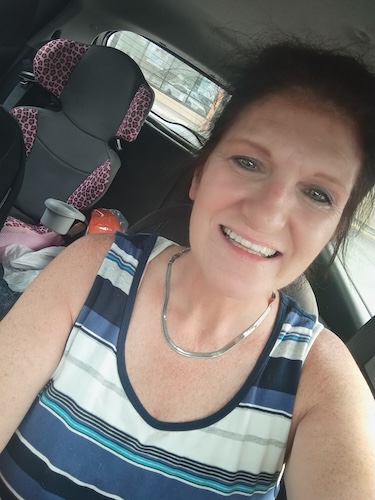
In 2009, Angela had a routine blood test come up positive for anemia and a stool test that showed blood. Within days, a colonoscopy confirmed what she said she had already known: colon cancer at age 38. She had no clear symptoms. What she did have was a family history of cancer. Her older brother had died of colon cancer just five years earlier, in his 30s, and people had urged her to get screened. She had not, until a dream convinced her she needed a colonoscopy immediately. After her diagnosis, Angela chose a proctocolectomy and a full hysterectomy rather than a smaller surgery. She took preventative measures because she was also diagnosed with what looked like Lynch syndrome.
Interviewed by: Taylor Scheib
Edited by: Chris Sanchez
For more than a decade, Angela’s scans came back clear. Then, in 2023, she woke up coughing blood and was rushed to the emergency room, where a CT scan found a mass on her lung. Days later, a scheduled scope found a large, aggressive tumor in her small bowel. The lung mass turned out to be a rare infection rather than cancer, but the small bowel tumor was real, and its removal came within centimeters of requiring a Whipple procedure to also remove her pancreas. A year later, in 2024, a second, genetically distinct tumor turned up in the same region. A complication during that surgery sent her to the ICU for two weeks with multiple blood transfusions, and doctors started her on a year of immunotherapy afterward.
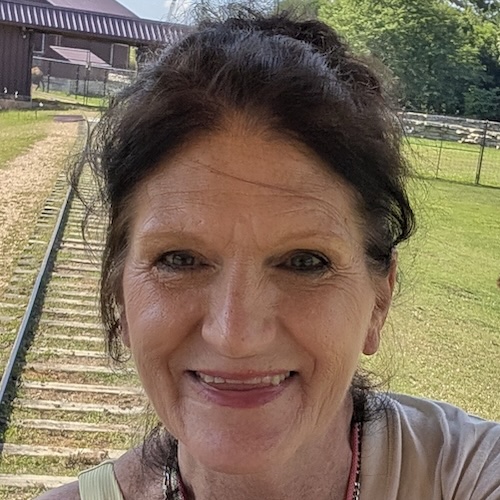
Genetic testing connected all of it. Angela had been apparently living with Lynch syndrome for years. Still, recent testing on both of her parents showed she had inherited a mutated copy of the MSH6 gene from each of them, which her doctors believe points toward a rarer condition called constitutional mismatch repair deficiency (CMMRD) and not Lynch syndrome. Her case, she says, is unusual enough that her genetic oncologist presents it at conferences.
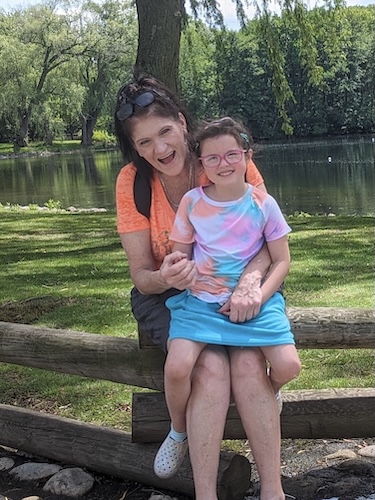
The repeated diagnoses changed how Angela deals with her doctors. After her care team told her she should have been screened yearly rather than every three years, she pushed to change her monitoring schedule, and now sees both a genetic oncologist and a regular oncologist annually. Today, she is raising her eight-year-old granddaughter, riding roller coasters despite being terrified, and telling the people she loves how much they mean to her while she still can.
Learn more about Angela’s story by watching her video or reading the edited transcript of her interview.
- Angela’s care team had been screening her every three years, the standard interval for Lynch syndrome, when a large tumor grew in her small bowel. After that find, she pushed for yearly monitoring instead, and her doctors agreed.
- Angela’s initial Lynch syndrome diagnosis did not fully explain her case until her father tested positive for Lynch syndrome years later, and doctors found she had inherited a mutated copy of the same gene from both parents, not just one. When this happens, it’s likely CMMRD or constitutional mismatch repair deficiency syndrome, but that is still only suspected.
- A persistent inner conviction that something is wrong, even without a clear symptom or a doctor’s recommendation, is worth acting on. Angela credits a dream, not a symptom, with getting her into a colonoscopy in time, and an oncologist later told her he believed patients should trust that instinct too.
- Angela is raising her eight-year-old granddaughter and riding roller coasters she is terrified of, telling herself that if she can get through three cancers, she can get through a theme park ride. It is her own way of choosing to be fully present for the time she has.
Angela’s Diagnosis Facts
- Name: Angela F.
- Age at Diagnosis:
- Colon Cancer: 38
- Small Bowel Cancer: 53 and 54
- Diagnoses:
- Colon Cancer
- Small Bowel Cancer
- Suspected CMMRD (first thought to be Lynch syndrome)
- Mutation:
- MSH6
- Symptoms:
- Colon Cancer:
- None; found through routine bloodwork and a stool test
- Small Bowel Cancer
- Coughing up blood
- Recurring heart palpitations
- Colon Cancer:
- Treatments:
- Surgeries: total proctocolectomy, temporary ileostomy, ileostomy reversal, hysterectomy, small bowel tumor resection
- Immunotherapy: pembrolizumab
This is not medical advice. Please consult with your healthcare provider to make informed treatment decisions.
- Angela’s Diagnosis Facts
- Hearing “cancer” three times: Who I am
- No symptoms, just a feeling: The road to my first diagnosis of colon cancer
- Losing my brother to colon cancer, and learning that it runs in the family
- The dream that sent me to the doctor
- Diagnosed with the same colon cancer that took my brother
- Choosing a proctocolectomy and a hysterectomy before Lynch syndrome could choose for me
- Cancer-free after surgery, and a lifetime of watching for it
- Fifteen years of living life, and then being blindsided
- How my doctors confirmed the genetic link behind all of it
- Learning to advocate for myself
- A third cancer a year later, and a complication that landed me in the ICU
- A year of immunotherapy and a tumor mutation burden “off the charts”
- Hearing the words, “You have cancer,” three different times
- What I’ve learned about my own strength
- Two oncologists, one team, and the peace of mind that comes with monitoring
- Why every family needs to track its cancer history
- Finding community and losing friends in online cancer support groups
- My advice: Be your own advocate and live your life
- Hear from people living with colon cancer
Hearing “cancer” three times: Who I am
My name is Angela, and I was diagnosed with colon cancer when I was 38 years old in 2009. Then I was diagnosed again with small bowel cancer in 2023, and then again a year later, in 2024. These were two separate cancers, and they know that because of the testing they do on the tumor.
I have been diagnosed with Lynch syndrome, but my doctors recently had my dad tested, and it showed that both of my parents gave me a mutated copy of the MSH6 gene. So my doctor said that I more than likely have constitutional mismatch repair deficiency. That’s the definition of it: inheriting a mutated copy from both parents. The one on my mom’s side has been classified as pathogenic. The one on my dad’s side is still a variant of unknown significance (VUS). They’re not sure if it causes cancer or not, but more than likely it does. That’s what the doctors believe at this point.
No symptoms, just a feeling: The road to my first diagnosis of colon cancer
I did not have symptoms in a way that you would think somebody would have symptoms. My brother was 18 months older than me, and he had died five years previously. A couple of people told me I should get a colonoscopy because my brother died, and I didn’t listen. But something told me that I had to get a colonoscopy, and I had to have one right now.
So I went to my doctor and explained how I was feeling, and he said, “Let’s just start out with some blood work,” and it showed that I was anemic. So right away he did a stool sample, and that showed quite a bit of occult blood in there. And then I just knew. I knew that I had cancer.
So they got me in for a colonoscopy, believe it or not, within a few days. They got me in right away because of my brother’s diagnosis. And when they did that, sure enough, I had cancer. I think they found cancer in three or four places during the colonoscopy. But it was far worse after I had the proctocolectomy and they did the pathology on it. There was cancer everywhere. He said if I had waited probably six more months, the outcome would have been completely different.
Losing my brother to colon cancer, and learning that it runs in the family
It was absolutely shocking. When he found out he had colon cancer, because of his age, that was the last thing they did. He only had three months to live. I think he didn’t even live three months, so that even makes it worse. He had lost so much weight, and clearly there was something wrong, but they just weren’t finding anything until they finally decided to do a colonoscopy. The times were different then too, though. Even though it was only 20 years ago, it still was different how they did things.
It was devastating. Thank goodness he didn’t have any kids. But still, to lose him at that age? He had his whole life ahead of him. I think about him a lot. I miss him. I just think of what he’s missed. So I’m trying to live for both of us, I guess.
They never tested him. Even when I went to get a colonoscopy after they had seen the blood in my stool, the doctor who did my colonoscopy said the chances that this would be cancer were one in a million. He said it would have to be something genetic for me to have cancer, as well as my brother dying of this in his 30s. It would have to be genetic.
He didn’t know at the time that that’s exactly what it was going to be, a big rabbit hole. So no one really suggested it. My mom’s doctor was the one who kept telling her: Push your daughter to get a colonoscopy; she needs to get one. But that’s really the only doctor who was getting a message to me through my mom to get a colonoscopy. No one else seemed concerned.
The dream that sent me to the doctor
I had a dream that something was terribly wrong and that I needed to get in right away.
From the time I went to the doctor to the time I got the colonoscopy, I don’t think it was more than 10 days. I was very adamant that I had cancer, and I wanted to get in and get a colonoscopy, because I just knew there was something much larger than myself.
I can’t explain it to this day. I think about that sometimes. But I do believe it was a dream, because when I woke up that morning, I knew I had to go to the doctor, and I had to get a colonoscopy right away.
I just feel that it was some message that somehow got to me, because prior to that, I didn’t really think about it. I just thought there’s no way I’m going to have that. Nothing’s wrong with me. I felt fine.
An oncologist who told me to trust my inner voice
I’m grateful for that. I had an oncologist right after my first cancer, and he told me, “Angela, I just want you to know that even if you have a dream or a feeling telling you that we need to do further testing, let me know. I think we should all listen to that inner voice that we have.”
And I thought that was a great way to approach being an oncologist and to approach a patient, to say, if you have a dream or you feel a certain way that we’re going to just look a little bit further, a little bit more, to make sure.
Diagnosed with the same colon cancer that took my brother
What’s strange about this is that even though I had cancer, and even though I knew I had cancer, there was some sort of inner voice inside of me telling me that it was going to be okay. I didn’t know how it was going to be okay, but I didn’t feel that I was going to die. I didn’t feel that it was my time yet, and I can’t explain that either.
The whole series of events around that time was quite strange. I was scared. I didn’t want to have cancer, and I was terrified. But there was also that other side to me that felt that everything was going to work out somehow.
Choosing a proctocolectomy and a hysterectomy before Lynch syndrome could choose for me
Because of my brother’s death, they knew that it was something genetic.
They pointed to a couple of things. One of them was Lynch syndrome. The other one was… I can’t remember what it’s called, but some sort of polyp condition where you get a lot of polyps that develop into cancer. (Editor’s Note: Angela is referring to familial adenomatous polyposis (FAP). According to Mayo Clinic, this is a rare inherited condition, affecting about 1 in 10,000, that leads to the development of hundreds to thousands of growths (polyps) in the colon and rectum. Without treatment, someone with FAP is almost certain to develop colorectal cancer, often by age 40.)
So they did decide on the route of doing a proctocolectomy and removing everything at once, and then, at the same time, also doing a full hysterectomy. They thought that if I have Lynch syndrome, I was going to have cancer somewhere by the time I was 50, they told me. So I decided to do that, because I just felt, after my research and everything, that that was going to be the best option. I didn’t want to take a chance. I could have taken the chance and just had my colon removed, but I know now, after they did the pathology, that I had cancer in many more places than they could see on the actual colonoscopy.
Recovering from major surgery, and still making it to Jamaica
It was a bad surgery; I’m not going to lie. But I’m pretty resilient, and I did recover pretty quickly. I made myself get out of bed and do things. Around that time, I had a vacation planned to go to Jamaica, and I went to Jamaica. Nothing was stopping me. With my ileostomy bag and everything, I went. I’m here, I’m alive, I’m going to go.
But it was really hard around that time, the whole healing process. And then having that ileostomy, which is not a fun thing to have. I wouldn’t wish that on anyone. But it served a purpose, and I knew what I had to do every day to take care of it. It really wasn’t that bad once I got used to it. I wouldn’t want to have it, but there were little tricks that I figured out how to do. Everybody kind of has their own way to do things. I just got to a point where I knew when it was time to change it. I knew how long after I ate that it was going to get filled up. So it worked out.
I’m glad I didn’t have to have it permanently. I was very grateful that I had a surgeon who could do things that a lot of other surgeons maybe wouldn’t have been able to do. So I was very grateful for that.
Cancer-free after surgery, and a lifetime of watching for it
None of the cancer had broken through the colon wall, although it was very, very close in a couple of spots, like within months, weeks maybe. So I didn’t have to do anything else. The follow-up was just CT scans.
For the first five years, they were very frequent, and then after that, it was just once a year: blood work and CT scans, and then genetic testing. I’ve been seeing the same genetic oncologist for years now, so that’s one good thing, because he’s always submitting things and keeping it updated with the science.
Getting the Lynch syndrome diagnosis confirmed
It was fairly quickly that they thought that I did, even though there was a letter that says it doesn’t look like Lynch syndrome. But my doctor still thought it was, even though they didn’t know, because at that time, the gene on my mom’s side was still of unknown significance. So I had two unknown-significance genes, from both parents, and it was just unknown whether that was pathogenic or not. But once they found out that it was pathogenic, then they did label it as Lynch syndrome on my mom’s side.
They were doing free genetic testing for anyone in our family who wanted to get tested, because they had never seen that mutation before in any other family, so they were pretty interested in getting a hold of as many people as they could.
Why the hysterectomy wasn’t a hard decision
It made it so much easier. I didn’t have to even think of it. I had known that I wasn’t going to have any more kids. My cycles were always pretty bad. So I thought, well, if they can remove this and prevent me from getting cancer, and I don’t have to have a period every month, I was fine with that.
And it wasn’t that bad. I was glad not to have to worry about another place on my body where I might get cancer, because all this time, I have always felt like I’m a ticking time bomb. That’s not how I feel in a lot of ways, but I have to live my life too.
Fifteen years of living life, and then being blindsided
I was working, I was going on vacations, my daughter had her first child, my first grandchild. Life was just going well. And honestly, during those years, I did not think a lot about getting cancer again. I was blindsided, to be perfectly honest, when I got the second diagnosis. I was a little shocked because I felt fine. Same as last time.
I will say this, though. Both times I had cancer — the first time and the second time, and even the third time — one of the things my body does is I start having palpitations, a lot of heart palpitations, because you’re bleeding from somewhere in your body. That is one of the things I did notice as a symptom, I guess you could say, but I didn’t put it together until after the second diagnosis, when they realized I was so anemic and I felt fine.
I had a blood test done, which was my regular yearly test, and my hemoglobin level was 13. By the time I went to the hospital two months later, in January, it dropped to nine, so that’s just crazy. They knew I was bleeding from somewhere, but they didn’t know where yet.
Coughing up blood in the middle of the night: My second cancer diagnosis
I woke up in the middle of the night and started coughing up blood, like it was in my lungs. I was coughing up bright red blood, and it was terrifying. I went to the emergency room. They did a CT scan, which showed a large mass on my lung. And now I’m thinking, “Oh my gosh, what is this?” And two days later, after I went to the emergency room, I was having my yearly EGD (esophagogastroduodenoscopy, or upper endoscopy) and pouchoscopy. But I had that done two days after I went to the emergency room, and that’s when they found this huge tumor, because they had waited three years to the month from the previous EGD.
I couldn’t believe it. I had cancer in my lung and cancer in my small bowel. I thought, “This is it.” I was getting sicker by the day because, as it turned out, what they thought was a mass in my lung turned out to be a rare lung infection called Mycobacterium avium complex (MAC), which causes cavities in the lung. They don’t know how I got it, but I would have had to have been immunocompromised for a long period of time to get that, probably during one of the times I had cancer. This is a lung infection that stays in your body and kind of festers until you get symptoms or they see it on a CT scan.
In my small bowel, there was a very large tumor, and it was a very aggressive cancer. That was the second cancer. And then, a year after that surgery to remove this cancer, I got cancer again in about the same area of the small bowel, but it was a completely different cancer. They tested the DNA of the tumor and saw that it was a different cancer.
I also get the Signatera test done, which detects if you have any of the cancer coming back in your body.
How my doctors confirmed the genetic link behind all of it
The cancer, 100%. There’s no other real explanation for that. This is part of Lynch syndrome, or what they believe now: I have CMMRD, which is constitutional mismatch repair deficiency.
Mine hasn’t followed the normal route. Usually, you get childhood cancers and you die in childhood, or get multiple different cancers by the time you’re an adult. But the definition of it is inheriting a mutated copy of one of those genes; one of them is MSH6, from both parents. That’s why the recent genetic testing my dad did was to confirm that, yes, he gave me a mutated copy of the same gene as well.
What are the chances of that?
A case so rare my doctor presents it at conferences
I think mine’s rarer because of how everything transpired. My genetic doctor put it this way. He said, “Your case is so bizarre on so many levels that I couldn’t even explain it to you,” and I wouldn’t want him to, because I wouldn’t understand it anyway.
But I think, because it’s the Lynch syndrome, and then them thinking that now what I actually have is the CMMRD, I don’t think to draw a line. I think both are bad. CMMRD is far worse, but there’s no good case of CMMRD either. Even saying you have a mild case doesn’t matter, because any case is bad.
Well, they had to do surgery. They knew that. It was right on top of where the pancreas opening is, so they were very concerned that they would have to do a Whipple procedure and take out my pancreas. They warned me that that was very much on the table when I went in to surgery that morning. And I came out, and they did not have to remove it, but by centimeters. They thought they got all the margins. This was a big surgery, I was in the hospital like 10 days, I think. And while I was in the hospital, they got the results from the pathology back, and they had cleared the margins all around the tumor. So I cried for an hour after that.
This was the cancer that scared me, because the tumor was so large and my doctor, the one who does all my colonoscopies, I could tell how upset he was. He even said, “Why didn’t you come in every year? You have Lynch syndrome. We should be doing these once a year on you.” But I was just going by what they tell you to do: Come in every three years. I would never let that happen again.
Now I push for things if I don’t feel comfortable. I know I want that done sooner. I’m trying to stick around for a while.
Learning to advocate for myself
It’s huge. It is different, because I am just so much more self-aware now. I don’t care what the textbooks say. You’re supposed to do X, Y, or Z every three years. I don’t feel comfortable with that.
My case is not the same as every other case or most Lynch syndrome cases or CMMRD cases. I want to be tested with certain things on a more regular basis, especially since I just had cancer two times again, a year apart.
The doctors were pushing again for that three-year textbook interval: Get the EGD scope every three years, or every year a colonoscopy and blood work. But that’s not what I felt comfortable with at all. So they are doing it now every year, and I’m glad about that.
But I think it’s so important that people speak up. If you don’t feel comfortable with something, say something. And if you have a doctor you don’t feel comfortable with, or who isn’t answering your questions fully, then I strongly suggest seeing someone else. Get a second opinion. It doesn’t cost anything but your time to get that peace of mind.
A third cancer a year later, and a complication that landed me in the ICU
Both cancers were in my duodenum. They could see it when they went down with the scope, right past my stomach, right into the beginning of the small intestine. Both tumors were there, and one was so large that he tattooed it when he was down there. That was the one from the first time.
The second one was a spot that just did not look right to him. It wasn’t a polyp, but it looked like irritated flesh. He biopsied it, and it was cancer again. That actually turned out to be a procedure done by a different doctor. It was a day procedure. He went in there and removed a small part of my small bowel, but he nicked it at the same time, and they didn’t know. I went home that day and ended up in the ICU for a couple of weeks with multiple blood transfusions. It was terrible.
They got the cancer out, but your small bowel is so delicate, so they have to be so careful. I can’t even get mad at them, because you know what they’re dealing with.
It’s an area that just had surgery done a year prior, and it’s sensitive already. It was very close to where the tumor was a year previous, but it wasn’t the same cancer. It was probably a different developing spot right there. They knew it was important at that time that I get either chemo or immunotherapy, which I did end up doing for a year.
A year of immunotherapy and a tumor mutation burden “off the charts”
I had no problems with it at all. It gave me a lot of peace of mind.
I finished about six or seven months ago. They do testing on your tumors to see how you’ll react, and my tumor mutation burden was in the 99th percentile. They say numbers between 10 and 20 are considered high. Mine was 52, just through the roof.
When my body starts producing cancer, it’s crazily making cells that my body does not recognize at all.
Hearing the words, “You have cancer,” three different times
It’s terrible. It truly is. I try not to think of it, because if I did, I don’t think I’d be able to function, to be perfectly honest. It scares me. It does. I honestly look at people who are in their 70s and 80s, and I think to myself, “I don’t even think there’s a chance.” I hope there is.
I want to stay here as long as I can and get as much out of the time I’m here as I can, because I feel like I’m a ticking time bomb. I always tell my mom that. I’m waiting for the other shoe to drop. But I can’t think about it all the time.
I have to remember that everyone dies. We just all go differently; that’s all.
What I’ve learned about my own strength
I’ve learned that I’m a lot stronger than I ever thought I was, and that I could learn a lot more about myself than I ever thought possible. I had no idea.
This all blindsided me, to be perfectly honest, from the time I found out I had cancer when I was 38, and everything that’s happened since. If I look back on it, it’s like, “Oh my gosh.” All the testing that they do, and finding out this and finding out that, it’s like putting a puzzle piece together; that’s what they’re doing, really, because genetic testing has come so far in the last 20 years, and it’s going to go even further. What more are they going to find out?
But I just hope that, whatever they’ve done and the testing they’ve done, I hope that somehow I can contribute to the research in some way.
Raising my granddaughter and riding roller coasters anyway
I’m a realist. I know that I’m probably going to get cancer again at some point, but while I’m here, I want to get as much out of everything as possible. I’m raising my eight-year-old granddaughter, and I love spending time with her, and I love what she makes me do, like going to Great America and going on the scary rides. I’m terrified, but if I could beat cancer three times, I could go on this roller coaster.
I want to do as much as I can while I’m here. That’s the way I look at it. I’m not going to worry about spending that $20. I’m here right now; I’m not going to be able to spend it if I’m not here. I’m just going to do whatever I can do while I’m here to fulfill my life and to show the people that I love and care about that I love and care about them, and that they’re important to me. Hopefully, I will get another 20 years, but if I don’t, I want to leave knowing that I packed as much as I could in.
Two oncologists, one team, and the peace of mind that comes with monitoring
It does give you a lot of peace of mind. I have two oncologists; one is a genetic oncologist that I see once a year, and then I see my other regular oncologist, but they work hand in hand, so there’s nothing that gets through either one of them. They make sure that anything new that we can try, we’re trying it. They’re always getting more up-to-date DNA testing done, and things like that.
My genetic oncologist goes to conferences all over the United States, and he says he always goes up there and talks about my case, because of how strange it is. But other people are out there with Lynch syndrome and with things like this that are not fully understood in the medical field.
It does take time, unfortunately, to put the pieces together. Even with my case, the VUS on my dad’s side, they still don’t know exactly how that plays into this yet, although they believe it’s probably pathogenic; they’re not sure if it’s a partially functioning gene. It could be. I’m still here.
There’s got to be some sort of function to that gene, because that specific gene is a cancer-fighting gene for your stomach, your intestines, and your brain. Those are the things that they’re very carefully watching all the time. I recently had an MRI on my brain because they want to start monitoring that too, which is scary.
Why every family needs to track its cancer history
It’s important. When you have something like this, to have a family tree and to keep track every year of any deaths or if anybody got cancer, because it’s important for any of your kids when they grow up, if they decide to get tested. They don’t do genetic testing on little kids. You have to be 18 years old; you have to make your own decision about that. But I would want to know, because knowing is the power to decide.
Then, from that moment, you’re going to be monitored, and you’re going to be watched closely. If you have something like Lynch syndrome or CMMRD, you’re going to get cancer. You might not get it in your 20s or 30s, but you’re going to get it eventually. (Editor’s Note: According to MD Anderson Cancer Center, the lifetime risk of developing colorectal cancer in Lynch syndrome carriers is between 40% and 80%. Men with Lynch syndrome have a 60% to 80% lifetime risk of developing colorectal cancer, while women have a 40% to 60% risk. For comparison, the lifetime risk of developing colorectal cancer in the general population is about 5%. As for CMMRD, St. Jude Children’s Research Hospital says the exact risk of developing cancer for people with this syndrome is not yet known, but it is expected to be high.)
Finding community and losing friends in online cancer support groups
I have had some people that I’ve been in contact with online that I’ve actually developed a relationship with, like on some chat boards on one of the cancer sites. One woman I ended up becoming so close to, and she just recently died of lung cancer, so it was so sad. I had become such good friends with her. We were texting almost every day for three years. She was there for me during the last major surgery I had. So it was sad to see her lose her battle.
You see somebody that you’re used to chatting with, and all of a sudden, they disappear for a while, and you find out they were sick. Inside you’re like, “Oh my gosh, what happened to them? Are they okay?” You just don’t know.
But having that community is important. It helped me so much, especially when I was going through the surgeries and the immunotherapy. It was so helpful to be able to get a lot of ideas and be able to talk to other people who understand what you’re going through, because no one does if they haven’t gone through it. They don’t know how worried you are, and how much it consumes you at the time, that worry, especially about the people that you love. If I don’t make it through this, are they going to be okay?
My advice: Be your own advocate and live your life
Be your own advocate. Do what your doctor suggests, but also push for the things that you feel are appropriate for your body. If you don’t advocate for yourself, nobody will. I know it’s an old saying, but it’s the truth.
More than that, though, live your life. Don’t go into the darkness and not come out. It’s so easy to do.
If you’re here breathing, walking, and talking, you are meant to be here, and you need to appreciate each day and all the people in your life who love and care about you. Let them know that they’re important, and how much they mean to you, while you can.
I don’t care if you’re here for a day or 20 more years; we should all be doing that more, because we forget. We get so busy with our lives, and we forget to tell the people we love and care about how much they mean to us.
Other than that, have fun. Try to have a good time in your life. Don’t have regrets. Try to have as few as possible, because we all do have regrets. Forgive yourself and live your life to its fullest.
This interview has been edited for clarity and length. The views and opinions expressed in this interview do not necessarily reflect those of The Patient Story. This content does not replace professional medical advice.
Inspired by Angela’s story?
Share your story, too!
Hear from people living with colon cancer
Real experiences with diagnosis, treatment choices, side effects, and life beyond colon cancer — in their own words.


Leave a Reply