
Planning Love and Life with Stage 4 Colorectal Cancer: Kayleigh’s Story
Living with stage 4 colorectal cancer gives every moment extra weight, especially for Kayleigh, who received her diagnosis in May 2025. Her experience began with blood in her stool and an immediate call to her doctor with pictures, leading to a complex healthcare journey that included referrals, waitlists, and repeated self-advocacy. Kayleigh’s colorectal cancer diagnosis changed her life’s trajectory, but her determination kept her moving forward, especially as she and her fiancé planned their wedding amid ongoing treatment.
Interviewed by: Taylor Scheib
Edited by: Chris Sanchez
Despite the demands of her colorectal cancer treatments, namely, chemotherapy, chemoradiation, and planned surgeries, Kayleigh’s spirit shines through. Side effects, like neuropathy and fatigue, presented real challenges, but wedding preparations and physical activity became her anchors. She openly shares how her mental health was tested by uncertainty and waiting, emphasizing the importance of finding support and honest communication with loved ones.
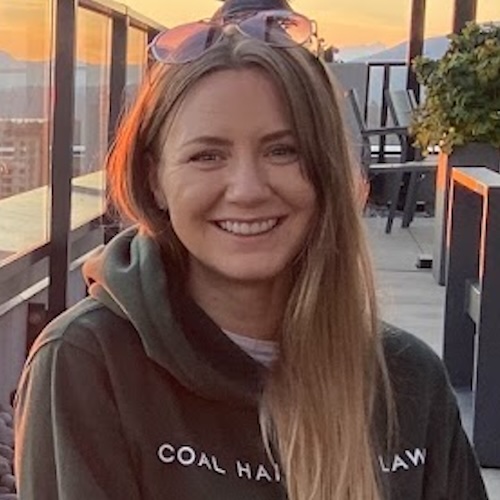
Navigating the twists of treatment, Kayleigh remains steadfast in advocating for herself. She presses for appointments, asks questions, and ensures that her voice is heard in a system that can be prone to delays. She highlights how looking “healthy” can mask profound struggle and how learning to accept help, slow down, and savor small moments fueled her resilience.
Kayleigh’s journey underscores that doing everything “right,” from diet and exercise to visiting the doctor regularly, doesn’t render anyone immune to cancer. Sharing her perspective, she reminds patients that no experience is typical, treatment doesn’t always mean isolation, and self-advocacy is essential for progress. Her hope rests in her care team’s curative intent and her own ability to adapt, accept, and keep living meaningfully.
Watch Kayleigh’s video and scroll through her edited interview transcript to learn more about how:
- Self-advocacy is essential: Patients must speak up and push for timely care when symptoms don’t resolve
- Maintaining life milestones (like wedding planning) can be empowering, even during intensive treatment
- Cancer often doesn’t “look” how others expect. Challenges are frequently invisible
- Support from loved ones makes vulnerability easier and provides strength
- It’s important to trust your instincts and accept support; transformation comes from learning persistence, self-compassion, and empowerment through advocacy
- Name: Kayleigh G-P.
- Diagnosis:
- Colorectal Cancer
- Staging:
- Stage 4
- Age at Diagnosis:
- 33
- Symptoms:
- Blood and mucus in stool
- Increased frequency and urgency of bowel movements
- Small bowel movements
- Treatments:
- Chemotherapy
- Chemoradiation
- Surgeries (planned): lower anterior resection, lobectomy



This interview has been edited for clarity and length. This is not medical advice. Please consult with your healthcare provider to make informed treatment decisions.
The views and opinions expressed in this interview do not necessarily reflect those of The Patient Story.
- Hi, I'm Kayleigh
- My first colorectal cancer symptoms
- I persisted in the face of diagnostic delays
- I took the initiative as a patient
- Finally getting a colonoscopy and an initial diagnosis
- My treatment approach and plan
- I’m coping with side effects and protecting my mental health
- Key lessons I’ve learned
- Self-advocacy and what keeps me going
- My advice for others
Hi, I’m Kayleigh
I was diagnosed with stage four colorectal cancer. That was in May 2025. I’m from Vancouver, BC. My symptoms started in 2024, and I was diagnosed in 2025.
Getting married is the be-all and end-all for my fiancé and me: to have this chapter come to a close and to start our new life together. I’m a little crazy for keeping the wedding date as is because it’s very close, it’s in April of next year. We’re six months away now.
I’m finishing treatment in January and may have two surgeries back-to-back before the wedding. This is the one thing I’m not willing to let go of and not let cancer take away from me.
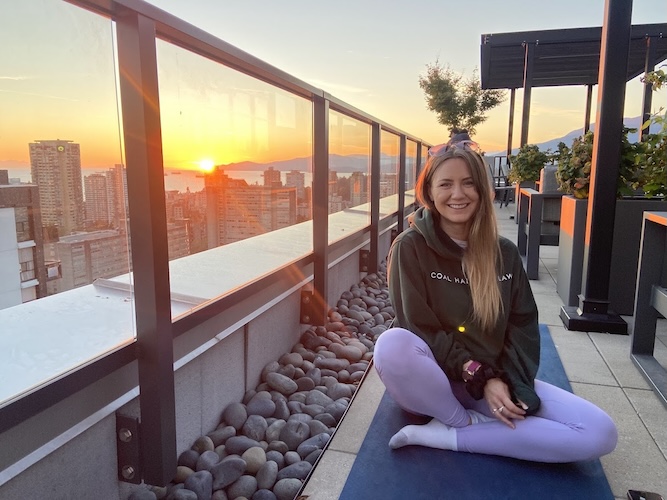
It’s extremely important to have moments, like the wedding, that cancer cannot take away. It’s given me a new perspective on life. I’m learning to slow down and appreciate the little things.
Wedding planning is my only distraction right now. Between that and working out, which I haven’t been able to do since radiation due to side effects and skin irritation, planning is my only way to keep focused.
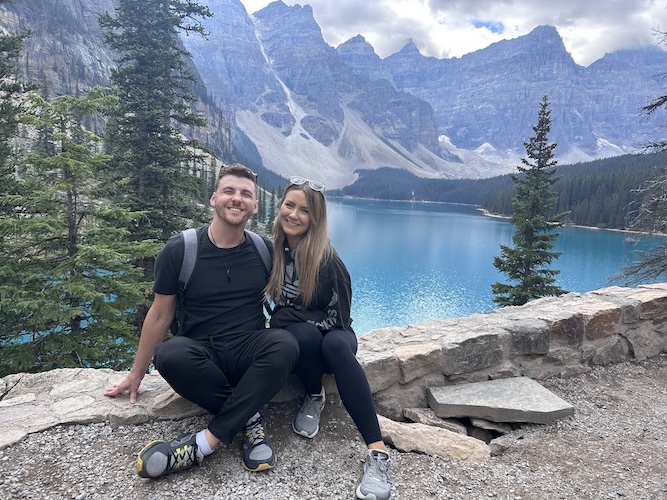
I think some of our engagement photos are my favorites. There are also some photos in which my family visited BC; those are my favorite memories to look back on because they are so happy, and I love showing them around BC and trying to convince them all to move out here.
My first colorectal cancer symptoms
The start of my journey is not typical. It began with just one symptom, blood in the stool one day. I took a photo for my doctor and called right away: “There’s blood in my stool. I need to see you.” This was very out of the norm for my body.
My doctor thought it was hemorrhoids and ordered blood work. My ferritin was low, so we did another blood test in two months, and it was still low. I asked for a FIT test since my main symptom was blood in the stool, which came back positive. Surprisingly, I wasn’t offered a colonoscopy right away. I did research and found that a positive FIT test qualifies you for a colonoscopy, so I asked my doctor to put in the referral. I requested a female doctor since my fiancé was leaving for a month and I didn’t want to be uncomfortable.
Unfortunately, the referral went to a doctor no longer doing colonoscopies and was nine months behind. We discovered this three months later after following up with no response. Another referral was put in, marked “semi-urgent” since it was now March. After waiting a month, I still hadn’t heard back. By April, my symptoms were ramping up: blood in stool every other week, then weekly.
The symptoms weren’t a large amount. I thought maybe it was IBS or colitis. Never considered cancer. My naturopath also said it was likely hemorrhoids. When I finally saw a surgeon, I explained my symptoms and how they were affecting my mental health, asking to expedite the referral. The surgeon wasn’t concerned, thought nothing would be found, and declined to see the photos I offered. He said, “You’re young, healthy, I don’t think we’ll find anything, but we’ll do the colonoscopy due to blood and mucus.” He quickly ate his words.
I persisted in the face of diagnostic delays
The delay was from October 2024 to the end of May 2025. My mental health deteriorated during this time. For six months, not knowing what was wrong was the hardest part. Constantly searching online and on ChatGPT, trying to figure out what it could be, became my focus. I talked about it all the time with my fiancé; I spent so much time Googling, trying to find answers because I wasn’t getting any.
My fiancé has been my rock throughout this. We’re an open book, although topics like stool were hard to discuss at first. I had to get used to being vulnerable and talking about it all the time. He made it easier and was so amazing and understanding; he made the whole process more bearable.
I’d visit my GP multiple times to update symptoms. I wanted everything in my record and took time off work for appointments. I emailed the surgeon’s office, feeling I had to take matters into my own hands. I called hospitals and made sure I was on cancellation lists for faster appointments with hospitals, MRIs, and CT scans, ensuring my name didn’t get lost.
I took the initiative as a patient
Early on, as I mentioned, I acted quickly when symptoms appeared; I didn’t wait. I’m very health-conscious and have health anxiety, so I put the process in motion immediately. Despite rapid action, it was still stage 4.
ChatGPT was a saving grace for my mental health. Even ChatGPT suggested ulcerative colitis, not cancer, which actually put me at ease for a while. Whenever I have questions, I ask ChatGPT and take answers with a grain of salt, using it to calm my mind until I’m able to ask my doctors.
Finally getting a colonoscopy and an initial diagnosis
After months of delays, I got the colonoscopy, and the doctor had been convinced nothing would be found. During the procedure, I overheard the word biopsy and saw something on the screen, making it real. The full realization hit when we got the biopsy results on my mom’s birthday: It was cancer. That day was really emotional.
For a while, we didn’t know the stage. Only recently, it was confirmed as stage 4 due to a nodule in my right lung that couldn’t be biopsied. A recent CT scan showed the nodule had shrunk, confirming stage 4, but with positive news, it had decreased by more than half.
My fiancé was beside himself, but quieter and more internal. He wanted to leave space for me to be emotional, to be there for me rather than show his own emotions. He’s been amazing, and now he shares his feelings too, though he tries to support me first.
My treatment approach and plan
My treatment plan is TNT, total neoadjuvant therapy, all chemo upfront in a sandwich approach. Six rounds of one chemo drug combination; three rounds, then chemoradiation, then three more rounds.
Surgery is planned for the main tumor and the lung. I’m considered oligometastatic, so they’re treating me with curative intent. I’m grateful to be in the best-case scenario of stage 4.
The latest CT scan showed liver spots, which may be due to different CT machines; if they are metastases, things could be more complicated. The doctor isn’t worried, since everything else is shrinking. My tumor, lymph nodes, and lung nodule have shrunk dramatically, indicating chemosensitive cancer.
If the tumor remains after chemo, and I’m eligible, I’ll have a large surgery, lower anterior resection and lung lobectomy, early next year.
I’m coping with side effects and protecting my mental health
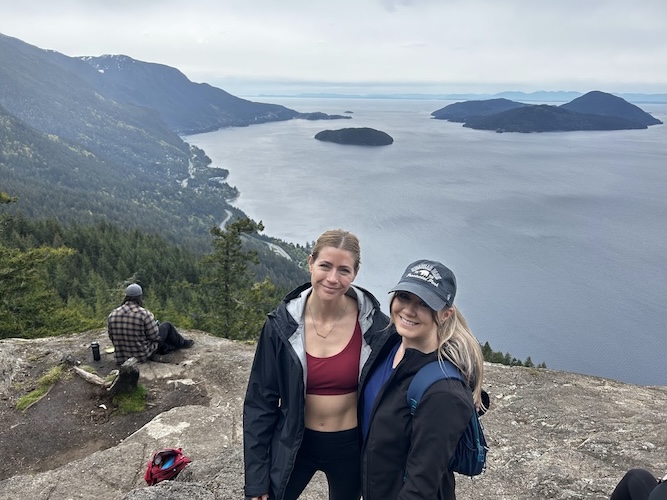
I’m fortunate radiation was harder than chemo; the pain was intense, but chemo is more manageable. I get neuropathy that fades in a week, first bite syndrome, and cold sensitivity that resolves. I can still work out, run, walk, and go to the gym. The fatigue is manageable; I’m tired and take more naps, but it’s tolerable.
Working out and running are critical for my mental health. Every day is more livable if I exercise. Walking, talking with my fiancé, journaling, reading cancer books, and meditation help me stay grounded. Sometimes I focus on wedding planning to distract myself.
I stay on top of appointments and procedures. If my doctor wants me to have an MRI or CT and I haven’t heard back, I call after a reasonable time. I don’t just rely on the system; gentle reminders and ensuring I’m on cancellation lists keep things moving, especially with a wedding deadline.
Key lessons I’ve learned
The biggest lesson is that you never know what others are experiencing based on how they look.
When people see me, they say I look great, but it’s a misconception; I may feel terrible inside. You can do everything right, eat healthy, exercise, avoid alcohol, and have no family history, and still end up here. Sometimes, it’s just luck or the environment.
What’s holding me together is knowing my team is treating me with curative intent. I’m holding on to that as my silver lining. I’m doing everything within my control to give myself the best chance: staying active, being an advocate.
Self-advocacy and what keeps me going
Self-advocacy is crucial. You are your own best advocate and have your best interest in mind; don’t leave it to others. Take action to help yourself, nourish your mind, and avoid spiraling.
Speak up, ask questions, and be a respectful thorn in the system. You matter, and you need to do everything you can to make sure things move forward.
Looking forward to my wedding keeps me going. It’s a goal at the end of this journey, a source of joy in chaotic, emotional times. The emotional roller coaster is tempered by focusing on things that bring happiness.
My advice for others
Take things into your own hands. Remember, you have your best intentions in mind and advocate for yourself. If something doesn’t seem right, speak up. Be a thorn in the system’s side (respectfully).
Your life matters. Do everything you can to push things along if they’re not going as you hoped.
Chemo and radiation can be manageable. You can still live a daily life, see friends, exercise, and enjoy yourself. Treatment doesn’t take everything away. Everyone experiences and reacts to treatment differently. I thought I’d be debilitated, but I have been able to do more than expected.
It doesn’t take everything away from you. Everyone’s different.
Inspired by Kayleigh's story?
Share your story, too!
More Metastatic Colorectal Cancer Stories

Lindsay D., Colon Cancer, Stage 4
Symptoms: Lump in pelvic area, funny-smelling food, weight loss
Treatment: Chemotherapy, colectomy (surgery)