
My Breast Cancer Diagnosis at 15 Weeks Pregnant as a Surrogate: Shelby’s Extraordinary Story
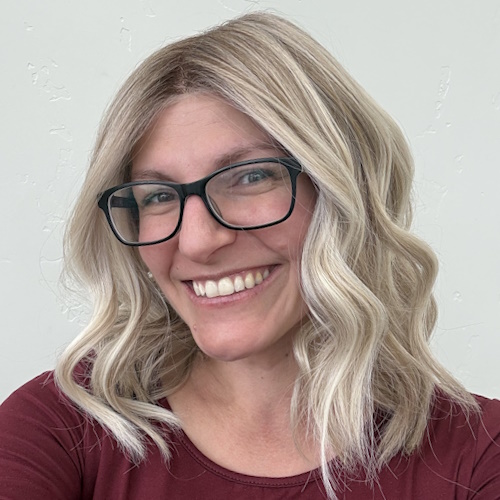
Shelby was 15 weeks pregnant as a first-time surrogate when she was diagnosed with breast cancer, specifically invasive ductal carcinoma (IDC), HER2-positive. At 34 years old with no family history of breast cancer, Shelby had no reason to expect a cancer diagnosis. What led to her early detection wasn’t even a routine screening, but a heightened sense of responsibility she felt while carrying someone else’s child.
Interviewed by: Taylor Scheib
Edited by: Katrina Villareal
Shelby felt a lump in the shower the same week her pregnancy was confirmed. Because she was carrying her intended parents’ baby, she felt compelled to mention it at her very first appointment. Her OB didn’t dismiss it. Shelby fully believes that she wouldn’t have caught this as soon as she did if she weren’t a surrogate.
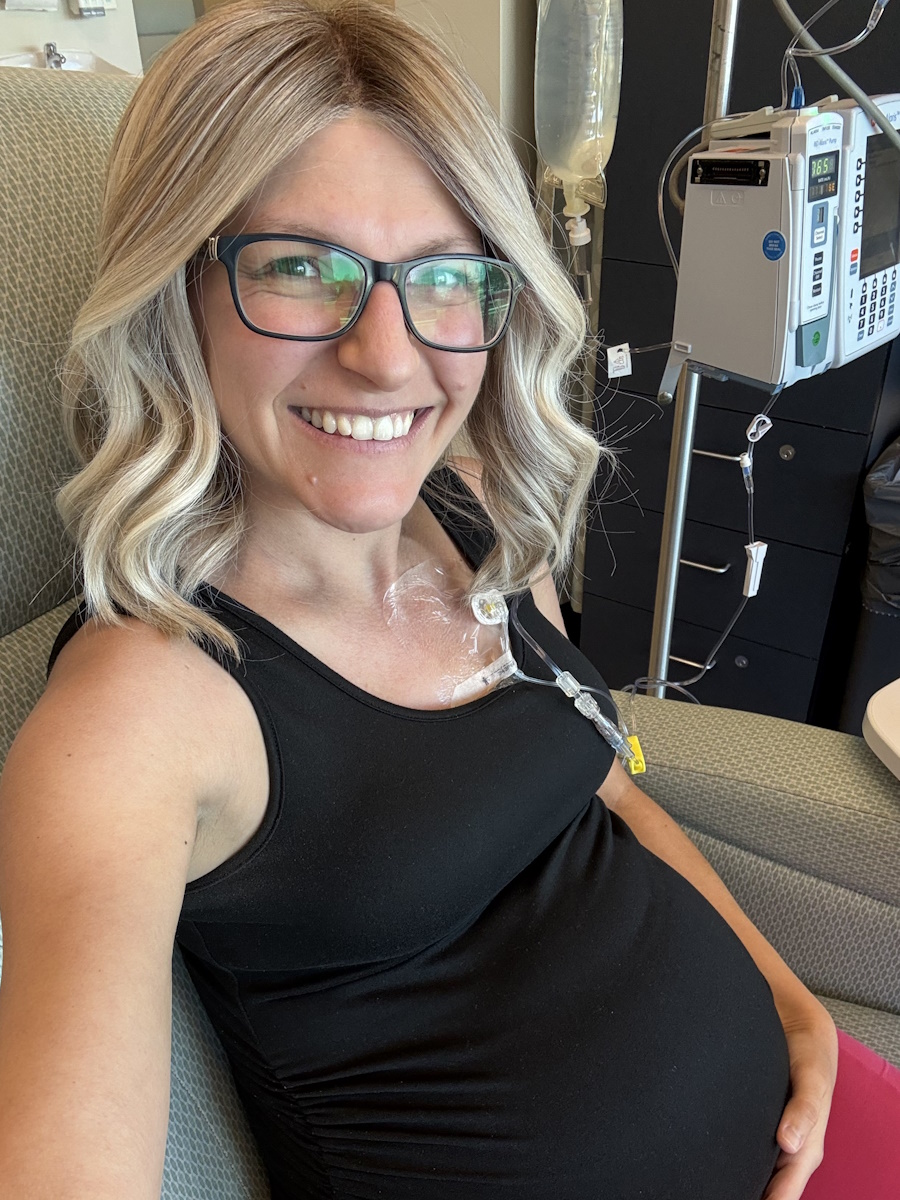
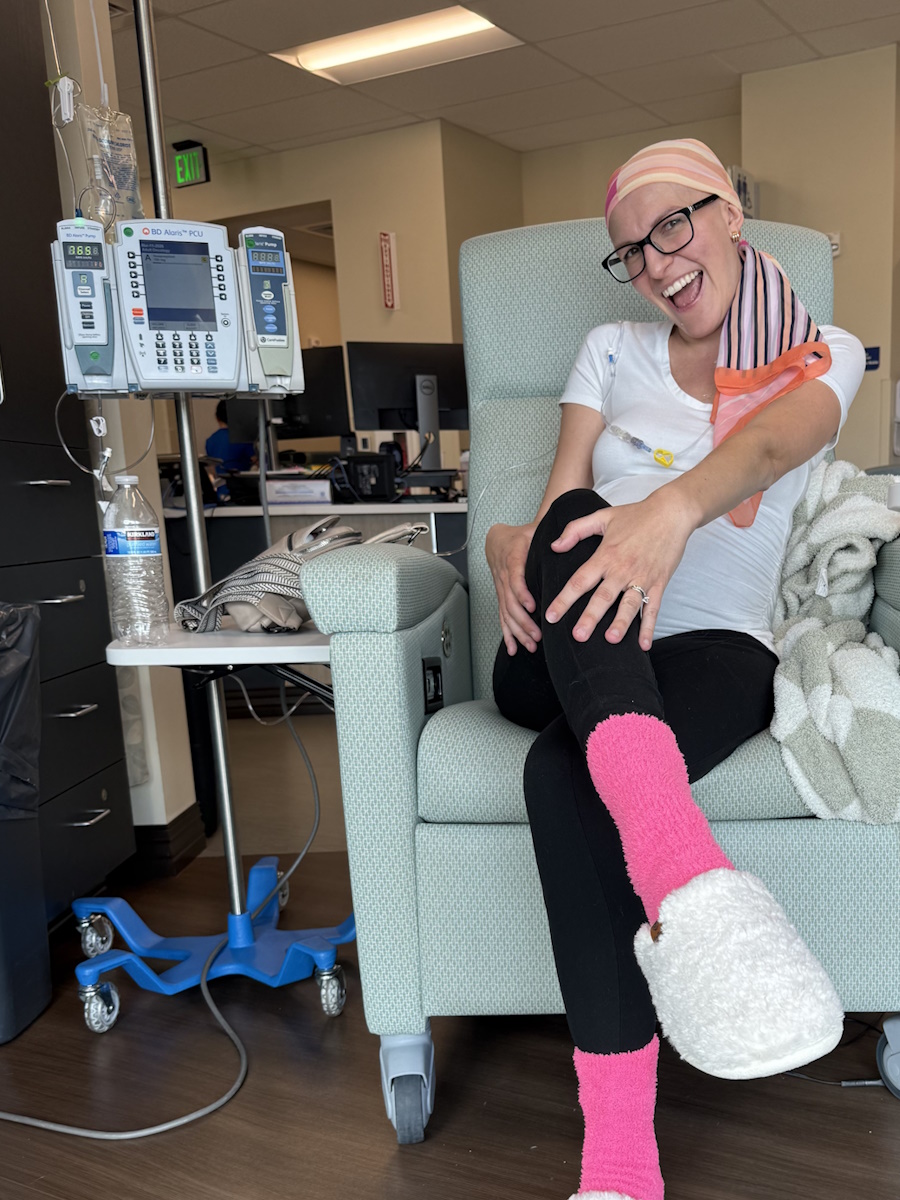
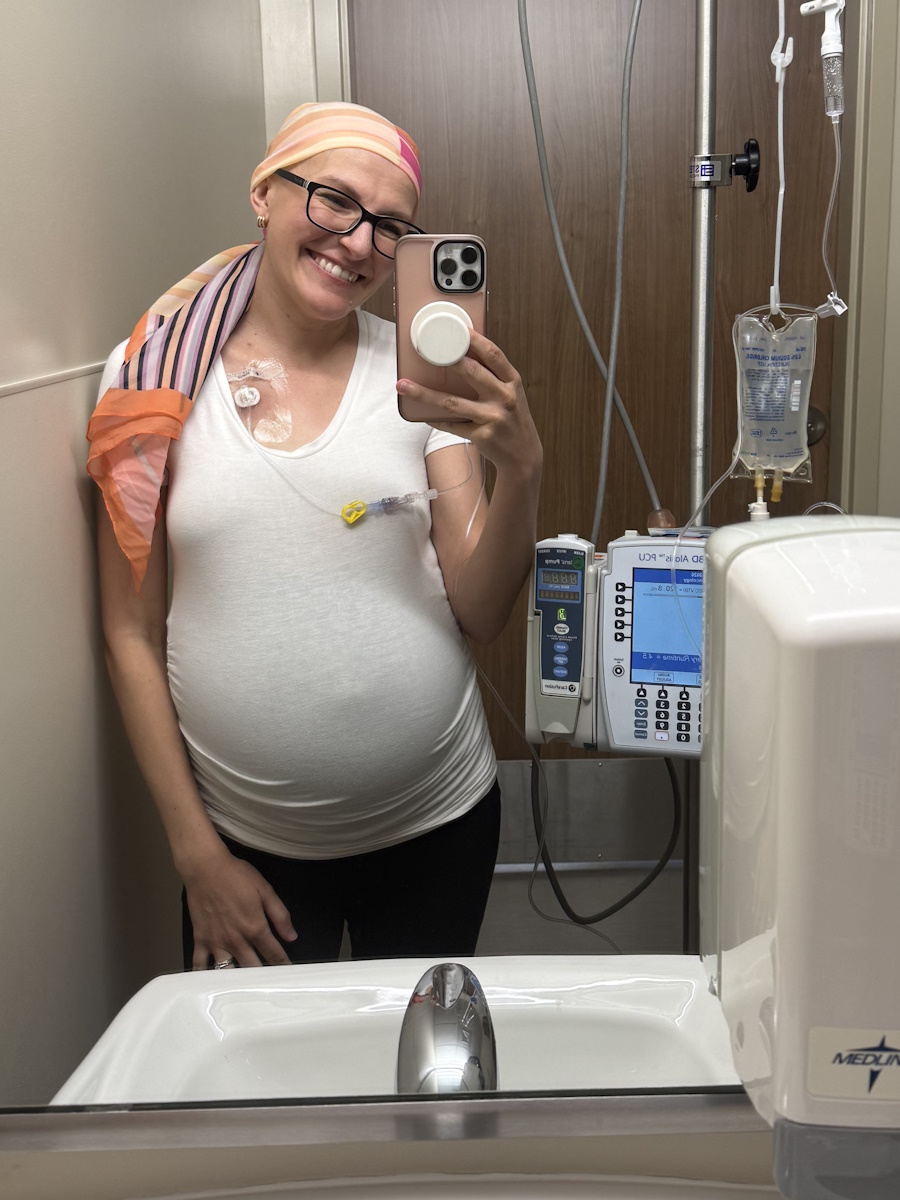
After having a biopsy, she received a MyChart notification on New Year’s Day informing her of her breast cancer diagnosis, even before the official phone call came. She assembled a four-person care team, including an OB/GYN, maternal-fetal medicine (MFM) expert, a breast surgeon, and an oncologist, to coordinate her cancer treatment while protecting her health and the baby she was carrying. At 21 weeks pregnant, she underwent a bilateral mastectomy, followed by four cycles of AC chemotherapy (doxorubicin and cyclophosphamide) during her second and third trimesters.
Throughout her experience, Shelby kept the intended parents informed and included, inviting them to be on speakerphone for major medical appointments because she was carrying their baby, and it wasn’t just about her. Their response to the diagnosis was immediate and telling: their first concern was her health, not the pregnancy.
As she approaches her induction date and prepares to begin weekly paclitaxel chemotherapy one week after delivery, Shelby faces the next chapter of her treatment with characteristic clarity and strength. She’s a mother of three, a first-time surrogate, a breast cancer patient, and someone who has chosen every single day to meet the impossible with humor, honesty, and an unshakeable sense of purpose.
Watch Shelby’s video and read the edited transcript of her interview to find out more about her story:
- Speaking up at a medical appointment can change everything. Shelby almost dismissed the lump she found as a side effect of in vitro fertilization (IVF) hormones. Because she was a surrogate and felt accountable to her intended parents, she brought it up at her first OB visit, and her doctor didn’t write it off.
- Cancer treatment during pregnancy is possible, and multidisciplinary coordination is essential. Shelby’s care team of specialists worked in concert to sequence surgery, chemotherapy, and delivery in a way that was safe for both mother and baby. The placenta provides a protective barrier during the second and third trimesters, which made chemotherapy possible.
- Hair loss can be harder to process than a double mastectomy. Shelby’s candid reflection on losing her hair versus losing her breasts challenges assumptions about which physical changes are most emotionally significant. Her experience is a reminder that every patient’s grief about their body is personal.
- We all process differently, for Shelby it was refusing to see herself as a victim of her circumstances. Shelby entered her diagnosis in shock, bawled all day, and then chose to wipe her tears and asked what’s next. That pivot, from devastation to action, was not denial. To her, it was a form of courage. She describes herself now as thriving, not despite her situation, but within it.
- There is no single right way to process a cancer diagnosis. Shelby’s humor and positivity didn’t mean she didn’t have hard days. She allowed herself to feel every emotion and then returned to forward motion. For patients newly navigating a diagnosis, Shelby’s story is a permission slip: process it in the way that’s authentic to who you are.
Shelby’s Diagnosis Facts
- Name: Shelby M.
- Age at Diagnosis:
- 34
- Diagnosis:
- Breast Cancer (Invasive Ductal Carcinoma)
- Staging:
- Stage 2B
- Biomarker:
- HER2
- Symptom:
- Palpable breast lump
- Treatments:
- Surgery: bilateral mastectomy
- Chemotherapy: AC (doxorubicin and cyclophosphamide), paclitaxel
- Targeted therapy (planned post-delivery)
This interview has been edited for clarity and length. This is not medical advice. Please consult with your healthcare provider to make informed treatment decisions. The views and opinions expressed in this interview do not necessarily reflect those of The Patient Story.
- Shelby’s Diagnosis Facts
- My story
- Finding a lump during a surrogacy pregnancy
- How being a surrogate led to an earlier breast cancer diagnosis
- Telling the intended parents about my breast cancer diagnosis
- Treatment planning during pregnancy with a multidisciplinary care team
- Preparing for labor induction and returning to chemotherapy treatment one week after delivery
- Explaining surrogacy and cancer to three young children
- Processing the emotional rollercoaster of a complex cancer diagnosis
- Keeping the intended parents involved throughout the entire cancer treatment journey
- Gratitude for my body for carrying life and fighting cancer simultaneously
- Hear from people living with breast cancer
My story
When I was nearly 16 weeks pregnant as a first-time surrogate, I was diagnosed with breast cancer, invasive ductal carcinoma.
What inspired me to become a surrogate
I have three children, ages three, six, and nine. After our second child, I’ve loved being pregnant. People look at me like I’m a complete weirdo because most people don’t enjoy pregnancy, but I’ve always enjoyed it. Besides the first trimester when I’m sick, after that, it’s smooth sailing. I’ve never had any complications. I’ve always felt my best during pregnancy, and I’ve always wanted to give that to somebody else who is unable to carry a child.
I didn’t have a good grasp and understanding of what surrogacy entails. I looked into it, but I backed out. We ended up having our third child, and after that, one of my close friends went through the surrogacy process. I was with her from the transfer through delivery. After, I decided to officially look into doing it. I was at the point where I would regret not doing so because I have a perfectly healthy body. I should have knocked on wood back then. But that’s what brought me here. Immediately, I jumped right into talking with some agencies.
What it felt like to be matched with intended parents
It was so exciting and fun because when you’re in the matching process with an agency, it’s almost like dating profiles. You think, “Oh, I hope they like me. I hope they pick me,” and vice versa. I turned down the first profile that was shown to me. I didn’t know what I was for exactly, but I wanted the profile to jump out at me because we couldn’t speak with the couple yet.
When the second one came, I knew right off the bat. I thought, “There it is. This is the couple. I can see myself building a long-term relationship with them,” because that’s what I look forward to. I don’t want it to be transactional. I want to create a lifelong friendship, so it was exciting. I sent it to the agency, and I was biting my nails, thinking, “Do they like me? Do they pick me too?” It has to be mutual, so it was exciting when we got to choose each other.
Finding a lump during a surrogacy pregnancy
With surrogacy, you undergo an IVF pregnancy. You’re doing the progesterone shots and the estrogen pills on top of everything. My first embryo transfer ended up being a chemical pregnancy in August 2025. We were on our second embryo transfer at the beginning of October. After, I got home and we did all the blood tests to make sure the baby would stick.
We were excited. The test results came back looking good. But that same week, when we confirmed the baby was growing, was when I felt a lump in the shower.
I always tell people that I was being lazy that day, because I usually use a loofah to wash my body in the shower. I was freshly pregnant and so happy for the family I’m caring for. I thought, “I’m not grabbing my loofah,” so I put body wash on my hand and immediately started from my armpit going down. Then I stopped in my tracks. I felt a lump on the far right. I’m a skinny girl — not with my big baby bump, but I’m skinny — so it was very prominent in how much it stood out.
I freaked out. I followed some people on Instagram, and one influencer my age said it felt like a glass marble. I thought, “No, no, it’s the shots and all the added hormones because of the pregnancy,” so I continued, but it was in the back of my head.
My first OB appointment got delayed by a couple of weeks. By the time I went in, I was 11 1/2 weeks. I brought up the lump to my OB, so she performed the exam. I should add that, going through the surrogacy process, you do extensive medical screening. I had two different breast exams within the same year, and there was nothing before, so I felt like it popped up overnight.
My OB said, “Yes, I feel what you’re feeling.” I knew it was normal during pregnancy to get lumps. With the additional hormones due to IVF, it’s even more common. I never had any lumps with my three children, so it was new to me. She said, “It’s common, but anytime there’s anything new, we want to check it out and be safe.” She said she was going to refer me. I’m so thankful my OB didn’t write it off.
How being a surrogate led to an earlier breast cancer diagnosis
I’ve said to a lot of my family and friends that I don’t think I would have caught this as soon as I did if I weren’t a surrogate. I 100% believe that. I even talked to the intended parents I’m carrying for, and they said, as horrible as this whole situation has been, “I’m so glad that if this is what led you to finding it, then that’s what was meant to be.”
If I weren’t carrying someone else’s baby, I would have completely thought, “Oh, there’s a lump there. That’s weird,” and probably would have continued. But because I was thinking that I was pregnant with someone else’s baby, I wanted to make sure that I brought it up at my first appointment, so even the parents knew about it. I let them know. We were very clear in all of our communication. I said, “I don’t think it’s anything, but I did find a lump. We’re going to get it checked out.” They said, “Okay, yeah, better safe than sorry.”
My diagnostic journey: Ultrasound, biopsy, and the MyChart notification
My OB put in the referral for a mammogram and an ultrasound of the lump I felt, but she said that since I was pregnant, they might not do the mammogram, as they try to avoid that unless necessary. My OB initial appointment was on December 2nd. She submitted the referral, which we had to chase down a little bit, and it caused even more delay. Then, over two weeks later, they got me in for the mammogram and ultrasound, and told me the same thing: “We’re not going to do the mammogram. It’s not 100% necessary. We’re going to do the ultrasound.”
The tech warned me when she went to get the radiologist, “Don’t be worried. This one usually likes to scan it herself.” The doctor came in and immediately grabbed the gel again. I was glad I was warned, because I would have been even more freaked out thinking, “She just scanned it. Why are you looking at it again?” To this day, I still don’t know if she was trying to keep me calm.
The radiologist was very matter-of-fact. I’m a jokester. I was laughing and chit-chatting about kids when she said, “Well, it has some irregular margins. I want to go ahead and get it biopsied just to be safe.” I thought I was coming in that day to get a clean bill of health, that it was a cyst, and it’s totally fine. When she said that, I went into panic mode. I thought, “Okay, don’t start crying in her office. You literally have a boob out and your arms up. Calm down.”
It was right around Christmas. I got dressed and kept it together. They got me in on December 30th for the biopsy. Then they warned me, “You’ll probably get the results in your MyChart before you get the phone call.” I said, “I’m opening them. I’m not going to wait.” In my head, I was thinking, “It’s benign. It’s totally fine.”
On Friday that same week, at around 9 a.m., I was cutting strawberries for my kids when I received the MyChart notification. I immediately put down what I was doing and opened it. The results had a lot of pages, so I was scrolling and started shaking. I was looking for the word “benign,” but I wasn’t seeing it anywhere. I sat down, and my husband was at the bar where I was cutting strawberries when he received a call from a coworker. I thought, “Okay, let me look at these results to be sure,” because I didn’t see “malignant” either.
I went back to the top of the page. I should have gone straight to the bold writing; it said, “invasive ductal carcinoma.” I thought that carcinoma sounded like a cancer term. I didn’t know anything about cancer. I had no family history. As I was shaking, I copied and pasted it into Google.
My husband looked over, and he looked like he’d seen a ghost because he saw that I was in full panic. He was on his headset with a coworker and said, “I have to go,” and hung up. He came over, and I handed him my phone and said, “Tell me: Is that what I think it says?” He sat down and said, “Yes, it does. I’m sorry.”
That was a hard day. And that’s how he found out. I called my sister after, because she’s a nurse. I sent her a screenshot and said, “Tell me: What am I looking at? I don’t understand any of this. It’s all mumbo-jumbo to me.” She said, “You need to get off the phone with me and call the ones who did the biopsy. Call your OB.” I started making phone calls back to back. I said, “I’m not waiting until Monday’s phone call. It’s Friday. Someone is going to get on the phone with me.”
Within about 15 minutes, which felt like the longest 15 minutes of my life, I got a call from my angel of a nurse navigator at St. Luke’s. She said that they could see that I had opened the results, and they scrambled to call me. I told them, “It’s not your fault. I was warned I’d get the results before the phone call. But 97% of me thought it was benign. I don’t have breast cancer in my family. There’s no way. I’m a perfectly healthy 34-year-old woman.”
Telling the intended parents about my breast cancer diagnosis
Having to tell the baby’s parents was definitely one of the hardest things ever. They were very well aware that I was getting a biopsy done. I uploaded my ultrasound pictures to ChatGPT, and it said there was a 10% chance of it being malignant, so there was basically no concern. As we were texting back and forth, I sent it to the parents and said, “See!” The intended mother said, “I was looking at it too, and everything says it’s going to be totally fine. We’re going to start the New Year with a clean bill of health.” The biopsy was on December 30th, and I got the call on January 2nd.
I was on the phone with my nurse navigator for about 45 minutes or longer. She walked us through every detail of the diagnosis on speakerphone because we didn’t know any of the terminology on the pathology report. After that, I called my other sister and told my best friend who lives nearby. I knew that I was going to tell the parents that night, but I needed to figure out how, because they weren’t expecting results until the following week.
That night, my husband and I called them on speakerphone. I had to have him talk because I couldn’t bring myself to say the words. They knew something was up when they heard Terry’s voice instead of mine. He said, “Hey, it’s Terry,” and the intended mother said, “Hold on, let me get my husband.” She wanted them to be together. Then Terry told them we got the results and that it’s breast cancer.
She cried with us. It was a hard call, but it was also a good conversation. I already knew I loved these parents. Their immediate response was thinking about my health and safety over their baby’s. I kept telling them, “It’s not going to come to that. It’s going to be fine. I can feel it. It’s going to be okay.”
Treatment planning during pregnancy with a multidisciplinary care team
The month of January was such a blur with several doctor appointments every week. I’ve got my OB. Maternal-fetal medicine (MFM) is now involved, and then the breast surgeon. That was my first appointment. Oncology didn’t come into play yet. I had four pillars of my care team: OB, MFM, breast surgeon, and oncology, all of whom came together.
At the appointment with the breast surgeon, the big question was: What comes next? Do I do chemotherapy? Do I have surgery? Do I flip-flop it? Everybody was on the same page. We’re going to do surgery first because I was in my second trimester and surgery is safest then. They also told me that I was going to have to do chemo; they could tell that from my diagnosis. It’s not one of the cancers where you can get away with targeted therapy or radiation therapy. It needs chemotherapy, especially at my age, and the fact that I was young and healthy.
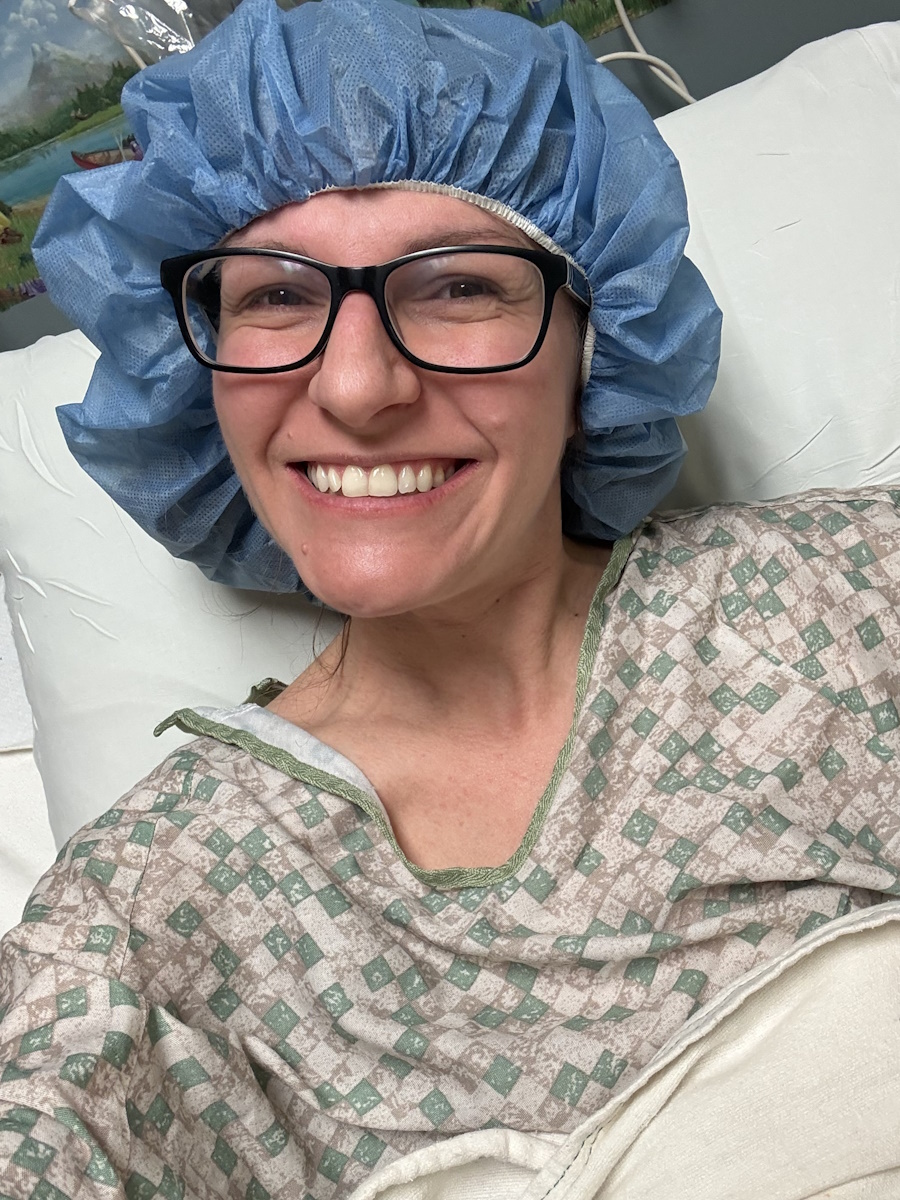
The options were lumpectomy versus mastectomy. The cancer was only on my right side, but we took both breasts, which was my choice. I said, “Take them both. They fed three babies amazingly. Thank you so much. Take them off me. They have done their job.” The length of time for taking one versus two was only a little bit longer, and it was still safe. With every choice we made in my care, everybody was involved: my husband, my four-person healthcare team, and my intended parents. I wanted everyone on the same page. I was 21 weeks pregnant during surgery, which went super well.
The next step of the game plan was to start chemotherapy after I recovered. Regardless of what the surgical pathology showed, because they took some lymph nodes from the cancer side, they told me I’d still have to do chemo during pregnancy. There’s no way around it.
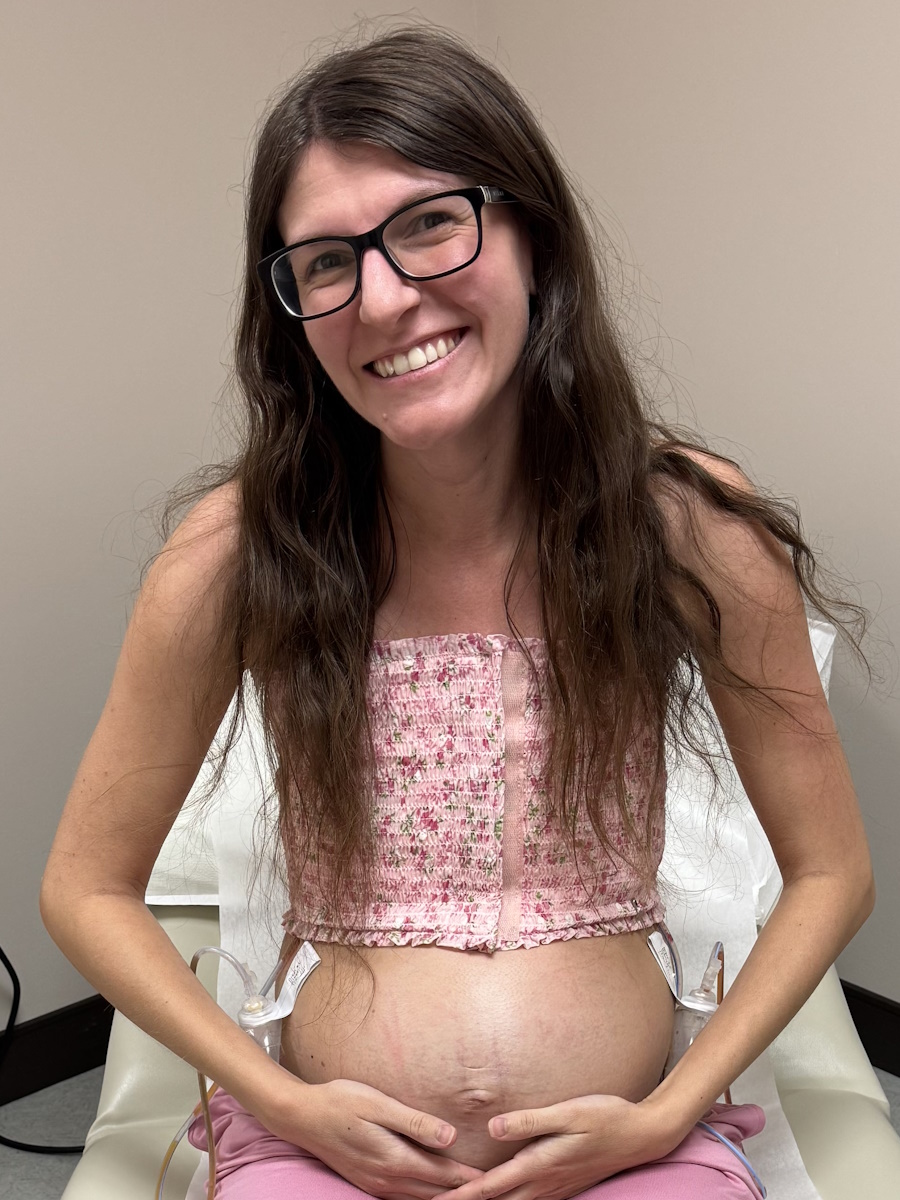
A lot of people ask me about getting chemo while pregnant. Yes, the placenta acts as a protective barrier in the second and third trimesters, but not in the first. Since I was already in my second trimester, the timing made sense: Surgery first to remove both breasts, then four cycles of AC chemo (doxorubicin and cyclophosphamide). The timing worked out perfectly, so I’d have a four-week break before delivering the baby, and then I’d jump back into chemo a week after.
Navigating hair loss, double mastectomy, and body image during pregnancy
Before I was fitted for my prosthetics, which were boob inserts in a bra with little pockets, I would walk around completely flat, but I had this big baby bump. The babies I grow are like basketballs; they grow straight out. I was so thankful at the same time that I was pregnant while being so flat, because I would think, “I wish I could jump into some of these people’s minds that are seeing me walk by in the store.” At that point, I hadn’t lost my hair, and they’re probably confused. I’m completely flat, but I’ve got a big baby bump, so I was thankful to show a little bit of the womanhood I still had.
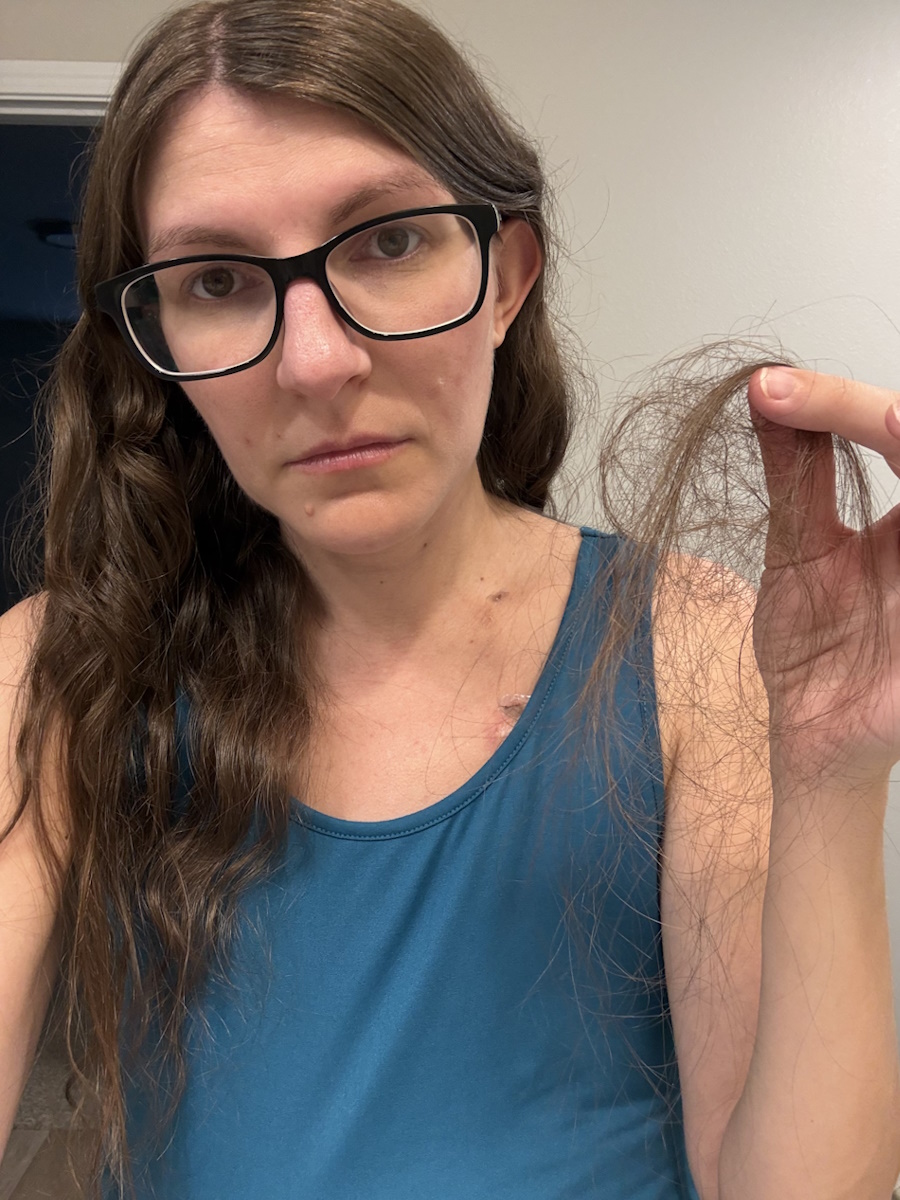
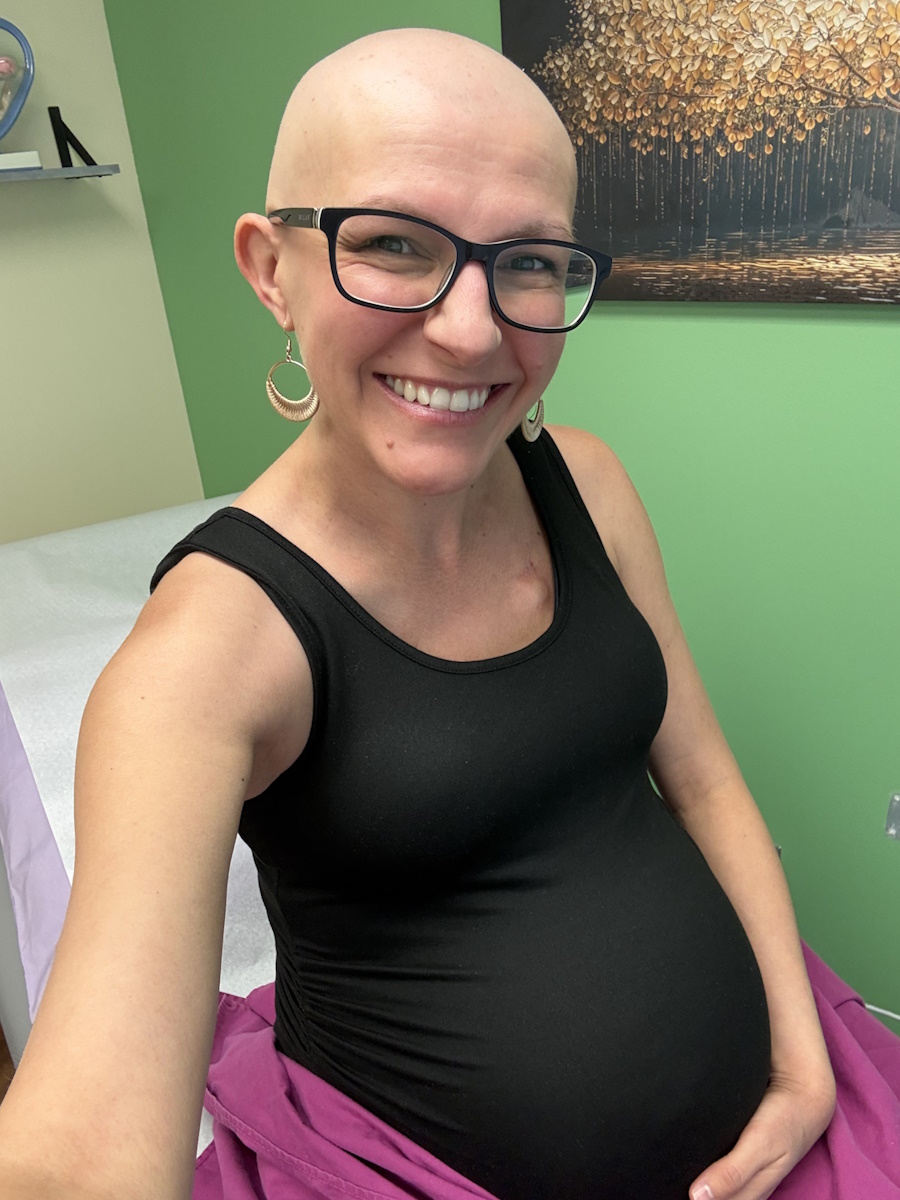
I had long brown hair. Losing my hair was harder than losing my breasts. I say this in a joking way, but I do mean it. I was a very small A-cup before, so I thought, “It’s not that much of a difference.” It was a little easier for me. Yes, I don’t have nipples because we didn’t do nipple-sparing. It’s definitely different looking in the mirror. I expected to have this intense visual reaction the first time seeing myself like that, and I didn’t. I feel like that’s connected to being so small before. For someone who had larger breasts and suddenly they’re gone, that’s a huge change.
Losing my hair was harder because it is part of someone’s identity. Something I dislike is when people say, “Oh, it’ll grow back. It’s just hair.” I know it’ll grow back. I’ve even got some peach fuzz right now. But it’s not going to stay because I go right back into chemo after delivery anyway. Without hair, I don’t know. It’s part of your style. It’s part of who you are entirely.
I feel like I handled both losses well, but the harder part was definitely losing my hair. I do have some fun wigs, though.
Preparing for labor induction and returning to chemotherapy treatment one week after delivery
I’m excited to get to the next stage. Since I got diagnosed, it has been a whole bunch of hurry up and wait. The surrogacy process was also a lot of hurry up and wait. My patience has definitely been tested with this entire experience. With the induction coming up, I’m excited because then I’ll think that we’ve made it to the big finish line of what we started.
A week after delivery is when I start my weekly paclitaxel chemotherapy regimen. I will do that for three months, along with two different targeted therapies, because I’m HER2-positive. I feel like there’s so much busyness going on that it’s such a huge distraction. Before, I was doing chemotherapy every three weeks, so I would live my life in three-week increments, always waiting for the next one. The next time I go through it, it’s going to be every week. Once that’s done, I’m going to think, “Okay, I’m not pregnant anymore and not doing chemotherapy weekly. What do I do now?”
Explaining surrogacy and cancer to three young children
I have a three-, six-, and nine-year-old. My nine-year-old son has such a good understanding of everything. When we explained that I was going to be carrying someone else’s baby, that it’s another family’s baby and they’re going to put the baby in my tummy and I was going to grow it for them, he completely understood; even my six-year-old did. The three-year-old asked, “Is that a baby dinosaur?” She calls it an egg. She won’t remember any of this, but we will.
My nine- and six-year-olds also have a good understanding of breast cancer. They knew something was up the day we got diagnosed. “Why is Mom crying? Why is Dad crying? I don’t see Dad cry.” We explained it the best way we could. We talked about how our body has flowers and weeds. Mommy has lots of flowers in her body, but there are also some weeds. We have to do certain treatments, like medicines and surgery, to get the weeds out. My son understood that. We told him that it was called breast cancer.
My six-year-old was nodding her head and then said, “Can I take a bath now?” My son later said, “I’m sorry that you have… What’s it called again, Mom?” I said, “Breast cancer.” He said, “I’m sorry that you have breast cancer.” I said, “It’s okay, honey.” And he said, “No, it’s not.” And I said, “You know what? You’re right. I’m sorry; that was just an instant reaction. You’re right. It’s not okay. But it’s going to be okay.”
We also got children’s books for free from Bright Spot Network. They were so amazing. They talk about all the treatments. We had already discussed with the kids that I was going to lose my hair and go bald, and that Daddy’s going to shave it when it gets to a certain point. I showed them my port and explained, “This is how I get the medicine that helps me. It’s going to make me healthy again. But in the meantime, it destroys stuff, both good and bad, in my body… All the weeds and the flowers. That’s why Mommy’s hair falls out.” They loved the children’s books. They helped.
Processing the emotional rollercoaster of a complex cancer diagnosis
I feel like I’ve been through all the ups and downs. At every doctor’s appointment I went to, whoever I was seeing, they looked at me strangely: “You’re handling this well.” The way I see it is that when I got my diagnosis, I was a complete wreck and bawling all day. After that, I wiped the tears away and started asking, “What do we do? How do we get rid of it? What’s next? Let’s get this done,” because there are so many pieces involved. It’s not just me.
I’ve always turned to humor. I’m a talker. At my first oncology appointment, he was looking at my husband and me like, “Okay, what do I do with you guys?” He was probably more used to somber people getting their diagnosis. But mine was different. I didn’t meet my oncologist until after surgery, almost two months after my diagnosis.
Most of the time, I’m positive and chipper. Other times, I take a step back and think, “Holy crap. I’m literally pregnant as a surrogate with breast cancer. Am I being punked? Where is Ashton?” But I do keep a positive mindset.
When people ask how I’m doing, it’s such a loaded question. I’ve gotten to a point where I say, “I honestly feel like I’m thriving,” which sounds ridiculous given my situation. But I also feel lucky because I know there are so many people going through chemo who are having a hard time with the side effects. I felt like I was “cheating” chemo because I barely had anything.
Where my unshakeable positivity comes from
I’ve always been positive. I’ve always loved making people laugh. I love laughing. I’m a people person. You could say I’m a social butterfly. As I’ve gotten older, I’ve become more of a homebody, but I’m still a very happy, positive person. Life’s too short to be unhappy, to be intentionally rude to people, and to not laugh about things.
Do I have my moments? Absolutely. I’ll have my breakdowns and my Negative Nancy thoughts, but that’s what they are: moments. I don’t spend whole days doing that. I have my time, let my body have a release and process, have my emotional breakdown, and go right back.
I say this, and it sounds silly, but out of the people I know, if anybody had to get cancer, I’m glad it was me, because I know I can handle it. I said this at the very beginning, when I was talking to my intended parents. It’s all going to be okay. I know it’s going to be okay.
Keeping the intended parents involved throughout the entire cancer treatment journey
During appointments, I made it a point to ask them if they wanted to be on speakerphone. I didn’t have to be, but I was very open. Some people say, “Wow, are you serious?” I’m carrying their baby. This isn’t just me. Even MFM and the doctors said, “Your health takes priority. We can’t keep the baby healthy and safe if you’re not healthy and safe.” Everybody has a full understanding of that. But I can only imagine having the roles reversed. I would want to be on speakerphone for some of these important conversations.
With the surgery conversation especially, I wanted the parents involved. They were on the phone for whatever appointments were necessary, and they could ask any questions. My memory is horrible, especially with pregnancy brain and chemo brain, and I don’t want to play telephone. They could hear directly from the doctor and ask whatever they want.
Gratitude for my body for carrying life and fighting cancer simultaneously
One of the most common things I hear is people talking about feeling betrayed by their body when they get a cancer diagnosis. Honestly, I’m so grateful for my body. The fact that it can still carry a baby and the baby is perfectly healthy. I get monthly scans and the baby is so active, moving all the time, and growing beautifully. Everything’s looking fantastic. Even my lab work looks great. I haven’t gotten sick once. I haven’t had to take a single anti-nausea med.
My body has gone through so much, but what a freaking powerhouse of a body. I thought, “Hell yeah, do your thing.” I’m carrying a baby, going through chemo, and went through surgery. I have no breasts and no hair, but I’m still chugging along. My body’s not just barely making it; it’s literally thriving.
Did it have cancer in it? Yeah, but I also haven’t been able to get a full-body scan because of my pregnancy. After delivery, that same week, I’m getting a brain MRI and a full-body PET scan, so ask me again after those results.
Inspired by Shelby’s story?
Share your story, too!
Hear from people living with breast cancer
Real experiences with diagnosis, treatment choices, side effects, and life beyond breast cancer — in their own words.
Leave a Reply