
From Losing His Appetite to Stage 4 Colon Cancer: Joe’s Story
Joe’s stage 4 colon cancer experience began at age 34 with symptoms that were easy to dismiss in the restaurant world: fatigue, loss of appetite, and an indescribable sense of feeling off. He had spent his life on his feet in kitchens, eventually co-founding a popular bagel shop in Austin and living in Georgetown, TX, with his wife Christen. When he suddenly found himself unable to enjoy food on a cross-country trip, he later woke up with the worst abdominal pain he had ever felt and a life-changing CT scan showing his liver completely covered in lesions.
Interviewed by: Tory Midkiff
Edited by: Chris Sanchez
A colonoscopy confirmed that Joe had colon cancer, and urgent surgery removed a mass in his colon that was close to causing an obstruction. He then heard blunt assessments from clinicians suggesting he had widespread disease and little time left, and should simply enjoy what remained. Yet he began chemotherapy and targeted therapy. Against expectations, his first scans after treatment brought an enormous wave of hope: almost all the cancer had shrunk, many liver lesions began to calcify, and soon he reached no evidence of disease (NED), a milestone he never thought he would see.
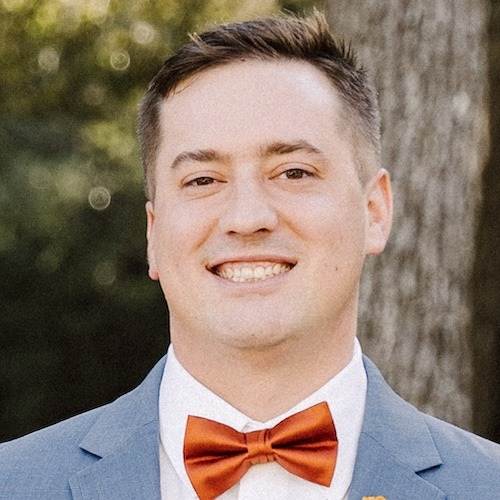
Over time, however, cancer returned; first in Joe’s liver, then his lymph nodes, and later his lungs. He cycled through more treatments, only to see the disease progress again. Today, he is patient number zero on an immunotherapy clinical trial at MD Anderson, describing it as a giant leap of faith rooted in both realism and hope within his ongoing colon cancer experience.
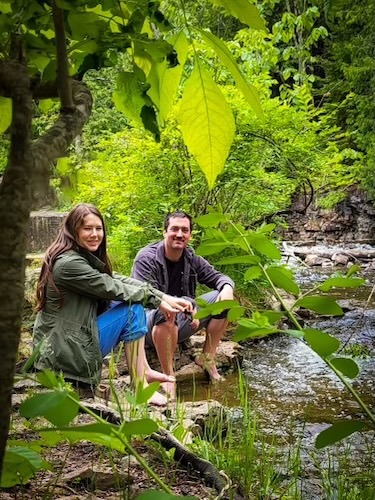
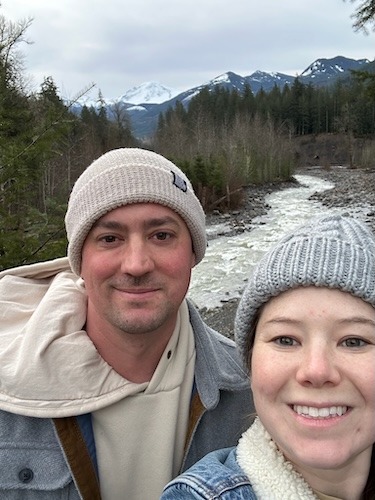
Throughout, Joe and Christen have focused on mental health, nature, and community. From therapy, meditation, and prayer to pushing himself outside for quiet time in beautiful places, he says that getting into nature, zoning out, and being present have been some of the greatest gifts of this experience. Just as importantly, he has become a powerful advocate, volunteering with the American Cancer Society, co-hosting fundraising events, and serving as a Fight CRC Team Crow ambassador with Christen. In Washington, DC, they help install flags on the Capitol lawn to represent lives lost to colorectal cancer and meet lawmakers to push for better funding and earlier screening, especially as colorectal cancer has become the leading cancer killer in people under 50.
Watch Joe’s video or read his edited interview transcript below to find out more about his story.
- Joe’s experience shows how easy it can be to dismiss early symptoms like fatigue and loss of appetite, especially when they resemble everyday life in a demanding job.
- Even with advanced disease, he experienced dramatic early responses to treatment, including no evidence of disease, which reshaped his sense of what was possible.
- Joe learned that being present, especially in nature, and tending to mental health through therapy, meditation, prayer, and rest can be as vital as medical treatment.
- His perspective shifted from focusing only on his own experience to building community and advocacy through volunteering, fundraising, and policy work.
- A universal truth in Joe’s story is that feeling less alone and staying connected to others can change how someone moves through serious illness.
- Name: Joe C.
- Age at Diagnosis:
- 34
- Diagnosis:
- Colon Cancer
- Staging:
- Stage 4
- Symptoms:
- Loss of appetite
- Fatigue
- Malaise
- Severe pain in the abdominal/liver area
- Back and shoulder pain
- Lightheadedness
- Treatments:
- Surgery: colon resection
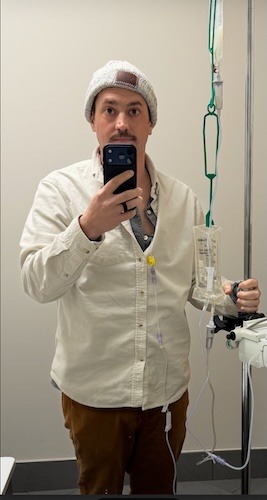
- Chemotherapy: FOLFOX, capecitabine, FOLFIRI
- Targeted therapy (monoclonal antibody): panitumumab
- Radiation therapy
- Immunotherapy (clinical trial)
This interview has been edited for clarity and length. This is not medical advice. Please consult with your healthcare provider to make informed treatment decisions.
The views and opinions expressed in this interview do not necessarily reflect those of The Patient Story.
- Early life, career, and restaurant journey
- Travel, music, and life with Christen
- Early symptoms, fatigue, and loss of appetite
- Misdiagnosis, pain, and rushing to the ER
- ER visit and first CT scan
- Colon surgery, official diagnosis, and my first days in the hospital
- Lifetime chemo plan and my initial treatment response
- No evidence of disease, maintenance chemo, and first recurrences
- Progression to my liver and lungs, and moving to new lines of chemo
- Mental health, nature, and staying present
- Community, support system, and advocacy
- Fight CRC, Capitol flags, and screening advocacy
- Colorectal cancer funding gaps and “be the buffalo”
Early life, career, and restaurant journey
So my name is Joe Carr. I am 37 years old. I live in Georgetown, Texas, and in 2023, I was diagnosed with stage 4 colon cancer. So I’m living with colon cancer.
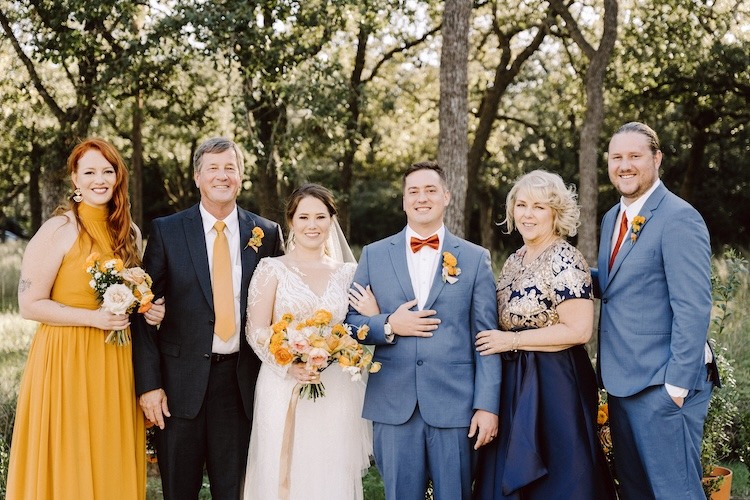
Before my diagnosis, I grew up in Michigan. So I lived there for 28 years, went to Michigan State University, grew up in the Lansing, Michigan area, and moved to Austin in pursuit of opening my own restaurant one day. It’s what I’ve always done since I was like 16. My first job was at Pizza Hut. And so I’ve always worked in restaurants, and I helped open a couple of restaurants in the Austin area for a while, and eventually met up with a really good friend of mine who was a business mentor, who was consulting for another guy in the area that wanted to open a bagel shop. He had a really good bagel recipe, but he wasn’t super experienced in the operational side of running and opening a restaurant. So we kind of joined forces, and that was in early 2021 when we opened Rosen’s Bagel Shop in Austin. And then we opened a second one, like five months into it. It was an opportunity that kind of fell in our lap. We weren’t actually planning on opening a second location that fast. And it’s been really great. The bagel business has done really well.
Travel, music, and life with Christen
We’re really happy with our team and our product, and we’re looking forward to growing Rosen’s. So that’s kind of career-wise where I’m at. Fun-wise, my wife and I love traveling. Her name is Christen. We married in 2021 as well. And we’ve traveled all over the place together, traveled almost completely across the United States at this point. We went to Peru and did a bunch of hiking and sand surfing. We went to Guatemala for our honeymoon and spent like ten days there. It was beautiful. I highly suggest Guatemala; it is very underrated.
And that’s kind of how we looked at our year. Every year, we would try to plan something big like that. We had a trip planned for Spain that got canceled because of COVID. We had a trip planned for Switzerland, and that got canceled because of the cancer diagnosis. But other than travel, I’m a big music fan. We’ve probably gone to 20 or 30 different live concerts together since we’ve been married. So any opportunity to get out and enjoy live music or food is huge. Obviously, being in the restaurant industry, I’m constantly going to new restaurants and trying new things and trying to broaden our food diversity a little bit, keep things interesting.
Early symptoms, fatigue, and loss of appetite
Yeah. So it was an interesting kind of set of circumstances. Being someone who’s in the food industry, I always have an appetite. And being in the restaurant industry, people who work in that industry know that it’s long hours. You’re on your feet a lot, so you’re tired all the time. So when I started looking back, when I realized what the signs and symptoms were, it was really easy for me to push them off as normal life occurrences because of what I did for a living. The weirdest one was the loss of appetite, though.
We were going on a kind of cross-country trip. We were going to Salt Lake City for a couple of days, and then Boise, and then Florida to attend a graduation. And when we were in Boise, we went to this really nice restaurant, and they brought out the bread, and I took a bite of the bread and, from a technical perspective, I could tell it was really good. It was baked well. It had fantastic flavor, but for some reason, I just didn’t want to eat it. And I’ve never experienced that before in my life, other than maybe when I had the flu or was really sick and just didn’t want to eat. And then the next couple, we ordered probably five or six dishes, and everything was the same thing. I just had no desire to continue eating them, even though they were tasty.
So that night, we boxed up most of our food and went home. And then a few days later in Florida, the same situation happened. We went to this Cuban restaurant. It’s pretty famous down there in the Tampa area. I ordered this monster Cuban sandwich, which I was really excited to try, and I probably had three bites of it, and I was like, I just can’t eat. And it was the weirdest feeling. I was the guy who would not only eat my entire plate normally, but I would also finish Christen’s plate. I love food. And so that was pretty alarming to me.
And I just kind of felt generally off. It’s really hard to explain, but I lacked a lot of energy. The weeks before that, I remember a couple of times driving to different bagel locations of our restaurants and having to pull over in the middle of downtown Austin and just rest for like five minutes. I’d set a five-minute alarm on my phone, pull into a parking spot, and fall asleep. So that was when the signs were really like, something is wrong. I ended up going to a blood testing kind of chain where you just walk in and walk out, and they email you the results, and it’s kind of up to you to decide what to do with those. And there were red flags on there, but most of them pointed towards a pre-diabetic situation.
Misdiagnosis, pain, and rushing to the ER
And so I was like, “Okay, I’ll just eat better and exercise and take care of this on my own.” Still started feeling weird. Went to an urgent care. The doctor gave me a kind of a quick review and saw that the insides of my ears were inflamed, which was really common for me. I’ve had a ton of ear problems growing up as a kid. And he was like, “Yeah, because of all the elevation gain you just had on your trip, you probably had an ear infection. You’re just coming out of that. It might make you feel a little lightheaded and blah, blah, blah. And that’s probably what it is. So we’re going to give you some antibiotics, and hopefully that takes care of it.”
And then everything from there happened really quickly. It was a couple of days later. I was at work, and I started having really bad back and shoulder pain. It felt like I pinched a nerve or something, and I was trying to just stretch it out during the day. We had a business meeting that day. I couldn’t sit down. I was standing flat against the wall while we were having this meeting. It was super awkward. And my business partner Joe looked at me, and he was like, “You need to leave. You don’t look well.” And so I went straight to a masseuse and tried to get them just to hammer whatever I thought was wrong with me out of my shoulder. And that did not work.
I went home, lay on the couch, and fell asleep. This was like 3 or 4 in the afternoon. Woke up around 10:00. My wife was trying to get me to go to bed, and I was like, “No, I’m just going to sleep on the couch. I don’t feel like moving.” And then about 3 or 4 in the morning, I woke up with the worst pain I’ve ever experienced in my stomach, kind of in the liver area. And I couldn’t move. And every breath I took, it literally felt like someone was stabbing me. So I kind of slid off the couch and crawled to the bedroom and propped myself up on the bed, and I’m super awkward because I’m holding my breath. After all, it hurts so bad. And so I’m grunting, making these weird noises that woke my wife up, and she’s like, “What the heck is going on? What are you doing?” And I was like, “We need to go to the hospital right now.”
And so those were the symptoms that led up to it. I never saw blood in my stool, which is a really common occurrence for colon cancer. I never saw changes in bowel habits. I had nothing to do with that stuff. It was all the fatigue and the appetite and then the pain the night before.
ER visit and first CT scan
The hospital was an interesting situation. It was Father’s Day weekend, so there were not a lot of doctors available, we found out. But when we got into the ER, they did the basic vitals and blood tests, and the doctor was like, “I’m not really sure if there’s anything serious. Let’s maybe put you on some pain medications, send you home, and see how you feel.” And that’s kind of been a weird thing for me throughout my entire cancer journey: even when I’m on chemo or things like that, I’ve had pretty good blood test results that look like a healthy human being. So it’s been kind of bizarre.
But before they sent me home, I said, “Okay, I will say, I haven’t been eating, and I’m struggling with energy and that sort of thing.” And so he was like, “Okay, well, then let’s get you into a CT scan just to double-check.” And so I went to a scan, came out of the scan, and the ER doctor just looked at me, and he said, “I have good news and bad news. The good news is chemotherapy is really good these days.” And that’s how the conversation was led off. And I was like, “Are you saying what I think you’re saying? Do I have cancer?” And he was like, “Well, I’m not technically the person who can diagnose you. But it does appear that you have cancer because your liver is completely covered in lesions.”
Colon surgery, official diagnosis, and my first days in the hospital
And so that was how we kind of pre-found out without the official diagnosis. And so I didn’t even know what to think. I think I asked him, “Okay, do I go home, like, what’s happening?” And he was like, “No, you’re here for the weekend for sure, and we’ll go over the next steps.” So they got me into a room. We had to get a colonoscopy the next day. So I went into the colonoscopy prep that night, and it was Saturday. We went and did the colonoscopy. And I remember coming out of the colonoscopy very woozy. And I’ve heard this from other cancer fighters, that it’s very bizarre because they tell you right when you’re coming out of anesthesia what they found, and you’re still trying to figure out where you are. But I remember him very clearly saying, you know, we found a mass, and it’s confirmed that you have cancer.
And so that was Saturday. Sunday was Father’s Day. There weren’t any surgeons available. We needed to do surgery before chemotherapy because my mass was really close to causing obstruction in my bowel pathways, so we needed to get it out of there pretty quickly. So I just had to sit there for two days on pain meds because no one was available to do the surgery, which was really fun. And then Monday came around. We finally got into surgery.
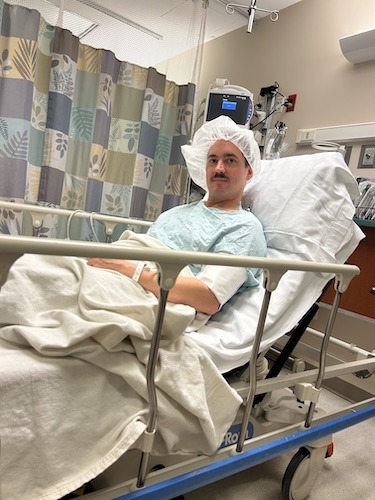
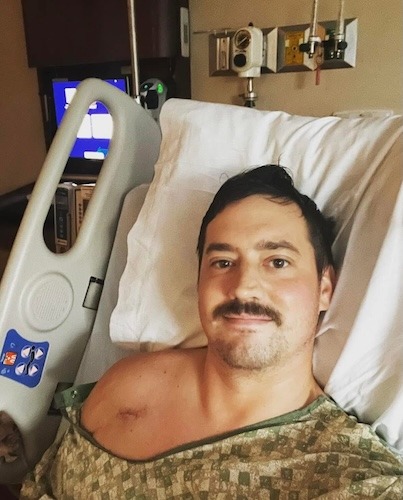
They removed the mass. They only had to take a small amount of my colon out, so I wasn’t required to have a colostomy bag. And then from there, they said, “You need to recover, and then you can start chemo in two weeks.” And so that was kind of the hospital experience. The hospital experience was also like, you have so many questions, but you’re not talking to the right people yet because you don’t have your oncologist. And so I’m asking, “What should I be eating? How should I be helping my body even now, before this all starts?” And I remember the surgeon looked at me and he said, “You know, brother, you’ve got so much cancer spread that you should just go home and have pizza and have beer because it doesn’t look good. You know, just enjoy your life.”
And then the same thing happened, because we couldn’t see an oncologist. After all, no one was available. I received a phone call from an oncologist. And over the phone, he was like, “I looked at your reports, and you’ve probably got about two years left to live. And so all this is happening, and there’s not actually anyone to have that conversation with. So you’re just spiraling mentally. It was… that was definitely the hardest few days of my life.
Lifetime chemo plan and my initial treatment response
So they originally told me I was going to be on chemo for life. And what that means is chemo until it stops working, you know, is what they say. And it’s a frustrating thing for someone with stage 4. All you ever hear is, “We’re going to give you treatment to keep you alive as long as we can, but nothing we’re doing is going to cure you.” And that’s what the standard, I guess, verbiage is coming from the doctors.
Now, people have lived a really long time being stage 4. But it’s just not something I don’t think doctors are comfortable saying, or they’re just so used to the terrible statistics that they kind of treat you like just a number. So I had a port installed in my chest during the procedure when they removed the mass, so we were ready for chemo. We did a drug called FOLFOX, which is one of the most standard lines of treatment for colon cancer. And then the plan was to do six months of that in combination with a targeted therapy called panitumumab. I am somewhat fortunate that my cancer is not mutated, so I had a little bit more options and a hopeful response from the chemo.
So we started chemo, and we got our next PET scan three months in, and the initial PET scan that we received was so great. Almost all the cancer was gone. Everything had shrunk by about 60%, and a lot of the lesions on my liver had started to calcify and die.
No evidence of disease, maintenance chemo, and first recurrences
So it was this huge wave of hope that we really needed. So right from the get-go, we had positive results. And then I think the next PET scan, I had no evidence of disease anywhere, which was something that I never actually expected to get to. After the 12 rounds and going NED, I was kind of like, “Okay, so can I stop? Do I need to stop doing chemo?” And they’re like, no, no, no, you’re in chemo for life. I’m telling you, it’ll come back.
And so we went on maintenance chemo, which was one drug. I think we did that for a few months, and then we switched to an oral pill. And that was a lot better, just side-effect-wise and just quality of life. Then we started seeing the tumor markers in the blood tests rise again, signaling there’s a recurrence coming. And the blood test that we get usually can detect the cancer recurrence, like four to six months sooner than a PET scan can. It’s at a really microscopic, microscopic level. So once that happened, we did see in the PET scan a little spot in my liver come back. So they put me back on FOLFOX because my body had tolerated it well. They felt it was still safe. And, you know, a month or two later, it was gone, and I went back into no evidence of disease. So I started getting this cockiness.
I want to say honestly that I was like, “I can do this.” And it was helpful in a confident way, but I think it made me kind of lose track of how serious this is, and not to take things for granted. Because a year later, after that, now we’re in the second year, there was a recurrence in my liver again, and this time also in my lymph nodes. So the liver spots were still relatively small, so they thought that it would be fine to go off chemo for a little bit, or to take the chemo pills and use radiation to try and get rid of the lymph nodes. So we did three weeks of radiation, 15 treatments, and zapped away the lymph nodes. But while we were on the radiation, and because we weren’t on an aggressive chemo anymore, the liver started spreading more and more.
Progression to my liver and lungs, and moving to new lines of chemo
And then it ended up getting to the point, at the next PET scan, that we saw progression not only in the liver, but now it had spread to my lungs for the first time. And so they were like, “Okay, you responded well to chemo the first time. We’re going to try it again, even though it’s not fun.” And this time we tried it, and, you know, a month or so in, we realized it wasn’t working. So they switched to a different drug called FOLFIRI. It’s still a first-line treatment as far as the lines go. And we did that for a couple of months and saw that that wasn’t working.
And that’s kind of where we are today. But we recently just started a clinical trial, an immunotherapy clinical trial at MD Anderson, two weeks ago. And we’re the patient number zero. We’re the first ones to do this trial at MD Anderson. So there’s been some really positive results in it in other cancers. It’s the first time we’re using it in colon cancer, and being the first one at MD Anderson, it’s a lot like a, you know, we’ll see how it goes kind of thing. So it’s an interesting mental experience. You’re hopeful because you’ve seen positive results, but also, there’s nothing to go on for your cancer. It’s just a giant leap of faith. And that’s where we’re sitting today.
Mental health, nature, and staying present
It is a persistent struggle.
So very early on, we knew that if we were going to have any chance at this, we needed to be as mentally strong as we possibly could be. So we did a lot of the classic stuff: of course, going to therapy, we were doing breathwork, meditation. I was finding myself praying a lot more than I ever had. I never really considered myself much of a super religious person. But there’s something when you’re going through this that brings you to that point.
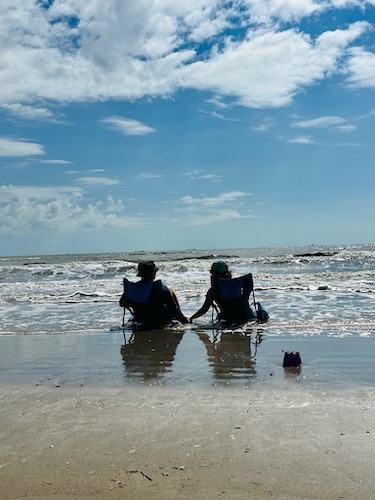
But what really made the world of difference to me was getting out into nature and reconnecting there and going to it even when I didn’t want to go to it. The side effects from chemo are so intense that it’s giving you every excuse in the world to lie in your bed and rest and feel sorry for yourself and scroll on social media and not have an active lifestyle at all. And you have every right to do that when you’re going through this. You need rest. I think that’s the most critical thing for recovery. But my wife has been so strong in pulling me out of those moments and booking trips and being like, “Okay, this is going to be two days after your chemotherapy, but we can do this, you can do this. And if you feel bad when you get there, we’ll rest. You don’t have to do anything you don’t want to do.”
But when I found that I would push myself to get out there a little more and just spend time in silence in nature, I felt so strong. It’s hard to explain, but I think it was more of the relaxed state. Because if you’re ever going to be present somewhere, what better place to be than when you’re staring at a beautiful landscape or mountains that you can’t describe or paint? And so it teaches you the appreciation of being present, which is what we’ve learned through this cancer diagnosis. You have to be, because as soon as you start thinking too far in advance, whether it’s on the positive side, you start to neglect your day-to-day and your steps and your habits that you’re building to recover. Or if it’s the alternate side, the negative side, where you start thinking about your mortality, then you cause all the stress in your body, and everything gets bad. Then you start making terrible decisions, and you’re not thinking straight. So getting into nature, zoning out, being present has been, by far, I think, our biggest gift that we’ve learned so far.
Community, support system, and advocacy
So I think something I haven’t really touched on is how strong community and a support system are. It’s a lonely experience. And if you allow it to be that lonely experience — some studies show that outcomes are not great with people who isolate themselves in these situations. So my goal from the beginning has been to try to find ways to either prevent this from happening to somebody else or help somebody through it. I’ve felt that I’ve been strong enough mentally and physically to be able to help, and if you’re able to help, why wouldn’t you help?
So we first got into some volunteering. We worked with the American Cancer Society. We’ve helped throw an event called Fought Cancer for the last two years, which has raised money to help cover lodging and transportation costs for patients who are visiting MD Anderson or San Antonio, and they’re outside of the city. And something like that, a lot of people might not realize the impact it has, but any barrier or resistance to going to treatment when you’re mentally weak and physically weak is like giving a kid a piece of candy. It’s like, “If I don’t have to go, or if it’s too hard for me to go, I’m not going to go.” And I’ve heard people saying too many times, “I stopped going to this treatment because it was too long a drive, it was too expensive. So we just gave up.” And it’s heartbreaking.
And so we kind of found some advocacy in there. And then, more focused on colorectal cancer, is the organization Fight CRC. We were nominated to be ambassadors this year, which has been a really amazing experience. Usually, in the past, Fight CRC has done individual ambassadors every year. This year, they did teams. So it got to be a group effort. So my wife Christen and I are a team. We’re called Team Crow. It’s our names put together, Christen and Joe. So you’ll see crows all over our house, too. It’s just a fun name.
Fight CRC, Capitol flags, and screening advocacy
Fight CRC has a couple of goals. One is to raise awareness and advocate. And this week, on March 1st, on Sunday, we’ll be in Washington, DC. There’s a big flag installation on the Capitol lawn where we will put flags down, and it’ll represent the number of deaths expected for colorectal cancer this year. And as we found out through the new statistics that the American Cancer Society just came out with, it’s the number one killer in people under the age of 50 years old now. That was originally expected to be by 2030. So it’s moving faster than even the expectations were. So there’s a huge sense of urgency to make a change.
And so going to the Capitol, doing the flag installation, that’s more of an awareness. You can see it from a plane when you’re flying in, and you can see it when you’re walking by. The representatives in Congress can see it from the windows of the Capitol. So it’s impossible to ignore. And then two days later, there are about 300 of us that will break up into groups, and we will talk to our representatives of our states to try and advocate for more funding and better screening access on the preventative side.
Colorectal cancer funding gaps and “be the buffalo”
And as far as the funding ask when we all meet, if you look at the top ten cancer deaths and diagnoses in the United States, for whatever reason, colorectal cancer is the only one that doesn’t have a dedicated research program. So it’s now, like I said, the number one killer under the age of 50, but it doesn’t have its own research program. So clinical trials are limited, and the standard care practices haven’t changed in a long time. There are things that are happening now; it’s getting a lot better because of the funding that we do have. But we need a lot more. So that’s kind of the main focus.
But yeah, I’m happy we pointed out the nature thing. To sidebar, we’ve got our buffalo here, which is our mascot. The crow is our marriage mascot. The buffalo behind me and the buffalo skull are our mantra and the way we view this journey. We learned that buffalo are one of the few animals that run into storms. If you go into the storm, it passes more quickly than if you run away from it. So every time we’ve hit an obstacle, we’ve absorbed it emotionally, handled it the way we needed to handle it, and then told ourselves, you know, be the buffalo and let’s get after it and go kick some butt. So it’s always been around us.
Inspired by Joe's story?
Share your story, too!
More Metastatic Colon Cancer Stories
Raquel A., Colorectal Cancer, Stage 4 (Metastatic)
Symptoms: Frequent bowel movements, pin-thin stools, mild red blood in stool
Treatment: Chemotherapy
Steve S., Colorectal Cancer, Stage 4 (Metastatic)
Symptoms: Blood in stool, changes in bowel habits, feeling gassy and bloated
Treatments: Surgery, chemotherapy, monoclonal antibody, liver transplant

Jessica T., Colon Cancer, BRAF+, Stage 4 (Metastatic)
Symptoms: Severe stomach cramps, diarrhea, vomiting, anemia (discovered later)
Treatments: Surgery (hemicolectomy), chemotherapy
Jennifer T., Colon Cancer, Stage 4 (Metastatic)
Symptoms: Weight loss, coughing, vomiting, sciatica pain, fatigue
Treatments: Surgeries (colectomy, lung wedge resection on both lungs), chemotherapy, immunotherapy

Kasey S., Colon Cancer, Stage 4 (Metastatic)
Symptoms: Extreme abdominal cramping, mucus in stool, rectal bleeding, black stool, fatigue, weight fluctuations, skin issues (guttate psoriasis)
Treatments: Surgeries (colectomy & salpingectomy), chemotherapy