
Jake Found a Lump Putting On Deodorant. That Lump Turned Out To Be Stage 4 Male Breast Cancer.
Jake Messier was 52 years old when he discovered a small lump in his armpit while putting on deodorant, a routine moment that would set off one of the most profound experiences of his life. He would be diagnosed with male breast cancer that would ultimately progress to stage 4. It set off not only a demanding treatment experience, but also a complete reimagining of who Jake was and what his life was for.
Interviewed by: Taylor Scheib
Edited by: Chris Sanchez
Male breast cancer is diagnosed far less frequently than female breast cancer, affecting roughly 1 in 728 men compared to 1 in 8 women. And only 10% of those cases will be stage 4. Jake’s story sits at that rare intersection, and he has made it his life’s work to make sure other men never face it alone or uninformed.
Before his male breast cancer diagnosis, Jake had already undergone a remarkable personal transformation. After spending much of his adult life in what he calls an “unhealthy cycle,” he suffered from a stroke in 2018, then committed in 2020 to addressing the root causes of his struggles through therapy, walking, yoga, and meditation. He shed 120 pounds during the COVID-19 pandemic without pharmaceutical intervention: a period he calls the birth of “Jake 2.0.” That emotional and mental foundation, he believes, is the reason he was able to face a breast cancer diagnosis with resilience rather than collapse.
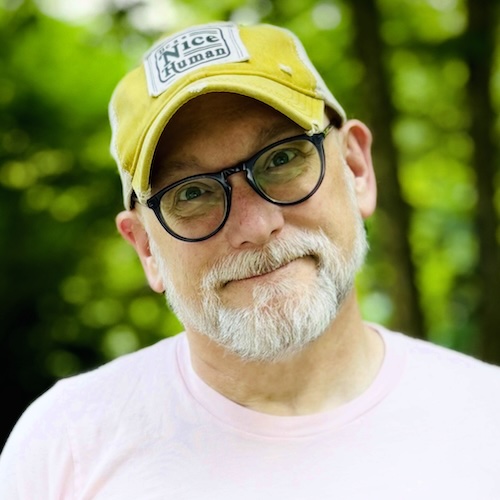
Jake’s treatment experience included 20 weeks of chemotherapy (doxorubicin and paclitaxel), three surgeries, including a full right-side mastectomy, and two rounds of radiation at Dana-Farber Cancer Institute, home to one of the top male breast cancer departments in the world. He was initially misdiagnosed at stage 2 but has since been confirmed at stage 4, with a metastatic lesion in his hip that is now either dead or dying following his most recent radiation. To keep his estrogen-positive breast cancer in check, his medical team has him on a targeted treatment plan using a hormone blocker and what’s called a CDK inhibitor.
Today, Jake Messier channels his 30 years of marketing experience through his website, The Guy with Stage 4 Breast Cancer and social media, reaching tens of thousands and inspiring people well beyond the breast cancer community. His call to action is clear: Men can get breast cancer. His mantra, born during chemotherapy, says everything about how he has chosen to face this experience: “You take the stairs until you can’t.”
For more about Jake’s male breast cancer story, watch his video and read the edited transcript of his interview below.
- Awareness can be lifesaving and it starts with knowing what’s normal. Jake found his lump incidentally while applying deodorant. He didn’t know men could get breast cancer, and that knowledge gap cost him months before seeking care.
- Male breast cancer is real, and due to its rarity – underserved. With approximately 2,800 men diagnosed per year in the U.S. and breast cancer being 30% more fatal in men than in women, the gap in awareness, resources, and medical infrastructure can have measurable, life-or-death consequences.
- The emotional and mental dimensions of cancer are as real as the physical ones. Jake credits his pre-cancer investment in therapy, physical wellness, and spiritual grounding as the very thing that kept him alive physically and emotionally.
- A stage 4 diagnosis does not have to mean the end of identity or purpose; it can be the beginning of a new one. Jake’s evolution from “Jake 2.0” to “Jake 3.0” illustrates that who you were before cancer no longer fully exists, and that’s not only a loss. It can be a doorway.
- Advocacy doesn’t require a platform. It requires honesty. When a man who had kept his male breast cancer secret for 12 years changed his Facebook profile after watching Jake’s videos, he was met with an outpouring of love. Jake’s response: “You could do what I do. I’m not doing anything special. I’m literally just talking about this.”
Jake’s Diagnosis Facts
- Name: Jake Messier
- Age at Diagnosis:
- 52
- Diagnosis:
- Male Breast Cancer
- Staging:
- Stage 4 (Metastatic)
- Biomarker:
- Estrogen receptor-positive (ER+)
- Symptom:
- Appearance of a lump in the armpit
- Treatments:
- Chemotherapy: doxorubicin, paclitaxel
- Surgeries: full right mastectomy, clear margin re-excision, tracheal tumor excision
- Radiation therapy
- Targeted therapy: abemaciclib
- Hormone therapy: tamoxifen
This interview has been edited for clarity and length. This is not medical advice. Please consult with your healthcare provider to make informed treatment decisions. The views and opinions expressed in this interview do not necessarily reflect those of The Patient Story.
- Jake’s Diagnosis Facts
- The first red flag: How I discovered I had male breast cancer
- My health transformation before breast cancer
- From misdiagnosis to stage 4: Understanding how my male breast cancer actually progressed
- Becoming Jake 3.0: Reinventing my identity after the stage 4 diagnosis
- Finding out it was stage 4: How I was misdiagnosed
- My full treatment timeline: Chemo, mastectomy, and other surgeries, radiation, and hormone therapy
- The turning point: Why I started sharing my story on social media
- Hear from people living with breast cancer
The first red flag: How I discovered I had male breast cancer
My first time noticing something was wrong was in March or April 2023. I was literally just putting on some deodorant in the morning, and I felt a lump. I was like, “That’s weird,” and I went on with my day — because that’s what guys do. About a month later, I was like, “The lump hasn’t gone away. It’ll fix itself.” About four months went by, and there was no change.
We were visiting our best friends down in Georgia. My best friend happens to be married to my wife’s best friend, which is very convenient for everybody. My best friend and I are old military buddies. I was walking by him, and he gave me what, let’s just call it what it is, a “titty twister.” I was walking by him, and he just grabbed me, and because we’re old military, whatever. But it dropped me to my knees. I literally fell to the ground.
Those things generally don’t feel good, but they generally don’t cause an excruciating flash of pain that goes up into your neck. That was in the July timeframe of 2023, and that was the first time I was like, “Oh, maybe this pain is connected to the lump and that’s probably not good.”
In August, I had a primary care visit coming up. I’m a 52-year-old guy. I have a laundry list of things I need to bring up. I brought my little list, and one of the things on it was, “Yeah, I have this lump. I don’t know what it is.” My primary care physician listed off about ten things it could be, none of which were breast cancer. But out of an abundance of caution, he said, “Let’s send you to a mammogram anyway.” I’m like, “What? A mammogram? What are you talking about?”
So I go to the mammogram, and they’re trying to compress as much breast tissue as possible. This was my first time seeing a scan. I had no idea what I was looking at. Three years in, I can read scans like nobody’s business, but back then I didn’t even know what I was looking at. She had been through a million of these things. She’d seen a million cancer cases and a million non-cancer cases. I decided to ask her. I said, “Do I have cancer?” She said, “I can’t tell you that. The doctor will be in in a couple of minutes, and they’ll be able to confirm or tell you what’s going on.” Then she said, “But what I can tell you is that your life is going to start moving incredibly fast and incredibly slow, all at the same time.”
Why male breast cancer is diagnosed so late, and why that makes it more deadly
What I try to do is go back in my mind and remember, before 2023 and whether I knew that guys could get breast cancer. I don’t think I did. Now it’s my life. It’s not just my diagnosis; it’s become my professional life and everything else. But I don’t think I knew that guys could get breast cancer before that.
That goes back to the big overarching problem, which is: it’s not the fact that breast cancer isn’t talked about because it’s a small number. It’s literally the fact that breast cancer is 30% more fatal in men than in women. And the reason is that we are diagnosed so much later. We have all kinds of social and psychosocial issues. There’s emasculation, there’s “dealing with a woman’s disease” and all of these things that cause men to be diagnosed later and go to treatment later. Some men don’t even stay in treatment because of the flowers and the pink, they can’t deal with that.
I tell people all the time: if I’m the appointed voice of male breast cancer in this country, if I’m that guy out there talking about this wherever I can go, then I’ll work on the 3,000 years of human male toxicity that doesn’t allow men to sit in a waiting room, or doesn’t allow them to have things with flowers on them.
But it’s way easier if you, as the organization, paint your waiting room green or orange or yellow or whatever. A couple of gallons of paint is way cheaper than I am. I’ll work on the other stuff. It’s way easier for you to just paint your waiting room orange, and we’ll move on with our day.
All of this was coming out at the same time. Between September and into chemo, which was October, November, December, January, February of 2024–25, I had a really hard time. I don’t have a problem with the color pink. I wore pink long before I got breast cancer. It’s the constant, I’ll use the word micro-aggressions, because that’s a word people talk about now when it comes to disparities. With most micro-aggressions, they’re not necessarily intended. If it were intended, it would be an aggression, not a micro-aggression.
I go to Dana-Farber. I live in Massachusetts. Dana-Farber is an amazing place to go. It’s a top-level cancer center, and more importantly, Dana-Farber has [one of the top] male breast cancer departments in the world. I just happen to live 70 miles from there.
But when I step out onto the eighth floor of Dana-Farber, where all the breast cancer doctors are, I step onto the Susan F. Smith Center for Women’s Cancers. I belong there, I have breast cancer, but I’m sitting on the floor for women’s cancers. And from there all the way down, there are tons of things that make it really difficult for men to navigate this world.
There’s a significant pushback against mixing the messaging, because they say, “We need to be solely focused on our messaging, and as soon as you start dropping in, ‘Oh yeah, and guys —’ it starts diluting our messaging.” I’ve been told straight to my face: “Men have too much voice in this world, and you’re not taking mine away from me.” And I’m like, “I am not trying to take away your voice. I am literally just trying to make my voice heard and let people know that guys can get breast cancer.” That’s the end of my mission.
The isolation of being a male breast cancer patient
I’m not there to take away anybody’s voice. I’m literally just there to make sure that people aren’t in the situation I was in at 52 years old, where I didn’t even know about male breast cancer.
Those first few months were hard. For most cancer patients, dealing with cancer during those first few months is incredibly hard. It’s incredibly defeating. When you’re dealing with cancer, when you’re “not supposed to be” — as a young person, as a guy with breast cancer, as a woman with colorectal cancer — when you’re in a group that you don’t necessarily belong to, it makes it hard. It makes dealing with cancer that much harder. You have all kinds of stuff layered on top of just trying to deal with cancer, trying to go to chemo, trying to go through surgeries, trying to go through radiation — all on top of the fact that the world looks at you like you have breast cancer and says, “That’s weird.”
It’s only exacerbated by the fact that there are about 2,000 breast cancer organizations in this country. There are three for men. Three. When you first start googling, you can’t even find anything, or everything you find is written for women. When I first got cancer, they hand you a packet — the brochures and the information, your nurse navigator — and you take it home and try to read through it. When I took it home and tried to read through it, none of it applied to me. None of it. There were no pictures of people like me. Everything was “she,” “her.” I can apply myself as a human being, and I can get over that — but I’m like, I don’t belong in this disease, and it’s very clear that the disease doesn’t want me in it yet. I’m still battling this disease.
My health transformation before breast cancer
In 2019, I was almost 300 pounds. I had had a stroke in 2018. I was completely stressed out and completely unhealthy from a weight standpoint. For most of my adult life, I had dieted, lost 50 pounds, gained 70 pounds, back and forth.
At the end of 2019, I made a New Year’s resolution to be better. But instead of just trying to put less food in my face and exercise more, I decided to tackle the root causes of why I gained weight, which meant going into deep therapy. I was in deep therapy for about two years, 2021 and 2022, where I flipped over every stone in my soul and looked underneath it and saw all the ugly parts and the good parts. I made a list of about 75 people I owed apologies to — people from my childhood, from college, from the Marine Corps, from my early business career, old girlfriends — people I felt deserved an apology if I was going to be the best version of myself. What I found was that when I started untangling all those emotional, spiritual, and mental hurdles, the weight started falling off.
I decided to start losing weight in January of 2020. March 2020 is COVID. But everybody was out walking during COVID because there was nothing else to do. I lost 120 pounds through walking during COVID. I didn’t use any kind of pharmaceutical aid. I decided I was going to put less stuff in my face, and I wasn’t going to do a crazy no-carb diet where I eat a piece of bread and gain 7 pounds. I was going to do something sustainable for when I’m no longer on this journey.
So the 2021 and 2022 period was the beginning of “Jake 2.0.” I lost all that weight through walking. I got heavily into yoga and meditation — six days a week. Reiki, all of these things were part of my journey.
Then 2023 rolls around, and I’m like, “Wait, what? I have cancer.” But I will tell you that if I hadn’t done that work in 2020, 2021, and 2022, I would not be here now. There’s no doubt in my mind. Cancer is a physical disease, but it’s also an emotional and mental disease. You can go down all the dark rabbit holes. My ability — having already done two years of deep self-analysis therapy — set me up so that when I was told, “You have cancer,” my attitude was: “Well, I have overcome a lot of things in my life. What’s one more thing?”
From misdiagnosis to stage 4: Understanding how my male breast cancer actually progressed
I was initially diagnosed as stage 2, right now I’m stage 4. The original was a misdiagnosis. I should have been diagnosed with stage 3. And then it progressed to stage 4.
I was trying to figure out how I fit into this disease, how my new world — Jake 2.0 — fits into this disease. At the beginning of this past year, because I was trying to get back into yoga, I was trying to get back into meditation, and I was trying to get back into the things that made me feel whole. I just could not get there. I have lymphedema, and there are some physical limitations; downward dog is a little hard, but it was more the mental and emotional aspects of why I couldn’t get back on the mat.
What I came to realize is that, yes, I had done a ton of work to get to Jake 2.0. That was 52 years of churn to get to, and then two years of fixing. But Jake 2.0 doesn’t exist through the lens of cancer. What I was trying to do was pigeonhole the person I had become and try to go back to that somehow. I was so proud of the accomplishments I had made. Everybody around me was proud of me. But I’m just not that person anymore.
Over the winter, I was in probably the hardest emotional and mental state of my entire cancer journey. It wasn’t chemo. It wasn’t radiation. It was survivorship — this notion of survivorship. Even though I’m stage 4, and survivorship doesn’t necessarily apply to me in the traditional sense — survivorship is mostly for stage 0 through 3, where you come out of it, you’re done with treatment, and then you go on with the rest of your life. And everybody expects you to just go back to work and things, and you’re like, “I have gone through hell for the past two years, and I am not that person anymore.”
Becoming Jake 3.0: Reinventing my identity after the stage 4 diagnosis
Over the winter and into the early spring, I just started thinking, “I can’t be Jake 2.0 anymore. That person doesn’t exist, especially through this lens of stage 4 cancer.” So Jake 3.0 came out a couple of weeks ago — the things I decided to change and let go of, the stuff that wasn’t serving me in my previous iteration, now filtered through this somewhat jaded but also tremendously opportunistic lens of being Jake 3.0.
I use this as an opportunity because it’s true — I get to do this every day. I spent my entire career in marketing, communications, advertising, PR, and social media — 30 years of that. When I got to this point, I was like, “How do I try to make a difference?” I started on my social channels — primarily TikTok and Instagram — just documenting my journey. I’d be like, “Here’s me in chemo and this sucks.” And I realized, “Man, I’m doing all this content, but it’s really sad. It’s not uplifting. It’s just commiserating with tens of thousands of other cancer patients, which has value — but I’m not bringing any value to people watching. People are not on social media to get bummed out by the guy with stage 4 cancer. People are there to laugh at dog videos and cooking videos.”
So I decided: I’m going to take the uniqueness of my story. If I’m a unicorn here — which I pretty much am — the numbers are that 1 in 8 women is going to get breast cancer. That’s a big, scary number. And men are in a very different category: 1 in 728 versus 1 in 8. And if you go to the stage four route, men are 1 in 7,200.
I decided to take that unicorn status, my 30 years of marketing and branding, and what I had transformed into — being a kind human, all the things I had worked so hard to do — and turn those onto my branded channels. People like it. People appreciate what I am trying to do.
I’m well aware — I do marketing for a living, I’m in the analytics all the time — my audience is roughly 97% women, age 45 to 64. Most of the people on my channels are women with breast cancer.
But I also have subcategories of content I value deeply. If 99% of breast cancer cases are in women, then 1% are in men; 2,800 guys a year will get breast cancer. Women in the colorectal space are 5% to 95% of men to women, so not quite the same ratio, but they certainly don’t feel like they’re part of that space. I have this small group of people with rare cancers who are like, “Oh, you get me. You say the things I want to say. You get how isolating this is.”
There’s a handful of guys that follow me, but for the most part, I am talking to breast cancer patients. I try to encourage them, when there’s an appropriate opportunity, to bring up the fact that men can get breast cancer too. That’s the end of my mission. I have to have a call to action. I’m a marketing guy. I have to have a call to action and a mission. I’m not selling merch. I’m not fundraising. My call to action is: “Hey, everybody — guys can get breast cancer.”
The critical need for breast health education
You need to know that guys can get breast cancer, too, so that when you’re 52 years old, and you’re sitting in that bathroom putting on deodorant, somewhere along the line somebody will have told you that guys can get breast cancer — and that synapse fires, and you don’t wait six months to go get checked. Women are taught in sixth-grade health class that if you find a lump, you tell somebody — a trusted adult, a doctor. Men are never taught that. Men are never taught that.
I would love for the American education system to include breast health in health class for boys. But that’s 50 years’ worth of curriculum to cycle through. Something has to be done before that — and that’s where I come in. Talking about this wherever I can, in ways that don’t seem scary to men.
Because as soon as you say to men, “Hey, you can get breast cancer,” the first thing they say is, “I don’t have breasts.” I scale it back and say, “Yes, you’re right, you do not have breasts. Fine. If that’s the hill you want to die on, we’re good. But if you’re a human mammal, you have breast tissue. It does not matter if you’re female, male, non-binary, trans, or whatever you are. If you’re a human mammal, you have breast tissue, and therefore you are susceptible to breast cancer.”
That’s where a lot of guys have met me — halfway. They’re not going to walk in a Susan G. Komen walk. They’re not going to wear a pink ribbon. But they’re willing to accept that human mammals have breast tissue and that breast tissue is susceptible to breast cancer. “If that’s as far as we get — great. You’re not sitting there at 52 years old thinking, ‘This lump is weird,’ and not getting it checked out.”
What does a male breast cancer lump feel like? Signs and symptoms men should know
I could feel it. It wasn’t something I noticed by pressing hard — I was just putting on deodorant at the normal pressure. Normally, the process is smooth, but when I did it that day, I went, “Well, that’s weird.” I sort of stuck my finger up there to feel the lump. It was maybe the size of a small pea, maybe a little bit bigger, maybe the size of a bean. It wasn’t huge. But it was definitely palpable. That’s not the case in all breast cancers — it’s simply not the case. Breast cancer presents itself mostly in the same ways in men and women, although that’s not even fully known. Your nipple could be inverted, or you could have dimpling of the skin — and that’s if you don’t have a visible or physical lump.
Honestly, just being aware of what your normal looks and feels like is a big step. Because then, when something becomes abnormal, you’re like, “Okay, I need to address this.”
I also tell people: hey, women — because I know you’re mostly the ones listening to my social media — you may be touching your guy’s chest more than they are. You may notice a lump before they do. If you find a lump, you should tell your significant other. Because guys are going to be guys to a certain point. Sometimes we need to be saved by the women in our lives.
Finding out it was stage 4: How I was misdiagnosed
Last summer was a little different in this journey. I had been diagnosed as stage 3 at Dana-Farber. I was at a previous cancer center before that, left, and went to Dana-Farber. They diagnosed me as stage 3 and then said, “Oh — and we found this one spot of metastasis on your hip, which moves you to stage 4.”
But that same conversation also included: “We also can’t necessarily find that spot on your hip. We know it’s there, but we can’t find it.” So I went into no evidence of disease (NED) status for several months. They knew there were tumors inside me, but PET scans couldn’t find them. The cancer cells were there, but not forming, so they couldn’t locate them.
All of last summer, I was going through various biopsies and tests. Dana-Farber came back and said, “Listen — we’re not sure if that tumor on your hip is actually a tumor, which means you would not be stage 4. You could go back to stage 3.” They spent ten months between Dana-Farber and Mass General Orthopedics battling over it — Mass General thought it was inflammation, Dana-Farber thought it was cancer. Biopsies, inconclusive. All these things, inconclusive.
During this whole time, I’m living life as NED, because I’m not going to allow myself to go down that rabbit hole of truly being stage 4. If there’s a chance I’m stage 3, I’m going to hang on to that hope. My wife and I at first didn’t want to have that hope, but as months went by, you start to think, “Maybe we are stage 3. Maybe this is curable.”
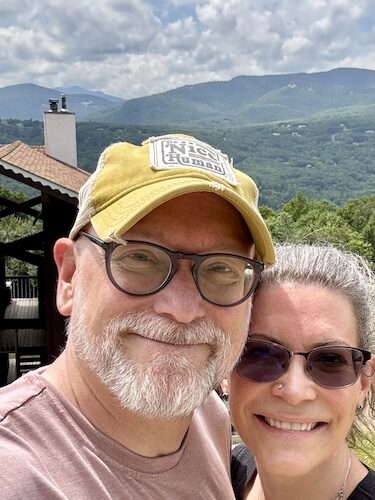
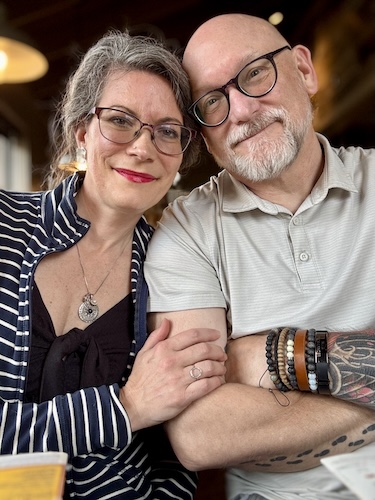
We went on vacation last summer — up in the White Mountains in New Hampshire — and my wife and I were bickering the whole time. Anybody who has been following my channels for a long time knows that my wife is the most supreme being in the history of all beings. She is an amazing individual, and we were just bickering. It’s not something we do, and it’s especially not something we’d do during cancer — she’s my primary caregiver; she’s doing everything she can to keep me comfortable. But last summer, when I was feeling more normal, I looked over at her in the middle of vacation, and I said, “I’m pretty happy that we’re fighting a lot more right now.” She said, “Why?” I said, “Because it means we’re not so wrapped up in the crisis of cancer that we have other things to think about.”
That October, they did a biopsy and confirmed: “It’s stage 4. We know this now.” So I had a soft launch of being stage 4. I had been effectively stage 4 but in NED status for ten months. I had ten months to accept it, even if I didn’t fully let myself go there. So when they confirmed stage 4 in October, I was like, “Well, that sucks — but it’s really no different from what I’ve been dealing with for the past couple of years.”
My favorite musical is Hamilton. I just went and saw Hamilton — my granddaughter, who’s six years old, was singing all the songs, dressed up in her little Eliza dress, and I wore my tuxedo. One of the main themes of Hamilton is that he lived this very condensed life. “Why do you write like you’re running out of time?” is a line from Hamilton. And what I found was that when I truly became stage 4 — when I was truly told I’m on a condensed timeline — at 53 years old, I made a choice.
“I need to get the most amount of work done that I can on the timeline I’ve been given.” And that’s why I plowed into this. I get to do this. I’m going to do this for as long as I can, and I don’t know how long that is — and I’m okay with that. Because I know I’m making an impact and changing people’s lives.
My full treatment timeline: Chemo, mastectomy, and other surgeries, radiation, and hormone therapy
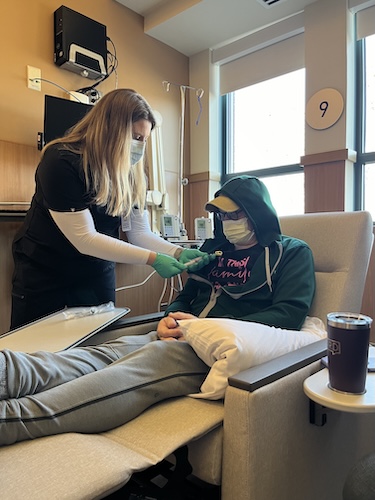
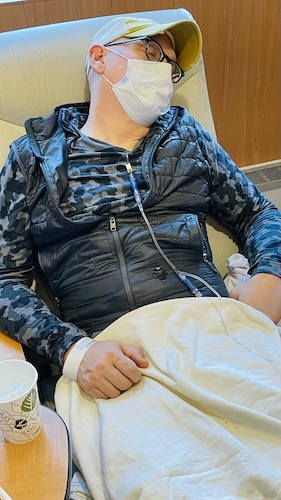
When I was initially diagnosed, they said, “You’re going to go into chemo.” So I did 20 weeks of chemo — four rounds on doxorubicin, and then 16 on paclitaxel. I sort of cruised through doxorubicin, and everybody was like, “Wow, you’re doing remarkably well.” It sucked, don’t get me wrong, but it wasn’t truly debilitating. Then I got to paclitaxel, which is supposed to be the easy one — and that one destroyed me. About 7% of people have a harder time with paclitaxel than with doxorubicin. And I’m like, “Okay — if there’s a very small percentage chance of something, that’s going to be me.” I’m one of the 1% of guys who get breast cancer. I’m the 7% of paclitaxel.
After chemo, I went to my initial mastectomy — a full right-side mastectomy. My nipple’s gone. It’s a big, giant scar. They asked if I wanted reconstructive surgery. I said, “Why? Male nipples are useless anyway. Why would I elect to do another surgery?” They did not get clear margins after that first surgery, so about a week later, I was back in surgery for them to get clear margins. The morning of the mastectomy, everybody was celebrating — “The cancer’s finally out!” — and then they came back and said, “We did not get clear margins. We have to go back in.” That was hard. Not easy at all. I went back in, and they were like, “We got it all.”
About a month later, we were in the planning phase for radiation and dosimetry. My radiation oncologist said, “I found a couple more tumors.” That’s one of the reasons I left my previous cancer center: they were terrible at finding and excising tumors.
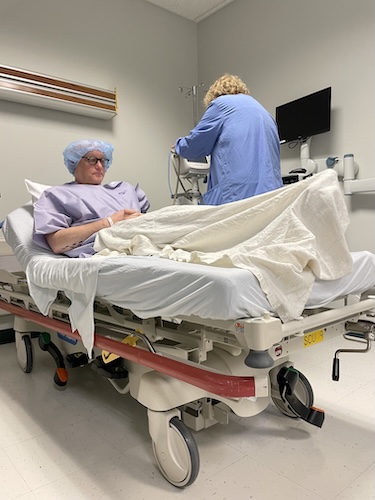
So I went through 20 weeks of chemo and three surgeries. In the third surgery, they were going after a tumor on my trachea. When they were in there, they nicked a vein in my chest. I started bleeding out. They had to bring in an emergency vascular team to repair me, and they didn’t even go for the tumor anymore. It was a nightmare. I said, “I need to leave. I’m going to Dana-Farber.”
Dana-Farber started from scratch — all new scans, all new everything. They confirmed the extra tumors and said, “We’re going straight to radiation.” So I did a round of radiation in December of 2024. Then I went into that NED period — there wasn’t a lot going on. The one thing I happen to be on is three daily pills, but two medications — endocrine therapy — because I have estrogen-positive breast cancer. I’m on tamoxifen and abemaciclib, which are the workhorses for tamping down estrogen. These are the same two medications that send women into instant menopause. You could be 31 years old and go into medical menopause just like that. Being on endocrine therapy is very difficult. I’m having hot flashes. My wife is having hot flashes. We’re both having hot flashes at the same time. All kinds of gastrointestinal issues come with those two medications long-term — but they’re also the things keeping me alive.
When they confirmed the tumor on my hip, they did another round of radiation in December. I was just coming out of that radiation funk as recently as April. I just had a PET scan two weeks ago, and they said, “The tumor on your hip is either dead or dying.” Which is great, awesome. They can’t necessarily see it anymore. It’s in the bone, so it’s a little different. That’s the “End Then” video I did a couple of weeks ago — we received this amazing news that this hip tumor we spent ten months battling is finally dead or dying.
But in the same conversation, my radiation oncologist said, “Oh — but there’s this other little spot in your chest that we’re now starting to be concerned about.” I just wanted the good news. But it’s always “this is amazing news, and then…” They’re not calling it a tumor yet — they’re calling it a spot of worry — and they’re going to watch it over the next couple of PET scans. But I know my proclivity for low-percentage things. I’m just waiting for it to be another tumor. And I’ll go after that one. It’ll just be another thing.
Chemo, three surgeries, two rounds of radiation, and hormone therapy. Since my cancer is stage 4, we’re just going to keep treating it. When this hormone therapy stops working, we’ll find the next line of treatment. And when that stops working, we’ll find the next line. It’s keeping you alive long enough to hopefully find some kind of cure. They’re coming up with things every three to six months. You never know.
I tell people all the time: this is not a competition. Some people have it way worse than I do. Way worse. But all of those things — all that heartache, all the hard physical pain, the emotional pain — lead to where we’re at now. It leads to being able to not just sit and cry on social media.
What people don’t understand about being a man with stage 4 breast cancer
There’s no such thing as a “typical guy” who is going to get diagnosed. 2,800 of us are going to get diagnosed in 2026. That’s a small number, but it’s not a tiny number.
I encourage men to take this opportunity to change their lives. Your life is going to change anyway — somebody said the C-word in front of you. However, you have the choice to be something better or something different.
There was a guy who reached out to me a couple of weeks ago. He said, “I’ve been following you for about a year. I’ve never commented, I’ve never liked anything, but I’ve been following you because I had male breast cancer 12 years ago, went through treatment, and I’ve been in remission.” He said five people in his life knew he had breast cancer — his two kids, his wife, and his parents. Everybody else just knew he was sick, or had cancer — but he was too afraid of people’s reactions to tell them it was breast cancer.
He said, “I’ve been watching you for a year, and you made it okay enough. You made me not feel afraid enough that I changed my Facebook profile to include ‘breast cancer survivor.’” He received so much support and love from that one little change. He said, “I can never do what you do.” And I stopped him. I said, “Absolutely not — you could do what I do. I’m not doing anything special. I’m literally just talking about this.”
Those kinds of moments — that man after 12 years of feeling so isolated. That’s the really hard part of this disease: the isolation. Cancer is isolating in itself. When you’re in a rare cancer, it’s even more isolating. It took me almost two full years to meet, in person, another guy with breast cancer — and I’m out there doing this regularly. It took me two years to go have lunch with another guy with breast cancer who lives in Albany, an hour and a half away from me. That’s how rare this is.
But that’s how important it is for guys to continue to communicate and to be honest. To take the opportunity, because you’re going to change during cancer. It’s my obligation as a good human being to help other human beings in whatever capacity I can — whether through humor, education, or advocacy. This has become my life’s work. It’s become the thing I will be remembered for. My TikTok will live long after I’m gone. My TikTok will continue to be a tool that people use to get out of bed after I’m gone. I don’t know what that timeline looks like, but it will continue to be used. And that’s what I want.
The turning point: Why I started sharing my story on social media
I can point back to when I was in chemo. Before I changed my mentality on social media, one of the first videos that connected was when I would go to chemo on the second floor of the building. Every time I went, I’d walk up the stairs with my phone and say, “We are taking the stairs until we can’t. And then we’ll take the elevator. But we’re going to take the stairs until we can’t.” That became a thing. People were like, “He’s still taking the stairs.” I made it all the way through my last chemo appointment, where literally — you watch the video — I am trudging up the stairs one at a time. But I got up the stairs. And my mantra during that time was: “You take the stairs until you can’t.”
That was when I noticed people were reacting. I didn’t decide to change my social media because I decided to change it — I decided to change it because people were like, “Thank you for saying this.” My moment came in asking: “Can I truly be a help to somebody using social media?” Social media has so much ugliness on it — but can I truly be a help? That was my moment. Somebody’s out there taking the stairs right now because I asked them to. And people were sending me videos: “Hey Jake, we’re taking the stairs.” And other people were sending videos saying, “I saw your video about taking the stairs, but I’m going through a divorce right now — and this applied to my life.”
Crazy good came out of me taking the stairs to go to chemo. It doesn’t always have to be a positive video to elicit the good in people. Sometimes it’s really hard to find videos that elicit the good in people.
You’re a cancer patient. I’m a cancer patient. We’re all connected — it doesn’t matter if you’re thyroid, breast, lung, or colorectal. We’re connected. And for the most part, I see most people facing cancer trying to make their world, or their little corner of the world, a little bit better. There’s life there. There’s a beautiful life outside of, and living with, cancer. You just have to have your eyes open enough and your mind open enough to acknowledge it.
Inspired by Jake’s story?
Share your story, too!
Hear from people living with breast cancer
Real experiences with diagnosis, treatment choices, side effects, and life beyond breast cancer — in their own words.

Leave a Reply